
Software for Estate Accounting
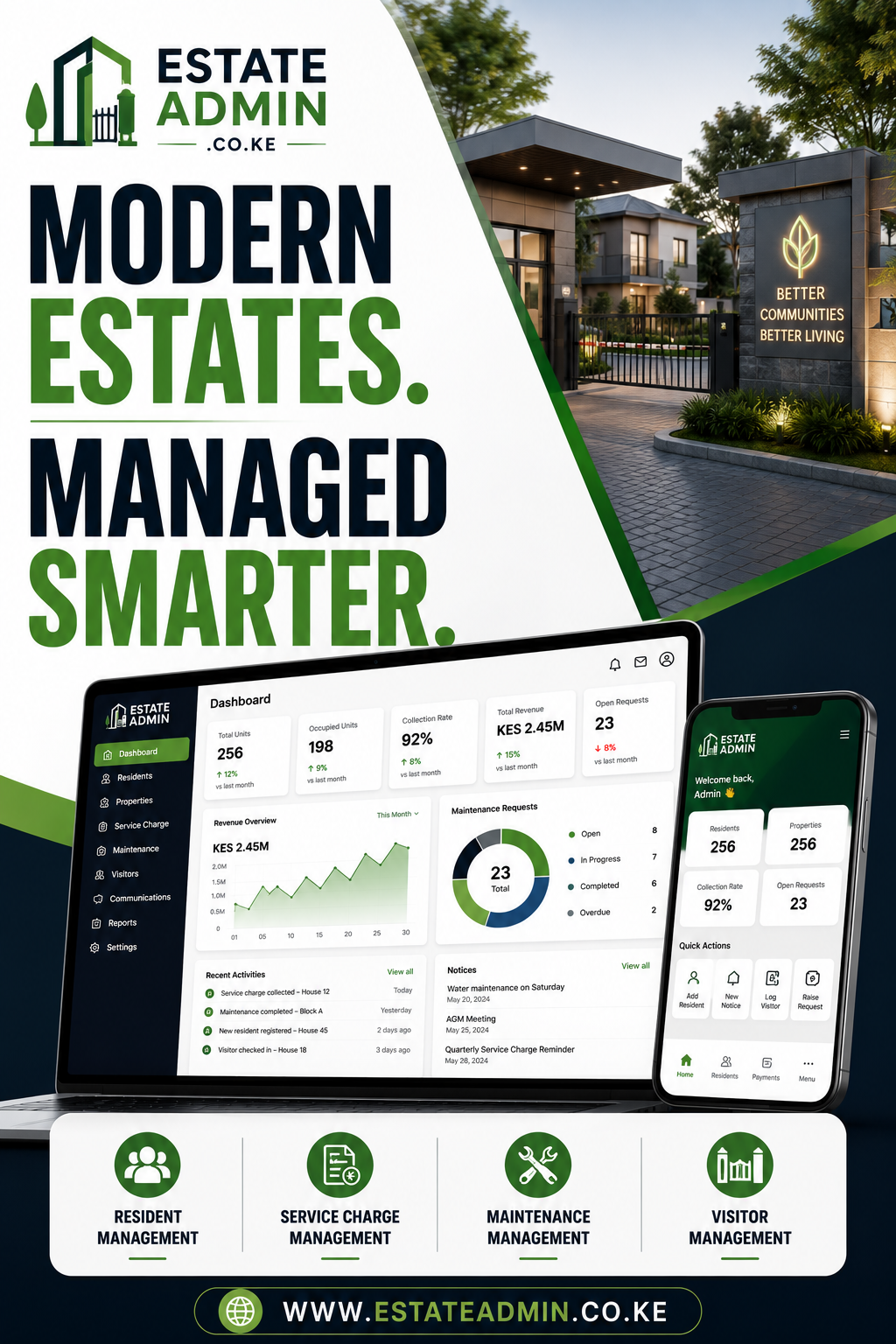
Software for Estate Accounting helps estate managers, property owners, homeowners’ associations, estate management companies, residential communities, and mixed-use developments simplify financial operations by automating billing, service charge collection, expense tracking, budgeting, financial reporting, and resident account management. As residential estates across Kenya continue expanding, manual accounting processes using spreadsheets, paper receipts, and disconnected accounting systems often lead to billing errors, delayed collections, inaccurate financial reports, and increased administrative work. A modern Software for Estate Accounting solution centralizes estate finances into one secure platform, improving efficiency, transparency, and financial control.
Managing estate finances involves much more than recording payments. Estate administrators must generate service charge invoices, collect resident payments, monitor outstanding balances, manage utility billing, approve expenses, reconcile bank transactions, prepare budgets, track maintenance costs, and generate financial reports for management committees and property owners. Software for Estate Accounting simplifies these tasks by bringing every financial process into one integrated system.
Traditional estate accounting methods often rely on manual bookkeeping and multiple spreadsheets, making it difficult to maintain accurate financial records or monitor cash flow. Professional Software for Estate Accounting automates recurring financial processes while ensuring that every transaction is recorded accurately and securely.
Modern residential estates frequently manage hundreds of homes, apartments, commercial spaces, parking areas, and shared facilities. Administrators must oversee recurring service charges, maintenance budgets, utility expenses, contractor payments, reserve funds, and resident accounts simultaneously. A comprehensive Software for Estate Accounting platform provides complete financial visibility while reducing administrative workload.
Across Kenya, gated communities, apartment complexes, residential estates, commercial developments, mixed-use properties, and homeowners’ associations require digital financial management solutions that improve accountability and operational efficiency. Professional Software for Estate Accounting enables estate administrators to streamline accounting operations, strengthen financial reporting, improve collection rates, and enhance resident confidence.
Manual accounting processes often result in delayed billing, inaccurate reconciliations, missing receipts, inconsistent reporting, and poor financial planning. Modern Software for Estate Accounting automates invoicing, payment tracking, budgeting, expense management, financial reporting, bank reconciliation, and operational analytics. This proactive approach improves financial management while supporting long-term estate sustainability.
Whether managing a small residential estate, a gated community, an apartment complex, a mixed-use development, or multiple residential properties, implementing Software for Estate Accounting enables organizations to improve financial control, reduce administrative costs, increase collection efficiency, and support transparent estate management.
Table of Contents
- Understanding Software for Estate Accounting
- Why Digital Estate Accounting Matters
- Core Features of Software for Estate Accounting
- Managing Estate Finances Efficiently
- Billing and Service Charge Management
- Reporting and Financial Analytics
- Improving Estate Operations
- Security and Financial Data Protection
- Applications Across Different Estate Types
Understanding Software for Estate Accounting
Modern estate management requires centralized financial systems that improve transparency and simplify accounting operations. Software for Estate Accounting provides estate administrators with one platform for managing invoices, service charges, expenses, budgeting, resident accounts, and financial reporting.
Instead of maintaining multiple accounting records manually, administrators can monitor every financial activity from one centralized dashboard while ensuring accurate bookkeeping and regulatory compliance.
As estate communities continue growing across Kenya, professional estate accounting software has become essential for efficient financial management.
Why Digital Estate Accounting Matters
Efficient financial management improves accountability, cash flow, and resident satisfaction. Software for Estate Accounting enables estate managers to automate recurring financial tasks while improving reporting accuracy.
Organizations benefit through:
- Faster service charge collection
- Better financial reporting
- Improved cash flow
- Reduced paperwork
- Better budgeting
- Improved expense tracking
- Stronger financial transparency
- Increased operational efficiency
Digital accounting creates a more organized and financially sustainable estate.
Core Features of Software for Estate Accounting
Modern Software for Estate Accounting combines billing, financial management, budgeting, reporting, and resident account administration into one integrated platform.
Core features include:
- Service charge billing
- Resident account management
- Payment tracking
- Invoice generation
- Expense recording
- Budget management
- Bank reconciliation
- Financial reporting
- Utility billing
- Outstanding balance tracking
- Multi-estate management
- Role-based permissions
- Audit logs
- Secure cloud access
- Executive dashboards
These features simplify estate accounting while improving financial accuracy.
Managing Estate Finances Efficiently
Effective estate accounting requires accurate financial information and organized workflows. Software for Estate Accounting enables administrators to manage every financial process from one centralized system.
Administrators can monitor:
- Resident accounts
- Service charge payments
- Outstanding balances
- Operating expenses
- Utility costs
- Maintenance budgets
- Contractor payments
- Cash flow
- Financial performance
- Reserve funds
Centralized financial management improves accountability while reducing manual administration.
Billing and Service Charge Management
Reliable billing ensures stable estate operations. Software for Estate Accounting automates recurring billing and collection processes.
Key capabilities include:
- Automated invoice generation
- Service charge billing
- Payment reminders
- Digital receipts
- Outstanding balance tracking
- Payment reconciliation
- Resident account statements
- Collection reporting
Automation improves revenue collection while reducing administrative effort.
Reporting and Financial Analytics
Accurate reporting enables better financial planning. Software for Estate Accounting generates comprehensive financial reports in real time.
Reports include:
- Income statements
- Expense reports
- Cash flow reports
- Service charge collections
- Budget performance
- Outstanding balances
- Financial dashboards
- Executive summaries
- Resident account reports
- Revenue analysis
Detailed reporting supports informed financial decision-making.
Improving Estate Operations
Automation reduces repetitive accounting work while improving operational consistency. Software for Estate Accounting automates daily financial workflows.
Automation includes:
- Invoice generation
- Payment allocation
- Budget tracking
- Expense approvals
- Bank reconciliation
- Financial reporting
- Resident notifications
- Collection reminders
Automation improves productivity while minimizing manual errors.
Security and Financial Data Protection
Estate financial records contain sensitive information that requires strong protection. Software for Estate Accounting incorporates enterprise-grade security features that safeguard financial data while maintaining operational reliability.
Security capabilities include:
- Role-based permissions
- Secure authentication
- Data encryption
- Audit logging
- Cloud backups
- Secure financial records
- Administrative controls
- Activity monitoring
These protections improve financial security while supporting regulatory compliance.
Applications Across Different Estate Types
Software for Estate Accounting supports a wide range of residential and commercial communities.
- Residential estates manage service charges efficiently.
- Gated communities improve financial transparency.
- Apartment complexes automate billing.
- Mixed-use developments centralize accounting.
- Homeowners’ associations manage member contributions.
- Commercial estates monitor shared operational expenses.
- Estate management companies oversee multiple communities.
For organizations seeking a complete estate financial management platform, EstateAdmin provides professional Software for Estate Accounting capabilities that integrate resident management, billing, service charge collection, budgeting, expense tracking, financial reporting, maintenance management, and operational analytics into one centralized solution. Estate managers across Kenya benefit from improved efficiency, stronger financial control, and transparent community management.
Benefits of Software for Estate Accounting for Different Stakeholders
Software for Estate Accounting benefits every stakeholder involved in estate financial management. Estate owners gain complete visibility into financial performance, estate managers automate accounting operations, finance teams improve billing and reporting accuracy, committee members receive transparent financial information, and residents enjoy convenient payment services. By centralizing accounting processes, Software for Estate Accounting improves efficiency, strengthens financial accountability, and supports sustainable estate management.
As residential estates and gated communities continue expanding across Kenya, implementing Software for Estate Accounting enables organizations to manage increasing financial responsibilities while maintaining transparency, accuracy, and operational excellence.
Estate Owners
Estate owners require accurate financial information to monitor community performance and protect long-term investments. Software for Estate Accounting provides real-time insights into revenue, expenses, service charge collections, and cash flow.
Key benefits include:
- Better financial visibility
- Improved revenue tracking
- Stronger cash flow management
- Reduced operational costs
- Better budgeting
- Improved investment planning
- Transparent reporting
- Sustainable estate growth
Centralized accounting enables owners to make informed financial decisions while improving estate performance.
Estate Managers
Managing estate finances manually consumes valuable time and increases administrative workload. Software for Estate Accounting provides one centralized platform for managing all accounting activities.
Estate managers can:
- Generate invoices
- Track resident payments
- Monitor outstanding balances
- Manage operating expenses
- Approve financial transactions
- Generate reports
- Monitor budgets
- Reconcile accounts
Centralized accounting improves productivity while reducing paperwork.
Finance Teams
Finance departments require accurate financial records for reporting and compliance.
Using Software for Estate Accounting, finance teams can:
- Process resident payments
- Reconcile bank transactions
- Generate financial statements
- Track expenses
- Prepare budgets
- Monitor collections
- Produce audit reports
- Improve cash flow management
Integrated financial management improves accounting accuracy while simplifying reporting.
Estate Committees
Committee members require transparent financial information to oversee estate operations.
Advantages include:
- Financial dashboards
- Budget monitoring
- Expense visibility
- Collection reports
- Reserve fund tracking
- Performance analysis
- Audit support
- Better governance
Transparent reporting strengthens accountability while improving financial oversight.
Residents
Residents benefit from faster and more convenient financial services.
Benefits include:
- Online service charge payments
- Digital receipts
- Account statements
- Payment history
- Billing notifications
- Improved communication
- Faster issue resolution
- Greater financial transparency
Professional financial services improve resident satisfaction and trust.
Improving Efficiency Through Automation
Automation reduces repetitive accounting tasks while improving consistency across financial operations. Software for Estate Accounting automates daily accounting workflows that improve productivity and reduce manual errors.
Automated Billing
The platform simplifies recurring billing processes.
Automation includes:
- Service charge invoicing
- Utility billing
- Payment reminders
- Digital receipts
- Outstanding balance notifications
- Account updates
- Collection tracking
- Resident statements
Automated billing improves collection efficiency while reducing administrative effort.
Automated Financial Management
Financial operations become faster and more accurate.
Automation supports:
- Payment allocation
- Expense recording
- Budget monitoring
- Bank reconciliation
- Cash flow updates
- Financial summaries
- Revenue tracking
- Accounting reports
Automation improves financial accuracy while simplifying daily accounting tasks.
Automated Expense Management
Estate expenses are monitored through organized digital workflows.
Automation includes:
- Expense approvals
- Contractor payments
- Maintenance expenses
- Utility costs
- Purchase records
- Budget comparisons
- Payment scheduling
- Financial history
Automated expense management improves cost control while supporting better budgeting.
Automated Reporting
Managers receive comprehensive financial reports instantly.
Reports include:
- Income statements
- Expense reports
- Cash flow reports
- Collection summaries
- Budget reports
- Outstanding balances
- Financial dashboards
- Executive summaries
Automated reporting supports informed financial planning and strategic decision-making.
Compliance, Security and Risk Management
Estate financial information requires strong protection. Software for Estate Accounting incorporates enterprise-grade security controls that safeguard financial records while supporting accountability and regulatory compliance.
Role-Based User Permissions
Different users require different levels of financial access.
Typical user roles include:
- Estate Owners
- Estate Managers
- Finance Officers
- Committee Members
- Accountants
- System Administrators
Role-based permissions ensure sensitive financial information remains accessible only to authorized users.
Secure Financial Information
The platform securely stores:
- Resident accounts
- Payment records
- Financial statements
- Budget reports
- Expense records
- Bank reconciliation data
- Audit reports
- Executive dashboards
Secure information management protects valuable financial records while improving operational continuity.
Audit Trails
Every accounting activity is recorded automatically.
Audit logs include:
- Invoice generation
- Payment processing
- Expense approvals
- Budget changes
- User logins
- Administrative actions
Comprehensive audit trails strengthen accountability while simplifying financial reviews.
Backup and Disaster Recovery
Reliable estate accounting depends on dependable information protection.
Professional platforms provide:
- Automated backups
- Secure cloud storage
- Historical financial records
- Disaster recovery procedures
- Data restoration capabilities
These protections ensure financial information remains available during unexpected events.
Reducing Operational Risks
Professional Software for Estate Accounting helps organizations reduce risks such as:
- Missed service charge collections
- Billing errors
- Lost financial records
- Budget overruns
- Cash flow challenges
- Unauthorized financial access
Reliable automation improves financial stability while reducing administrative risks.
Why EstateAdmin is the Ideal Software for Estate Accounting
Managing estate finances requires more than basic bookkeeping. Estate managers need a complete platform that integrates resident management, service charge billing, payment tracking, budgeting, expense management, financial reporting, maintenance coordination, and operational analytics into one centralized solution.
EstateAdmin provides comprehensive Software for Estate Accounting capabilities for gated communities, residential estates, apartment complexes, mixed-use developments, homeowners’ associations, commercial estates, and estate management companies across Kenya.
Core capabilities include:
- Service charge billing
- Resident account management
- Automated payment tracking
- Invoice generation
- Budget management
- Expense tracking
- Bank reconciliation
- Financial reporting
- Multi-estate management
- Executive dashboards
- Role-based access control
- Audit logging
Whether managing a small residential estate or multiple large communities, EstateAdmin provides scalable tools that improve financial management, strengthen transparency, and support sustainable estate operations.
Future Trends in Software for Estate Accounting
Estate financial technology continues evolving, and Software for Estate Accounting will increasingly integrate advanced technologies that improve financial management and operational efficiency.
Artificial Intelligence
AI-powered accounting platforms will support:
- Revenue forecasting
- Budget predictions
- Expense analysis
- Cash flow forecasting
- Automated financial insights
Artificial intelligence will help estate managers make smarter financial decisions.
Digital Payments
Future platforms will expand support for:
- Mobile money integration
- Online payment gateways
- Automatic reconciliation
- Digital payment confirmations
- Self-service resident payments
Digital payment solutions will improve convenience while accelerating collections.
Cloud-Based Accounting
Cloud platforms will provide:
- Remote financial management
- Multi-estate administration
- Secure online access
- Automatic updates
- Real-time collaboration
Cloud technology will improve flexibility while supporting business growth.
Advanced Financial Analytics
Future systems will deliver:
- Revenue forecasting
- Collection analysis
- Budget performance insights
- Financial benchmarking
- Executive business intelligence
Advanced analytics will improve long-term financial planning.
Greater Automation
Future Software for Estate Accounting solutions will automate:
- Billing
- Payment reconciliation
- Budget tracking
- Financial reporting
- Resident notifications
Automation will continue improving efficiency while reducing manual accounting work.
Getting Started with Software for Estate Accounting
Implementing Software for Estate Accounting begins with reviewing current accounting procedures, resident records, billing structures, expense categories, bank accounts, budgets, and financial reports. Estate administrators should organize financial data, verify resident account balances, digitize historical accounting records, reconcile outstanding transactions, and prepare operational information before migrating to a centralized accounting platform.
The next step involves configuring user roles, registering estates and residential units, importing resident information, setting up service charge schedules, enabling payment tracking, configuring budgeting tools, generating financial dashboards, and training estate managers, finance officers, accountants, and committee members on daily system operations.
After implementation, organizations should continuously monitor revenue collection, review operating expenses, analyze cash flow, generate financial statements, evaluate budget performance, strengthen resident communication, and use financial analytics to improve operational planning. For estate managers and homeowners’ associations across Kenya, adopting Software for Estate Accounting provides a scalable foundation for improving financial transparency, increasing collection efficiency, strengthening accountability, and supporting sustainable community management.
Conclusion
Efficient financial management is essential for successful estate administration. Manual accounting processes often result in billing errors, delayed collections, inaccurate reporting, and increased administrative work. Software for Estate Accounting enables estate managers to centralize financial operations, automate recurring accounting tasks, improve reporting accuracy, and strengthen financial control.
By integrating service charge billing, resident account management, payment tracking, budgeting, expense management, bank reconciliation, financial reporting, maintenance coordination, and operational analytics into one centralized platform, organizations can improve efficiency while reducing financial management costs. This enables estate managers to provide greater transparency, strengthen accountability, and make informed financial decisions.
Whether managing residential estates, gated communities, apartment complexes, homeowners’ associations, commercial developments, or mixed-use properties, organizations that implement Software for Estate Accounting position themselves for long-term success. With EstateAdmin, estate managers throughout Kenya can confidently modernize financial operations, improve service delivery, and build financially sustainable communities.
Benefits of Software for Estate Accounting for Different Stakeholders
Software for Estate Accounting benefits every stakeholder involved in estate financial management. Estate owners gain complete visibility into financial performance, estate managers automate accounting operations, finance teams improve billing and reporting accuracy, committee members receive transparent financial information, and residents enjoy convenient payment services. By centralizing accounting processes, Software for Estate Accounting improves efficiency, strengthens financial accountability, and supports sustainable estate management.
As residential estates and gated communities continue expanding across Kenya, implementing Software for Estate Accounting enables organizations to manage increasing financial responsibilities while maintaining transparency, accuracy, and operational excellence.
Estate Owners
Estate owners require accurate financial information to monitor community performance and protect long-term investments. Software for Estate Accounting provides real-time insights into revenue, expenses, service charge collections, and cash flow.
Key benefits include:
- Better financial visibility
- Improved revenue tracking
- Stronger cash flow management
- Reduced operational costs
- Better budgeting
- Improved investment planning
- Transparent reporting
- Sustainable estate growth
Centralized accounting enables owners to make informed financial decisions while improving estate performance.
Estate Managers
Managing estate finances manually consumes valuable time and increases administrative workload. Software for Estate Accounting provides one centralized platform for managing all accounting activities.
Estate managers can:
- Generate invoices
- Track resident payments
- Monitor outstanding balances
- Manage operating expenses
- Approve financial transactions
- Generate reports
- Monitor budgets
- Reconcile accounts
Centralized accounting improves productivity while reducing paperwork.
Finance Teams
Finance departments require accurate financial records for reporting and compliance.
Using Software for Estate Accounting, finance teams can:
- Process resident payments
- Reconcile bank transactions
- Generate financial statements
- Track expenses
- Prepare budgets
- Monitor collections
- Produce audit reports
- Improve cash flow management
Integrated financial management improves accounting accuracy while simplifying reporting.
Estate Committees
Committee members require transparent financial information to oversee estate operations.
Advantages include:
- Financial dashboards
- Budget monitoring
- Expense visibility
- Collection reports
- Reserve fund tracking
- Performance analysis
- Audit support
- Better governance
Transparent reporting strengthens accountability while improving financial oversight.
Residents
Residents benefit from faster and more convenient financial services.
Benefits include:
- Online service charge payments
- Digital receipts
- Account statements
- Payment history
- Billing notifications
- Improved communication
- Faster issue resolution
- Greater financial transparency
Professional financial services improve resident satisfaction and trust.
Improving Efficiency Through Automation
Automation reduces repetitive accounting tasks while improving consistency across financial operations. Software for Estate Accounting automates daily accounting workflows that improve productivity and reduce manual errors.
Automated Billing
The platform simplifies recurring billing processes.
Automation includes:
- Service charge invoicing
- Utility billing
- Payment reminders
- Digital receipts
- Outstanding balance notifications
- Account updates
- Collection tracking
- Resident statements
Automated billing improves collection efficiency while reducing administrative effort.
Automated Financial Management
Financial operations become faster and more accurate.
Automation supports:
- Payment allocation
- Expense recording
- Budget monitoring
- Bank reconciliation
- Cash flow updates
- Financial summaries
- Revenue tracking
- Accounting reports
Automation improves financial accuracy while simplifying daily accounting tasks.
Automated Expense Management
Estate expenses are monitored through organized digital workflows.
Automation includes:
- Expense approvals
- Contractor payments
- Maintenance expenses
- Utility costs
- Purchase records
- Budget comparisons
- Payment scheduling
- Financial history
Automated expense management improves cost control while supporting better budgeting.
Automated Reporting
Managers receive comprehensive financial reports instantly.
Reports include:
- Income statements
- Expense reports
- Cash flow reports
- Collection summaries
- Budget reports
- Outstanding balances
- Financial dashboards
- Executive summaries
Automated reporting supports informed financial planning and strategic decision-making.
Compliance, Security and Risk Management
Estate financial information requires strong protection. Software for Estate Accounting incorporates enterprise-grade security controls that safeguard financial records while supporting accountability and regulatory compliance.
Role-Based User Permissions
Different users require different levels of financial access.
Typical user roles include:
- Estate Owners
- Estate Managers
- Finance Officers
- Committee Members
- Accountants
- System Administrators
Role-based permissions ensure sensitive financial information remains accessible only to authorized users.
Secure Financial Information
The platform securely stores:
- Resident accounts
- Payment records
- Financial statements
- Budget reports
- Expense records
- Bank reconciliation data
- Audit reports
- Executive dashboards
Secure information management protects valuable financial records while improving operational continuity.
Audit Trails
Every accounting activity is recorded automatically.
Audit logs include:
- Invoice generation
- Payment processing
- Expense approvals
- Budget changes
- User logins
- Administrative actions
Comprehensive audit trails strengthen accountability while simplifying financial reviews.
Backup and Disaster Recovery
Reliable estate accounting depends on dependable information protection.
Professional platforms provide:
- Automated backups
- Secure cloud storage
- Historical financial records
- Disaster recovery procedures
- Data restoration capabilities
These protections ensure financial information remains available during unexpected events.
Reducing Operational Risks
Professional Software for Estate Accounting helps organizations reduce risks such as:
- Missed service charge collections
- Billing errors
- Lost financial records
- Budget overruns
- Cash flow challenges
- Unauthorized financial access
Reliable automation improves financial stability while reducing administrative risks.
Why EstateAdmin is the Ideal Software for Estate Accounting
Managing estate finances requires more than basic bookkeeping. Estate managers need a complete platform that integrates resident management, service charge billing, payment tracking, budgeting, expense management, financial reporting, maintenance coordination, and operational analytics into one centralized solution.
EstateAdmin provides comprehensive Software for Estate Accounting capabilities for gated communities, residential estates, apartment complexes, mixed-use developments, homeowners’ associations, commercial estates, and estate management companies across Kenya.
Core capabilities include:
- Service charge billing
- Resident account management
- Automated payment tracking
- Invoice generation
- Budget management
- Expense tracking
- Bank reconciliation
- Financial reporting
- Multi-estate management
- Executive dashboards
- Role-based access control
- Audit logging
Whether managing a small residential estate or multiple large communities, EstateAdmin provides scalable tools that improve financial management, strengthen transparency, and support sustainable estate operations.
Future Trends in Software for Estate Accounting
Estate financial technology continues evolving, and Software for Estate Accounting will increasingly integrate advanced technologies that improve financial management and operational efficiency.
Artificial Intelligence
AI-powered accounting platforms will support:
- Revenue forecasting
- Budget predictions
- Expense analysis
- Cash flow forecasting
- Automated financial insights
Artificial intelligence will help estate managers make smarter financial decisions.
Digital Payments
Future platforms will expand support for:
- Mobile money integration
- Online payment gateways
- Automatic reconciliation
- Digital payment confirmations
- Self-service resident payments
Digital payment solutions will improve convenience while accelerating collections.
Cloud-Based Accounting
Cloud platforms will provide:
- Remote financial management
- Multi-estate administration
- Secure online access
- Automatic updates
- Real-time collaboration
Cloud technology will improve flexibility while supporting business growth.
Advanced Financial Analytics
Future systems will deliver:
- Revenue forecasting
- Collection analysis
- Budget performance insights
- Financial benchmarking
- Executive business intelligence
Advanced analytics will improve long-term financial planning.
Greater Automation
Future Software for Estate Accounting solutions will automate:
- Billing
- Payment reconciliation
- Budget tracking
- Financial reporting
- Resident notifications
Automation will continue improving efficiency while reducing manual accounting work.
Getting Started with Software for Estate Accounting
Implementing Software for Estate Accounting begins with reviewing current accounting procedures, resident records, billing structures, expense categories, bank accounts, budgets, and financial reports. Estate administrators should organize financial data, verify resident account balances, digitize historical accounting records, reconcile outstanding transactions, and prepare operational information before migrating to a centralized accounting platform.
The next step involves configuring user roles, registering estates and residential units, importing resident information, setting up service charge schedules, enabling payment tracking, configuring budgeting tools, generating financial dashboards, and training estate managers, finance officers, accountants, and committee members on daily system operations.
After implementation, organizations should continuously monitor revenue collection, review operating expenses, analyze cash flow, generate financial statements, evaluate budget performance, strengthen resident communication, and use financial analytics to improve operational planning. For estate managers and homeowners’ associations across Kenya, adopting Software for Estate Accounting provides a scalable foundation for improving financial transparency, increasing collection efficiency, strengthening accountability, and supporting sustainable community management.
Conclusion
Efficient financial management is essential for successful estate administration. Manual accounting processes often result in billing errors, delayed collections, inaccurate reporting, and increased administrative work. Software for Estate Accounting enables estate managers to centralize financial operations, automate recurring accounting tasks, improve reporting accuracy, and strengthen financial control.
By integrating service charge billing, resident account management, payment tracking, budgeting, expense management, bank reconciliation, financial reporting, maintenance coordination, and operational analytics into one centralized platform, organizations can improve efficiency while reducing financial management costs. This enables estate managers to provide greater transparency, strengthen accountability, and make informed financial decisions.
Whether managing residential estates, gated communities, apartment complexes, homeowners’ associations, commercial developments, or mixed-use properties, organizations that implement Software for Estate Accounting position themselves for long-term success. With EstateAdmin, estate managers throughout Kenya can confidently modernize financial operations, improve service delivery, and build financially sustainable communities.