
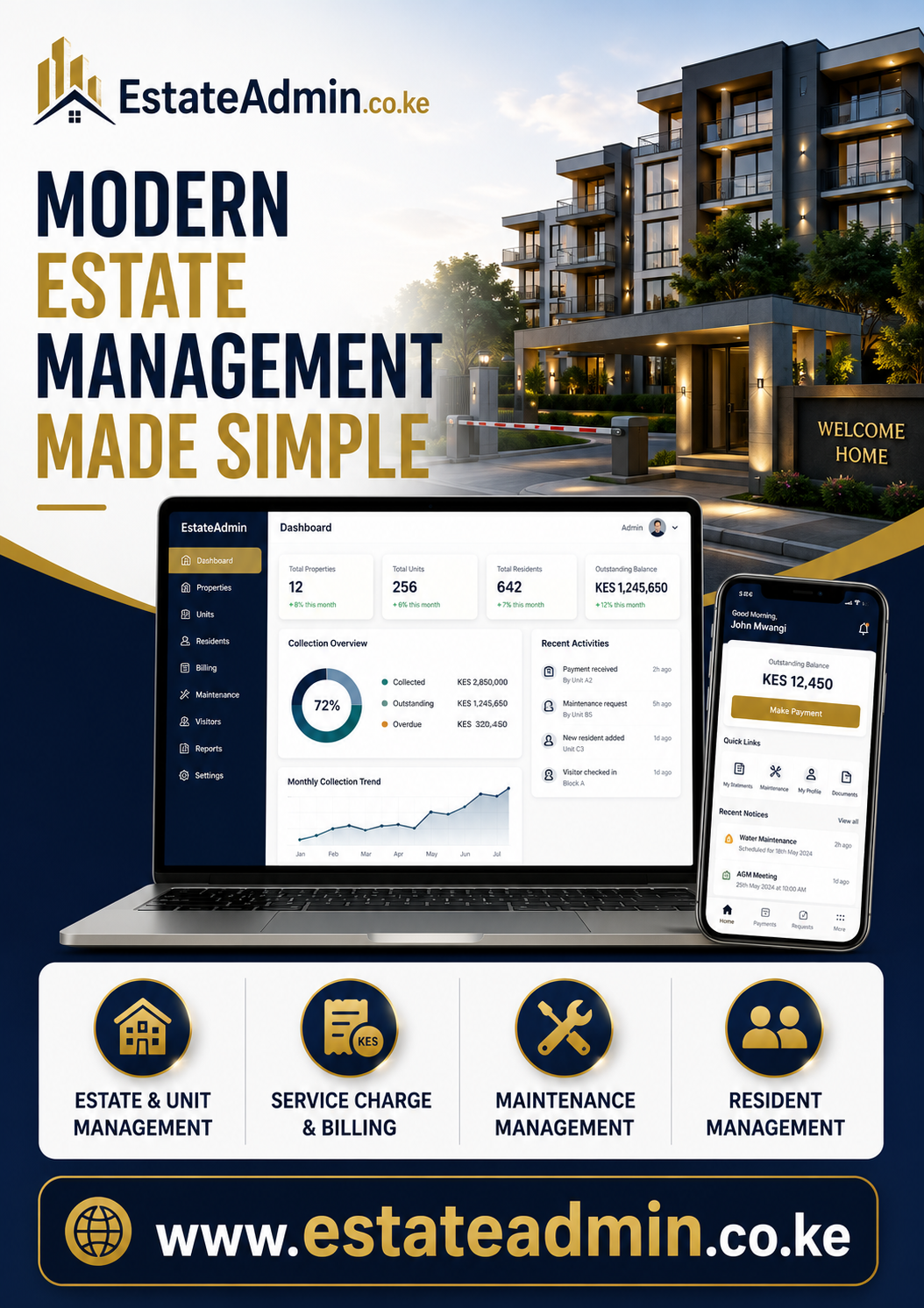
Resident Ledger Management System is a vital solution for estate managers, homeowners associations, gated communities, residential developments, and property management companies seeking to maintain accurate financial records and improve accountability across resident accounts.
Managing resident financial records manually can quickly become challenging, especially in growing estates with hundreds of homeowners and tenants. Estate administrators must track invoices, payments, outstanding balances, credits, penalties, adjustments, and account histories while ensuring records remain accurate and accessible.
A modern Resident Ledger Management System centralizes all resident financial activities into a single platform. Instead of relying on spreadsheets, paper records, and disconnected accounting systems, estate managers can automate financial tracking and maintain complete visibility over resident accounts.
As residential estates continue to expand throughout Kenya, accurate financial management is becoming increasingly important. Residents expect transparency regarding their accounts, while estate committees require reliable reporting and accountability.
Resident Ledger Management System provides the tools needed to achieve these objectives while supporting efficient estate operations.
Table of Contents
- Understanding Resident Ledger Management System
- Why Resident Ledger Management System Matters
- Core Features of Resident Ledger Management System
- Resident Account and Ledger Management
- Billing, Payments, and Balance Tracking
- Arrears Monitoring and Financial Control
- Reporting and Financial Visibility
- Challenges of Traditional Methods
Understanding Resident Ledger Management System
A Resident Ledger Management System is a software platform designed to manage and maintain financial records for residents within an estate, gated community, apartment complex, homeowners association, or residential development.
A resident ledger serves as a complete financial history for each homeowner or tenant. It records all invoices, payments, credits, adjustments, penalties, balances, and financial transactions associated with a resident account.
Traditionally, estate managers maintained these records manually using spreadsheets, accounting books, and multiple software systems. While this approach may work for small communities, it often becomes difficult to manage as estates grow.
Resident Ledger Management System simplifies this process by centralizing resident financial information within a structured and automated platform.
The system creates a single source of truth for all resident account activity, ensuring records remain accurate, consistent, and accessible.
For estates across Kenya, where financial accountability is increasingly important, maintaining organized resident ledgers helps improve transparency and trust between residents, management teams, and estate committees.
Resident Ledger Management System provides the foundation needed to support efficient financial administration and long-term estate sustainability.
Why Resident Ledger Management System Matters
Accurate resident financial records are essential for effective estate management.
Without a structured ledger system, estate administrators may struggle to track balances, monitor payment activity, identify arrears, and generate reliable financial reports.
Resident Ledger Management System addresses these challenges by providing centralized visibility into every resident account.
One of the most significant benefits is improved financial accuracy. The platform automatically records transactions and updates balances, reducing the risk of errors associated with manual record keeping.
The system also improves transparency. Residents can receive accurate account statements, while administrators can quickly access transaction histories when resolving inquiries or disputes.
Another important advantage is operational efficiency. Estate managers spend less time updating records manually and more time focusing on community management and service delivery.
Resident Ledger Management System also supports scalability. As resident populations increase, the system continues to provide organized and reliable financial management without creating additional administrative complexity.
For modern estates in Kenya, accurate ledger management is no longer optional. It is a critical component of effective financial governance.
Core Features of Resident Ledger Management System
A comprehensive Resident Ledger Management System includes a range of features designed to simplify resident financial management.
Resident account management allows administrators to maintain detailed profiles linked to financial records and property information.
Automated transaction recording ensures payments, invoices, credits, penalties, and adjustments are captured accurately.
Balance tracking capabilities provide real-time visibility into account status and outstanding obligations.
Invoice management tools support automated billing and service charge administration.
Payment reconciliation features help ensure incoming payments are matched correctly to resident accounts.
Statement generation allows administrators to produce detailed account summaries whenever required.
Arrears tracking tools identify overdue balances and support collection efforts.
Financial reporting provides insights into estate revenue, outstanding balances, collection performance, and resident account activity.
Role-based access controls help maintain data security while supporting accountability.
Together, these features help create an organized and transparent financial management environment.
Resident Account and Ledger Management
Resident account management forms the foundation of an effective Resident Ledger Management System.
Each resident account contains a complete financial history that can be accessed whenever needed.
The ledger records invoices, payments, credits, penalties, adjustments, refunds, and any other financial transactions associated with the account.
Administrators can view current balances and historical activity without searching through multiple systems or documents.
The platform maintains a chronological record of all financial events, ensuring transparency and accountability.
Resident Ledger Management System also simplifies account maintenance by automatically updating records when new transactions occur.
For large residential communities, centralized ledger management significantly improves efficiency and reduces administrative complexity.
The ability to access complete account histories quickly helps estate managers provide better service and resolve resident inquiries more effectively.
Accurate resident ledger management contributes directly to stronger financial control and improved operational performance.
Billing, Payments, and Balance Tracking
Managing resident billing and payment activity is one of the most important responsibilities within estate administration.
Resident Ledger Management System automates these processes by linking invoices, payments, and balances directly to resident accounts.
When service charge invoices are generated, the system updates resident ledgers automatically.
As payments are received, balances are adjusted in real time, providing accurate visibility into account status.
Payment integrations can further improve efficiency by automating transaction updates and reducing manual data entry.
Administrators can monitor collection performance and identify outstanding balances immediately.
Balance tracking tools help ensure that financial records remain current and accurate at all times.
Resident Ledger Management System creates a reliable financial framework that supports both operational efficiency and financial accountability.
For growing estates, automated billing and balance tracking significantly reduce administrative workloads while improving service quality.
Arrears Monitoring and Financial Control
Monitoring outstanding balances is essential for maintaining healthy estate finances.
Resident Ledger Management System provides tools that help administrators identify overdue accounts and manage arrears effectively.
The platform automatically highlights unpaid balances and generates reports showing aging information and collection performance.
Administrators can prioritize collection activities based on account status and estate policies.
The system maintains detailed records of payment activity and outstanding obligations, improving financial visibility and accountability.
Resident Ledger Management System also helps reduce revenue leakage by ensuring overdue balances are identified promptly.
Automated monitoring supports proactive financial management and reduces reliance on manual tracking processes.
For estates throughout Kenya, effective arrears management is critical for maintaining consistent cash flow and supporting essential community services.
The software helps ensure financial obligations are monitored accurately and managed efficiently.
Reporting and Financial Visibility
Reliable reporting is essential for estate managers, accountants, and management committees.
Resident Ledger Management System provides reporting tools that transform financial data into actionable information.
Account statements provide detailed visibility into resident balances and transaction histories.
Collection reports help administrators monitor payment performance and outstanding balances.
Financial dashboards offer real-time insights into revenue trends and account activity.
Management committees can access reports that support informed decision-making and financial oversight.
The system improves transparency by maintaining complete records of all resident financial transactions.
For estates managing multiple phases or large resident populations, centralized reporting provides a unified view of financial performance.
Resident Ledger Management System helps organizations improve accountability while supporting better financial planning and governance.
Challenges of Traditional Methods
Many estates continue to maintain resident financial records using spreadsheets, manual ledgers, and paper-based processes.
Although these methods may appear manageable initially, they often become inefficient as communities grow.
Manual record keeping increases the likelihood of data entry errors, missing information, and inconsistent account balances.
Payment reconciliation can become time-consuming and difficult to manage.
Generating statements and financial reports often requires significant administrative effort.
Resident inquiries may take longer to resolve because information is scattered across multiple systems and documents.
Arrears monitoring becomes less effective due to limited visibility and inconsistent tracking procedures.
Resident Ledger Management System addresses these challenges by centralizing financial records, automating transaction management, improving reporting capabilities, and maintaining accurate resident account histories.
For estate managers, homeowners associations, residential developments, and property management companies throughout Kenya, implementing a Resident Ledger Management System is becoming increasingly important for maintaining transparency, accountability, and efficient financial management.
Benefits for Estate Managers
Resident Ledger Management System provides substantial benefits for estate managers seeking to improve financial accuracy, strengthen accountability, and streamline resident account administration.
One of the primary advantages is centralized financial record management. Instead of maintaining multiple spreadsheets, paper files, and disconnected accounting records, estate managers can access complete resident ledger information from a single platform.
The system improves operational efficiency by automating transaction recording, balance calculations, payment updates, and account tracking.
Resident Ledger Management System also enhances financial visibility by providing real-time access to resident balances, outstanding charges, credits, and payment histories.
Administrators can quickly resolve account inquiries because all transaction information is available in one place.
The platform reduces administrative workloads by minimizing manual reconciliation and record maintenance tasks.
As estates expand and resident populations increase, Resident Ledger Management System supports scalable financial management without increasing operational complexity.
Organizations that implement automated ledger management often experience improved accuracy, better collection performance, and stronger financial control.
Benefits for Estate Committees
Estate committees require reliable financial information to oversee estate operations and make informed governance decisions.
Resident Ledger Management System provides committee members with accurate and transparent access to resident financial records and collection performance data.
The platform improves accountability by maintaining complete transaction histories for every resident account.
Committee members can review financial reports, monitor outstanding balances, and evaluate collection trends using centralized reporting tools.
Resident Ledger Management System also supports financial transparency by ensuring that all charges, payments, adjustments, and balances are properly documented.
This level of visibility helps build trust among residents while strengthening governance processes.
Accurate ledger reporting enables committees to make better decisions regarding budgeting, service improvements, infrastructure projects, and financial planning.
For residential communities throughout Kenya, improved financial oversight contributes significantly to operational stability and community confidence.
Resident Ledger Management System helps estate committees maintain effective control over resident financial management activities.
Benefits for Residents
Residents benefit greatly from the transparency and convenience provided by Resident Ledger Management System.
One of the most important advantages is access to accurate account information.
Residents can view account statements, payment histories, outstanding balances, invoices, and transaction records whenever needed.
The platform improves transparency by ensuring financial information remains current and readily accessible.
Resident Ledger Management System also reduces disputes because detailed records are maintained for every transaction.
Residents can quickly verify payments, review charges, and understand their financial obligations without relying on manual explanations from administrators.
Automated updates ensure account balances reflect the latest payment activity.
The system improves communication between residents and estate management teams by providing a reliable source of financial information.
For homeowners and tenants alike, Resident Ledger Management System creates a more professional and transparent estate management experience.
These improvements contribute to higher resident satisfaction and stronger trust within the community.
Improving Efficiency Through Automation
Automation plays a central role in modern Resident Ledger Management System implementations.
Traditional ledger management often requires extensive manual effort to update balances, record transactions, reconcile payments, and generate reports.
These repetitive tasks consume valuable time and increase the likelihood of human error.
Resident Ledger Management System automates transaction recording, account updates, statement generation, and financial reporting.
Whenever invoices are issued or payments are received, resident ledgers are updated automatically.
Automated workflows ensure financial records remain accurate and synchronized across the platform.
The system also simplifies account maintenance by eliminating many manual administrative processes.
As residential estates continue growing throughout Kenya, automation becomes increasingly important for maintaining efficiency.
Resident Ledger Management System helps organizations manage larger resident populations without sacrificing financial accuracy or operational quality.
The result is improved productivity, reduced administrative workloads, and stronger financial management capabilities.
Compliance, Accountability, and Financial Control
Maintaining accurate financial records is essential for responsible estate management.
Resident Ledger Management System improves accountability by creating a complete audit trail for every resident account.
Invoices, payments, credits, adjustments, penalties, refunds, and balance changes are all recorded within the system.
This centralized record keeping supports financial reviews, audits, committee reporting, and dispute resolution processes.
Resident Ledger Management System also helps reduce risks associated with missing records, inconsistent balances, and unauthorized account modifications.
Role-based access controls ensure that sensitive financial information remains secure while allowing authorized personnel to perform their responsibilities effectively.
Accurate ledger records strengthen financial governance and improve confidence among residents, management teams, and committees.
For estates, homeowners associations, and property management companies throughout Kenya, these capabilities support stronger operational discipline and financial accountability.
Resident Ledger Management System provides the structure needed to maintain reliable and transparent resident financial records.
Why EstateAdmin Is the Ideal Solution
EstateAdmin is designed specifically to help estate managers, homeowners associations, gated communities, residential developments, and property management companies manage estate finances efficiently.
Resident Ledger Management System becomes significantly more valuable when integrated with resident management, service charge billing, payment tracking, collections management, arrears monitoring, and financial reporting.
EstateAdmin combines these capabilities within a single platform.
The system enables administrators to maintain detailed resident ledgers, automate account updates, monitor balances, reconcile payments, and generate financial reports from one centralized dashboard.
EstateAdmin supports M-Pesa payment integration, ensuring transactions are recorded accurately and reflected automatically within resident accounts.
Resident Ledger Management System powered by EstateAdmin helps organizations improve transparency, reduce administrative workloads, and strengthen financial control.
For estates throughout Kenya, EstateAdmin provides a scalable solution capable of supporting both small communities and large residential developments.
By centralizing resident financial management and automating key processes, EstateAdmin helps organizations improve efficiency, accountability, and long-term operational success.
Future Trends
The future of Resident Ledger Management System will be shaped by automation, cloud computing, artificial intelligence, and advanced financial analytics.
Cloud-based ledger platforms will continue gaining popularity because they provide secure access to financial information from any location.
Artificial intelligence may help identify unusual account activity, predict collection risks, and support proactive financial management strategies.
Advanced analytics tools will provide deeper insights into payment behavior, resident account trends, and collection performance.
Mobile access will become increasingly important as residents and administrators expect real-time visibility into financial information.
Digital payment integrations will continue expanding, enabling faster transaction processing and improved account accuracy.
As residential developments across Kenya continue to grow, estate managers will require increasingly sophisticated ledger management solutions capable of supporting larger resident populations and more complex financial operations.
Resident Ledger Management System will remain a critical component of modern estate financial management.
Organizations that adopt innovative technologies early will gain significant advantages in efficiency, accountability, and resident satisfaction.
Getting Started
Implementing Resident Ledger Management System begins with evaluating current resident financial management processes and identifying areas that would benefit from automation.
Estate managers should review existing ledger records, billing procedures, payment tracking methods, reporting requirements, and reconciliation workflows.
The next step involves centralizing resident financial information within a structured ledger management platform.
Organizations should establish account management standards, financial policies, reporting procedures, and access controls before implementation.
Staff training is also important to ensure administrators can effectively manage automated workflows and utilize reporting capabilities.
Resident Ledger Management System delivers the greatest value when integrated with broader estate management processes including resident administration, service charge billing, collections management, payment processing, and financial reporting.
For organizations seeking a comprehensive solution, EstateAdmin provides integrated capabilities that support resident ledgers, billing automation, M-Pesa collections, arrears tracking, reporting, and operational oversight.
By implementing Resident Ledger Management System, estates can improve financial accuracy, strengthen accountability, reduce administrative workloads, and create a scalable foundation for long-term financial management success.