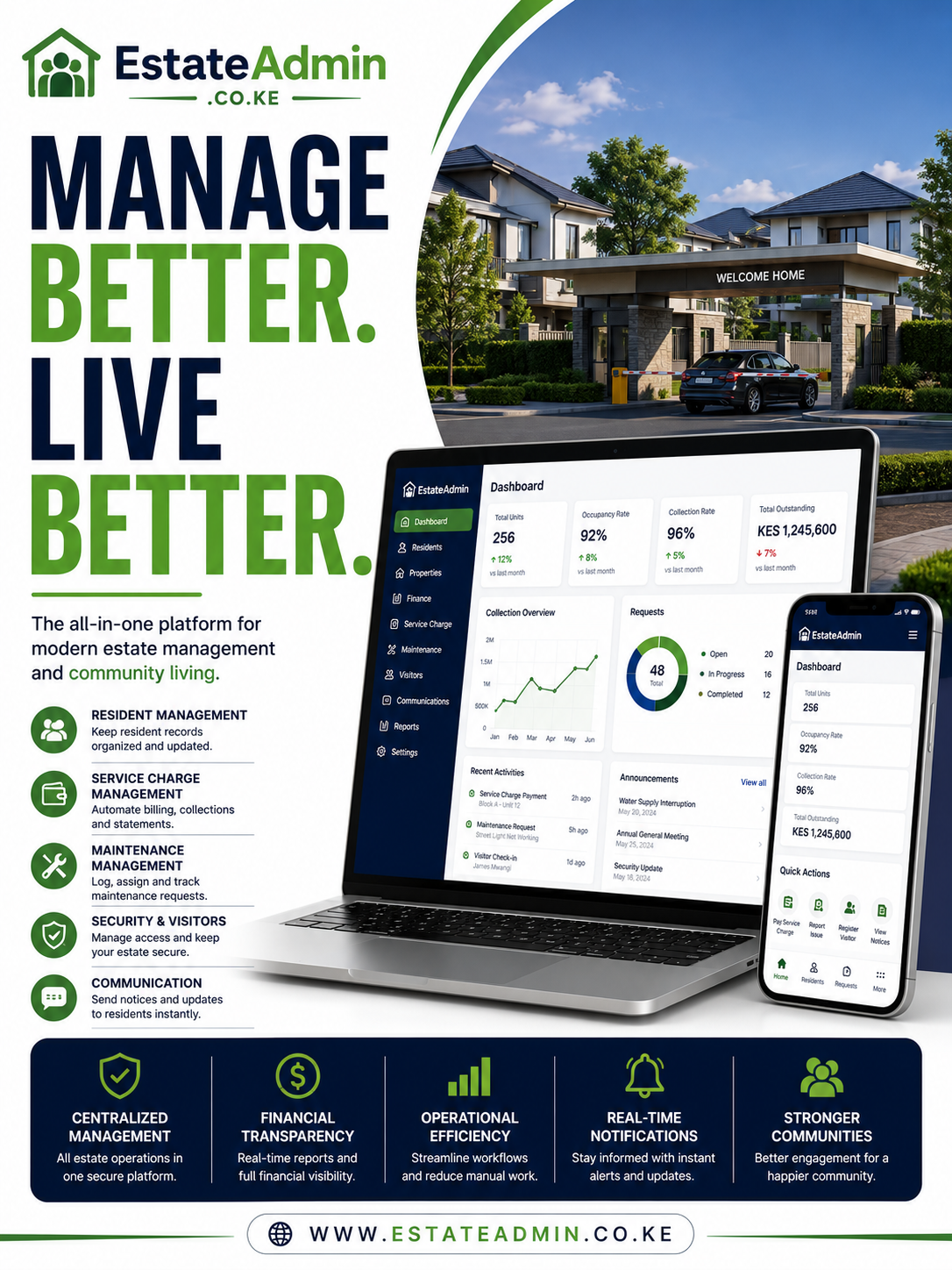
Property service charge collection system technology is changing how property managers, estate administrators, landlords, and homeowners’ associations manage recurring charges across residential and commercial properties. As apartment complexes, gated communities, mixed-use developments, and managed estates continue to grow, collecting service charges manually can create significant administrative challenges.
Property managers are responsible for collecting funds needed to pay for essential shared services such as security, cleaning, landscaping, garbage collection, water, electricity in common areas, repairs, and general maintenance. When these payments are managed through spreadsheets, paper receipts, bank statements, and multiple communication channels, it can become difficult to maintain accurate records and follow up on outstanding balances.
A modern Property service charge collection system centralizes billing, payment tracking, receipts, account management, and financial reporting in one platform. Instead of spending hours manually updating records, property managers can automate recurring invoices, monitor collections, identify overdue accounts, and provide residents with accurate statements.
For Kenyan property managers, digital collection systems can also make it easier to accommodate popular payment methods such as M-PESA and bank transfers. When payment information is integrated with property accounts, managers can reduce reconciliation work while residents benefit from more convenient payment processes.
This guide explores how a modern service charge collection platform works, the challenges associated with manual collection, the features property managers should look for, and the benefits of automating service charge administration.
A property service charge collection system is a digital platform designed to help property managers automate and organize the process of billing occupants and collecting payments for shared property services.
The system connects residents, property units, invoices, payments, receipts, and financial records in one centralized environment.
Depending on the platform, it can support:
- Resident registration
- Property and unit management
- Recurring billing
- Service charge invoices
- Payment processing
- M-PESA integration
- Bank payment tracking
- Automatic receipts
- Outstanding balance tracking
- Payment reminders
- Financial reports
- Expense monitoring
Instead of maintaining separate records for each activity, managers can manage the complete collection cycle through one system.
Understanding Property Service Charges
Service charges are payments made by property occupants or owners to cover the costs of maintaining and operating shared areas and facilities.
The exact charges depend on the property and the services provided.
Common service charge expenses include:
- Security
- Cleaning
- Landscaping
- Garbage collection
- Water management
- Common-area electricity
- Lift maintenance
- Generator servicing
- Swimming pool maintenance
- CCTV maintenance
- Gate maintenance
- Road repairs
- Drainage maintenance
- Administrative services
For example, residents in an apartment complex may contribute monthly service charges to fund security guards, cleaning services, garbage collection, lift maintenance, and maintenance of common areas.
The property manager must therefore collect enough money from residents to ensure these services can continue without interruption.
Why Efficient Service Charge Collection Matters
Service charge collection directly affects the financial health of a property.
When residents pay on time, management has sufficient funds to meet operational obligations.
However, when a significant percentage of accounts remain unpaid, the property may experience:
- Delayed supplier payments
- Reduced maintenance
- Security challenges
- Utility interruptions
- Accumulating debts
- Cash-flow problems
Efficient collection is therefore not simply an accounting responsibility. It directly affects the quality of services residents receive.
A reliable Property service charge collection system gives managers better visibility into collection performance and allows them to identify payment problems early.
Problems With Manual Service Charge Collection
Many properties still rely on spreadsheets, notebooks, printed invoices, and manual payment confirmations.
These methods can work for small communities, but they become increasingly difficult as the number of units grows.
Manual Invoice Preparation
Preparing invoices individually every month takes considerable time.
For a property with hundreds of units, staff may need to:
- Calculate the charge.
- Create the invoice.
- Enter the resident’s details.
- Send the invoice.
- Record the transaction.
Repeating these steps every billing cycle increases administrative workload.
Automation eliminates much of this repetitive work.
Payment Recording Challenges
Residents may pay through different channels.
For example:
- M-PESA
- Bank transfer
- Cheque
- Cash
- Online payment gateway
When payments are recorded manually, staff must identify the payer and update the correct account.
This can result in:
- Delayed account updates
- Duplicate entries
- Unallocated payments
- Incorrect balances
- Missing receipts
A centralized system helps reduce these problems.
Difficulty Tracking Outstanding Balances
One of the biggest challenges in manual collection is identifying overdue accounts.
A manager may need to review spreadsheets and compare different records to determine:
- Who has paid?
- Who has partially paid?
- Who has not paid?
- How long has the balance been outstanding?
- How much does each unit owe?
A digital system provides this information through dedicated collection reports and account dashboards.
Delayed Payment Reminders
Manual reminders require staff to contact residents individually.
This may involve:
- Phone calls
- SMS messages
- WhatsApp messages
- Emails
- Printed notices
Automated reminders can reduce this workload by sending notifications according to predefined billing and payment schedules.
Limited Financial Visibility
Without centralized reporting, property managers may struggle to understand the property’s financial position.
They may not immediately know:
- Total billed amount
- Total collected amount
- Outstanding balances
- Monthly collection rate
- Highest overdue accounts
- Expected future collections
A digital dashboard provides a clearer picture of financial performance.
How Digital Collection Systems Work
A modern service charge platform typically follows a structured process.
Step 1: Register the Property
The property manager enters:
- Property name
- Buildings or blocks
- Units
- Owners
- Occupants
- Billing structures
Step 2: Configure Charges
Management defines the service charge rules.
These may be:
- Fixed monthly charges
- Unit-based charges
- Square-footage-based charges
- Percentage allocations
- Custom charges
Step 3: Generate Invoices
The system automatically generates invoices according to the configured billing schedule.
Step 4: Collect Payments
Residents make payments using available channels.
Step 5: Reconcile Transactions
Payments are matched with the correct resident or unit account.
Step 6: Update Balances
The system automatically updates the account.
Step 7: Generate Reports
Management can review collection performance and outstanding balances.
This creates a complete digital collection cycle.
Automated Service Charge Billing
Automated billing is one of the most valuable features of a digital collection platform.
Instead of creating invoices manually every month, managers configure billing rules once.
The system can then generate recurring charges automatically.
For example, an apartment management company could configure a monthly service charge for each unit.
At the beginning of the billing period, invoices are automatically generated and delivered to residents.
This reduces repetitive work and helps ensure consistent billing.
Flexible Billing Structures
Not every property calculates service charges in the same way.
A professional Property service charge collection system should accommodate different billing structures.
Fixed Charges
Every unit pays the same amount.
For example:
- Unit A: KSh 5,000
- Unit B: KSh 5,000
- Unit C: KSh 5,000
Unit-Specific Charges
Different units have different service charge amounts.
For example:
- Two-bedroom apartment: KSh 4,000
- Three-bedroom apartment: KSh 6,000
- Penthouse: KSh 10,000
Size-Based Charges
Charges may be calculated based on property size.
Larger units may therefore contribute more toward shared expenses.
Special Assessments
An estate may need additional funds for a major project.
Examples include:
- Road repairs
- Painting
- Security upgrades
- Generator replacement
- Major plumbing work
The system can create separate charges for approved projects.
Resident and Unit Account Management
Every unit should have a clear financial history.
The system can maintain information such as:
- Resident name
- Unit number
- Contact information
- Invoice history
- Payment history
- Outstanding balance
- Receipts
- Adjustments
- Special charges
This creates a complete financial profile for each account.
When a resident asks about an outstanding balance, the manager can quickly review the account rather than searching through multiple files.
M-PESA and Digital Payment Collection in Kenya
M-PESA plays a major role in Kenya’s digital payment ecosystem.
For property managers, integrating M-PESA into a Property service charge collection system can simplify the collection process.
Instead of manually checking payment messages and updating spreadsheets, integrated payment systems can connect transactions with property accounts.
This can help:
- Reduce manual data entry
- Speed up payment confirmation
- Improve reconciliation
- Reduce unidentified payments
- Generate digital receipts
Residents also benefit from a familiar and convenient payment method.
Payment Reconciliation
Reconciliation ensures that collected money matches the financial records.
A digital platform can help managers compare expected collections with actual payments.
For example:
Amount billed: KSh 1,000,000
Amount collected: KSh 850,000
Outstanding: KSh 150,000
This gives management an immediate understanding of collection performance.
The system can also help identify individual accounts responsible for outstanding balances.
Outstanding Balance Management
Outstanding balances can negatively affect property operations if they remain unresolved.
A digital platform can categorize unpaid accounts based on how long they have been outstanding.
For example:
- Current
- 30 days overdue
- 60 days overdue
- 90 days overdue
- Long-term outstanding
This allows management to prioritize follow-up activities.
Automated Payment Reminders
Automated reminders can be scheduled around the billing cycle.
For example:
Before the Due Date
A resident receives a reminder that payment is approaching.
On the Due Date
The system sends a notification that payment is due.
After the Due Date
The system sends an overdue notification.
This consistent communication can encourage residents to settle accounts on time.
Digital Receipts
Once a payment is successfully recorded, the system can generate a digital receipt.
Receipts provide residents with confirmation that their payment has been received.
They can include:
- Resident name
- Unit number
- Payment amount
- Payment date
- Transaction reference
- Outstanding balance
Digital receipts reduce the need for printed paperwork and make historical records easier to retrieve.
Financial Reporting
Accurate reporting allows property managers to understand collection performance.
A modern platform can generate reports such as:
- Collection reports
- Outstanding balance reports
- Payment history reports
- Income reports
- Expense reports
- Monthly summaries
- Annual summaries
- Unit-level statements
These reports support both daily operations and long-term financial planning.
Benefits for Property Managers
A Property service charge collection system can significantly reduce administrative work.
Managers can benefit from:
- Automated billing
- Faster payment reconciliation
- Reduced paperwork
- Easier account tracking
- Automated reminders
- Faster reporting
- Better collection visibility
- Improved financial organization
Instead of spending hours maintaining spreadsheets, management can focus on property operations and resident service.
Benefits for Property Owners and Residents
Residents also benefit from digital service charge management.
They can enjoy:
- Convenient payment options
- Accurate invoices
- Digital receipts
- Faster payment confirmation
- Easy access to account statements
- Clear outstanding balances
- Better communication
Transparency can also reduce disputes because residents can review their financial records more easily.
Why Kenyan Properties Need Automated Collection
Kenya’s property market continues to evolve, with more apartments, gated communities, commercial developments, and mixed-use properties being professionally managed.
As the number of units increases, manual service charge collection becomes increasingly difficult.
A digital Property service charge collection system provides the scalability required to manage larger properties without proportionally increasing administrative workload.
It also provides the financial visibility needed to maintain services, control expenses, and improve resident satisfaction.
Creating a More Efficient Collection Process
A successful service charge collection process should be:
- Accurate
- Transparent
- Convenient
- Automated
- Secure
- Easy to monitor
Digital systems bring these requirements together in one platform.
From generating an invoice to receiving a payment and producing a receipt, every stage can be connected.
This reduces unnecessary manual intervention and creates a more reliable financial workflow.
Property service charge collection system solutions are becoming increasingly important for property managers who want to improve billing accuracy, simplify payment collection, and maintain better control over property finances. As estates, apartments, gated communities, and managed developments grow, relying on manual spreadsheets and disconnected payment records can make financial administration increasingly difficult.
A centralized digital platform can connect residents, units, invoices, payments, expenses, and reports. This gives property managers a clearer view of collection performance while providing residents with more convenient ways to manage their accounts.
Part 3 focuses on implementation, collection best practices, financial controls, common mistakes, frequently asked questions, and the long-term benefits of adopting digital service charge management.
How to Successfully Implement a Digital Collection System
Implementing a new platform requires more than simply creating an account and entering resident information. Property managers should approach the process systematically.
1. Review Existing Collection Processes
Before implementation, management should document how service charges are currently handled.
Review:
- How invoices are created
- How payments are received
- How payments are reconciled
- How receipts are issued
- How overdue accounts are identified
- How residents receive reminders
- How financial reports are prepared
This allows the organization to identify inefficient processes that the new platform should improve.
2. Organize Property and Resident Information
Accurate property information is essential.
Management should verify:
- Property names
- Buildings
- Blocks
- Unit numbers
- Owner information
- Tenant information
- Contact details
- Billing categories
Incorrect information can result in invoices being sent to the wrong accounts or inaccurate financial records.
3. Verify Existing Balances
Before migrating to a new platform, existing balances should be reconciled.
For every account, management should confirm:
- Previous invoices
- Payments received
- Outstanding amounts
- Credits
- Adjustments
- Penalties where applicable
This creates a reliable opening balance for the new system.
4. Configure Billing Rules
Each property should have clearly defined billing rules.
Management should determine:
- Billing frequency
- Service charge amounts
- Due dates
- Special assessments
- Penalty rules
- Utility charges
- Other recurring fees
Once these rules are configured, recurring invoices can be generated automatically.
5. Connect Payment Channels
Where supported, payment channels should be connected to the collection process.
For Kenyan properties, this may include:
- M-PESA
- Bank payments
- Online payment gateways
The objective is to ensure that payment information reaches the appropriate property account quickly and accurately.
6. Establish User Permissions
Every user should have access based on their responsibilities.
For example:
Administrator: manages system configuration.
Accountant: manages financial transactions.
Property Manager: manages residents, billing, and operations.
Committee Member: views approved reports.
This reduces unauthorized access and improves accountability.
7. Train Employees
Staff should receive practical training before the system becomes part of daily operations.
Training should cover:
- Creating accounts
- Generating invoices
- Recording payments
- Checking balances
- Reconciling transactions
- Managing expenses
- Generating reports
- Handling resident queries
A well-trained team is more likely to use the platform correctly and consistently.
8. Communicate With Residents
Residents should be informed about the transition.
Management can explain:
- How invoices will be delivered
- How payments should be made
- How receipts will be received
- How statements can be accessed
- How to raise billing questions
Clear communication reduces confusion and encourages residents to adopt the new process.
Best Practices for Improving Service Charge Collection
Technology is most effective when combined with good financial procedures.
Set Clear Payment Due Dates
Residents should know exactly when service charges are due.
Clear due dates make it easier to automate reminders and monitor overdue accounts.
Send Timely Reminders
Do not wait until an account is significantly overdue before contacting the resident.
A structured reminder process can include:
- Pre-due reminder
- Due-date notification
- First overdue reminder
- Follow-up notification
This creates consistency across the property.
Monitor Collection Rates
Property managers should regularly measure how much of the billed amount has been collected.
For example:
Total billed: KSh 2,000,000
Total collected: KSh 1,800,000
Outstanding: KSh 200,000
The collection rate is therefore 90%.
Monitoring this figure over time helps management identify whether collection performance is improving or declining.
Prioritize Long-Overdue Accounts
Not every outstanding account requires the same approach.
Managers can categorize debts according to age and amount.
For example:
- Current
- 30 days overdue
- 60 days overdue
- 90 days overdue
- Long-term outstanding
This allows the management team to prioritize accounts requiring more urgent attention.
Maintain Accurate Records
Every payment should be properly recorded.
Important information includes:
- Date
- Amount
- Payment method
- Transaction reference
- Resident
- Unit
- Invoice
- Account balance
Accurate records reduce disputes and make financial reporting easier.
Reconcile Payments Regularly
Reconciliation should be performed consistently rather than only at the end of the financial year.
Regular reconciliation helps identify:
- Missing payments
- Duplicate transactions
- Incorrect allocations
- Unidentified deposits
- Account discrepancies
Early detection makes corrections easier.
Separate Income and Expenses
Property managers should maintain clear distinctions between money collected and money spent.
Service charge income should be recorded separately from expenses such as:
- Security
- Cleaning
- Repairs
- Utilities
- Landscaping
- Administration
This creates a clearer picture of the property’s financial performance.
Control Property Expenses
Efficient collection is only useful if collected funds are managed responsibly.
Management should monitor spending against approved budgets.
A Property service charge collection system connected to expense management can help managers identify unnecessary or unexpected costs.
For example, if maintenance expenditure suddenly increases, management can investigate the cause before it affects the property’s financial position.
Use Financial Reports for Decision-Making
Reports should not simply be generated and stored.
Management should use them to make decisions.
For example, reports can help answer:
- Are residents paying on time?
- Which accounts have the highest outstanding balances?
- Which expenses are increasing?
- Is the property operating within budget?
- Is the current service charge sufficient?
- Are reserve funds growing as planned?
Using financial data this way turns accounting information into a management tool.
Common Mistakes When Managing Service Charge Collection
Relying Entirely on Spreadsheets
Spreadsheets can be useful for analysis, but they become difficult to manage when used as the primary collection system for large properties.
Multiple versions can result in:
- Conflicting balances
- Duplicate records
- Missing transactions
- Accidental changes
A centralized system provides better control.
Failing to Update Resident Information
Residents and property owners may change their contact details or ownership status.
Outdated information can result in:
- Missed invoices
- Failed reminders
- Incorrect statements
- Communication problems
Resident records should therefore be reviewed regularly.
Ignoring Small Outstanding Balances
Small unpaid amounts can accumulate over time.
A resident who repeatedly underpays by a small amount can eventually build a significant outstanding balance.
Automated account monitoring makes it easier to identify these differences.
Not Reviewing Expense Trends
Managers may focus heavily on collections while overlooking expenditure.
A property can have strong collections but still experience financial difficulties if operating expenses are poorly controlled.
Income and expenses should therefore be reviewed together.
Data Security and Privacy
Financial and resident information should be protected carefully.
A reliable digital platform should provide appropriate security measures such as:
- Secure login
- User permissions
- Data encryption
- Backups
- Activity monitoring
- Controlled access
Staff should also be trained to protect passwords and avoid sharing account credentials.
The Importance of Audit Trails
An audit trail makes financial activity easier to review.
Management should be able to determine:
- Who created a transaction
- Who modified it
- Who approved it
- When the action occurred
This is especially useful when investigating discrepancies or preparing for financial reviews.
How Digital Collection Improves Resident Experience
Service charge collection should not only benefit property managers.
Residents should also experience a simpler process.
A modern platform can allow residents to:
- View invoices
- Check balances
- Make payments
- Download receipts
- Access statements
- Receive reminders
- Submit service requests
This reduces dependence on manual communication.
Supporting Better Property Governance
Good financial management supports effective property governance.
Estate committees and property owners can use accurate reports to monitor:
- Collection performance
- Expenditure
- Supplier payments
- Budget performance
- Reserve funds
- Outstanding accounts
This creates greater accountability among the people responsible for managing the property.
Scaling From One Property to Multiple Properties
Property management companies often begin with one estate and eventually expand their portfolios.
A scalable system allows them to manage additional properties without creating completely separate financial processes.
Each property can maintain its own:
- Units
- Residents
- Billing
- Payments
- Expenses
- Suppliers
- Reports
At the same time, management can view consolidated information across the portfolio.
The Future of Property Service Charge Collection
Digital property management will continue evolving as payment technology, automation, and data analytics become more advanced.
Future platforms are likely to place greater emphasis on:
- Artificial intelligence
- Predictive analytics
- Automated reconciliation
- Mobile applications
- Smart metering
- Digital approvals
- Integrated communication
- Real-time financial dashboards
These technologies can help property managers move from reactive financial administration to proactive property management.
Artificial Intelligence and Collection Analytics
Artificial intelligence can potentially identify patterns in payment behavior.
For example, analytics may help identify:
- Seasonal collection changes
- Frequently late accounts
- Unusual payment patterns
- Increasing expenses
- Collection risks
This can allow managers to take action earlier.
Smart Property Integration
Future property management platforms may connect financial information with physical property systems.
These may include:
- Smart water meters
- Electricity meters
- Access control
- Security systems
- Maintenance equipment
This can create a more connected property management environment.
Frequently Asked Questions
It is a digital platform that helps property managers bill residents, collect payments, track balances, reconcile transactions, issue receipts, and generate financial reports.
Can it manage apartment service charges?
Yes. It can be configured to manage recurring service charges for apartments, gated communities, residential estates, and other managed properties.
Can it support M-PESA payments?
Depending on the platform and integration available, M-PESA can be connected to the collection process, allowing payment information to be associated with resident accounts.
Can residents see their balances?
Resident access depends on the platform, but systems with resident portals can allow users to view invoices, balances, payment histories, and receipts.
Can it manage multiple properties?
Many modern platforms support multiple properties, allowing management companies to maintain separate records while overseeing the entire portfolio.
Does it replace accounting software?
It depends on the platform. Some property management systems include accounting functionality, while others integrate with dedicated accounting platforms.
Property managers should determine whether they need complete accounting capabilities or primarily service charge collection and property financial management.
Can it track overdue payments?
Yes. Digital collection platforms can identify outstanding balances and organize overdue accounts according to their age or amount.
How can automated reminders improve collection?
Automated reminders ensure residents receive consistent notifications about upcoming and overdue payments without requiring staff to contact every resident manually.
Is cloud-based property collection software useful?
Cloud-based platforms can allow authorized users to access property information from different locations while keeping records centralized.
This can be particularly useful for property management companies overseeing multiple developments.
How to Choose the Right Solution
When evaluating a Property service charge collection system, property managers should look beyond basic billing.
The platform should ideally support:
- Property and unit management
- Automated recurring billing
- M-PESA integration
- Multiple payment channels
- Payment reconciliation
- Automated reminders
- Digital receipts
- Resident statements
- Expense management
- Budget monitoring
- Financial reporting
- User permissions
- Audit trails
- Data backups
- Multi-property management
- Resident self-service
- Maintenance integration
The most suitable platform will depend on the property’s size, financial structure, number of units, payment methods, and operational requirements.
Why Service Charge Collection Should Become Digital
The traditional approach to service charge management depends heavily on manual processes. Staff may spend hours preparing invoices, checking payment messages, updating spreadsheets, sending reminders, and creating reports.
As properties become larger, these processes become increasingly difficult to maintain.
Digital collection provides a more structured alternative.
It connects the entire process:
Billing → Invoice → Payment → Reconciliation → Receipt → Balance → Reporting
This creates a consistent financial workflow that is easier to monitor and manage.
Building a More Financially Sustainable Property
Service charge collection is ultimately about maintaining the resources required to operate a property.
When payments are collected efficiently, management has better access to funds for:
- Security
- Cleaning
- Maintenance
- Utilities
- Landscaping
- Repairs
- Infrastructure
- Shared facilities
Better collection therefore contributes directly to better property operations.
Conclusion
Efficient service charge management is essential for the long-term success of residential estates, apartment complexes, gated communities, and other managed properties. Property managers need reliable systems that make it easy to create invoices, receive payments, monitor outstanding accounts, reconcile transactions, and produce accurate financial reports.
A Property service charge collection system provides a centralized approach to these activities. By automating recurring billing, connecting payment channels, generating digital receipts, tracking outstanding balances, and providing real-time financial information, the system can reduce administrative workload while improving financial visibility.
For Kenyan properties, payment convenience is also an important consideration. Supporting digital payment methods such as M-PESA can make it easier for residents to settle their service charges while helping management maintain organized transaction records.
The benefits extend beyond payment collection. When service charge information is connected with expenses, budgets, suppliers, maintenance, and resident communication, property managers gain a broader view of how the property is performing financially and operationally.
Successful implementation requires accurate data, clear billing rules, appropriate user permissions, regular reconciliation, staff training, and effective communication with residents. Property managers should also select a platform that can scale as the number of units and properties grows.
As property management continues to become more digital, automated service charge collection will play an increasingly important role in improving efficiency and accountability. A well-designed Property service charge collection system can help property managers spend less time on repetitive administrative tasks and more time maintaining properties, supporting residents, controlling costs, and planning for long-term growth.
For property owners and residents, the result is a more transparent and convenient financial experience. For management companies, it provides better control, reporting, and scalability. Ultimately, digital service charge collection creates a stronger foundation for professionally managed properties and more sustainable property operations.
- Property service charge collection system
- Property service charge collection system
- Property service charge collection system
- Property service charge collection system
- Property service charge collection system
- Property service charge collection system
- Property service charge collection system
- Property service charge collection system
- Property service charge collection system
- Property service charge collection system
- Property service charge collection system
- Property service charge collection system
- Property service charge collection system
- Property service charge collection system
- Property service charge collection system
- Property service charge collection system
- Property service charge collection system
- Property service charge collection system
- Property service charge collection system
- Property service charge collection system
- Property service charge collection system
- Property service charge collection system
- Property service charge collection system
- Property service charge collection system
- Property service charge collection system
- Property service charge collection system
- Property service charge collection system
- Property service charge collection system
- Property service charge collection system
- Property service charge collection system
- Property service charge collection system
- Property service charge collection system
- Property service charge collection system
- Property service charge collection system
- Property service charge collection system
- Property service charge collection system
- Property service charge collection system
- Property service charge collection system
- Property service charge collection system
- Property service charge collection system
