
Property Management Software in Kenya: The Complete Guide for Landlords and Property Managers in 2026
Managing rental properties in Kenya can become increasingly difficult as your property portfolio grows. Tracking tenants, collecting rent, following up on arrears, recording expenses, managing maintenance requests, and preparing financial reports can take a significant amount of time when everything is handled manually.
This is where property management software in Kenya comes in.
Modern property management systems help landlords and property managers automate routine tasks, organize property information, improve tenant communication, and gain better control over rental income and expenses.
Whether you manage a single apartment, several residential units, commercial properties, or a large portfolio, the right property management system can make your daily operations more efficient.
In this guide, we explore what property management software is, its benefits, the features to look for, how it can help Kenyan landlords, and why digital property management is becoming increasingly important.
What Is Property Management Software?
Property management software is a digital platform designed to help landlords, property managers, real-estate companies, and property owners manage their properties from one centralized system.
Instead of relying on spreadsheets, notebooks, WhatsApp messages, paper receipts, and separate accounting tools, property managers can use one platform to manage important property operations.
Depending on the software, features may include:
- Property and unit management
- Tenant management
- Rent collection
- Automated rent reminders
- Rent arrears tracking
- Expense management
- Maintenance management
- Tenant communication
- Lease management
- Financial reporting
- Property performance reports
- Occupancy tracking
- Payment records
- User and staff management
For Kenyan property owners, this can significantly simplify the process of managing rental properties.
Why Do Landlords in Kenya Need Property Management Software?
The Kenyan rental property market includes everything from single-room rentals and apartments to commercial buildings and large residential estates.
As the number of tenants increases, manually managing the portfolio becomes more challenging.
For example, a landlord with 10 tenants may be able to track payments using a spreadsheet. However, managing hundreds of tenants manually can result in missed payments, incorrect records, delayed communication, and difficulties preparing financial reports.
Property management software provides a centralized solution.
1. Easier Rent Collection
Rent collection is one of the most important responsibilities of a landlord or property manager.
A good property management system allows managers to record tenant payments and monitor outstanding balances from one dashboard.
Instead of manually checking multiple records, managers can quickly identify:
- Tenants who have paid
- Tenants with outstanding balances
- Partial payments
- Overdue rent
- Payment history
- Monthly rental income
This makes rent administration much easier.
2. Better Rent Arrears Management
Rent arrears can negatively affect a property’s cash flow.
Without an organized system, landlords may forget to follow up with tenants or struggle to determine exactly how much is outstanding.
Property management software can help track arrears automatically and provide a clear picture of outstanding rent.
Managers can then follow up with tenants before arrears become a larger problem.
3. Automated Tenant Communication
Communication is an important part of successful property management.
Landlords regularly need to communicate with tenants about:
- Rent reminders
- Payment confirmations
- Maintenance updates
- Lease information
- Property notices
- Important announcements
Using property management software can make these communications more organized.
Instead of searching through hundreds of WhatsApp conversations, emails, or SMS messages, property managers can maintain tenant information in one centralized system.
4. Centralized Tenant Records
Keeping accurate tenant records is essential.
A property management system can store important information such as:
- Tenant names
- Contact information
- Unit numbers
- Lease details
- Rent amounts
- Payment history
- Outstanding balances
- Maintenance requests
This makes it easier for property managers to retrieve information whenever it is needed.
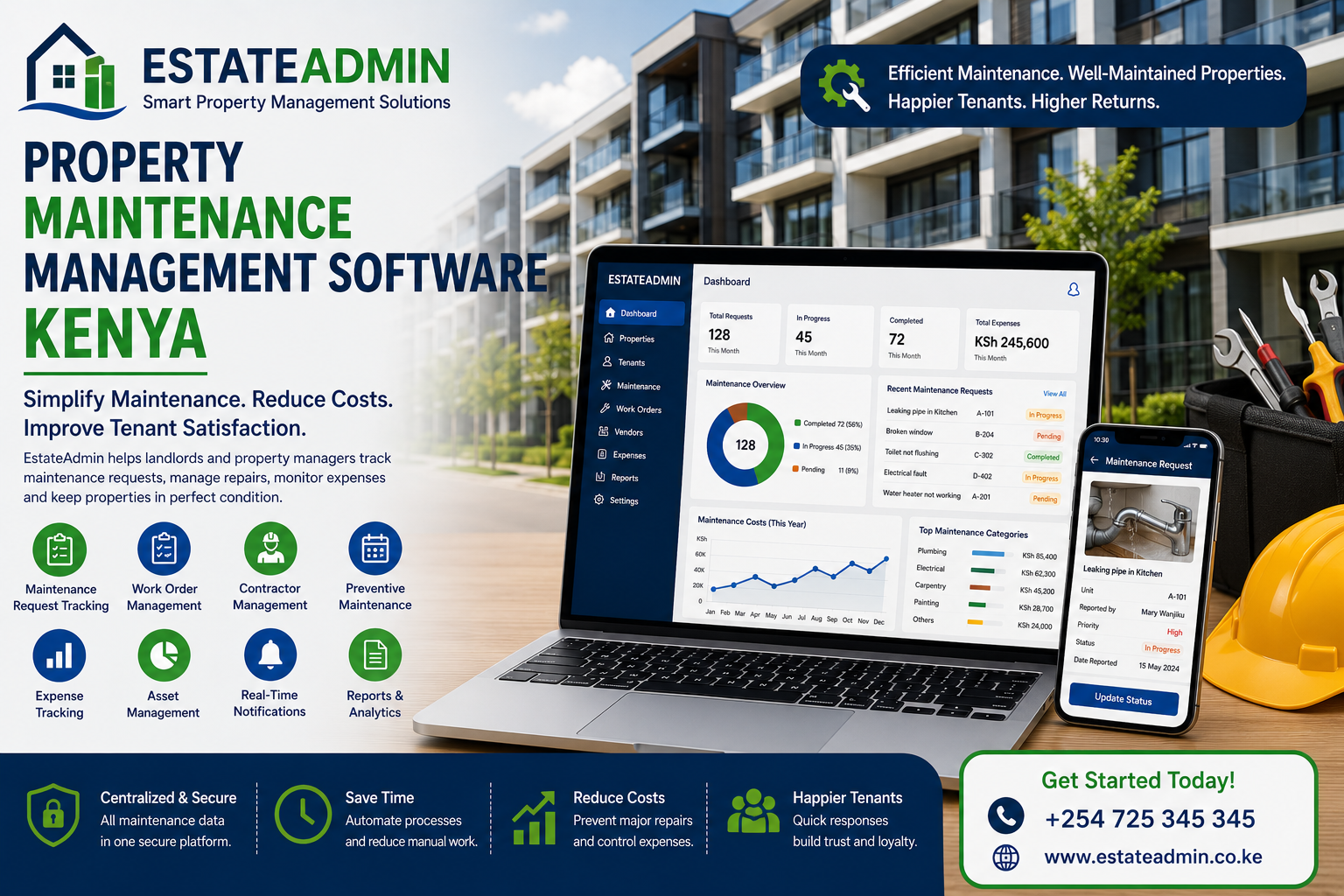
5. Maintenance Management
Property maintenance can quickly become difficult to manage when requests are received through different channels.
One tenant may call, another may send a WhatsApp message, while another may report an issue in person.
Without a proper system, maintenance requests can easily be forgotten.
Property management software can help managers record and track maintenance requests from the time they are reported until they are completed.
A maintenance workflow may include:
Tenant reports issue → Manager records request → Technician assigned → Work completed → Request closed
This provides better accountability and helps ensure that tenant complaints are handled promptly.
6. Better Property Financial Management
Property owners need accurate financial information to understand whether their investments are performing well.
A property management system can help track:
- Rental income
- Property expenses
- Maintenance costs
- Outstanding rent
- Deposits
- Payments
- Other property-related transactions
With organized financial records, landlords can make better decisions about their properties.
7. Automated Reports
Preparing reports manually can consume many hours, especially for large property portfolios.
Property management software can generate reports based on information already stored in the system.
Common reports include:
- Rent collection reports
- Arrears reports
- Income reports
- Expense reports
- Tenant reports
- Occupancy reports
- Property performance reports
These reports can help property owners understand what is happening across their portfolios.
Key Features to Look for in Property Management Software in Kenya
Not all property management platforms provide the same features.
Before choosing a system, landlords and property managers should consider the following.
Tenant Management
The software should make it easy to create, update, and manage tenant records.
A centralized tenant management system reduces the need for paper files and scattered spreadsheets.
Rent Tracking
Rent tracking should provide a clear view of expected rent, collected rent, and outstanding balances.
This is particularly important for landlords managing multiple properties.
Payment Management
The system should make it easy to record and reconcile tenant payments.
For the Kenyan market, property managers should also consider systems that support payment methods commonly used by local tenants.
Maintenance Tracking
Look for software that allows property managers to create, assign, monitor, and close maintenance requests.
This helps improve accountability.
Expense Tracking
Property expenses should be recorded and categorized.
This allows owners to understand how much they are spending on maintenance, utilities, repairs, management, and other operational costs.
Reporting and Analytics
Reports help property owners understand their property’s financial and operational performance.
A good system should make important information easy to access without requiring complicated calculations.
Tenant Communication
Communication tools can help property managers send important notifications and maintain organized records.
Lease Management
Lease information should be easy to store and retrieve.
A digital system can help managers monitor lease terms, rental amounts, tenant details, and important dates.
Property Management Software vs Excel Spreadsheets
Many landlords start managing properties using Excel or Google Sheets.
Spreadsheets can work for small portfolios, but they become increasingly difficult to manage as the number of properties and tenants grows.
| Feature | Spreadsheet | Property Management Software |
|---|---|---|
| Tenant records | Yes | Yes |
| Rent tracking | Manual | Automated/organized |
| Arrears monitoring | Manual | Easier to monitor |
| Maintenance tracking | Limited | Dedicated workflows |
| Reporting | Manual | Automated |
| Tenant communication | Separate tools | Often integrated |
| Data centralization | Limited | Yes |
| Scalability | Limited | Better for growing portfolios |
| Automation | Limited | Extensive |
The biggest difference is automation and centralization.
A spreadsheet stores information, while property management software can help manage the processes around that information.
How Property Management Software Can Save Time
Consider a property manager responsible for 100 rental units.
Every month, the manager may need to:
- Check rent payments.
- Identify unpaid accounts.
- Follow up with tenants.
- Record expenses.
- Handle maintenance requests.
- Update tenant records.
- Prepare reports.
- Communicate with property owners.
Doing all these activities manually can consume a significant amount of time.
With a centralized property management platform, many of these processes can be organized in one system.
This allows property managers to spend less time on administrative work and more time improving the performance of their properties.
Benefits for Property Managers
Professional property managers can benefit significantly from using property management software.
Improved Organization
All property and tenant information can be managed from one place.
Faster Operations
Automating repetitive tasks reduces administrative workload.
Better Tenant Service
Faster responses to maintenance requests and tenant inquiries can improve tenant satisfaction.
Improved Financial Visibility
Managers can quickly see rent collection, arrears, and expenses.
Better Accountability
Digital records make it easier to track payments, maintenance requests, and property activities.
Benefits for Landlords
Property owners can also benefit even when they do not personally manage their properties.
A property management system can provide better visibility into:
- Rental income
- Occupancy
- Arrears
- Expenses
- Maintenance
- Tenant activity
- Property performance
This can make it easier for landlords to monitor their investments without being physically present at the property.
How to Choose the Best Property Management Software in Kenya
Choosing the right platform requires more than looking at the number of features.
Consider the following factors.
1. Ease of Use
The system should be easy for landlords, property managers, accountants, and staff to understand.
A complicated platform may create more problems than it solves.
2. Mobile Accessibility
Property managers are often away from their desks.
A platform that works well on mobile devices allows managers to access important information while visiting properties or meeting tenants.
3. Security
Property management systems handle sensitive information.
Look for platforms that use appropriate security controls, access permissions, secure authentication, backups, and other measures designed to protect property and tenant data.
4. Scalability
The software should be able to grow with your portfolio.
A platform suitable for 20 units should ideally provide a path for managing hundreds or thousands of units.
5. Reporting
Good reporting capabilities are important for understanding property performance.
6. Payment Integration
Consider whether the platform supports payment methods that are convenient for your tenants and suitable for your business operations.
7. Customer Support
Reliable customer support can make a major difference when implementing new software.
Is Property Management Software Worth It?
For landlords managing only one or two units, manual management may still be practical.
However, as a portfolio grows, the administrative workload increases.
Property management software becomes particularly valuable when you are managing:
- Multiple apartment buildings
- Large residential estates
- Commercial properties
- Hundreds of tenants
- Multiple property owners
- Multiple staff members
The value comes from reducing repetitive work, improving organization, reducing errors, and providing better visibility into property operations.
The Future of Property Management in Kenya
Property management is becoming increasingly digital.
Landlords and property managers are moving away from paper-based processes and fragmented spreadsheets toward centralized digital platforms.
The future of property management is likely to involve more automation, real-time reporting, digital payments, mobile management, automated communication, and data-driven decision-making.
For property owners, adopting technology early can provide a competitive advantage.
A well-managed property is not only about collecting rent. It is also about maintaining accurate records, communicating effectively with tenants, controlling expenses, managing maintenance, and understanding financial performance.
Why EstateAdmin.co.ke Can Help
EstateAdmin.co.ke is designed to help property owners and managers simplify the administration of rental properties.
Instead of managing different aspects of your property portfolio using disconnected tools, a centralized property management solution can bring essential operations together.
Whether you are managing apartments, residential units, commercial properties, or a growing rental portfolio, using the right technology can make property management more organized and efficient.
Final Thoughts
Managing rental properties manually can become increasingly difficult as your portfolio grows.
From rent collection and tenant communication to maintenance, expenses, and reporting, property managers have many responsibilities to handle every month.
Property management software in Kenya provides a more organized way to manage these responsibilities.
By centralizing property information, automating repetitive tasks, improving rent tracking, and providing better reporting, property management software can help landlords and property managers save time and operate more efficiently.
If you are still managing your rental properties using notebooks, spreadsheets, or multiple disconnected applications, it may be time to consider a dedicated property management system.
The right technology can turn property management from a time-consuming administrative task into a more organized, efficient, and data-driven operation.