
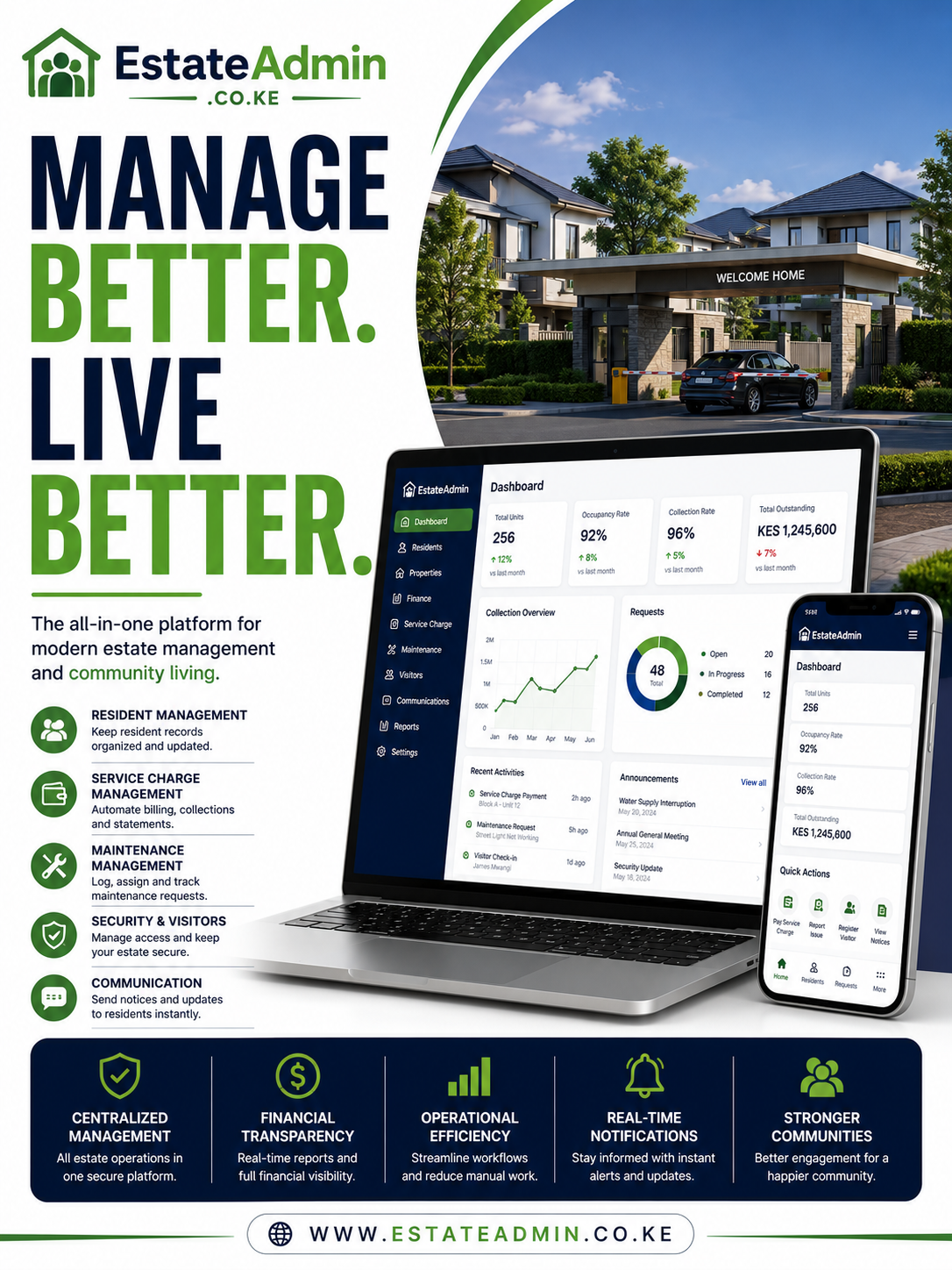
Estate invoice management software in Nairobi is becoming an important tool for estate managers, property management companies, residential communities, developers, and estate administrators looking to simplify billing and improve financial control. Managing invoices manually across spreadsheets, receipt books, emails, and separate payment records can become increasingly difficult as the number of units and residents grows.
A modern digital platform can centralize invoice creation, billing schedules, payment tracking, resident accounts, service charges, utilities, arrears, receipts, and financial reports. For Nairobi estates managing large numbers of households, this can make monthly billing more organized and reduce repetitive administrative work.
The growth of digital property management in Kenya is also creating demand for systems that combine invoicing with M-PESA, bank payments, accounting, resident communication, and reporting. Kenyan property-management platforms now commonly advertise automated invoicing, payment reconciliation, service-charge billing, and digital receipts as part of their property-management workflows.
Table of Contents
ToggleUnderstanding Estate Invoice Management
Estate invoice management software in Nairobi refers to digital technology designed to help residential estates create, distribute, track, and manage invoices for residents, tenants, property owners, or other customers.
An estate invoice can cover different types of charges depending on how the property is managed.
These may include:
- Service charges
- Rent
- Water bills
- Electricity-related charges
- Garbage collection
- Security charges
- Parking fees
- Maintenance charges
- Facility usage fees
- Penalties
- Other approved estate charges
Instead of preparing each invoice manually, management can configure recurring charges and generate invoices for multiple units.
This is particularly valuable when an estate has hundreds of units.
Why Estate Invoicing Is Important
Invoicing is one of the most important financial processes within an estate.
An invoice tells a resident:
- What they owe
- Why they owe it
- When payment is due
- What their previous balance was
- What amount is currently outstanding
Accurate invoicing therefore creates the foundation for effective collections.
When invoices contain errors, residents may question their balances, payments can be delayed, and management may spend additional time resolving disputes.
A centralized Estate invoice management software in Nairobi platform can help standardize how invoices are created and managed.
Problems With Manual Estate Invoicing
Many property managers still rely on spreadsheets to prepare monthly invoices.
This may work when managing a small number of units, but problems can emerge as the portfolio grows.
Manual Data Entry
Staff may need to enter the same information repeatedly.
For example:
- Resident name
- Unit number
- Charge amount
- Due date
- Previous balance
- Payment information
Repeated data entry increases the possibility of human error.
Duplicate Records
Different employees may maintain separate versions of the same spreadsheet.
One file may show that a resident owes KSh 10,000 while another shows KSh 8,000.
Resolving these differences takes time.
Delayed Invoice Generation
Preparing hundreds of invoices manually can take hours or even days.
This delays the billing process and may affect collection timelines.
Difficult Payment Tracking
After invoices are issued, management needs to determine which residents have paid.
If payments are recorded separately from invoices, reconciliation becomes more complicated.
Centralized Invoice Generation
One of the main advantages of Estate invoice management software in Nairobi is centralized invoice generation.
Management can create billing rules and generate invoices for multiple units from one system.
For example, if an estate has 300 units and each unit has a monthly service charge, management can generate the month’s invoices in bulk instead of preparing 300 separate documents.
This can significantly reduce administrative workload.
Recurring Billing
Many estate charges occur repeatedly.
Examples include:
- Monthly service charges
- Monthly rent
- Regular security fees
- Recurring maintenance contributions
- Scheduled utility charges
A digital platform can automate recurring billing.
Management can establish:
Charge → Amount → Frequency → Due date → Invoice
The system can then generate invoices according to the configured schedule.
Bulk Invoicing
Bulk invoicing is particularly useful for large residential communities.
Instead of generating invoices one by one, management can select an estate, building, category, or group of units.
The platform can then create invoices for the selected residents.
Some Kenyan property-management systems specifically offer bulk invoice generation for hundreds of units.
Invoice Numbering
Professional invoice management requires consistent invoice numbers.
Each invoice should have a unique identifier.
For example:
- INV-2026-001
- INV-2026-002
- INV-2026-003
This makes invoices easier to locate and reference.
A digital system can automatically generate sequential invoice numbers.
This reduces the possibility of duplicate numbering.
Invoice Dates and Due Dates
Invoices should clearly distinguish between:
- Invoice date
- Billing period
- Due date
- Payment date
This information helps residents understand their obligations and helps management monitor overdue accounts.
Billing Periods
An estate may bill residents monthly, quarterly, annually, or according to another approved schedule.
A digital platform can organize charges according to the appropriate billing period.
For example:
January 2026 Service Charge
February 2026 Service Charge
March 2026 Service Charge
This creates a clear historical record.
Service Charge Invoicing
Service charges are among the most common reasons residential estates need structured invoicing.
Service charges can fund shared services such as:
- Security
- Cleaning
- Landscaping
- Waste management
- Common-area lighting
- Water systems
- Lift maintenance
- Shared facilities
Estate invoice management software in Nairobi can help management generate service-charge invoices and monitor payments against those invoices.
Utility Invoicing
Some estates separately bill residents for utilities.
Examples include:
- Water
- Electricity
- Garbage
- Internet
- Other shared services
A system can add these charges to resident invoices.
This can create one consolidated bill instead of several separate payment requests.
Water Billing
Water billing can become complicated when each unit has its own meter.
Management may need to record:
- Previous reading
- Current reading
- Consumption
- Rate
- Amount due
A digital system can calculate consumption-based charges where the relevant functionality is available.
Some Kenyan property-management platforms support utility billing and meter-based invoicing.
Consolidated Invoices
Residents may prefer receiving one invoice containing several charges.
For example:
| Charge | Amount |
|---|---|
| Service charge | KSh 8,000 |
| Water | KSh 1,500 |
| Parking | KSh 2,000 |
| Previous balance | KSh 500 |
| Total | KSh 12,000 |
A consolidated invoice makes it easier for residents to understand their total obligation.
Resident Account Statements
Invoices show individual charges, while statements provide a broader view of an account.
A resident statement can show:
- Previous balance
- New invoices
- Payments
- Adjustments
- Credits
- Current balance
This can be particularly useful when resolving billing questions.
Payment Tracking
Generating invoices is only the first stage.
Management also needs to know whether each invoice has been paid.
A digital system can display statuses such as:
- Draft
- Issued
- Partially paid
- Paid
- Overdue
- Cancelled
This provides an immediate view of collection performance.
Partial Payments
Residents may sometimes make payments that do not completely settle an invoice.
For example:
Invoice: KSh 20,000
Payment: KSh 12,000
Remaining balance: KSh 8,000
The system should retain the invoice while reflecting the partial payment.
This prevents the account from being incorrectly marked as fully paid.
M-PESA Payment Integration
M-PESA is an important payment channel for many Kenyan residents.
For this reason, Estate invoice management software in Nairobi can be particularly useful when it connects invoices with M-PESA payment workflows.
Depending on the platform, payments may be matched against the correct resident, unit, and invoice.
This can reduce manual reconciliation.
Kenyan property platforms currently advertise M-PESA integration and automatic payment matching as part of their billing workflows.
Bank Payment Tracking
Some residents may pay through bank transfers.
A comprehensive invoice system should therefore accommodate multiple payment methods where possible.
These may include:
- M-PESA
- Bank transfers
- Cash
- Cards
- Other digital channels
The important requirement is that the payment should be correctly allocated to the resident’s account.
Automatic Payment Reconciliation
Payment reconciliation involves matching received money to the correct account or invoice.
Manual reconciliation can be time-consuming when an estate receives hundreds of transactions.
Automation can help identify:
- Resident
- Unit
- Invoice
- Amount
- Transaction reference
This makes account updates faster and more accurate.
Digital Receipts
After payment, residents may need confirmation.
Digital receipts can provide:
- Receipt number
- Resident name
- Unit
- Amount paid
- Payment method
- Transaction reference
- Date
- Remaining balance
Some Kenyan property platforms provide automated receipts after payment reconciliation.
Automated Invoice Delivery
Invoices should reach residents promptly.
A digital platform can distribute invoices through supported channels such as:
- SMS
- Resident portals
- Mobile applications
- Other integrated communication channels
This reduces reliance on printed invoices.
Email Invoices
Email can be useful for residents who prefer digital documentation.
A system can send the invoice directly to the resident’s registered email address.
This also creates a searchable digital record.
SMS Notifications
SMS can be useful for short billing notifications.
For example:
Your estate invoice of KSh 12,000 is due on 5 September 2026. Please make payment using the approved payment method.
SMS reminders can help residents remember approaching deadlines.
Resident Portals
A resident portal gives residents direct access to their billing information.
Depending on the platform, residents may be able to:
- View invoices
- View statements
- Check balances
- Download receipts
- Make payments
- Submit maintenance requests
- Receive announcements
This reduces the number of routine billing questions directed to estate administrators.
Automated Payment Reminders
Late payments can negatively affect estate cash flow.
A digital platform can automatically send reminders before and after the due date.
For example:
Before Due Date
“Your invoice is due in three days.”
On Due Date
“Your estate invoice is due today.”
After Due Date
“Your account has an outstanding balance.”
This creates a consistent collection process.
Arrears Management
Arrears are one of the biggest challenges in estate financial administration.
Management needs to know:
- Who owes money
- How much they owe
- How long the balance has been outstanding
- Which invoices remain unpaid
A digital dashboard can make this information easier to access.
Aging Reports
An aging report can classify outstanding balances according to how long they have remained unpaid.
For example:
- Current
- 30 days
- 60 days
- 90 days
- Over 90 days
This allows management to prioritize collection efforts.
Improving Collection Efficiency
Better invoicing can improve collections because residents receive accurate bills on time.
A strong process looks like:
Generate invoice → Deliver invoice → Send reminder → Receive payment → Reconcile → Issue receipt → Update balance
Each stage creates a traceable record.
Invoice Adjustments
Sometimes an invoice needs to be corrected.
For example:
- A charge was entered incorrectly.
- A resident received an approved credit.
- A previous payment was allocated incorrectly.
- A billing rate changed.
A digital platform should provide controlled adjustment functionality rather than requiring staff to delete financial records.
Credit Notes
Credit notes can be used to document approved reductions or corrections.
This provides a clearer audit trail than simply changing the original invoice.
Invoice Cancellation
If an invoice was created incorrectly, management may need to cancel it.
The cancellation should be recorded rather than simply deleting the invoice.
This preserves historical accountability.
Audit Trails
Financial accountability is important when managing residents’ contributions.
A good Estate invoice management software in Nairobi platform should maintain records showing relevant activities.
An audit trail may record:
- Who created an invoice
- Who edited it
- Who cancelled it
- Who recorded a payment
- When the action occurred
This helps management investigate discrepancies.
Role-Based Access
Not every employee should have access to every financial function.
A platform can assign different roles.
For example:
Administrator: General system access.
Accountant: Billing, payments, and financial reports.
Estate Manager: Operational and resident management.
Viewer: Read-only access to approved information.
Role-based access improves control.
Financial Reporting
Invoices generate valuable financial data.
Management can use reports to monitor:
- Total invoiced
- Total collected
- Outstanding balances
- Collection rate
- Revenue by charge type
- Revenue by building
- Revenue by month
These reports help estate managers understand financial performance.
Monthly Billing Reports
A monthly billing report can show:
- Number of invoices generated
- Total invoice value
- Payments received
- Outstanding amount
- Number of overdue accounts
This can be presented to management or estate committees.
Building-Level Reports
Large estates may have several blocks.
Management may want to compare collections between buildings.
For example:
Block A — 96% collected
Block B — 89% collected
Block C — 94% collected
This helps identify areas requiring attention.
Unit-Level Financial History
Management may need to review the history of a particular unit.
A unit account can show:
- Resident
- Previous invoices
- Payments
- Credits
- Outstanding balances
- Receipts
This is much easier than searching through multiple spreadsheets.
Estate Committee Reporting
Estate committees often need financial information for meetings and decision-making.
Reports can provide information about:
- Billing
- Collections
- Arrears
- Expenses
- Service charges
- Outstanding accounts
This improves financial visibility.
Reducing Billing Disputes
Billing disputes often occur because residents do not understand how an amount was calculated.
Clear invoices can reduce confusion by displaying:
- Charge description
- Amount
- Billing period
- Previous balance
- Payment history
- Current balance
A resident can therefore see how the final amount was reached.
Improving Transparency
Transparent billing helps strengthen relationships between management and residents.
Residents should be able to understand what they have been charged and what payments have been received.
Digital records can make this information easier to access.
Supporting Nairobi Estate Managers
Nairobi has a large and diverse residential property market, ranging from apartment developments to gated communities and mixed-use estates.
As the number of units increases, manual invoicing becomes increasingly difficult to scale.
Estate invoice management software in Nairobi can provide a centralized billing environment that supports estates with different charge structures and resident requirements.
Managing Multiple Estates
Property management companies may manage several estates.
Instead of maintaining separate spreadsheets for every development, a multi-property platform can allow management to organize each estate within one system.
For example:
Management Company
→ Estate A
→ Estate B
→ Estate C
→ Estate D
Each estate can maintain its own:
- Residents
- Units
- Charges
- Invoices
- Payments
- Reports
Multi-User Collaboration
Estate management often involves several people.
The accountant may handle payments while the estate manager handles residents and operations.
A centralized platform allows authorized staff to work from the same information.
This reduces duplication and improves coordination.
Cloud-Based Invoice Management
Cloud-based systems allow authorized users to access billing information through internet-connected devices.
This can be useful for property managers who work:
- At the estate
- From the office
- From home
- Across multiple Nairobi properties
Instead of being tied to one computer, management can access the system according to assigned permissions.
Mobile Access
Mobile access can make estate administration more responsive.
A manager visiting an estate can potentially check:
- Resident accounts
- Invoice status
- Payment information
- Outstanding balances
- Maintenance records
without returning to an office computer.
Data Security
Estate billing systems contain sensitive financial and resident information.
Management should therefore consider:
- Authentication
- User permissions
- Secure backups
- Encryption
- Activity monitoring
- Access controls
The selected platform should provide appropriate security measures for the information it stores.
What to Look for in Estate Invoice Software
Before choosing Estate invoice management software in Nairobi, estate managers should evaluate the system based on practical requirements.
Important features include:
- Bulk invoice generation
- Recurring billing
- Service charge billing
- Utility billing
- M-PESA integration
- Bank payment tracking
- Payment reconciliation
- Digital receipts
- Resident statements
- Automated reminders
- Arrears reports
- Financial reporting
- Role-based access
- Audit trails
- Multi-estate management
- Resident portals
- Mobile access
- Data backups
The right combination depends on the size and complexity of the estate.
Questions to Ask Before Implementation
Management should ask potential software providers:
- Can the platform generate invoices in bulk?
- Can it handle recurring service charges?
- Can it manage utility charges?
- Does it support M-PESA?
- Can payments be automatically reconciled?
- Can residents access their invoices?
- Can the system generate statements?
- Can it track arrears?
- Can it manage multiple estates?
- Does it provide financial reports?
- Can different employees have different permissions?
- Does it maintain an audit trail?
- Can invoices be sent electronically?
- Does it support mobile access?
- How is financial and resident data protected?
These questions can help management compare solutions based on actual operational needs rather than simply choosing a platform based on price.
Transitioning From Spreadsheets
Moving from spreadsheets to Estate invoice management software in Nairobi should be done systematically.
The first step is to clean existing data.
Management should verify:
- Unit numbers
- Resident names
- Contact information
- Current balances
- Service charge rates
- Previous payments
- Outstanding invoices
Only accurate information should be migrated.
Staff Training
Staff should understand how the new platform works before full implementation.
Training should cover:
- Creating invoices
- Editing billing rules
- Recording payments
- Reconciling transactions
- Sending reminders
- Generating statements
- Producing reports
Training reduces mistakes during the transition.
Resident Onboarding
Residents should also receive clear instructions.
They should understand:
- How invoices will be delivered
- How payments should be made
- Where statements can be accessed
- How receipts are issued
- How to contact management about billing issues
Good onboarding can make the transition smoother.
Measuring Results
After implementation, management should monitor key indicators.
These can include:
- Invoice generation time
- Collection rate
- Outstanding balances
- Payment reconciliation time
- Number of billing disputes
- Administrative workload
- Resident response rate
These metrics can demonstrate whether the system is improving estate financial operations.
Building a More Efficient Billing Workflow
The ultimate objective of Estate invoice management software in Nairobi is not simply to generate invoices.
It is to create a connected financial workflow.
A modern workflow can look like:
Resident setup → Charge configuration → Invoice generation → Invoice delivery → Payment → Reconciliation → Receipt → Statement → Reporting
When each stage is connected, management can obtain a clearer view of the estate’s financial position.
The Role of Automation
Automation can reduce repetitive administrative work.
Instead of manually preparing invoices every month, management can configure recurring billing.
Instead of manually sending payment reminders, the platform can automate notifications.
Instead of manually matching every payment, integrated payment workflows can assist with reconciliation.
This allows estate staff to focus more on resident service and property operations.
Advanced Billing, Payment Tracking, Automation and Financial Control
Estate invoice management software in Nairobi can transform how residential estates handle recurring billing, resident accounts, payment reconciliation, arrears, service charges, utilities, receipts, and financial reporting. As estates become larger and property managers handle hundreds or thousands of units, manual invoicing can consume significant time and create opportunities for errors.
Modern property platforms in Kenya increasingly combine invoicing with payment collection, M-PESA reconciliation, resident portals, automated reminders, reporting, and accounting. For example, current Kenyan property-management solutions advertise bulk invoice generation, automated payment matching, financial reporting, and multi-property management.
Automated Estate Billing
One of the biggest advantages of digital invoicing is automation.
Instead of preparing invoices manually every month, management can establish recurring billing rules.
For example:
Service charge → Monthly → KSh 8,000 → Due on the 5th
The system can use the configured billing schedule to generate invoices consistently.
This reduces repetitive data entry and makes the billing cycle more predictable.
Managing Different Charge Categories
Estates rarely have only one type of charge.
Depending on the property’s structure, residents may receive charges for:
- Service charges
- Rent
- Water
- Parking
- Garbage collection
- Security
- Shared facilities
- Maintenance
- Penalties
- Other approved fees
A centralized billing platform can separate these categories while keeping them connected to the resident’s account.
Some Kenyan property systems support billing for rent, service charges, utilities, parking, and other fees from one platform.
Charge Libraries
A charge library can make recurring billing easier.
Management can define common charges such as:
Security Levy
Cleaning Fee
Water Charge
Parking Fee
Service Charge
Once these categories are configured, they can be applied consistently to the appropriate units or resident groups.
This reduces the need to recreate billing rules every month.
Billing Different Units Differently
Not every unit within an estate necessarily has the same charges.
For example:
- A three-bedroom apartment may have a different service charge.
- A penthouse may have a different parking allocation.
- A commercial unit may have different utility charges.
- Some units may have additional facility fees.
A flexible system should allow different billing rules for different units or categories.
This makes invoicing more accurate.
Bulk Invoice Generation
Large estates can benefit significantly from bulk invoice generation.
Imagine an estate with 500 units.
Creating 500 invoices individually could require substantial administrative effort.
With bulk invoicing, management can generate the invoices for an entire billing cycle at once.
Some Kenyan platforms specifically advertise bulk invoice generation for property portfolios.
Invoice Status Tracking
Management should always know the status of an invoice.
Common statuses include:
- Draft
- Issued
- Partially paid
- Paid
- Overdue
- Cancelled
This gives the finance team a clear picture of outstanding collections.
Partial Payment Management
Residents may occasionally pay only part of an invoice.
For example:
Invoice: KSh 15,000
Payment: KSh 10,000
Remaining balance: KSh 5,000
The system should retain the invoice while recording the partial payment.
This prevents the account from being incorrectly marked as fully settled.
Estate-focused systems can support partial payment status and running resident balances.
Recurring Service Charge Billing
Service charges are usually recurring.
Management may need to bill residents every month or according to the estate’s approved billing schedule.
Automation means the finance team does not have to manually recreate the same invoice every billing period.
The system can generate the charge, assign the due date, and make the invoice available to the resident.
Utility Billing
Utility billing can add another layer of complexity.
Estates may charge residents for:
- Water
- Electricity
- Garbage
- Shared utilities
- Other consumption-based services
If utility charges are included in the invoice, residents can receive one consolidated bill.
Meter-Based Billing
Where units have individual meters, management can record readings and calculate consumption.
For example:
Previous reading: 1,250
Current reading: 1,310
Consumption: 60 units
Rate: KSh 50
Water charge: KSh 3,000
Automating this calculation can reduce spreadsheet work and billing errors.
Some Kenyan property-management platforms advertise meter-based water billing and utility management.
Consolidated Resident Invoices
A consolidated invoice can make billing easier for residents.
Instead of receiving separate payment requests for every charge, the resident can receive one invoice.
For example:
| Description | Amount |
|---|---|
| Service charge | KSh 8,000 |
| Water | KSh 1,800 |
| Parking | KSh 2,000 |
| Previous balance | KSh 500 |
| Total due | KSh 12,300 |
This provides a clearer picture of the resident’s total financial obligation.
M-PESA Integration
M-PESA is an important consideration when selecting Estate invoice management software in Nairobi.
Residents can make payments using M-PESA, while an integrated platform can associate the transaction with the appropriate account.
This can help reduce manual payment entry.
Current Kenyan property-management systems advertise M-PESA payment integration and automatic payment matching.
Automated Payment Matching
Receiving money is only part of the collection process.
Management also needs to identify:
- Who paid
- Which unit they paid for
- Which invoice should be settled
- How much was received
- What balance remains
Automated reconciliation can help connect these records.
A typical workflow is:
M-PESA payment → Transaction reference → Resident account → Invoice → Payment allocation → Updated balance
This reduces manual reconciliation.
Bank Reconciliation
Not all residents will necessarily use the same payment channel.
Some may pay by bank transfer.
A comprehensive billing platform should therefore allow management to track payments from different sources and associate them with the correct resident accounts.
This is especially useful for larger estates receiving many transactions.
Digital Receipts
After a payment is successfully recorded, the resident should receive confirmation.
A digital receipt can include:
- Receipt number
- Resident
- Unit
- Amount paid
- Payment method
- Transaction reference
- Date
- Balance
Digital receipts are easier to retrieve than paper receipts.
Some Kenyan property-management platforms advertise automated digital receipts and payment reconciliation.
Resident Statements
A statement gives residents a complete view of their account.
It can include:
- Opening balance
- New invoices
- Payments
- Adjustments
- Credits
- Closing balance
This is useful when a resident wants to understand how an outstanding amount was calculated.
Automated Reminders
Payment reminders can be automated according to the invoice due date.
For example:
Five Days Before Due Date
A reminder can inform the resident that payment is approaching.
Due Date
The system can notify the resident that payment is due.
After Due Date
A further message can explain that the account has become overdue.
This reduces the amount of manual follow-up required from estate staff.
SMS Billing Notifications
SMS is particularly useful when residents do not regularly check email.
Management can send short messages containing:
- Invoice amount
- Due date
- Account reference
- Payment instructions
- Outstanding balance
Some Kenyan property-management platforms support SMS communication for invoices, receipts, and reminders.
Email Invoicing
Email provides a convenient way to deliver detailed invoices and statements.
Residents can keep digital copies for their records.
This can also reduce printing and physical document handling.
Resident Portal
A resident portal can give residents access to their financial information without requiring management to send every document manually.
Depending on the platform, residents may be able to:
- View invoices
- View statements
- Check balances
- Download receipts
- Make payments
- Submit maintenance requests
- Receive announcements
Kenyan property-management platforms increasingly include tenant or resident portals as part of their digital workflows.
Arrears Management
Outstanding invoices can affect an estate’s ability to pay for services.
Management should therefore have a clear view of arrears.
An arrears dashboard can show:
- Resident
- Unit
- Invoice
- Amount overdue
- Days overdue
- Previous collection activity
This allows management to prioritize follow-ups.
Aging Analysis
Aging reports can categorize outstanding balances according to their age.
For example:
| Age | Outstanding |
|---|---|
| Current | KSh 300,000 |
| 30 days | KSh 120,000 |
| 60 days | KSh 75,000 |
| 90 days | KSh 40,000 |
| Over 90 days | KSh 25,000 |
This gives estate management a clearer understanding of collection risk.
Collection Rate
Management can calculate the percentage of billed amounts collected during a specific period.
For example:
Total invoiced: KSh 5,000,000
Total collected: KSh 4,600,000
Collection rate: 92%
Tracking this figure every month can help management determine whether collection performance is improving.
Reducing Invoice Disputes
Billing disputes can consume significant administrative time.
Clear invoices can reduce confusion by showing:
- Billing period
- Charge description
- Amount
- Previous balance
- Payments
- Adjustments
- Current balance
Residents can therefore see how the final amount was calculated.
Credit and Adjustment Management
Billing errors sometimes occur.
An estate may need to:
- Apply a credit
- Correct a charge
- Reverse an incorrect entry
- Adjust a previous balance
These changes should be documented rather than handled informally.
A controlled adjustment process creates a clearer financial record.
Audit Trails
Financial records should be traceable.
An audit trail can show:
- Who created an invoice
- Who modified an invoice
- Who recorded a payment
- Who approved an adjustment
- When the action occurred
This is particularly important where several employees are involved in estate administration.
Estate management platforms can provide role-based access and financial audit controls to support accountability.
Role-Based Access
A good system should allow management to control what different employees can do.
For example:
Accountant
Can create invoices, record payments, and generate financial reports.
Estate Manager
Can manage residents, review accounts, and monitor operations.
Administrator
Can manage general system settings.
Viewer
Can view approved reports without changing financial records.
This separation can improve financial controls.
Multi-Estate Management
Property management companies may manage several estates across Nairobi.
A multi-property platform can allow each estate to maintain separate:
- Units
- Residents
- Invoices
- Payments
- Charges
- Reports
At the same time, the management company can obtain an overall portfolio view.
Some Kenyan property systems support multiple properties and units from a centralized dashboard.
Estate-Level Reporting
Management can generate reports for individual estates.
Reports may show:
- Total invoices
- Total payments
- Outstanding balances
- Collection rates
- Charge categories
This makes it easier to evaluate each property independently.
Block-Level Reporting
Large residential developments may have several blocks.
Management can compare billing and collection performance across blocks.
For example:
Block A: 95% collection
Block B: 90% collection
Block C: 97% collection
This can identify areas requiring additional follow-up.
Financial Dashboards
A financial dashboard provides an overview of estate performance.
Key figures can include:
- Total billed
- Total collected
- Outstanding
- Collection rate
- Monthly revenue
- Number of overdue accounts
Real-time dashboards are increasingly available in Kenyan property-management platforms.
Cash-Flow Visibility
Invoice data can help management forecast expected collections.
If the estate has KSh 10 million worth of invoices due during the month, management can compare expected revenue against:
- Security costs
- Cleaning
- Utilities
- Maintenance
- Supplier payments
This supports better cash-flow planning.
Expense and Invoice Integration
Revenue management should be considered alongside expenditure.
A complete property-management platform can connect resident billing with expenses and accounting.
This allows management to compare:
Money billed → Money collected → Money spent → Remaining funds
Some Kenyan platforms provide accounting and operational reporting alongside invoicing.
Supplier and Vendor Payments
Estates often pay vendors for:
- Security
- Cleaning
- Landscaping
- Plumbing
- Electrical work
- Lift maintenance
- Waste collection
Recording supplier invoices and payments alongside resident collections can give management a more complete financial picture.
Budget Monitoring
Estate committees often work with approved budgets.
Management can compare actual expenditure with planned spending.
For example:
Security budget: KSh 1,200,000
Actual spending: KSh 1,280,000
Variance: KSh 80,000
This can prompt management to investigate the difference.
Reporting for Estate Committees
Estate committees require accurate information when reviewing property finances.
A digital billing platform can generate reports covering:
- Invoices
- Payments
- Arrears
- Expenses
- Collection rates
- Resident balances
This can reduce the need to manually compile reports before committee meetings.
Improving Financial Transparency
Residents contribute money toward estate operations, so clear financial records are important.
Providing residents with accurate invoices and statements helps them understand their obligations.
For management committees, consolidated financial reporting can make it easier to review collections and outstanding balances.
Cloud-Based Invoice Management
Cloud-based Estate invoice management software in Nairobi can provide authorized users with access from different locations.
This is useful for managers who may work across multiple properties.
A manager can potentially access billing information from:
- Estate offices
- Management company offices
- Home
- Other property locations
This supports flexible working.
Mobile Access
Mobile-friendly systems allow management to check information while away from a desktop computer.
A manager conducting a site visit could review:
- Resident account
- Invoice status
- Payment status
- Outstanding balance
This can improve responsiveness.
Data Security
Estate invoice systems contain sensitive financial and resident information.
Management should evaluate:
- User authentication
- Password controls
- Role permissions
- Data encryption
- Backups
- Activity logs
Security should be considered before selecting a platform.
Data Backups
Billing records should be protected against accidental loss.
Important data includes:
- Invoices
- Payments
- Resident accounts
- Statements
- Receipts
- Financial reports
Automated backups can provide an additional layer of protection.
Integration With Accounting Systems
For larger property management companies, invoicing may need to connect with accounting software.
This can reduce duplicate data entry and help accounting teams maintain consistent financial records.
Some Kenyan platforms advertise integrations with accounting tools alongside property-management functionality.
eTIMS Considerations
For businesses operating in Kenya, electronic tax invoicing requirements may be relevant depending on the nature of the transaction and taxpayer’s obligations.
Management should evaluate whether its chosen platform supports the applicable KRA eTIMS workflows.
Some Kenyan property-management platforms currently advertise eTIMS integration as part of their invoicing functionality.
Choosing the Right Invoice Management Platform
Before purchasing Estate invoice management software in Nairobi, management should evaluate more than just the invoice-generation feature.
Important areas include:
- Billing automation
- M-PESA support
- Payment reconciliation
- Resident statements
- Arrears tracking
- Service charge management
- Utility billing
- Financial reporting
- User permissions
- Audit trails
- Resident portals
- Multi-property support
- Mobile access
- Data security
- Accounting integration
The system should match the estate’s actual operational requirements.
Questions to Ask Software Providers
Before implementation, ask:
- Can invoices be generated in bulk?
- Can recurring charges be automated?
- Can different units have different billing rules?
- Can M-PESA payments be reconciled automatically?
- Can residents access their invoices online?
- Can the system generate statements?
- Can partial payments be recorded?
- Can overdue invoices be tracked?
- Can automated reminders be sent?
- Can the platform manage multiple estates?
- Can accountants have restricted access?
- Does the system provide audit trails?
- Can financial reports be exported?
- Does it support utility billing?
- Can it integrate with accounting or tax systems?
These questions help estate managers select a platform based on operational requirements.
Moving Away From Spreadsheets
The transition from spreadsheets should begin with data preparation.
Management should verify:
- Unit numbers
- Resident information
- Opening balances
- Existing invoices
- Payment records
- Charge structures
- Contact details
Incorrect information should be corrected before migration.
Staff Training
Staff should be trained before the system becomes the primary billing platform.
Training should cover:
- Creating invoices
- Managing recurring charges
- Recording payments
- Reconciling transactions
- Generating statements
- Managing arrears
- Producing reports
This reduces implementation errors.
Resident Onboarding
Residents should also understand the new billing process.
Management should explain:
- How invoices will be delivered
- Where residents can view statements
- How payments should be made
- How receipts are issued
- How billing questions should be submitted
Good communication can make adoption easier.
Measuring the Results
After implementation, management should measure improvements.
Useful indicators include:
- Time required to generate invoices
- Collection rate
- Outstanding balances
- Payment reconciliation time
- Number of billing disputes
- Administrative hours
- Resident response rates
These metrics can show whether the system is producing measurable value.
The Future of Estate Invoicing
Estate invoicing is moving toward greater automation and integration.
Future systems are likely to combine:
- Automated billing
- Digital payments
- AI-powered reporting
- Smart meters
- Predictive analytics
- Resident portals
- Automated reconciliation
- Accounting integrations
The goal is to create a complete financial workflow rather than simply replacing paper invoices with PDFs.
AI-Powered Financial Analysis
Artificial intelligence can potentially analyze billing and payment data to identify patterns.
For example, analytics could identify:
- Increasing arrears
- Units with repeated late payments
- Unusual payment activity
- Changes in collection rates
- Increasing expenses
Management could then investigate these trends earlier.
Smart Utility Billing
Smart meters can provide more frequent consumption data.
When connected to billing software, the system could potentially calculate charges automatically based on recorded consumption.
This may reduce manual meter-reading and billing errors.
Automated Collections
The future of estate billing is likely to involve more connected workflows.
A resident may receive:
Automated invoice → Payment reminder → M-PESA payment → Automatic reconciliation → Digital receipt → Updated statement
This reduces the number of manual steps required by estate staff.
Creating a Complete Digital Estate Finance Workflow
The ultimate value of Estate invoice management software in Nairobi comes from connecting invoicing to the rest of estate management.
A complete workflow can look like:
Resident → Unit → Charge → Invoice → Payment → Reconciliation → Receipt → Statement → Financial Report
When these records remain connected, management can quickly determine what has been billed, what has been collected, what remains outstanding, and how the estate is performing financially.
That provides a stronger foundation for financial control, resident communication, and long-term estate management.
-
Estate invoice management software in Nairobi
Estate invoice management software in Nairobi
Estate invoice management software in Nairobi
Estate invoice management software in Nairobi
Estate invoice management software in Nairobi
Estate invoice management software in Nairobi
Estate invoice management software in Nairobi
Estate invoice management software in Nairobi
Estate invoice management software in Nairobi
Estate invoice management software in Nairobi
Estate invoice management software in Nairobi
Estate invoice management software in Nairobi
Estate invoice management software in Nairobi
Estate invoice management software in Nairobi
Estate invoice management software in Nairobi
Estate invoice management software in Nairobi
Estate invoice management software in Nairobi
Estate invoice management software in Nairobi
Estate invoice management software in Nairobi
Estate invoice management software in Nairobi
Estate invoice management software in Nairobi
Estate invoice management software in Nairobi
Estate invoice management software in Nairobi
Estate invoice management software in Nairobi
Estate invoice management software in Nairobi
Estate invoice management software in Nairobi
Estate invoice management software in Nairobi
Estate invoice management software in Nairobi
Estate invoice management software in Nairobi
Estate invoice management software in Nairobi
Estate invoice management software in Nairobi
Estate invoice management software in Nairobi
Estate invoice management software in Nairobi
Estate invoice management software in Nairobi
Estate invoice management software in Nairobi
Estate invoice management software in Nairobi
Estate invoice management software in Nairobi
Estate invoice management software in Nairobi
Estate invoice management software in Nairobi
Estate invoice management software in Nairobi
Estate invoice management software in Nairobi
Estate invoice management software in Nairobi
Estate invoice management software in Nairobi
Estate invoice management software in Nairobi
Estate invoice management software in Nairobi
Estate invoice management software in Nairobi
Estate invoice management software in Nairobi
Estate invoice management software in Nairobi
Estate invoice management software in Nairobi
Estate invoice management software in Nairobi
Estate invoice management software in Nairobi
Estate invoice management software in Nairobi
Estate invoice management software in Nairobi
Estate invoice management software in Nairobi
Estate invoice management software in Nairobi
Estate invoice management software in Nairobi
Estate invoice management software in Nairobi
Estate invoice management software in Nairobi
Estate invoice management software in Nairobi
Estate invoice management software in Nairobi
Estate invoice management software in Nairobi
Estate invoice management software in Nairobi
Estate invoice management software in Nairobi
Estate invoice management software in Nairobi
Estate invoice management software in Nairobi
Estate invoice management software in Nairobi
Estate invoice management software in Nairobi
Estate invoice management software in Nairobi
Estate invoice management software in Nairobi
Estate invoice management software in Nairobi
Estate invoice management software in Nairobi
Estate invoice management software in Nairobi
Estate invoice management software in Nairobi
Estate invoice management software in Nairobi
Estate invoice management software in Nairobi
Estate invoice management software in Nairobi
Estate invoice management software in Nairobi
Estate invoice management software in Nairobi
Estate invoice management software in Nairobi
Estate invoice management software in Nairobi
Estate invoice management software in Nairobi
Estate invoice management software in Nairobi
Estate invoice management software in Nairobi
Estate invoice management software in Nairobi
Estate invoice management software in Nairobi
Estate invoice management software in Nairobi
Estate invoice management software in Nairobi
Estate invoice management software in Nairobi
Estate invoice management software in Nairobi
Estate invoice management software in Nairobi
Estate invoice management software in Nairobi
Estate invoice management software in Nairobiv
Estate invoice management software in Nairobi
Estate invoice management software in Nairobi
Estate invoice management software in Nairobi