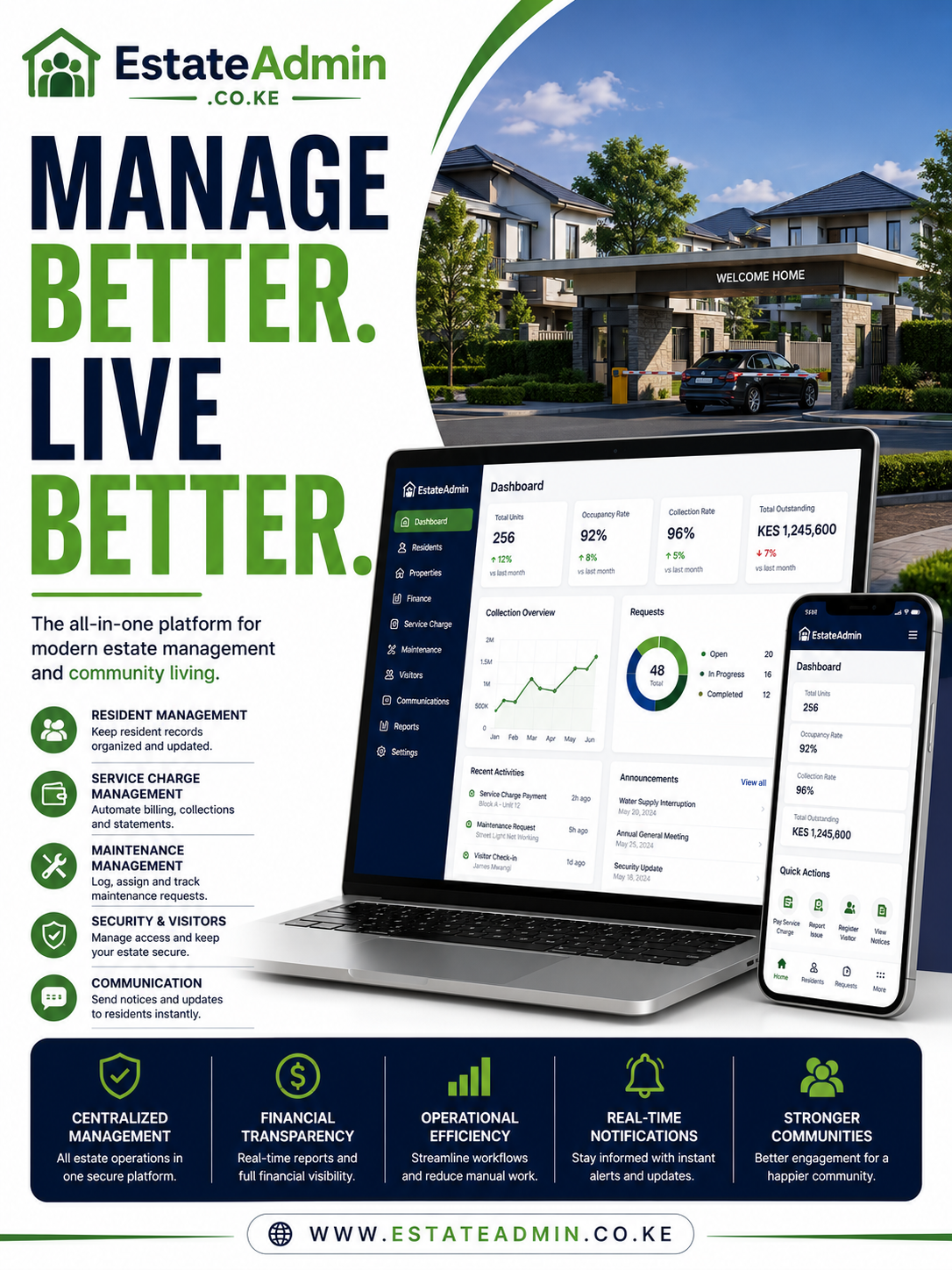
Estate Committee Management Software Tatu City: A Complete Guide to Smarter Community Administration

Estate committee management software Tatu city

Estate committee management software Tatu City solutions are becoming increasingly important as residential communities grow in size, complexity, and operational requirements. Estate committees have to coordinate finances, service charges, maintenance, resident communication, security, suppliers, meetings, documents, and community activities. Managing all these responsibilities through spreadsheets, paper files, messaging groups, and disconnected records can make administration difficult.

Digital management software provides a centralized way to organize these activities. Instead of relying on different tools for accounting, resident records, maintenance requests, communication, and reporting, committee members can use a structured platform to manage information from one location.

For communities in and around Tatu City, this approach can be particularly useful because modern developments often involve multiple buildings, shared facilities, residents, contractors, service providers, and recurring community expenses. As the number of residents and properties increases, the committee needs reliable systems that can support transparency, accountability, and efficient administration.

Table of Contents

What Is Estate Committee Management Software?

Estate committee management software is a digital platform designed to help residential estate committees manage the administrative and operational responsibilities associated with a community.

A typical platform can bring together:

  • Resident records
  • Property and unit information
  • Service charges
  • Billing
  • Payments
  • Arrears
  • Expenses
  • Maintenance
  • Suppliers
  • Communication
  • Documents
  • Meetings
  • Reports

Instead of maintaining separate spreadsheets for each activity, committee members can organize these records within one system.

For a community searching for Estate committee management software Tatu City, the most important consideration is whether the platform can support the actual responsibilities of the committee rather than simply providing a generic property database.

Why Estate Committees Need Digital Management

Estate committees often operate in environments where many activities happen simultaneously.

The committee may need to:

  • Collect service charges
  • Pay security providers
  • Coordinate cleaning
  • Maintain shared facilities
  • Manage landscaping
  • Handle resident complaints
  • Organize meetings
  • Approve expenses
  • Monitor contractors
  • Prepare financial reports

When these activities are managed manually, important information can become scattered.

A payment may be recorded in a spreadsheet, an expense may be discussed in a WhatsApp group, a maintenance request may be sent to an administrator privately, and a supplier invoice may exist only as an email attachment.

This makes it difficult to establish one reliable source of information.

A centralized digital platform helps bring these activities together.

Managing Estate Information

The first requirement of effective committee administration is having accurate information about the estate.

The system can organize information about:

  • Estate
  • Blocks
  • Buildings
  • Units
  • Owners
  • Residents
  • Shared facilities
  • Parking spaces
  • Service providers

Each unit can have an individual record.

For example:

Unit: A-305

Owner: Registered owner

Resident: Current occupant

Service charge: Monthly amount

Outstanding balance: Current balance

Maintenance: Open requests

This creates a structured information base.

Managing Multiple Buildings

Large developments may contain multiple buildings or sections.

A committee can organize the property into different levels.

For example:

Community

→ Block A

→ Block B

→ Block C

→ Shared facilities

This structure makes it easier to associate residents, charges, maintenance requests, and expenses with the correct area.

For committees evaluating Estate committee management software Tatu City, multi-building support should be an important feature to investigate.

Resident Management

Resident information is central to community administration.

The system can maintain records such as:

  • Resident name
  • Unit
  • Phone number
  • Email
  • Occupancy status
  • Owner or tenant status
  • Account balance
  • Communication history

Having this information centralized allows authorized committee members and administrators to find relevant records more quickly.

Owner and Tenant Records

In many residential developments, the owner of a unit is not necessarily the person living there.

The system should therefore allow the committee to distinguish between:

Property owner

and

Resident or tenant

This distinction is important when sending financial notices, community announcements, or maintenance communications.

Occupancy Tracking

Understanding occupancy helps management maintain accurate estate records.

The platform can identify:

  • Occupied units
  • Vacant units
  • Owner-occupied units
  • Tenant-occupied units

This information can also support financial and administrative reporting.

Service Charge Management

Service charges are one of the most important financial responsibilities for many residential estates.

They can contribute toward:

  • Security
  • Cleaning
  • Landscaping
  • Waste management
  • Common-area electricity
  • Water systems
  • Repairs
  • Shared facilities
  • Estate administration

An Estate committee management software Tatu City platform can help committees create recurring service-charge invoices and monitor payments.

This provides a clearer picture of how much has been billed and collected.

Recurring Billing

Manual monthly billing can become repetitive when an estate has hundreds of units.

Instead of creating every invoice individually, software can support recurring billing rules.

For example:

Monthly service charge → Automatic invoice → Resident notification → Payment → Receipt

This reduces administrative workload.

Different Service Charge Structures

Not every estate uses the same calculation method.

Charges may be based on:

  • Fixed amounts
  • Unit size
  • Ownership percentage
  • Property category
  • Specific services
  • Other approved formulas

The software should therefore provide sufficient flexibility to accommodate the estate’s billing structure.

Payment Collection

Collecting service charges is only one part of financial management.

The committee also needs to know whether payments have been correctly allocated to the appropriate accounts.

A digital platform can track:

  • Amount billed
  • Amount paid
  • Payment date
  • Payment reference
  • Outstanding amount

This gives the committee a clearer view of collection performance.

M-PESA Payments

M-PESA is an important consideration for property management in Kenya.

Many Kenyan property platforms support M-PESA-related collection and reconciliation workflows. For example, property-management systems available in Kenya advertise M-PESA integration for rent and property-related payments.

For an estate committee, convenient digital payment options can make it easier for residents to settle their obligations.

When evaluating Estate committee management software Tatu City, committees should verify whether M-PESA integration is included and how payment reconciliation works.

Bank Payment Tracking

Some residents may use bank transfers rather than mobile money.

The software should therefore accommodate the payment methods used by the estate.

Management should be able to identify:

  • Transaction amount
  • Transaction date
  • Reference
  • Resident account
  • Invoice
  • Allocation status

This reduces confusion when multiple residents make payments around the same time.

Payment Reconciliation

Payment reconciliation involves matching received money with the correct resident account and invoice.

Suppose the estate receives:

KSh 20,000

The system should help determine which account should receive the payment.

Accurate reconciliation prevents situations where a resident has already paid but the system still shows an outstanding balance.

Digital Receipts

After payment has been recorded, the resident should ideally receive confirmation.

Digital receipts can contain:

  • Receipt number
  • Resident
  • Unit
  • Amount
  • Date
  • Payment reference
  • Payment method
  • Remaining balance

This creates a clear transaction record.

Arrears Management

Service-charge arrears can create financial pressure for an estate.

If residents delay payments, the committee may struggle to pay:

  • Security providers
  • Cleaning contractors
  • Maintenance suppliers
  • Utility providers
  • Other service providers

A digital system can help identify accounts with outstanding balances.

Arrears Reports

The committee can review arrears by:

  • Resident
  • Unit
  • Building
  • Age
  • Amount

For example:

Arrears Period Outstanding
Current KSh 450,000
30 days KSh 180,000
60 days KSh 120,000
90 days KSh 80,000
Over 90 days KSh 60,000

This provides a clearer collection picture.

Payment Reminders

Manual payment reminders can consume significant administrative time.

Where supported, software can automate notifications.

A typical process can include:

Upcoming due date

→ Reminder

Due date

→ Payment notification

Overdue

→ Arrears reminder

This creates a consistent collection process.

Resident Statements

Residents may question their balances when several charges and payments have accumulated.

A statement can show:

  • Opening balance
  • New charges
  • Payments
  • Adjustments
  • Credits
  • Closing balance

This can make financial communication more transparent.

Expense Management

Collecting money is only one side of estate finances.

The committee also needs to control expenditure.

Common estate expenses include:

  • Security
  • Cleaning
  • Landscaping
  • Repairs
  • Electricity
  • Water
  • Waste collection
  • Insurance
  • Professional services

An Estate committee management software Tatu City platform can help record and categorize these expenses.

Expense Categories

Consistent expense categories make financial reporting easier.

For example:

Security

Cleaning

Maintenance

Utilities

Landscaping

Administration

Insurance

Other

Management can then determine where estate funds are being spent.

Expense Approval

Committees should have clear procedures for approving expenditure.

A digital approval workflow can provide a structured process.

For example:

Expense request

↓

Committee review

↓

Approval

↓

Supplier invoice

↓

Payment

↓

Recorded expense

This creates greater accountability.

Supplier Management

Estates often work with multiple contractors.

These may include:

  • Security companies
  • Cleaning companies
  • Landscapers
  • Plumbers
  • Electricians
  • Waste collection providers
  • Lift maintenance companies

The software can maintain supplier records and associate them with contracts, invoices, payments, and maintenance activities.

Supplier Performance

Committee members can use historical records to evaluate suppliers.

They can consider:

  • Service quality
  • Response time
  • Cost
  • Number of jobs
  • Complaints
  • Contract compliance

This helps the committee make more informed supplier decisions.

Contractor Management

Contractors may work on both routine and emergency projects.

The system can record:

  • Contractor
  • Work requested
  • Location
  • Cost
  • Approval
  • Completion date
  • Payment

This gives the committee an organized history of contractor activity.

Maintenance Management

Maintenance is one of the biggest operational responsibilities of an estate committee.

Residents may report:

  • Water leaks
  • Electrical faults
  • Damaged infrastructure
  • Broken lighting
  • Plumbing problems
  • Common-area issues
  • Security-related repairs

A digital maintenance system allows these issues to be recorded and tracked.

Maintenance Requests

A resident can submit a request that contains:

Issue: Water leak

Location: Block B

Unit: B-204

Priority: High

Description: Water leaking from bathroom pipe

The management team can then assign the request to an appropriate technician.

Maintenance Status Tracking

Maintenance requests can move through defined statuses:

New

Assigned

In progress

Completed

Closed

This makes it easier to identify unresolved issues.

Maintenance Priorities

Some problems require immediate action.

Software can categorize requests according to priority.

For example:

Emergency

Major water leak or dangerous electrical fault.

High

Issue affecting essential services.

Normal

Routine repair.

Low

Non-urgent improvement.

This helps teams allocate resources appropriately.

Preventive Maintenance

Good estate management is not only about responding to breakdowns.

Preventive maintenance can help protect shared assets.

Schedules can be established for:

  • Generators
  • Water pumps
  • Lifts
  • Fire equipment
  • Electrical systems
  • Security equipment
  • Water tanks

This allows the committee to plan maintenance instead of waiting for failures.

Maintenance History

Historical maintenance records are valuable.

Suppose a water pump has required repairs five times within a year.

The committee can use this information to determine whether another repair is financially sensible or whether replacement should be considered.

Maintenance Cost Tracking

Every maintenance request can potentially be connected to an expense.

For example:

Repair: Plumbing

Supplier: Contractor

Materials: KSh 5,000

Labour: KSh 4,000

Total: KSh 9,000

This provides better visibility into maintenance expenditure.

Managing Common Areas

Residential communities have shared facilities that require continuous management.

These may include:

  • Roads
  • Gardens
  • Swimming pools
  • Gyms
  • Playgrounds
  • Parking areas
  • Clubhouses
  • Security gates

The committee can use digital records to track maintenance and expenses associated with these areas.

Security Management

Security is a critical consideration for many residential communities.

While dedicated security systems may operate separately, management software can help record security-related activities.

These might include:

  • Security incidents
  • Contractor details
  • Maintenance of security equipment
  • Related expenses
  • Resident communications

The committee can then maintain an operational record.

Community Communication

Communication is essential for maintaining a well-organized estate.

Committees regularly need to communicate:

  • Meeting announcements
  • Service interruptions
  • Maintenance schedules
  • Security notices
  • Payment reminders
  • Community events
  • General updates

A centralized platform can support structured communication.

Reducing Dependence on Messaging Groups

WhatsApp and other messaging platforms are useful for quick communication, but they are not necessarily designed for structured property administration.

Important information can disappear among hundreds of messages.

A property platform can provide a more organized place for:

  • Official notices
  • Financial information
  • Maintenance requests
  • Resident records

Targeted Notifications

Not every message applies to every resident.

For example, maintenance affecting Block C should not necessarily be sent to every resident.

A digital system can provide targeted communication capabilities where supported.

Document Management

Committees handle many important documents.

These can include:

  • Meeting minutes
  • Supplier contracts
  • Invoices
  • Financial reports
  • Maintenance reports
  • Notices
  • Policies
  • Community documents

Centralized digital storage makes these records easier to retrieve.

Meeting Management

Estate committees regularly hold meetings to discuss:

  • Finances
  • Maintenance
  • Security
  • Suppliers
  • Community concerns
  • Upcoming projects

Digital systems can support meeting administration by keeping relevant documents and records organized.

Meeting Minutes

Meeting minutes should provide an accurate record of decisions.

Important information can include:

  • Meeting date
  • Attendees
  • Agenda
  • Discussions
  • Decisions
  • Action items

Storing these records digitally makes them easier to retrieve.

Action Item Tracking

A committee meeting may produce several tasks.

For example:

Task: Obtain three security quotations

Responsible: Committee member

Deadline: 15 September

Status: Pending

Digital task tracking can help prevent important decisions from being forgotten.

Transparency

Transparency is one of the most important reasons committees adopt management software.

Residents want to know how their contributions are being used.

A centralized system can provide reports on:

  • Collections
  • Expenses
  • Arrears
  • Maintenance
  • Supplier payments

This helps establish a clearer financial trail.

Accountability

Accountability means being able to determine what happened and who was responsible for an action.

Audit trails can help record:

  • Who created an invoice
  • Who recorded a payment
  • Who approved an expense
  • Who changed a record
  • Who closed a maintenance request

This can improve internal controls.

Financial Reporting

An Estate committee management software Tatu City platform can simplify financial reporting by collecting relevant transactions in one system.

Reports can include:

  • Service-charge collections
  • Arrears
  • Expenses
  • Supplier balances
  • Cash flow
  • Budget performance

The availability of specific reports depends on the software provider.

Monthly Committee Reports

Committees often require monthly updates.

A monthly report can show:

Opening balance

Collections

Expenses

Outstanding balances

Closing balance

This gives committee members a clearer picture of the estate’s financial position.

Budget Management

A community budget should reflect expected income and expenses.

For example:

Category Annual Budget
Security KSh 4,000,000
Cleaning KSh 1,500,000
Maintenance KSh 2,000,000
Landscaping KSh 800,000
Utilities KSh 1,200,000

The actual expenses can then be compared against these allocations.

Budget Variance

Suppose the annual maintenance budget is KSh 2 million, but actual expenditure reaches KSh 2.4 million.

The variance is:

KSh 400,000

The committee can investigate why spending exceeded the original plan.

Possible reasons could include:

  • Emergency repairs
  • Equipment failure
  • Unexpected infrastructure problems
  • Higher supplier costs

Cash-Flow Management

An estate can have significant amounts of money owed by residents while simultaneously having large supplier obligations.

Cash-flow monitoring helps the committee understand:

Money expected

versus

Money required

This supports better financial planning.

Reserve Funds

Some communities establish reserves for major future projects.

Examples include:

  • Roof replacement
  • Road repairs
  • Major painting
  • Lift replacement
  • Generator replacement
  • Security infrastructure

The committee can track reserve contributions and project expenditure separately from ordinary operating expenses.

Digital Governance

Software can also support stronger governance.

The committee can establish defined workflows for:

  • Expense approvals
  • Payment authorization
  • Supplier onboarding
  • Maintenance approvals
  • Resident communication

This reduces reliance on informal processes.

User Roles

Not every committee member should necessarily have access to every function.

The platform can provide roles such as:

  • Administrator
  • Estate manager
  • Accountant
  • Committee member
  • Maintenance officer
  • Resident

Each role can have different permissions.

Protecting Financial Information

Financial records should be protected from unauthorized access.

A platform should provide appropriate controls around:

  • Login credentials
  • User permissions
  • Financial data
  • Resident information
  • Documents

Committees should understand how the provider protects and stores data.

Cloud Accessibility

One major benefit of cloud software is accessibility.

An Estate committee management software Tatu City platform can allow authorized users to access information from different locations using internet-connected devices.

This can be useful when committee members are not physically at the estate office.

Supporting Remote Committee Members

Committee members may have different schedules and may not always be available at the property.

Cloud access can allow authorized users to review:

  • Reports
  • Expenses
  • Maintenance requests
  • Resident records
  • Documents

This improves continuity of administration.

Mobile Access

Estate managers and committee members often work away from their desks.

Mobile-friendly software can help users:

  • Review requests
  • Check payments
  • Access resident information
  • View reports
  • Update maintenance status

This is particularly useful during property inspections.

Managing Growing Communities

As a residential development grows, administration becomes more complicated.

A small community may have 50 units.

A larger development may have:

200 units

500 units

1,000+ units

At that scale, spreadsheets and paper records become increasingly difficult to maintain.

An Estate committee management software Tatu City solution should therefore be evaluated for scalability.

Multi-Property Support

Some management companies may oversee several communities.

A platform with multi-property support can organize:

Estate A

Estate B

Estate C

within one management environment.

This allows managers to maintain separate financial and resident records while retaining centralized oversight.

Why Local Requirements Matter

Property-management requirements differ between countries.

For Kenyan estates, committees may need to consider:

  • M-PESA
  • Local banking
  • Service-charge structures
  • Local suppliers
  • Resident communication
  • Local accounting practices

This makes local suitability an important consideration when choosing software.

Choosing the Right Software

When evaluating Estate committee management software Tatu City, committees should avoid selecting a platform based only on price or the number of features listed on a website.

The software should be evaluated against actual estate requirements.

Important questions include:

  1. Can it manage multiple buildings?
  2. Can it manage residents and owners?
  3. Can it generate recurring service-charge invoices?
  4. Can it track arrears?
  5. Does it support M-PESA?
  6. Can it handle bank payments?
  7. Can it reconcile transactions?
  8. Can it manage expenses?
  9. Can it track maintenance?
  10. Can it manage suppliers?
  11. Can it generate financial reports?
  12. Can residents access their accounts?
  13. Can residents submit maintenance requests?
  14. Does it support user permissions?
  15. Does it maintain audit trails?
  16. Can committee documents be stored?
  17. Is it accessible on mobile devices?
  18. Can it scale as the community grows?
  19. Does it support multiple estates?
  20. What support is available during implementation?

These questions can help a committee compare different systems based on practical requirements.

Preparing for Implementation

Before introducing new software, the committee should review its existing records.

This includes:

  • Resident lists
  • Unit numbers
  • Owner records
  • Service-charge balances
  • Supplier records
  • Existing contracts
  • Financial information
  • Maintenance records

Incorrect information should be cleaned before it is transferred into the new platform.

Staff and Committee Training

Even good software can fail if users do not understand how to use it.

Training should cover the actual responsibilities of each user.

For example:

Finance team: Billing and payments

Maintenance team: Work orders

Committee: Reports and approvals

Residents: Payments and service requests

This creates clearer responsibilities.

Resident Onboarding

Residents should be informed about how the new system works.

They may need instructions on:

  • Accessing their accounts
  • Viewing invoices
  • Making payments
  • Downloading receipts
  • Checking balances
  • Reporting maintenance issues

Clear communication can improve adoption.

Data Migration

Historical data can be migrated into the new system where supported.

This may include:

  • Resident records
  • Unit information
  • Outstanding balances
  • Payment history
  • Supplier records

Data should be reviewed after migration to confirm accuracy.

System Testing

Before full implementation, the committee should test common workflows.

For example:

Create resident

Generate invoice

Record payment

Reconcile transaction

Generate receipt

Submit maintenance request

Approve expense

Generate report

Testing reduces the possibility of operational problems after launch.

Financial Control, Resident Services and Community Operations

An Estate committee management software Tatu City solution can help residential communities move from fragmented administration to a more organized digital operating model. Once property and resident information has been centralized, committees can build more efficient workflows around billing, collections, expenses, maintenance, communication, approvals, and reporting.

For a growing community, the objective is not simply to digitize existing paperwork. The greater opportunity is to connect different activities so that information can move from one process to another without unnecessary manual entry.

Centralized Committee Administration

Estate committees often have several responsibilities running at the same time.

A committee may be reviewing service-charge collections while also dealing with maintenance requests, supplier invoices, security contracts, resident complaints, and upcoming community projects.

Without a centralized platform, these activities can become difficult to coordinate.

A digital system provides a common environment where authorized users can access the information relevant to their responsibilities.

This can include:

  • Resident records
  • Unit information
  • Financial records
  • Maintenance requests
  • Supplier information
  • Documents
  • Committee decisions
  • Reports

Centralization makes it easier to maintain consistent records.

Digital Service Charge Administration

Service charges are a recurring financial responsibility for many residential communities.

The charges may contribute toward:

  • Security
  • Cleaning
  • Landscaping
  • Waste collection
  • Common-area utilities
  • Repairs
  • Shared facilities
  • Administration

An Estate committee management software Tatu City platform can automate recurring service-charge billing according to the rules configured by the community.

Instead of manually preparing individual invoices, the committee or administrator can configure recurring charges and monitor the resulting accounts.

Service Charge Invoice Generation

A structured invoice should identify:

  • Resident or owner
  • Unit
  • Billing period
  • Description
  • Amount
  • Due date
  • Previous balance
  • Current balance

Digital invoices create a consistent record for both management and residents.

Managing Additional Charges

Estates sometimes need to collect charges beyond ordinary service fees.

Examples can include:

  • Parking fees
  • Utility charges
  • Special assessments
  • Facility charges
  • Approved one-time contributions

A flexible platform can help separate these charges while keeping them associated with the correct unit or account.

Special Assessments

Committees may occasionally approve additional contributions for major projects.

For example, residents may need to contribute toward:

  • Roof repairs
  • Road rehabilitation
  • Security upgrades
  • Lift replacement
  • Major painting
  • Infrastructure improvements

Digital billing can make it easier to create and monitor these additional charges.

Payment Tracking

Once invoices have been issued, the committee needs to monitor collections.

A centralized system can show:

Total billed

Total collected

Outstanding

Overdue

This gives committee members a clearer understanding of financial performance.

M-PESA Collection

M-PESA is an important payment method for many Kenyan residents and businesses.

A property-management platform can connect M-PESA transactions with resident accounts where the required integration is available.

This can reduce manual reconciliation work.

For committees considering Estate committee management software Tatu City, M-PESA compatibility should be one of the questions asked during software evaluation.

Bank Payments

Bank transfers are also common for property-related payments.

The software should make it possible to record or reconcile bank payments against the appropriate account.

This helps prevent situations where funds have been received but the resident’s account still appears unpaid.

Automated Payment Reconciliation

Payment reconciliation is particularly important when an estate receives many transactions.

A system can help match:

Payment

with

Resident

and

Invoice

This creates a more accurate financial record.

Partial Payments

A resident may sometimes pay only part of an outstanding amount.

For example:

Invoice: KSh 15,000

Payment: KSh 10,000

Balance: KSh 5,000

The software should preserve the original charge while showing the remaining balance.

Digital Receipts

Digital receipts provide confirmation after payment.

They can include:

  • Receipt number
  • Amount
  • Payment date
  • Transaction reference
  • Resident
  • Unit
  • Remaining balance

Residents can keep the receipt for their records without depending on printed documents.

Arrears Management

Outstanding service charges can create cash-flow problems for an estate.

The committee may still have to pay:

  • Security companies
  • Cleaning providers
  • Contractors
  • Utility bills
  • Maintenance providers

even when some residents have not paid their contributions.

A digital arrears dashboard helps management identify accounts requiring follow-up.

Aging Analysis

Arrears can be organized according to age.

For example:

Age Amount
Current KSh 350,000
30 days KSh 160,000
60 days KSh 95,000
90 days KSh 70,000
Over 90 days KSh 40,000

This helps the committee prioritize collection efforts.

Automated Reminders

Payment reminders can be scheduled where supported.

A typical sequence may be:

Before due date: Friendly reminder

Due date: Payment notification

After due date: Overdue reminder

Long-term arrears: Formal follow-up

Automation helps establish a consistent process.

Resident Account Statements

Financial disputes often arise when residents do not understand how a balance was calculated.

A statement can show:

  • Previous balance
  • New charges
  • Payments
  • Credits
  • Adjustments
  • Closing balance

This gives residents a clearer view of their accounts.

Financial Transparency

An Estate committee management software Tatu City platform can improve transparency by creating a structured record of collections and expenditure.

Residents and committee members can have access to appropriate reports showing how community funds are being managed.

Transparency does not mean every user needs access to every financial record. Access should be controlled according to roles and responsibilities.

Expense Management

The committee must monitor how collected funds are spent.

Common estate expenses include:

  • Security
  • Cleaning
  • Landscaping
  • Repairs
  • Electricity
  • Water
  • Waste management
  • Insurance
  • Administration

A digital expense system can organize these transactions into categories.

Expense Approval

A defined approval process helps prevent unauthorized expenditure.

A possible workflow is:

Expense request

↓

Supporting documents

↓

Committee review

↓

Approval

↓

Payment

↓

Recorded transaction

This provides a clear record of the decision-making process.

Expense Documentation

Expenses should ideally be supported by appropriate documentation.

This may include:

  • Supplier invoice
  • Quotation
  • Receipt
  • Purchase order
  • Approval record
  • Payment confirmation

Digital storage makes these documents easier to retrieve during reviews.

Budget Management

Committees should establish budgets for major expense categories.

For example:

Category Annual Budget
Security KSh 3,500,000
Cleaning KSh 1,200,000
Maintenance KSh 1,800,000
Landscaping KSh 700,000
Utilities KSh 1,000,000

Actual expenditure can then be compared with the approved budget.

Budget Variance

If maintenance expenditure reaches KSh 1.5 million against a six-month budget of KSh 900,000, the committee should investigate the difference.

Possible explanations could include:

  • Emergency repairs
  • Equipment failures
  • Unexpected infrastructure work
  • Supplier price increases

The purpose of variance analysis is to identify the reason behind the difference.

Cash-Flow Monitoring

An estate may have high outstanding receivables while simultaneously having large supplier obligations.

Cash-flow monitoring helps committees understand the relationship between:

Expected collections

and

Expected expenditure

This can support better financial planning.

Reserve Fund Management

Long-term projects require financial planning.

A community may maintain funds for:

  • Major repairs
  • Equipment replacement
  • Infrastructure upgrades
  • Renovation projects

A digital platform can help track reserve contributions and expenditure separately from routine operating costs.

Accounting Integration

Some committees already work with accounting software.

An Estate committee management software Tatu City platform can potentially integrate with accounting systems where supported.

This can reduce duplicate data entry and improve consistency between property and accounting records.

When evaluating an integration, committees should confirm:

  • Which transactions are synchronized
  • How often synchronization occurs
  • Whether data flows both ways
  • How errors are handled
  • Who controls accounting records

Financial Reporting

Committee members need reports that help them understand the estate’s financial condition.

Useful reports can include:

  • Collection reports
  • Arrears reports
  • Income reports
  • Expense reports
  • Supplier balances
  • Budget reports
  • Cash-flow reports
  • Resident statements

The specific reports available will depend on the software.

Monthly Management Reports

A monthly report can provide a concise view of estate performance.

It might contain:

Opening balance

Collections

Expenses

Supplier payments

Outstanding balances

Closing balance

This gives committee members a consistent basis for reviewing operations.

Maintenance Management

Maintenance is another major area where committee software can provide value.

Residents may report problems involving:

  • Plumbing
  • Electrical systems
  • Lighting
  • Water supply
  • Common facilities
  • Roads
  • Security infrastructure
  • Landscaping

Digital maintenance requests can prevent important issues from being lost in conversations.

Maintenance Ticketing

A maintenance request can contain:

Issue: Broken common-area light

Location: Block B

Priority: Normal

Assigned to: Maintenance contractor

Status: In progress

This provides a structured workflow.

Maintenance Priorities

Requests can be classified according to urgency.

Emergency

Problems that may create immediate safety or major property risks.

High

Issues affecting essential services.

Normal

Routine repairs.

Low

Non-urgent improvements.

This helps maintenance teams prioritize work.

Maintenance Tracking

Management should be able to identify:

  • New requests
  • Assigned requests
  • Active requests
  • Completed requests
  • Overdue requests

This makes it easier to identify unresolved issues.

Preventive Maintenance

Preventive maintenance helps protect shared infrastructure.

Scheduled activities may include:

  • Generator servicing
  • Pump servicing
  • Lift inspections
  • Fire equipment checks
  • Electrical inspections
  • Water tank cleaning
  • Security equipment maintenance

A digital calendar can help management keep track of recurring tasks.

Maintenance History

Historical records can reveal recurring problems.

If the same pump requires repairs every few months, the committee can review the history and determine whether replacement would be more economical.

This is a major advantage of keeping maintenance information digitally.

Maintenance Cost Analysis

The committee can compare maintenance spending by:

  • Building
  • Equipment
  • Supplier
  • Type of repair
  • Time period

This can reveal areas with unusually high costs.

Supplier Management

Supplier management is another important function.

An estate may work with:

  • Security providers
  • Cleaners
  • Landscapers
  • Plumbers
  • Electricians
  • Lift technicians
  • Waste companies

A centralized supplier database can keep their information organized.

Supplier Contracts

Contract records can contain:

  • Supplier
  • Service
  • Contract start
  • Contract expiry
  • Contract value
  • Renewal date

Automated reminders can help ensure that renewal dates are not forgotten.

Supplier Invoice Tracking

Supplier invoices should be tracked from receipt to payment.

A digital workflow can help identify:

  • Unpaid invoices
  • Approved invoices
  • Overdue invoices
  • Payment dates

This improves accounts-payable visibility.

Supplier Performance Monitoring

The committee can use historical records to evaluate suppliers.

Important measures can include:

  • Response time
  • Cost
  • Quality
  • Number of complaints
  • Repeat repairs
  • Contract performance

This supports more informed procurement decisions.

Resident Communication

Good communication is critical in community management.

Residents need timely information about:

  • Water interruptions
  • Maintenance
  • Security
  • Meetings
  • Payment deadlines
  • Community projects
  • Other important notices

A centralized communication system can help ensure that official information reaches the intended audience.

Digital Notices

Instead of printing notices for every communication, management can send digital announcements.

This can reduce printing costs and make information available more quickly.

Targeted Communication

A maintenance issue affecting one building should not necessarily be communicated to every resident.

Where the platform supports targeted messaging, administrators can send information to:

  • Specific buildings
  • Specific units
  • Owners
  • Tenants
  • Committee members

This reduces unnecessary communication.

Resident Self-Service

Residents should not have to contact the estate office for every simple request.

A resident portal can provide access to:

  • Account balance
  • Invoices
  • Statements
  • Receipts
  • Payment options
  • Maintenance requests
  • Notices

This can reduce routine administrative workload.

Digital Maintenance Requests From Residents

A resident can submit a maintenance request without physically visiting the management office.

The request can include:

  • Issue description
  • Location
  • Category
  • Priority
  • Supporting image where supported

The management team can then assign and track it.

Resident Feedback

Community software can also support feedback collection.

The committee can use digital surveys or forms where available to gather resident opinions on:

  • Maintenance
  • Security
  • Community services
  • Facilities
  • Communication

Feedback can support better decision-making.

Community Meetings

Estate committees regularly hold meetings with residents and committee members.

Software can help organize:

  • Meeting dates
  • Agendas
  • Documents
  • Minutes
  • Action items

This creates a more organized meeting process.

Digital Meeting Records

Meeting minutes can be stored digitally with other estate documents.

This makes it easier to retrieve previous decisions.

For example, the committee may need to verify:

  • When a supplier was approved
  • What budget was agreed
  • Which project was authorized
  • Who was assigned an action

A digital archive can simplify this process.

Action Item Tracking

Meetings often produce tasks.

For example:

Action: Obtain quotations for security upgrade

Assigned to: Committee member

Deadline: 20 September

Status: Pending

Tracking these actions improves follow-through.

Document Management

Estate committees handle many documents.

These can include:

  • Meeting minutes
  • Supplier contracts
  • Financial reports
  • Invoices
  • Receipts
  • Maintenance records
  • Community notices
  • Policies

Centralized storage improves accessibility.

Searching Estate Documents

Digital documents are easier to search than physical files.

An administrator can search by:

  • Document type
  • Supplier
  • Date
  • Unit
  • Resident
  • Project

This reduces the time spent searching through folders.

Access Permissions

Not all users should have identical access.

A system may provide different roles for:

Committee members

Estate managers

Finance staff

Maintenance staff

Residents

Each role can be given appropriate permissions.

Audit Trails

Audit trails improve accountability.

They can record actions such as:

  • Invoice creation
  • Payment recording
  • Expense approval
  • Resident updates
  • Maintenance status changes

This helps management understand what happened and when.

Data Security

An Estate committee management software Tatu City platform should have appropriate security measures because it may store personal and financial information.

Committees should consider:

  • Secure authentication
  • User permissions
  • Encryption
  • Backups
  • Audit logs
  • Data recovery

The provider should clearly explain its security and data-handling practices.

Backup and Recovery

Before adopting software, the committee should understand how data is backed up.

Important questions include:

  • How frequently are backups performed?
  • How long are they retained?
  • How is data recovered?
  • What happens if the platform experiences downtime?
  • Who can restore information?

This is an important part of business continuity.

Managing Committee Access

Committee membership can change over time.

When a member leaves the committee, their system access should be reviewed or removed.

When a new member joins, appropriate permissions can be provided.

This prevents former users from retaining unnecessary access.

Managing Different User Roles

A well-designed system can separate responsibilities.

For example:

Finance administrator

Can manage billing and payments.

Maintenance administrator

Can manage maintenance requests.

Committee member

Can review approved reports and decisions.

Resident

Can access their own account.

This reduces unnecessary exposure to sensitive information.

Improving Accountability

Digital records can help establish responsibility for different activities.

For example, the system can show who:

  • Approved an expense
  • Created an invoice
  • Recorded a payment
  • Assigned a contractor
  • Closed a maintenance request

This is particularly useful when several people participate in estate administration.

Operational Dashboards

A dashboard can give committee members an overview of current performance.

For example:

Total units: 400

Occupied: 380

Collection rate: 95%

Outstanding balances: KSh 600,000

Open maintenance requests: 14

Pending supplier invoices: KSh 250,000

The committee can use this information to identify areas requiring attention.

Key Performance Indicators

Committees can establish measurable KPIs.

Collection Rate

Measures how much of the billed amount has been collected.

Arrears

Measures unpaid resident balances.

Maintenance Response Time

Measures how quickly reported problems are addressed.

Maintenance Completion Time

Measures how long repairs take.

Budget Variance

Measures actual expenditure against approved budgets.

These indicators make management more measurable.

Improving Decision-Making

Reliable data supports better committee decisions.

Instead of asking:

“Why are maintenance expenses high?”

the committee can review historical data and determine:

  • Which building generated the costs
  • Which equipment failed
  • Which suppliers were used
  • How often repairs occurred
  • How much was spent

This creates a stronger basis for decisions.

Supporting Long-Term Planning

Digital records become increasingly valuable over time.

After several years, the estate may have historical data covering:

  • Collections
  • Arrears
  • Maintenance
  • Supplier costs
  • Utilities
  • Projects
  • Expenses

The committee can use these trends when planning future budgets and projects.

Scalability

As communities grow, administrative requirements increase.

A platform should be able to accommodate:

  • More units
  • More residents
  • More buildings
  • More transactions
  • More suppliers
  • More committee users

Scalability should therefore be considered before implementation.

Multi-Property Management

Professional management companies may manage several estates.

A platform with multi-property functionality can provide centralized administration while keeping each community’s records separate.

For example:

Community A

Community B

Community C

Each can have its own:

  • Residents
  • Units
  • Charges
  • Payments
  • Expenses
  • Maintenance

This is useful for organizations managing multiple developments.

Supporting Commercial and Mixed-Use Areas

Some developments contain more than residential units.

They may include:

  • Shops
  • Offices
  • Restaurants
  • Commercial facilities
  • Parking

The software should be able to accommodate different property types where required.

Integrating Other Systems

A modern estate platform may need to connect with external systems.

Potential integrations include:

  • M-PESA
  • Banks
  • Accounting platforms
  • Email
  • SMS
  • Access-control systems
  • Smart meters

The available integrations depend on the provider.

API Connectivity

For larger organizations, API access can provide additional flexibility.

An API can allow different systems to exchange information.

For example:

Payment platform → Estate software

or

Estate software → Accounting system

Before selecting software, technical teams should determine whether APIs are available and what functionality they expose.

Reporting for External Audits

Well-organized digital records can make financial reviews easier.

Auditors or accountants may need access to:

  • Payment records
  • Invoices
  • Expenses
  • Receipts
  • Bank transactions
  • Supplier records

A centralized platform can reduce the effort required to assemble this information.

Improving Record Retention

Digital records can help committees maintain historical information over longer periods.

The committee can retain records related to:

  • Financial transactions
  • Contracts
  • Meetings
  • Maintenance
  • Resident accounts

Retention policies should still comply with applicable legal and organizational requirements.

Supporting Professional Property Management

As residential communities become more sophisticated, committees increasingly need professional management practices.

An Estate committee management software Tatu City platform can provide standardized workflows for:

  • Billing
  • Collections
  • Approvals
  • Maintenance
  • Reporting
  • Communication

This helps reduce dependence on informal processes.

Creating Standard Operating Procedures

Software works best when combined with clear procedures.

For example, the committee can establish:

Billing procedure

Who creates invoices?

Who checks them?

When are they issued?

Payment procedure

Who reconciles payments?

Who approves adjustments?

Expense procedure

Who approves expenditure?

What documentation is required?

Maintenance procedure

Who assigns requests?

Who confirms completion?

The software can then support these procedures.

Measuring Administrative Efficiency

Committees can measure whether digital management is producing improvements.

Useful metrics include:

  • Time spent preparing invoices
  • Time spent reconciling payments
  • Report preparation time
  • Maintenance response time
  • Number of unresolved requests
  • Collection performance

This helps determine whether the implementation is delivering practical value.

Preparing for Digital Transformation

Moving from manual administration to digital management requires planning.

The committee should:

  1. Review current processes.
  2. Identify operational problems.
  3. Clean existing data.
  4. Define required features.
  5. Evaluate suitable software.
  6. Configure the platform.
  7. Train administrators.
  8. Test workflows.
  9. Onboard residents.
  10. Monitor results.

A structured approach reduces implementation problems.

Data Cleaning Before Migration

Existing records should be reviewed before they are imported.

The committee should verify:

  • Unit numbers
  • Resident names
  • Contact information
  • Account balances
  • Service charges
  • Supplier information
  • Lease details

Incorrect information can create problems in billing and reporting.

Training and Adoption

Technology adoption depends on users.

Committee members and administrators should understand how the system fits into their responsibilities.

Training should be practical rather than purely theoretical.

Users should practice:

  • Creating invoices
  • Recording payments
  • Viewing reports
  • Managing expenses
  • Assigning maintenance
  • Sending notifications

Resident Onboarding

Residents should also understand why the new system is being introduced.

Management can provide simple guidance on:

  • Logging in
  • Checking balances
  • Viewing invoices
  • Making payments
  • Downloading receipts
  • Reporting maintenance issues

This helps create confidence in the new system.

Measuring Results After Implementation

After deployment, the committee should review results.

Questions can include:

  • Has payment reconciliation become faster?
  • Are fewer accounts showing unexplained balances?
  • Are maintenance requests being resolved faster?
  • Is report preparation easier?
  • Has resident communication improved?
  • Is financial information easier to access?

The answers help determine whether additional configuration or training is required.

Building a More Efficient Estate

The ultimate objective of digital committee management is not simply to eliminate paper.

It is to create a more coordinated community administration process.

When resident records connect with billing, billing connects with payments, payments connect with financial reports, and maintenance connects with suppliers and expenses, the committee gains a more complete picture of the estate.

This connected approach can make daily administration easier while also supporting better long-term planning.

Looking Beyond Basic Property Administration

Estate committee software is increasingly becoming more than a record-keeping tool.

The future of community management is moving toward:

  • Automation
  • Real-time financial information
  • Digital payments
  • Resident self-service
  • Mobile management
  • Data analytics
  • Connected property systems

These capabilities can give committees better visibility and allow them to respond more quickly to operational needs.

The next stage of this discussion focuses on implementation strategy, advanced technology, measurable benefits, selection criteria, and how communities can use digital tools to build a more transparent and efficient management structure.

Implementation, Advanced Technology, Benefits and Future of Estate Management

As residential communities continue to develop, estate committees need systems that can support both everyday administration and long-term planning. An Estate committee management software Tatu City solution can bring financial management, resident administration, maintenance, communication, supplier coordination, and reporting into a connected digital environment.

The effectiveness of such software, however, depends on more than the features available. The committee must choose an appropriate platform, configure it correctly, train users, maintain accurate information, and establish clear procedures for using the system.

Choosing the Right Software

Before adopting an Estate committee management software Tatu City platform, the committee should identify the problems it wants the software to solve.

For example, the estate may currently struggle with:

  • Delayed service-charge payments
  • Poor arrears visibility
  • Manual reconciliation
  • Unorganized maintenance requests
  • Difficult expense tracking
  • Scattered resident information
  • Slow report preparation
  • Poor document management
  • Communication challenges

Understanding these problems helps the committee identify the functionality it actually needs.

Essential Features to Evaluate

A suitable platform should ideally support the estate’s most important operations.

These may include:

  • Resident management
  • Unit management
  • Service-charge billing
  • Payment tracking
  • M-PESA integration
  • Arrears management
  • Expense management
  • Maintenance management
  • Supplier management
  • Document management
  • Committee reporting
  • Resident communication
  • User permissions

The availability of individual features varies between software providers.

Ease of Use

Complex software can become difficult to adopt if users need extensive technical knowledge.

The interface should make common activities straightforward.

For example, an administrator should be able to quickly:

  1. Find a resident.
  2. View the account.
  3. Check outstanding charges.
  4. Record or verify payment.
  5. Generate a statement.

Similarly, maintenance staff should be able to locate open requests without navigating through unnecessary screens.

Mobile Accessibility

Committee members may not always work from an office.

A mobile-friendly Estate committee management software Tatu City platform can allow authorized users to access information while they are:

  • Inspecting the property
  • Attending meetings
  • Visiting suppliers
  • Checking maintenance work
  • Responding to community issues

Mobile access can make management more flexible.

Cloud Accessibility

Cloud-based software allows authorized users to access the system through an internet connection.

This can be useful when committee members have different schedules or work from different locations.

Instead of relying on one computer in the estate office, information can be accessible according to user permissions.

Internet Reliability

Cloud systems depend on internet connectivity.

Before implementation, the estate should consider whether its office has reliable internet access.

Management should also understand what happens when connectivity is temporarily unavailable.

Security Evaluation

Property software can contain sensitive financial and personal information.

Security should therefore be a major selection criterion.

The committee should ask providers about:

  • User authentication
  • Password controls
  • Access permissions
  • Data encryption
  • Backups
  • Audit logs
  • Data recovery
  • Security monitoring

The provider should clearly explain its security practices.

Role-Based Permissions

Different users should have access to different functions.

For example:

Estate manager

May access most operational information.

Accountant

May manage financial records.

Maintenance officer

May access maintenance requests.

Committee member

May review reports and approvals.

Resident

May access their own account.

This limits unnecessary access.

Audit Trails

Audit trails can strengthen accountability.

A system may record:

  • Who created an invoice
  • Who changed an account
  • Who recorded a payment
  • Who approved an expense
  • Who updated a maintenance request

These records can help resolve disputes and investigate discrepancies.

Data Backup

The committee should understand the platform’s backup strategy.

Questions should include:

  • How frequently is data backed up?
  • Where are backups stored?
  • How long are they retained?
  • Can deleted information be recovered?
  • How quickly can the system be restored?

Reliable backups are essential for continuity.

Data Migration

When moving from spreadsheets or another system, existing records may need to be imported.

This can include:

  • Unit records
  • Resident information
  • Owner details
  • Opening balances
  • Payment history
  • Supplier information
  • Maintenance records

Data should be cleaned before migration.

Verifying Opening Balances

Financial data requires particular attention during migration.

The committee should verify:

Opening balance

New charges

−

Payments

=

Closing balance

The figures should agree with existing financial records before the new system becomes the official source of information.

Implementation Planning

An effective implementation can be divided into stages.

Stage One: Requirements

Identify what the estate needs.

Stage Two: Data Preparation

Clean existing records.

Stage Three: Configuration

Set up the property structure and workflows.

Stage Four: Testing

Test common processes.

Stage Five: Training

Train administrators and committee members.

Stage Six: Resident Onboarding

Introduce residents to the system.

Stage Seven: Monitoring

Review performance after launch.

This approach reduces implementation risks.

Pilot Implementation

Large communities can begin with a smaller group of units.

A pilot can help identify:

  • Data problems
  • Billing issues
  • User confusion
  • Payment reconciliation challenges
  • Communication gaps

The committee can resolve these issues before expanding implementation.

Staff Training

Training should focus on practical tasks.

Finance users can learn:

  • Billing
  • Payments
  • Reconciliation
  • Statements
  • Reports

Maintenance users can learn:

  • Request management
  • Work orders
  • Supplier assignment
  • Completion tracking

Committee members can learn:

  • Dashboards
  • Approvals
  • Reports
  • Financial monitoring

Resident Training

Residents should understand how to use the platform for routine activities.

They may need guidance on:

  • Accessing accounts
  • Viewing invoices
  • Checking balances
  • Making payments
  • Downloading receipts
  • Reporting maintenance problems

Clear onboarding improves adoption.

Resident Support

Some residents may initially require assistance.

Management should provide a simple process for handling questions related to:

  • Login problems
  • Payment allocation
  • Account balances
  • Invoices
  • Maintenance requests

This can make the transition smoother.

Managing Change

Moving from manual systems to digital administration changes how people work.

Some staff members may initially prefer spreadsheets or messaging applications because they are familiar with them.

The committee should explain:

  • Why the new system is being introduced
  • What problems it addresses
  • What each user is expected to do
  • How it improves administration

Clear communication can reduce resistance.

Standardizing Committee Processes

Software works best when the committee establishes standard procedures.

For example, every expense could follow the same process:

Request → Review → Approval → Invoice → Payment → Record

Every maintenance request could follow:

Report → Assignment → Work → Inspection → Completion → Closure

Standardized workflows make administration more predictable.

Financial Controls

Financial controls should be established before the system becomes the primary management platform.

These controls can define:

  • Who can create invoices
  • Who can approve expenses
  • Who can authorize payments
  • Who can issue adjustments
  • Who can access financial reports

Separating responsibilities can strengthen internal controls.

Managing Billing Adjustments

Occasionally, an invoice may require an adjustment.

Examples include:

  • Incorrect charge
  • Approved waiver
  • Credit
  • Refund
  • Duplicate billing

The system should maintain a record of the adjustment rather than simply deleting the original transaction.

This preserves financial history.

Handling Resident Disputes

Residents may question charges or account balances.

Digital statements and transaction histories can make investigations easier.

Management can review:

  • Original invoice
  • Payment history
  • Adjustments
  • Receipts
  • Outstanding balance

This provides evidence when resolving account questions.

Financial Reporting to the Committee

An Estate committee management software Tatu City platform can help committees receive consistent financial reports.

Reports can include:

  • Income
  • Expenses
  • Arrears
  • Collections
  • Supplier balances
  • Budget performance
  • Cash flow

Regular reporting allows the committee to monitor financial performance.

Collection Rate Monitoring

One useful metric is the collection rate.

For example:

Total billed: KSh 5,000,000

Total collected: KSh 4,500,000

Collection rate: 90%

Tracking this over several months can help determine whether collection performance is improving or declining.

Arrears Trends

The committee can also track arrears over time.

For example:

Month Arrears
January KSh 900,000
February KSh 850,000
March KSh 760,000
April KSh 690,000

A declining balance could indicate improved collection performance.

The committee should still investigate the underlying reasons rather than relying only on the number.

Expense Trends

Expense analysis can reveal increasing costs.

For example, if security expenditure increases significantly over several months, the committee can investigate whether the change resulted from:

  • Contract changes
  • Additional guards
  • Salary adjustments
  • New security requirements

Historical information provides context.

Maintenance Cost Trends

Maintenance data can show whether particular assets are becoming expensive to maintain.

If the same equipment repeatedly generates high repair costs, replacement may eventually be more economical.

This supports lifecycle planning.

Community Project Management

Estate committees may oversee projects such as:

  • Road repairs
  • Security upgrades
  • Landscaping
  • Painting
  • Facility improvements
  • Drainage work

Project management features can help organize:

  • Budget
  • Contractor
  • Timeline
  • Payments
  • Progress
  • Completion

Project Budget Tracking

Suppose a project has an approved budget of KSh 8 million.

Management can track:

Approved: KSh 8,000,000

Committed: KSh 6,500,000

Paid: KSh 4,000,000

Remaining: KSh 4,000,000

This gives the committee greater visibility into project finances.

Project Documentation

Important project documents can be stored digitally.

These may include:

  • Quotations
  • Contracts
  • Drawings
  • Invoices
  • Approval records
  • Completion reports

This creates a useful project history.

Procurement Management

Committees may require multiple quotations before approving major expenditure.

A digital system can help organize:

  • Supplier quotations
  • Supplier comparisons
  • Approvals
  • Purchase decisions

This can make procurement more transparent.

Comparing Supplier Quotations

For a major project, the committee may receive three quotations.

The committee can compare:

  • Price
  • Scope
  • Warranty
  • Delivery time
  • Supplier experience

The decision can then be recorded with the supporting documentation.

Community Asset Management

Estates have physical assets that require ongoing management.

These may include:

  • Generators
  • Pumps
  • Lifts
  • Fire systems
  • CCTV equipment
  • Gates
  • Water tanks
  • Landscaping infrastructure

An asset register can store information such as:

  • Asset name
  • Location
  • Installation date
  • Supplier
  • Warranty
  • Maintenance schedule

This supports better asset management.

Asset Lifecycle Planning

Knowing the age and maintenance history of equipment helps committees plan replacements.

For example, a generator nearing the end of its expected operating life may require a replacement budget.

The committee can use historical information rather than waiting for complete failure.

Utility Management

Utilities can represent a significant community expense.

Depending on the estate’s structure, management may monitor:

  • Water
  • Electricity
  • Common-area power
  • Generator fuel

Historical data can reveal unusual consumption.

Utility Cost Analysis

If water costs suddenly increase, the committee can investigate potential causes such as:

  • Leakage
  • Increased consumption
  • Meter problems
  • Tariff changes

Digital records can make these comparisons easier.

Smart Property Technology

The future of estate management is likely to include greater integration with smart technologies.

Potential systems include:

  • Smart meters
  • Access-control systems
  • CCTV
  • Parking systems
  • Building sensors
  • Energy monitoring

Integration can reduce manual data collection.

Artificial Intelligence in Estate Management

Artificial intelligence may also support property administration.

AI-based analytics could help identify patterns in:

  • Arrears
  • Maintenance
  • Expenses
  • Utility consumption
  • Resident requests

For example, software could identify unusually high maintenance expenditure in one section of the estate and highlight it for review.

AI should be treated as a support tool, with appropriate human oversight.

Predictive Maintenance

Predictive maintenance uses historical and sensor data to identify potential equipment problems before failure.

For example, repeated pump failures could trigger a recommendation for closer inspection.

This can potentially reduce emergency repairs.

Automated Reporting

Future platforms may generate regular management reports automatically.

Instead of manually preparing monthly summaries, management could configure scheduled reports containing:

  • Collections
  • Arrears
  • Expenses
  • Maintenance
  • Supplier balances
  • Budget performance

Automation reduces repetitive reporting work.

Digital Communication

Community communication is likely to become increasingly digital.

Residents can receive:

  • Notices
  • Payment reminders
  • Maintenance updates
  • Meeting information
  • Emergency announcements

The committee can maintain more organized communication records.

Emergency Communication

During emergencies, speed matters.

Examples include:

  • Water outages
  • Security incidents
  • Major infrastructure failures
  • Power problems

A digital communication system can help management notify affected residents quickly where such functionality is available.

Resident Satisfaction

Technology should ultimately improve the resident experience.

Residents benefit when they can:

  • Access account information
  • Make payments conveniently
  • Receive receipts
  • Submit maintenance requests
  • Receive official announcements
  • Track requests

These conveniences can improve perceptions of estate management.

Reducing Administrative Work

Automation can reduce repetitive activities such as:

  • Invoice generation
  • Reminder sending
  • Receipt creation
  • Report preparation
  • Maintenance assignment
  • Payment reconciliation

This allows administrators to spend more time on activities requiring judgment and personal interaction.

Improving Committee Productivity

Committee members are usually responsible for governance rather than performing every administrative task themselves.

A digital platform can give them access to summarized information.

Instead of reviewing hundreds of individual transactions, they can review:

  • Collection rates
  • Arrears
  • Expenses
  • Budget variance
  • Maintenance performance

This helps them focus on oversight and decision-making.

Better Community Governance

Strong governance requires reliable information.

A committee can make better decisions when it has access to accurate records of:

  • Income
  • Expenses
  • Contracts
  • Maintenance
  • Projects
  • Resident concerns

Digital management provides a foundation for evidence-based governance.

Supporting Accountability

Accountability improves when activities are documented.

A committee should be able to establish:

What happened?

When did it happen?

Who approved it?

How much did it cost?

What documentation supports it?

A structured digital system can help answer these questions.

Supporting Audits

Financial audits and internal reviews require documentation.

A centralized system can make it easier to locate:

  • Invoices
  • Receipts
  • Payment records
  • Supplier documents
  • Approvals
  • Financial reports

This can reduce the time spent gathering records.

Cost Considerations

The cost of an Estate committee management software Tatu City platform should be evaluated against the value it provides.

Possible costs include:

  • Subscription
  • Setup
  • Data migration
  • Training
  • Integrations
  • Support
  • Customization

The committee should consider the total cost rather than looking only at the monthly subscription.

Evaluating Return on Investment

Potential benefits can include:

  • Reduced administrative hours
  • Faster reconciliation
  • Improved collections
  • Better expense control
  • Reduced paperwork
  • Faster maintenance management
  • Better reporting

The committee should identify measurable indicators before implementation.

Avoiding Unnecessary Features

More features do not automatically mean better software.

A committee should prioritize functions that solve actual problems.

For example, a simple and reliable billing and maintenance system may be more useful than a platform with dozens of advanced features that staff never use.

Local Payment Requirements

For Kenyan estates, payment functionality is especially important.

The committee should verify how the platform handles:

  • M-PESA
  • Bank transfers
  • Payment references
  • Reconciliation
  • Receipts

Local payment compatibility can have a direct effect on administrative efficiency.

Local Support

Technical support is another important consideration.

The committee should determine:

  • How support requests are submitted
  • Support operating hours
  • Response times
  • Training availability
  • Escalation procedures

Reliable support can be particularly important during implementation.

Data Ownership

The committee should understand who owns the estate’s information.

Before signing a contract, management should clarify:

  • How data can be exported
  • What happens if the contract ends
  • Whether historical data remains accessible
  • How data is transferred to another provider

This protects the estate’s long-term interests.

Vendor Evaluation

Before selecting an Estate committee management software Tatu City provider, the committee should evaluate several areas.

These include:

Functionality

Does it support the required workflows?

Security

How is information protected?

Reliability

How stable is the platform?

Scalability

Can it support future growth?

Integration

Can it connect with required payment and accounting systems?

Support

Can users get assistance when needed?

Cost

Does the overall cost fit the estate’s budget?

Questions for Software Providers

The committee can ask providers:

  1. Can the platform manage multiple estates?
  2. Can it handle multiple buildings?
  3. Can it manage owners and tenants?
  4. Can it automate recurring charges?
  5. Can it track arrears?
  6. Does it support M-PESA?
  7. Can it handle bank payments?
  8. Can it generate receipts?
  9. Can residents access their accounts?
  10. Can residents submit maintenance requests?
  11. Can expenses be approved digitally?
  12. Can suppliers be managed?
  13. Can documents be stored?
  14. Are audit trails available?
  15. Are role-based permissions available?
  16. How are backups handled?
  17. How is data protected?
  18. Can financial reports be customized?
  19. Does the system integrate with accounting platforms?
  20. What implementation support is provided?

Long-Term Digital Strategy

A committee should avoid thinking about software only as a short-term administrative tool.

The platform should ideally support the estate’s future.

The community may eventually require:

  • More units
  • More residents
  • Additional facilities
  • More suppliers
  • More financial transactions
  • Additional integrations

Choosing scalable technology can reduce the need for frequent system changes.

Creating a Digital Source of Truth

One of the greatest benefits of an integrated platform is creating a reliable source of information.

Instead of having:

Resident data in spreadsheets

Payments in banking records

Maintenance requests in WhatsApp

Supplier invoices in email

Reports in separate documents

the estate can organize relevant information in one structured environment.

This makes information easier to access and verify.

Improving Operational Visibility

When financial and operational information is centralized, committee members can identify relationships between different activities.

For example:

High maintenance costs

↓

Higher expenditure

↓

Budget variance

↓

Need for asset replacement

This provides a more complete understanding of estate performance.

Building a More Professional Community

Professional estate management depends on organization, transparency, communication, and accountability.

Technology can support all four.

A properly implemented platform can create standardized procedures for:

  • Billing
  • Collections
  • Expenses
  • Maintenance
  • Communication
  • Reporting
  • Approvals

This can help the estate operate with greater consistency.

The Role of the Estate Committee

Software does not replace the committee.

The committee remains responsible for governance, decisions, approvals, policies, and oversight.

Technology provides information and workflows that help committee members perform these responsibilities more effectively.

The strongest results occur when software and good governance work together.

The Future of Estate Management in Tatu City

Modern residential developments require modern administrative systems.

As communities grow and residents expect faster digital services, estate committees will increasingly need tools that can support:

  • Digital payments
  • Real-time reporting
  • Resident self-service
  • Automated communication
  • Maintenance tracking
  • Financial transparency
  • Mobile access
  • Data analytics

This shift can make community administration more responsive and organized.

Conclusion

An Estate committee management software Tatu City platform can provide a centralized foundation for managing the financial, administrative, operational, and communication responsibilities of a modern residential community.

The most valuable benefit is not simply replacing paper records with digital records. It is the ability to connect different estate processes. Resident information can connect with billing, billing can connect with payments, payments can connect with financial reports, maintenance requests can connect with suppliers and expenses, and committee decisions can be supported by current operational data.

For estate committees, this connectivity can improve visibility into service-charge collections, arrears, expenses, budgets, supplier obligations, maintenance activities, and community projects. It can also reduce repetitive administrative work through recurring billing, digital receipts, automated reminders, structured maintenance workflows, and scheduled reporting.

Residents can benefit from easier access to their accounts, digital invoices, payment confirmations, statements, maintenance requests, and official community announcements. This can reduce the need for residents to make repeated visits or calls to the estate management office for routine information.

Financial transparency is another important advantage. When invoices, payments, expenses, approvals, and supporting documents are recorded systematically, committees have stronger information for reviewing how community funds are collected and spent. Appropriate permissions and audit trails can also strengthen accountability.

Maintenance management can become more proactive. Instead of waiting for equipment to fail, committees can maintain schedules for generators, pumps, lifts, fire systems, water tanks, security equipment, and other shared assets. Historical maintenance information can help identify recurring problems and support better replacement decisions.

The implementation process should be carefully planned. Before adopting software, the committee should identify its requirements, clean existing records, evaluate potential providers, configure the system, test important workflows, train users, and introduce residents to the platform. Security, backups, data ownership, user permissions, integrations, and technical support should also be carefully evaluated.

For Kenyan communities, local payment functionality is an important consideration. Support for M-PESA, bank payments, payment reconciliation, and digital receipts can make a significant difference in day-to-day financial administration.

The technology is also likely to evolve. Mobile applications, smart meters, connected security systems, predictive maintenance, automated analytics, and artificial intelligence can provide additional capabilities in the future. These technologies can help committees identify trends and make better-informed decisions while maintaining appropriate human oversight.

Ultimately, the best system is not necessarily the one with the longest feature list. It is the platform that fits the community’s actual requirements, is easy for authorized users to operate, protects important information, supports transparent processes, and can scale as the estate develops.

For communities in Tatu City and other growing residential areas, adopting a structured digital management approach can provide a stronger foundation for financial control, resident service, maintenance coordination, governance, and long-term community management.

Estate committee management software Tatu city

Leave a Reply

Your email address will not be published. Required fields are marked *