
Community Finance Management System – Complete Guide for Residential Estate Financial Management
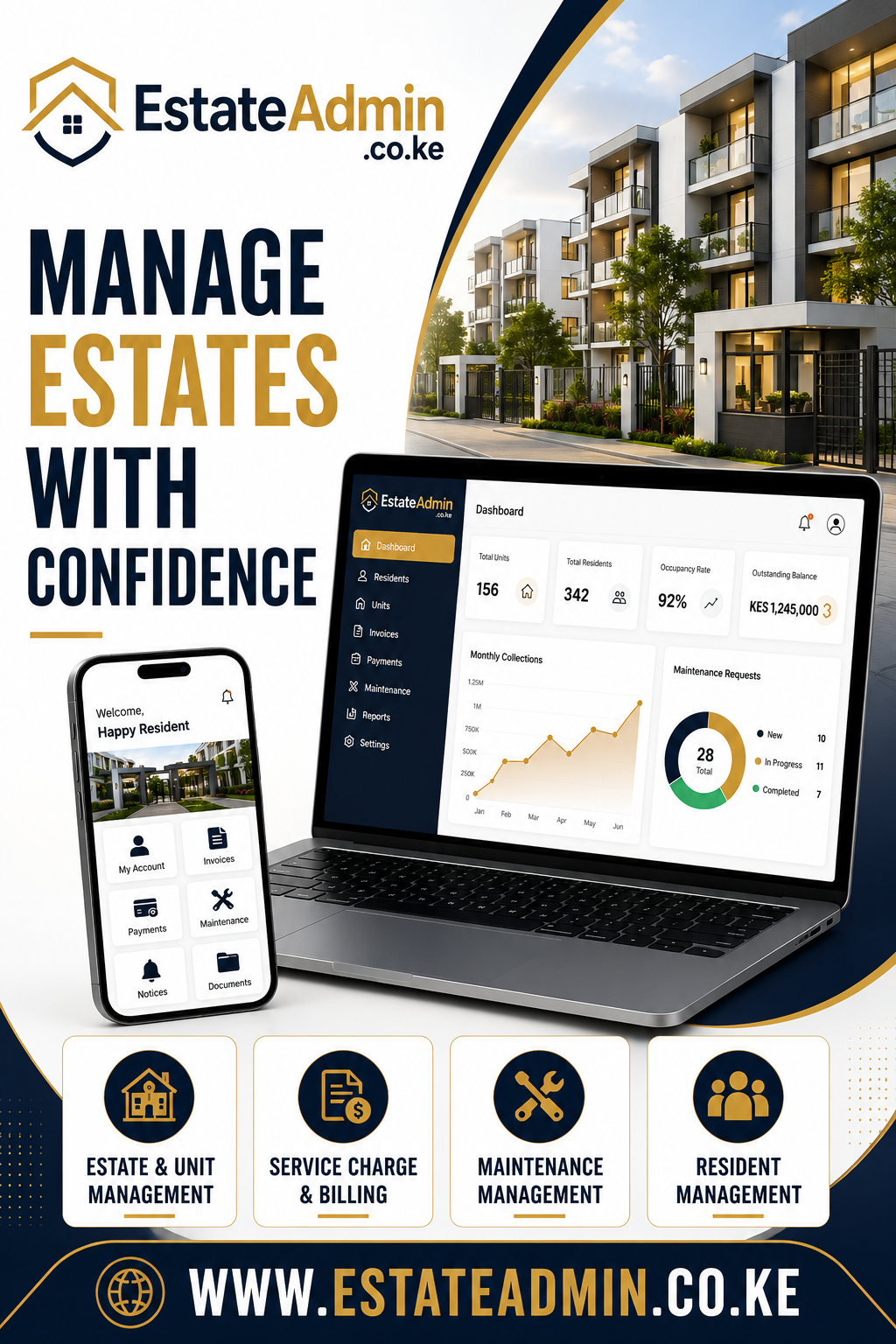
Financial management is one of the most important responsibilities within every residential community. Every service delivered to residents—including security, cleaning, landscaping, maintenance, waste collection, water services, electricity for common areas, infrastructure improvements, and administrative operations—depends on effective financial planning and control. As residential estates continue expanding throughout Kenya, managing community finances manually has become increasingly difficult.
A Community Finance Management System provides a centralized digital solution that enables estate managers, accountants, finance officers, management committees, and property developers to manage every financial activity from one integrated platform. Instead of relying on spreadsheets, manual ledgers, printed receipts, paper invoices, and disconnected accounting systems, communities can automate financial operations while improving transparency and accountability.
Modern residential communities require accurate financial records.
Service charges must be billed correctly.
Payments must be reconciled promptly.
Budgets must be monitored continuously.
Expenditure requires proper authorization.
Financial reports must remain accurate.
Reserve funds require careful planning.
Auditors expect complete financial documentation.
A Community Finance Management System brings all these financial responsibilities together within one secure environment.
Automation significantly improves financial efficiency.
Service charge invoices can be generated automatically according to predefined billing schedules.
Resident payments received through banks, mobile money platforms, online payment gateways, or direct deposits can be reconciled automatically.
Receipts are generated instantly while resident account balances update in real time.
Managers no longer spend unnecessary time performing repetitive accounting tasks.
Financial visibility also improves dramatically.
Operational dashboards provide immediate access to revenue performance, outstanding balances, payment trends, expenditure analysis, budget performance, reserve fund balances, supplier payments, and community financial health.
These insights support better financial planning while helping identify operational risks before they affect community services.
The platform also strengthens governance.
Every invoice, payment, receipt, budget adjustment, procurement approval, expenditure transaction, audit record, and financial report remains securely documented.
Historical financial records remain available for committee meetings, audits, compliance reviews, dispute resolution, and long-term planning.
Residents benefit through increased transparency.
They receive accurate invoices, immediate payment confirmations, up-to-date account statements, and convenient online access to their financial information.
Improved financial communication strengthens trust between residents and estate management while reducing billing disputes.
Management committees also gain confidence because reliable financial information supports informed decision-making.
As residential communities continue expanding throughout Kenya, scalable financial management systems become increasingly valuable.
Whether managing a small gated estate or a large mixed-use development containing thousands of residential units, a Community Finance Management System provides the financial infrastructure required for sustainable community administration.
Implementation generally begins with reviewing existing accounting procedures, billing workflows, payment channels, budgeting methods, financial reporting requirements, procurement controls, and reconciliation processes.
Historical financial information can then be migrated into the platform while workflows are configured according to estate financial policies.
Finance teams and administrators receive comprehensive training before implementation to ensure smooth adoption.
For residential estates, homeowners’ associations, apartment developments, and gated communities throughout Kenya, Community Finance Management System technology provides the financial foundation necessary to improve accountability, strengthen governance, automate accounting processes, increase operational efficiency, and support long-term financial sustainability.
Organizations that invest in modern financial management technology position themselves to deliver professional community services while maintaining complete financial transparency.
Table of Contents
- Understanding Community Finance Management System
- Why Digital Community Financial Management Matters
- Core Features of Community Finance Management System
- Service Charge Billing and Revenue Management
- Budgeting, Expenditure, and Financial Control
- Financial Reporting and Operational Visibility
- Governance, Compliance, and Audit Management
- Supporting Sustainable Community Financial Operations
Understanding Community Finance Management System
Residential communities manage a wide variety of financial activities every day.
Service charge invoices are issued.
Resident payments are received.
Contractors are paid.
Budgets are monitored.
Reserve funds are maintained.
Financial reports are prepared.
Committee approvals are processed.
Managing these activities manually often results in duplicated work, delayed reporting, accounting errors, and reduced financial visibility.
A Community Finance Management System centralizes every financial process within one integrated platform.
Billing, accounting, budgeting, reconciliation, reporting, procurement, financial approvals, and operational oversight remain connected through one secure digital environment.
This significantly improves efficiency while strengthening financial governance.
Accurate financial information becomes immediately available whenever required.
As residential communities throughout Kenya continue growing, centralized financial management supports responsible governance while improving long-term sustainability.
Why Digital Community Financial Management Matters
Traditional financial administration often relies on spreadsheets, manual receipts, printed reports, calculators, paper vouchers, bank statements, and disconnected accounting software.
These manual processes increase administrative workloads while making financial reporting more difficult.
A Community Finance Management System digitizes financial operations by integrating billing, payments, reconciliation, budgeting, reporting, and expenditure management into one centralized solution.
Finance teams access accurate information in real time.
Estate managers monitor financial performance more effectively.
Management committees receive reliable reports.
Residents benefit from greater financial transparency.
Digital financial management also strengthens accountability because every transaction remains securely documented.
For residential estates throughout Kenya, modern financial technology improves operational efficiency while supporting stronger financial governance.
Core Features of Community Finance Management System
Modern financial management platforms combine numerous accounting capabilities within one integrated solution.
Service charge billing automates invoicing.
Payment management supports multiple collection channels.
Bank reconciliation improves accounting accuracy.
Budget management strengthens financial planning.
Expenditure tracking improves operational control.
Supplier payment management supports procurement.
Financial reporting improves decision-making.
Resident account management strengthens transparency.
Audit trails improve accountability.
Operational dashboards provide financial visibility.
A Community Finance Management System integrates these capabilities into one centralized financial platform that simplifies residential estate administration.
Service Charge Billing and Revenue Management
Reliable revenue collection supports every residential community.
Digital billing automates invoice generation according to predefined billing schedules.
Residents receive accurate invoices while finance teams monitor collections continuously.
Payments received through banks, mobile money platforms, online payment gateways, and direct deposits can be reconciled automatically.
Outstanding balances update immediately.
Receipts are generated instantly.
Historical payment records remain securely stored.
A Community Finance Management System improves revenue management while reducing manual accounting workloads.
Budgeting, Expenditure, and Financial Control
Responsible budgeting ensures community resources remain available for essential services and long-term development.
Digital budgeting tools help finance teams prepare annual budgets, monitor expenditure, manage reserve funds, evaluate departmental spending, approve procurement requests, and analyse financial performance.
Managers immediately identify overspending while maintaining continuous financial control.
A Community Finance Management System strengthens financial planning while supporting sustainable community operations.
Financial Reporting and Operational Visibility
Financial reporting provides valuable insights into community performance.
Operational dashboards display revenue collections, outstanding balances, expenditure trends, budget performance, reserve funds, supplier payments, cash flow, and financial forecasts.
Historical reports support committee meetings, budgeting, audits, procurement reviews, and strategic planning.
A Community Finance Management System transforms financial data into meaningful operational intelligence that supports better community decision-making.
Governance, Compliance, and Audit Management
Residential communities require complete financial accountability.
Invoices, receipts, payment records, procurement approvals, budgets, expenditure reports, contracts, reconciliation histories, and audit documents must remain securely organized.
Role-based permissions protect financial information while maintaining operational transparency.
Historical financial records remain available during audits, committee meetings, legal reviews, taxation requirements, and compliance inspections.
A Community Finance Management System strengthens governance while supporting responsible residential financial management.
Supporting Sustainable Community Financial Operations
Long-term community success depends upon sound financial management.
Digital financial systems improve budgeting, increase transparency, strengthen governance, reduce administrative workloads, improve reporting, and support informed decision-making.
Automation allows finance teams to focus more on strategic planning rather than repetitive accounting activities.
Historical financial information supports continuous improvement while strengthening operational resilience.
A Community Finance Management System enables residential communities throughout Kenya to establish financially sustainable operations capable of supporting long-term growth while maintaining professional financial administration.
Benefits for Estate Managers
Estate managers are responsible for ensuring that residential communities remain financially stable while delivering reliable services to residents. Every operational activity, including security, cleaning, landscaping, maintenance, waste collection, utility management, contractor payments, insurance, and infrastructure improvements, depends on effective financial administration. As residential estates continue expanding throughout Kenya, managing community finances manually becomes increasingly challenging.
One of the greatest advantages of a Community Finance Management System is the ability to centralize every financial process within one secure digital platform. Instead of maintaining multiple spreadsheets, paper receipts, manual ledgers, printed invoices, bank statements, and disconnected accounting software, estate managers gain complete financial visibility through one integrated dashboard.
This centralized approach significantly improves operational efficiency.
Finance teams can generate invoices automatically, monitor collections in real time, reconcile payments, approve expenditures, manage budgets, track supplier payments, and prepare financial reports without repeatedly entering the same information into multiple systems.
Administrative workloads decrease considerably while accounting accuracy improves.
Another important advantage is improved financial visibility.
Real-time dashboards display service charge collections, outstanding balances, cash flow, departmental expenditure, reserve fund performance, budget utilization, supplier payments, and financial forecasts.
Managers immediately identify overdue accounts, unusual spending patterns, declining revenue, and operational risks before they become major financial problems.
A Community Finance Management System also strengthens collaboration between estate managers, accountants, finance officers, procurement teams, and management committees.
Everyone accesses the same financial information, reducing inconsistencies while improving decision-making.
Historical financial records provide additional strategic value.
Managers can review previous budgets, expenditure trends, contractor payments, procurement history, reserve fund performance, audit findings, and revenue growth whenever required.
These insights support more accurate budgeting and long-term financial planning.
Financial transparency also improves significantly.
Every invoice, receipt, payment, reconciliation, approval, budget adjustment, procurement transaction, and expenditure record remains securely documented.
Complete audit trails strengthen accountability while supporting professional estate governance.
For residential estates throughout Kenya, digital financial management enables estate managers to improve operational efficiency while maintaining responsible financial control and sustainable community development.
Benefits for Property Developers, Estate Owners, and Management Committees
Property developers, estate owners, homeowners’ associations, and management committees require reliable financial information to oversee residential communities effectively.
Without centralized financial systems, budgeting becomes difficult, expenditure monitoring weakens, reporting becomes inconsistent, and long-term planning suffers.
A Community Finance Management System provides complete visibility into every financial activity within the community.
Management committees receive accurate reports covering service charge collections, expenditure performance, reserve funds, cash flow, outstanding balances, supplier payments, procurement activities, and financial forecasts.
Instead of relying on manually prepared financial summaries, committee members access continuously updated dashboards supported by accurate accounting records.
Property developers managing multiple residential communities also benefit from standardized financial procedures.
Consistent accounting workflows simplify financial oversight while improving governance across multiple developments.
The software further strengthens accountability.
Every financial approval, invoice, payment, procurement request, budget adjustment, supplier transaction, reconciliation activity, and audit record remains securely documented.
Historical financial information supports audits, committee meetings, regulatory reviews, taxation requirements, insurance claims, and strategic planning.
Long-term investment planning also becomes more reliable.
Management committees evaluate infrastructure upgrades, reserve fund allocations, maintenance planning, staffing costs, and community expansion using dependable financial information.
A Community Finance Management System further strengthens investor and resident confidence because financial operations remain transparent, organized, and professionally managed.
Communities with strong financial governance generally experience greater operational stability and improved long-term property values.
For residential developments throughout Kenya, centralized financial management provides the foundation for responsible governance and sustainable community growth.
Benefits for Residents
Residents contribute financially through service charges and therefore expect transparency, accountability, and accurate financial administration.
Manual accounting systems often create delayed receipts, incorrect balances, billing disputes, and limited financial visibility.
A Community Finance Management System significantly improves the resident experience.
Residents receive accurate invoices generated according to approved billing schedules.
Payments processed through banks, mobile money platforms, or online payment systems update resident accounts promptly.
Digital receipts provide immediate confirmation following successful payment.
Residents also benefit from secure self-service financial portals.
They can access invoices, payment history, account statements, outstanding balances, receipts, and financial notifications whenever needed.
This reduces unnecessary visits to estate offices while improving convenience.
Financial communication becomes faster and more transparent.
Billing reminders, payment confirmations, financial announcements, annual budgets, and committee-approved financial updates can all be delivered electronically.
Residents gain greater confidence because every financial transaction remains accurately recorded.
Billing disputes become easier to resolve since supporting documentation remains readily available.
For residential communities throughout Kenya, transparent financial administration contributes directly to stronger resident trust, improved satisfaction, and healthier relationships between residents and estate management.
Improving Financial Efficiency Through Automation
Manual financial administration consumes considerable administrative time.
Finance teams prepare invoices manually, reconcile payments, process receipts, monitor budgets, verify supplier payments, prepare reports, and maintain accounting records using multiple disconnected systems.
These repetitive activities increase operational costs while creating opportunities for accounting errors.
A Community Finance Management System automates many of these routine financial activities.
Service charge invoices are generated automatically.
Resident payments are reconciled digitally.
Receipts are issued immediately.
Budget monitoring occurs continuously.
Supplier payments follow structured approval workflows.
Financial reports update automatically using real-time accounting information.
Automation significantly reduces administrative workloads.
Finance personnel spend less time processing transactions while focusing more on budgeting, financial planning, compliance, and strategic decision-making.
Automation also improves accounting consistency.
Standardized financial workflows reduce duplicate records, calculation errors, delayed reconciliations, and inconsistent reporting.
Operational reporting becomes considerably faster.
Instead of manually preparing financial summaries, managers generate real-time dashboards displaying revenue performance, expenditure trends, reserve funds, procurement activities, and overall financial health.
Automation also strengthens collaboration because finance officers, estate managers, accountants, procurement personnel, auditors, and management committees all work from one centralized accounting platform.
For residential communities throughout Kenya, automation transforms financial management into a faster, more accurate, and highly efficient operational process.
Financial Governance, Compliance, and Risk Management
Responsible financial governance requires secure accounting records, transparent reporting, standardized approval procedures, and effective compliance management.
Residential communities manage significant financial resources that require careful oversight.
A Community Finance Management System strengthens governance by maintaining complete financial histories for every accounting activity.
Role-based permissions ensure only authorized personnel access sensitive financial information.
Comprehensive audit trails document invoices, payments, reconciliations, procurement approvals, budget revisions, supplier transactions, financial reports, and accounting adjustments.
Historical financial records remain securely available during audits, committee meetings, legal reviews, insurance assessments, taxation procedures, and regulatory inspections.
Risk management also improves considerably.
Managers identify overdue payments, unusual expenditure patterns, procurement irregularities, declining revenue, budget overruns, and cash flow challenges before they affect community operations.
Internal financial controls become stronger because every expenditure follows predefined approval workflows.
Financial accountability improves while reducing operational and compliance risks.
For residential estates throughout Kenya, stronger governance supports responsible financial administration and sustainable community development.
Why EstateAdmin Is the Ideal Solution
EstateAdmin has been developed specifically to simplify residential estate financial management by integrating accounting, service charge administration, budgeting, procurement, reporting, resident management, maintenance coordination, communication, and governance within one comprehensive cloud-based platform.
Unlike generic accounting software, EstateAdmin addresses the unique financial requirements of residential estates, homeowners’ associations, apartment developments, and gated communities.
A Community Finance Management System delivers maximum value when financial activities operate alongside every operational function within one integrated platform.
EstateAdmin combines automated billing, payment reconciliation, budgeting, reserve fund management, supplier administration, procurement approvals, financial dashboards, audit trails, reporting, resident account management, and operational analytics into one secure solution.
Estate managers gain complete financial visibility.
Finance teams automate routine accounting activities.
Management committees receive reliable financial information that supports informed decision-making.
Residents benefit from transparent financial communication and accurate account management.
Whether managing a small gated estate or a large mixed-use residential community with thousands of units, EstateAdmin provides scalable financial technology capable of supporting long-term community growth.
For residential communities throughout Kenya, EstateAdmin delivers a comprehensive financial management platform that improves accounting accuracy, strengthens governance, increases operational efficiency, and supports sustainable estate administration.
Future Trends
Community financial management will continue evolving through advances in artificial intelligence, cloud computing, automation, predictive analytics, and digital payment technologies.
Artificial intelligence will increasingly assist finance teams by forecasting revenue, predicting expenditure trends, identifying financial anomalies, and recommending budget improvements.
Cloud-based accounting platforms will continue improving accessibility while supporting remote financial management across multiple residential developments.
A Community Finance Management System will increasingly integrate with banking platforms, mobile payment services, accounting software, procurement systems, smart estate technologies, taxation systems, and business intelligence tools.
Advanced analytics will provide deeper visibility into financial sustainability, operational efficiency, reserve fund performance, collection trends, and long-term investment planning.
Residential communities throughout Kenya that adopt modern financial technology will remain better positioned to strengthen governance while maintaining sustainable financial operations.
Getting Started
Implementing a modern financial management platform begins with evaluating current accounting procedures and identifying opportunities for improvement.
Estate managers should assess billing systems, payment collection methods, budgeting processes, procurement controls, reconciliation procedures, reporting requirements, audit workflows, and financial governance practices.
Following this assessment, accounting workflows are configured according to the financial policies of the residential community.
Historical accounting records, resident balances, budgets, supplier information, and financial reports can be migrated where necessary.
User permissions are established for finance officers, accountants, estate managers, auditors, committee members, and administrators.
Comprehensive staff training ensures every department understands billing, reconciliation, budgeting, reporting, procurement, and financial approval procedures.
Continuous monitoring after implementation enables finance teams to optimize accounting processes while improving operational efficiency.
For residential communities seeking comprehensive financial management capabilities, EstateAdmin provides integrated solutions covering service charge billing, budgeting, accounting, payment reconciliation, procurement management, reserve fund administration, financial reporting, audit management, operational dashboards, and complete estate administration.
By implementing a Community Finance Management System, residential estates throughout Kenya can strengthen financial governance, improve accounting accuracy, automate routine financial processes, increase transparency, reduce administrative workloads, support informed decision-making, and establish a scalable financial foundation capable of supporting sustainable long-term community growth.
- Community Finance Management System
- Community Finance Management System
- Community Finance Management System