
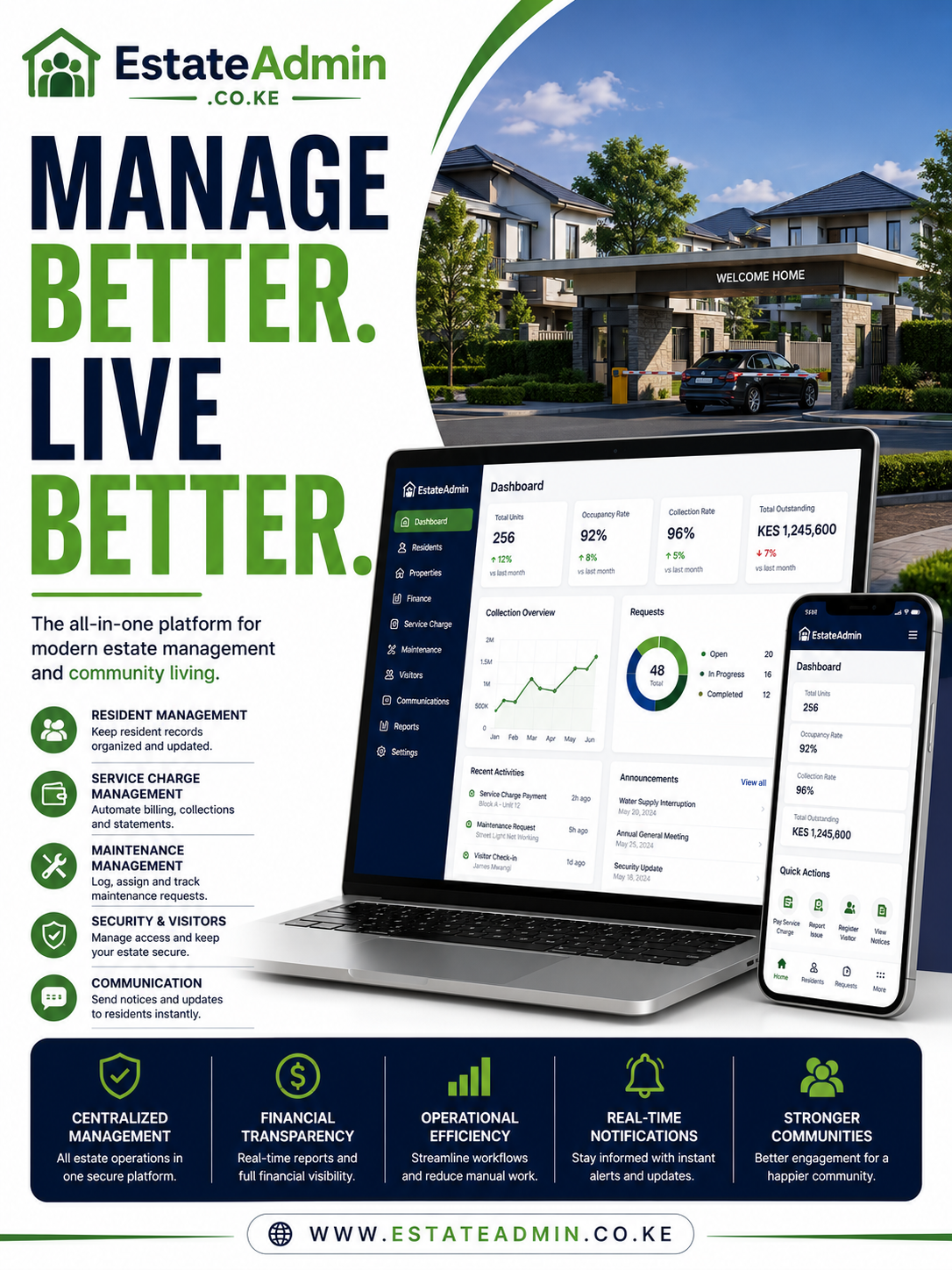
Estate committee management software Tatu City solutions are becoming increasingly important as residential communities grow in size, complexity, and operational requirements. Estate committees have to coordinate finances, service charges, maintenance, resident communication, security, suppliers, meetings, documents, and community activities. Managing all these responsibilities through spreadsheets, paper files, messaging groups, and disconnected records can make administration difficult.
Digital management software provides a centralized way to organize these activities. Instead of relying on different tools for accounting, resident records, maintenance requests, communication, and reporting, committee members can use a structured platform to manage information from one location.
For communities in and around Tatu City, this approach can be particularly useful because modern developments often involve multiple buildings, shared facilities, residents, contractors, service providers, and recurring community expenses. As the number of residents and properties increases, the committee needs reliable systems that can support transparency, accountability, and efficient administration.
What Is Estate Committee Management Software?
Estate committee management software is a digital platform designed to help residential estate committees manage the administrative and operational responsibilities associated with a community.
A typical platform can bring together:
- Resident records
- Property and unit information
- Service charges
- Billing
- Payments
- Arrears
- Expenses
- Maintenance
- Suppliers
- Communication
- Documents
- Meetings
- Reports
Instead of maintaining separate spreadsheets for each activity, committee members can organize these records within one system.
For a community searching for Estate committee management software Tatu City, the most important consideration is whether the platform can support the actual responsibilities of the committee rather than simply providing a generic property database.
Why Estate Committees Need Digital Management
Estate committees often operate in environments where many activities happen simultaneously.
The committee may need to:
- Collect service charges
- Pay security providers
- Coordinate cleaning
- Maintain shared facilities
- Manage landscaping
- Handle resident complaints
- Organize meetings
- Approve expenses
- Monitor contractors
- Prepare financial reports
When these activities are managed manually, important information can become scattered.
A payment may be recorded in a spreadsheet, an expense may be discussed in a WhatsApp group, a maintenance request may be sent to an administrator privately, and a supplier invoice may exist only as an email attachment.
This makes it difficult to establish one reliable source of information.
A centralized digital platform helps bring these activities together.
Managing Estate Information
The first requirement of effective committee administration is having accurate information about the estate.
The system can organize information about:
- Estate
- Blocks
- Buildings
- Units
- Owners
- Residents
- Shared facilities
- Parking spaces
- Service providers
Each unit can have an individual record.
For example:
Unit: A-305
Owner: Registered owner
Resident: Current occupant
Service charge: Monthly amount
Outstanding balance: Current balance
Maintenance: Open requests
This creates a structured information base.
Managing Multiple Buildings
Large developments may contain multiple buildings or sections.
A committee can organize the property into different levels.
For example:
Community
→ Block A
→ Block B
→ Block C
→ Shared facilities
This structure makes it easier to associate residents, charges, maintenance requests, and expenses with the correct area.
For committees evaluating Estate committee management software Tatu City, multi-building support should be an important feature to investigate.
Resident Management
Resident information is central to community administration.
The system can maintain records such as:
- Resident name
- Unit
- Phone number
- Occupancy status
- Owner or tenant status
- Account balance
- Communication history
Having this information centralized allows authorized committee members and administrators to find relevant records more quickly.
Owner and Tenant Records
In many residential developments, the owner of a unit is not necessarily the person living there.
The system should therefore allow the committee to distinguish between:
Property owner
and
Resident or tenant
This distinction is important when sending financial notices, community announcements, or maintenance communications.
Occupancy Tracking
Understanding occupancy helps management maintain accurate estate records.
The platform can identify:
- Occupied units
- Vacant units
- Owner-occupied units
- Tenant-occupied units
This information can also support financial and administrative reporting.
Service Charge Management
Service charges are one of the most important financial responsibilities for many residential estates.
They can contribute toward:
- Security
- Cleaning
- Landscaping
- Waste management
- Common-area electricity
- Water systems
- Repairs
- Shared facilities
- Estate administration
An Estate committee management software Tatu City platform can help committees create recurring service-charge invoices and monitor payments.
This provides a clearer picture of how much has been billed and collected.
Recurring Billing
Manual monthly billing can become repetitive when an estate has hundreds of units.
Instead of creating every invoice individually, software can support recurring billing rules.
For example:
Monthly service charge → Automatic invoice → Resident notification → Payment → Receipt
This reduces administrative workload.
Different Service Charge Structures
Not every estate uses the same calculation method.
Charges may be based on:
- Fixed amounts
- Unit size
- Ownership percentage
- Property category
- Specific services
- Other approved formulas
The software should therefore provide sufficient flexibility to accommodate the estate’s billing structure.
Payment Collection
Collecting service charges is only one part of financial management.
The committee also needs to know whether payments have been correctly allocated to the appropriate accounts.
A digital platform can track:
- Amount billed
- Amount paid
- Payment date
- Payment reference
- Outstanding amount
This gives the committee a clearer view of collection performance.
M-PESA Payments
M-PESA is an important consideration for property management in Kenya.
Many Kenyan property platforms support M-PESA-related collection and reconciliation workflows. For example, property-management systems available in Kenya advertise M-PESA integration for rent and property-related payments.
For an estate committee, convenient digital payment options can make it easier for residents to settle their obligations.
When evaluating Estate committee management software Tatu City, committees should verify whether M-PESA integration is included and how payment reconciliation works.
Bank Payment Tracking
Some residents may use bank transfers rather than mobile money.
The software should therefore accommodate the payment methods used by the estate.
Management should be able to identify:
- Transaction amount
- Transaction date
- Reference
- Resident account
- Invoice
- Allocation status
This reduces confusion when multiple residents make payments around the same time.
Payment Reconciliation
Payment reconciliation involves matching received money with the correct resident account and invoice.
Suppose the estate receives:
KSh 20,000
The system should help determine which account should receive the payment.
Accurate reconciliation prevents situations where a resident has already paid but the system still shows an outstanding balance.
Digital Receipts
After payment has been recorded, the resident should ideally receive confirmation.
Digital receipts can contain:
- Receipt number
- Resident
- Unit
- Amount
- Date
- Payment reference
- Payment method
- Remaining balance
This creates a clear transaction record.
Arrears Management
Service-charge arrears can create financial pressure for an estate.
If residents delay payments, the committee may struggle to pay:
- Security providers
- Cleaning contractors
- Maintenance suppliers
- Utility providers
- Other service providers
A digital system can help identify accounts with outstanding balances.
Arrears Reports
The committee can review arrears by:
- Resident
- Unit
- Building
- Age
- Amount
For example:
| Arrears Period | Outstanding |
|---|---|
| Current | KSh 450,000 |
| 30 days | KSh 180,000 |
| 60 days | KSh 120,000 |
| 90 days | KSh 80,000 |
| Over 90 days | KSh 60,000 |
This provides a clearer collection picture.
Payment Reminders
Manual payment reminders can consume significant administrative time.
Where supported, software can automate notifications.
A typical process can include:
Upcoming due date
→ Reminder
Due date
→ Payment notification
Overdue
→ Arrears reminder
This creates a consistent collection process.
Resident Statements
Residents may question their balances when several charges and payments have accumulated.
A statement can show:
- Opening balance
- New charges
- Payments
- Adjustments
- Credits
- Closing balance
This can make financial communication more transparent.
Expense Management
Collecting money is only one side of estate finances.
The committee also needs to control expenditure.
Common estate expenses include:
- Security
- Cleaning
- Landscaping
- Repairs
- Electricity
- Water
- Waste collection
- Insurance
- Professional services
An Estate committee management software Tatu City platform can help record and categorize these expenses.
Expense Categories
Consistent expense categories make financial reporting easier.
For example:
Security
Cleaning
Maintenance
Utilities
Landscaping
Administration
Insurance
Other
Management can then determine where estate funds are being spent.
Expense Approval
Committees should have clear procedures for approving expenditure.
A digital approval workflow can provide a structured process.
For example:
Expense request
↓
Committee review
↓
Approval
↓
Supplier invoice
↓
Payment
↓
Recorded expense
This creates greater accountability.
Supplier Management
Estates often work with multiple contractors.
These may include:
- Security companies
- Cleaning companies
- Landscapers
- Plumbers
- Electricians
- Waste collection providers
- Lift maintenance companies
The software can maintain supplier records and associate them with contracts, invoices, payments, and maintenance activities.
Supplier Performance
Committee members can use historical records to evaluate suppliers.
They can consider:
- Service quality
- Response time
- Cost
- Number of jobs
- Complaints
- Contract compliance
This helps the committee make more informed supplier decisions.
Contractor Management
Contractors may work on both routine and emergency projects.
The system can record:
- Contractor
- Work requested
- Location
- Cost
- Approval
- Completion date
- Payment
This gives the committee an organized history of contractor activity.
Maintenance Management
Maintenance is one of the biggest operational responsibilities of an estate committee.
Residents may report:
- Water leaks
- Electrical faults
- Damaged infrastructure
- Broken lighting
- Plumbing problems
- Common-area issues
- Security-related repairs
A digital maintenance system allows these issues to be recorded and tracked.
Maintenance Requests
A resident can submit a request that contains:
Issue: Water leak
Location: Block B
Unit: B-204
Priority: High
Description: Water leaking from bathroom pipe
The management team can then assign the request to an appropriate technician.
Maintenance Status Tracking
Maintenance requests can move through defined statuses:
New
Assigned
In progress
Completed
Closed
This makes it easier to identify unresolved issues.
Maintenance Priorities
Some problems require immediate action.
Software can categorize requests according to priority.
For example:
Emergency
Major water leak or dangerous electrical fault.
High
Issue affecting essential services.
Normal
Routine repair.
Low
Non-urgent improvement.
This helps teams allocate resources appropriately.
Preventive Maintenance
Good estate management is not only about responding to breakdowns.
Preventive maintenance can help protect shared assets.
Schedules can be established for:
- Generators
- Water pumps
- Lifts
- Fire equipment
- Electrical systems
- Security equipment
- Water tanks
This allows the committee to plan maintenance instead of waiting for failures.
Maintenance History
Historical maintenance records are valuable.
Suppose a water pump has required repairs five times within a year.
The committee can use this information to determine whether another repair is financially sensible or whether replacement should be considered.
Maintenance Cost Tracking
Every maintenance request can potentially be connected to an expense.
For example:
Repair: Plumbing
Supplier: Contractor
Materials: KSh 5,000
Labour: KSh 4,000
Total: KSh 9,000
This provides better visibility into maintenance expenditure.
Managing Common Areas
Residential communities have shared facilities that require continuous management.
These may include:
- Roads
- Gardens
- Swimming pools
- Gyms
- Playgrounds
- Parking areas
- Clubhouses
- Security gates
The committee can use digital records to track maintenance and expenses associated with these areas.
Security Management
Security is a critical consideration for many residential communities.
While dedicated security systems may operate separately, management software can help record security-related activities.
These might include:
- Security incidents
- Contractor details
- Maintenance of security equipment
- Related expenses
- Resident communications
The committee can then maintain an operational record.
Community Communication
Communication is essential for maintaining a well-organized estate.
Committees regularly need to communicate:
- Meeting announcements
- Service interruptions
- Maintenance schedules
- Security notices
- Payment reminders
- Community events
- General updates
A centralized platform can support structured communication.
Reducing Dependence on Messaging Groups
WhatsApp and other messaging platforms are useful for quick communication, but they are not necessarily designed for structured property administration.
Important information can disappear among hundreds of messages.
A property platform can provide a more organized place for:
- Official notices
- Financial information
- Maintenance requests
- Resident records
Targeted Notifications
Not every message applies to every resident.
For example, maintenance affecting Block C should not necessarily be sent to every resident.
A digital system can provide targeted communication capabilities where supported.
Document Management
Committees handle many important documents.
These can include:
- Meeting minutes
- Supplier contracts
- Invoices
- Financial reports
- Maintenance reports
- Notices
- Policies
- Community documents
Centralized digital storage makes these records easier to retrieve.
Meeting Management
Estate committees regularly hold meetings to discuss:
- Finances
- Maintenance
- Security
- Suppliers
- Community concerns
- Upcoming projects
Digital systems can support meeting administration by keeping relevant documents and records organized.
Meeting Minutes
Meeting minutes should provide an accurate record of decisions.
Important information can include:
- Meeting date
- Attendees
- Agenda
- Discussions
- Decisions
- Action items
Storing these records digitally makes them easier to retrieve.
Action Item Tracking
A committee meeting may produce several tasks.
For example:
Task: Obtain three security quotations
Responsible: Committee member
Deadline: 15 September
Status: Pending
Digital task tracking can help prevent important decisions from being forgotten.
Transparency
Transparency is one of the most important reasons committees adopt management software.
Residents want to know how their contributions are being used.
A centralized system can provide reports on:
- Collections
- Expenses
- Arrears
- Maintenance
- Supplier payments
This helps establish a clearer financial trail.
Accountability
Accountability means being able to determine what happened and who was responsible for an action.
Audit trails can help record:
- Who created an invoice
- Who recorded a payment
- Who approved an expense
- Who changed a record
- Who closed a maintenance request
This can improve internal controls.
Financial Reporting
An Estate committee management software Tatu City platform can simplify financial reporting by collecting relevant transactions in one system.
Reports can include:
- Service-charge collections
- Arrears
- Expenses
- Supplier balances
- Cash flow
- Budget performance
The availability of specific reports depends on the software provider.
Monthly Committee Reports
Committees often require monthly updates.
A monthly report can show:
Opening balance
Collections
Expenses
Outstanding balances
Closing balance
This gives committee members a clearer picture of the estate’s financial position.
Budget Management
A community budget should reflect expected income and expenses.
For example:
| Category | Annual Budget |
|---|---|
| Security | KSh 4,000,000 |
| Cleaning | KSh 1,500,000 |
| Maintenance | KSh 2,000,000 |
| Landscaping | KSh 800,000 |
| Utilities | KSh 1,200,000 |
The actual expenses can then be compared against these allocations.
Budget Variance
Suppose the annual maintenance budget is KSh 2 million, but actual expenditure reaches KSh 2.4 million.
The variance is:
KSh 400,000
The committee can investigate why spending exceeded the original plan.
Possible reasons could include:
- Emergency repairs
- Equipment failure
- Unexpected infrastructure problems
- Higher supplier costs
Cash-Flow Management
An estate can have significant amounts of money owed by residents while simultaneously having large supplier obligations.
Cash-flow monitoring helps the committee understand:
Money expected
versus
Money required
This supports better financial planning.
Reserve Funds
Some communities establish reserves for major future projects.
Examples include:
- Roof replacement
- Road repairs
- Major painting
- Lift replacement
- Generator replacement
- Security infrastructure
The committee can track reserve contributions and project expenditure separately from ordinary operating expenses.
Digital Governance
Software can also support stronger governance.
The committee can establish defined workflows for:
- Expense approvals
- Payment authorization
- Supplier onboarding
- Maintenance approvals
- Resident communication
This reduces reliance on informal processes.
User Roles
Not every committee member should necessarily have access to every function.
The platform can provide roles such as:
- Administrator
- Estate manager
- Accountant
- Committee member
- Maintenance officer
- Resident
Each role can have different permissions.
Protecting Financial Information
Financial records should be protected from unauthorized access.
A platform should provide appropriate controls around:
- Login credentials
- User permissions
- Financial data
- Resident information
- Documents
Committees should understand how the provider protects and stores data.
Cloud Accessibility
One major benefit of cloud software is accessibility.
An Estate committee management software Tatu City platform can allow authorized users to access information from different locations using internet-connected devices.
This can be useful when committee members are not physically at the estate office.
Supporting Remote Committee Members
Committee members may have different schedules and may not always be available at the property.
Cloud access can allow authorized users to review:
- Reports
- Expenses
- Maintenance requests
- Resident records
- Documents
This improves continuity of administration.
Mobile Access
Estate managers and committee members often work away from their desks.
Mobile-friendly software can help users:
- Review requests
- Check payments
- Access resident information
- View reports
- Update maintenance status
This is particularly useful during property inspections.
Managing Growing Communities
As a residential development grows, administration becomes more complicated.
A small community may have 50 units.
A larger development may have:
200 units
500 units
1,000+ units
At that scale, spreadsheets and paper records become increasingly difficult to maintain.
An Estate committee management software Tatu City solution should therefore be evaluated for scalability.
Multi-Property Support
Some management companies may oversee several communities.
A platform with multi-property support can organize:
Estate A
Estate B
Estate C
within one management environment.
This allows managers to maintain separate financial and resident records while retaining centralized oversight.
Why Local Requirements Matter
Property-management requirements differ between countries.
For Kenyan estates, committees may need to consider:
- M-PESA
- Local banking
- Service-charge structures
- Local suppliers
- Resident communication
- Local accounting practices
This makes local suitability an important consideration when choosing software.
Choosing the Right Software
When evaluating Estate committee management software Tatu City, committees should avoid selecting a platform based only on price or the number of features listed on a website.
The software should be evaluated against actual estate requirements.
Important questions include:
- Can it manage multiple buildings?
- Can it manage residents and owners?
- Can it generate recurring service-charge invoices?
- Can it track arrears?
- Does it support M-PESA?
- Can it handle bank payments?
- Can it reconcile transactions?
- Can it manage expenses?
- Can it track maintenance?
- Can it manage suppliers?
- Can it generate financial reports?
- Can residents access their accounts?
- Can residents submit maintenance requests?
- Does it support user permissions?
- Does it maintain audit trails?
- Can committee documents be stored?
- Is it accessible on mobile devices?
- Can it scale as the community grows?
- Does it support multiple estates?
- What support is available during implementation?
These questions can help a committee compare different systems based on practical requirements.
Preparing for Implementation
Before introducing new software, the committee should review its existing records.
This includes:
- Resident lists
- Unit numbers
- Owner records
- Service-charge balances
- Supplier records
- Existing contracts
- Financial information
- Maintenance records
Incorrect information should be cleaned before it is transferred into the new platform.
Staff and Committee Training
Even good software can fail if users do not understand how to use it.
Training should cover the actual responsibilities of each user.
For example:
Finance team: Billing and payments
Maintenance team: Work orders
Committee: Reports and approvals
Residents: Payments and service requests
This creates clearer responsibilities.
Resident Onboarding
Residents should be informed about how the new system works.
They may need instructions on:
- Accessing their accounts
- Viewing invoices
- Making payments
- Downloading receipts
- Checking balances
- Reporting maintenance issues
Clear communication can improve adoption.
Data Migration
Historical data can be migrated into the new system where supported.
This may include:
- Resident records
- Unit information
- Outstanding balances
- Payment history
- Supplier records
Data should be reviewed after migration to confirm accuracy.
System Testing
Before full implementation, the committee should test common workflows.
For example:
Create resident
Generate invoice
Record payment
Reconcile transaction
Generate receipt
Submit maintenance request
Approve expense
Generate report
Testing reduces the possibility of operational problems after launch.