
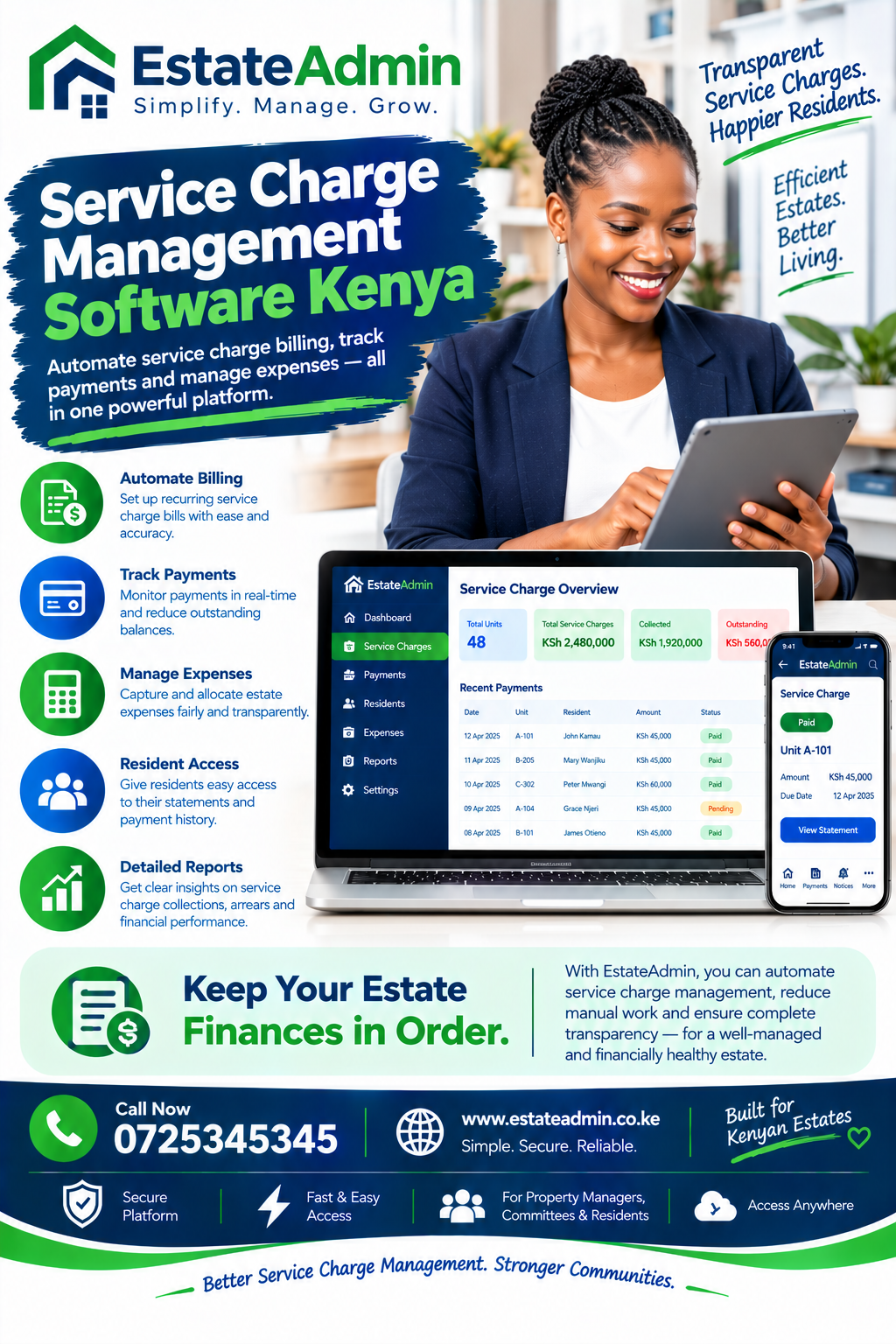
Service Charge Management Software Kenya: A Complete Guide for Modern Estates
Managing service charges can become complicated when an estate has dozens or hundreds of units, different resident categories, recurring charges, partial payments and outstanding balances. Service Charge Management Software Kenya gives estate managers, committees, accountants and property management companies a structured way to manage the full service-charge cycle, from setting up charges and generating invoices to recording payments, monitoring arrears and producing resident statements.
Service charges are an important part of running residential estates, gated communities and managed developments. They help fund shared services such as security, cleaning, landscaping, waste management, common-area maintenance and other operational costs. The challenge is ensuring that the charges are calculated consistently, billed correctly and followed up properly.
For a small estate, a spreadsheet may initially seem sufficient. As the number of units grows, however, manual systems can become difficult to maintain. One spreadsheet may contain resident information, another may contain payment records, while invoices and statements may be prepared separately. When these records do not match, the management team can spend considerable time investigating differences.
A well-designed Service Charge Management Software Kenya workflow brings these activities into a connected system. Instead of treating billing, payments, balances and statements as separate tasks, the platform can link them together.
This guide explains what service charge management software is, why it matters to Kenyan estates, which features to look for, how it can support M-Pesa and other payment workflows, how to manage arrears, how committees can use reports and what property managers should consider before choosing a solution.
What Is Service Charge Management Software?
Service Charge Management Software Kenya is software designed to help residential estates and property management teams organize service-charge billing, invoicing, payments, balances, statements and reporting.
A service charge system may help management teams handle:
- Resident records
- Unit records
- Resident categories
- Recurring service charges
- Invoice generation
- Payment recording
- Payment reconciliation
- Partial payments
- Outstanding balances
- Arrears
- Resident statements
- Reports
- Exports
- User permissions
- Audit history
The exact features depend on the provider.
For example, EstateAdmin describes its service-charge workflow around recurring charges, bulk invoice generation, payment tracking, resident ledgers, roles, approvals and reporting.
The most important concept is continuity.
The system should connect the charge to the invoice, the invoice to the payment and the payment to the resident’s remaining balance.
This creates a clearer record.
Suppose a resident is billed KES 10,000 for a monthly service charge and pays KES 6,000. The system should show that KES 6,000 has been received while KES 4,000 remains outstanding.
That is more useful than having a spreadsheet that simply records the original invoice and another sheet that records the payment.
The purpose of Service Charge Management Software Kenya is therefore not simply to replace paper records. It is to create a repeatable service-charge process that management teams can follow every billing period.
Why Service Charge Management Matters in Kenyan Estates
Service charges fund the day-to-day operation of many managed residential communities.
An estate may need money for:
- Security guards
- Cleaning
- Landscaping
- Waste collection
- Common-area lighting
- Water systems
- Repairs
- Grounds maintenance
- Administration
- Shared facilities
The amount collected needs to be tracked against the expenses and obligations of the estate.
This means service-charge management has both an operational and financial dimension.
Service Charge Management Software Kenya can help managers organize the billing and collection side of this process.
A typical monthly cycle may involve:
- Confirming the residents or units that should be billed.
- Confirming the applicable charge.
- Generating invoices.
- Sending or issuing invoices.
- Receiving payments.
- Allocating payments to the correct accounts.
- Identifying partial and outstanding balances.
- Following up arrears.
- Generating statements.
- Preparing management or committee reports.
EstateAdmin’s published service-charge workflow follows a similar cycle, emphasizing charges, invoices, payments, reconciliation, communication and reporting.
The benefit of a structured system is consistency.
Each month should not feel like a new accounting exercise.
The Problems With Spreadsheet-Based Service Charge Management
Spreadsheets are useful tools, especially for small operations. The problem arises when an estate becomes dependent on several disconnected spreadsheets.
Imagine an estate with 200 units.
The administrator maintains a resident spreadsheet.
The accountant maintains a payment spreadsheet.
The committee receives a monthly report prepared manually.
Invoices are generated from another document.
Payment confirmations arrive through M-Pesa.
Resident statements are prepared when requested.
Every time information changes, several files may need to be updated.
This creates opportunities for errors.
Service Charge Management Software Kenya can reduce this fragmentation by connecting resident information, invoices, payments and balances within one workflow.
The goal is not to eliminate spreadsheets completely. Exports can still be useful for analysis and reporting. The goal is to reduce the number of conflicting versions of the same information.
Common spreadsheet problems
Estate managers may encounter:
- Duplicate resident records
- Incorrect balances
- Missing payments
- Incorrect invoice amounts
- Outdated resident lists
- Manual calculation errors
- Delayed statements
- Difficult arrears tracking
- Time-consuming reporting
A system can provide greater structure, although accurate results still depend on accurate data and proper procedures.
Understanding the Service Charge Billing Cycle
A good service-charge process starts before an invoice is generated.
Service Charge Management Software Kenya can support a repeatable billing cycle when the system is configured correctly.
Step 1: Define the billing population
Determine which residents or units should receive the charge.
Step 2: Define the charge
Confirm the amount, period and applicable category.
Step 3: Generate invoices
Create invoices for the relevant residents.
Step 4: Review
Check the invoice count and sample records before distribution.
Step 5: Receive payments
Record payments against the appropriate invoices.
Step 6: Reconcile
Check whether payments have been correctly allocated.
Step 7: Monitor balances
Identify fully paid, partially paid and outstanding invoices.
Step 8: Follow up
Communicate with residents who have outstanding balances.
Step 9: Generate statements
Provide residents with clear records of charges and payments.
Step 10: Report
Prepare information for management and committee review.
This cycle helps prevent billing from becoming an informal process.
Recurring Service Charges
Many estates charge residents on a recurring basis.
A charge might be monthly, quarterly or based on another approved schedule.
Service Charge Management Software Kenya can help administrators create recurring charge rules where this functionality is available.
A recurring charge should contain enough information to make the billing instruction clear.
For example:
- Charge description
- Amount
- Billing period
- Applicable residents
- Applicable category
- Due date
Before generating invoices, administrators should review material changes.
EstateAdmin’s service-charge guidance specifically treats recurring charges as controlled billing instructions rather than something administrators should generate without review.
This is important because automation should make a correct process repeatable. It should not make an incorrect process repeat itself faster.
Bulk Invoice Generation
Generating individual invoices manually can take a significant amount of time when an estate has many units.
Service Charge Management Software Kenya can support bulk invoice generation where the feature is included.
Instead of creating 200 invoices one by one, the administrator can use the established charge rules to generate invoices for the relevant billing population.
However, bulk generation still needs controls.
For example, if the estate expects 200 invoices but only 195 are generated, the difference should be investigated.
Similarly, if 200 invoices are generated but five residents should not have been billed, those exceptions should be corrected.
EstateAdmin’s published guidance recommends reviewing the invoice count and sampling units from different categories after a bulk invoice run.
Resident Categories
Not every resident or unit necessarily has the same billing arrangement.
An estate may have:
- Different unit sizes
- Different service-charge rates
- Commercial units
- Residential units
- Special categories
- Units with different approved charging rules
Service Charge Management Software Kenya can help organize residents into categories where the platform supports category-based billing.
The key is to define categories for a real operational reason.
Each category should have a clear meaning.
For example, if two groups are charged different amounts, the administrator should be able to explain why they belong to different categories.
Poorly designed categories can create billing confusion.
Well-defined categories can make billing and reporting more consistent.
Managing Service Charge Payments
Billing is only one part of the process.
Once invoices have been issued, the estate needs to know what has actually been collected.
Service Charge Management Software Kenya can help management record payments and update invoice balances.
A payment record should ideally preserve information such as:
- Resident
- Invoice
- Amount
- Date
- Payment reference
- Payment method
- Allocation status
The more structured the record, the easier it becomes to answer resident questions.
For example:
“How much did I pay?”
“Which invoice did my payment settle?”
“Why does my account still show a balance?”
A connected payment record makes these questions easier to investigate.
M-Pesa and Service Charge Collection
M-Pesa is an important consideration for service-charge collection in Kenya.
Many residents may prefer mobile payments because of convenience and familiarity.
Service Charge Management Software Kenya can support M-Pesa-related workflows where the selected platform provides the relevant integration.
EstateAdmin currently describes an M-Pesa service-charge collection and reconciliation workflow built around invoices, recorded payments and resident balances.
The important point is that receiving a payment is not enough.
The management team must know:
- Who paid?
- How much did they pay?
- When was it paid?
- Which invoice does it relate to?
- Is the invoice fully paid?
- Is there a remaining balance?
A payment that cannot be matched correctly can create accounting and resident-service problems.
Partial Payments
Partial payments are common in payment administration.
A resident may owe KES 10,000 and pay KES 5,000.
The system should preserve that distinction.
Service Charge Management Software Kenya can help management track partial payments where the platform supports invoice status and balance tracking.
The account should show:
Invoice: KES 10,000
Payment: KES 5,000
Remaining balance: KES 5,000
This is more informative than marking the invoice simply as “paid” or “unpaid.”
EstateAdmin states that invoices can reflect statuses such as partial and paid based on recorded payments.
Partial-payment handling is especially important when management is following up arrears.
The resident may not have ignored the entire charge. They may have paid part of it.
A precise statement allows the management team to communicate the remaining balance accurately.
Handling Unmatched Payments
Sometimes an estate receives a payment without enough information to identify the correct resident or invoice.
This can happen because:
- A payment reference is incorrect.
- A resident uses another person’s account.
- The payment description is incomplete.
- A payment arrives before the invoice is created.
- The payment amount differs from the expected amount.
Service Charge Management Software Kenya can help provide a structured place to record and investigate these exceptions.
The management team should not simply guess where the payment belongs.
Instead, the transaction should remain identifiable until the responsible person verifies it.
This protects both the estate and the resident.
Service Charge Arrears Management
Arrears are one of the biggest challenges in service-charge administration.
An estate may have excellent billing procedures but still experience delayed payments.
Service Charge Management Software Kenya can help managers identify outstanding balances and organize follow-up.
A good arrears process begins with accurate information.
Before contacting a resident, the management team should confirm:
- Invoice amount
- Payments received
- Payment dates
- Remaining balance
- Due date
- Previous outstanding amounts
A resident should receive information that clearly explains what is outstanding.
This is where resident statements become useful.
Resident Statements
A statement provides a running record of an account.
Service Charge Management Software Kenya can support resident statements where the system includes statement functionality.
A useful statement may show:
| Date | Description | Charge | Payment | Balance |
|---|---|---|---|---|
| 1 June | Service Charge | KES 10,000 | — | KES 10,000 |
| 8 June | Payment | — | KES 6,000 | KES 4,000 |
| 20 June | Payment | — | KES 4,000 | KES 0 |
This format makes the account easier to understand.
EstateAdmin’s resident-portal documentation describes statements showing invoices, payments and a running balance, with the aim of making billing clearer for residents and committees.
Statements can also reduce disputes.
Instead of exchanging multiple messages about whether a resident has paid, the management team can provide the relevant account history.
Improving Transparency
Service charges can sometimes become a source of tension between residents and management.
Residents may ask:
- What am I being charged for?
- How much have I paid?
- Why is there a balance?
- What period does this invoice cover?
- Why is my charge different from another unit?
Service Charge Management Software Kenya can help improve transparency by keeping billing and payment information organized.
Transparency does not mean that software decides what residents should pay.
The estate’s approved policies, budgets, agreements and governance procedures determine the applicable charges.
The software helps record and administer those decisions.
That distinction is important.
Reporting for Estate Committees
Estate committees need information that supports oversight and decision-making.
A committee report might include:
- Total amount billed
- Total amount collected
- Outstanding balances
- Partially paid accounts
- Collection trends
- Resident statements
- Billing summaries
Service Charge Management Software Kenya can make this reporting process more structured where reporting and export features are available.
A committee report should focus on useful information rather than simply presenting a large spreadsheet.
For example, a committee may want to know whether collections are improving, whether arrears are concentrated among particular accounts and whether there are unusual payment patterns.
EstateAdmin states that its reporting tools provide invoice, payment and resident-statement information for board packs and audits.
Monthly Service Charge Reporting
Monthly reporting creates a regular management rhythm.
Service Charge Management Software Kenya can support recurring reporting based on the records created during the billing cycle.
A monthly report may answer:
- How much was invoiced?
- How much was collected?
- How much remains outstanding?
- How many accounts are partially paid?
- Are there unusual exceptions?
- What requires committee attention?
The report should also specify the period covered.
A report without a clear date range can create confusion.
Audit Trails and Accountability
Service-charge records may need to be reviewed months after an invoice or payment was entered.
Service Charge Management Software Kenya can support accountability where the platform includes user roles and activity history.
EstateAdmin’s platform describes roles such as Admin, Manager, Accountant and Viewer, as well as audit-ready history showing what changed, when and by whom.
This can help answer operational questions.
Who created the invoice?
Who recorded the payment?
Who changed a record?
When was the change made?
The exact audit capabilities depend on the system, but role-based access and activity history can be valuable controls.
Separating Duties
Good administration does not require every employee to have access to every function.
Service Charge Management Software Kenya can support role separation when appropriate access controls are available.
For example:
| Role | Possible Responsibility |
|---|---|
| Administrator | Resident and system records |
| Accountant | Payments and financial records |
| Manager | Operations and oversight |
| Committee/Viewer | Review and reporting |
The exact responsibilities should be defined by the estate.
Separating duties can reduce the risk of unauthorized changes and make accountability clearer.
Service Charge Management for Property Management Companies
Property management companies may administer several estates.
Each estate can have different:
- Residents
- Charges
- Billing schedules
- Committees
- Reporting requirements
- Payment arrangements
Service Charge Management Software Kenya can help standardize workflows across estates when multi-estate functionality is available.
The company can establish a consistent process for:
- Setting up charges
- Generating invoices
- Recording payments
- Reviewing balances
- Producing statements
- Preparing reports
Standardization is valuable because staff do not need to invent a different process for every estate.
At the same time, each estate’s records should remain appropriately separated.
Multi-Estate Management
Managing multiple communities requires careful organization.
Service Charge Management Software Kenya can support multi-estate workflows when the selected platform offers separate workspaces or equivalent functionality.
A management company might have:
- Estate A
- Estate B
- Estate C
- Estate D
Each estate may have different charge rules and resident records.
The software should make it clear which estate a user is working in.
This reduces the risk of recording a transaction against the wrong community.
Service Charge Management for Developers
Developers preparing a new residential development also need a clear service-charge process.
Service Charge Management Software Kenya can support the transition from property development to ongoing estate administration where the system includes appropriate setup and reporting features.
Before residents move in, the developer or management team may need to establish:
- Units
- Resident categories
- Charges
- Billing periods
- Payment procedures
- Reporting structures
A clean setup makes later administration easier.
EstateAdmin specifically describes a developer-oriented solution focused on service charges, billing workflows, reporting and resident categories.
Service Charges and Estate Budgets
Service charges should be connected to the estate’s operational needs.
A budget may include expected spending on:
- Security
- Cleaning
- Landscaping
- Maintenance
- Utilities
- Administration
- Shared facilities
Service Charge Management Software Kenya can help with the billing and collection side of the process, while the estate’s governance structure remains responsible for approving budgets and charges.
It is important not to confuse service-charge billing software with a complete budgeting or statutory accounting solution unless the provider explicitly offers those functions.
The system should be used according to its documented capabilities.
Why Accurate Billing Matters
Incorrect billing can create several problems.
A resident may be charged too much.
Another resident may be left off the invoice list.
A wrong category may be applied.
A due date may be incorrect.
Service Charge Management Software Kenya can reduce repetitive manual billing work, but accuracy still requires proper configuration and review.
Before a billing run, management should verify:
- Resident list
- Unit list
- Charge amount
- Billing period
- Categories
- Exceptions
- Due dates
After the run, management should review the results.
Automation works best when combined with controls.
Service Charge Invoicing
An invoice should clearly communicate what the resident owes.
Service Charge Management Software Kenya can help create consistent invoices where invoice-generation functionality is available.
A service-charge invoice may include:
- Estate name
- Resident
- Unit
- Invoice number
- Billing period
- Charge description
- Amount
- Due date
- Payment instructions
- Previous balance where applicable
Consistent invoices make it easier for residents to understand what they are being asked to pay.
EstateAdmin’s billing software page describes recurring billing, invoice generation, due dates and arrears tracking as part of its service-charge workflow.
Payment Reconciliation
Reconciliation means confirming that recorded payments match the amounts expected and are assigned correctly.
Service Charge Management Software Kenya can support reconciliation workflows where payment records and invoices are connected.
A basic reconciliation process may involve:
- Identify payments received.
- Confirm payment references.
- Match payments to residents.
- Apply payments to invoices.
- Review remaining balances.
- Investigate unmatched transactions.
This process helps maintain accurate resident ledgers.
Without reconciliation, an estate may receive money while the resident’s account still appears unpaid.
That creates avoidable disputes.
Managing Payment Exceptions
Not every payment will be straightforward.
There may be:
- Overpayments
- Underpayments
- Duplicate payments
- Unidentified payments
- Incorrect references
- Payments allocated to the wrong invoice
Service Charge Management Software Kenya can help management maintain clearer records around these exceptions when the platform supports the relevant workflows.
An overpayment, for example, should not simply disappear into the general payment total.
The estate should have a documented method for handling the difference.
Overpayments
An overpayment occurs when a resident pays more than the amount due.
Suppose the invoice is KES 10,000 and the resident pays KES 12,000.
The system should preserve the payment amount and show the resulting account position according to the estate’s approved treatment of credits.
Service Charge Management Software Kenya can help keep such transactions visible when the system supports payment allocation and account balances.
The management team can then determine how the excess should be handled.
Underpayments
Underpayments are easier to understand when the system retains the outstanding balance.
If the resident pays KES 8,000 against a KES 10,000 invoice, KES 2,000 remains due.
Service Charge Management Software Kenya can help preserve this distinction.
This makes arrears follow-up more accurate.
The resident should not receive a message claiming that the entire KES 10,000 remains unpaid when KES 8,000 has already been received.
Accurate records support better communication.
Resident Communication
Service-charge collection involves communication as much as accounting.
Residents may need:
- Invoices
- Payment instructions
- Statements
- Reminders
- Clarifications
- Notices
Service Charge Management Software Kenya can support organized resident communication when relevant notification or portal functions are included.
The communication should be clear.
For example, an arrears reminder should state:
- Account or resident
- Relevant invoice
- Amount paid
- Remaining amount
- Due date
- Appropriate payment instructions
This gives the resident enough information to act.
Resident Portals
A resident portal can provide direct access to information.
Service Charge Management Software Kenya may support resident-facing functions where the provider includes a portal.
EstateAdmin’s resident service-charge portal describes professional invoices, statements and payment history designed to show residents their billed amount, payments and running balance.
A portal can reduce routine questions because residents can access their own account information.
However, portal design should be simple.
Residents should not need technical expertise to understand their balance.
Reducing Service Charge Disputes
Disputes can arise when records are unclear.
A resident may say:
“I already paid.”
Management may respond:
“Our spreadsheet says you have not.”
The problem is not necessarily the resident or the manager. The problem may be inconsistent records.
Service Charge Management Software Kenya can reduce this type of confusion by connecting invoices, payments and statements.
When the records are consistent, both sides can review the same information.
This does not guarantee that disputes disappear, but it can make them easier to investigate.
Reporting to Committees and Boards
Committees need information they can review without spending the entire meeting reconstructing financial records.
Service Charge Management Software Kenya can support board and committee reporting where reports and exports are provided.
A useful committee pack may include:
- Billing summary
- Payment summary
- Arrears summary
- Selected statements
- Collection trends
- Outstanding exceptions
The committee can then focus on decisions rather than manual reconciliation.
Exporting Data
Sometimes management needs to analyze data outside the property-management platform.
Service Charge Management Software Kenya can provide export functionality where supported.
Exports can be useful for:
- Committee reports
- Accounting review
- Audits
- Data analysis
- Record keeping
However, exporting should not become a reason to maintain multiple competing spreadsheets.
The primary system should remain the main operational record where the organization’s process is designed that way.
Data Security
Service-charge systems may contain personal and financial information.
Service Charge Management Software Kenya should therefore be evaluated for access controls and data-security practices.
Questions to ask include:
- Who can access resident information?
- Can users have different roles?
- Is activity history available?
- Are records backed up?
- Can data be exported?
- How are accounts protected?
- How is access removed when an employee leaves?
Security is part of good administration.
Training Estate Staff
Even a well-designed platform will not deliver good results if staff do not know how to use it.
Service Charge Management Software Kenya should be introduced with practical training.
Training should cover the tasks each employee actually performs.
For example:
Administrator
- Resident setup
- Categories
- Charges
- Invoices
Accountant
- Payments
- Reconciliation
- Balances
- Reports
Manager
- Oversight
- Exceptions
- Arrears
- Reporting
Viewer or committee member
- Reports
- Statements
- Management information
Role-specific training is often easier to understand than trying to teach every employee every function.
Implementing Service Charge Software
A new system should be introduced carefully.
Service Charge Management Software Kenya can be implemented through a structured process.
Phase 1: Document the existing process
Write down how service charges are currently calculated, billed, collected and reported.
Phase 2: Clean essential data
Review resident names, units, categories and opening balances.
Phase 3: Configure charges
Enter approved recurring charges and applicable categories.
Phase 4: Test
Run representative cases.
Test:
- Normal invoices
- Partial payments
- Full payments
- Outstanding accounts
- Statements
Phase 5: Run one controlled billing cycle
Monitor the entire process.
Phase 6: Review
Identify problems and correct the workflow.
Phase 7: Standardize
Document the new monthly procedure.
EstateAdmin’s own implementation guidance recommends documenting the current cycle, cleaning only the necessary data, rehearsing representative cases, running a controlled live period and reviewing the first cycle.
Common Implementation Mistakes
One mistake is migrating every old spreadsheet without cleaning the information first.
Another is failing to establish who is responsible for approving charge changes.
Another is allowing multiple people to modify financial records without clear responsibilities.
Service Charge Management Software Kenya works best when the estate also establishes clear procedures.
The technology should support the process.
It should not be expected to solve unclear governance.
Choosing the Right Service Charge Platform
When comparing Service Charge Management Software Kenya options, create a practical checklist.
Billing
Can the system create recurring charges?
Invoicing
Can invoices be generated in bulk?
Payments
Can payments be recorded against invoices?
Reconciliation
Can unmatched payments be identified?
Partial payments
Can the system retain remaining balances?
Statements
Can residents receive clear account statements?
Reporting
Can committees receive useful reports?
Security
Can staff have different roles?
Scalability
Can the platform handle the estate’s expected growth?
Support
Is training and technical assistance available?
This approach is more useful than comparing feature counts alone.
Service Charge Software for Small Estates
A small estate may have only a few dozen units.
The management team may already know most residents and handle billing manually.
Even then, structured records can be useful.
Service Charge Management Software Kenya can help establish consistent billing and payment records before the estate becomes larger.
Starting with good processes can make future growth easier.
The estate should, however, choose a solution proportionate to its size and budget.
Service Charge Software for Large Estates
Large estates may have hundreds of units and more complicated billing structures.
They need systems that can handle:
- Bulk invoices
- Multiple categories
- Large payment volumes
- Partial payments
- Arrears
- Reports
- User roles
- Resident statements
Service Charge Management Software Kenya can support these workflows when the selected platform is designed for the estate’s scale.
Large estates should test the system with realistic data before going fully live.
Service Charge Software for Management Companies
Management companies have another requirement: consistency across multiple clients.
Service Charge Management Software Kenya can help standardize billing and reporting processes where multi-estate functionality is available.
A management company may want one common workflow while keeping each estate’s data separate.
This can improve staff training and make monthly operations more predictable.
Measuring the Success of the System
After implementing Service Charge Management Software Kenya, the estate should measure whether the system is actually improving operations.
Useful indicators include:
- Time required to generate invoices
- Time required to reconcile payments
- Number of unmatched payments
- Number of billing corrections
- Time required to produce statements
- Number of unresolved arrears accounts
- Time required to prepare committee reports
- Number of spreadsheets still used for core processes
The aim is practical improvement.
A system should make administration clearer and more repeatable.
The Importance of Accurate Opening Balances
When migrating to a new system, opening balances need particular attention.
Service Charge Management Software Kenya cannot produce reliable statements if the starting information is incorrect.
Before migration, management should agree on:
- Resident list
- Unit list
- Outstanding invoices
- Payments already received
- Credits
- Balances
The opening position should be reviewed before the first live billing cycle.
Managing Changes to Service Charges
Service charges may change after an approved budget or management decision.
The process for changing charges should be controlled.
Service Charge Management Software Kenya can help record the new billing rule once the relevant decision has been made.
The software should not be treated as the authority that decides the amount.
The estate’s approved governance process determines the charge.
The system records and administers that decision.
This distinction helps maintain proper accountability.
Using Statements for Better Follow-Up
A statement is more useful than a generic reminder.
Instead of saying:
“Please pay your outstanding service charge.”
Management can provide a statement showing:
- Previous balance
- Current invoice
- Payments
- Remaining balance
Service Charge Management Software Kenya can support this approach where resident statement functionality is available.
Clear information can make it easier for residents to understand exactly what needs to be paid.
Practical Example: A 100-Unit Estate
Consider a 100-unit residential estate in Nairobi.
The estate currently uses a spreadsheet for service-charge billing.
At the start of each month, the administrator copies resident names into a new worksheet.
Invoices are created manually.
Residents send M-Pesa payment confirmations through WhatsApp.
The accountant then checks the confirmations and updates the spreadsheet.
At the end of the month, the committee asks for an arrears report.
The administrator spends several hours preparing it.
This process can become increasingly difficult as the estate grows.
A connected Service Charge Management Software Kenya workflow could organize the same process around resident records, recurring charges, invoices, payments and statements.
The administrator could generate the month’s invoices from the approved charge setup.
Payments could be recorded against the relevant invoices.
Balances could then be reviewed.
The committee report could be generated from the same underlying records.
The exact workflow depends on the software, but the central principle is to maintain one connected record.
Practical Example: Partial Payment
Suppose a resident receives a KES 15,000 service-charge invoice.
The resident pays KES 10,000.
The remaining KES 5,000 should remain visible.
Service Charge Management Software Kenya can support this kind of balance tracking where partial-payment functionality is available.
The resident statement can then show the original charge, the payment and the remaining balance.
This makes the follow-up more accurate.
Practical Example: Multiple Resident Categories
Imagine an estate where different categories of units have different approved service charges.
The administrator needs to make sure that each resident is billed according to the appropriate rule.
Service Charge Management Software Kenya can help organize these categories when category-based billing is available.
Before generating invoices, the administrator should verify that residents are assigned correctly.
This prevents the software from repeating a configuration error across the entire estate.
Practical Example: Management Company
A management company administers ten residential estates.
Each estate has its own residents and service-charge rules.
Service Charge Management Software Kenya can help centralize operations while keeping estates appropriately separated if the platform supports multi-workspace management.
The company can establish a consistent process:
- Review resident records
- Confirm charges
- Generate invoices
- Record payments
- Review arrears
- Prepare statements
- Produce reports
Standardization can make staff training and quality control easier.
What to Ask During a Software Trial
Before choosing Service Charge Management Software Kenya, test a realistic scenario.
Do not simply look at the dashboard.
Create:
- Several residents
- Different categories
- A recurring charge
- A normal payment
- A partial payment
- An unpaid invoice
- An unmatched payment
- A resident statement
Then ask:
Can the team identify the balance?
Can the manager produce a report?
Can the resident understand the statement?
Can the accountant trace the payment?
Can the administrator identify exceptions?
A realistic test provides more useful information than a generic product demonstration.
Frequently Asked Questions
What is service charge management software?
Service charge management software is a digital system used to manage service-charge billing, invoices, payments, resident balances, arrears, statements and reporting.
Why do estates need service charge software?
As the number of units increases, manual billing and payment records can become difficult to maintain. Software can connect charges, invoices, payments and balances into a repeatable workflow.
Can service charge software support M-Pesa?
Some platforms support M-Pesa-related service-charge collection and reconciliation. The exact integration should be confirmed with the provider before implementation. EstateAdmin currently describes M-Pesa service-charge collection and reconciliation as part of its payment workflow.
Can residents make partial payments?
Platforms with partial-payment functionality can record a payment against an invoice while retaining the remaining balance. EstateAdmin states that its invoices can reflect partial and paid statuses based on recorded payments.
Can the system manage arrears?
Yes. Service-charge systems can provide visibility into outstanding balances and support statements and follow-up workflows. Software improves visibility, but arrears collection still requires appropriate management procedures.
Can residents receive statements?
Many service-charge platforms provide resident statements. EstateAdmin describes statements showing invoices, payments and running balances.
Can committees receive reports?
Yes, depending on the platform. Reports can summarize invoices, payments, outstanding balances and other service-charge information.
Can service-charge software manage different resident categories?
Some systems support resident categories and different billing rules. Categories should be configured carefully according to the estate’s approved policies.
Is service-charge software suitable for small estates?
Yes. Small estates can benefit from organized billing and payment records, although the chosen system should match the estate’s size and operational needs.
What should an estate check before choosing software?
Review billing, invoicing, payment tracking, reconciliation, partial payments, statements, arrears visibility, reporting, user roles, security, integrations, scalability, support and total cost.
Conclusion
Service-charge administration is a recurring process that requires accurate billing, reliable payment records, clear resident balances and useful reporting.
Service Charge Management Software Kenya can help estates move away from fragmented spreadsheets and toward a more structured workflow covering charges, invoices, payments, arrears and statements.
For estate managers, the value comes from consistency.
The same billing process can be repeated each month.
For accountants, connected payment records can make reconciliation easier.
For committees, reports can provide a clearer view of collections and outstanding balances.
For residents, invoices and statements can make their accounts easier to understand.
For management companies, standardized workflows can make it easier to administer multiple communities.
Kenyan estates should also consider how residents pay. M-Pesa is an important payment channel, so payment tracking and reconciliation should be evaluated carefully during software selection.
The software itself, however, is only part of the solution. Estates still need approved service-charge policies, accurate resident information, responsible financial procedures and clear governance.
A good system makes those processes easier to execute and review.
Before choosing a platform, test a complete billing cycle rather than evaluating features individually. Set up a representative resident group, create a recurring charge, generate invoices, record full and partial payments, review balances, produce statements and prepare a management report.
EstateAdmin currently positions its service-charge platform around recurring charges, bulk invoice generation, payment tracking, resident statements, arrears visibility, roles and reporting.
The practical next step for an estate is to document its current service-charge process, identify where billing and payment records become difficult to reconcile, and then test a suitable digital workflow against those real problems.
Service Charge Management Software Kenya can form part of that transition when the platform’s features, controls and workflows match the estate’s operational requirements.
Service Charge Management Software Kenya