
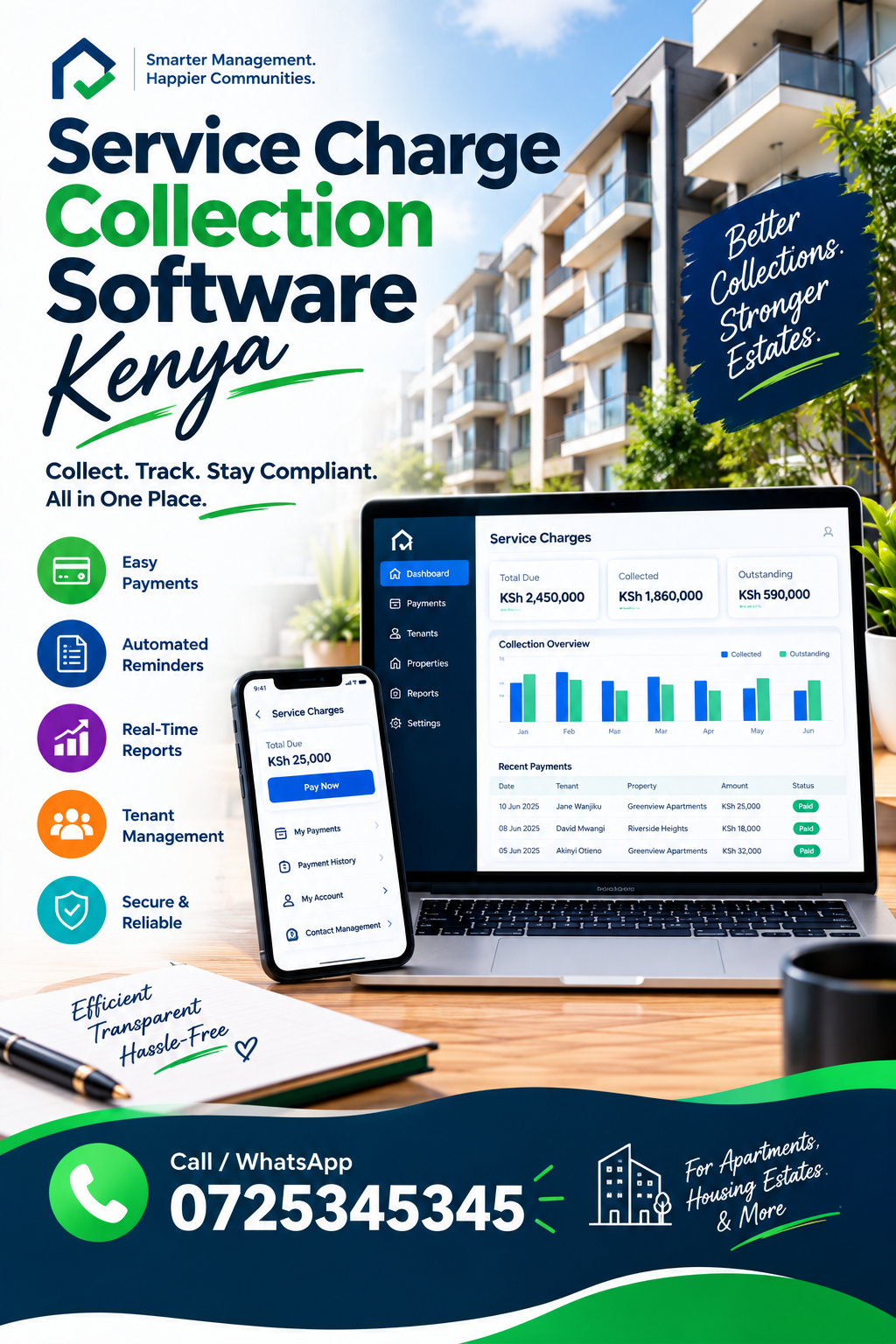
How Service Charge Collection Works in Kenya: A Practical Guide for Property Managers
Managing service charges sounds straightforward until a property has dozens or hundreds of units, different payment dates, arrears, shared expenses, receipts, owner queries and monthly reports to reconcile. For Kenyan property managers, Service Charge Collection Software Kenya can make this work more organised by bringing billing, payment tracking, tenant and owner records, arrears follow-up and reporting into one system. This guide explains what the software does, why service charge administration can become difficult, the features that matter, how automation can improve collection, and what to consider before choosing a platform.
What service charge collection involves
Service charges are payments made by property owners or occupants to cover shared costs associated with running and maintaining a development. Depending on the property, these costs can include cleaning common areas, security, lighting, landscaping, waste management, lift maintenance, repairs, water for shared facilities and other operational expenses.
The exact arrangement differs from one development to another. A residential apartment block may collect a fixed monthly amount from every unit, while a commercial building may use a different formula based on unit size, agreed contributions or the services provided. Some estates also have additional charges for specific services or exceptional works.
That variety creates an administrative problem. A manager has to know what each unit owes, when it was billed, what has been paid, what remains outstanding and which payments relate to which invoice. A spreadsheet can handle a small number of records, but it becomes harder to maintain as the property portfolio grows.
A dedicated Service Charge Collection Software Kenya system is designed around this type of recurring billing. Instead of keeping property details in one file, invoices in another and payment confirmations somewhere else, the information can be connected. This gives the manager a clearer picture of the account for each unit.
Why manual service charge collection becomes difficult
Manual processes are not automatically bad. They can work when a property is small and the number of transactions is limited. The problem usually appears when the volume increases.
1. Payment records become scattered
A manager may receive payments through different channels and then record them manually. Some residents may send proof of payment by WhatsApp, while others may pay through a bank or mobile money channel. If these records are not organised consistently, matching a payment to the right unit can take time.
2. Arrears are easy to overlook
A unit that misses one payment may become two or three months behind. If the manager relies on memory or manually checks several spreadsheets, follow-up can be delayed.
A Service Charge Collection Software Kenya platform can help by keeping outstanding balances visible. Instead of checking every resident individually, the manager can review accounts that have unpaid balances and prioritise follow-up.
3. Calculations take time
Recurring charges often require repeated calculations. Even when the monthly amount is fixed, the administrator still has to create bills, update payment status and prepare statements. If there are late fees or other charges, the process becomes more complicated.
4. Residents want clear answers
Questions such as “How much do I owe?”, “Which month is unpaid?” or “Did my payment reflect?” are common in property administration. Answering them is easier when a manager can open a unit account and see the billing history.
5. Reporting takes longer than it should
Management committees and property owners may need summaries of collections, arrears and expenses. Preparing these reports manually can turn a routine administrative task into several hours of work.
What is service charge collection software?
At its simplest, service charge collection software is a digital system for creating, managing and tracking charges collected for shared property services.
A useful Service Charge Collection Software Kenya solution should do more than generate an invoice. It should connect the charge to a specific property and unit, keep a record of the amount due, record payments and show the remaining balance.
The most useful systems also support related property management activities. These may include unit management, owner or tenant records, recurring billing, receipts, arrears tracking, expense records, communication and financial reporting.
The goal is not simply to replace paper. The goal is to create a reliable flow of information from the moment a charge is created to the moment it is paid and reconciled.
For example, consider an apartment development with 80 units. If every unit has a monthly service charge, the administrator needs to create 80 billing records, monitor 80 payment statuses and follow up on unpaid accounts. A Service Charge Collection Software Kenya platform can organise these records in one place and reduce the amount of repetitive manual work.
Key features to look for
Not every property management platform handles service charges in the same way. Before choosing one, property managers should look at the features that directly affect daily operations.
Property and unit management
The system should allow the administrator to create properties and their units. Each unit should have a clear record that can be connected to the relevant owner, tenant or account.
This is important because a service charge should not exist as an isolated number. The manager needs to know which property and unit the charge belongs to.
A Service Charge Collection Software Kenya system can be especially useful when a company manages several developments. Instead of maintaining separate spreadsheets for each building, the administrator can work from a central system while still keeping property records distinct.
Recurring billing
Service charges are commonly recurring. A manager should not have to recreate the same billing setup every month if the amount and rules remain unchanged.
Recurring billing can help standardise the process. Once the appropriate charge has been configured, the system can support the repeated creation of billing records according to the property’s setup.
Payment tracking
Payment tracking is one of the most important parts of the process. The manager needs to know the amount billed, amount received and balance remaining.
A Service Charge Collection Software Kenya system can provide a clearer account history, helping the administrator distinguish paid, partially paid and outstanding charges.
Receipts and statements
A resident or owner may need proof of payment or a statement showing their account history. Digital receipts and statements reduce the need to search through paper files or old messages.
Arrears management
Arrears are one of the biggest concerns in service charge administration. The software should make outstanding amounts easy to identify.
A good Service Charge Collection Software Kenya platform can support arrears follow-up by giving managers an account-level view of unpaid charges. Where communication features are available, reminders can also be incorporated into the collection process.
Late fees and interest
Some property arrangements include late fees or interest when payments are made after a defined period. If the property applies such rules, the software should provide a clear way to configure and track them.
The administrator should always confirm that the system’s settings match the property’s approved charging policy rather than assuming that every development uses the same rules.
Reporting
Reports help managers understand collection performance. Useful reports can include total billed, total collected, outstanding balances, payment histories and summaries by property or unit.
A Service Charge Collection Software Kenya solution can turn transaction records into reports that are easier to review during management meetings or routine financial checks.
How automation can improve collection
Automation is valuable when it removes repetitive work without removing human oversight.
Imagine a property manager who normally spends the first few days of every month preparing service charge invoices. The process involves opening a spreadsheet, copying unit numbers, entering amounts, checking names and then preparing individual records.
With a properly configured Service Charge Collection Software Kenya system, much of the repetitive setup can be handled within the platform. The manager can spend more time checking exceptions and following up on accounts rather than recreating the same records.
Automation can also improve consistency. A recurring charge that is configured once is less likely to be mistyped every month than a figure manually entered dozens of times.
The important point is that automation should support the administrator, not operate without review. Managers should still check unusual balances, adjustments, disputed charges and other exceptions before acting on them.
M-Pesa and Kenyan payment habits
Payment convenience matters in Kenya. Mobile money is part of everyday business for many consumers and organisations, so property managers often need a collection process that fits the payment methods their residents already use.
A Service Charge Collection Software Kenya platform that supports suitable payment workflows can make it easier to connect incoming payments with resident accounts. However, the exact payment integrations offered by a software provider should be verified before purchase.
The administrator should ask practical questions:
- Which payment channels are supported?
- How are payments matched to units?
- Are transaction references captured?
- How quickly are payments reflected?
- Can a payment be allocated to an invoice or account?
- What happens when a resident pays the wrong amount?
- Can administrators correct a misallocation without deleting the audit trail?
These questions are more useful than choosing software simply because it advertises “M-Pesa integration.”
A simple example of monthly collection
Consider a residential development with 50 units and a monthly service charge set by the property’s management arrangement.
At the beginning of the billing period, the administrator creates the monthly charges. Each unit receives a billing record. During the month, payments are received and allocated to the appropriate accounts.
At the end of the period, the administrator checks the collection report. Suppose 43 units have paid in full, four have made partial payments and three have not paid.
With a Service Charge Collection Software Kenya system, the administrator can review the outstanding accounts and see which balances require follow-up. The manager can then contact the relevant residents instead of manually checking all 50 accounts.
The example is simple, but the time saving becomes more significant when the same process is repeated across multiple properties.
Service charge collection for apartment managers
Apartment managers have to balance financial administration with day-to-day property operations. They may be dealing with security contractors, cleaners, maintenance teams, residents, landlords and management committees at the same time.
A Service Charge Collection Software Kenya platform can bring the financial side of service charge administration into a more structured workflow.
For example, a manager could maintain:
- A property profile
- A list of apartment units
- Owner and tenant information
- Recurring service charges
- Payment records
- Outstanding balances
- Receipts and statements
- Relevant reports
Having these records connected can make it easier to move from a resident’s question to the underlying account information.
Service charge collection for commercial properties
Commercial buildings may have more complex charging arrangements. Different tenants can occupy different-sized spaces, and the services provided may vary.
The right Service Charge Collection Software Kenya software should therefore be flexible enough to support the building’s actual billing structure. The administrator should be able to understand how charges are calculated and trace a billed amount back to the relevant account.
Commercial property managers may also need clearer reporting because multiple stakeholders can be involved in reviewing income and shared operating costs.
The software should make records easy to audit internally. If an amount is changed, the administrator should know what changed, why it changed and which account was affected.
Improving arrears follow-up
Collecting service charges is not only about issuing bills. It is also about following up on unpaid balances in a consistent manner.
A practical arrears process can include:
- Identify outstanding accounts.
- Review the age and amount of the balance.
- Confirm that the charge is correct.
- Check whether a payment has been received but not allocated.
- Contact the account holder with clear information.
- Record relevant follow-up actions.
- Monitor the account until it is resolved.
A Service Charge Collection Software Kenya system can make the first and sixth steps easier when it provides clear account histories and administrative records.
Managers should avoid sending automated reminders without checking disputed accounts. A resident who has already paid should not receive a demand simply because a transaction has not yet been reconciled.
Statements and transparency
Service charge disputes sometimes begin with a lack of information. A resident may see a balance and not understand where it came from.
Clear statements can reduce this confusion by showing charges, payments, adjustments and balances over time.
A Service Charge Collection Software Kenya platform that keeps a detailed account history can help administrators answer questions with evidence rather than relying on memory.
For example, if a resident says they paid last month, the manager can check the payment record. If the payment is present but allocated to another unit, the issue can be corrected through the proper administrative process.
Transparency is also useful for management committees because it gives them a clearer view of collection activity.
Reporting for property management teams
Reports are useful when they answer a specific management question.
Instead of producing reports simply because the software has a reporting button, managers should identify the information they actually need.
Common questions include:
- How much was billed this month?
- How much has been collected?
- Which units have balances?
- How old are the outstanding balances?
- Which properties are collecting well?
- What payments were received during a particular period?
- Are there unusual adjustments?
A Service Charge Collection Software Kenya system can support these questions when its reporting tools are properly configured.
For a property company managing several buildings, reporting by property can be particularly helpful. It separates one development’s performance from another and reduces the risk of mixing records.
Why data accuracy matters
Software cannot fix inaccurate information automatically. If a unit is entered under the wrong property, a charge can still be associated with the wrong account.
That is why data setup should be treated as an important implementation stage.
Before going live, managers should check:
- Property names
- Unit numbers
- Owner details
- Tenant details where applicable
- Opening balances
- Charge amounts
- Billing dates
- Late fee rules
- Payment records
- User permissions
A Service Charge Collection Software Kenya platform becomes much more useful when the underlying data is clean.
It is also worth creating a simple procedure for correcting errors. The administrator should know who can edit a charge, who can approve adjustments and how corrections are recorded.
Security and user access
Property management systems contain business and personal information, so access should be controlled.
A manager should ask whether the platform provides user accounts and permission controls. Not every staff member needs access to every function.
For example, a person responsible for entering payments may not need the same permissions as the person responsible for configuring charges or viewing sensitive reports.
A Service Charge Collection Software Kenya system should also be assessed for its approach to data protection, backups, account security and access management. Ask the provider how data is stored, how backups are handled and what happens if an authorised user’s account is compromised.
Security is not a feature to consider only after implementation. It should be part of the selection process.
Cloud-based access for property managers
Property managers are not always sitting in an office. They may visit buildings, meet contractors, inspect common areas or respond to resident issues.
A Service Charge Collection Software Kenya cloud-based solution can be useful when managers need to access records from different locations, provided they have a reliable internet connection and the provider’s system is designed for secure remote access.
Before choosing a cloud platform, test it on the devices your team actually uses. Check how it behaves on a laptop, tablet or phone if mobile access matters to your workflow.
Integrating service charges with wider property management
Service charge administration rarely exists on its own. Property managers also deal with maintenance, tenants, owners, units, expenses and communication.
A Service Charge Collection Software Kenya solution can be more valuable when it fits into a wider property management workflow rather than forcing staff to maintain several disconnected systems.
For instance, a maintenance expense may relate to a particular building, while the cost may eventually need to be reflected in financial records or management reports. Keeping property information organised makes these relationships easier to understand.
The aim should be a single source of reliable information wherever practical.
How to choose the right software in Kenya
There are many factors to compare, but property managers can start with the following checklist.
1. Understand your current process
Write down how you currently create charges, receive payments, reconcile accounts, follow up on arrears and prepare reports.
This shows what the software actually needs to solve.
2. List must-have features
A Service Charge Collection Software Kenya platform should be judged against your actual requirements. For example:
- Property and unit management
- Recurring billing
- Payment tracking
- Receipts
- Statements
- Arrears monitoring
- Reporting
- User permissions
- Relevant payment integrations
3. Ask for a demonstration
A live demonstration is more useful than a feature list. Ask the provider to demonstrate the exact workflow you use.
For example, ask them to create a property, add units, configure a service charge, record a payment, generate a receipt and show an arrears report.
4. Test usability
If staff struggle to understand the interface, adoption will suffer. A Service Charge Collection Software Kenya system should be reasonably clear for the people who will use it every day.
5. Understand pricing
Do not compare only the headline subscription price. Ask whether pricing changes based on properties, units, users, transactions or additional modules.
Also ask about setup, training, support and integrations.
Questions to ask a software provider
Before signing up, ask practical questions rather than relying only on marketing claims.
A Service Charge Collection Software Kenya provider should be able to explain how its system handles the workflows relevant to your property.
Ask:
- Can I manage multiple properties?
- Can I create and manage units?
- Can I configure recurring service charges?
- Can I track partial payments?
- Can I see outstanding balances?
- Can I generate statements?
- Can I produce collection reports?
- Can I manage late fees or interest where required?
- How are payment references handled?
- What user permissions are available?
- How is data backed up?
- What support is included?
- Can existing records be imported?
- What happens if we need to export our data?
The answers will help you determine whether the platform fits the business rather than simply looking impressive during a sales demonstration.
Common mistakes when implementing collection software
Buying software is only the first step. Poor implementation can create the same problems that existed before.
Uploading incomplete data
If some units are missing, the billing picture will be incomplete. Start with a verified property and unit list.
Ignoring opening balances
If a development already has arrears, those balances need to be handled carefully. Otherwise, the first statements produced by the new system may be misleading.
Giving everyone full access
Too many administrative permissions increase the chance of accidental changes. Use role-based access where possible.
Automating before testing
A Service Charge Collection Software Kenya system should be tested before recurring billing or automated reminders are relied upon. Create test accounts and confirm that calculations, statements and payment allocation work as expected.
Failing to train staff
Even simple software requires a basic operating procedure. Staff should know how to create a charge, record a payment, correct an error and produce a report.
Moving from spreadsheets to a digital system
Switching from spreadsheets does not have to happen overnight.
A controlled migration can be easier.
Start by identifying the information that must move into the new system. This may include properties, units, account holders, opening balances and active charges.
Then clean the data. Remove duplicate records, standardise unit names and check balances.
After that, test a small set of accounts. Create charges, record payments and generate statements. Compare the results with the existing records.
A Service Charge Collection Software Kenya platform can then be introduced gradually, allowing the team to gain confidence before all properties are moved across.
The role of administrators
Software does not remove the need for a competent property administrator. Instead, it changes where their time is spent.
A manager should spend less time copying numbers between spreadsheets and more time reviewing exceptions, resolving disputes, communicating with residents and making sure the property operates properly.
A Service Charge Collection Software Kenya system can help with routine organisation, but human judgement remains important. Managers still need to decide whether a charge is valid, whether a payment should be allocated differently and how a disputed account should be handled.
Handling partial payments
Partial payments are common enough to deserve attention during software selection.
Suppose a unit has an outstanding service charge balance and the account holder pays only part of it. The system should make it possible to record the payment accurately and retain the remaining balance.
A Service Charge Collection Software Kenya solution should make the account status understandable after the transaction. The administrator should not have to create a separate spreadsheet just to track the unpaid portion.
Partial payments also matter when preparing arrears reports. The report should distinguish between an account that has paid nothing and one that has paid part of the amount due.
Managing adjustments and corrections
Errors happen. A charge may be entered incorrectly, a payment may be allocated to the wrong unit or an approved adjustment may need to be made.
The answer is not to hide the mistake. A good administrative process should preserve an understandable record of what happened.
A Service Charge Collection Software Kenya system should therefore be assessed for how it handles edits, reversals and adjustments. Ask whether changes are logged and whether authorised users can see the relevant history.
This becomes particularly important when multiple employees manage the same portfolio.
Service charge budgets and expenses
Collection is one side of service charge management. Understanding what the money is intended to support is another.
Property managers may need to monitor shared expenses such as cleaning, security, repairs and common-area utilities. The exact categories will depend on the property.
A Service Charge Collection Software Kenya platform can be useful when it connects collection information with broader financial and property records. This can give management a better picture of income and the costs associated with maintaining the development.
Managers should still distinguish between software records and formal accounting requirements. Where professional accounting or regulatory advice is required, the appropriate professional should be consulted.
Communication with residents
Good collection does not depend entirely on sending more reminders. The quality of information matters.
A clear message can state the amount due, the relevant billing period, the account reference and how payment should be made.
A Service Charge Collection Software Kenya system that supports clear statements and organised records can help the administrator communicate more confidently.
Residents are also more likely to raise disputes when they cannot understand their balances. Giving them a clear account history can reduce unnecessary back-and-forth.
Measuring collection performance
Managers should track collection performance using useful measures rather than vague impressions.
Possible measures include:
- Total amount billed
- Total amount collected
- Outstanding balance
- Number of accounts in arrears
- Value of long-outstanding balances
- Collection rate for a billing period
- Number of disputed accounts
A Service Charge Collection Software Kenya system can make these figures easier to obtain when transactions are recorded consistently.
The numbers should be interpreted carefully. A high collection rate in one month does not necessarily mean every account is healthy if a few large balances remain unpaid.
Service charge collection across multiple properties
A property management company may handle several apartment blocks, gated communities or commercial buildings.
Managing each property independently can become difficult if there is no central view.
A Service Charge Collection Software Kenya platform can help by keeping each property separate while allowing authorised managers to work within one environment. This can reduce the need to maintain multiple unrelated spreadsheets.
The ideal setup depends on the size of the organisation and the number of people involved. A small manager may need only basic controls, while a larger property company may require multiple user roles and detailed reporting.
Why local context matters
Software designed for property management should fit the realities of the market where it is used.
For Kenyan property managers, this includes considering mobile payments, local business practices, internet availability, support responsiveness and the way property teams communicate with residents.
A Service Charge Collection Software Kenya system should therefore be assessed not only by its feature list but also by how well it fits the team’s actual working environment.
Ask whether the provider understands the challenges faced by Kenyan property managers. Local support can matter when staff need help with configuration, billing or payment workflows.
Cost considerations
The cheapest platform is not necessarily the least expensive option in practice.
A low subscription can become costly if staff spend many hours working around limitations. Likewise, a more capable system may not be worthwhile if the property is too small to use its advanced features.
When evaluating a Service Charge Collection Software Kenya option, consider total operating cost.
This can include:
- Subscription fees
- Setup or onboarding
- Data migration
- Training
- Payment integration charges
- Additional users
- Support
- Reporting or premium modules
Calculate the likely cost against the administrative time the system could save and the improvements it could make to visibility and follow-up.
A practical implementation plan
A property manager can use a simple phased approach.
Phase 1: Map the process
Document the current billing and collection process. Identify where errors, delays and duplicate work occur.
Phase 2: Prepare data
Verify properties, units, account holders, charges and opening balances.
Phase 3: Configure the system
Set up the property structure, billing rules, users and relevant payment workflows.
Phase 4: Test
Use sample accounts. Test full payments, partial payments, arrears, statements, receipts and corrections.
Phase 5: Train
Give staff practical exercises rather than only a presentation. They should be able to complete routine tasks independently.
Phase 6: Go live
Move to the new process after the core workflows have been tested.
Phase 7: Review
After the first billing cycles, identify what needs improvement.
A Service Charge Collection Software Kenya solution is most effective when implementation is treated as a process improvement project rather than simply a software purchase.
How service charge software can support cash-flow visibility
Property managers need to know not only what has been billed but what money is actually coming in.
When payment records are updated consistently, a Service Charge Collection Software Kenya system can help show the difference between expected collections and actual collections.
This visibility can support better planning. If several accounts are significantly overdue, the management team can identify the issue earlier and decide on appropriate follow-up.
The software does not guarantee that residents will pay. Its value is in making the information about billing and payments easier to understand and act on.
Using reports in management meetings
Reports become more useful when they are linked to decisions.
A management committee may want to know why collections fell. The administrator can review the outstanding accounts, identify whether the problem is concentrated in a few units or spread across many accounts and then discuss appropriate action.
A Service Charge Collection Software Kenya platform can support this process by reducing the time required to compile the underlying information.
Keep reports simple enough to be understood quickly. A clear arrears list may be more useful in a meeting than a page filled with unnecessary figures.
Supporting accountability
Property management involves multiple people. One employee may create charges, another may record payments and a manager may review reports.
A Service Charge Collection Software Kenya system with suitable user controls can help define responsibilities.
For example, administrators can have access to routine billing while a senior user reviews adjustments. The exact structure should reflect the organisation’s internal controls.
The principle is simple: the system should make it easier to know who can do what and, where supported, maintain records of important actions.
What residents expect from a modern collection process
Residents generally want three things from a billing system: accurate charges, convenient payment options and clear records.
A Service Charge Collection Software Kenya platform can contribute to these expectations by making account information more organised.
Convenience also means reducing unnecessary administrative friction. If a resident has to send the same payment confirmation several times because records are difficult to locate, the process needs improvement.
The best software is therefore not only about the manager’s dashboard. It should improve the overall experience around billing and account management.
When software is especially valuable
The need for dedicated software usually becomes clearer as complexity increases.
It may be particularly useful when a property has:
- Many units
- Several properties
- Recurring monthly charges
- Multiple staff members
- Frequent payment transactions
- Significant arrears
- Regular management reporting
- A need for clearer resident statements
For a small development with very few accounts, spreadsheets may remain workable. The important question is whether the current process is reliable, efficient and easy to audit.
A Service Charge Collection Software Kenya system becomes attractive when manual administration starts consuming time that could be used for higher-value property management work.
Questions to ask during a trial
If a provider offers a demo or trial, do not simply click around the dashboard. Recreate a real scenario.
Ask the team to demonstrate how they would:
- Add a property.
- Add several units.
- Create a recurring service charge.
- Record a full payment.
- Record a partial payment.
- Identify an arrears account.
- Produce a statement.
- Correct a payment allocation.
- Generate a collection report.
A Service Charge Collection Software Kenya platform that handles these workflows clearly is easier to evaluate than one judged only from screenshots or a marketing brochure.
Data migration from an existing system
Migration deserves attention if the property already has years of records.
Do not assume that every old spreadsheet row should be imported without review. Some records may be duplicates, obsolete or inconsistent.
Create a migration checklist covering:
- Active properties
- Active units
- Account holders
- Current balances
- Recent payment history
- Active charges
- Relevant historical records
A Service Charge Collection Software Kenya system should be evaluated partly on the support it provides for this transition. If the provider can import data, understand exactly what formats are supported and what validation is performed.
Staff training and adoption
A system only delivers value when people use it correctly.
Training should cover the tasks employees perform most often. Start with property setup, unit records, billing, payment entry, receipts, statements, arrears and reports.
A Service Charge Collection Software Kenya platform may have many features, but staff do not need to master everything on the first day. Focus first on the core workflow.
Create short internal procedures for common tasks. This helps when a new employee joins the property management team or someone is away.
Handling disputes professionally
Not every unpaid balance means a resident is refusing to pay. There can be genuine disputes over charges, payments or account details.
A Service Charge Collection Software Kenya system can help provide the records needed to investigate such cases, but the manager still needs to communicate professionally.
Before escalating an arrears issue, verify:
- The charge amount
- The billing period
- The account holder
- Previous payments
- Any approved adjustments
- The current outstanding balance
Good records make difficult conversations easier because the discussion can focus on specific transactions rather than assumptions.
Backups and business continuity
A property management company should consider what happens if its primary system becomes unavailable.
Ask the provider about backup practices, service availability, recovery processes and data export.
A Service Charge Collection Software Kenya solution should be assessed for business continuity in addition to everyday convenience.
The manager should also understand what information can be exported and how frequently important reports can be retained for internal records.
Evaluating customer support
Software support becomes important when a billing cycle is approaching and something is not working as expected.
Ask about support channels, response times, working hours, onboarding assistance and whether training materials are provided.
A Service Charge Collection Software Kenya provider that offers responsive support can reduce disruption when the team encounters a technical issue.
Do not assume that support is included simply because a provider has a help page. Confirm what is included in the plan you are considering.
Service charge collection and internal controls
Financial processes benefit from separation of duties where practical.
For example, the person who enters a payment might not be the same person who approves a significant adjustment. The exact controls depend on the organisation.
A Service Charge Collection Software Kenya system can support stronger administration when permissions, records and approval processes are aligned with internal procedures.
Managers should document who is responsible for billing, payment reconciliation, adjustments, reporting and oversight.
Frequently asked questions
What is service charge collection software?
Service charge collection software is a digital system used to create recurring charges, track payments, monitor balances and manage records related to shared property costs. A Service Charge Collection Software Kenya platform may also include wider property management features such as unit records, receipts, statements and reporting.
Can service charge software help with M-Pesa payments?
It can, depending on the platform and its integrations. Before selecting a Service Charge Collection Software Kenya solution, ask the provider exactly how mobile-money transactions are received, matched and reflected in resident accounts.
Is service charge software suitable for apartment buildings?
Yes. Apartment developments are a common use case because managers often need to handle recurring charges across many units. A Service Charge Collection Software Kenya system can help organise unit records, billing, payment tracking and arrears.
Can I manage more than one property?
Many property management systems are designed for multiple properties, but capabilities differ. Ask whether the Service Charge Collection Software Kenya platform supports separate property records, units, users and reports for the portfolio you manage.
Can the software track arrears?
Arrears tracking is a core requirement for collection management. A Service Charge Collection Software Kenya system should make it easy to identify outstanding accounts, review balances and produce useful arrears reports.
Can residents receive statements?
Some systems provide statements and receipts. Check exactly what documents can be generated and whether they can be customised. A Service Charge Collection Software Kenya platform should ideally make account information clear and easy to retrieve.
What if a resident makes a partial payment?
The system should allow the payment to be recorded against the account while leaving the unpaid balance visible. Confirm how the Service Charge Collection Software Kenya solution handles partial payments before implementation.
Can late fees or interest be configured?
Some systems allow late fees, grace periods or interest settings. The available options vary, so confirm whether the Service Charge Collection Software Kenya platform supports the rules used by your property and whether administrators can review calculations before they are applied.
Is cloud-based software better than spreadsheets?
Cloud software can provide centralised access, automated workflows and easier reporting, but it is not automatically better for every property. A Service Charge Collection Software Kenya solution should be chosen based on the property’s size, processes, budget, staff and operational requirements.
How much does service charge software cost in Kenya?
There is no single price that applies to every platform. Pricing can depend on the number of properties, units, users, features, transactions and integrations. Compare the total cost of a Service Charge Collection Software Kenya solution rather than looking only at the monthly subscription.
How long does implementation take?
Implementation time depends on the number of properties, quality of existing data, system complexity and training needs. A small property may be configured faster than a large portfolio. For a Service Charge Collection Software Kenya platform, ask the provider for an implementation plan based on your actual records and workflows.
What should I test before choosing software?
Test the complete collection cycle: create a property, add units, set charges, record payments, handle partial payments, review arrears, generate statements and produce reports. A Service Charge Collection Software Kenya solution should make these core tasks understandable and manageable for the staff who will use it.