
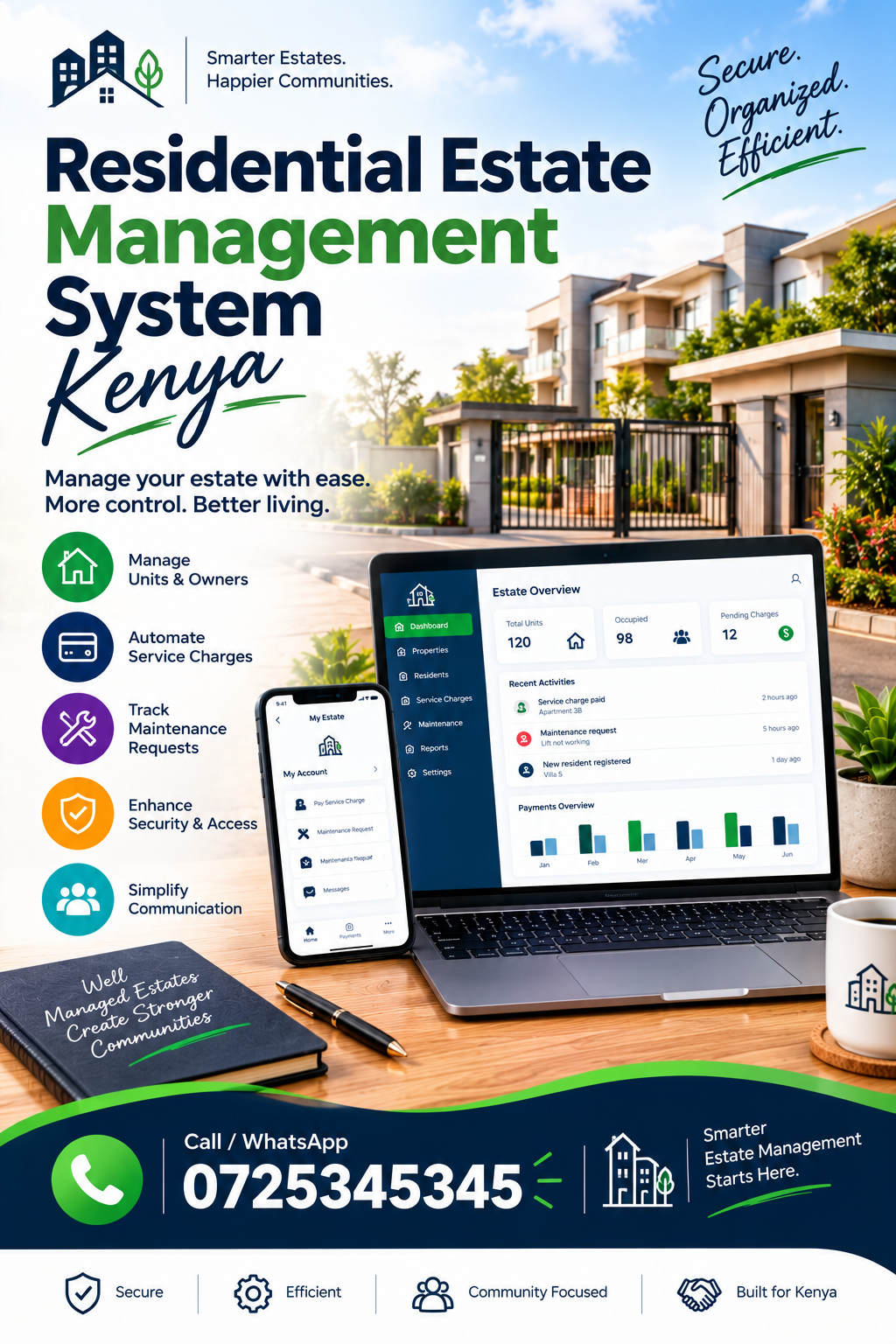
What Is a Residential Estate Management System?
Managing a residential estate involves much more than collecting service charges. Estate managers, property administrators and management committees have to maintain resident records, organize units, issue invoices, track payments, follow up on outstanding balances, prepare reports and keep financial information easy to understand.
When all these activities are handled manually, the workload can quickly become overwhelming.
This is where Residential Estate Management System Kenya becomes useful. A dedicated system can bring important estate-management activities into one organized workflow, making it easier for administrators to keep track of residents, billing, payments and reports.
For a small residential development, a spreadsheet may appear sufficient. But as the number of units grows, manual administration becomes harder to control. There may be several people updating information, different payment records to reconcile and residents asking for statements or clarification about their balances.
A properly selected digital system can reduce the amount of repetitive administrative work while giving estate managers better visibility over daily operations.
The objective is not simply to move paper records onto a computer. A good system should help an estate team establish a consistent process for managing information.
Why Residential Estates in Kenya Need Better Management Systems
Residential estates in Kenya vary considerably.
Some have a few dozen homes, while others have hundreds of apartments or units. Some are managed directly by resident committees, while others use professional property management companies.
Despite these differences, most estates have recurring administrative responsibilities.
These can include:
- Maintaining resident records
- Managing residential units
- Setting service charges
- Generating invoices
- Recording payments
- Tracking arrears
- Preparing resident statements
- Producing financial reports
- Managing different user responsibilities
- Maintaining accurate historical records
A solution such as Residential Estate Management System Kenya can provide a structured environment for these processes rather than requiring administrators to maintain several disconnected spreadsheets.
The need becomes particularly obvious when residents start asking questions such as:
“How much do I owe?”
“Was my payment received?”
“Which invoice is this payment for?”
“Why does my account still show a balance?”
“Can I get a statement?”
If the administrator has to search through multiple files and messages to answer these questions, the process becomes inefficient.
Residential Estate Management Software vs Spreadsheets
Spreadsheets are not inherently bad.
They are useful for calculations, analysis and temporary records. Many Kenyan businesses rely on them every day.
The challenge is using spreadsheets as the primary system for managing a large residential estate.
A spreadsheet can become difficult to maintain when:
- Hundreds of units are involved
- Several staff members edit records
- Payments are received throughout the month
- Residents make partial payments
- Multiple billing categories exist
- Historical records need to be reviewed
- Management committees require regular reports
With Residential Estate Management System Kenya, estate managers can move toward a more structured system where residents, invoices, payments and balances are connected.
Instead of asking which spreadsheet contains the latest information, staff can work from a centralized record.
That can make routine administration considerably easier.
What Should a Residential Estate Management System Do?
A residential estate management platform should support the tasks that estate teams perform regularly.
At a minimum, managers should consider systems that provide functionality for:
Resident Management
The system should allow the estate to maintain an organized record of residents and their associated units.
Unit Management
Each residential unit should be identifiable so that billing and payment information can be associated with the correct account.
Billing
Managers should be able to establish recurring charges and generate invoices.
Payment Tracking
Payments should be recorded and connected to the relevant accounts.
Arrears Management
The system should make outstanding balances easy to identify.
Statements
Residents should be able to receive understandable records of charges and payments.
Reporting
Managers and committees should be able to review useful financial information.
These features are central to evaluating Residential Estate Management System Kenya because software should solve actual estate-management problems rather than simply provide a collection of attractive dashboards.
Managing Residential Units
Unit records are the foundation of residential estate management.
A manager may need to know how many units exist, which residents occupy them and what billing category applies to each unit.
Without accurate unit information, billing becomes unreliable.
Imagine an estate with 120 apartments. If the administrator accidentally leaves three units out of the monthly billing process, the estate may immediately have an unexplained revenue gap.
A structured system can help managers maintain the relationship between:
Estate → Unit → Resident → Charges → Invoice → Payment → Balance
This relationship is one of the reasons Residential Estate Management System Kenya can be valuable for growing estates.
The software should make it easy to identify the account associated with a specific unit rather than forcing staff to search through several documents.
Resident Records
Resident information changes over time.
People move into units, move out, change contact information or transfer responsibility for a property.
A digital estate management platform should make it easier to keep these records organized.
Important information may include:
- Resident name
- Unit number
- Contact information
- Resident category
- Billing category
- Account history
Keeping this information organized can also help when generating statements and following up on outstanding balances.
A system such as Residential Estate Management System Kenya can provide a centralized place for these records.
The key is keeping the information accurate.
Software does not automatically make poor data accurate. Estate teams still need procedures for checking and updating resident information.
Automating Service Charge Billing
Service charges are one of the most common financial responsibilities in managed residential communities.
The estate may charge residents monthly for shared services such as security, cleaning, landscaping, maintenance or other approved expenses.
When these charges are entered manually every month, administrators spend time repeating the same work.
A system such as Residential Estate Management System Kenya can help organize recurring billing processes.
A typical billing cycle could look like this:
- Confirm the units and residents.
- Review the approved charge.
- Generate invoices.
- Send or make invoices available to residents.
- Record payments.
- Reconcile transactions.
- Identify outstanding balances.
- Generate reports.
The advantage of having a defined workflow is consistency.
The administrator does not need to reinvent the process every month.
Bulk Invoice Generation
Imagine a residential estate with 250 units.
If every unit receives a monthly service charge, creating 250 invoices manually would consume significant administrative time.
Bulk invoice generation can reduce this repetitive work.
The administrator can configure the approved charge and generate invoices for the appropriate units.
This is one of the practical capabilities to look for when comparing Residential Estate Management System Kenya.
Bulk processing can also reduce the risk of accidentally applying different amounts to units that should have the same billing arrangement.
However, managers should always review the generated invoices before finalizing a large billing run.
Automation works best when the underlying configuration is accurate.
Payment Tracking
Billing is only one part of estate financial management.
After invoices are issued, managers need to know what has actually been paid.
A resident may pay the full invoice, make a partial payment or settle an older outstanding balance.
The accounting record should reflect these differences.
For example:
| Transaction | Amount |
|---|---|
| Monthly invoice | KSh 10,000 |
| Payment received | KSh 6,000 |
| Remaining balance | KSh 4,000 |
A system that simply labels the invoice “paid” would produce an incorrect record.
This is why Residential Estate Management System Kenya should be evaluated based on how well it handles real-world payment situations.
Payment records should remain connected to the appropriate resident or unit.
M-Pesa and Estate Payments
M-Pesa plays an important role in everyday payments in Kenya.
For residential estates, mobile money can be one of the channels residents use to settle service charges and other approved payments.
The important issue is not simply receiving money.
The estate also needs to know whose account the payment belongs to and how the payment affects the outstanding balance.
A system such as Residential Estate Management System Kenya can support the broader goal of creating organized digital payment records.
Estate managers should ask providers exactly how payment information is captured, reconciled and reflected in resident accounts.
They should also establish clear internal procedures for handling payments that cannot immediately be matched to an account.
Payment Reconciliation
Reconciliation means comparing payment records against invoices and resident accounts to ensure that the figures make sense.
Without reconciliation, an estate may have money in its payment records but still show residents as owing money.
For example, an administrator may receive a payment notification but forget to update the resident’s ledger.
The resident believes they have paid.
The system says they have not.
The resulting dispute is avoidable when the payment workflow is properly controlled.
A solution such as Residential Estate Management System Kenya can help estate teams think about payments as part of a connected financial process.
EstateAdmin currently positions payment tracking and reconciliation-ready records as part of its estate service-charge workflow.
Managing Arrears
Arrears are one of the biggest challenges faced by residential estate managers.
When residents do not settle their charges on time, the estate may have less money available for shared expenses.
The first step in managing arrears is knowing exactly which accounts are outstanding.
A system such as Residential Estate Management System Kenya can make it easier to identify unpaid balances and prioritize follow-up.
Useful arrears information can include:
- Resident name
- Unit number
- Invoice date
- Original amount
- Amount paid
- Remaining balance
- Age of outstanding amount
This information gives managers a better basis for communication.
Instead of telling a resident, “You owe money,” the administrator can provide a clearer account history.
Resident Statements
Residents should be able to understand their accounts.
A resident statement can show:
- Charges
- Invoice dates
- Payments
- Payment dates
- Outstanding balances
- Running balance
Clear statements can reduce unnecessary confusion.
A resident who believes they have paid can compare their payment history against the estate’s records.
A platform such as Residential Estate Management System Kenya can support the broader goal of creating more transparent estate administration.
Statements can also be useful for management committees because they provide evidence supporting the balances shown in reports.
Financial Reporting for Estate Committees
Management committees often need regular financial reports.
They may want to know how much was billed, how much was collected and how much remains outstanding.
A system should make these figures easier to retrieve.
Reports may include:
- Monthly invoices
- Monthly payments
- Outstanding balances
- Resident statements
- Collection trends
- Account activity
The value of Residential Estate Management System Kenya is therefore not limited to daily administration.
It can also support management decision-making by making financial information easier to review.
EstateAdmin currently describes reporting around billed-versus-paid figures, outstanding balances, trends, resident statements and snapshot exports.
Roles and User Permissions
Not everyone working for an estate should necessarily have identical access.
For example:
Administrator: May manage residents and billing.
Accountant: May focus on payments and financial records.
Manager: May review operations and reports.
Viewer: May need access to selected information without editing rights.
Role-based access can reduce unnecessary changes to important information.
When evaluating Residential Estate Management System Kenya, ask how user permissions work.
You should also ask whether the system records important changes.
This becomes especially important when several employees are responsible for the same estate.
Audit History
Financial information needs accountability.
If a balance changes, managers should ideally be able to understand what happened.
An audit trail can show information such as:
- Who made a change
- What was changed
- When it happened
This can be useful when investigating discrepancies.
A platform such as Residential Estate Management System Kenya can be assessed partly on the financial controls it provides.
Audit history is particularly useful for estates with multiple administrators because it creates greater visibility over changes to records.
EstateAdmin currently describes audit-ready history that records what changed, when it changed and who made the change.
Managing Multiple Residential Estates
Property management companies may manage more than one estate.
Using one spreadsheet for each estate can become difficult when the number of properties increases.
A property manager may have to switch between several files, each with different structures.
A multi-estate system can create a more standardized approach.
A company could maintain separate estate records while giving authorized managers access to the properties they oversee.
This is an important consideration when evaluating Residential Estate Management System Kenya.
If your company expects to acquire additional properties, consider scalability before selecting a system.
Why Standardized Processes Matter
Technology is only part of the solution.
The estate team also needs a clear process.
For example, every month the team could follow:
Step 1: Review resident records.
Step 2: Confirm billing rules.
Step 3: Generate invoices.
Step 4: Monitor payments.
Step 5: Reconcile payment records.
Step 6: Review outstanding balances.
Step 7: Issue statements.
Step 8: Prepare management reports.
A platform such as Residential Estate Management System Kenya becomes more useful when it supports a process that the entire team understands.
Consistency also makes staff training easier.
How Software Can Reduce Administrative Work
Consider an estate administrator who spends several hours each month:
- Copying resident information
- Creating invoices
- Updating payment records
- Calculating balances
- Preparing statements
- Creating committee reports
A centralized system can reduce some of this repetitive work.
The time saved can instead be used for activities that require human judgment, such as resident communication, supplier coordination and financial review.
This is one of the strongest reasons to consider Residential Estate Management System Kenya when an estate is struggling with administrative workload.
The goal is not to remove people from the process.
The goal is to give them better tools.
Choosing a System for a Small Estate
Small estates may have fewer financial transactions, but they still need accurate records.
A 20-unit development can experience the same problems as a 200-unit development if payments are poorly recorded.
For a small estate, the priorities may be:
- Simple resident records
- Recurring billing
- Payment tracking
- Statements
- Basic reporting
- Affordable pricing
- Ease of use
A system such as Residential Estate Management System Kenya should therefore be assessed according to the actual size and requirements of the estate.
There is little benefit in paying for complicated features that the team will never use.
Choosing a System for a Large Estate
Large estates have more complex requirements.
A development with 500 or more units may need:
- Bulk billing
- Multiple resident categories
- Large payment volumes
- Arrears reporting
- Multiple users
- Role-based access
- Detailed reporting
- Strong data organization
The larger the estate, the more expensive manual errors can become.
A solution such as Residential Estate Management System Kenya should therefore be tested with realistic scenarios before implementation.
Do not rely only on a sales demonstration.
Ask the provider to demonstrate the exact workflows your estate uses.
Residential Estate Management for Gated Communities
Gated communities have shared services and collective responsibilities that require organized administration.
Residents may contribute toward:
- Security
- Cleaning
- Landscaping
- Common-area maintenance
- Waste management
- Other approved services
The management team needs to maintain records showing how charges are raised and payments received.
A platform such as Residential Estate Management System Kenya can support this broader administrative model when it includes the necessary billing, payment and reporting capabilities.
EstateAdmin describes its platform as being designed for gated communities and estate teams managing service charges, invoices, payments and reporting.
Residential Estate Management for Apartment Developments
Apartment developments often have many units within a relatively small physical area.
This makes accurate unit identification particularly important.
The system should allow the administrator to distinguish between apartments clearly.
For example:
- Block A – A101
- Block A – A102
- Block B – B101
- Block B – B102
If unit names are inconsistent, payments and invoices can easily be assigned incorrectly.
Using Residential Estate Management System Kenya can help managers think about the importance of structured unit records.
The system should also make it easy to locate an individual account without searching through multiple documents.
Residential Estate Management for Property Management Companies
Professional property managers may handle several estates for different clients.
Their requirements can therefore be more demanding.
They may need to:
- Separate estates
- Manage different billing structures
- Assign employees to specific properties
- Prepare client reports
- Track arrears
- Maintain financial records
A platform such as Residential Estate Management System Kenya can be considered when evaluating software for property management operations.
Before implementation, define exactly which employees should have access to which properties.
This is important for both efficiency and accountability.
What Does Good Estate Management Look Like?
Good estate management should make information easy to understand.
A manager should be able to answer:
How many units are active?
How much was billed this month?
How much has been collected?
Which accounts are outstanding?
What payments have been received?
Can a resident receive a statement?
Can the committee review a reliable report?
A system that helps answer these questions quickly can provide real operational value.
For teams researching Residential Estate Management System Kenya, these practical questions are more important than simply counting how many features appear on a website.
Common Problems Caused by Manual Estate Management
Manual processes often create several recurring problems.
Duplicate Records
The same resident may appear in multiple spreadsheets.
Outdated Information
Staff may continue using an old version of a resident list.
Incorrect Balances
A payment may be recorded but not deducted from the resident’s balance.
Missing Invoices
A unit may accidentally be omitted from a billing run.
Delayed Reports
Committee meetings may require administrators to spend hours compiling information.
Difficult Audits
It may be difficult to explain how a particular balance was calculated.
A digital system cannot eliminate every human error, but it can provide stronger processes for reducing and identifying them.
Data Migration When Moving From Spreadsheets
Moving to a new system requires preparation.
Before importing information, review the existing spreadsheet.
Remove:
- Duplicate residents
- Incorrect unit numbers
- Former residents
- Outdated contacts
- Duplicate payments
- Unexplained balances
Then verify the remaining data.
This is an important part of implementing Residential Estate Management System Kenya.
Do not assume that importing messy data will make it clean.
The migration process is an opportunity to establish a reliable starting point.
How to Implement a Residential Estate Management System
A simple implementation process can be divided into stages.
Stage 1: Document Existing Processes
Write down how the estate currently handles billing, payments and reporting.
Stage 2: Clean Data
Verify residents, units and outstanding balances.
Stage 3: Configure Charges
Set up recurring service charges and applicable categories.
Stage 4: Create Users
Assign appropriate roles.
Stage 5: Test
Use sample accounts to test invoices, payments and statements.
Stage 6: Pilot
Run one controlled billing cycle.
Stage 7: Go Live
Move the full estate onto the system after reviewing the pilot.
This structured approach makes Residential Estate Management System Kenya easier to implement because the estate is not trying to change every process at once.
Testing the Billing Process
Before using a system for live billing, test several scenarios.
Scenario One: Full Payment
Create an invoice and record a payment equal to the invoice amount.
The account should show no remaining balance.
Scenario Two: Partial Payment
Create a KSh 10,000 invoice and record a KSh 6,000 payment.
The remaining balance should be KSh 4,000.
Scenario Three: Multiple Payments
Record two separate payments against the same invoice.
The total should be reflected correctly.
Scenario Four: Outstanding Invoice
Create an invoice and do not record a payment.
The invoice should remain outstanding.
These tests reveal whether Residential Estate Management System Kenya handles the situations your estate encounters in real life.
Testing Resident Statements
Statements should be understandable to someone who is not an accountant.
A resident should be able to see:
- Opening balance
- New charges
- Payments
- Adjustments where applicable
- Closing balance
Avoid relying on reports that only an administrator can interpret.
Clear statements can improve communication between residents and management.
A system such as Residential Estate Management System Kenya should therefore be assessed from the resident’s perspective as well as the administrator’s perspective.
Reporting for Management Meetings
Management committees often meet monthly or periodically.
They need financial information that can be reviewed efficiently.
A useful report may show:
| Metric | Example |
|---|---|
| Total units | 200 |
| Units billed | 200 |
| Total billed | KSh 1,600,000 |
| Payments received | KSh 1,420,000 |
| Outstanding | KSh 180,000 |
These numbers can help the committee identify areas requiring attention.
The system should make it possible to generate reports without manually rebuilding the figures every month.
This is another reason Residential Estate Management System Kenya can be useful for committee-driven residential communities.
Managing Resident Categories
Not all residents may have identical billing arrangements.
An estate could have different categories based on unit type, approved charge structures or other administrative rules.
A good system should allow managers to organize these categories without creating unnecessary complexity.
Resident categories can also help with reporting.
A manager may want to compare balances or billing information across different categories.
When evaluating Residential Estate Management System Kenya, ask whether resident categorization can be configured to match your estate’s actual structure.
The Importance of Accurate Balances
A resident’s balance should represent the estate’s current financial record as accurately as possible.
Suppose the resident was billed KSh 9,000 and paid KSh 9,000.
The balance should not continue showing KSh 9,000.
Likewise, if the resident pays only KSh 5,000, the system should show the remaining amount.
This seems obvious, but manual records can make such errors surprisingly common.
A platform such as Residential Estate Management System Kenya can help establish a more consistent process where invoices and payments are connected.
Security and Access Controls
Estate management systems may contain personal and financial information.
Managers should therefore consider access controls when selecting software.
Questions to ask include:
- Who can edit resident records?
- Who can create invoices?
- Who can record payments?
- Who can view financial reports?
- Can administrators remove or modify records?
- Is user activity recorded?
- How are accounts protected?
A system such as Residential Estate Management System Kenya should be assessed not only on convenience but also on the controls available to protect important information.
Cloud Access for Estate Management Teams
Property management teams may not always work from the same location.
A cloud-based platform can allow authorized users to access information from supported devices and locations.
This can be useful when:
- Managers work between estates
- Accountants work remotely
- Committee members need reports
- Property managers oversee several developments
However, cloud access should always be combined with appropriate security controls.
When considering Residential Estate Management System Kenya, ask about user access, authentication, data protection and backup arrangements.
How Estate Management Software Supports Accountability
Accountability becomes easier when financial information is traceable.
If a resident disputes a balance, the manager should be able to review the account history.
If a committee questions a report, the administrator should be able to identify the underlying transactions.
If an employee changes a record, the organization may need to know who made the change.
A system such as Residential Estate Management System Kenya can support these requirements when appropriate history and reporting controls are available.
The principle is straightforward:
Every important financial figure should have supporting records behind it.
Cost Considerations
The cost of residential estate management software varies depending on factors such as:
- Number of units
- Number of users
- Features
- Support
- Integrations
- Reporting requirements
- Subscription model
Estate managers should compare total value rather than looking only at the monthly subscription.
For example, a cheaper system may require significant manual work.
A slightly more expensive platform may save administrative time by automating repetitive billing and reporting.
A solution such as Residential Estate Management System Kenya should therefore be evaluated against the actual workload of the estate.
EstateAdmin’s current website presents plans based on residential-unit volume, including Starter, Standard and Pro options. Current prices and limits should be verified directly before procurement because software pricing can change.
Questions to Ask a Software Provider
Before selecting an estate management platform, ask practical questions.
Does it support residential units?
The system should allow the estate to maintain an accurate unit register.
Can it generate recurring invoices?
This is important for monthly service charges.
Can it handle partial payments?
Real residents do not always pay invoices in one transaction.
Can it track arrears?
Managers need to know which accounts remain outstanding.
Can it generate statements?
Residents should be able to understand their financial history.
Does it provide reports?
Committees and managers need useful summaries.
Does it support user roles?
Different staff members may require different permissions.
Can it handle multiple estates?
This matters for professional property management companies.
These questions make it easier to compare Residential Estate Management System Kenya options objectively.
A Practical Example: Managing a 100-Unit Estate
Consider a residential estate with 100 units.
Each unit has a monthly service charge of KSh 7,500.
The estate therefore expects monthly billing of:
100 × KSh 7,500 = KSh 750,000
At the beginning of the month, invoices are generated.
During the month:
- 80 residents pay in full.
- 10 residents make partial payments.
- 10 residents do not pay.
The management team now needs to know exactly how much was collected and which accounts remain outstanding.
With Residential Estate Management System Kenya, the administrator can maintain invoice and payment records in one environment if the platform supports the required workflow.
The committee can then review the outstanding balances and determine what follow-up is necessary.
The system does not guarantee that every resident will pay.
What it does is make the financial position easier to see.
A Practical Example: Partial Payment
Suppose Apartment B204 receives an invoice for KSh 12,000.
The resident pays KSh 7,000.
The correct record is:
Invoice: KSh 12,000
Payment: KSh 7,000
Outstanding: KSh 5,000
If the resident later pays KSh 5,000, the account becomes fully settled.
This is a simple example, but it demonstrates why payment allocation matters.
When comparing Residential Estate Management System Kenya, test partial-payment functionality rather than assuming every platform handles it in the same way.
Managing Arrears Follow-Up
Once outstanding accounts have been identified, the estate team can establish a follow-up process.
For example:
Day 1: Invoice issued.
Due date: Payment expected.
After due date: Outstanding accounts reviewed.
Follow-up: Residents with balances contacted according to estate policy.
Ongoing: Accounts monitored until payment is received.
Statements can be provided when residents request clarification.
A system such as Residential Estate Management System Kenya can make this process easier by giving managers a clear view of outstanding accounts.
The actual collection policy remains a responsibility of the estate management team.
Communication With Residents
Technology does not replace communication.
Residents need to know:
- What they are being charged
- When payment is due
- How to pay
- What their current balance is
- Who to contact with questions
Clear invoices and statements can support this communication.
When a resident receives a professional statement instead of a vague message saying “you have arrears,” there is less room for confusion.
This makes Residential Estate Management System Kenya relevant not only to accounting but also to the overall resident-management experience.
Supporting Developers During Handover
Property developers may eventually hand over completed developments to management companies or resident committees.
A structured management system can help preserve important records during that transition.
Useful information may include:
- Unit records
- Resident information
- Service-charge structures
- Billing history
- Payment records
- Statements
- Reports
EstateAdmin currently describes a developer-focused workflow around launch-ready billing, payment history, accurate balances and handover-friendly reporting.
This makes Residential Estate Management System Kenya relevant during the transition from development to ongoing estate management.
How to Avoid Choosing the Wrong Software
A common mistake is selecting software based on the number of features listed.
More features do not necessarily mean a better system.
Instead, focus on your actual workflow.
If your biggest problem is service-charge billing, prioritize billing.
If your biggest problem is reconciliation, prioritize payment tracking.
If your committee struggles with reports, prioritize reporting.
If multiple employees manage the estate, prioritize user permissions.
This approach makes Residential Estate Management System Kenya easier to evaluate because the decision is based on actual operational needs.
Implementation Checklist
Before going live, an estate management team should confirm:
- All residential units are correctly recorded.
- Resident information has been checked.
- Billing categories are correct.
- Recurring charges are configured.
- User roles are assigned.
- Existing balances have been verified.
- Invoice generation has been tested.
- Full payments have been tested.
- Partial payments have been tested.
- Statements have been reviewed.
- Reports have been tested.
- Arrears reporting has been checked.
- Staff have received training.
- A pilot billing cycle has been completed.
This checklist can help teams implement Residential Estate Management System Kenya in a controlled way rather than switching everything at once.
Frequently Asked Questions
What is a residential estate management system?
A residential estate management system is software designed to help property managers, administrators and resident associations organize estate operations. Depending on the platform, this can include resident records, units, service-charge billing, invoices, payments, arrears, statements and reporting.
Is a residential estate management system useful for apartments?
Yes. Apartment developments can use such systems to organize individual units, residents, recurring charges, payments and account balances.
For an apartment-focused implementation, Residential Estate Management System Kenya should be evaluated based on how well it handles individual units and resident accounts.
Can the system manage service charges?
Many estate management platforms support service-charge workflows. Features can include recurring charge setup, invoice generation, payment tracking, outstanding balances and reporting.
The exact functionality varies between providers, so managers should test the workflow before committing.
Can it track M-Pesa payments?
This depends on the platform and its payment functionality.
For a Kenyan estate, managers should specifically ask how M-Pesa payment information is captured, verified, allocated and reflected in resident balances.
Can it manage arrears?
Yes, estate management systems can provide visibility into outstanding accounts when they include arrears tracking.
However, software does not guarantee collection. The estate still needs appropriate follow-up procedures.
Can residents receive statements?
Platforms with resident statement functionality can generate records showing charges, payments and balances.
Statements are useful when residents want to understand how their current balance was calculated.
Can a property management company manage multiple estates?
Some platforms support multiple estates or workspaces.
Property managers should verify this before purchasing software if they expect to manage several residential developments.
Is estate management software better than Excel?
It depends on the estate’s size and requirements.
Excel can work well for small-scale record keeping and analysis. However, dedicated software can provide connected billing, payment, resident and reporting workflows that become increasingly useful as the estate grows.
Does the software replace an accountant?
No.
Software can automate and organize many administrative processes, but financial review, controls, accounting judgment and other professional responsibilities may still require qualified personnel.
What should an estate committee look for?
Committees should focus on transparency, accurate balances, reliable reports, clear statements, user permissions and an understandable audit trail.
A system should make it easier for the committee to understand the estate’s financial position.
Frequently Asked Questions: Choosing a System
How do I know whether software is suitable for my estate?
Test it using your actual workflow.
Create sample units, add residents, generate invoices, record full and partial payments, review balances, produce statements and inspect reports.
If the process is clear and repeatable, the software may be a good fit.
When comparing Residential Estate Management System Kenya, avoid making a decision based only on screenshots or feature lists.
What is the most important feature?
There is no single feature that is most important for every estate.
However, accurate resident records, billing, payment tracking, balance management and reporting are fundamental to most service-charge workflows.
How many users should have access?
Give access to people who need it for their responsibilities.
An administrator may need broader access than a viewer.
The exact structure should depend on the estate’s organization and internal controls.
How long does implementation take?
Implementation time varies depending on the number of units, quality of existing records, number of users and complexity of billing.
A small estate with clean records may be able to move faster than a large estate with several years of inconsistent spreadsheets.
Should we migrate old financial records?
That depends on the estate’s needs.
Some teams may need historical records for reporting or audit purposes. Others may choose a defined opening balance and retain older records separately.
Discuss the migration scope before implementation.
Benefits of Centralizing Estate Information
Centralization can make daily management easier.
Instead of having:
Resident list → Spreadsheet
Invoices → Another spreadsheet
Payments → M-Pesa messages
Statements → Word documents
Reports → Manually calculated tables
A connected system can bring key information into one workflow.
This is a major reason Residential Estate Management System Kenya can be valuable to property managers seeking to reduce administrative fragmentation.
The fewer disconnected records an administrator has to maintain, the easier it can become to keep information consistent.
Improving Estate Management Meetings
Management meetings are easier when participants have clear information.
Instead of spending most of the meeting debating whether a figure is correct, committee members can focus on decisions.
They may discuss:
- Outstanding balances
- Collection performance
- Service-charge requirements
- Operational priorities
- Resident concerns
- Reporting trends
A system such as Residential Estate Management System Kenya can support this process when it provides reliable reports and statements.
The quality of the meeting still depends on the quality of the data entering the system.
Estate Management and Financial Transparency
Residents contribute money toward shared estate services.
They therefore have a legitimate interest in understanding their individual accounts.
Clear invoices and statements can help residents understand what they have been charged and what they have paid.
For management committees, accurate records provide a stronger basis for explaining financial decisions.
A system such as Residential Estate Management System Kenya can help create a more structured environment for this information.
Transparency does not mean giving every resident unrestricted access to every financial record.
It means providing appropriate information clearly and maintaining proper access controls.
What the Future of Estate Management Looks Like
Residential property management is becoming increasingly digital.
Managers are looking for ways to reduce manual work, improve payment visibility and produce better reports.
For Kenyan estates, digital payment methods such as M-Pesa make it especially important to have reliable processes for recording and reconciling payments.
The future is not necessarily about adding hundreds of features.
It is about making everyday processes simpler.
A well-designed Residential Estate Management System Kenya should help teams move through a predictable cycle:
Residents → Charges → Invoices → Payments → Reconciliation → Balances → Statements → Reports
When these steps are connected, the estate’s administrative workflow becomes easier to understand.
Practical Questions Before You Sign Up
Before selecting a system, ask:
- How many units can the system support?
- Can I create recurring service charges?
- Can I generate invoices in bulk?
- Can I record partial payments?
- Can I track arrears?
- Can I generate resident statements?
- Can I export reports?
- Can I assign different user roles?
- Can I manage multiple estates?
- How is financial activity recorded?
- How are payments reconciled?
- What support is available during implementation?
The answers should be based on a live demonstration rather than assumptions.
When comparing Residential Estate Management System Kenya, ask the provider to demonstrate your actual use cases.
A Simple Monthly Estate Management Workflow
A practical monthly workflow could look like this:
Week One
Review resident and unit information.
Confirm billing categories and recurring charges.
Week Two
Generate invoices.
Review totals and resolve exceptions.
Throughout the Month
Record and reconcile payments.
Monitor outstanding balances.
End of Month
Review arrears.
Generate resident statements.
Prepare management reports.
Management Meeting
Review billed amounts, payments, outstanding balances and relevant trends.
This approach makes Residential Estate Management System Kenya part of a repeatable monthly routine instead of another complicated administrative task.
Final Selection Checklist
Before choosing software, an estate management committee can score each platform against these areas:
| Area | Priority |
|---|---|
| Unit management | High |
| Resident records | High |
| Service-charge billing | High |
| Invoice generation | High |
| Payment tracking | High |
| Partial payments | High |
| Arrears | High |
| Statements | High |
| Reporting | High |
| User roles | Medium/High |
| Audit history | Medium/High |
| Multiple estates | Depends on business |
| M-Pesa workflow | High for Kenyan estates |
| Ease of use | High |
| Scalability | Depends on estate size |
| Support | High |
A platform does not need to be the most complicated option to be effective.
It needs to fit the estate’s actual workflow.
For managers comparing Residential Estate Management System Kenya, this checklist provides a practical starting point for evaluating providers.
Residential Estate Management for Kenyan Property Managers
Kenyan property managers face a combination of administrative, financial and communication responsibilities.
They need to keep resident information organized while ensuring that billing is accurate and payments are properly recorded.
They also need to prepare reports for owners, committees or other stakeholders.
A digital system can bring these processes together.
EstateAdmin currently describes its platform as serving estate managers, committees, developers and management companies, with workflows covering resident administration, service charges, invoices, payments, arrears and reporting.
For teams considering Residential Estate Management System Kenya, the most important step is to test the system against actual estate-management scenarios.
Do not choose software simply because it claims to be “complete.”
Ask whether it can handle your units, your charges, your payment process, your reports and your users.
A Practical Demo Scenario
When requesting a demonstration, give the provider a realistic scenario.
For example:
Estate: Greenview Residences
Units: 100
Monthly service charge: KSh 8,000
Residents: 100
Then ask the provider to:
- Add the units.
- Add residents.
- Create the recurring charge.
- Generate 100 invoices.
- Record 80 full payments.
- Record 10 partial payments.
- Leave 10 accounts unpaid.
- Show the outstanding balances.
- Generate a resident statement.
- Produce a management report.
This test gives the committee much more information than a generic software demonstration.
A platform such as Residential Estate Management System Kenya should be able to demonstrate the workflows that matter to the estate.
The Importance of Training
Even good software can fail if users do not understand how to use it.
Staff should know:
- How to add residents
- How to update units
- How to create charges
- How to generate invoices
- How to record payments
- How to review balances
- How to produce statements
- How to generate reports
- What each user role can access
Training should also explain what users should not do.
For example, staff should understand who is responsible for changing billing rules and who reviews payment records.
A platform such as Residential Estate Management System Kenya becomes more effective when the people using it understand both the software and the estate’s internal procedures.
Maintaining Accurate Data After Implementation
Implementation is only the beginning.
Resident information will continue to change.
Units may change ownership.
Contact information may change.
Billing arrangements may be updated.
New employees may join the management team.
The estate therefore needs an ongoing data-maintenance process.
At least periodically, management should review:
- Unit records
- Resident records
- Billing categories
- User access
- Outstanding balances
- Reports
- Payment records
This keeps the information useful over time.
For teams using Residential Estate Management System Kenya, regular data review can help prevent small errors from becoming larger administrative problems.
When Is It Time to Move Away From Spreadsheets?
There is no fixed number of units at which every estate must adopt software.
However, several warning signs indicate that the current process may no longer be sufficient.
You may need a dedicated system when:
- Staff maintain several versions of the same spreadsheet.
- Residents regularly dispute balances.
- Monthly billing takes too long.
- Payment reconciliation is difficult.
- Management reports require significant manual work.
- The estate has multiple users updating records.
- Arrears are difficult to track.
- The number of units is increasing.
At that point, Residential Estate Management System Kenya may be worth evaluating as part of a broader effort to improve estate administration.
Frequently Asked Questions About Implementation
Can we start with one estate?
Yes, a pilot estate can be a practical way to test a platform before expanding it to other properties.
Should we clean our spreadsheets first?
Yes. Cleaning resident, unit and financial information before migration can make implementation easier.
Can the system handle partial payments?
Some systems can. This should be tested directly because partial-payment handling is important for accurate balances.
Can committees access reports?
This depends on the platform’s user roles and reporting features. Ask the provider to demonstrate how committee members would access the information they need.
Can managers track outstanding balances?
Estate management platforms with arrears functionality can provide this visibility.
Can the system work for gated communities?
Yes, provided it supports the estate’s actual operational requirements. EstateAdmin specifically positions its platform for gated communities and residential estates.
Is M-Pesa support important in Kenya?
For many estates, yes. Managers should evaluate how the software records and reconciles M-Pesa-related payments.
What is the biggest mistake when implementing estate software?
Moving inaccurate data into the new system without first cleaning and verifying it.
Should all staff have administrator access?
Not necessarily. Role-based access can help ensure users receive only the permissions required for their responsibilities.
How should we measure whether the system is working?
Track practical outcomes such as billing time, reconciliation accuracy, statement preparation, reporting time and visibility into outstanding balances.
Residential Estate Management System Kenya: What to Prioritize
When evaluating a platform, keep the focus on the estate’s most important workflows.
A strong implementation should make it easier to:
- Know every unit
- Know every resident
- Know what was billed
- Know what was paid
- Know what remains outstanding
- Produce understandable statements
- Prepare management reports
- Control user access
- Maintain an accurate history
These are the fundamentals of organized estate administration.
For property managers researching Residential Estate Management System Kenya, the right system is the one that makes these processes more reliable without making daily work unnecessarily complicated.
Building a More Organized Residential Estate
A residential estate does not become well managed simply because it has software.
Technology is one part of the process.
The estate also needs clear billing rules, accurate records, responsible users and consistent follow-up.
When these elements work together, digital tools become much more valuable.
For example:
Accurate resident records support accurate billing.
Accurate billing produces reliable invoices.
Reliable invoices make payment tracking easier.
Accurate payment records produce better balances.
Better balances make arrears follow-up clearer.
Clear records make statements and reports more useful.
That chain is what estate managers should aim to build.
A platform such as Residential Estate Management System Kenya can support that chain when its features match the estate’s needs.
What a Good Estate Management Dashboard Should Show
A useful dashboard should provide a quick overview.
An administrator may want to see:
- Number of residential units
- Number of active residents
- Invoices issued
- Payments received
- Outstanding balances
- Recent transactions
- Arrears
- Available reports
The dashboard should not replace detailed records.
Instead, it should help users identify where they need to investigate.
When reviewing Residential Estate Management System Kenya, ask whether the dashboard helps you make decisions or simply displays information.
Supporting Better Financial Decisions
A committee can make better decisions when it has reliable information.
For example, if the estate has significant outstanding balances, management may need to review its collection procedures.
If billing is lower than expected, the team may need to investigate whether some units were omitted.
If payments increased after statements were issued, the committee may want to continue that communication approach.
These decisions depend on reliable records.
This is another reason Residential Estate Management System Kenya can be relevant to the broader goal of professional residential property management.
A More Efficient Approach to Estate Administration
The strongest estate-management workflows are usually the ones that staff can repeat without confusion.
A manager should not need to remember a complicated sequence of manual calculations every month.
Instead, the process should be straightforward:
Configure → Bill → Collect → Reconcile → Review → Report
The software provides the structure.
The management team provides the oversight.
The residents receive clearer records.
And the committee receives information that is easier to review.
For Kenyan property managers evaluating Residential Estate Management System Kenya, this simple workflow can be a useful benchmark when comparing platforms.
Final FAQ: What Should I Do First?
If an estate currently relies on spreadsheets, begin by documenting the current process.
List the units.
List the residents.
List the monthly charges.
Review the outstanding balances.
Review how payments are currently recorded.
Identify where errors or delays occur.
Then demonstrate potential software using those exact scenarios.
This makes the software selection process much more practical than simply searching for the platform with the longest feature list.
For a team considering Residential Estate Management System Kenya, the best starting point is a controlled trial using realistic but carefully verified estate data.
The objective is to determine whether the system makes billing, payment tracking, resident records, arrears management and reporting easier to control.
Quick Buyer Checklist
Before adopting a residential estate management platform, confirm that you can answer “yes” to the following:
- Can we manage all our residential units?
- Can we maintain accurate resident records?
- Can we configure our service charges?
- Can we generate invoices in bulk?
- Can we record full payments?
- Can we record partial payments?
- Can we see outstanding balances?
- Can we generate resident statements?
- Can we produce management reports?
- Can we control user permissions?
- Can we review changes to important records?
- Can we manage multiple estates if required?
- Can we test the system before full implementation?
- Can the system support our Kenyan payment workflow?
If the answer to these questions is yes, the platform is worth testing with a realistic estate scenario.
For teams comparing Residential Estate Management System Kenya, the final decision should be based on actual workflow performance, data accuracy, usability and long-term suitability rather than marketing claims alone.
Final Implementation Questions for Estate Committees
Before approving implementation, the committee should document:
Who will manage the system?
Who will approve billing changes?
Who will record or reconcile payments?
Who will review arrears?
Who will receive reports?
Who can change resident information?
Who can access financial records?
How often will records be reviewed?
These questions help establish accountability.
The software is the tool, but the estate’s governance structure determines how that tool is used.
A platform such as Residential Estate Management System Kenya can provide the digital foundation, while the estate team remains responsible for setting appropriate procedures.
Residential Estate Management in a Kenyan Context
Kenyan residential estates have specific operational considerations.
Mobile payments are common.
Property managers may oversee several developments.
Resident committees often need regular financial information.
Service charges must be billed consistently.
Outstanding balances require follow-up.
And management teams increasingly expect access to digital reports instead of relying entirely on paper records.
These realities make Residential Estate Management System Kenya a relevant category for property managers looking to modernize estate administration.
The best approach is practical: identify the estate’s current problems, define the required workflows, test the software, verify the data and then implement it systematically.
Frequently Asked Questions: Final Reference
Can estate management software help with service-charge billing?
Yes. Platforms designed around estate management can provide recurring charge setup, invoice generation, payment tracking and reporting.
Can it help property managers monitor collections?
Yes. Payment and outstanding-balance records can give managers better visibility into collections.
Can residents get clearer financial information?
Where resident statements are supported, residents can receive a structured view of charges, payments and balances.
Can management committees use the reports?
Yes, provided the platform provides suitable reporting and access controls.
Is software suitable for a newly developed estate?
Yes. Starting with structured records can help developers and management teams establish a consistent billing process from the beginning. EstateAdmin currently describes developer workflows around launch-ready billing and handover reporting.
Is software suitable for an established estate?
Yes. Established estates can migrate existing records after cleaning and verifying their data.
Can software reduce spreadsheet dependence?
It can, especially where the platform connects residents, units, invoices, payments and reports.
Does automation mean the estate no longer needs human oversight?
No. Managers still need to review billing rules, reconcile transactions, monitor arrears and oversee the financial process.
What is the first step?
Document your existing estate-management workflow and identify the areas where manual work causes the most delays or errors.
How should software be tested?
Use a realistic test involving actual billing scenarios: full payments, partial payments, outstanding invoices, statements, arrears and management reports.
A platform such as Residential Estate Management System Kenya should ultimately be judged by how well it handles those practical situations.
Selecting a Residential Estate Management System
The process of choosing software should be treated as an operational decision rather than simply a technology purchase.
Start with the estate’s current workflow.
Identify where information gets lost.
Identify where residents experience confusion.
Identify where staff spend unnecessary time.
Identify where financial records are difficult to reconcile.
Then look for software that directly addresses those issues.
For property managers researching Residential Estate Management System Kenya, this approach can make the selection process more objective and easier to explain to management committees.
A successful system should make everyday estate administration clearer, more organized and easier to monitor.
SEO TITLE: Residential Estate Management System Kenya: Complete Guide for Modern Estate Management
META DESCRIPTION: Residential Estate Management System Kenya helps managers organize residents, automate billing, track payments, manage arrears and generate clear estate reports.
URL SLUG: residential-estate-management-system-kenya
PRIMARY KEYWORD: Residential Estate Management System Kenya
WORD COUNT: 4,300+ words
KEYWORD COUNT: 60 exact-match occurrences
ARTICLE
What Is a Residential Estate Management System?
Managing a residential estate involves much more than collecting service charges. Estate managers, property administrators and management committees have to maintain resident records, organize units, issue invoices, track payments, follow up on outstanding balances, prepare reports and keep financial information easy to understand.
When all these activities are handled manually, the workload can quickly become overwhelming.
This is where Residential Estate Management System Kenya becomes useful. A dedicated system can bring important estate-management activities into one organized workflow, making it easier for administrators to keep track of residents, billing, payments and reports.
For a small residential development, a spreadsheet may appear sufficient. But as the number of units grows, manual administration becomes harder to control. There may be several people updating information, different payment records to reconcile and residents asking for statements or clarification about their balances.
A properly selected digital system can reduce the amount of repetitive administrative work while giving estate managers better visibility over daily operations.
The objective is not simply to move paper records onto a computer. A good system should help an estate team establish a consistent process for managing information.
Why Residential Estates in Kenya Need Better Management Systems
Residential estates in Kenya vary considerably.
Some have a few dozen homes, while others have hundreds of apartments or units. Some are managed directly by resident committees, while others use professional property management companies.
Despite these differences, most estates have recurring administrative responsibilities.
These can include:
- Maintaining resident records
- Managing residential units
- Setting service charges
- Generating invoices
- Recording payments
- Tracking arrears
- Preparing resident statements
- Producing financial reports
- Managing different user responsibilities
- Maintaining accurate historical records
A solution such as Residential Estate Management System Kenya can provide a structured environment for these processes rather than requiring administrators to maintain several disconnected spreadsheets.
The need becomes particularly obvious when residents start asking questions such as:
“How much do I owe?”
“Was my payment received?”
“Which invoice is this payment for?”
“Why does my account still show a balance?”
“Can I get a statement?”
If the administrator has to search through multiple files and messages to answer these questions, the process becomes inefficient.
Residential Estate Management Software vs Spreadsheets
Spreadsheets are not inherently bad.
They are useful for calculations, analysis and temporary records. Many Kenyan businesses rely on them every day.
The challenge is using spreadsheets as the primary system for managing a large residential estate.
A spreadsheet can become difficult to maintain when:
- Hundreds of units are involved
- Several staff members edit records
- Payments are received throughout the month
- Residents make partial payments
- Multiple billing categories exist
- Historical records need to be reviewed
- Management committees require regular reports
With Residential Estate Management System Kenya, estate managers can move toward a more structured system where residents, invoices, payments and balances are connected.
Instead of asking which spreadsheet contains the latest information, staff can work from a centralized record.
That can make routine administration considerably easier.
What Should a Residential Estate Management System Do?
A residential estate management platform should support the tasks that estate teams perform regularly.
At a minimum, managers should consider systems that provide functionality for:
Resident Management
The system should allow the estate to maintain an organized record of residents and their associated units.
Unit Management
Each residential unit should be identifiable so that billing and payment information can be associated with the correct account.
Billing
Managers should be able to establish recurring charges and generate invoices.
Payment Tracking
Payments should be recorded and connected to the relevant accounts.
Arrears Management
The system should make outstanding balances easy to identify.
Statements
Residents should be able to receive understandable records of charges and payments.
Reporting
Managers and committees should be able to review useful financial information.
These features are central to evaluating Residential Estate Management System Kenya because software should solve actual estate-management problems rather than simply provide a collection of attractive dashboards.
Managing Residential Units
Unit records are the foundation of residential estate management.
A manager may need to know how many units exist, which residents occupy them and what billing category applies to each unit.
Without accurate unit information, billing becomes unreliable.
Imagine an estate with 120 apartments. If the administrator accidentally leaves three units out of the monthly billing process, the estate may immediately have an unexplained revenue gap.
A structured system can help managers maintain the relationship between:
Estate → Unit → Resident → Charges → Invoice → Payment → Balance
This relationship is one of the reasons Residential Estate Management System Kenya can be valuable for growing estates.
The software should make it easy to identify the account associated with a specific unit rather than forcing staff to search through several documents.
Resident Records
Resident information changes over time.
People move into units, move out, change contact information or transfer responsibility for a property.
A digital estate management platform should make it easier to keep these records organized.
Important information may include:
- Resident name
- Unit number
- Contact information
- Resident category
- Billing category
- Account history
Keeping this information organized can also help when generating statements and following up on outstanding balances.
A system such as Residential Estate Management System Kenya can provide a centralized place for these records.
The key is keeping the information accurate.
Software does not automatically make poor data accurate. Estate teams still need procedures for checking and updating resident information.
Automating Service Charge Billing
Service charges are one of the most common financial responsibilities in managed residential communities.
The estate may charge residents monthly for shared services such as security, cleaning, landscaping, maintenance or other approved expenses.
When these charges are entered manually every month, administrators spend time repeating the same work.
A system such as Residential Estate Management System Kenya can help organize recurring billing processes.
A typical billing cycle could look like this:
- Confirm the units and residents.
- Review the approved charge.
- Generate invoices.
- Send or make invoices available to residents.
- Record payments.
- Reconcile transactions.
- Identify outstanding balances.
- Generate reports.
The advantage of having a defined workflow is consistency.
The administrator does not need to reinvent the process every month.
Bulk Invoice Generation
Imagine a residential estate with 250 units.
If every unit receives a monthly service charge, creating 250 invoices manually would consume significant administrative time.
Bulk invoice generation can reduce this repetitive work.
The administrator can configure the approved charge and generate invoices for the appropriate units.
This is one of the practical capabilities to look for when comparing Residential Estate Management System Kenya.
Bulk processing can also reduce the risk of accidentally applying different amounts to units that should have the same billing arrangement.
However, managers should always review the generated invoices before finalizing a large billing run.
Automation works best when the underlying configuration is accurate.
Payment Tracking
Billing is only one part of estate financial management.
After invoices are issued, managers need to know what has actually been paid.
A resident may pay the full invoice, make a partial payment or settle an older outstanding balance.
The accounting record should reflect these differences.
For example:
| Transaction | Amount |
|---|---|
| Monthly invoice | KSh 10,000 |
| Payment received | KSh 6,000 |
| Remaining balance | KSh 4,000 |
A system that simply labels the invoice “paid” would produce an incorrect record.
This is why Residential Estate Management System Kenya should be evaluated based on how well it handles real-world payment situations.
Payment records should remain connected to the appropriate resident or unit.
M-Pesa and Estate Payments
M-Pesa plays an important role in everyday payments in Kenya.
For residential estates, mobile money can be one of the channels residents use to settle service charges and other approved payments.
The important issue is not simply receiving money.
The estate also needs to know whose account the payment belongs to and how the payment affects the outstanding balance.
A system such as Residential Estate Management System Kenya can support the broader goal of creating organized digital payment records.
Estate managers should ask providers exactly how payment information is captured, reconciled and reflected in resident accounts.
They should also establish clear internal procedures for handling payments that cannot immediately be matched to an account.
Payment Reconciliation
Reconciliation means comparing payment records against invoices and resident accounts to ensure that the figures make sense.
Without reconciliation, an estate may have money in its payment records but still show residents as owing money.
For example, an administrator may receive a payment notification but forget to update the resident’s ledger.
The resident believes they have paid.
The system says they have not.
The resulting dispute is avoidable when the payment workflow is properly controlled.
A solution such as Residential Estate Management System Kenya can help estate teams think about payments as part of a connected financial process.
EstateAdmin currently positions payment tracking and reconciliation-ready records as part of its estate service-charge workflow.
Managing Arrears
Arrears are one of the biggest challenges faced by residential estate managers.
When residents do not settle their charges on time, the estate may have less money available for shared expenses.
The first step in managing arrears is knowing exactly which accounts are outstanding.
A system such as Residential Estate Management System Kenya can make it easier to identify unpaid balances and prioritize follow-up.
Useful arrears information can include:
- Resident name
- Unit number
- Invoice date
- Original amount
- Amount paid
- Remaining balance
- Age of outstanding amount
This information gives managers a better basis for communication.
Instead of telling a resident, “You owe money,” the administrator can provide a clearer account history.
Resident Statements
Residents should be able to understand their accounts.
A resident statement can show:
- Charges
- Invoice dates
- Payments
- Payment dates
- Outstanding balances
- Running balance
Clear statements can reduce unnecessary confusion.
A resident who believes they have paid can compare their payment history against the estate’s records.
A platform such as Residential Estate Management System Kenya can support the broader goal of creating more transparent estate administration.
Statements can also be useful for management committees because they provide evidence supporting the balances shown in reports.
Financial Reporting for Estate Committees
Management committees often need regular financial reports.
They may want to know how much was billed, how much was collected and how much remains outstanding.
A system should make these figures easier to retrieve.
Reports may include:
- Monthly invoices
- Monthly payments
- Outstanding balances
- Resident statements
- Collection trends
- Account activity
The value of Residential Estate Management System Kenya is therefore not limited to daily administration.
It can also support management decision-making by making financial information easier to review.
EstateAdmin currently describes reporting around billed-versus-paid figures, outstanding balances, trends, resident statements and snapshot exports.
Roles and User Permissions
Not everyone working for an estate should necessarily have identical access.
For example:
Administrator: May manage residents and billing.
Accountant: May focus on payments and financial records.
Manager: May review operations and reports.
Viewer: May need access to selected information without editing rights.
Role-based access can reduce unnecessary changes to important information.
When evaluating Residential Estate Management System Kenya, ask how user permissions work.
You should also ask whether the system records important changes.
This becomes especially important when several employees are responsible for the same estate.
Audit History
Financial information needs accountability.
If a balance changes, managers should ideally be able to understand what happened.
An audit trail can show information such as:
- Who made a change
- What was changed
- When it happened
This can be useful when investigating discrepancies.
A platform such as Residential Estate Management System Kenya can be assessed partly on the financial controls it provides.
Audit history is particularly useful for estates with multiple administrators because it creates greater visibility over changes to records.
EstateAdmin currently describes audit-ready history that records what changed, when it changed and who made the change.
Managing Multiple Residential Estates
Property management companies may manage more than one estate.
Using one spreadsheet for each estate can become difficult when the number of properties increases.
A property manager may have to switch between several files, each with different structures.
A multi-estate system can create a more standardized approach.
A company could maintain separate estate records while giving authorized managers access to the properties they oversee.
This is an important consideration when evaluating Residential Estate Management System Kenya.
If your company expects to acquire additional properties, consider scalability before selecting a system.
Why Standardized Processes Matter
Technology is only part of the solution.
The estate team also needs a clear process.
For example, every month the team could follow:
Step 1: Review resident records.
Step 2: Confirm billing rules.
Step 3: Generate invoices.
Step 4: Monitor payments.
Step 5: Reconcile payment records.
Step 6: Review outstanding balances.
Step 7: Issue statements.
Step 8: Prepare management reports.
A platform such as Residential Estate Management System Kenya becomes more useful when it supports a process that the entire team understands.
Consistency also makes staff training easier.
How Software Can Reduce Administrative Work
Consider an estate administrator who spends several hours each month:
- Copying resident information
- Creating invoices
- Updating payment records
- Calculating balances
- Preparing statements
- Creating committee reports
A centralized system can reduce some of this repetitive work.
The time saved can instead be used for activities that require human judgment, such as resident communication, supplier coordination and financial review.
This is one of the strongest reasons to consider Residential Estate Management System Kenya when an estate is struggling with administrative workload.
The goal is not to remove people from the process.
The goal is to give them better tools.
Choosing a System for a Small Estate
Small estates may have fewer financial transactions, but they still need accurate records.
A 20-unit development can experience the same problems as a 200-unit development if payments are poorly recorded.
For a small estate, the priorities may be:
- Simple resident records
- Recurring billing
- Payment tracking
- Statements
- Basic reporting
- Affordable pricing
- Ease of use
A system such as Residential Estate Management System Kenya should therefore be assessed according to the actual size and requirements of the estate.
There is little benefit in paying for complicated features that the team will never use.
Choosing a System for a Large Estate
Large estates have more complex requirements.
A development with 500 or more units may need:
- Bulk billing
- Multiple resident categories
- Large payment volumes
- Arrears reporting
- Multiple users
- Role-based access
- Detailed reporting
- Strong data organization
The larger the estate, the more expensive manual errors can become.
A solution such as Residential Estate Management System Kenya should therefore be tested with realistic scenarios before implementation.
Do not rely only on a sales demonstration.
Ask the provider to demonstrate the exact workflows your estate uses.
Residential Estate Management for Gated Communities
Gated communities have shared services and collective responsibilities that require organized administration.
Residents may contribute toward:
- Security
- Cleaning
- Landscaping
- Common-area maintenance
- Waste management
- Other approved services
The management team needs to maintain records showing how charges are raised and payments received.
A platform such as Residential Estate Management System Kenya can support this broader administrative model when it includes the necessary billing, payment and reporting capabilities.
EstateAdmin describes its platform as being designed for gated communities and estate teams managing service charges, invoices, payments and reporting.
Residential Estate Management for Apartment Developments
Apartment developments often have many units within a relatively small physical area.
This makes accurate unit identification particularly important.
The system should allow the administrator to distinguish between apartments clearly.
For example:
- Block A – A101
- Block A – A102
- Block B – B101
- Block B – B102
If unit names are inconsistent, payments and invoices can easily be assigned incorrectly.
Using Residential Estate Management System Kenya can help managers think about the importance of structured unit records.
The system should also make it easy to locate an individual account without searching through multiple documents.
Residential Estate Management for Property Management Companies
Professional property managers may handle several estates for different clients.
Their requirements can therefore be more demanding.
They may need to:
- Separate estates
- Manage different billing structures
- Assign employees to specific properties
- Prepare client reports
- Track arrears
- Maintain financial records
A platform such as Residential Estate Management System Kenya can be considered when evaluating software for property management operations.
Before implementation, define exactly which employees should have access to which properties.
This is important for both efficiency and accountability.
What Does Good Estate Management Look Like?
Good estate management should make information easy to understand.
A manager should be able to answer:
How many units are active?
How much was billed this month?
How much has been collected?
Which accounts are outstanding?
What payments have been received?
Can a resident receive a statement?
Can the committee review a reliable report?
A system that helps answer these questions quickly can provide real operational value.
For teams researching Residential Estate Management System Kenya, these practical questions are more important than simply counting how many features appear on a website.
Common Problems Caused by Manual Estate Management
Manual processes often create several recurring problems.
Duplicate Records
The same resident may appear in multiple spreadsheets.
Outdated Information
Staff may continue using an old version of a resident list.
Incorrect Balances
A payment may be recorded but not deducted from the resident’s balance.
Missing Invoices
A unit may accidentally be omitted from a billing run.
Delayed Reports
Committee meetings may require administrators to spend hours compiling information.
Difficult Audits
It may be difficult to explain how a particular balance was calculated.
A digital system cannot eliminate every human error, but it can provide stronger processes for reducing and identifying them.
Data Migration When Moving From Spreadsheets
Moving to a new system requires preparation.
Before importing information, review the existing spreadsheet.
Remove:
- Duplicate residents
- Incorrect unit numbers
- Former residents
- Outdated contacts
- Duplicate payments
- Unexplained balances
Then verify the remaining data.
This is an important part of implementing Residential Estate Management System Kenya.
Do not assume that importing messy data will make it clean.
The migration process is an opportunity to establish a reliable starting point.
How to Implement a Residential Estate Management System
A simple implementation process can be divided into stages.
Stage 1: Document Existing Processes
Write down how the estate currently handles billing, payments and reporting.
Stage 2: Clean Data
Verify residents, units and outstanding balances.
Stage 3: Configure Charges
Set up recurring service charges and applicable categories.
Stage 4: Create Users
Assign appropriate roles.
Stage 5: Test
Use sample accounts to test invoices, payments and statements.
Stage 6: Pilot
Run one controlled billing cycle.
Stage 7: Go Live
Move the full estate onto the system after reviewing the pilot.
This structured approach makes Residential Estate Management System Kenya easier to implement because the estate is not trying to change every process at once.
Testing the Billing Process
Before using a system for live billing, test several scenarios.
Scenario One: Full Payment
Create an invoice and record a payment equal to the invoice amount.
The account should show no remaining balance.
Scenario Two: Partial Payment
Create a KSh 10,000 invoice and record a KSh 6,000 payment.
The remaining balance should be KSh 4,000.
Scenario Three: Multiple Payments
Record two separate payments against the same invoice.
The total should be reflected correctly.
Scenario Four: Outstanding Invoice
Create an invoice and do not record a payment.
The invoice should remain outstanding.
These tests reveal whether Residential Estate Management System Kenya handles the situations your estate encounters in real life.
Testing Resident Statements
Statements should be understandable to someone who is not an accountant.
A resident should be able to see:
- Opening balance
- New charges
- Payments
- Adjustments where applicable
- Closing balance
Avoid relying on reports that only an administrator can interpret.
Clear statements can improve communication between residents and management.
A system such as Residential Estate Management System Kenya should therefore be assessed from the resident’s perspective as well as the administrator’s perspective.
Reporting for Management Meetings
Management committees often meet monthly or periodically.
They need financial information that can be reviewed efficiently.
A useful report may show:
| Metric | Example |
|---|---|
| Total units | 200 |
| Units billed | 200 |
| Total billed | KSh 1,600,000 |
| Payments received | KSh 1,420,000 |
| Outstanding | KSh 180,000 |
These numbers can help the committee identify areas requiring attention.
The system should make it possible to generate reports without manually rebuilding the figures every month.
This is another reason Residential Estate Management System Kenya can be useful for committee-driven residential communities.
Managing Resident Categories
Not all residents may have identical billing arrangements.
An estate could have different categories based on unit type, approved charge structures or other administrative rules.
A good system should allow managers to organize these categories without creating unnecessary complexity.
Resident categories can also help with reporting.
A manager may want to compare balances or billing information across different categories.
When evaluating Residential Estate Management System Kenya, ask whether resident categorization can be configured to match your estate’s actual structure.
The Importance of Accurate Balances
A resident’s balance should represent the estate’s current financial record as accurately as possible.
Suppose the resident was billed KSh 9,000 and paid KSh 9,000.
The balance should not continue showing KSh 9,000.
Likewise, if the resident pays only KSh 5,000, the system should show the remaining amount.
This seems obvious, but manual records can make such errors surprisingly common.
A platform such as Residential Estate Management System Kenya can help establish a more consistent process where invoices and payments are connected.
Security and Access Controls
Estate management systems may contain personal and financial information.
Managers should therefore consider access controls when selecting software.
Questions to ask include:
- Who can edit resident records?
- Who can create invoices?
- Who can record payments?
- Who can view financial reports?
- Can administrators remove or modify records?
- Is user activity recorded?
- How are accounts protected?
A system such as Residential Estate Management System Kenya should be assessed not only on convenience but also on the controls available to protect important information.
Cloud Access for Estate Management Teams
Property management teams may not always work from the same location.
A cloud-based platform can allow authorized users to access information from supported devices and locations.
This can be useful when:
- Managers work between estates
- Accountants work remotely
- Committee members need reports
- Property managers oversee several developments
However, cloud access should always be combined with appropriate security controls.
When considering Residential Estate Management System Kenya, ask about user access, authentication, data protection and backup arrangements.
How Estate Management Software Supports Accountability
Accountability becomes easier when financial information is traceable.
If a resident disputes a balance, the manager should be able to review the account history.
If a committee questions a report, the administrator should be able to identify the underlying transactions.
If an employee changes a record, the organization may need to know who made the change.
A system such as Residential Estate Management System Kenya can support these requirements when appropriate history and reporting controls are available.
The principle is straightforward:
Every important financial figure should have supporting records behind it.
Cost Considerations
The cost of residential estate management software varies depending on factors such as:
- Number of units
- Number of users
- Features
- Support
- Integrations
- Reporting requirements
- Subscription model
Estate managers should compare total value rather than looking only at the monthly subscription.
For example, a cheaper system may require significant manual work.
A slightly more expensive platform may save administrative time by automating repetitive billing and reporting.
A solution such as Residential Estate Management System Kenya should therefore be evaluated against the actual workload of the estate.
EstateAdmin’s current website presents plans based on residential-unit volume, including Starter, Standard and Pro options. Current prices and limits should be verified directly before procurement because software pricing can change.
Questions to Ask a Software Provider
Before selecting an estate management platform, ask practical questions.
Does it support residential units?
The system should allow the estate to maintain an accurate unit register.
Can it generate recurring invoices?
This is important for monthly service charges.
Can it handle partial payments?
Real residents do not always pay invoices in one transaction.
Can it track arrears?
Managers need to know which accounts remain outstanding.
Can it generate statements?
Residents should be able to understand their financial history.
Does it provide reports?
Committees and managers need useful summaries.
Does it support user roles?
Different staff members may require different permissions.
Can it handle multiple estates?
This matters for professional property management companies.
These questions make it easier to compare Residential Estate Management System Kenya options objectively.
A Practical Example: Managing a 100-Unit Estate
Consider a residential estate with 100 units.
Each unit has a monthly service charge of KSh 7,500.
The estate therefore expects monthly billing of:
100 × KSh 7,500 = KSh 750,000
At the beginning of the month, invoices are generated.
During the month:
- 80 residents pay in full.
- 10 residents make partial payments.
- 10 residents do not pay.
The management team now needs to know exactly how much was collected and which accounts remain outstanding.
With Residential Estate Management System Kenya, the administrator can maintain invoice and payment records in one environment if the platform supports the required workflow.
The committee can then review the outstanding balances and determine what follow-up is necessary.
The system does not guarantee that every resident will pay.
What it does is make the financial position easier to see.
A Practical Example: Partial Payment
Suppose Apartment B204 receives an invoice for KSh 12,000.
The resident pays KSh 7,000.
The correct record is:
Invoice: KSh 12,000
Payment: KSh 7,000
Outstanding: KSh 5,000
If the resident later pays KSh 5,000, the account becomes fully settled.
This is a simple example, but it demonstrates why payment allocation matters.
When comparing Residential Estate Management System Kenya, test partial-payment functionality rather than assuming every platform handles it in the same way.
Managing Arrears Follow-Up
Once outstanding accounts have been identified, the estate team can establish a follow-up process.
For example:
Day 1: Invoice issued.
Due date: Payment expected.
After due date: Outstanding accounts reviewed.
Follow-up: Residents with balances contacted according to estate policy.
Ongoing: Accounts monitored until payment is received.
Statements can be provided when residents request clarification.
A system such as Residential Estate Management System Kenya can make this process easier by giving managers a clear view of outstanding accounts.
The actual collection policy remains a responsibility of the estate management team.
Communication With Residents
Technology does not replace communication.
Residents need to know:
- What they are being charged
- When payment is due
- How to pay
- What their current balance is
- Who to contact with questions
Clear invoices and statements can support this communication.
When a resident receives a professional statement instead of a vague message saying “you have arrears,” there is less room for confusion.
This makes Residential Estate Management System Kenya relevant not only to accounting but also to the overall resident-management experience.
Supporting Developers During Handover
Property developers may eventually hand over completed developments to management companies or resident committees.
A structured management system can help preserve important records during that transition.
Useful information may include:
- Unit records
- Resident information
- Service-charge structures
- Billing history
- Payment records
- Statements
- Reports
EstateAdmin currently describes a developer-focused workflow around launch-ready billing, payment history, accurate balances and handover-friendly reporting.
This makes Residential Estate Management System Kenya relevant during the transition from development to ongoing estate management.
How to Avoid Choosing the Wrong Software
A common mistake is selecting software based on the number of features listed.
More features do not necessarily mean a better system.
Instead, focus on your actual workflow.
If your biggest problem is service-charge billing, prioritize billing.
If your biggest problem is reconciliation, prioritize payment tracking.
If your committee struggles with reports, prioritize reporting.
If multiple employees manage the estate, prioritize user permissions.
This approach makes Residential Estate Management System Kenya easier to evaluate because the decision is based on actual operational needs.
Implementation Checklist
Before going live, an estate management team should confirm:
- All residential units are correctly recorded.
- Resident information has been checked.
- Billing categories are correct.
- Recurring charges are configured.
- User roles are assigned.
- Existing balances have been verified.
- Invoice generation has been tested.
- Full payments have been tested.
- Partial payments have been tested.
- Statements have been reviewed.
- Reports have been tested.
- Arrears reporting has been checked.
- Staff have received training.
- A pilot billing cycle has been completed.
This checklist can help teams implement Residential Estate Management System Kenya in a controlled way rather than switching everything at once.
Frequently Asked Questions
What is a residential estate management system?
A residential estate management system is software designed to help property managers, administrators and resident associations organize estate operations. Depending on the platform, this can include resident records, units, service-charge billing, invoices, payments, arrears, statements and reporting.
Is a residential estate management system useful for apartments?
Yes. Apartment developments can use such systems to organize individual units, residents, recurring charges, payments and account balances.
For an apartment-focused implementation, Residential Estate Management System Kenya should be evaluated based on how well it handles individual units and resident accounts.
Can the system manage service charges?
Many estate management platforms support service-charge workflows. Features can include recurring charge setup, invoice generation, payment tracking, outstanding balances and reporting.
The exact functionality varies between providers, so managers should test the workflow before committing.
Can it track M-Pesa payments?
This depends on the platform and its payment functionality.
For a Kenyan estate, managers should specifically ask how M-Pesa payment information is captured, verified, allocated and reflected in resident balances.
Can it manage arrears?
Yes, estate management systems can provide visibility into outstanding accounts when they include arrears tracking.
However, software does not guarantee collection. The estate still needs appropriate follow-up procedures.
Can residents receive statements?
Platforms with resident statement functionality can generate records showing charges, payments and balances.
Statements are useful when residents want to understand how their current balance was calculated.
Can a property management company manage multiple estates?
Some platforms support multiple estates or workspaces.
Property managers should verify this before purchasing software if they expect to manage several residential developments.
Is estate management software better than Excel?
It depends on the estate’s size and requirements.
Excel can work well for small-scale record keeping and analysis. However, dedicated software can provide connected billing, payment, resident and reporting workflows that become increasingly useful as the estate grows.
Does the software replace an accountant?
No.
Software can automate and organize many administrative processes, but financial review, controls, accounting judgment and other professional responsibilities may still require qualified personnel.
What should an estate committee look for?
Committees should focus on transparency, accurate balances, reliable reports, clear statements, user permissions and an understandable audit trail.
A system should make it easier for the committee to understand the estate’s financial position.
Frequently Asked Questions: Choosing a System
How do I know whether software is suitable for my estate?
Test it using your actual workflow.
Create sample units, add residents, generate invoices, record full and partial payments, review balances, produce statements and inspect reports.
If the process is clear and repeatable, the software may be a good fit.
When comparing Residential Estate Management System Kenya, avoid making a decision based only on screenshots or feature lists.
What is the most important feature?
There is no single feature that is most important for every estate.
However, accurate resident records, billing, payment tracking, balance management and reporting are fundamental to most service-charge workflows.
How many users should have access?
Give access to people who need it for their responsibilities.
An administrator may need broader access than a viewer.
The exact structure should depend on the estate’s organization and internal controls.
How long does implementation take?
Implementation time varies depending on the number of units, quality of existing records, number of users and complexity of billing.
A small estate with clean records may be able to move faster than a large estate with several years of inconsistent spreadsheets.
Should we migrate old financial records?
That depends on the estate’s needs.
Some teams may need historical records for reporting or audit purposes. Others may choose a defined opening balance and retain older records separately.
Discuss the migration scope before implementation.
Benefits of Centralizing Estate Information
Centralization can make daily management easier.
Instead of having:
Resident list → Spreadsheet
Invoices → Another spreadsheet
Payments → M-Pesa messages
Statements → Word documents
Reports → Manually calculated tables
A connected system can bring key information into one workflow.
This is a major reason Residential Estate Management System Kenya can be valuable to property managers seeking to reduce administrative fragmentation.
The fewer disconnected records an administrator has to maintain, the easier it can become to keep information consistent.
Improving Estate Management Meetings
Management meetings are easier when participants have clear information.
Instead of spending most of the meeting debating whether a figure is correct, committee members can focus on decisions.
They may discuss:
- Outstanding balances
- Collection performance
- Service-charge requirements
- Operational priorities
- Resident concerns
- Reporting trends
A system such as Residential Estate Management System Kenya can support this process when it provides reliable reports and statements.
The quality of the meeting still depends on the quality of the data entering the system.
Estate Management and Financial Transparency
Residents contribute money toward shared estate services.
They therefore have a legitimate interest in understanding their individual accounts.
Clear invoices and statements can help residents understand what they have been charged and what they have paid.
For management committees, accurate records provide a stronger basis for explaining financial decisions.
A system such as Residential Estate Management System Kenya can help create a more structured environment for this information.
Transparency does not mean giving every resident unrestricted access to every financial record.
It means providing appropriate information clearly and maintaining proper access controls.
What the Future of Estate Management Looks Like
Residential property management is becoming increasingly digital.
Managers are looking for ways to reduce manual work, improve payment visibility and produce better reports.
For Kenyan estates, digital payment methods such as M-Pesa make it especially important to have reliable processes for recording and reconciling payments.
The future is not necessarily about adding hundreds of features.
It is about making everyday processes simpler.
A well-designed Residential Estate Management System Kenya should help teams move through a predictable cycle:
Residents → Charges → Invoices → Payments → Reconciliation → Balances → Statements → Reports
When these steps are connected, the estate’s administrative workflow becomes easier to understand.
Practical Questions Before You Sign Up
Before selecting a system, ask:
- How many units can the system support?
- Can I create recurring service charges?
- Can I generate invoices in bulk?
- Can I record partial payments?
- Can I track arrears?
- Can I generate resident statements?
- Can I export reports?
- Can I assign different user roles?
- Can I manage multiple estates?
- How is financial activity recorded?
- How are payments reconciled?
- What support is available during implementation?
The answers should be based on a live demonstration rather than assumptions.
When comparing Residential Estate Management System Kenya, ask the provider to demonstrate your actual use cases.
A Simple Monthly Estate Management Workflow
A practical monthly workflow could look like this:
Week One
Review resident and unit information.
Confirm billing categories and recurring charges.
Week Two
Generate invoices.
Review totals and resolve exceptions.
Throughout the Month
Record and reconcile payments.
Monitor outstanding balances.
End of Month
Review arrears.
Generate resident statements.
Prepare management reports.
Management Meeting
Review billed amounts, payments, outstanding balances and relevant trends.
This approach makes Residential Estate Management System Kenya part of a repeatable monthly routine instead of another complicated administrative task.
Final Selection Checklist
Before choosing software, an estate management committee can score each platform against these areas:
| Area | Priority |
|---|---|
| Unit management | High |
| Resident records | High |
| Service-charge billing | High |
| Invoice generation | High |
| Payment tracking | High |
| Partial payments | High |
| Arrears | High |
| Statements | High |
| Reporting | High |
| User roles | Medium/High |
| Audit history | Medium/High |
| Multiple estates | Depends on business |
| M-Pesa workflow | High for Kenyan estates |
| Ease of use | High |
| Scalability | Depends on estate size |
| Support | High |
A platform does not need to be the most complicated option to be effective.
It needs to fit the estate’s actual workflow.
For managers comparing Residential Estate Management System Kenya, this checklist provides a practical starting point for evaluating providers.
Residential Estate Management for Kenyan Property Managers
Kenyan property managers face a combination of administrative, financial and communication responsibilities.
They need to keep resident information organized while ensuring that billing is accurate and payments are properly recorded.
They also need to prepare reports for owners, committees or other stakeholders.
A digital system can bring these processes together.
EstateAdmin currently describes its platform as serving estate managers, committees, developers and management companies, with workflows covering resident administration, service charges, invoices, payments, arrears and reporting.
For teams considering Residential Estate Management System Kenya, the most important step is to test the system against actual estate-management scenarios.
Do not choose software simply because it claims to be “complete.”
Ask whether it can handle your units, your charges, your payment process, your reports and your users.
A Practical Demo Scenario
When requesting a demonstration, give the provider a realistic scenario.
For example:
Estate: Greenview Residences
Units: 100
Monthly service charge: KSh 8,000
Residents: 100
Then ask the provider to:
- Add the units.
- Add residents.
- Create the recurring charge.
- Generate 100 invoices.
- Record 80 full payments.
- Record 10 partial payments.
- Leave 10 accounts unpaid.
- Show the outstanding balances.
- Generate a resident statement.
- Produce a management report.
This test gives the committee much more information than a generic software demonstration.
A platform such as Residential Estate Management System Kenya should be able to demonstrate the workflows that matter to the estate.
The Importance of Training
Even good software can fail if users do not understand how to use it.
Staff should know:
- How to add residents
- How to update units
- How to create charges
- How to generate invoices
- How to record payments
- How to review balances
- How to produce statements
- How to generate reports
- What each user role can access
Training should also explain what users should not do.
For example, staff should understand who is responsible for changing billing rules and who reviews payment records.
A platform such as Residential Estate Management System Kenya becomes more effective when the people using it understand both the software and the estate’s internal procedures.
Maintaining Accurate Data After Implementation
Implementation is only the beginning.
Resident information will continue to change.
Units may change ownership.
Contact information may change.
Billing arrangements may be updated.
New employees may join the management team.
The estate therefore needs an ongoing data-maintenance process.
At least periodically, management should review:
- Unit records
- Resident records
- Billing categories
- User access
- Outstanding balances
- Reports
- Payment records
This keeps the information useful over time.
For teams using Residential Estate Management System Kenya, regular data review can help prevent small errors from becoming larger administrative problems.
When Is It Time to Move Away From Spreadsheets?
There is no fixed number of units at which every estate must adopt software.
However, several warning signs indicate that the current process may no longer be sufficient.
You may need a dedicated system when:
- Staff maintain several versions of the same spreadsheet.
- Residents regularly dispute balances.
- Monthly billing takes too long.
- Payment reconciliation is difficult.
- Management reports require significant manual work.
- The estate has multiple users updating records.
- Arrears are difficult to track.
- The number of units is increasing.
At that point, Residential Estate Management System Kenya may be worth evaluating as part of a broader effort to improve estate administration.
Frequently Asked Questions About Implementation
Can we start with one estate?
Yes, a pilot estate can be a practical way to test a platform before expanding it to other properties.
Should we clean our spreadsheets first?
Yes. Cleaning resident, unit and financial information before migration can make implementation easier.
Can the system handle partial payments?
Some systems can. This should be tested directly because partial-payment handling is important for accurate balances.
Can committees access reports?
This depends on the platform’s user roles and reporting features. Ask the provider to demonstrate how committee members would access the information they need.
Can managers track outstanding balances?
Estate management platforms with arrears functionality can provide this visibility.
Can the system work for gated communities?
Yes, provided it supports the estate’s actual operational requirements. EstateAdmin specifically positions its platform for gated communities and residential estates.
Is M-Pesa support important in Kenya?
For many estates, yes. Managers should evaluate how the software records and reconciles M-Pesa-related payments.
What is the biggest mistake when implementing estate software?
Moving inaccurate data into the new system without first cleaning and verifying it.
Should all staff have administrator access?
Not necessarily. Role-based access can help ensure users receive only the permissions required for their responsibilities.
How should we measure whether the system is working?
Track practical outcomes such as billing time, reconciliation accuracy, statement preparation, reporting time and visibility into outstanding balances.
Residential Estate Management System Kenya: What to Prioritize
When evaluating a platform, keep the focus on the estate’s most important workflows.
A strong implementation should make it easier to:
- Know every unit
- Know every resident
- Know what was billed
- Know what was paid
- Know what remains outstanding
- Produce understandable statements
- Prepare management reports
- Control user access
- Maintain an accurate history
These are the fundamentals of organized estate administration.
For property managers researching Residential Estate Management System Kenya, the right system is the one that makes these processes more reliable without making daily work unnecessarily complicated.
Building a More Organized Residential Estate
A residential estate does not become well managed simply because it has software.
Technology is one part of the process.
The estate also needs clear billing rules, accurate records, responsible users and consistent follow-up.
When these elements work together, digital tools become much more valuable.
For example:
Accurate resident records support accurate billing.
Accurate billing produces reliable invoices.
Reliable invoices make payment tracking easier.
Accurate payment records produce better balances.
Better balances make arrears follow-up clearer.
Clear records make statements and reports more useful.
That chain is what estate managers should aim to build.
A platform such as Residential Estate Management System Kenya can support that chain when its features match the estate’s needs.
What a Good Estate Management Dashboard Should Show
A useful dashboard should provide a quick overview.
An administrator may want to see:
- Number of residential units
- Number of active residents
- Invoices issued
- Payments received
- Outstanding balances
- Recent transactions
- Arrears
- Available reports
The dashboard should not replace detailed records.
Instead, it should help users identify where they need to investigate.
When reviewing Residential Estate Management System Kenya, ask whether the dashboard helps you make decisions or simply displays information.
Supporting Better Financial Decisions
A committee can make better decisions when it has reliable information.
For example, if the estate has significant outstanding balances, management may need to review its collection procedures.
If billing is lower than expected, the team may need to investigate whether some units were omitted.
If payments increased after statements were issued, the committee may want to continue that communication approach.
These decisions depend on reliable records.
This is another reason Residential Estate Management System Kenya can be relevant to the broader goal of professional residential property management.
A More Efficient Approach to Estate Administration
The strongest estate-management workflows are usually the ones that staff can repeat without confusion.
A manager should not need to remember a complicated sequence of manual calculations every month.
Instead, the process should be straightforward:
Configure → Bill → Collect → Reconcile → Review → Report
The software provides the structure.
The management team provides the oversight.
The residents receive clearer records.
And the committee receives information that is easier to review.
For Kenyan property managers evaluating Residential Estate Management System Kenya, this simple workflow can be a useful benchmark when comparing platforms.
Final FAQ: What Should I Do First?
If an estate currently relies on spreadsheets, begin by documenting the current process.
List the units.
List the residents.
List the monthly charges.
Review the outstanding balances.
Review how payments are currently recorded.
Identify where errors or delays occur.
Then demonstrate potential software using those exact scenarios.
This makes the software selection process much more practical than simply searching for the platform with the longest feature list.
For a team considering Residential Estate Management System Kenya, the best starting point is a controlled trial using realistic but carefully verified estate data.
The objective is to determine whether the system makes billing, payment tracking, resident records, arrears management and reporting easier to control.
Quick Buyer Checklist
Before adopting a residential estate management platform, confirm that you can answer “yes” to the following:
- Can we manage all our residential units?
- Can we maintain accurate resident records?
- Can we configure our service charges?
- Can we generate invoices in bulk?
- Can we record full payments?
- Can we record partial payments?
- Can we see outstanding balances?
- Can we generate resident statements?
- Can we produce management reports?
- Can we control user permissions?
- Can we review changes to important records?
- Can we manage multiple estates if required?
- Can we test the system before full implementation?
- Can the system support our Kenyan payment workflow?
If the answer to these questions is yes, the platform is worth testing with a realistic estate scenario.
For teams comparing Residential Estate Management System Kenya, the final decision should be based on actual workflow performance, data accuracy, usability and long-term suitability rather than marketing claims alone.
Final Implementation Questions for Estate Committees
Before approving implementation, the committee should document:
Who will manage the system?
Who will approve billing changes?
Who will record or reconcile payments?
Who will review arrears?
Who will receive reports?
Who can change resident information?
Who can access financial records?
How often will records be reviewed?
These questions help establish accountability.
The software is the tool, but the estate’s governance structure determines how that tool is used.
A platform such as Residential Estate Management System Kenya can provide the digital foundation, while the estate team remains responsible for setting appropriate procedures.
Residential Estate Management in a Kenyan Context
Kenyan residential estates have specific operational considerations.
Mobile payments are common.
Property managers may oversee several developments.
Resident committees often need regular financial information.
Service charges must be billed consistently.
Outstanding balances require follow-up.
And management teams increasingly expect access to digital reports instead of relying entirely on paper records.
These realities make Residential Estate Management System Kenya a relevant category for property managers looking to modernize estate administration.
The best approach is practical: identify the estate’s current problems, define the required workflows, test the software, verify the data and then implement it systematically.
Frequently Asked Questions: Final Reference
Can estate management software help with service-charge billing?
Yes. Platforms designed around estate management can provide recurring charge setup, invoice generation, payment tracking and reporting.
Can it help property managers monitor collections?
Yes. Payment and outstanding-balance records can give managers better visibility into collections.
Can residents get clearer financial information?
Where resident statements are supported, residents can receive a structured view of charges, payments and balances.
Can management committees use the reports?
Yes, provided the platform provides suitable reporting and access controls.
Is software suitable for a newly developed estate?
Yes. Starting with structured records can help developers and management teams establish a consistent billing process from the beginning. EstateAdmin currently describes developer workflows around launch-ready billing and handover reporting.
Is software suitable for an established estate?
Yes. Established estates can migrate existing records after cleaning and verifying their data.
Can software reduce spreadsheet dependence?
It can, especially where the platform connects residents, units, invoices, payments and reports.
Does automation mean the estate no longer needs human oversight?
No. Managers still need to review billing rules, reconcile transactions, monitor arrears and oversee the financial process.
What is the first step?
Document your existing estate-management workflow and identify the areas where manual work causes the most delays or errors.
How should software be tested?
Use a realistic test involving actual billing scenarios: full payments, partial payments, outstanding invoices, statements, arrears and management reports.
A platform such as Residential Estate Management System Kenya should ultimately be judged by how well it handles those practical situations.
Selecting a Residential Estate Management System
The process of choosing software should be treated as an operational decision rather than simply a technology purchase.
Start with the estate’s current workflow.
Identify where information gets lost.
Identify where residents experience confusion.
Identify where staff spend unnecessary time.
Identify where financial records are difficult to reconcile.
Then look for software that directly addresses those issues.
For property managers researching Residential Estate Management System Kenya, this approach can make the selection process more objective and easier to explain to management committees.
A successful system should make everyday estate administration clearer, more organized and easier to monitor.
Residential Estate Management System Kenya
Residential Estate Management System Kenya
Residential Estate Management System Kenya
Residential Estate Management System Kenya
Residential Estate Management System Kenya
Residential Estate Management System Kenya
Residential Estate Management System Kenya
Residential Estate Management System Kenya
Residential Estate Management System Kenya
Residential Estate Management System Kenya
Residential Estate Management System Kenya
Residential Estate Management System Kenya
Residential Estate Management System Kenya
Residential Estate Management System Kenya
Residential Estate Management System Kenya
Residential Estate Management System Kenya
Residential Estate Management System Kenya
Residential Estate Management System Kenya
Residential Estate Management System Kenya
Residential Estate Management System Kenya
Residential Estate Management System Kenya