
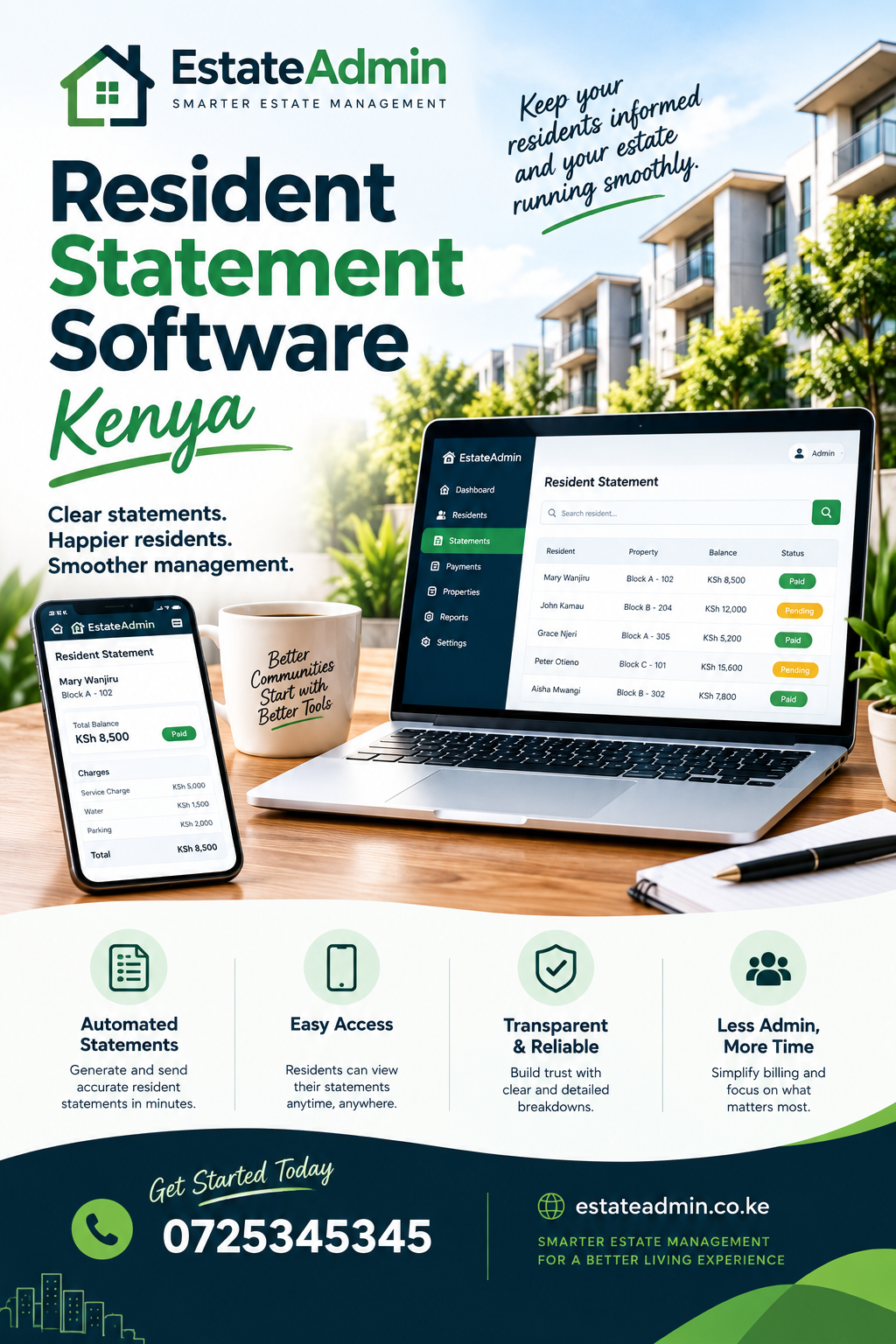
Resident Statement Software Kenya: A Complete Guide for Modern Estate Management
Managing resident accounts manually can become difficult when an estate has dozens or hundreds of households, recurring service charges, partial payments, arrears, adjustments, and frequent requests for account statements. Resident Statement Software Kenya provides a structured way to organize resident billing information and present invoices, payments, balances, and account activity clearly. For estate managers, property administrators, accountants, committees, and developers, having a reliable statement process can make financial communication easier while reducing dependence on scattered spreadsheets, paper records, and manually prepared account summaries.
A resident statement is more than a document showing an amount due. It is an explanation of how an account reached its current position. A useful statement can show previous balances, invoices raised, payments received, adjustments where applicable, and the resulting running balance. When these records are connected to the underlying billing and payment workflow, management teams can answer resident questions with greater consistency.
This is particularly relevant in Kenya, where residential estates, gated communities, apartments, and property management companies often manage recurring service charges and multiple payment references. A structured system can help ensure that the information given to residents reflects the records held by the estate administration team.
What Is Resident Statement Software?
Resident Statement Software Kenya refers to software designed to help property and estate management teams maintain resident account information and generate clear statements from recorded financial activity.
Instead of preparing statements manually, an estate can use a connected system to organize:
- Resident records
- Unit information
- Service charges
- Invoices
- Payments
- Partial payments
- Outstanding balances
- Credits and adjustments
- Arrears
- Transaction histories
- Reporting information
The primary purpose is not simply to create a PDF or printable statement. The more important function is maintaining a reliable relationship between what was billed, what was paid, and what remains outstanding.
For example, imagine a resident receives a monthly service charge invoice of KSh 8,000. The resident pays KSh 5,000 and later pays another KSh 3,000. A properly maintained account should reflect both payments and eventually show the invoice as settled.
If another resident pays only KSh 5,000, the statement should continue to show the remaining KSh 3,000. That distinction is important when estate administrators follow up on arrears.
Why Resident Statements Matter in Kenyan Estates
A clear statement gives both the resident and the estate administration team a common financial reference.
Resident Statement Software Kenya can support this process by organizing transactions into a consistent account history rather than requiring administrators to reconstruct the account from multiple spreadsheets.
Consider some of the questions residents commonly ask:
- What was I billed for this month?
- What was my previous balance?
- Did management receive my payment?
- Was my payment allocated to the correct invoice?
- Why does my account still show an outstanding balance?
- How much do I currently owe?
- Which payments have been recorded?
- Was a previous adjustment applied?
- Can I receive my complete account history?
When information is scattered across spreadsheets, receipts, bank records, M-Pesa references, emails, and WhatsApp conversations, answering these questions can take considerable administrative effort.
A centralized statement process makes the explanation more straightforward.
Moving Away From Spreadsheet-Based Statements
Many estates start with spreadsheets because they are inexpensive and familiar. A simple spreadsheet may work when the number of residents is small and transactions are limited.
However, complexity increases as an estate grows.
Resident Statement Software Kenya can provide a more structured alternative when administrators need to maintain many resident accounts and recurring billing records.
A spreadsheet-based process may involve one file for residents, another for invoices, another for payments, and perhaps another for arrears. The administrator then needs to combine the information whenever a resident requests a statement.
This creates several risks.
Duplicate Records
The same resident may appear in multiple files with slightly different information.
Manual Errors
A formula may be changed accidentally, a payment may be entered twice, or an old balance may not be carried forward correctly.
Version Confusion
Different team members may hold different copies of the same spreadsheet.
Slow Statement Preparation
Producing an individual statement may require several manual steps.
Weak Auditability
It can become difficult to determine who changed a figure and when.
A structured property management platform can reduce these challenges by keeping resident and financial records connected.
What Should a Resident Statement Contain?
A good statement should be easy to understand without requiring the resident to contact the management office for every detail.
Resident Statement Software Kenya can help estates organize statements around the information residents actually need.
A typical statement may contain:
| Statement Element | Purpose |
|---|---|
| Resident name | Identifies the account holder |
| Unit number | Connects the account to the property |
| Opening balance | Shows the position at the beginning of the period |
| Invoice date | Shows when a charge was raised |
| Invoice reference | Provides transaction identification |
| Description | Explains the charge |
| Amount billed | Shows the charge |
| Payment date | Shows when money was recorded |
| Payment reference | Helps verify the payment |
| Amount paid | Shows the received amount |
| Running balance | Shows the account position after each transaction |
| Closing balance | Shows the final amount due or credit |
The exact layout can vary between systems and estates, but clarity should remain the priority.
Invoices and Statements Are Not the Same
An invoice tells a resident what they have been billed.
A statement tells the resident how their account has changed over time.
This distinction is important.
Resident Statement Software Kenya becomes especially useful when an account contains several invoices and payments.
For example:
| Transaction | Debit | Credit | Balance |
|---|---|---|---|
| Opening balance | — | — | KSh 2,000 |
| September service charge | KSh 8,000 | — | KSh 10,000 |
| Payment | — | KSh 5,000 | KSh 5,000 |
| October service charge | KSh 8,000 | — | KSh 13,000 |
| Payment | — | KSh 10,000 | KSh 3,000 |
The resident can immediately see why the current balance is KSh 3,000.
Without a statement, management may simply tell the resident, “Your account has an outstanding balance of KSh 3,000.” That answer does not explain how the balance was calculated.
The Importance of Running Balances
A running balance is one of the most useful features of a well-designed resident account statement.
Resident Statement Software Kenya can help administrators maintain a clearer transaction sequence where invoices and payments are recorded over multiple periods.
Suppose a resident starts the month owing KSh 4,000. A new KSh 10,000 service charge is raised. The account now stands at KSh 14,000.
If the resident pays KSh 7,000, the running balance becomes KSh 7,000.
The next month, another KSh 10,000 charge is raised, making the balance KSh 17,000.
If the resident then pays KSh 12,000, the account falls to KSh 5,000.
A statement showing this progression is far more useful than a single closing figure.
Managing Partial Payments
Partial payments are common in real-world property administration.
A resident may not always pay the entire invoice at once. They may pay part of an amount and settle the remainder later.
Resident Statement Software Kenya can help make these situations easier to track when payment records are connected to resident accounts.
Consider an invoice of KSh 15,000.
The resident pays:
- KSh 5,000 on the first date
- KSh 5,000 later
- KSh 5,000 afterward
The account should show the three payments and the remaining balance after each transaction.
This prevents the administration team from treating the first payment as a full settlement.
Partial payment visibility is also useful for arrears follow-up because staff can distinguish between residents who have made no payment and those who have already made a contribution toward their outstanding balance.
Resident Statements and Arrears Management
Arrears management depends heavily on accurate account information.
Resident Statement Software Kenya can support arrears workflows by helping administrators identify what has been billed, what has been paid, and what remains outstanding.
A resident who owes money may not necessarily understand why the balance exists.
For example, the account may contain:
- An opening arrears amount
- Two monthly service charges
- One partial payment
- A late adjustment
- A new invoice
A statement gives the resident the full sequence.
This can make an arrears conversation more specific.
Instead of saying:
“Your account is overdue.”
The administrator can explain:
“Your account opened with KSh 4,000 outstanding. A KSh 8,000 service charge was added, and KSh 5,000 was subsequently recorded as paid. The remaining balance is KSh 7,000.”
That is a much clearer basis for communication.
Reducing Resident Billing Disputes
Not every billing dispute is caused by incorrect billing.
Sometimes residents simply cannot see how the final figure was calculated.
Resident Statement Software Kenya can improve transparency by presenting the transaction history behind the balance.
Common causes of account queries include:
- A payment that has not yet been recorded
- A payment allocated to the wrong resident
- A partial payment misunderstood as a full payment
- An old balance carried forward
- A duplicated charge
- A missing adjustment
- A resident using a different payment reference
- Confusion between invoice and statement totals
A statement cannot automatically resolve every accounting issue, but it can make the issue visible.
The administration team can then investigate the specific transaction rather than manually reconstructing the entire account.
Payment Records and Resident Statements
Payments form the other half of the resident account.
Resident Statement Software Kenya is most useful when payment records are accurately associated with resident accounts and invoices.
For every recorded payment, administrators may need information such as:
- Resident
- Unit
- Amount
- Date
- Payment method
- Transaction reference
- Invoice allocation
- Remaining balance
In Kenya, residents may use different approved payment channels depending on how an estate has structured its collections.
The important issue is not merely receiving money. The payment must be recorded against the correct account so that the statement reflects the true position.
M-Pesa and Resident Account Records
M-Pesa is widely used for payments in Kenya, including payments associated with residential communities and service charges.
Resident Statement Software Kenya can help place payment information into the broader resident account workflow where the estate’s chosen payment process supports such recording.
However, estates should distinguish between receiving a transaction and correctly allocating it.
For example, if an estate receives a payment reference without enough identifying information, administrators may need to investigate before applying it to a resident account.
A responsible software workflow should not encourage teams to assume that every transaction is automatically matched without verification.
The goal is to maintain an accurate ledger.
Resident Statements for Estate Committees
Estate committees need financial visibility without necessarily performing every administrative task.
Resident Statement Software Kenya can help committees review resident account information through reports and statements prepared from the underlying billing records.
Committee members may need to understand:
- Total billed amounts
- Total payments received
- Outstanding balances
- Partial payments
- Arrears
- Monthly collection trends
- Resident account histories
This information can support committee meetings and financial reviews.
The committee can ask better questions when the underlying records are organized.
For example:
- Which accounts are significantly overdue?
- Are outstanding balances increasing?
- Were payments recorded correctly?
- Are there unusual account adjustments?
- Which residents require follow-up?
Statements therefore become part of a broader governance process.
Statement Generation for Property Managers
Property management companies may oversee multiple estates.
Resident Statement Software Kenya can help standardize how resident accounts are presented across different communities when the platform supports the required estate structure.
Without standardization, every property may develop its own spreadsheet format.
One estate may use columns for invoices and payments. Another may maintain separate sheets. A third may use printed statements.
A standardized digital workflow can create consistency.
Property managers can establish common practices for:
- Recording residents
- Setting up charges
- Generating invoices
- Recording payments
- Reviewing balances
- Generating statements
- Following up on arrears
- Preparing reports
This makes staff training and handovers easier.
Why Accurate Resident Data Matters
A statement is only as reliable as the records behind it.
Resident Statement Software Kenya works best when resident information, unit details, billing rules, and payment records are maintained accurately.
Before generating statements, estate teams should review:
- Resident names
- Unit numbers
- Account identifiers
- Billing categories
- Approved charges
- Previous balances
- Payment records
- Outstanding invoices
Data cleanup is especially important when moving from spreadsheets to a digital system.
A software platform can apply calculations consistently, but it cannot correct inaccurate source information automatically in every situation.
Resident Categories and Different Billing Rules
Not every unit in an estate necessarily has identical billing arrangements.
Some communities may have different categories based on unit type, service arrangements, or approved estate policies.
Resident Statement Software Kenya can be part of a broader billing workflow in which resident categories are used to organize accounts.
For example, an estate might have:
- Standard residential units
- Larger residential units
- Commercial units
- Special categories
- Units with approved adjustments
The actual categories should always reflect the estate’s approved billing structure.
Once categories are configured correctly, statements can help residents understand the charges applied to their accounts.
Monthly Statement Workflow
A consistent monthly workflow is one of the biggest advantages of digital estate administration.
Resident Statement Software Kenya can fit into a process such as:
Step 1: Review Resident Records
Confirm that active units and resident information are current.
Step 2: Review Billing Rules
Check recurring service charges and applicable categories.
Step 3: Generate Invoices
Create the month’s invoices according to the approved billing setup.
Step 4: Record Payments
Enter or reconcile payments against the relevant resident accounts.
Step 5: Review Outstanding Balances
Identify unpaid and partially paid invoices.
Step 6: Generate Statements
Create statements showing the transaction history.
Step 7: Review Exceptions
Investigate unusual balances, missing payments, or incorrect records.
Step 8: Communicate With Residents
Send statements or use them as references during account follow-ups.
Step 9: Prepare Management Reports
Summarize billing, payments, and outstanding balances for management or committee review.
This repeatable process is easier to control than rebuilding statements manually every month.
Digital Records Improve Accessibility
Paper statements can be misplaced.
Emails can be difficult to search.
Spreadsheets can become fragmented.
Resident Statement Software Kenya can help create a centralized digital approach to resident account information.
Digital records can make it easier for authorized staff to retrieve an account when a resident contacts the office.
For example, a resident may ask about a payment made several weeks earlier.
Instead of searching through:
- Receipt books
- Bank statements
- M-Pesa messages
- Email conversations
- WhatsApp messages
- Multiple spreadsheets
the administrator can review the resident’s account history in the system.
That can significantly improve the speed and consistency of account support.
Resident Statements and Financial Transparency
Transparency is essential in community management.
Resident Statement Software Kenya can support transparency by giving residents a clearer explanation of the financial transactions recorded against their accounts.
Residents are more likely to understand an outstanding balance when they can see the underlying transactions.
A transparent statement should answer three fundamental questions:
What was charged?
The statement should identify invoices and applicable charges.
What was paid?
The statement should show recorded payments.
What remains?
The running or closing balance should make the current position clear.
This simple structure can make financial communication much more effective.
Statements for Resident Queries
Resident queries are inevitable in property administration.
Resident Statement Software Kenya can help administrators respond to account questions using a common reference.
For example, a resident might say:
“I paid last month. Why am I still showing an amount due?”
The administrator can review the statement and determine whether:
- The payment was received
- The payment was allocated
- The payment was partial
- The payment was applied to an older balance
- The invoice was different from the resident’s expectation
The statement does not replace investigation, but it gives the administrator a structured starting point.
Audit Trails and Accountability
Financial records require accountability.
Resident Statement Software Kenya can support an environment where resident billing records are maintained systematically, while features such as roles and activity history can help estates understand changes to records.
Access should be assigned according to responsibilities.
For example:
| Role | Typical Responsibility |
|---|---|
| Administrator | Resident and operational records |
| Accountant | Payment and financial records |
| Manager | Oversight and approvals |
| Committee member | Review and governance |
| Viewer | Read-only access where appropriate |
The exact roles should reflect the estate’s internal governance arrangements.
The objective is to avoid a situation where every user can freely change financial information without accountability.
Protecting Resident Financial Information
Resident statements contain financial information and should be handled responsibly.
Resident Statement Software Kenya should be evaluated alongside broader requirements for user access, account security, data handling, and administrative controls.
Estate management teams should consider:
- Who can access resident accounts?
- Who can modify payment records?
- Who can generate statements?
- Who can export information?
- Who can approve changes?
- How are former staff accounts disabled?
- How are administrator credentials protected?
Security is not simply a technology feature.
It also depends on internal procedures.
Strong passwords, appropriate permissions, staff awareness, and controlled access all contribute to better information management.
Statement Exports and Reporting
Resident statements are useful individually, but management teams also need aggregated information.
Resident Statement Software Kenya can form part of a reporting workflow where administrators need both resident-level information and broader estate-level summaries.
For example, management may want to review:
- Total invoices issued
- Total payments recorded
- Total outstanding balances
- Number of partially paid accounts
- Arrears by resident
- Monthly collections
- Statement histories
Exports can also be useful when preparing committee packs or conducting financial reviews.
The important consideration is that reports should be generated from the same underlying records as the resident statements.
Why Consistency Matters
Imagine two residents ask for their statements on the same day.
If one statement is prepared from a spreadsheet and another from a receipt book, the formatting and calculation process may differ.
Resident Statement Software Kenya can help estates create a more consistent approach to resident account reporting.
Consistency means residents receive statements that follow the same basic structure.
It also helps staff because they do not have to invent a new process for every account request.
A consistent statement process can cover:
- Opening position
- Charges
- Payments
- Adjustments
- Running balance
- Closing position
This is particularly useful for larger estates.
Resident Statements During Handover
Property management teams can change.
An estate may appoint a new manager, accountant, administrator, or managing company.
Resident Statement Software Kenya can help preserve a structured account history that makes handover easier when records are maintained digitally.
A new administrator should be able to understand:
- Which residents are active
- Which invoices have been issued
- Which payments have been recorded
- Which balances are outstanding
- Which accounts have arrears
- What transaction history exists
A handover based on scattered personal files can be difficult.
A centralized system creates a better starting point for continuity.
Handling Historical Balances
Migration from an old system often requires opening balances.
Resident Statement Software Kenya can be valuable in a broader migration workflow where an estate needs to transition from spreadsheets or another accounting process.
Before importing historical balances, administrators should identify:
- The resident
- The unit
- The opening amount
- The period covered
- Supporting documentation
- Any disputed balances
- Any pending payments
The objective should be to establish a clear starting point.
An unexplained opening balance can create problems later because residents may question where the amount originated.
Using Statements to Improve Arrears Follow-Up
A statement can make collection communication more specific.
Resident Statement Software Kenya allows the account history to become the reference point for a conversation.
Instead of sending a generic reminder, an administrator can identify:
- Outstanding invoice
- Original amount
- Payments already received
- Remaining balance
- Relevant dates
This distinction is important because residents who have partially paid should not necessarily receive the same communication as residents who have made no payment.
Clear information can help management teams organize follow-up more effectively.
Statements for Gated Communities
Gated communities often have recurring service-charge obligations covering shared services and common-area operations.
Resident Statement Software Kenya can support the financial communication side of this environment by helping connect resident accounts with billing and payment records.
The exact charges will vary from community to community.
They may relate to approved services such as:
- Security
- Landscaping
- Common-area maintenance
- Waste management
- Shared utilities
- Estate administration
- Other approved community expenses
The statement should focus on the charges actually applicable to the resident’s account.
Statements for Apartment Communities
Apartment communities also benefit from structured account statements.
Resident Statement Software Kenya can help apartment administrators present account activity in a standardized format.
An apartment resident may need to distinguish between:
- Current service charge
- Previous balance
- Payment made
- Outstanding amount
- Adjustment
- Credit
This is particularly important where several monthly invoices accumulate.
The more transactions an account contains, the more useful a chronological statement becomes.
Choosing Resident Statement Software
Selecting software should involve more than checking whether the system can generate a statement.
Resident Statement Software Kenya should be assessed as part of the estate’s entire billing and financial workflow.
Consider these questions:
Does it maintain resident records?
A statement needs accurate account ownership.
Does it support invoice generation?
The statement should be connected to actual billing records.
Does it record payments?
Payments should update the account position.
Does it handle partial payments?
Partial payments should not disappear into general totals.
Does it show running balances?
Residents should understand how the closing balance was reached.
Does it support arrears visibility?
Management should identify outstanding accounts.
Does it provide reporting?
Committees and management need summarized information.
Does it provide role-based access?
Financial information should be controlled appropriately.
Does it maintain activity history?
Administrators should be able to review changes where supported.
Questions to Ask a Software Provider
Before adopting a platform, estate managers should test it using realistic scenarios.
Resident Statement Software Kenya should be evaluated against actual estate workflows rather than a generic demonstration.
Ask the provider:
- Can we create resident accounts?
- Can residents be associated with units?
- Can we create recurring charges?
- Can invoices be generated in bulk?
- Can payments be recorded?
- Can partial payments be tracked?
- Can statements show invoices and payments together?
- Does the statement show a running balance?
- Can arrears be identified?
- Can statements be exported?
- Can different users have different permissions?
- Can the system support multiple estates?
- Can we review activity history?
- How is data backed up?
- What happens when a resident account changes?
The best evaluation process uses real examples.
Test a Complete Resident Account
A software demonstration can look impressive while failing to answer practical questions.
Resident Statement Software Kenya should therefore be tested using a realistic account.
Create a sample resident with:
- Opening balance
- New invoice
- Partial payment
- Second invoice
- Additional payment
- Outstanding amount
Then generate the statement.
Check whether the statement clearly explains every transaction.
This is more useful than simply asking whether the platform has a “statement” button.
A Practical Example for a Kenyan Estate
Consider a residential community with a recurring monthly service charge.
A resident begins September with an opening balance of KSh 3,000.
The September invoice is KSh 10,000.
The resident pays KSh 8,000.
The account therefore has KSh 5,000 remaining.
In October, another KSh 10,000 invoice is raised.
The new balance becomes KSh 15,000.
The resident then pays KSh 12,000.
The remaining balance becomes KSh 3,000.
A well-organized statement should make each step visible.
Resident Statement Software Kenya can help structure this type of account history when the underlying invoices and payments are accurately recorded.
The resident can see why KSh 3,000 remains outstanding instead of receiving only a final figure.
Benefits for Estate Administrators
Administrators are often responsible for responding to residents, maintaining records, preparing reports, and following up on arrears.
Resident Statement Software Kenya can reduce some of the repetitive work associated with preparing account information.
Potential operational benefits include:
- Faster retrieval of resident records
- Consistent statement formats
- Easier payment history review
- Better arrears visibility
- Reduced spreadsheet dependence
- Easier reporting
- More organized resident communication
- Better continuity during staff handovers
The biggest benefit is often not the statement itself.
It is the connected workflow behind the statement.
Benefits for Residents
Residents benefit when financial information is easy to understand.
Resident Statement Software Kenya can help provide a clearer account history that residents can use when checking their obligations.
A good statement can give residents confidence that:
- Their payments have been recorded
- Their current balance is visible
- Previous transactions can be reviewed
- Outstanding amounts can be understood
- Queries can be discussed using specific transaction information
Transparency benefits both sides of the relationship.
Benefits for Committees
Committees need enough information to oversee estate finances without becoming involved in every routine transaction.
Resident Statement Software Kenya can support committee reporting by giving decision-makers access to organized resident account information.
Committee members can focus on questions such as:
- Are collections being monitored?
- Are arrears visible?
- Are payment records consistent?
- Are resident queries supported by transaction histories?
- Are reports prepared from the same underlying records?
This supports more informed governance.
Common Mistakes When Managing Resident Statements
Even with software, poor processes can create inaccurate statements.
Resident Statement Software Kenya should therefore be accompanied by sound administrative practices.
Common mistakes include:
1. Entering Incorrect Opening Balances
An incorrect opening balance affects every subsequent statement.
2. Recording Payments Against the Wrong Account
This creates inaccurate resident balances.
3. Ignoring Partial Payments
A partial payment must remain visible as part of the account history.
4. Duplicating Payments
Entering the same transaction twice can artificially reduce a resident’s balance.
5. Failing to Review Exceptions
Unusual balances should be investigated rather than ignored.
6. Giving Too Many Users Financial Editing Rights
Access should be assigned according to responsibility.
7. Relying on Manual Reconciliation
Manual processes become increasingly difficult as transaction volumes grow.
How to Implement a Resident Statement System
Implementation should be controlled rather than rushed.
Resident Statement Software Kenya can deliver better results when an estate starts with clean and verified information.
A practical implementation process can follow these steps.
Step 1: Document the Current Process
Write down how residents, invoices, payments, balances, and statements are currently managed.
Step 2: Clean Resident Data
Remove duplicates and verify unit information.
Step 3: Review Opening Balances
Confirm outstanding amounts before migration.
Step 4: Configure Billing Categories
Set up the estate’s approved billing structure.
Step 5: Add Users
Assign appropriate roles and permissions.
Step 6: Test Representative Accounts
Use accounts with full payments, partial payments, and arrears.
Step 7: Generate Test Statements
Check calculations and presentation.
Step 8: Run a Controlled Billing Cycle
Use one cycle to identify issues.
Step 9: Review Exceptions
Correct discrepancies before expanding the workflow.
Step 10: Standardize the Process
Document how staff should generate and review statements.
Why Staff Training Matters
Software does not eliminate the need for good administration.
Resident Statement Software Kenya should be introduced with clear procedures so staff understand how records should be maintained.
Training can cover:
- Adding residents
- Managing units
- Creating invoices
- Recording payments
- Handling partial payments
- Reviewing balances
- Generating statements
- Managing arrears
- Exporting reports
- Following access controls
Staff should also understand what to do when something looks wrong.
A system is most useful when users know when to investigate rather than simply accepting every figure without review.
Resident Statement Software and Financial Control
A statement system can contribute to stronger financial control because it creates a consistent relationship between transactions.
Resident Statement Software Kenya can be part of a broader estate management process where billing, payment recording, arrears visibility, statements, and reporting work together.
A simple control cycle looks like this:
Approved charge → Invoice → Payment → Updated balance → Statement → Review → Follow-up
Breaking that chain across unrelated spreadsheets can create unnecessary reconciliation work.
Keeping the process connected makes it easier to identify where an error occurred.
The Role of Reporting
Statements provide account-level detail.
Reports provide the estate-level picture.
Resident Statement Software Kenya can contribute to a reporting workflow in which management moves from individual resident accounts to the overall financial position.
For example, an estate manager may first review the total outstanding balance.
They can then identify residents with significant arrears.
The manager can then open individual statements to understand the transaction history.
This creates a useful progression:
Summary → Resident account → Transaction history → Follow-up
Without organized underlying statements, high-level reports may not be easy to explain.
Why EstateAdmin Is Relevant to Resident Statements
EstateAdmin positions resident statements within a broader service-charge workflow rather than treating statements as an isolated document. Its statements page describes statements containing invoices, payments, and a running balance, while its main platform connects residents, invoices, payments, arrears, reporting, roles, and audit-ready history.
Resident Statement Software Kenya is therefore best understood as part of a connected estate billing process.
For an estate manager, the goal should be to maintain one consistent source of account information.
When an invoice is generated, it should belong to the appropriate resident account.
When a payment is recorded, it should affect the account balance.
When a resident requests a statement, the statement should reflect those transactions.
When management reviews arrears, the figures should connect back to resident accounts.
That connected structure is what makes digital statement management valuable.
Resident Statements and Better Communication
Financial communication is often more effective when it is specific.
Resident Statement Software Kenya can give estate teams a common reference for discussions about balances and payment histories.
Instead of exchanging multiple messages asking for clarification, the administrator can provide the relevant statement and identify the transaction that requires attention.
This is especially useful when the issue involves:
- An old invoice
- A partial payment
- A disputed charge
- An unallocated payment
- An opening balance
- A credit
- A correction
The statement becomes the shared document for the conversation.
Future-Proofing Estate Financial Administration
As estates grow, the volume of financial information increases.
Resident Statement Software Kenya can support a more scalable approach to resident account management than relying exclusively on manually maintained files.
Growth can introduce:
- More residents
- More invoices
- More payments
- More administrators
- More committee reporting
- More account queries
- More arrears follow-up
- More historical records
A process that works for 30 units may become difficult at 300 units.
The solution is not simply to add more spreadsheets.
A better approach is to create a repeatable digital workflow that can support increased activity while retaining appropriate controls.
Frequently Asked Questions
1. What is Resident Statement Software?
Resident statement software helps estate and property management teams organize resident account information and produce statements showing transactions such as invoices, payments, balances, and applicable adjustments.
2. Why do Kenyan estates need resident statements?
Resident statements help residents and administrators understand how an outstanding balance was calculated. They can be especially useful where estates manage recurring service charges and multiple payments.
3. Can resident statements show partial payments?
Yes, a suitable system should be able to reflect partial payments so that the remaining balance is not incorrectly treated as fully settled.
4. Can resident statements help with arrears?
Yes. A statement provides the transaction history behind an outstanding amount, allowing administrators to identify what was billed, what was paid, and what remains due.
5. Can committees use resident statements?
Yes. Statements can support committee reviews, financial discussions, arrears follow-up, and reporting when committee members need to understand resident account positions.
6. Can resident statements replace invoices?
No. An invoice communicates a specific charge, while a statement provides a broader account history. Both can serve different purposes.
7. Is spreadsheet-based statement management suitable for every estate?
Small estates with limited transactions may manage adequately with spreadsheets, but larger or more complex estates can benefit from a connected system that reduces manual reconciliation and improves consistency.
8. Can resident statements include payment references?
A well-structured statement can include payment references or related transaction information where those records are maintained by the system.
9. How should an estate choose statement software?
The estate should test a complete workflow involving residents, invoices, payments, partial payments, balances, arrears, statements, reporting, user permissions, and historical records.
10. What should be tested before implementation?
Use realistic resident accounts rather than only a simple demonstration. Test opening balances, invoices, partial payments, full payments, arrears, adjustments, and statement generation.
Final Thoughts
Clear resident financial records are fundamental to effective estate administration. Residents want to understand what they owe, what they have paid, and how their current balance was calculated. Estate managers and committees need the same information to manage collections, respond to queries, monitor arrears, and prepare financial reports.
Resident Statement Software Kenya can help estates move away from fragmented statement preparation toward a more structured account-management process.
The strongest approach is not simply to generate attractive statements. It is to connect the entire workflow behind them.
That means maintaining accurate resident records, generating invoices consistently, recording payments correctly, tracking partial payments, monitoring arrears, and producing statements from the same underlying information.
For a Kenyan estate, this can create a more transparent relationship between management and residents.
When a resident asks why a balance is outstanding, the administration team should not have to search through several files to reconstruct the answer.
They should be able to review the account, see the invoices, identify the payments, understand the running balance, and communicate the position clearly.
That is the practical value of digital resident statement management.
For estates evaluating their options, the best next step is to test the complete workflow using realistic accounts. Create a resident, apply a charge, record a payment, add a partial payment, review the resulting balance, generate a statement, and then examine the reporting process.
Resident Statement Software Kenya should ultimately be evaluated not as an isolated statement generator, but as one component of a dependable estate management workflow.
A system that keeps resident records, invoices, payments, balances, arrears, statements, and reporting connected can give estate managers a stronger foundation for day-to-day administration and long-term financial visibility.
When financial information is clear, consistent, and easy to retrieve, residents can get better answers, administrators can spend less time reconstructing records, and committees can make decisions using information they can actually understand.
Resident Statement Software Kenya
Resident Statement Software Kenya
Resident Statement Software Kenya
Resident Statement Software Kenya
Resident Statement Software Kenya
Resident Statement Software Kenya
Resident Statement Software Kenya
Resident Statement Software Kenya
Resident Statement Software Kenya
Resident Statement Software Kenya
Resident Statement Software Kenya
Resident Statement Software Kenya
Resident Statement Software Kenya