
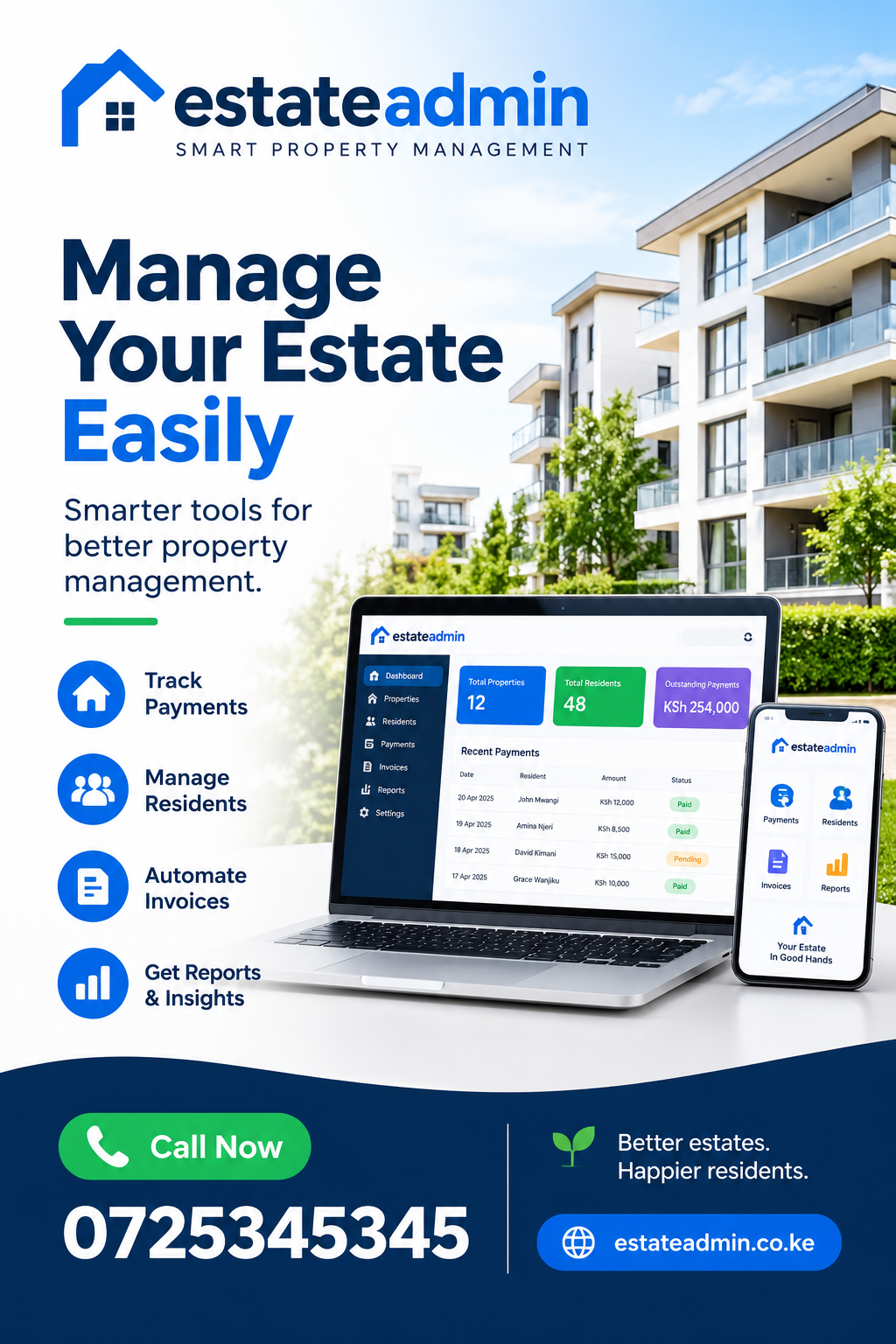
Resident Complaint Management Software Kenya: Complete Guide for Kenyan Estates
Managing resident complaints is one of the most important responsibilities in residential property management. A leaking pipe, broken lift, blocked drainage system, noisy neighbour, security concern, billing question or delayed maintenance request can quickly become a major source of dissatisfaction when there is no clear process for handling it. For estate managers, property management companies, caretakers and residents’ committees, Resident Complaint Management Software Kenya provides a structured way to receive, organize, assign, monitor and resolve resident concerns.
A modern complaint management process is not simply about giving residents another place to submit a message. It is about creating accountability. Every complaint should have a clear record, an appropriate priority, a responsible person and a documented outcome. This guide explains how digital complaint management works, the features estates should look for, the benefits for Kenyan property managers and residents, and practical ways to introduce a complaint-management system successfully.
What Is Resident Complaint Management Software?
Resident Complaint Management Software Kenya is a digital system designed to help residential estates capture and manage complaints raised by residents. Instead of relying entirely on notebooks, phone calls, emails, WhatsApp messages or verbal instructions, management can maintain a structured record of every issue.
A complaint-management system normally allows an estate to record information such as:
- Resident details
- Apartment or unit information
- Complaint category
- Date and time reported
- Description of the issue
- Location of the problem
- Priority level
- Assigned staff member
- Action taken
- Current status
- Resolution details
- Follow-up information
The main objective is visibility. Management should be able to see what has been reported, what is being handled, what is overdue and what has already been resolved.
For example, imagine an apartment resident reports that water is leaking through the ceiling. Under a manual system, the resident may call the caretaker, send a WhatsApp message and later call again to ask whether anything has been done. With a structured platform, the issue can be logged, assigned to maintenance staff, updated after inspection and closed once the repair is completed.
That process creates a reliable history instead of relying on memory.
Why Complaint Management Matters in Kenyan Residential Estates
Property managers in Kenya deal with a wide range of resident concerns. Some are routine maintenance matters, while others can affect safety, security, finances or the overall operation of the property.
Resident Complaint Management Software Kenya can help management handle these concerns using a consistent workflow.
In a busy Nairobi apartment complex, for instance, several residents may report different problems during the same week. One resident may complain about a blocked drainage channel. Another may report a faulty access card. A third may question a service charge. Someone else may report a broken light in the parking area.
If these issues are scattered across phone calls and messaging platforms, management may struggle to determine which cases are outstanding.
A digital system creates a central record.
This matters for several reasons:
1. It improves accountability
Every complaint can be assigned to a responsible employee, department or contractor. This makes it easier to determine who should take the next action.
2. It reduces forgotten complaints
A recorded complaint can remain visible until it is resolved instead of disappearing in a conversation.
3. It improves communication
Residents can receive clearer updates instead of repeatedly contacting the management office.
4. It helps identify recurring problems
If residents repeatedly complain about the same lift, gate, water pump or drainage area, management can investigate the underlying problem.
5. It supports better reporting
Managers can review complaint numbers, categories, locations and statuses when preparing reports for owners or residents’ committees.
Problems With Manual Complaint Management
Many estates begin with simple complaint-handling methods. A caretaker may use a notebook while the property manager communicates with residents through WhatsApp. This may work for a small property, but problems appear as the estate grows.
Resident Complaint Management Software Kenya can address many of these problems by giving management a centralized workflow.
Complaints get buried
Messaging groups often contain hundreds or thousands of messages. A maintenance complaint can easily be overlooked.
Residents repeat themselves
When a staff member cannot find the original complaint, the resident may have to explain the same problem again.
Managers lack visibility
A manager may know that complaints exist but not have a clear picture of how many are open, who is handling them or how long they have been pending.
Follow-ups depend on memory
Staff may remember urgent issues but forget routine requests, particularly when there are many competing tasks.
Reporting becomes difficult
Preparing a report manually requires collecting information from different notebooks, messages, spreadsheets and emails.
Recurring problems remain hidden
When individual complaints are not analyzed together, management may fail to recognize a pattern.
For these reasons, Resident Complaint Management Software Kenya can be valuable even when an estate already has experienced staff. The software supports those staff by organizing information and making follow-up easier.
How a Digital Complaint Workflow Works
A good complaint-management workflow should be simple enough for residents to use and structured enough for managers to control.
Resident Complaint Management Software Kenya can support a process such as:
- Complaint submission – The resident reports an issue.
- Complaint classification – Management categorizes it.
- Priority assessment – The issue receives an appropriate urgency level.
- Assignment – A staff member, maintenance team or contractor receives responsibility.
- Investigation – The responsible person examines the issue.
- Action – Repairs, communication or other appropriate steps are taken.
- Status update – The record is updated as work progresses.
- Resolution – The complaint is addressed.
- Closure – The case is formally closed.
- Reporting – Management can use the information for analysis.
This process prevents a complaint from becoming an informal promise such as “we will look into it.”
Instead, there is a record showing what happened.
Essential Features to Look For
When evaluating Resident Complaint Management Software Kenya, property managers should focus on practical features rather than selecting software simply because it has a long feature list.
Complaint registration
Residents should be able to submit complaints without unnecessary complexity.
The system should capture enough information to help staff understand the problem, but the form should not be so long that residents avoid using it.
Complaint categorization
Useful categories may include:
- Plumbing
- Electrical
- Security
- Cleaning
- Parking
- Noise
- Waste management
- Landscaping
- Billing
- Service charges
- Access control
- Common-area maintenance
- Internet or shared utilities
- General administration
Priority levels
Not every complaint should have the same urgency.
A major water leak should not be handled in exactly the same way as a request to repaint a common-area wall.
Assignment
A complaint should be assigned to someone responsible for resolving it.
Status tracking
Useful statuses include:
- New
- Assigned
- In progress
- Awaiting information
- Awaiting contractor
- Resolved
- Closed
Notes and action history
Staff should be able to record what they did and when they did it.
Search and filtering
Managers should be able to find complaints by resident, apartment, date, category, status or location.
Reporting
Management should be able to understand complaint volumes and trends.
Mobile access
Caretakers and maintenance teams frequently work around the property rather than behind a desk. Mobile usability can therefore be important.
A platform such as Resident Complaint Management Software Kenya should make these activities easy enough to become part of normal daily operations.
Complaint Categories for Kenyan Estates
Good categorization makes complaint data much more useful.
Resident Complaint Management Software Kenya can help estates organize complaints into categories that reflect actual property operations.
For example, an estate may create a maintenance category with subcategories for plumbing, electrical, carpentry and civil works.
A security category might include:
- Gate access
- Visitor management
- Lost access cards
- Suspicious activity
- CCTV concerns
- Lighting around security areas
A resident-services category might include:
- Noise
- Parking
- Common-area use
- Cleaning
- Waste collection
- Landscaping
Financial or administrative categories might include:
- Service charge queries
- Payment allocation questions
- Invoice concerns
- Account statements
- General administrative requests
The categories should remain understandable. Creating too many categories can make the system difficult to use.
Prioritizing Resident Complaints
A major advantage of Resident Complaint Management Software Kenya is the ability to separate urgent matters from routine requests.
A simple four-level approach can work well.
Critical
Examples may include:
- Serious security incidents
- Dangerous electrical faults
- Major flooding
- Significant water leaks
- Serious safety hazards
High
These complaints require prompt attention but may not represent an immediate emergency.
Medium
These are important issues that should be handled within the estate’s normal service process.
Low
Examples can include cosmetic issues, suggestions and minor non-urgent requests.
The actual definitions should be agreed upon by estate management.
A priority system should never be used merely to make residents compete for attention. It should be based on risk, urgency, impact and the estate’s established service policy.
Connecting Complaints With Maintenance
One of the strongest reasons to implement Resident Complaint Management Software Kenya is the connection between resident complaints and maintenance activities.
A resident complaint often signals a maintenance task.
For example:
Resident report: Water is leaking under the kitchen sink.
Category: Plumbing.
Priority: Medium.
Assignment: Maintenance technician.
Action: Inspect pipework and replace damaged fitting.
Status: Resolved.
Closure: Resident or management confirms the issue has been addressed.
This process is much stronger than simply recording “resident called about plumbing.”
Over time, management can also identify recurring maintenance issues.
If the same water pump generates multiple complaints, the solution may not be another temporary repair. Management may need to investigate the equipment, maintenance schedule or replacement options.
Improving Resident Communication
Communication is one of the most important parts of complaint management.
Resident Complaint Management Software Kenya can help create a clearer communication trail between residents and property managers.
Residents generally want three basic things when they report a problem:
- Confirmation that the complaint was received.
- Information about what is happening.
- Confirmation when the issue has been resolved.
This does not mean management must promise immediate resolution.
A repair may require a contractor, spare part or inspection. What matters is that the resident understands the status.
For example:
Complaint received → Maintenance assigned → Technician inspection scheduled → Replacement part required → Repair completed.
This sequence gives the resident more confidence than silence followed by repeated phone calls.
Managing Noise and Neighbour Complaints
Not every resident complaint involves a physical repair.
Noise, parking disputes, unauthorized use of shared spaces and disagreements between residents can also require management attention.
Resident Complaint Management Software Kenya can give management a consistent way to document such complaints.
A complaint about noise might record:
- Date
- Time
- Location
- Nature of the complaint
- Relevant estate rule
- Action taken
- Follow-up required
Management should handle these matters fairly and avoid exposing unnecessary personal information.
A structured record can help prevent inconsistent treatment of similar cases.
Handling Service Charge and Billing Complaints
Financial questions can be another important category.
Resident Complaint Management Software Kenya can provide a structured channel for residents who need clarification about billing or estate charges.
A resident might question:
- A service charge amount
- A payment allocation
- An invoice
- A utility charge
- An outstanding balance
- A penalty
- A previous payment
Complaint management should not replace proper accounting records. Instead, it should provide a way to record the question and track the response.
For example, management can record that a resident requested clarification, assign the matter to the relevant finance administrator and document the explanation provided.
Where M-Pesa is used for payments, the financial records should still be properly reconciled. Complaint software can support communication around a payment question, but it should not be treated as the accounting ledger unless the platform is specifically designed and configured for that purpose.
Security and Resident Privacy
Complaint records can contain sensitive information.
Resident Complaint Management Software Kenya should therefore be evaluated with access control and data protection in mind.
A caretaker may need access to maintenance complaints but not necessarily confidential financial information.
A finance officer may need billing-related cases but not all security incidents.
A committee member may require summary reports without needing unrestricted access to every resident’s personal information.
Management should therefore review:
- User permissions
- Role-based access
- Password security
- Data backup
- Information retention
- Access to sensitive complaints
- Audit history
- Data export procedures
The principle should be simple: users should have access to the information necessary for their responsibilities.
Mobile Complaint Management
Estate operations rarely happen entirely in an office.
Resident Complaint Management Software Kenya can be particularly useful when caretakers, supervisors and technicians need to update cases while moving around the property.
A caretaker might inspect a leaking pipe and immediately update the complaint from a mobile device. A security officer might record the outcome of an access-control issue. A maintenance technician might update a repair after completing the work.
Mobile access can therefore reduce delays between physical action and administrative record-keeping.
When evaluating software, managers should test the actual mobile interface rather than assuming that a platform described as mobile-friendly will work well on every device.
Using Complaint Data for Better Decisions
A complaint system becomes more valuable when management analyzes the information it collects.
Resident Complaint Management Software Kenya can help management identify trends instead of treating every complaint as an isolated incident.
Consider an estate that receives:
- 20 plumbing complaints
- 15 security complaints
- 10 cleaning complaints
- 5 parking complaints
Those figures alone do not explain the situation. Management should investigate why the numbers are occurring.
If plumbing complaints are concentrated in one building, there may be an infrastructure problem.
If security complaints increase after a change in access procedures, management can investigate the process.
If cleaning complaints repeatedly involve the same common areas, the cleaning schedule or contractor performance may require review.
Complaint data can therefore become a management tool.
Useful Complaint Management Reports
Managers do not need dozens of complicated reports.
Resident Complaint Management Software Kenya can support practical reporting such as:
| Report | What it shows |
|---|---|
| Open complaints | Current unresolved workload |
| Overdue complaints | Cases requiring follow-up |
| Complaints by category | Main sources of resident concerns |
| Complaints by block | Areas generating more reports |
| Resolution report | Cases successfully completed |
| Recurring issues | Problems appearing repeatedly |
| Staff assignment report | Work allocated to different teams |
| Monthly trend | Changes in complaint volume |
These reports can support management meetings and residents’ committee discussions.
The purpose is not to create impressive dashboards. The purpose is to make decisions easier.
Benefits for Property Managers
Property managers can gain several operational benefits from Resident Complaint Management Software Kenya.
Better visibility
Managers can see the status of complaints without asking every staff member for an update.
Better accountability
Each case can have an owner.
Better delegation
Staff can receive clear assignments.
Better follow-up
Overdue complaints are easier to identify.
Better planning
Recurring problems can influence maintenance decisions.
Better reporting
Management can use actual records instead of estimates.
Better resident communication
Staff can review complaint history before responding.
The system does not eliminate the need for good management. It gives managers better information with which to manage.
Benefits for Residents
Residents also benefit from a structured process.
Resident Complaint Management Software Kenya can provide residents with a clearer route for reporting concerns.
Instead of wondering which employee to call, a resident can use the established complaint channel.
Other potential benefits include:
- Easier reporting
- Clearer status information
- Less repeated explanation
- Better accountability
- More consistent follow-up
- Better communication
- A documented history of complaints
Residents should also understand that software cannot guarantee instant resolution. The purpose is to improve organization and transparency.
Benefits for Maintenance Teams
Maintenance teams need clear information.
Resident Complaint Management Software Kenya can help technicians understand what needs attention and where the problem is located.
A maintenance request containing the apartment number, issue description and category is more useful than a vague verbal instruction.
Technicians can also update the case after completing the work.
This creates a history that can be reviewed if the same issue returns.
For contractors, documented work can also help managers assess whether repeated repairs are solving the underlying problem.
Benefits for Residents’ Committees
Residents’ committees often need evidence when discussing estate performance.
Resident Complaint Management Software Kenya can give committee members a more structured view of resident service issues.
Instead of relying entirely on individual anecdotes, committee discussions can consider complaint trends.
Questions can become more specific:
- Which complaints are most common?
- Which remain unresolved?
- Which areas require investment?
- Are contractors resolving assigned work?
- Are complaints increasing or decreasing?
- Which issues need policy changes?
This makes committee discussions more productive.
Choosing the Right Software
Selecting Resident Complaint Management Software Kenya should begin with the estate’s actual requirements.
Before comparing providers, management should document its current complaint process.
Ask:
- How do residents currently submit complaints?
- Who receives them?
- Who assigns them?
- Who performs the work?
- How are residents updated?
- How are complaints escalated?
- How are completed cases recorded?
- How are reports prepared?
- Which complaints require confidentiality?
- What problems occur most frequently?
Once these questions are answered, management can evaluate software against actual needs.
Questions to Ask a Software Provider
When reviewing Resident Complaint Management Software Kenya, ask the provider practical questions.
Can residents report issues easily?
The reporting process should be simple.
Can complaints be assigned?
Management should be able to identify who is responsible.
Can cases be prioritized?
Urgent matters should be distinguishable from routine requests.
Can management see overdue cases?
This is important for accountability.
Can residents receive updates?
Communication should be part of the workflow.
Can reports be generated?
Management should be able to analyze complaint activity.
Does it support multiple properties?
This matters for property-management companies handling several estates.
Is mobile access available?
Staff should be able to work from the property.
How are permissions handled?
Different users should have appropriate access.
What support is provided?
Training and ongoing support can affect implementation success.
Implementing a Complaint Management System
Technology works best when implementation is planned.
Resident Complaint Management Software Kenya can be introduced gradually rather than forcing every process to change overnight.
Step 1: Document the current system
Identify all existing complaint channels.
Step 2: Define categories
Use categories that residents and staff understand.
Step 3: Establish priorities
Create clear rules for urgent and routine cases.
Step 4: Assign responsibilities
Decide who receives, assigns, investigates and closes complaints.
Step 5: Configure the platform
Set up users, permissions, categories and statuses.
Step 6: Train staff
Use realistic examples from the estate.
Step 7: Inform residents
Explain how and where complaints should be submitted.
Step 8: Monitor adoption
Check whether residents and staff are actually using the system.
Step 9: Review reports
Identify recurring issues and overdue cases.
Step 10: Improve the workflow
Adjust categories and processes based on real experience.
Example: Managing a Water Leak
Consider an apartment resident who notices water leaking from the ceiling.
The resident submits a complaint.
The system records the apartment, location, category and description.
Management reviews the complaint and marks it as high priority.
The maintenance technician receives the assignment.
The technician investigates and discovers a damaged pipe.
The required repair is carried out.
The technician records the action.
Management reviews the case.
The complaint is closed.
This simple example shows why structured complaint management is useful. The system creates accountability at every stage.
Example: Managing a Security Complaint
Now consider a resident who reports that an access-control card is not working.
The complaint can be categorized under security or access control.
The responsible security or administration team receives the case.
The card is checked.
If the card is faulty, it can be replaced or reconfigured.
The action is recorded.
The case is closed after the resident receives an appropriate response.
The same process can be used for other access-related concerns.
Example: Managing a Noise Complaint
A resident reports repeated noise late at night.
Management records the complaint, including the relevant date and location.
The issue is reviewed according to estate rules.
Management communicates with the relevant parties where appropriate.
Any follow-up is documented.
If the problem continues, the history shows that the matter is recurring rather than a single incident.
This type of documentation can help management apply its policies consistently.
Complaint Resolution Time
Managers should avoid promising unrealistic resolution times.
Some issues can be resolved within minutes. Others require contractors, spare parts, investigations or committee decisions.
Instead of focusing only on speed, management should consider:
- How quickly the complaint was acknowledged
- How quickly it was assigned
- How quickly action began
- Whether the resident received updates
- How long the actual resolution required
- Whether the issue recurred
This creates a more useful understanding of service performance.
Common Mistakes to Avoid
Even good software can fail if the process around it is poorly designed.
Making the complaint form too long
Residents may stop using it.
Creating too many categories
Complexity can discourage accurate classification.
Giving complaints no owner
Unassigned complaints can remain unresolved.
Closing cases too quickly
Acknowledgement is not the same as resolution.
Ignoring recurring problems
Repeated complaints should trigger investigation.
Giving users excessive access
Permissions should match responsibilities.
Failing to train staff
A system is only effective when users understand how to operate it.
Relying entirely on automation
Sensitive complaints still require human judgment.
Ignoring resident feedback
The system should be improved based on actual user experience.
Complaint Management and Estate Governance
Complaint records can contribute to better estate governance.
Resident Complaint Management Software Kenya can give management a consistent operational record for resident service matters.
Good governance requires transparency, accountability and consistent procedures.
A documented complaint process can help demonstrate that issues are being handled through established procedures rather than personal relationships or informal decisions.
This is particularly important in larger developments where many residents interact with different staff members.
Data Security and Access Control
As complaint systems become more detailed, data management becomes increasingly important.
Resident Complaint Management Software Kenya should be evaluated for appropriate security and access controls.
Management should understand:
- Who can create complaints
- Who can view complaints
- Who can edit records
- Who can close cases
- Who can access reports
- How sensitive cases are restricted
- How backups are handled
- How accounts are secured
The objective is to protect resident information while ensuring staff have enough access to perform their responsibilities.
Complaint Management and M-Pesa Questions
Kenyan estates frequently receive questions relating to payments.
Resident Complaint Management Software Kenya can help structure the communication surrounding payment-related complaints.
For example, a resident may report that an M-Pesa payment does not appear to have been allocated correctly.
Management can record the complaint and assign it to the relevant finance officer.
The officer can investigate the transaction through the appropriate financial records and provide a response.
The complaint system therefore supports the service process while the accounting system remains responsible for financial accuracy.
Making Complaint Management Part of Daily Operations
Software should not become a separate administrative burden.
Resident Complaint Management Software Kenya should fit into the normal routines of the estate.
For example, management can establish a morning review of new and overdue complaints.
Caretakers can update assigned maintenance cases during property inspections.
Managers can review unresolved high-priority cases during daily operations.
Committee reports can be generated periodically rather than prepared manually from multiple sources.
The goal is consistency.
How Complaint Data Supports Preventive Maintenance
One of the long-term benefits of complaint records is the ability to identify maintenance patterns.
Resident Complaint Management Software Kenya can help management identify repeated complaints involving the same equipment, area or service.
Suppose residents repeatedly report:
- Lift failures
- Water pressure problems
- Broken security lights
- Drainage blockages
- Gate malfunctions
Management can analyze the frequency and locations.
The information may support a preventive maintenance decision.
Instead of waiting for another complaint, management can schedule inspection or replacement work.
Improving Contractor Management
Contractors can have a significant impact on resident satisfaction.
Resident Complaint Management Software Kenya can help managers keep a record of complaints connected to contracted services.
If a cleaning contractor repeatedly receives complaints about the same area, management can review the service arrangement.
If a maintenance contractor closes jobs but residents continue reporting the same problem, management has documented evidence for follow-up.
The purpose is not to blame contractors automatically. It is to provide accurate information for performance discussions.
Resident Education Matters
Technology cannot solve every complaint-management problem.
Residents should understand:
- Which issues should be reported
- How to report them
- What information to include
- What constitutes an emergency
- What response process to expect
- How to follow up
A short resident guide can make adoption easier.
For example, management can encourage residents to include the apartment number, exact location, description and photograph where appropriate.
Creating a Resident-Centred Process
The best complaint process begins with the resident’s experience.
Resident Complaint Management Software Kenya should make it easy for a resident to report a genuine concern without unnecessary barriers.
At the same time, management needs sufficient information to act.
The balance is important.
A form that asks for too little information creates follow-up work.
A form that asks for too much information frustrates residents.
The right approach is to capture essential information while allowing staff to add internal notes later.
Measuring Success
Management should define what improvement looks like.
Resident Complaint Management Software Kenya can support measurements such as:
- Complaint volume
- Response time
- Resolution time
- Open complaints
- Overdue complaints
- Recurring complaints
- Complaints by category
- Complaints by location
- Escalated complaints
- Contractor-related complaints
The figures should be interpreted carefully.
A rise in complaint numbers does not automatically mean service has become worse. It could indicate that residents have started using the reporting system more consistently.
Management should therefore consider both volume and resolution quality.
FAQs
What is Resident Complaint Management Software?
It is software that helps estates record, categorize, assign, track and resolve complaints raised by residents.
Why should an estate use digital complaint management?
A digital system can reduce lost complaints, improve accountability, simplify follow-up and provide useful reports.
Can complaint software handle maintenance issues?
Yes. Maintenance complaints can be categorized, assigned to technicians and tracked through resolution.
Can residents submit complaints using mobile phones?
A mobile-friendly platform can allow residents to submit and follow up on complaints using smartphones.
Can the system handle service charge complaints?
Yes, complaint-management software can record and track questions about service charges and payments. Financial verification should still be performed through the appropriate accounting records.
How should estates prioritize complaints?
Estates can use priority levels based on safety, security, service disruption, property risk and urgency.
Can complaint data improve maintenance planning?
Yes. Repeated complaints can reveal recurring problems and help managers decide where preventive maintenance may be necessary.
Should every complaint be visible to every staff member?
No. Access should be based on responsibilities and appropriate privacy controls.
Is complaint software suitable for apartment complexes?
Yes. It can be especially useful where many residents, buildings, staff members and contractors make manual tracking difficult.
What should property managers check before choosing software?
They should evaluate ease of use, complaint capture, assignment, priority management, status tracking, reporting, mobile access, security, support and compatibility with existing property-management processes.
Final Checklist for Estate Managers
Before implementing a complaint-management platform, management should confirm that it can:
- Capture resident complaints
- Record locations and categories
- Assign responsible staff
- Set priorities
- Track progress
- Record actions
- Identify overdue cases
- Communicate updates
- Generate useful reports
- Protect resident information
- Work on mobile devices
- Support multiple properties where necessary
- Integrate with wider estate operations where appropriate
- Provide adequate support and training
Testing the platform using actual estate scenarios is one of the best ways to determine whether it will work in practice.
Conclusion
Resident complaints are an unavoidable part of property management, but poor complaint handling does not have to be. A structured digital process can make it easier for residents to report issues and easier for property managers to respond, assign work, monitor progress and identify recurring problems.
Resident Complaint Management Software Kenya can be particularly useful for Kenyan estates that have moved beyond informal complaint handling and need stronger accountability.
The most important consideration is not the number of features a platform offers. It is whether the system fits the estate’s actual workflow.
Management should be able to answer simple questions at any time: What complaints are open? Who is handling them? Which ones are urgent? How long have they been waiting? Which problems keep coming back? What action has already been taken?
When those answers are easy to obtain, complaint management becomes part of effective estate administration rather than a daily source of confusion.
For property managers, landlords, estate administrators and residents’ committees looking to improve service delivery, Resident Complaint Management Software Kenya provides a structured approach to turning resident concerns into trackable, accountable actions.
A well-designed system can help estates improve communication, strengthen maintenance coordination, support better reporting and build greater confidence between residents and management.
Resident Complaint Management Software Kenya
Resident Complaint Management Software Kenya
Resident Complaint Management Software Kenya
Resident Complaint Management Software Kenya
Resident Complaint Management Software Kenya
Resident Complaint Management Software Kenya
Resident Complaint Management Software Kenya
Resident Complaint Management Software Kenya
Resident Complaint Management Software Kenya
Resident Complaint Management Software Kenya
Resident Complaint Management Software Kenya
Resident Complaint Management Software Kenya
Resident Complaint Management Software Kenya
Resident Complaint Management Software Kenya
Resident Complaint Management Software Kenya