
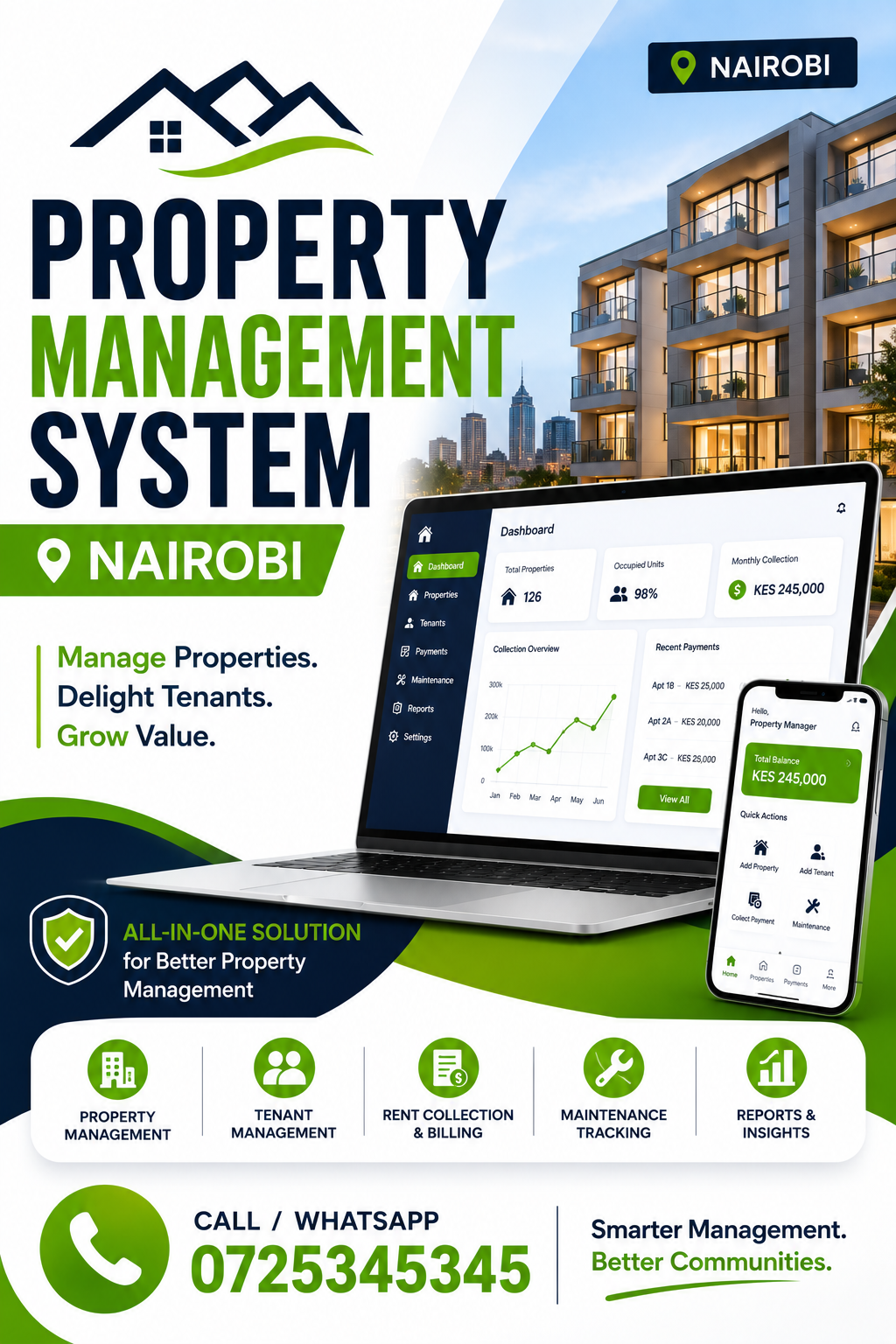
Property Management System Nairobi: A Complete Guide for Modern Property Management
Managing property in Nairobi involves much more than collecting rent. Property managers and landlords have to keep track of tenants, rental payments, service charges, maintenance requests, vacancies, expenses, leases and financial reports. As a property portfolio grows, managing these activities manually can become time-consuming and difficult to maintain accurately.
A reliable property management system nairobi solution can help property owners and managers bring these activities together in one organized platform.
Instead of relying on notebooks, spreadsheets, paper files and different communication channels, property managers can use software to centralize important property information. This makes it easier to monitor individual units while also maintaining an overview of the entire property portfolio.
Nairobi has a diverse property market that includes apartments, gated communities, commercial buildings, office spaces, student housing and mixed-use developments. Although these properties have different requirements, they all need accurate records and efficient management processes.
A properly implemented property management system nairobi platform can help streamline everyday property administration while giving managers better visibility over their operations.
This guide explores what property management software is, how it works, the features property owners should consider and how technology can improve rent collection, tenant management, maintenance, billing and reporting.
What Is a Property Management System?
A property management system is software designed to help landlords, property managers and property management companies organize their properties and related administrative activities.
Depending on the platform, the software may provide tools for:
- Property and unit management
- Tenant management
- Rent billing
- Payment tracking
- Arrears management
- Service charge management
- Utility billing
- Maintenance management
- Expense tracking
- Financial reporting
- Lease management
- Communication
- Document management
A property management system nairobi platform provides a centralized place where property-related information can be stored and accessed by authorized users.
For example, instead of storing tenant information in one spreadsheet and payment information in another, a property manager can maintain connected records within the same system.
This becomes increasingly valuable as the number of properties and units increases.
Why Property Management Software Is Important in Nairobi
Nairobi’s growing residential and commercial property sector creates significant administrative demands for landlords and property managers.
A landlord managing five units may be able to monitor payments manually. However, a property management company managing hundreds of units may have to deal with hundreds of tenants, multiple buildings, recurring bills, maintenance requests and numerous payment transactions every month.
This is where a property management system nairobi solution can provide significant organizational benefits.
A centralized system can help management monitor:
- Number of properties
- Number of units
- Occupancy
- Tenant details
- Rent amounts
- Payments received
- Outstanding balances
- Service charges
- Maintenance requests
- Property expenses
Having this information in one place can make daily management more efficient.
Challenges of Managing Properties Manually
Manual property management can work for a small portfolio, but several challenges may develop as the portfolio expands.
Scattered Information
Tenant details, payment confirmations, lease documents and maintenance records may be stored in different places.
This can make it difficult to retrieve information quickly.
Manual Calculations
Property managers may have to repeatedly calculate rent balances, service charges, utility bills and arrears.
Difficult Arrears Monitoring
When many tenants are involved, identifying every account with an outstanding balance can become difficult.
Time-Consuming Reports
Managers may need to combine information from multiple spreadsheets before preparing financial reports.
Maintenance Tracking
Repair requests can easily be forgotten when they are received through phone calls or informal messages.
Payment Reconciliation
Managers may need to manually match payments to individual tenant accounts.
A suitable property management system nairobi platform can help organize these processes.
Tenant Management
Tenant information is central to property management.
A digital system can maintain records containing information such as:
- Tenant name
- Contact details
- Unit number
- Rent amount
- Lease information
- Payment history
- Outstanding balance
- Deposit information
- Relevant documents
A property management system nairobi platform can make it easier for authorized staff to access tenant information when needed.
For example, if a tenant contacts the management office regarding their account, staff can search for the tenant and view the relevant information rather than checking multiple files.
This can improve response times and reduce unnecessary administrative work.
Property and Unit Management
Property management software should make it possible to organize properties according to their actual structure.
A property portfolio may contain:
- Multiple properties
- Buildings
- Blocks
- Floors
- Apartments
- Offices
- Shops
- Parking spaces
A property management system nairobi solution can help managers organize these properties and connect individual units to the appropriate tenant or owner records.
This is particularly useful for property management companies handling multiple developments.
Rent Management
Rent collection is one of the most important responsibilities of a property manager.
A good system should make it possible to track:
- Expected rent
- Amount billed
- Amount paid
- Payment date
- Outstanding balance
- Previous balances
- Payment history
A property management system nairobi platform can help property managers monitor rent at both unit and portfolio level.
For example:
| Unit | Rent Due | Paid | Balance |
|---|---|---|---|
| A01 | KSh 30,000 | KSh 30,000 | KSh 0 |
| A02 | KSh 25,000 | KSh 15,000 | KSh 10,000 |
| A03 | KSh 35,000 | KSh 0 | KSh 35,000 |
Instead of manually calculating these balances, management can use the financial information maintained within the system.
M-Pesa Payment Tracking
M-Pesa is widely used in Kenya for making payments, including rent and other property-related charges.
However, receiving a payment is only one part of rent collection.
The management team also needs to identify the transaction, connect it to the correct tenant account and update the account balance.
When evaluating a property management system nairobi solution, property managers should carefully examine how M-Pesa payments are handled.
Important questions include:
- Can payments be matched automatically?
- Can payment references be tracked?
- Can partial payments be recorded?
- How are unidentified payments handled?
- Can receipts be generated?
- Are balances updated after payment?
- Can payment records be reconciled?
Rather than simply asking whether a system supports M-Pesa, managers should request a practical demonstration of the entire payment process.
Rent Arrears Management
Rent arrears can create cash-flow challenges for landlords.
When tenants fail to pay on time, property managers need to know which accounts are outstanding and how much is owed.
A property management system nairobi platform can provide arrears reports that help management identify overdue accounts.
An arrears report may show:
- Tenant name
- Unit number
- Amount due
- Amount paid
- Outstanding balance
- Billing period
- Last payment date
This makes it easier for management to prioritize follow-up.
It also reduces the risk of overlooking outstanding balances.
Automated Rent Billing
Recurring rent billing can be repetitive when performed manually.
Property management software can allow managers to configure recurring charges based on the property’s requirements.
Once configured, the system may generate recurring bills automatically.
A property management system nairobi platform can therefore reduce the amount of repetitive work required from property management staff.
However, automatically generated bills should still be reviewed regularly to account for changes such as new tenants, vacancies, rent adjustments and other account changes.
Service Charge Management
Many apartment buildings and managed estates collect service charges in addition to rent.
Service charges may contribute toward shared services such as:
- Security
- Cleaning
- Landscaping
- Garbage collection
- Common-area electricity
- Lift maintenance
- Generator maintenance
- Repairs
- Shared facilities
A property management system nairobi platform can help property managers record and monitor service charges where the feature is available.
Keeping rent and service charges properly categorized can also make tenant statements easier to understand.
Utility Billing
Some properties charge tenants for utilities such as water or electricity.
The billing process can become complicated when different units have different consumption levels.
Where utility billing functionality is available, property managers may be able to enter meter readings and calculate applicable charges.
Before selecting a property management system nairobi solution, managers should establish exactly how utilities are currently billed and confirm that the software can accommodate that structure.
Not every property uses the same utility billing method, so flexibility is important.
Maintenance Management
Property maintenance is another major part of property management.
Tenants may report problems involving:
- Plumbing
- Electricity
- Water leaks
- Doors
- Windows
- Fixtures
- Appliances
- Security systems
- Other property facilities
When maintenance requests are managed entirely through phone calls and messages, it can be difficult to know which issues are pending and which have already been resolved.
A property management system nairobi platform with maintenance management functionality can help organize these requests.
A maintenance record may include:
- Property
- Unit
- Reported issue
- Date reported
- Assigned technician
- Status
- Cost
- Completion date
This creates a useful history of maintenance activity.
Preventive Maintenance
Property management should not focus only on responding to problems after they happen.
Preventive maintenance involves scheduling regular inspections and servicing to reduce unexpected breakdowns.
Examples include:
- Generator servicing
- Lift maintenance
- Water pump servicing
- Electrical inspections
- Plumbing inspections
- Security system maintenance
- Common-area inspections
A property management system nairobi solution can help managers schedule and monitor maintenance activities where the relevant functionality is available.
Historical maintenance information can also help managers identify recurring problems.
Expense Management
Property income should be considered alongside property expenses.
Common property expenses can include:
- Repairs
- Security
- Cleaning
- Landscaping
- Utilities
- Maintenance contracts
- Supplier payments
- Administrative expenses
A property management system nairobi platform can help organize expenses by property and category where expense management is supported.
This can help managers understand the cost of operating each property.
It can also assist with financial reporting and budgeting.
Financial Reporting
Property owners need accurate information about the performance of their properties.
Useful reports may include:
- Rent collection reports
- Arrears reports
- Expense reports
- Occupancy reports
- Payment histories
- Tenant statements
- Service charge reports
- Income summaries
A property management system nairobi platform can make it easier to generate and review these reports.
Instead of manually combining data from several spreadsheets, managers can use centralized records.
Owner Reporting
Many property owners do not participate in the daily management of their properties.
They may depend on a property manager to provide information about their investments.
Useful owner reports may include:
- Rent collected
- Outstanding rent
- Property expenses
- Occupancy
- Maintenance costs
- Service charge collections
- Other relevant transactions
A property management system nairobi solution can support owner reporting where appropriate reporting features are included.
This can improve visibility for owners who are not physically present at the property.
Managing Vacancies
Vacant units represent potential lost rental income.
Property managers therefore need to know which units are occupied, vacant or undergoing preparation for new tenants.
A centralized system can provide a clearer overview of occupancy.
For example:
| Status | Units |
|---|---|
| Occupied | 85 |
| Vacant | 10 |
| Under maintenance | 5 |
A property management system nairobi platform can help managers monitor occupancy information.
Combining occupancy information with rental data can also provide a better picture of the property’s revenue position.
Lease Management
Lease information is another important component of property administration.
Managers may need to track:
- Lease start date
- Lease expiry date
- Rent amount
- Deposit
- Tenant details
- Renewal dates
- Relevant documents
A property management system nairobi platform with lease management functionality can help organize this information.
Where supported, reminders can also help managers keep track of important lease dates.
Tenant Communication
Communication is essential for maintaining a good relationship between property managers and tenants.
Managers may need to communicate about:
- Rent
- Payment reminders
- Maintenance
- Inspections
- Service interruptions
- Building notices
- General announcements
A property management system nairobi solution may provide communication or notification functionality depending on the platform.
Centralizing communication can make it easier for management teams to maintain consistent records.
Digital Receipts and Statements
Tenants may need confirmation that their payments have been received.
Digital receipts can provide convenient payment confirmation.
Account statements can also provide a record of charges and payments over a specific period.
A property management system nairobi platform can help managers produce these documents where the relevant features are available.
This can reduce the amount of time spent responding to repeated requests for payment confirmations.
Managing Multiple Properties
Professional property managers may manage numerous buildings across Nairobi.
Without centralized software, each property may end up with separate spreadsheets and records.
This can make it difficult to obtain a portfolio-wide overview.
A property management system nairobi platform that supports multiple properties can allow managers to organize information at both property and portfolio level.
Management may then be able to compare:
- Collection rates
- Arrears
- Occupancy
- Expenses
- Maintenance activity
across different properties.
User Roles and Permissions
Property management systems can contain sensitive financial and personal information.
Not every employee needs access to every function.
For example, an accountant may need financial information while a caretaker may primarily need property and maintenance information.
When evaluating a property management system nairobi platform, managers should ask whether the software supports different user roles and permissions.
Access should ideally correspond to each employee’s responsibilities.
This can help reduce unauthorized access to sensitive information.
Cloud-Based Property Management
Cloud-based systems can allow authorized users to access property information through an internet-connected device.
This can be useful for property managers who move between different buildings.
A manager visiting a property may be able to review tenant or maintenance information without returning to the office.
When considering a property management system nairobi platform, managers should also ask about data storage, backups and security.
Mobile Access
Property management is often a field-based activity.
Managers and caretakers may spend much of their working day away from the office.
Mobile access can make it easier to:
- Check tenant information
- View balances
- Record maintenance requests
- Check property information
- Review reports
Before choosing a property management system nairobi solution, test how the software performs on mobile devices.
A system that works well on a desktop but is difficult to use on a phone may not be suitable for a field-based management team.
Data Security
Property management software may store important information, including:
- Tenant details
- Payment records
- Property information
- Financial reports
- Lease documents
Security should therefore be an important consideration.
Property managers should ask providers about:
- Password protection
- User permissions
- Backups
- Data recovery
- Access controls
- Activity logs
- Data export
A property management system nairobi provider should be able to explain how customer data is protected.
How to Choose the Right Property Management System
There is no single software solution that is perfect for every landlord.
The right system depends on the size and complexity of the property portfolio.
Before selecting software, property managers should identify their requirements.
Ask:
- How many units do we manage?
- How many properties do we manage?
- Do we collect rent?
- Do we collect service charges?
- Do we bill utilities?
- Do we use M-Pesa?
- How are arrears currently monitored?
- How are maintenance requests handled?
- What financial reports are required?
- How many employees need access?
These questions can help identify the features that matter most.
A property management system nairobi solution should address actual management challenges rather than simply offering a large number of features.
Test the Software Before Buying
A software demonstration can provide useful information, but testing realistic scenarios is even more valuable.
Ask the provider to demonstrate:
Creating a Property
Add a building and several units.
Adding Tenants
Create tenant records and assign them to units.
Generating Rent
Create a recurring rent charge.
Recording Payment
Record a full payment and verify the account balance.
Testing a Partial Payment
Record a payment that does not clear the full amount.
Checking Arrears
Generate an arrears report.
Recording Maintenance
Create a maintenance request and assign it to a responsible person.
Generating a Statement
Produce a tenant account statement.
Generating Reports
Create rent collection and expense reports.
These tests can show whether the system is practical for everyday operations.
Cost of Property Management Software in Nairobi
The cost of property management software varies depending on the provider and the features required.
Pricing may depend on:
- Number of units
- Number of properties
- Number of users
- Features
- Payment integrations
- Support
- Implementation
- Data migration
When comparing property management system nairobi options, property managers should consider the total value provided rather than focusing only on the initial subscription price.
A cheaper platform may not be economical if staff still have to perform most processes manually.
On the other hand, a complex enterprise system may be unnecessary for a small landlord.
Implementing a Property Management System
Moving from spreadsheets and manual records to software requires preparation.
Step 1: Clean Existing Data
Review tenant names, contact information, units and financial balances.
Step 2: Set Up Properties
Create buildings, blocks and units in the system.
Step 3: Add Tenants
Assign each tenant to the correct property and unit.
Step 4: Enter Financial Information
Verify opening balances carefully.
Step 5: Configure Billing
Set up rent, service charges and utilities where applicable.
Step 6: Configure Payment Methods
Set up the payment channels used by tenants.
Step 7: Create User Accounts
Assign appropriate roles and permissions.
Step 8: Train Staff
Make sure employees understand how to use the system.
Step 9: Test
Run sample billing, payment and maintenance transactions.
Step 10: Go Live
Begin using the platform for daily property operations.
A property management system nairobi implementation should therefore include both technical setup and staff training.
Common Mistakes to Avoid
Choosing Software Without Defining Requirements
A property manager should first identify the actual problems the software needs to solve.
Ignoring Payment Reconciliation
Payment workflows should be tested carefully before implementation.
Entering Incorrect Opening Balances
Incorrect historical balances can affect future reports.
Giving Every User Full Access
Employees should only receive the access required for their responsibilities.
Failing to Train Employees
Even good software can be ineffective if staff do not know how to use it.
Maintaining Multiple Unofficial Systems
Continuing to maintain several spreadsheets alongside the main system can create conflicting information.
Benefits of a Property Management System
A well-implemented property management system nairobi platform can provide several practical benefits.
Better Organization
Property and tenant information can be centralized.
Improved Payment Visibility
Managers can monitor payments and outstanding balances.
Faster Reporting
Reports can be generated more efficiently.
Easier Arrears Management
Outstanding accounts can be identified quickly.
Better Maintenance Tracking
Maintenance requests can be recorded and monitored.
Improved Tenant Service
Statements, receipts and account information can be accessed more efficiently.
Portfolio Visibility
Managers can monitor multiple properties from one system.
Property Management for Apartments in Nairobi
Apartment buildings are among the property types that can benefit from organized property management software.
Managers may have to coordinate rent, service charges, security, cleaning, maintenance and tenant communication across dozens or hundreds of units.
A property management system nairobi platform can help maintain unit-level records while giving management a broader overview of the building.
Property Management for Gated Communities
Gated communities often have shared infrastructure and services.
Residents may contribute toward:
- Security
- Road maintenance
- Landscaping
- Waste management
- Common lighting
- Shared facilities
A centralized property management system nairobi solution can help maintain contribution records and monitor shared property activities.
Property Management for Commercial Buildings
Commercial properties may have more complicated management requirements.
Office tenants, shops and other commercial occupants may have different rental agreements and billing arrangements.
Charges can include:
- Rent
- Service charges
- Utilities
- Parking
- Other agreed charges
A property management system nairobi platform should therefore be assessed according to the specific requirements of the commercial property.
Importance of Accurate Property Records
Accurate records are essential to property management.
If a tenant’s balance is incorrect, the tenant may be incorrectly shown as owing money.
If a payment is assigned to the wrong unit, two accounts may become inaccurate.
If an expense is recorded against the wrong property, financial reports may not reflect the actual performance of the property.
A property management system nairobi platform can help organize these records, but staff should still review transactions and reconcile important information regularly.
Improving Rent Collection
One objective of property management software is to make rent collection more efficient.
This can involve:
- Generating bills on time
- Providing clear account statements
- Making payment methods convenient
- Sending reminders
- Monitoring arrears
- Following up on overdue accounts
- Maintaining accurate payment histories
A property management system nairobi solution can support these activities where the required features are available.
Automated Notifications
Automated notifications can help property managers communicate with tenants.
Depending on the platform, reminders may be sent for:
- Upcoming rent
- Due dates
- Overdue balances
- Payment confirmations
- Maintenance updates
Automation can reduce repetitive communication tasks, but notifications should be configured carefully to avoid duplicate or inappropriate messages.
Reports Property Managers Should Monitor
Property managers should regularly review relevant reports.
Rent Collection Report
Shows how much rent has been billed and collected.
Arrears Report
Shows outstanding tenant balances.
Payment Report
Shows payments received during a selected period.
Unit Statement
Shows the financial history of an individual unit.
Service Charge Report
Shows service charge billing and collections.
Expense Report
Shows property-related expenses.
Occupancy Report
Shows occupied and vacant units.
A property management system nairobi platform can make these reports easier to organize where the relevant reporting functions are included.
Frequently Asked Questions
What is a property management system?
A property management system is software that helps landlords and property managers manage properties, tenants, rent, payments, maintenance and financial records.
Is a property management system useful for landlords in Nairobi?
Yes. It can help landlords and professional property managers organize tenant records, payments, maintenance and financial information.
Can property management software manage rent?
Many platforms provide rent billing and payment tracking. The exact functionality varies by provider.
Can property management software track M-Pesa payments?
Some platforms provide M-Pesa integration. Property managers should confirm how payments are matched to tenant accounts before selecting a system.
Can it track rent arrears?
Yes. Many systems provide arrears reports showing outstanding tenant balances.
Can property management software manage service charges?
Many platforms support service charge management, although the specific billing functionality varies between providers.
Can it manage maintenance requests?
Some platforms provide maintenance request management, work orders, scheduling and expense tracking.
Can one system manage multiple properties?
Many property management platforms support multiple properties and units. Managers should confirm the limits of the specific software they are considering.
Is cloud-based property management software useful?
Cloud-based software can provide access to property information from different locations. Managers should also evaluate security, backups, reliability and ease of use.
How much does property management software cost?
Pricing varies according to the provider, number of units, features, users and integrations. Property managers should compare the total cost with the functionality provided.
How do I choose the right system?
Start by identifying your biggest property management challenges. Then compare software based on tenant management, rent billing, payment reconciliation, M-Pesa support, arrears, maintenance, reporting, security, user permissions and support.
The Future of Property Management in Nairobi
Technology continues to change how properties are managed.
As property portfolios grow, manual systems can become increasingly difficult to maintain. Digital platforms can help property managers centralize information, automate repetitive processes and gain faster access to financial and operational data.
A property management system nairobi solution can provide a foundation for this transition.
However, adopting technology should not be about choosing the most complicated software available.
The system should solve genuine operational problems.
A small landlord may only require basic tenant and rent management, while a professional property management company managing hundreds of units may require advanced billing, reporting, maintenance and user-management capabilities.
Understanding these differences is important when selecting software.
Final Considerations Before Choosing a System
Before purchasing property management software, consider the size of the portfolio and the complexity of the management processes.
Ask:
- How many units do we manage?
- How many properties do we manage?
- How many tenants do we have?
- Do we collect rent?
- Do we collect service charges?
- Do we bill utilities?
- Do we use M-Pesa?
- How are arrears currently tracked?
- How are maintenance requests handled?
- What reports do owners require?
The answers will help determine which features are actually necessary.
A good property management system nairobi platform should simplify property management rather than add unnecessary complexity.
Conclusion
Managing property in Nairobi requires accurate financial records, organized tenant information and efficient administrative processes. As the number of units increases, relying entirely on spreadsheets, notebooks and manual payment tracking can become increasingly difficult.
A property management system nairobi solution can help landlords and property managers centralize important information and streamline activities such as rent billing, payment tracking, arrears management, service charge administration, maintenance and reporting.
For properties in Nairobi, M-Pesa payment management is an important consideration. Managers should test how a system handles payment matching, partial payments, receipts and reconciliation rather than relying solely on a provider’s feature list.
Maintenance, tenant communication and financial reporting are also important. A platform that brings these processes together can give managers a more complete view of their properties and reduce repetitive administrative work.
Before choosing a system, property owners should identify their requirements, compare suitable platforms and test realistic scenarios using actual property-management workflows.
Ultimately, the right property management system nairobi should help make property administration more organized, improve financial visibility and support better service for tenants and property owners.