
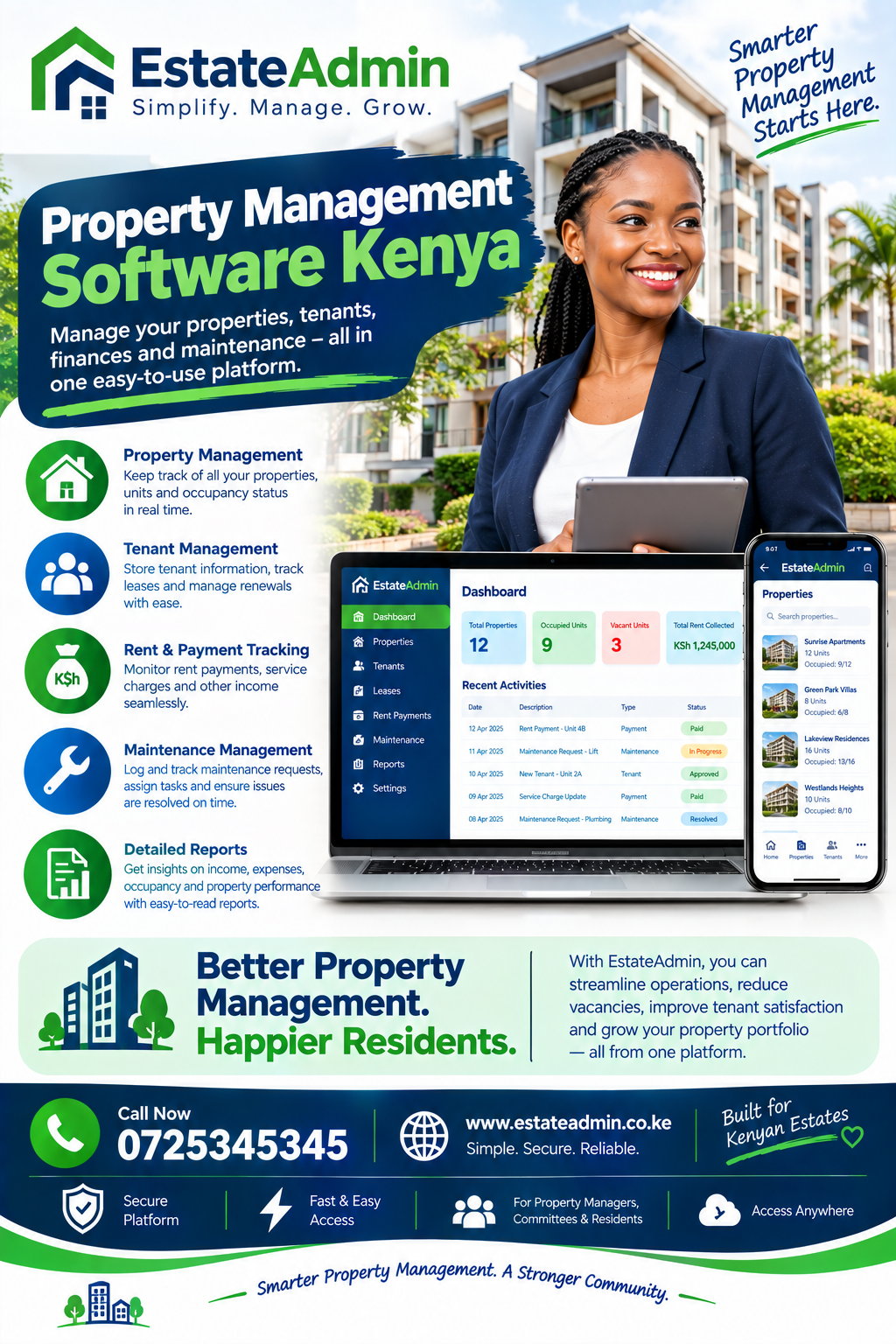
Property Management Software Kenya: A Complete Guide for Landlords and Property Managers
Managing rental properties manually can become difficult as the number of units, tenants, payments and maintenance requests increases. Property Management Software Kenya gives landlords, property managers and estate management companies a centralized way to organize property records, monitor rent, manage tenants, track maintenance, record expenses and prepare reports. For Kenyan property professionals, the right software can also make it easier to handle M-Pesa payments, service charges, utility billing and other activities that are part of everyday property management.
Property management involves many moving parts. A landlord may need to advertise a vacant unit, screen prospective tenants, prepare lease documents, collect rent, issue receipts, respond to maintenance requests, pay suppliers and monitor expenses. When all these activities are managed using notebooks, spreadsheets and separate communication channels, important information can become difficult to locate.
The challenge becomes even greater for property managers responsible for several buildings or hundreds of units. A payment received through M-Pesa needs to be connected to the correct tenant and unit. A maintenance request needs to be assigned and followed up. A lease nearing expiry needs attention. An owner may also expect a detailed monthly report showing income, expenses, arrears and occupancy.
This is where Property Management Software Kenya can become a practical business tool. Rather than treating rent collection, tenant records, maintenance and reporting as completely separate activities, property management software brings them together in a structured digital environment.
This guide explains how property management software works, the features worth considering, the benefits for Kenyan landlords and property managers, common implementation challenges, and the questions you should ask before selecting a platform.
What Is Property Management Software?
Property Management Software Kenya refers to digital systems designed to help landlords, estate managers and property companies organize and automate property-related activities.
Instead of maintaining separate records for every process, the software can connect information about:
- Properties
- Buildings
- Units
- Tenants
- Leases
- Rent
- Payments
- Invoices
- Expenses
- Maintenance
- Utilities
- Service charges
- Suppliers
- Reports
The exact functionality differs between providers. Some platforms focus mainly on rental management, while others offer broader estate administration, accounting, maintenance or communication features.
The important point is that the software creates a central record of property operations.
For example, a tenant should not exist only as a name in an Excel spreadsheet. Ideally, the tenant’s profile is connected to a unit, lease, rent amount, payment history and relevant maintenance records.
This structure makes information easier to access.
A property manager can potentially open a tenant’s account and quickly see the information required to answer a question. An accountant can review payment records. A caretaker can see assigned maintenance requests. A property owner can review reports.
That connected approach is one reason Property Management Software Kenya has become relevant to landlords and professional property managers looking for more organized ways to run their portfolios.
Why Property Management Is Becoming More Complex
Owning rental property can appear straightforward from the outside.
A property owner provides accommodation, tenants pay rent and the owner maintains the building.
In practice, there are many additional responsibilities.
A manager may need to keep track of tenant deposits, rent increases, lease renewals, maintenance costs, utility charges, contractor payments and service charges. The management team may also have to respond to tenant complaints and produce financial reports for property owners.
As a portfolio grows, the number of transactions grows as well.
A landlord managing five units may be able to remember most tenant details. A property manager responsible for 500 units cannot reasonably depend on memory.
Property Management Software Kenya helps address this issue by creating structured records that can be searched, updated and reported on.
This is particularly useful when several employees work on the same portfolio.
Instead of having one employee maintain a spreadsheet while another keeps paper files, the organization can work from a common database.
That does not eliminate the need for careful administration. Data still needs to be entered correctly, staff need appropriate training and managers need clear processes. However, the software can provide the framework within which those processes operate.
Property Management in the Kenyan Context
Kenyan property management has some specific operational considerations.
One of the most important is the widespread use of mobile payments.
M-Pesa is commonly used for business transactions in Kenya, including rental payments. This means property managers need more than a simple “payment received” record. They need to identify the tenant, unit, amount, date and payment reference.
Property Management Software Kenya can support payment workflows where the platform provides the required integration and reconciliation features.
Kenyan property managers may also deal with:
- Bank transfers
- M-Pesa payments
- Service charges
- Water billing
- Electricity charges
- Security costs
- Cleaning services
- Maintenance contractors
- Property taxes and statutory obligations
- Multiple property owners
- Residential and commercial tenants
The exact requirements vary from one property to another.
A Nairobi apartment block, a gated residential community, a commercial building and a mixed-use development may all require different workflows.
Therefore, choosing software should begin with the actual operation rather than simply choosing the platform with the largest number of advertised features.
Key Features of Property Management Software
When evaluating Property Management Software Kenya, it is useful to break the system into specific functions.
Property and Unit Management
A property management system should make it possible to organize buildings and individual units.
For each unit, managers may need to record:
- Unit number
- Property
- Floor
- Type
- Rent
- Occupancy status
- Tenant
- Lease dates
- Deposit
- Service charges
- Utility information
This creates a clear relationship between the physical property and the financial and tenant records associated with it.
For a company managing multiple apartment buildings, the ability to filter records by property can save considerable administrative time.
Tenant Management
Tenant information is central to rental operations.
A tenant profile may include:
- Name
- Phone number
- Identification information
- Unit
- Lease
- Rent amount
- Deposit
- Payment history
- Outstanding balance
- Relevant documents
Property Management Software Kenya can organize this information in a single tenant record where the software supports these functions.
This becomes particularly valuable when tenants contact management with questions about their accounts.
Instead of searching through several documents, staff can access the tenant’s account and review the relevant information.
Rent Collection
Rent collection is one of the most important property-management activities.
The system should help managers understand what rent is expected and what has actually been received.
A useful rent-management workflow can distinguish between:
- Fully paid accounts
- Partially paid accounts
- Overdue accounts
- Accounts with credits
- Accounts awaiting reconciliation
Property Management Software Kenya can help organize these records so property managers have better visibility into rent collection.
For example, if a tenant owes KES 30,000 and pays KES 20,000, the system should ideally retain the payment and show the remaining balance rather than treating the account as fully settled.
M-Pesa Payment Reconciliation
M-Pesa support is an important consideration for Kenyan property managers.
Receiving money is only part of the process. The payment must be connected to the correct tenant and account.
Property Management Software Kenya can help organize payment reconciliation when the selected platform provides M-Pesa integration.
Before selecting a system, ask specific questions about the payment workflow.
Does the software support your preferred payment method?
Can payments be matched automatically?
Can unmatched transactions be reviewed?
Can the system handle partial payments?
Can payment references be retained?
Can receipts be generated?
These details matter because two systems may both advertise M-Pesa support while handling the process differently.
Lease Management
Leases contain information that managers need to access regularly.
A lease-management function can help track:
- Lease start date
- Expiry date
- Rent
- Deposit
- Renewal
- Tenant
- Unit
- Documents
Property Management Software Kenya can help make lease information easier to monitor when these features are available.
Lease expiry alerts can also help managers plan renewals before the relevant date arrives.
Maintenance Management
Maintenance requests are unavoidable in property management.
Common examples include:
- Plumbing problems
- Electrical faults
- Broken locks
- Water leaks
- Damaged fixtures
- Painting requirements
- Appliance faults
- Common-area repairs
Without a tracking system, maintenance requests may remain buried in WhatsApp conversations or phone calls.
Property Management Software Kenya can provide a structured maintenance workflow.
A request can potentially be recorded, assigned, prioritized and closed after the work is completed.
A basic workflow might be:
- Tenant reports the issue.
- Manager records the request.
- The issue is categorized.
- A staff member or contractor is assigned.
- Work begins.
- Cost is recorded.
- The manager verifies completion.
- The request is closed.
The historical record can then remain available for future reference.
Expense Management
Property owners need to understand both income and expenditure.
Typical expenses include:
- Repairs
- Security
- Cleaning
- Landscaping
- Water
- Electricity
- Waste collection
- Staff wages
- Contractor payments
- Maintenance materials
- Administrative costs
Property Management Software Kenya can help managers record expenses against the appropriate property or category.
This makes it easier to identify where money is being spent.
For example, a manager may discover that one building consistently records higher plumbing expenses than another. That pattern may justify further investigation.
Expense records also support more transparent reporting to property owners.
Instead of presenting only rent collected, a manager can provide a broader picture of property income and expenses.
Service Charge Management
Service charges are common in apartment buildings and managed residential communities.
They may cover:
- Security
- Cleaning
- Landscaping
- Waste collection
- Common-area electricity
- Shared water systems
- Repairs
- Estate administration
Property Management Software Kenya can help managers organize service-charge billing and payment records where the system supports those features.
The objective is to maintain a clear relationship between the unit, the charge, the payment and the outstanding balance.
This is particularly useful when an estate contains many units and recurring service charges.
Utility Billing
Water and electricity billing can become complicated when utilities are shared or separately metered.
Managers may need to collect meter readings, calculate consumption, generate charges and record payments.
Property Management Software Kenya can help structure these processes when utility management is included.
A utility workflow may involve:
- Meter registration
- Reading entry
- Consumption calculation
- Billing
- Payment
- Balance tracking
- Historical records
The benefit is greater consistency.
If a tenant questions a bill, management can refer to the relevant record instead of relying on memory.
Invoicing and Receipts
Tenants need clear documentation of what they have been charged and what they have paid.
Property Management Software Kenya can help property managers generate invoices and receipts where those features are supported.
Invoices may contain:
- Tenant
- Unit
- Billing period
- Rent
- Service charges
- Utilities
- Other applicable charges
- Total amount
Receipts can document payments received.
Keeping these records together can simplify account reconciliation and reduce disputes.
Tracking Rent Arrears
Rent arrears are an important issue for property managers.
A manual system may require staff to check every tenant account individually.
A digital system can provide an arrears report that highlights accounts requiring attention.
Property Management Software Kenya can help managers organize outstanding balances and payment histories.
An effective arrears process should involve more than sending automatic reminders.
Managers may need to:
- Verify the balance
- Check payment history
- Confirm whether a payment is pending
- Contact the tenant
- Record the communication
- Follow up
- Update the account
The software provides the record, while staff remain responsible for appropriate communication and decisions.
Occupancy and Vacancy Tracking
Vacant units can affect rental income.
Property managers therefore need to know which units are occupied, vacant, reserved or undergoing maintenance.
Property Management Software Kenya can provide an overview of occupancy where the system includes property dashboards.
For example, a manager overseeing four buildings could quickly identify vacant units without opening several spreadsheets.
Vacancy information can also support marketing and leasing activities.
Property Owner Reporting
Property owners often want regular information about their investments.
A monthly report may include:
- Rent collected
- Rent outstanding
- Expenses
- Maintenance
- Occupancy
- Service charges
- Net income
- Significant property issues
Property Management Software Kenya can make this information easier to compile when reporting tools are included.
The report should be understandable rather than overloaded with unnecessary data.
A good property report answers practical questions.
How much was collected?
What remains outstanding?
What was spent?
What maintenance was performed?
Are there vacant units?
Are there issues requiring owner attention?
Benefits for Landlords
One major benefit of Property Management Software Kenya is better organization.
Landlords can use a centralized system to manage property information instead of depending entirely on separate files.
Better visibility
A landlord can review rental activity, vacancies and expenses more easily.
Organized tenant records
Tenant information can be stored systematically.
Easier payment tracking
Payments and balances can be reviewed in one place.
Maintenance history
Repairs can be recorded for future reference.
Financial reporting
Income and expenses can be organized into reports.
Reduced manual administration
Routine activities can be streamlined where automation is available.
These benefits can be useful for both individual landlords and larger property businesses.
Benefits for Property Managers
Professional property managers handle the day-to-day responsibilities of property portfolios.
Property Management Software Kenya can help them coordinate activities across multiple properties.
A property manager may use the system to:
- Monitor rent
- Review arrears
- Assign maintenance
- Check vacancies
- Review tenant records
- Prepare owner reports
- Monitor expenses
- Track leases
Centralized information also helps when multiple employees work on the same portfolio.
Instead of asking colleagues for information stored in private spreadsheets, staff can access shared records according to their permissions.
Benefits for Tenants
The tenant experience is also affected by property-management processes.
Property Management Software Kenya can help create more organized interactions when tenant-facing features are available.
Tenants may benefit from:
- Clear payment records
- Receipts
- Easier maintenance reporting
- Faster status updates
- Better billing information
- More consistent communication
However, software does not replace good customer service.
A property manager still needs to respond to tenants professionally and resolve issues appropriately.
Benefits for Estate Staff
Caretakers and maintenance staff are often responsible for activities happening physically at the property.
They may receive reports about:
- Leaking pipes
- Broken lights
- Damaged gates
- Water problems
- Cleaning issues
- Security concerns
Property Management Software Kenya can provide a structured method for recording these issues where staff-management functionality is available.
Instead of relying on verbal instructions, the caretaker can receive a documented task.
This can improve accountability because management can see which requests are open, assigned or completed.
Centralizing Property Information
A major problem with manual property management is fragmented information.
One spreadsheet may contain tenant names.
Another may contain rent.
A notebook may contain maintenance information.
M-Pesa statements may contain payments.
Paper files may contain leases.
Property Management Software Kenya can bring many of these records into a connected environment.
Centralization makes it easier to answer questions.
For example:
“What happened with Unit B12 last month?”
A manager should be able to access the relevant tenant, payment and maintenance information without searching through several unrelated sources.
Data and Reporting
Property management creates a large amount of useful data.
Managers can use that information to understand:
- Collection performance
- Vacancy
- Maintenance costs
- Expense categories
- Tenant turnover
- Outstanding balances
- Property income
Property Management Software Kenya can help turn operational records into reports where analytics and reporting functions are available.
Reports are particularly useful for identifying patterns.
If maintenance costs increase over several months, management can investigate.
If arrears are concentrated in a particular building, management can review the underlying circumstances.
If vacancy increases, the property owner may need to examine pricing, marketing or property conditions.
Software does not make these decisions automatically. It provides organized information that supports management review.
Security and User Permissions
Property systems contain information that should be protected.
Tenant contact details, identification records, lease documents and financial information may all require controlled access.
Property Management Software Kenya should therefore be evaluated for security and user-management features.
Different employees may require different levels of access.
For example:
| User | Possible Access |
|---|---|
| Property manager | Property and tenant operations |
| Accountant | Financial records |
| Caretaker | Assigned property activities |
| Maintenance staff | Maintenance requests |
| Owner | Relevant property reports |
| Tenant | Own account information |
The exact permissions depend on the platform.
When evaluating a provider, ask about:
- User roles
- Access controls
- Password security
- Backups
- Audit trails
- Data recovery
- Data export
- Account management
Security should be considered before implementation rather than after a problem occurs.
How to Choose Property Management Software
Choosing Property Management Software Kenya should begin with the organization’s actual needs.
Start by documenting your current processes.
How do tenants pay?
How do you record payments?
How do you handle maintenance?
How do you calculate service charges?
How do you prepare owner statements?
How do you track expenses?
How do you monitor vacant units?
Once these questions are answered, compare software based on those requirements.
Consider the number of units
A landlord managing 20 units may have different needs from an agency managing 2,000 units.
Consider the number of users
If several employees will use the platform, check user permissions and pricing.
Consider integrations
M-Pesa and other payment integrations may be important in Kenya.
Consider reporting
Ask to see actual reports before signing up.
Consider support
Find out how training and technical support are provided.
Consider scalability
Make sure the system can accommodate growth.
Questions to Ask a Software Provider
Before purchasing Property Management Software Kenya, ask the provider practical questions.
Does it support multiple properties?
This matters if you manage several buildings.
Does it support multiple units?
The platform should be capable of handling the number of units in your portfolio.
How does rent collection work?
Ask how invoices, payments, balances and receipts are handled.
Does it support M-Pesa?
Ask for details about the exact integration.
Can payments be reconciled?
Find out whether the system matches payments with tenant accounts automatically or manually.
Can tenants report maintenance?
Ask whether tenants can submit requests directly.
Can owners access reports?
This may be useful for property management companies.
Can data be exported?
Data portability is an important consideration.
What happens during onboarding?
Understand how existing records will be moved into the system.
What support is available?
Ask about response times, training and ongoing assistance.
Common Mistakes When Selecting Software
A platform may have many features and still fail to meet the organization’s needs.
One common mistake is choosing software based entirely on price.
Property Management Software Kenya should instead be assessed according to total value and suitability.
Another mistake is failing to test the system.
A demonstration can reveal whether the workflow makes sense for actual staff.
Another problem is poor data preparation.
If tenant names, balances and unit numbers are entered incorrectly, the resulting reports will also be unreliable.
Training is another important consideration.
Employees need to understand not only how to click through the software but also which information they are responsible for entering and updating.
Implementing a Property Management System
Introducing Property Management Software Kenya is a business process, not simply a technical installation.
A structured implementation can make adoption easier.
Stage 1: Clean existing records
Review tenant names, unit numbers, balances and lease dates.
Stage 2: Set up properties
Create the buildings and units.
Stage 3: Add tenants
Connect each tenant to the correct unit.
Stage 4: Configure rent
Enter rent amounts and billing schedules.
Stage 5: Configure payments
Set up the payment channels and reconciliation process.
Stage 6: Add expenses
Create relevant expense categories.
Stage 7: Train users
Give employees role-specific training.
Stage 8: Test
Run sample transactions and maintenance requests.
Stage 9: Go live
Begin using the system for regular operations.
Stage 10: Review
After implementation, identify problems and refine the workflow.
This approach helps avoid confusion during the transition.
Property Management for Small Landlords
Small landlords sometimes believe that digital property management is only necessary for large companies.
That is not always true.
Even a landlord with a small number of units may need to track rent, tenants, repairs, deposits and expenses.
Property Management Software Kenya can provide structure for these records when the platform’s features match the landlord’s requirements.
The important issue is proportionality.
A landlord with 10 units may not need the same features as a company managing 5,000 units.
Look for software that matches the size and complexity of the portfolio.
Property Management for Large Portfolios
Large portfolios create more administrative pressure.
A company managing hundreds of units may handle thousands of monthly transactions.
Property Management Software Kenya can help centralize these operations when the software is designed to scale.
Large organizations should pay particular attention to:
- User permissions
- Bulk operations
- Reporting
- Payment reconciliation
- Maintenance workflows
- Data security
- Integrations
- Performance
- Customer support
Scalability should be discussed with the provider before implementation.
Managing Gated Communities
Gated communities may require additional functions beyond traditional rental management.
These can include:
- Resident records
- Service charges
- Shared facilities
- Security communication
- Maintenance
- Common-area expenses
- Notices
Property Management Software Kenya can support these workflows if the selected platform provides the relevant functionality.
Before choosing a system for a gated community, identify whether the software is intended primarily for rental properties or whether it also supports estate administration.
Commercial Property Management
Commercial buildings introduce different requirements.
They may include offices, retail shops, warehouses or mixed-use spaces.
Commercial property managers may need to track:
- Leases
- Rent
- Service charges
- Utility charges
- Invoices
- Maintenance
- Occupancy
- Tenant accounts
Property Management Software Kenya can help organize these records when commercial property features are available.
Managers should confirm whether the software can handle the billing structures used by their properties.
Managing Property Maintenance
Maintenance deserves special attention because it affects both costs and tenant satisfaction.
A property management system can help managers identify recurring issues.
Property Management Software Kenya can provide historical maintenance records where the feature is included.
This allows managers to review questions such as:
- Which units generate the most requests?
- Which systems require frequent repairs?
- How much was spent?
- How long do repairs usually remain open?
- Which contractors handle particular jobs?
The information can support preventive maintenance planning.
For example, repeated repairs on the same water pump may indicate that replacement should be considered rather than continuing with individual repairs.
Managing Contractors and Suppliers
Property managers often work with plumbers, electricians, cleaners, security companies and other service providers.
Property Management Software Kenya can help maintain records of supplier activities and expenses when supplier management is available.
Useful supplier records can include:
- Supplier name
- Contact details
- Service category
- Work performed
- Invoice
- Amount
- Payment status
- Property
- Maintenance history
This can make supplier-related administration more organized.
Automation in Property Management
Automation can reduce repetitive administrative work.
Depending on the platform, Property Management Software Kenya may automate activities such as:
- Recurring invoices
- Payment reminders
- Receipts
- Notifications
- Reports
- Recurring charges
- Task assignments
Automation should be used carefully.
Not every communication should be automated, especially when a tenant’s circumstances require individual attention.
The best use of automation is usually repetitive administrative work that follows a clear rule.
Financial Visibility
A property business needs clear financial information.
Managers should be able to distinguish between income and expenses and understand the position of each property.
Property Management Software Kenya can help organize financial information when accounting and reporting functions are included.
Property-level financial reporting can help owners understand:
- Gross rent
- Collected rent
- Outstanding rent
- Operating expenses
- Maintenance costs
- Service charges
- Other income
- Net position
The exact reports vary by platform.
Reducing Administrative Work
Manual data entry is one of the most time-consuming parts of property management.
A manager may repeatedly copy information between:
- M-Pesa statements
- Spreadsheets
- Accounting software
- Tenant records
- Reports
Property Management Software Kenya can reduce some of this duplication where integrations and automation are available.
The objective should be to minimize unnecessary administrative steps while maintaining accurate records.
Improving Tenant Communication
Tenants expect timely responses to important issues.
A property manager may need to communicate about:
- Rent
- Payments
- Repairs
- Water interruptions
- Service charges
- Estate notices
Property Management Software Kenya can help structure these interactions when communication tools are available.
A clear record also helps staff understand what has already been communicated.
This is useful when one employee takes over from another.
Practical Example: A 50-Unit Apartment
Consider a landlord managing 50 units in Nairobi.
The landlord currently uses a spreadsheet for rent and WhatsApp for maintenance.
Every month, the landlord checks M-Pesa payments and manually updates the spreadsheet.
When a tenant asks about a previous payment, the landlord searches through messages.
When a maintenance request is reported, the landlord writes it down.
As the number of requests increases, the process becomes harder to control.
Property Management Software Kenya could centralize the tenant, payment and maintenance records.
The landlord could then review rent information, outstanding balances and maintenance requests from the same system.
The exact improvements depend on the platform selected and how it is implemented, but the centralized approach can reduce fragmented record keeping.
Practical Example: A Property Management Company
Now consider a company managing 400 units across eight buildings.
There are separate employees responsible for:
- Accounts
- Tenant support
- Maintenance
- Property management
Property Management Software Kenya can give each employee access to the information relevant to their role.
The accountant can manage financial records.
The maintenance team can manage work requests.
The property manager can monitor the portfolio.
Owners can receive reports.
This structure reduces the need for every employee to maintain separate copies of the same information.
Measuring the Results
After implementing Property Management Software Kenya, managers should measure whether the system is producing practical benefits.
Useful measurements include:
- Time spent preparing reports
- Time spent reconciling payments
- Number of unresolved maintenance requests
- Number of inaccurate tenant records
- Time needed to find documents
- Number of manual spreadsheets
- Tenant response times
- Payment-record accuracy
The purpose is to determine whether the new system is improving actual business processes.
If staff continue using multiple spreadsheets for the same tasks, management should investigate why.
The issue may be inadequate training, unsuitable software or unclear internal procedures.
How Software Supports Better Decision-Making
Property managers make decisions based on information.
Should a vacant unit be marketed differently?
Are maintenance expenses increasing?
Which tenants have outstanding balances?
Which property requires more attention?
Property Management Software Kenya can organize the information needed for these discussions.
The software does not replace management judgment.
Instead, it provides a structured source of operational data.
This distinction is important.
A report can show that maintenance expenses increased. Management still needs to investigate why and determine what action is appropriate.
Scalability and Future Growth
A property management platform should be evaluated with future needs in mind.
Property Management Software Kenya should be capable of supporting the portfolio’s expected growth if possible.
A business may grow from:
- 20 units to 50
- 50 units to 200
- One property to several properties
- One staff member to a larger management team
As the portfolio grows, transaction volumes and administrative requirements increase.
Before selecting software, ask how additional properties, units and users affect the subscription.
Pricing Considerations
Property management software pricing varies considerably.
Some providers charge according to:
- Number of units
- Number of properties
- Number of users
- Features
- Subscription period
- Transactions
Property Management Software Kenya should therefore be compared based on total cost rather than monthly price alone.
Ask about:
- Setup fees
- Data migration
- Training
- User charges
- Unit charges
- Payment integration fees
- Support fees
- Additional modules
A clear understanding of the total cost can prevent surprises after implementation.
What Makes a Property Management System Useful?
A useful system should fit the organization’s daily operations.
Property Management Software Kenya should make common tasks easier to complete rather than adding unnecessary complexity.
Important characteristics include:
- Easy navigation
- Reliable records
- Relevant reports
- Appropriate security
- Payment support
- Maintenance tracking
- Tenant management
- Property management
- Good support
- Scalability
The best software for one organization may not be suitable for another because property portfolios differ.
Questions to Ask Before Going Live
Before introducing Property Management Software Kenya across the organization, conduct a final review.
Confirm that:
- All properties are correctly entered.
- Units have the correct numbers.
- Tenants are linked to the correct units.
- Rent amounts are accurate.
- Opening balances have been checked.
- Payment channels are configured.
- Users have appropriate permissions.
- Staff understand their responsibilities.
- Reports have been tested.
- Backup procedures are understood.
A careful launch can prevent avoidable data problems.
Frequently Asked Questions
1. What does property management software do?
Property management software helps landlords and property managers organize properties, tenants, rent, payments, leases, maintenance, expenses and reports through a centralized digital system.
2. Is property management software useful for Kenyan landlords?
Yes. Kenyan landlords can use digital property-management systems to organize tenant records, rent collection, M-Pesa-related payment workflows, maintenance and financial information. The usefulness depends on the features of the selected platform and the landlord’s portfolio.
3. Can property software handle M-Pesa payments?
Many systems serving the Kenyan market provide M-Pesa-related payment functionality. However, integration methods differ, so landlords should confirm the exact payment and reconciliation process before subscribing.
4. Can I manage multiple rental properties with one system?
Many property-management platforms support multiple properties and units. Confirm the provider’s portfolio limits and pricing before choosing a system.
5. Can property management software track rent arrears?
Yes, systems with rent and tenant accounting features can record outstanding balances and payment histories, helping managers identify accounts requiring follow-up.
6. Can tenants report maintenance issues?
Some platforms allow tenants or staff to create maintenance requests. These can then be assigned, monitored and closed depending on the system’s capabilities.
7. Can property software manage service charges?
Some platforms support service-charge billing and collection. This is especially relevant for apartments, gated communities and managed residential estates.
8. Can property managers generate financial reports?
Many platforms provide reports covering rent, payments, expenses, arrears and property performance. The exact reports available depend on the provider.
9. Is property management software suitable for small landlords?
Yes. A small landlord can use software to organize tenants, rent, payments, expenses and maintenance. The important consideration is selecting a system that matches the size and complexity of the portfolio.
10. What should I consider when choosing property management software?
Consider the number of units, tenant-management features, rent tracking, M-Pesa support, maintenance, reporting, security, user permissions, integrations, customer support, scalability and total cost.
Final Considerations for Kenyan Property Managers
Managing rental property requires accurate records and consistent follow-up. As the number of units increases, manual methods can create unnecessary administrative work and make it harder to maintain a clear picture of the portfolio.
Property Management Software Kenya can provide a central structure for property records, tenant management, rent collection, maintenance, expenses, service charges and reporting.
For landlords, this can make property information easier to organize. For property managers, it can support coordination across buildings and staff. For tenants, organized systems can improve payment records, communication and maintenance reporting.
Kenyan property managers should pay particular attention to local payment workflows. M-Pesa, bank payments and other collection methods need to be reconciled accurately with tenant accounts.
The right system should also match the size and type of property being managed. A small landlord may need a straightforward rent and tenant management platform, while a professional property management company may require advanced reporting, role-based access, maintenance workflows and multiple-property management.
Before selecting a platform, document your existing processes and identify where the most time is being lost. Then compare software based on how well it addresses those specific challenges.
Property Management Software Kenya can be an important part of a more organized property-management process when the selected platform matches the organization’s requirements and staff use it consistently.
The practical next step is to review your current property-management workflow, list the tasks you perform manually and identify the features that would have the greatest impact on daily operations. From there, property owners and managers can evaluate suitable platforms, request demonstrations and compare the systems against their actual business requirements.
Property Management Software Kenya
Property Management Software Kenya
Property Management Software Kenya
Property Management Software Kenya
Property Management Software Kenya
Property Management Software Kenya
Property Management Software Kenya
Property Management Software Kenya