
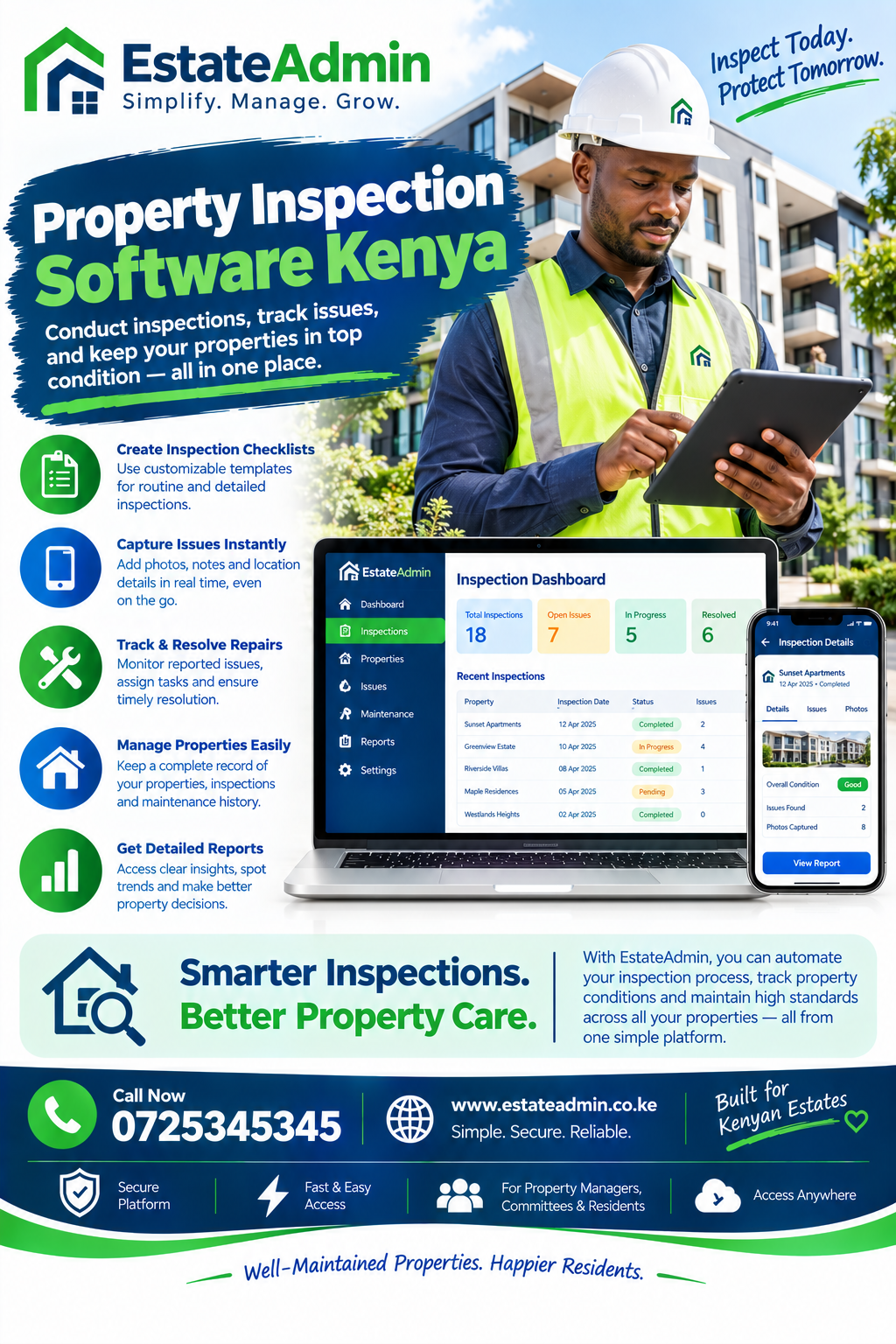
Property Inspection Software Kenya: Complete Guide for Property Managers and Landlords
Managing properties involves much more than collecting rent and communicating with tenants. Property managers and landlords also need to inspect buildings, identify maintenance issues, document property conditions, follow up on repairs and keep reliable records. For businesses handling several residential or commercial units, these tasks can quickly become difficult when they depend on notebooks, spreadsheets, WhatsApp messages and scattered photographs. Property Inspection Software Kenya provides a structured way to manage this important part of property operations.
A good inspection system helps property professionals create inspection schedules, record observations, attach photographs, assign tasks and maintain a history of property conditions. This article explains how inspection software works, why it matters in Kenya, which features to look for, how it can improve maintenance and tenant management, and what property managers should consider before choosing a solution.
What Is Property Inspection Software?
Property Inspection Software Kenya is a digital system designed to help landlords, property managers, estate administrators and facility teams plan, conduct, document and follow up on property inspections.
Instead of recording information manually, an inspection platform creates a central digital record for each property, building, unit or inspection area. Staff can record observations while on site and update the relevant property record immediately.
Depending on the system, an inspection can cover areas such as:
- Walls, ceilings and floors
- Plumbing fixtures
- Electrical installations
- Doors and windows
- Roofing and drainage
- Common areas
- Security installations
- Parking facilities
- Landscaping
- Fire safety equipment
- Lifts and other shared facilities
- Tenant-reported issues
- Vacant units
- Move-in and move-out conditions
Property Inspection Software Kenya becomes particularly useful when inspections need to be repeated regularly. A property manager can compare previous inspection records, identify recurring problems and determine whether reported issues have been resolved.
The system can also improve accountability. Instead of simply recording that an inspection was completed, the manager can retain details about what was inspected, what was found, who handled the inspection and what action followed.
Why Property Inspections Matter in Kenya
Property Inspection Software Kenya can support property businesses because inspections provide information that is difficult to obtain from financial records alone.
Rent collection reports may show whether tenants have paid, but they do not show whether a leaking pipe has damaged a wall, whether a gate is functioning correctly or whether a common area requires attention.
Regular inspections help property owners identify problems before they become more expensive. For example, a small plumbing leak may be easier to address than extensive water damage discovered months later.
Inspections are also useful when managing tenant relationships. A documented inspection gives both the property manager and the tenant a clearer record of the property’s condition.
For Kenyan landlords and property managers, common inspection situations include:
- Routine property inspections
- New tenant move-in inspections
- Tenant move-out inspections
- Maintenance follow-up inspections
- Vacant property inspections
- Pre-leasing inspections
- Post-repair inspections
- Common-area inspections
- Safety inspections
- Periodic building condition assessments
Property Inspection Software Kenya helps organize these different inspection activities instead of treating each one as a separate manual process.
Problems With Manual Property Inspection Processes
Many property businesses start with simple tools. A caretaker may carry a notebook, take photographs using a phone and send updates through WhatsApp. Another staff member may maintain an Excel spreadsheet containing repair information.
These methods can work for a small number of properties, but they become harder to manage as the portfolio grows.
Scattered information
Property Inspection Software Kenya can replace scattered inspection notes with centralized records.
With a manual process, photographs may remain in one person’s phone while written observations are stored in a notebook. Maintenance requests may be discussed in a WhatsApp group, while invoices are stored somewhere else.
Finding the complete history later can take considerable time.
Missed inspections
Without automated scheduling, staff can forget periodic inspections. This can result in property conditions going unchecked for longer than intended.
Poor follow-up
Recording an issue is only the first step. Someone needs to investigate it, assign the repair, monitor progress and confirm completion.
A manual system may record the original problem without providing an effective workflow for what happens next.
Difficulty comparing property conditions
Property Inspection Software Kenya can make historical inspection information easier to access. A manager can review previous observations and compare them with current findings.
This is valuable when recurring problems need investigation.
Limited accountability
If a problem is reported verbally, it can be difficult to determine when it was reported, who received the information and what action was taken.
Digital records provide a clearer audit trail.
How Property Inspection Software Works
Property Inspection Software Kenya generally follows a straightforward workflow.
Step 1: Create property records
The property manager adds buildings, units, common areas and other relevant locations to the system.
Information may include:
- Property name
- Location
- Unit number
- Tenant details
- Inspection frequency
- Property category
- Assigned staff
- Maintenance information
Step 2: Schedule inspections
Inspections can then be scheduled according to the property’s needs.
For example, a manager may establish monthly inspections for common areas and quarterly inspections for individual units.
Step 3: Conduct the inspection
The inspector visits the property and records observations.
Depending on the software, the inspector may use a mobile device to complete inspection forms while moving through the property.
Step 4: Record findings
Property Inspection Software Kenya allows observations to be recorded against specific properties or units.
The inspector may mark an item as satisfactory, requiring attention or requiring urgent action.
Step 5: Attach evidence
Photographs and supporting notes can be added to provide evidence of the property’s condition.
Step 6: Create follow-up tasks
Where an issue is identified, the system can support assigning a maintenance task to the appropriate person.
Step 7: Track completion
The manager can monitor whether the issue remains open, is being worked on or has been completed.
Step 8: Maintain inspection history
Completed inspections remain available as part of the property’s historical record.
Property Inspection Software Kenya therefore turns an inspection from a one-time checklist into a repeatable property management process.
Key Features to Look For
Not every inspection platform provides the same functionality. Before selecting software, property managers should understand the features that will actually support their workflow.
Inspection scheduling
Property Inspection Software Kenya should make it easy to schedule inspections according to property type and operational requirements.
A scheduling feature reduces reliance on memory and manual calendars.
Useful scheduling capabilities may include:
- Recurring inspections
- Inspection dates
- Assigned inspectors
- Property-specific schedules
- Reminders
- Overdue inspection tracking
Digital inspection checklists
Paper forms can be inconsistent. One inspector may check ten items while another checks fifteen.
Digital checklists provide a more standardized process.
A checklist might include sections for:
- Exterior condition
- Interior condition
- Plumbing
- Electrical systems
- Doors and windows
- Security
- Cleanliness
- Common areas
- Safety equipment
- Maintenance requirements
Property Inspection Software Kenya can make it easier to standardize these inspection criteria across multiple buildings.
Photo documentation
Photographs can be particularly useful when documenting property conditions.
For example, if an inspector identifies a damaged ceiling, a photograph can be attached to the inspection record.
This gives the maintenance team a clearer understanding of the issue.
Issue tracking
Property Inspection Software Kenya should make it possible to distinguish between normal observations and issues requiring action.
A manager should be able to see which problems are:
- Newly reported
- Assigned
- In progress
- Awaiting approval
- Completed
- Requiring further inspection
Maintenance integration
Inspection and maintenance management are closely connected.
An inspection identifies a problem. Maintenance addresses the problem.
When these processes are connected, staff do not need to recreate information manually every time an issue is discovered.
Historical records
A property manager may need to understand how a building has changed over time.
Property Inspection Software Kenya can help maintain a historical inspection record showing previous findings, completed work and recurring problems.
Mobile Inspection Capabilities
Property inspections are normally performed away from the office. For that reason, mobile accessibility is an important consideration.
Property Inspection Software Kenya can allow inspectors and property staff to access relevant information from a smartphone, tablet or other supported device.
A mobile inspection workflow may allow staff to:
- Open an assigned inspection
- View the property details
- Complete checklist items
- Add notes
- Capture photographs
- Record defects
- Submit the inspection
- Create maintenance requests
This can reduce the delay between discovering a problem and recording it.
For property businesses managing buildings across Nairobi or other parts of Kenya, mobile functionality can also make field operations easier to coordinate.
Property Condition Reports
A major benefit of a structured inspection system is the ability to create consistent property condition reports.
Property Inspection Software Kenya can help transform individual inspection observations into organized reports for management review.
A report could contain:
| Inspection Area | Condition | Issue Identified | Action Required |
|---|---|---|---|
| Plumbing | Fair | Leaking tap | Repair |
| Walls | Good | None | Monitor |
| Electrical | Good | None | No action |
| Roofing | Fair | Minor damage | Assess |
| Common area | Needs attention | Broken light | Replace |
Reports can help managers prioritize work instead of relying on memory.
Move-In and Move-Out Inspections
Tenant transitions are one of the most important situations for property inspections.
Before a tenant moves into a unit, the property manager can document the existing condition.
Property Inspection Software Kenya can support a structured move-in inspection record containing details about rooms, fixtures, appliances and visible defects.
When the tenant leaves, another inspection can be performed.
The two records can then be compared to identify changes that occurred during the tenancy.
This process can be useful for:
- Documenting existing defects
- Confirming the condition at handover
- Tracking damage
- Supporting maintenance decisions
- Improving tenant communication
- Maintaining consistent property records
The value comes from having documented information rather than relying solely on verbal explanations.
Managing Maintenance Issues From Inspections
Inspection software is most valuable when it connects inspection findings with maintenance workflows.
Suppose an inspector discovers a blocked drainage system.
The inspection record should identify the issue. The property manager can then create a maintenance task, assign it to a technician or contractor, monitor progress and confirm completion.
Property Inspection Software Kenya can support this chain of information.
A useful maintenance workflow can include:
- Issue identified
- Issue documented
- Priority assigned
- Responsible person selected
- Repair scheduled
- Work completed
- Evidence added
- Manager verifies completion
- Inspection record updated
This approach makes it easier to distinguish between issues that have simply been reported and those that have actually been resolved.
Prioritizing Inspection Findings
Not every defect requires immediate attention.
A broken light in a common area may require relatively quick attention, while a cosmetic wall mark may be scheduled for later.
Property Inspection Software Kenya can help managers categorize issues according to urgency.
For example:
Critical: Problems that could create significant safety, security or property risks.
High priority: Problems that can cause substantial inconvenience or damage if ignored.
Medium priority: Issues that should be addressed but do not require immediate intervention.
Low priority: Minor defects that can be handled during routine maintenance.
Having a defined priority system helps maintenance teams focus their time and resources.
Improving Tenant Communication
Property inspections can affect tenant satisfaction because they often involve entering occupied units or responding to reported problems.
Clear communication is therefore important.
Property Inspection Software Kenya can support better coordination by keeping inspection and maintenance information organized.
For example, when a tenant reports a leaking sink, the property manager can record the issue, arrange an inspection and create a maintenance task.
Instead of asking several staff members for updates, the manager can refer to the relevant record.
Good communication should also explain:
- Why an inspection is needed
- When it will take place
- What areas will be inspected
- Whether access is required
- What was discovered
- What action will follow
The exact communication process should reflect the property manager’s policies and applicable tenancy arrangements.
Using Inspection Data for Property Management Decisions
Inspection records can provide more than individual repair information.
Over time, property managers can identify patterns.
Property Inspection Software Kenya can help organize inspection data that supports questions such as:
- Which buildings generate the most maintenance issues?
- Which systems fail repeatedly?
- Which units require frequent attention?
- Which repairs remain unresolved?
- Which areas need investment?
- Are recurring problems increasing?
- Which contractors handle certain categories of work?
These observations can support maintenance planning and budgeting.
For example, if a building repeatedly experiences plumbing problems, the manager may decide that repeated small repairs are less practical than investigating the underlying system.
Preventive Maintenance and Inspections
Preventive maintenance aims to address equipment and property issues before failures become serious.
Inspections can play an important role in this approach.
Property Inspection Software Kenya can help property managers connect inspection schedules with maintenance activities.
Consider a residential development with several shared facilities. Regular inspections may reveal deteriorating paint, damaged lighting, drainage problems or worn fittings.
Addressing these issues early can help property managers avoid allowing minor defects to develop into larger maintenance projects.
Preventive inspections can be especially useful for:
- Roofs
- Drainage
- Plumbing
- Electrical systems
- Security equipment
- Common-area lighting
- Parking areas
- Landscaping
- Water systems
The objective is not to eliminate every repair. Instead, it is to create a systematic way to identify and address problems.
Supporting Multiple Properties
Managing one building is different from managing a portfolio.
A portfolio may contain dozens of properties and hundreds of units.
Property Inspection Software Kenya can help organize inspections according to property, building and unit.
A centralized dashboard can make it easier to see:
- Scheduled inspections
- Completed inspections
- Overdue inspections
- Open defects
- High-priority issues
- Pending maintenance
- Recently completed repairs
This gives management a broader view without requiring staff to search through separate spreadsheets.
Inspection Software for Property Managers
Property managers often coordinate landlords, tenants, caretakers, contractors and maintenance teams.
This creates a need for clear information flow.
Property Inspection Software Kenya can provide a central place for inspection-related information.
A property manager can use inspection records when preparing reports for property owners.
For example, an owner may ask why maintenance expenditure has increased. Inspection records can provide context by showing recurring problems or newly identified defects.
Similarly, if a tenant disputes the condition of a unit, documented inspection records may help the manager review what was previously recorded.
Inspection Software for Landlords
Individual landlords can also benefit from organized inspection records.
Property Inspection Software Kenya is not only relevant to large property management companies.
A landlord with several apartments, houses or commercial spaces may still need to schedule inspections and track maintenance.
Digital records become especially useful when the landlord is not physically present at every property.
A caretaker or property manager can perform the inspection while the owner reviews the report remotely.
Managing Vacant Properties
Vacant units require attention even when they do not have tenants.
A vacant property can develop problems involving water, security, electrical systems, weather exposure or unauthorized access.
Property Inspection Software Kenya can help property managers schedule periodic checks on vacant units.
A vacant-property inspection might cover:
- Doors and locks
- Windows
- Water supply
- Electrical systems
- Leaks
- Walls and ceilings
- Security
- Cleanliness
- Outdoor areas
Regular checks can help managers identify problems before a new tenant moves in.
Inspection Checklists for Kenyan Properties
The correct checklist depends on the property.
A residential apartment may require different checks from an office block, retail property or gated estate.
Property Inspection Software Kenya can support customized inspection procedures.
A residential unit checklist could include:
Living areas
- Walls
- Floors
- Ceiling
- Windows
- Doors
- Electrical sockets
- Lighting
Kitchen
- Sink
- Taps
- Drainage
- Cabinets
- Countertops
- Electrical appliances where applicable
Bathroom
- Toilet
- Shower
- Basin
- Taps
- Drainage
- Ventilation
- Tiles
External areas
- Balcony
- Parking
- Gates
- Landscaping
- Drainage
The checklist should be practical rather than unnecessarily long. Staff should be able to complete it consistently.
Reporting and Management Visibility
Managers need more than raw inspection records. They need information that helps them understand the state of the portfolio.
Property Inspection Software Kenya can support reporting around inspection completion and identified defects.
Useful reports may include:
- Inspections completed by month
- Overdue inspections
- Issues by property
- Issues by category
- Open maintenance tasks
- Completed repairs
- Recurring defects
- Inspection activity by staff member
These reports can help managers identify operational bottlenecks.
For example, if many inspections are consistently overdue, the issue may not be the inspection process itself. The company may need to review staffing, scheduling or workload.
Security and Access Control
Inspection information may contain sensitive property details.
A software solution should therefore provide appropriate user access controls.
Property Inspection Software Kenya should be evaluated based on how it handles users, permissions and access to property information.
Different employees may require different levels of access.
For example:
- Inspectors may need access to assigned inspections.
- Maintenance staff may need access to assigned repair tasks.
- Property managers may require broader portfolio visibility.
- Owners may require access to relevant reports.
The exact permissions should reflect the organization’s operational structure.
Cloud-Based Property Inspection Management
Cloud-based systems can make inspection records accessible from supported devices without requiring staff to maintain files on individual computers.
Property Inspection Software Kenya can be particularly useful when property teams work from multiple locations.
A cloud-based workflow may allow information entered at a property to become available to authorized office staff without waiting for physical paperwork.
However, property businesses should still consider connectivity, user training, backup practices and the provider’s security controls before implementation.
Integrating Inspections With Other Property Processes
Inspection management rarely operates independently.
Property businesses also deal with:
- Rent collection
- Tenant management
- Invoicing
- Accounting
- Maintenance
- Service charges
- Contractor management
- Communication
- Property reporting
Property Inspection Software Kenya can become more useful when inspection information connects with these wider workflows.
For example, an inspection may identify a maintenance issue. The maintenance workflow may then generate a work request. The completed work may result in an expense that is recorded for the relevant property.
This creates a more complete operational history.
M-Pesa and Kenyan Property Operations
M-Pesa is widely used for business payments in Kenya, including many property-related transactions.
Although inspection software is primarily focused on property condition and maintenance, integration with broader property management systems can help businesses connect operational information with financial processes.
Property Inspection Software Kenya can be part of a larger digital property management workflow where inspections, maintenance, tenant records and financial information are managed in an organized environment.
The specific payment integrations available depend on the software selected, so property managers should confirm supported payment services before purchasing.
How Inspections Can Reduce Operational Delays
A common problem in property management is the gap between identifying an issue and acting on it.
For instance, a caretaker may discover a leaking pipe but forget to report it immediately. The property manager may then learn about the issue days later.
Property Inspection Software Kenya can shorten this information gap by allowing observations to be documented as part of the inspection workflow.
When an issue is recorded immediately, the next step becomes clearer.
The objective is not simply to collect more data. It is to move useful information to the right person at the right time.
Choosing the Right Software
Selecting an inspection platform should begin with the property’s actual requirements.
Property Inspection Software Kenya should be assessed against practical questions rather than a long list of unnecessary features.
Ask:
- How many properties need to be inspected?
- How frequently are inspections performed?
- How many staff members conduct inspections?
- Do inspectors need mobile access?
- Are photographs required?
- Are customized checklists needed?
- Does the system track maintenance issues?
- Can managers generate reports?
- Can different users have different permissions?
- Can the system integrate with other property workflows?
A simple system that staff consistently use may be more useful operationally than a complicated system that employees struggle to understand.
Common Mistakes When Implementing Inspection Software
Buying software does not automatically improve inspection processes.
Property Inspection Software Kenya works best when the business also establishes clear procedures.
Mistake 1: Creating overly complicated checklists
If an inspection checklist contains too many irrelevant items, staff may rush through it.
Keep checklists focused on meaningful inspection criteria.
Mistake 2: Failing to assign responsibility
Every identified issue should have a clear owner.
Mistake 3: Ignoring historical information
Inspection records become more useful when managers review them over time.
Mistake 4: Treating photographs as the entire inspection
Photos are useful evidence, but they should be supported by written observations and structured data.
Mistake 5: Failing to train staff
Property Inspection Software Kenya will only provide value if employees know how to use it correctly.
Training should cover inspection procedures, data entry, photographs, issue reporting and follow-up.
Cost Considerations
The price of property inspection software varies according to the provider, number of users, features, property portfolio size and deployment model.
Property Inspection Software Kenya should therefore be evaluated based on total operational value rather than price alone.
When comparing costs, consider:
- Subscription fees
- Number of users
- Number of properties
- Setup costs
- Training
- Support
- Integration
- Data migration
- Mobile access
- Reporting capabilities
A lower-cost solution may not provide the workflow needed by a larger property operation, while an expensive system may contain features that a small landlord does not need.
Calculating the Business Value
Property managers can consider the amount of time currently spent on manual inspections.
Suppose staff spend several hours every week compiling inspection notes, locating photographs and following up on maintenance issues.
A structured system may reduce some of this administrative work.
Property Inspection Software Kenya can also provide value through better visibility and more consistent follow-up.
A practical evaluation can compare:
Current process costs
- Staff time
- Paperwork
- Data entry
- Follow-up
- Missed maintenance
- Repeated inspections
against:
Digital process costs
- Software subscription
- Implementation
- Training
- Support
- Device requirements
The comparison should be based on the organization’s actual workflow.
Staff Training and Adoption
Technology works only when people use it consistently.
Property Inspection Software Kenya should therefore be introduced with a simple training plan.
Staff should understand:
- Why inspections are being digitized
- How to access assigned inspections
- How to complete checklists
- How to record defects
- How to attach photographs
- How to create maintenance requests
- How to close completed issues
- How to find historical records
Managers should also establish standards for inspection quality.
For example, inspectors may be required to photograph significant defects and provide a short explanation of each issue.
Creating a Standard Inspection Process
Before implementing software, property managers should define how inspections should happen.
Property Inspection Software Kenya can then be configured around that process.
A standard operating procedure might look like this:
Before inspection
- Review previous issues
- Confirm inspection schedule
- Notify relevant occupants
- Prepare checklist
During inspection
- Inspect each area
- Record observations
- Photograph significant defects
- Assign priority
- Add notes
After inspection
- Review findings
- Assign maintenance tasks
- Notify relevant parties
- Monitor repairs
- Confirm completion
- Store the final report
A consistent process helps ensure that software supports the business rather than simply becoming another place to enter information.
Benefits for Property Owners
Owners want to protect the condition and value of their properties while controlling operating costs.
Property Inspection Software Kenya can provide owners and managers with better visibility into property conditions.
Instead of receiving occasional informal updates, owners can receive structured information about inspections, defects and maintenance activity.
This can support more informed decisions about:
- Repairs
- Renovations
- Preventive maintenance
- Capital improvements
- Property budgets
- Tenant-related issues
Owners should still ensure that reporting practices match their agreements with property managers and the specific requirements of their properties.
Benefits for Estate Administrators
Estate administrators often coordinate multiple buildings, residents, service providers and common areas.
Property Inspection Software Kenya can help centralize inspection information for shared spaces and individual units.
For an estate, inspection areas might include:
- Entrance gates
- Roads
- Parking
- Security facilities
- Lighting
- Drainage
- Landscaping
- Waste areas
- Recreation facilities
- Common buildings
The administrator can then identify recurring issues and coordinate maintenance more systematically.
Benefits for Facility Teams
Commercial properties require regular checks because equipment and building conditions can affect business operations.
Property Inspection Software Kenya can support facility teams by organizing recurring inspection activities.
Office buildings, retail centers, warehouses and other facilities may have different inspection requirements, so customization is important.
A facility team may need to track:
- Lighting
- HVAC systems
- Plumbing
- Electrical infrastructure
- Fire safety equipment
- Access control
- Common areas
- Structural observations
The inspection system should reflect the property’s actual operational needs.
Data Quality and Accurate Records
Digital records are only useful when the information entered is accurate.
Property Inspection Software Kenya should be supported by clear standards for data entry.
For example, instead of entering a vague note such as “wall problem,” an inspector can describe the location and condition more clearly.
A useful observation might identify:
- Building
- Unit
- Room
- Issue
- Severity
- Photograph
- Recommended action
Consistent data makes reports easier to interpret.
How to Improve Inspection Efficiency
Property managers can improve their inspection process by combining software with practical procedures.
Property Inspection Software Kenya can support efficiency when the organization also focuses on workflow design.
Consider these practices:
- Use property-specific checklists.
- Schedule recurring inspections.
- Give inspectors clear responsibilities.
- Record issues immediately.
- Use photographs for important defects.
- Assign maintenance tasks promptly.
- Set priorities.
- Review overdue issues regularly.
- Analyze recurring problems.
- Keep historical records organized.
The goal should be a process that is thorough without becoming unnecessarily complicated.
Future-Proofing Property Operations
Property portfolios can change over time.
A landlord may acquire additional units, an estate may add new buildings, or a property management company may take on new clients.
Property Inspection Software Kenya should therefore be scalable enough to support reasonable growth.
When evaluating a platform, ask how easily the business can add:
- Properties
- Units
- Users
- Inspection templates
- Maintenance categories
- Reports
- New workflows
Scalability matters because replacing a system every time the portfolio grows can create unnecessary disruption.
Questions to Ask a Software Provider
Before selecting a solution, prepare a list of questions.
Property Inspection Software Kenya providers should be able to explain how their system handles the workflows that matter to your business.
Useful questions include:
- Can inspections be scheduled automatically?
- Can users create custom checklists?
- Can inspectors attach photographs?
- Can issues be assigned to staff?
- Can maintenance tasks be tracked?
- Can managers view inspection history?
- Is the platform mobile-friendly?
- Can user permissions be configured?
- What reporting features are available?
- How is customer support provided?
- How is customer data protected?
- Can the platform integrate with other systems?
- What happens when the subscription changes?
- How is data exported if the business changes systems?
These questions help distinguish between software that looks useful in a demonstration and software that fits the organization’s real workflow.
Frequently Asked Questions
1. What is Property Inspection Software Kenya?
Property Inspection Software Kenya refers to digital software used by landlords, property managers and estate teams to schedule inspections, record property conditions, document defects and manage inspection follow-up.
2. Can property inspection software be used for apartments?
Yes. Apartment managers can use inspection software for individual units, common areas, vacant properties, move-in inspections, move-out inspections and maintenance follow-up.
3. Can inspection software include photographs?
Many modern inspection platforms support photographs or other evidence attachments. Property managers should confirm the exact media features available before selecting a provider.
4. Does inspection software replace maintenance software?
Not necessarily. Inspection and maintenance are related but different processes. Inspection identifies and documents conditions, while maintenance focuses on correcting problems. Some platforms connect both workflows.
5. Is Property Inspection Software Kenya suitable for small landlords?
Property Inspection Software Kenya can be useful for small landlords when the inspection process involves multiple properties or requires reliable historical records. The appropriate solution depends on the landlord’s portfolio and requirements.
6. Can inspection software support move-in and move-out reports?
Yes, inspection systems can be designed around move-in and move-out checklists, provided the selected platform supports those workflows.
7. Can property managers track unresolved inspection issues?
A suitable system can connect inspection findings with issue or maintenance tracking, allowing managers to monitor open and completed tasks.
8. Is mobile access important for property inspections?
Mobile access can be highly useful because inspections are normally conducted in the field. Inspectors can potentially record observations and photographs without waiting until they return to the office.
9. How does inspection software help property owners?
Property Inspection Software Kenya can give property owners and managers a more organized view of property conditions, maintenance requirements and inspection history.
10. What should I consider before buying inspection software?
Consider the number of properties, inspection frequency, users, mobile requirements, checklist customization, photographs, maintenance tracking, reporting, integrations, security, support and total cost.
Final Thoughts
Property inspections are an essential part of maintaining buildings, protecting property condition and providing better service to tenants and owners. When inspections are handled through notebooks, scattered photographs and disconnected messages, important information can easily become difficult to find.
A structured digital process can change that.
Property Inspection Software Kenya gives property managers a way to organize inspections, standardize checklists, document defects, attach evidence, assign follow-up work and maintain historical records. When connected with maintenance, tenant management and reporting processes, inspection information can become a useful part of wider property operations.
The most important consideration is not simply finding software with the longest feature list. Property managers should choose a solution that matches the size of their portfolio, the way their teams work and the type of properties they manage.
For a landlord with a few units, simplicity and ease of use may be most important. For a professional property management company, portfolio visibility, user permissions, reporting, maintenance workflows and scalability may matter more.
The right implementation should also include clear inspection procedures, staff training and consistent data entry.
For Kenyan property businesses, the practical objective is straightforward: make it easier to know the condition of every property, identify problems promptly, assign the right action and maintain a reliable record of what happened.
Property Inspection Software Kenya can be an important component of that approach when it is selected and implemented around real property management needs rather than technology alone.