
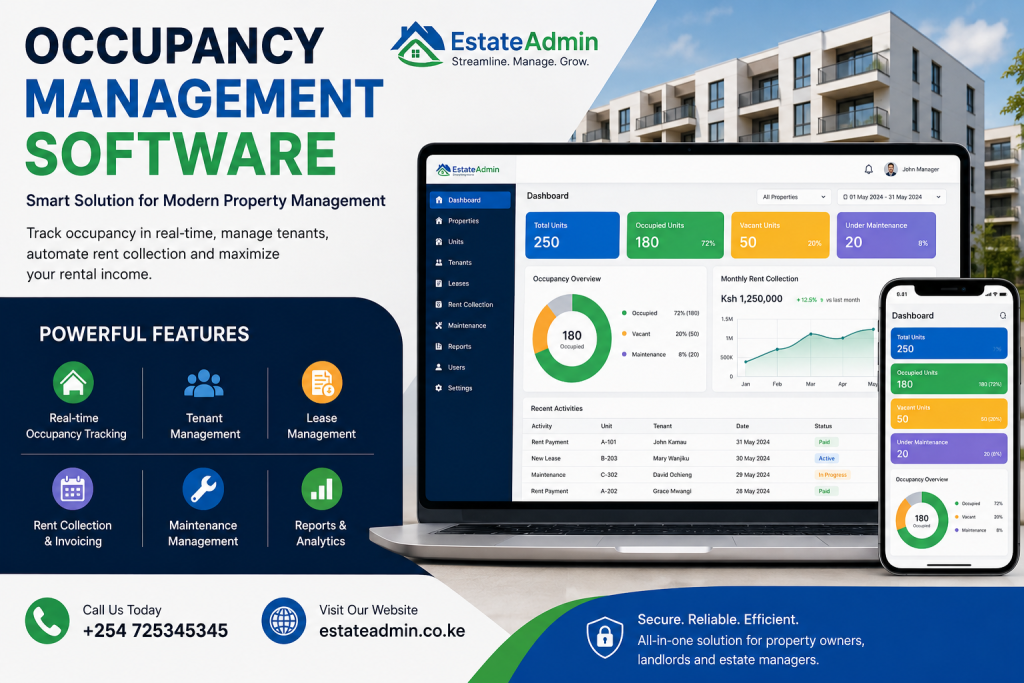
Introduction to Occupancy Management Software
Occupancy Management Software is rapidly becoming one of the most important tools in modern property management systems, especially in fast-growing real estate markets like Kenya. As urban areas such as Nairobi, Mombasa, Kisumu, Eldoret, and Nakuru continue to expand, landlords and estate managers are now handling more tenants, more rental units, and more complex operations than ever before.
Manually tracking tenants, rent payments, vacancies, and lease agreements is no longer practical. This is where Occupancy Management Software comes in.
Occupancy Management Software is a digital system designed to help property owners monitor and manage the occupancy status of rental units in real time. It provides clear visibility of which units are occupied, vacant, reserved, under maintenance, or available for leasing.
At Estate Admin, we provide advanced Occupancy Management Software designed specifically for the Kenyan real estate market. Our system helps landlords, property managers, and real estate agencies streamline operations, reduce losses, and improve rental income.
Understanding Occupancy Management Software
Occupancy Management Software is more than just a tracking tool—it is a complete property intelligence system. It allows landlords to know exactly what is happening in their property portfolio at any given moment.
Instead of relying on physical inspections or manual record books, everything is digitized and updated automatically.
The system typically tracks:
- Occupied units
- Vacant units
- Reserved units
- Units under repair or maintenance
- Upcoming lease expirations
- Tenant move-ins and move-outs
This level of automation ensures that no unit is left unmonitored, reducing revenue loss and improving efficiency.
In Kenya’s rental market, where demand is high but competition is also strong, having accurate occupancy data gives property owners a major advantage.
Why Occupancy Management Software is Important in Kenya
The real estate sector in Kenya is growing quickly, but many landlords still face major challenges due to outdated management methods. These include:
- Poor tracking of tenants
- Missed rental payments
- Long vacancy periods
- Lack of communication with tenants
- Disorganized lease records
- Revenue leakage due to inefficiency
Occupancy Management Software solves all these problems by automating and centralizing property operations.
1. Rapid Urban Growth
Cities like Nairobi and Mombasa are experiencing continuous population growth. This means more rental demand but also more pressure on landlords to manage properties efficiently.
2. Increasing Competition Among Landlords
With more property developers entering the market, landlords must reduce vacancy rates and improve tenant satisfaction to stay competitive.
3. Need for Digital Transformation
Traditional property management methods are no longer sufficient. Digital systems like Occupancy Management Software offer speed, accuracy, and scalability.
How Occupancy Management Software Works
Occupancy Management Software operates by connecting all property data into one centralized dashboard.
Here is a simplified breakdown of how it works:
Step 1: Property Setup
The landlord or property manager enters all buildings, estates, and rental units into the system.
Step 2: Unit Allocation
Each unit is assigned a status such as occupied, vacant, or under maintenance.
Step 3: Tenant Registration
Tenant details are recorded including:
- Name
- Contact information
- Lease agreement
- Payment history
Step 4: Real-Time Updates
Whenever a tenant moves in or out, the system automatically updates the occupancy status.
Step 5: Monitoring and Reporting
The system generates real-time reports showing occupancy rates, income levels, and vacancies.
This automation reduces human error and ensures accuracy in property records.
Key Features of Occupancy Management Software
Occupancy Management Software comes with powerful features that make estate management easier, faster, and more reliable.
1. Real-Time Occupancy Tracking
This is the core feature of the system. It allows landlords to see the exact status of every unit in real time.
You can instantly know:
- Which units are occupied
- Which units are empty
- Which units are reserved
This eliminates guesswork and improves decision-making.
2. Tenant Management System
The software stores all tenant information in one place. This includes:
- Personal details
- Identification documents
- Lease agreements
- Rent payment history
- Communication records
This ensures landlords have full visibility of tenant activities.
3. Vacancy Tracking and Alerts
Vacancy tracking is one of the most important functions of Occupancy Management Software.
The system automatically alerts property managers when:
- A tenant moves out
- A lease expires
- A unit becomes available
This helps reduce vacancy time and ensures faster re-leasing.
4. Lease Management
Managing lease agreements manually can lead to confusion and disputes. With Occupancy Management Software, lease tracking becomes automated.
You can track:
- Start date of lease
- End date of lease
- Renewal reminders
- Contract terms
This ensures smooth transitions between tenants.
5. Maintenance Status Tracking
Units under repair or maintenance are clearly marked in the system.
This helps avoid:
- Double booking
- Tenant confusion
- Loss of potential income due to miscommunication
6. Reporting and Analytics Dashboard
Occupancy Management Software provides powerful reporting tools that help landlords understand their business performance.
Reports include:
- Occupancy rate reports
- Monthly income reports
- Vacancy trends
- Tenant turnover rates
These insights help improve decision-making and profitability.
Benefits of Using Occupancy Management Software
Occupancy Management Software provides numerous benefits to landlords and estate managers in Kenya.
1. Saves Time and Reduces Manual Work
Manual record keeping is slow and inefficient. With automation, landlords save hours of administrative work every week.
2. Reduces Vacancy Losses
Every empty unit means lost income. The software ensures quick updates and faster leasing, reducing downtime.
3. Improves Financial Management
With real-time data, landlords can track income and expenses more accurately.
4. Enhances Tenant Satisfaction
Tenants benefit from faster communication, better service, and more organized management systems.
5. Supports Multi-Property Management
Whether you manage one apartment block or multiple estates across different towns, the system centralizes everything in one dashboard.
6. Reduces Human Error
Manual systems are prone to mistakes such as:
- Wrong records
- Lost documents
- Missed payments
Occupancy Management Software eliminates these errors.
Occupancy Management Software for Different Property Types
This software is not limited to one type of property. It can be used across various real estate sectors in Kenya:
1. Residential Apartments
Ideal for landlords managing flats and rental houses.
2. Commercial Buildings
Used to track office spaces, retail shops, and business premises.
3. Student Hostels
Helps manage high tenant turnover efficiently.
4. Airbnb and Short-Term Rentals
Ensures real-time tracking of bookings and availability.
5. Real Estate Agencies
Allows agents to manage multiple client properties in one system.
Occupancy Management Software vs Traditional Methods
Many landlords in Kenya still rely on notebooks, Excel sheets, or memory-based tracking. However, these methods are outdated and inefficient.
| Feature | Manual System | Occupancy Management Software |
|---|---|---|
| Accuracy | Low | High |
| Speed | Slow | Real-time |
| Data Storage | Scattered | Centralized |
| Reporting | Difficult | Automated |
| Scalability | Limited | Unlimited |
Clearly, digital systems offer a much more reliable solution.
Why Estate Admin is the Leading Solution in Kenya
At Estate Admin, we focus on building smart property management solutions tailored for the Kenyan market.
Our Occupancy Management Software helps landlords:
- Track occupancy in real time
- Manage tenants efficiently
- Reduce vacancy losses
- Automate reporting
- Improve rental income
We understand the challenges faced by Kenyan landlords and provide a system that is simple, powerful, and scalable.
📞 Contact us today: +254 725345345
🌐 Website: estateadmin.co.ke
Advanced Features of Occupancy Management Software
In Part 1, we covered the basics of Occupancy Management Software, how it works, and why it is important for landlords and estate managers in Kenya. In this second part, we go deeper into advanced functionality, real-world applications, implementation, and how property owners can maximize returns using Occupancy Management Software.
Modern Occupancy Management Software is not just about tracking vacancies—it is a complete property intelligence and automation system that transforms how estates are managed.
At Estate Admin, our system is designed to give landlords full control over occupancy, revenue, tenants, and operations in one powerful dashboard.
1. Automation in Occupancy Management Software
Automation is one of the biggest advantages of Occupancy Management Software.
Instead of manually updating records, the system automatically:
- Updates occupancy status when a tenant moves in or out
- Sends reminders for lease renewals
- Notifies landlords about vacant units
- Tracks rent payments linked to occupancy
- Generates occupancy reports automatically
This reduces human workload and eliminates errors caused by manual data entry.
In Kenya, where many landlords manage properties remotely, automation is a game-changer.
2. Occupancy Rate Analytics and Performance Tracking
One of the most powerful features of Occupancy Management Software is analytics.
The system provides detailed insights such as:
- Monthly occupancy rate
- Yearly occupancy trends
- Most frequently vacant units
- Tenant turnover rate
- Revenue per occupied unit
These analytics help landlords make informed decisions such as:
- Adjusting rent prices
- Improving tenant retention strategies
- Identifying underperforming properties
- Planning renovations or upgrades
With better data, landlords can increase profitability significantly.
3. Integration with Rent Collection Systems
Modern Occupancy Management Software integrates with rent collection tools to create a fully automated ecosystem.
This means:
- Occupied units are linked to active rent accounts
- Payment status is updated automatically
- Late payments trigger alerts
- Receipts are generated instantly
This integration reduces disputes between landlords and tenants and improves financial transparency.
At Estate Admin, occupancy tracking and rent management work together seamlessly to ensure no revenue is lost.
4. Multi-Property Management Dashboard
For landlords with multiple estates, managing properties individually can be overwhelming.
Occupancy Management Software solves this through a centralized dashboard that allows you to:
- Manage multiple estates in one place
- Compare occupancy across properties
- Monitor performance of each building
- Track income per location
- Identify high-performing estates
This is especially useful for real estate investors in Nairobi and other growing urban areas in Kenya.
5. Mobile Access and Remote Management
In today’s digital world, landlords no longer need to be physically present to manage properties.
Occupancy Management Software is accessible via:
- Mobile phones
- Tablets
- Web dashboards
This allows property managers to:
- Check occupancy from anywhere
- Approve maintenance requests remotely
- Monitor tenant activity in real time
- Receive instant notifications
This flexibility is critical for busy landlords and real estate agencies.
6. Security and Data Protection
Security is a major concern in property management systems.
Occupancy Management Software ensures:
- Encrypted tenant data storage
- Secure login access
- Role-based permissions
- Backup and recovery systems
This protects sensitive information such as tenant IDs, lease agreements, and payment records.
7. Real-Life Use Cases in Kenya
Occupancy Management Software is already being used across different property types in Kenya.
Residential Apartments in Nairobi
Landlords use the system to track tenants in high-density areas like Kilimani, Kileleshwa, and South B.
Student Hostels
Universities and private hostels use occupancy systems to manage high turnover rates efficiently.
Commercial Properties
Office buildings in Nairobi CBD use occupancy tracking to manage business tenants and lease agreements.
Airbnb and Short-Term Rentals
Hosts use occupancy data to track bookings, availability, and seasonal demand.
8. Implementation Process of Occupancy Management Software
Setting up Occupancy Management Software is simple and fast.
Step 1: System Setup
All properties and units are registered into the system.
Step 2: Data Migration
Existing tenant and lease data is uploaded into the system.
Step 3: Configuration
Occupancy rules, rent cycles, and notifications are configured.
Step 4: Training
Property managers are trained on how to use the system.
Step 5: Go Live
The system begins tracking occupancy in real time.
At Estate Admin, onboarding is designed to be smooth and user-friendly for Kenyan landlords.
9. Cost and Pricing Models in Kenya
The cost of Occupancy Management Software in Kenya varies depending on:
- Number of units managed
- Features required
- Level of automation
- Support and customization
Common pricing models include:
Monthly Subscription
Ideal for small landlords and startups.
Annual Subscription
More cost-effective for long-term users.
Enterprise Solutions
For large property companies managing hundreds of units.
Investing in Occupancy Management Software often pays for itself through reduced vacancy losses and improved efficiency.
10. Challenges Solved by Occupancy Management Software
Occupancy Management Software solves many common problems faced by Kenyan landlords:
Problem 1: Poor Record Keeping
✔ Solution: Centralized digital records
Problem 2: Long Vacancy Periods
✔ Solution: Real-time vacancy alerts
Problem 3: Missed Rent Payments
✔ Solution: Automated rent tracking
Problem 4: Tenant Disputes
✔ Solution: Transparent data records
Problem 5: Manual Errors
✔ Solution: Automation and validation systems
10.1 Real Benefits of Occupancy Management Software for Kenyan Landlords (DETAILED INSIGHT)
Occupancy Management Software is not just a digital tool—it is a complete transformation of how landlords and estate managers operate in Kenya. Many property owners still underestimate how much revenue they lose through poor tracking, delayed updates, and manual record systems.
With the introduction of Occupancy Management Software, landlords gain a structured, automated, and data-driven way of managing their rental businesses.
Improved Cash Flow Stability
One of the biggest challenges in the Kenyan rental market is inconsistent cash flow. This is usually caused by:
- Late rent payments
- Untracked tenants
- Vacant units not being re-advertised quickly
- Poor lease monitoring
Occupancy Management Software solves this by linking occupancy status directly with financial tracking. When a unit is marked as occupied, it is automatically tied to rent schedules, reminders, and payment tracking.
This ensures landlords always know:
- Who has paid
- Who has not paid
- Which unit is generating income
- Which unit is losing money
This level of clarity improves financial planning and stability.
Faster Tenant Turnover Management
When a tenant moves out, time is money. Every day a unit stays vacant means lost income.
Occupancy Management Software reduces vacancy time by:
- Instantly marking units as available
- Triggering alerts for marketing or re-leasing
- Tracking lease expiry dates in advance
- Allowing quick tenant onboarding
In competitive cities like Nairobi, this speed is extremely important because demand changes quickly.
A delay of even 7–14 days in re-leasing a unit can result in significant annual losses for landlords.
Better Decision Making for Property Owners
Traditional property management relies heavily on guesswork. Many landlords do not know:
- Which properties are performing best
- Which tenants are consistently late
- Which locations have high vacancy rates
- Where maintenance costs are too high
Occupancy Management Software solves this by providing real-time analytics dashboards.
With these insights, landlords can:
- Increase rent in high-demand areas
- Renovate underperforming units
- Sell or repurpose low-performing properties
- Improve tenant selection strategies
This shifts property management from reactive to proactive decision-making.
Reduced Operational Costs
Another major benefit is cost reduction.
By automating tasks such as:
- Tenant tracking
- Vacancy updates
- Lease monitoring
- Reporting
Landlords reduce the need for excessive manual labor or administrative staff.
This is especially useful for:
- Small landlords managing multiple units
- Real estate agencies handling multiple estates
- Property managers overseeing large portfolios
In the long run, automation significantly reduces operational expenses while improving accuracy.
Stronger Tenant Relationships
Tenant satisfaction plays a major role in occupancy stability.
Occupancy Management Software improves tenant relationships by:
- Ensuring faster communication
- Reducing billing disputes
- Providing clear lease information
- Offering transparent records
When tenants feel that management is organized and professional, they are more likely to:
- Renew leases
- Pay rent on time
- Take better care of property
This directly improves occupancy rates and reduces turnover.
Scalable Growth for Landlords
One of the most powerful advantages of Occupancy Management Software is scalability.
A landlord can start with:
- 5 units
and scale up to - 500+ units
without changing the system.
Everything remains centralized:
- Tenant records
- Occupancy tracking
- Financial reporting
- Lease management
This makes it ideal for growing real estate investors in Kenya who plan to expand their portfolios over time.
At Estate Admin, scalability is built into the system so landlords can grow without operational stress.
Competitive Advantage in the Kenyan Real Estate Market
The Kenyan property market is becoming more competitive every year. Landlords who still rely on manual systems risk falling behind.
Those using Occupancy Management Software gain a strong advantage because they can:
- Fill vacancies faster
- Track tenants more efficiently
- Manage multiple properties easily
- Respond quickly to market changes
This leads to higher occupancy rates and better long-term profitability.
11. Future of Occupancy Management Software in Kenya
The future of property management is fully digital.
In the coming years, Occupancy Management Software will include:
- AI-powered rent prediction
- Smart lease recommendations
- Automated tenant screening
- IoT integration for smart buildings
- Predictive vacancy analytics
Kenya’s real estate sector is moving toward full automation, and early adopters will benefit the most.
12. Why Estate Admin is the Best Choice
At Estate Admin, we are committed to transforming property management in Kenya through smart digital solutions.
Our Occupancy Management Software offers:
- Real-time occupancy tracking
- Full automation of estate operations
- Integrated rent management
- Multi-property dashboards
- Secure data handling
- Mobile accessibility
We help landlords reduce workload, increase efficiency, and maximize rental income.
📞 Contact us: +254 725345345
🌐 Visit: estateadmin.co.ke
SEO Keywords Used in This Part
This section is optimized for:
- Occupancy Management Software Kenya
- Property management system Kenya
- Estate management software
- Rental occupancy tracking system
- Automated property management Kenya
- Landlord software Kenya
- Real estate management system Kenya
- Vacancy tracking software
FINAL CONCLUSION (Full Article Ending)
Occupancy Management Software is no longer optional for modern landlords in Kenya—it is a necessity. From tracking occupancy in real time to automating rent collection and reducing vacancy losses, this technology is reshaping the real estate industry.
Landlords who adopt digital systems today will enjoy higher efficiency, better tenant satisfaction, and increased profitability in the long run.
At Estate Admin, we are proud to support this transformation by offering powerful, reliable, and easy-to-use Occupancy Management Software tailored for the Kenyan market.
📞 Contact: +254 725345345
🌐 Website: estateadmin.co.ke