
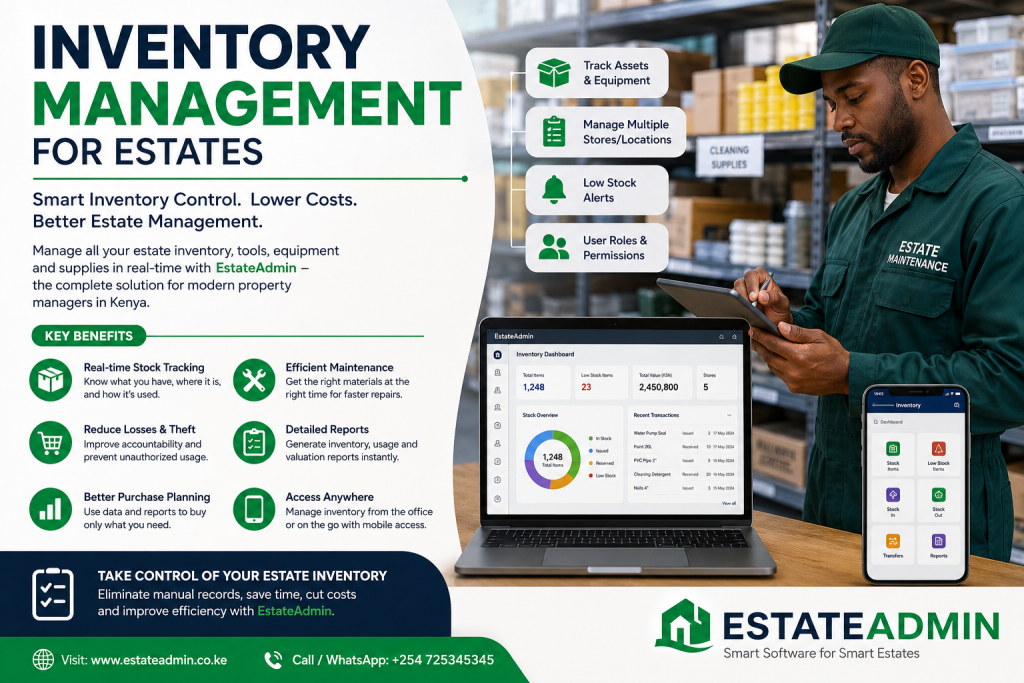
Managing an estate involves much more than collecting rent and handling maintenance requests. Every estate, whether residential, commercial, or mixed-use, owns hundreds or even thousands of assets that require proper monitoring. Without a reliable inventory management for estates solution, property managers can easily lose track of valuable equipment, maintenance supplies, office assets, and common-area facilities.
Today, many property managers in Kenya are replacing manual record books and spreadsheets with modern inventory management for estates software that automates stock control, purchase tracking, asset allocation, and inventory reporting.
If you manage apartments, gated communities, residential estates, shopping complexes, office buildings, or mixed developments, this guide explains why inventory management for estates is becoming one of the most important components of successful property management.
What is Inventory Management for Estates?
Inventory management for estates refers to the process of recording, monitoring, organizing, tracking, and controlling all physical assets and consumable items used within an estate.
These may include:
- Cleaning supplies
- Gardening equipment
- Electrical materials
- Plumbing materials
- Water pumps
- Backup generators
- Security equipment
- Office furniture
- Computers
- Maintenance tools
- Spare parts
- Fire extinguishers
- CCTV equipment
- Water tanks
- Street lighting equipment
- Building materials
- Paint supplies
- Construction materials
An effective inventory management for estates system ensures every item can be accounted for from purchase to usage or disposal.
Why Inventory Management for Estates Matters
Many estates lose substantial amounts of money due to poor inventory control.
Common problems include:
- Missing maintenance tools
- Duplicate purchases
- Overstocking
- Running out of critical supplies
- Theft
- Poor accountability
- Delayed maintenance
- Expired inventory
- Inaccurate stock records
Implementing inventory management for estates software eliminates these challenges by providing real-time visibility into every inventory movement.
Common Inventory Challenges Faced by Estates
1. Manual Inventory Records
Many estates still rely on notebooks or Excel spreadsheets.
This creates problems such as:
- Missing records
- Data duplication
- Human error
- Lost paperwork
- Slow reporting
A digital inventory management for estates platform stores all information securely in one central location.
2. Poor Stock Visibility
Without proper tracking, managers often do not know:
- Current stock levels
- Who used specific materials
- Which department requested inventory
- Remaining quantities
- Reorder levels
An automated inventory management for estates solution provides instant answers.
3. Unauthorized Usage
Maintenance staff may collect materials without documentation.
Examples include:
- Cement
- Paint
- Pipes
- Electrical cables
- Cleaning chemicals
Without proper inventory management for estates, these losses continue unnoticed.
4. Overstocking
Many managers purchase inventory based on estimates rather than actual data.
This leads to:
- Wasted capital
- Storage challenges
- Expired products
- Increased operational costs
Modern inventory management for estates software provides accurate inventory forecasting.
5. Running Out of Critical Items
Nothing delays maintenance faster than missing spare parts.
Examples include:
- Water pump seals
- Electrical breakers
- Plumbing fittings
- Light bulbs
- Cleaning detergents
Good inventory management for estates ensures minimum stock levels trigger timely reordering.
Benefits of Inventory Management for Estates
Better Accountability
Every inventory movement is recorded.
Managers know:
- Who requested an item
- Who approved it
- Quantity issued
- Date issued
- Remaining stock
This improves transparency across estate operations.
Reduced Inventory Losses
An organized inventory management for estates system minimizes:
- Theft
- Misplacement
- Duplicate purchases
- Waste
- Unauthorized withdrawals
Faster Maintenance
Maintenance teams receive required materials quickly because inventory availability is visible in real time.
This reduces service delays.
Improved Budget Control
Inventory reports help estate managers understand spending patterns.
They can identify:
- Frequently purchased items
- High-cost materials
- Monthly inventory expenses
- Annual purchasing trends
This makes budgeting much easier.
Accurate Procurement Planning
Historical inventory data helps managers purchase only what is needed.
This prevents unnecessary spending while ensuring adequate stock availability.
Features Every Inventory Management for Estates Software Should Have
Choosing the right inventory management for estates solution requires evaluating available features.
Important features include:
Real-Time Stock Tracking
Managers should always know:
- Current stock
- Available quantity
- Reserved inventory
- Issued inventory
- Returned inventory
Purchase Management
The software should track:
- Purchase orders
- Suppliers
- Delivery notes
- Purchase history
- Invoice records
Inventory Categories
Items should be grouped into categories such as:
- Electrical
- Plumbing
- Office supplies
- Cleaning materials
- Gardening
- Security
- Construction
- ICT equipment
Proper categorization improves organization.
Barcode or QR Code Support
Modern inventory management for estates software supports barcode scanning.
Benefits include:
- Faster inventory counting
- Accurate item identification
- Reduced errors
- Faster issuing of stock
Supplier Management
Managers should maintain supplier information including:
- Company name
- Contact details
- Purchase history
- Delivery performance
- Payment records
Multi-Store Inventory
Large estates often have several stores.
For example:
- Maintenance store
- Cleaning store
- Security equipment room
- Office supplies room
Good inventory management for estates software tracks inventory across multiple locations.
Asset Tracking
Besides consumables, estates own valuable assets such as:
- Lawn mowers
- Generators
- Water pumps
- Office computers
- Printers
- CCTV cameras
- Security radios
Each asset should have:
- Asset number
- Purchase date
- Warranty details
- Current condition
- Assigned department
Types of Inventory Found in Estates
Understanding inventory categories improves organization.
Maintenance Inventory
Includes:
- Paint
- Pipes
- Nails
- Cement
- Tiles
- Plumbing fittings
- Electrical cables
Cleaning Inventory
Examples include:
- Mops
- Buckets
- Cleaning chemicals
- Gloves
- Soap
- Brushes
Security Inventory
Includes:
- Flashlights
- Uniforms
- Radios
- CCTV accessories
- Batteries
- Reflective jackets
Gardening Inventory
Examples include:
- Fertilizers
- Grass cutters
- Garden hoses
- Wheelbarrows
- Watering cans
Office Inventory
Examples include:
- Paper
- Pens
- Toner
- Files
- Chairs
- Computers
Inventory Management Workflow for Estates
A typical inventory management for estates workflow follows these steps:
Step 1: Purchase Request
Department requests inventory.
↓
Step 2: Approval
Manager reviews and approves.
↓
Step 3: Purchase
Supplier delivers inventory.
↓
Step 4: Stock Entry
Items are recorded in the inventory system.
↓
Step 5: Storage
Inventory is assigned to specific store locations.
↓
Step 6: Stock Issue
Items are issued to maintenance or operations teams.
↓
Step 7: Usage Tracking
The system records where every item was used.
↓
Step 8: Reporting
Managers generate reports on inventory movement and stock balances.
How Inventory Management Supports Estate Maintenance
Maintenance depends heavily on inventory availability.
For example:
A leaking water pipe requires:
- Pipe fittings
- PVC glue
- Replacement pipes
- Tools
Without proper inventory management for estates, technicians may discover missing materials only after beginning the repair.
With an automated inventory system, stock availability is confirmed before work starts, allowing maintenance teams to complete tasks faster and improve resident satisfaction.
Why Choose EstateAdmin for Inventory Management for Estates
EstateAdmin is designed specifically for estate managers, landlords, property management companies, and gated communities in Kenya. The platform helps digitize inventory processes while integrating them with broader estate operations such as maintenance, finance, resident management, and reporting.
With EstateAdmin, you can:
- Track inventory in real time
- Manage maintenance supplies efficiently
- Reduce losses from theft and wastage
- Generate inventory reports instantly
- Monitor assets across multiple estate locations
- Improve purchasing decisions with accurate stock data
- Increase operational efficiency through automation
Whether you manage a small residential estate or a large property portfolio, EstateAdmin provides the tools needed to simplify inventory management.
Contact EstateAdmin
Ready to modernize your inventory management for estates?
Visit EstateAdmin at https://estateadmin.co.ke to learn more about the platform and request a demo.
Call us: +254 725345345
Advanced Inventory Management for Estates – Best Practices, Automation, and Future Trends
Managing inventory effectively goes beyond knowing how many items are in your store. Modern inventory management for estates focuses on ensuring that every asset, tool, spare part, and consumable item is available when needed while minimizing waste, preventing theft, and reducing unnecessary expenses. By implementing a robust inventory management strategy, estate managers can improve operational efficiency, increase accountability, and provide better services to residents.
Advanced Inventory Management for Estates
As estates continue to grow in size and complexity, inventory management also becomes more demanding. Large residential communities may have multiple maintenance teams, security departments, landscaping crews, and administrative offices—all relying on a steady supply of inventory.
An advanced inventory management for estates system provides centralized control while allowing each department to access the inventory they need without compromising accountability.
Some advanced capabilities include:
- Automated stock updates
- Department-based inventory allocation
- Multi-store management
- Asset lifecycle tracking
- Predictive inventory planning
- Purchase approval workflows
- Mobile inventory access
- Supplier performance monitoring
These features significantly reduce manual work while increasing operational transparency.
Inventory Audits for Estates
One of the most important aspects of inventory management for estates is conducting regular inventory audits.
Inventory audits help managers verify that the physical stock matches the quantities recorded in the system.
Benefits include:
- Detecting missing inventory
- Identifying damaged items
- Discovering duplicate records
- Preventing theft
- Improving financial reporting
- Maintaining accurate stock levels
Regular inventory audits should be performed monthly, quarterly, or annually depending on the size of the estate.
How to Conduct an Estate Inventory Audit
A successful inventory audit typically involves the following steps:
Step 1: Freeze Inventory Transactions
Temporarily stop issuing or receiving stock while counting is in progress.
Step 2: Count Physical Inventory
Maintenance staff verify the quantity of every item in storage.
Step 3: Compare with System Records
The recorded quantities are compared against actual stock.
Step 4: Investigate Variances
Managers determine why discrepancies exist.
Possible reasons include:
- Theft
- Data entry errors
- Damaged inventory
- Unrecorded stock issues
- Supplier shortages
Step 5: Update Inventory Records
Adjust inventory levels after confirming discrepancies.
Inventory Valuation Methods
Proper inventory management for estates also requires understanding how inventory is valued for accounting purposes.
Common methods include:
First In, First Out (FIFO)
The oldest inventory is used first.
This method works well for:
- Paint
- Cleaning chemicals
- Cement
- Adhesives
- Consumables
FIFO minimizes inventory expiration.
Last In, First Out (LIFO)
The newest inventory is issued first.
Although less common, some organizations use this approach for specific accounting purposes.
Weighted Average Cost
The average cost of all inventory purchases is calculated.
This method simplifies accounting and is commonly used by organizations managing large quantities of similar products.
Inventory Reorder Levels
One of the biggest advantages of modern inventory management for estates is automated reorder alerts.
Managers can define minimum stock quantities.
For example:
| Item | Minimum Quantity |
|---|---|
| Light bulbs | 50 |
| PVC Pipes | 30 |
| Paint | 20 |
| Cleaning Chemicals | 15 |
| Water Pump Seals | 10 |
Whenever inventory reaches these levels, the system automatically notifies managers that replenishment is required.
This prevents stock-outs that could delay maintenance activities.
Inventory Reports Every Estate Should Generate
Reports help managers make informed decisions.
Essential reports include:
Current Stock Report
Shows:
- Available inventory
- Reserved inventory
- Issued inventory
- Total inventory value
Low Stock Report
Highlights items nearing depletion.
This helps procurement teams reorder before shortages occur.
Inventory Movement Report
Shows:
- Items received
- Items issued
- Returns
- Transfers
- Adjustments
This report improves accountability.
Department Usage Report
Managers can identify which departments consume the most inventory.
For example:
- Security
- Cleaning
- Maintenance
- Administration
- Landscaping
This helps with budgeting.
Supplier Purchase Report
Displays:
- Total purchases
- Supplier performance
- Delivery frequency
- Purchase costs
Managers can compare suppliers and negotiate better pricing.
Asset Lifecycle Management
Good inventory management for estates extends beyond consumable items.
Assets such as:
- Computers
- Printers
- Lawn mowers
- Generators
- Water pumps
- CCTV systems
- Security radios
need to be tracked throughout their lifecycle.
A complete asset record should include:
- Purchase date
- Purchase price
- Supplier
- Warranty information
- Maintenance history
- Current condition
- Expected replacement date
- Assigned user
This ensures assets are properly maintained and replaced at the right time.
Mobile Inventory Management
Estate managers and maintenance technicians rarely spend all day in the office.
Mobile-enabled inventory management for estates software allows staff to:
- Check stock availability
- Issue inventory
- Record deliveries
- Scan barcodes
- Update inventory instantly
- Submit inventory requests
- View purchase history
This eliminates paperwork and speeds up operations.
Barcode and QR Code Inventory Tracking
Barcode technology greatly improves inventory accuracy.
Every inventory item receives a unique barcode or QR code.
When inventory is:
- Received
- Issued
- Returned
- Transferred
the barcode is scanned.
Benefits include:
- Faster processing
- Fewer errors
- Real-time updates
- Improved accountability
- Simplified inventory counts
Integrating Inventory Management with Estate Maintenance
Inventory and maintenance should work together seamlessly.
Imagine a maintenance request for repairing a leaking pipe.
An integrated system automatically:
- Creates a maintenance task
- Checks required materials
- Confirms inventory availability
- Reserves stock
- Issues inventory to technicians
- Updates stock balances after the repair
- Records material costs against the maintenance job
This integration improves efficiency and ensures every repair is properly documented.
Inventory Management for Multi-Estate Property Companies
Many property management companies oversee several estates across different locations.
A centralized inventory management for estates solution allows managers to:
- Monitor inventory across all properties
- Transfer stock between estates
- Compare inventory usage
- Consolidate purchasing
- Generate organization-wide reports
This reduces duplicate purchases and improves resource utilization.
Common Inventory Mistakes Estate Managers Should Avoid
Even with software, poor inventory practices can lead to unnecessary losses.
Avoid these common mistakes:
Ignoring Inventory Audits
Without regular audits, errors accumulate over time.
Buying Excess Inventory
Overstocking ties up cash and increases storage costs.
Delaying Stock Updates
Inventory should be updated immediately after receiving or issuing items.
Failing to Track Asset Maintenance
Ignoring maintenance schedules shortens asset lifespan.
Using Manual Processes
Paper records and spreadsheets increase the risk of mistakes and data loss.
Best Practices for Inventory Management for Estates
To maximize efficiency, estate managers should:
- Maintain accurate inventory records.
- Conduct routine stock counts.
- Use barcode or QR code technology.
- Set minimum and maximum stock levels.
- Restrict inventory access to authorized personnel.
- Record every inventory transaction immediately.
- Review inventory reports regularly.
- Evaluate supplier performance.
- Integrate inventory with maintenance operations.
- Train staff on inventory procedures.
Following these best practices helps reduce costs while improving service delivery.
How Inventory Management Improves Resident Satisfaction
Residents may never see the inventory system, but they experience its benefits every day.
With effective inventory management for estates, maintenance teams can respond more quickly because essential materials are readily available. Security departments remain properly equipped, cleaning supplies are consistently stocked, and landscaping teams have the tools needed to keep common areas attractive.
This leads to:
- Faster maintenance response times
- Cleaner shared spaces
- Improved safety
- Better property appearance
- Higher resident confidence
- Increased property value
A well-managed inventory system supports a better living experience for everyone in the estate.
Why EstateAdmin is the Best Inventory Management Software for Estates
Managing estate inventory manually is time-consuming and prone to costly mistakes. EstateAdmin provides a complete digital solution tailored to the needs of estate managers, landlords, property management companies, and gated communities in Kenya.
With EstateAdmin, you can:
- Monitor inventory in real time.
- Track maintenance materials and consumables.
- Manage assets throughout their lifecycle.
- Generate detailed inventory and usage reports.
- Set automatic low-stock alerts.
- Manage multiple storage locations.
- Record supplier information and purchase history.
- Improve accountability with user-based inventory tracking.
- Integrate inventory management with maintenance requests.
- Access your inventory securely from anywhere.
Whether you manage a single apartment block or a portfolio of estates, EstateAdmin helps streamline operations, reduce losses, and improve efficiency.
Frequently Asked Questions (FAQs)
What is inventory management for estates?
Inventory management for estates is the process of recording, tracking, storing, issuing, and controlling all assets, tools, equipment, and consumable materials used in estate operations.
Why is inventory management important for property managers?
It reduces losses, improves accountability, supports timely maintenance, prevents stock shortages, and enables better financial planning.
Can inventory management software track estate assets?
Yes. Modern systems track both consumable inventory and long-term assets such as generators, pumps, office equipment, CCTV systems, and maintenance tools.
Is inventory management suitable for small estates?
Absolutely. Even smaller estates benefit from organized stock control, reduced waste, and better purchasing decisions.
Can inventory management software support multiple estate locations?
Yes. EstateAdmin allows managers to monitor inventory across multiple properties from a centralized platform, making it ideal for property management companies with distributed portfolios.
Conclusion
Effective inventory management for estates is no longer optional—it’s an essential part of modern property management. By digitizing inventory processes, estate managers gain greater visibility into stock levels, improve accountability, reduce operational costs, and ensure maintenance teams always have the materials they need.
Whether you’re managing a residential estate, a gated community, commercial property, or a mixed-use development, investing in a reliable inventory management solution will improve efficiency, support informed decision-making, and enhance resident satisfaction.
If you’re looking for a comprehensive platform built specifically for the Kenyan property market, EstateAdmin offers the tools you need to simplify inventory control and streamline estate operations.
Visit: https://estateadmin.co.ke
Call or WhatsApp: +254 725345345
Choose EstateAdmin today and transform the way you handle inventory management for estates with a smarter, faster, and more reliable digital solution.