
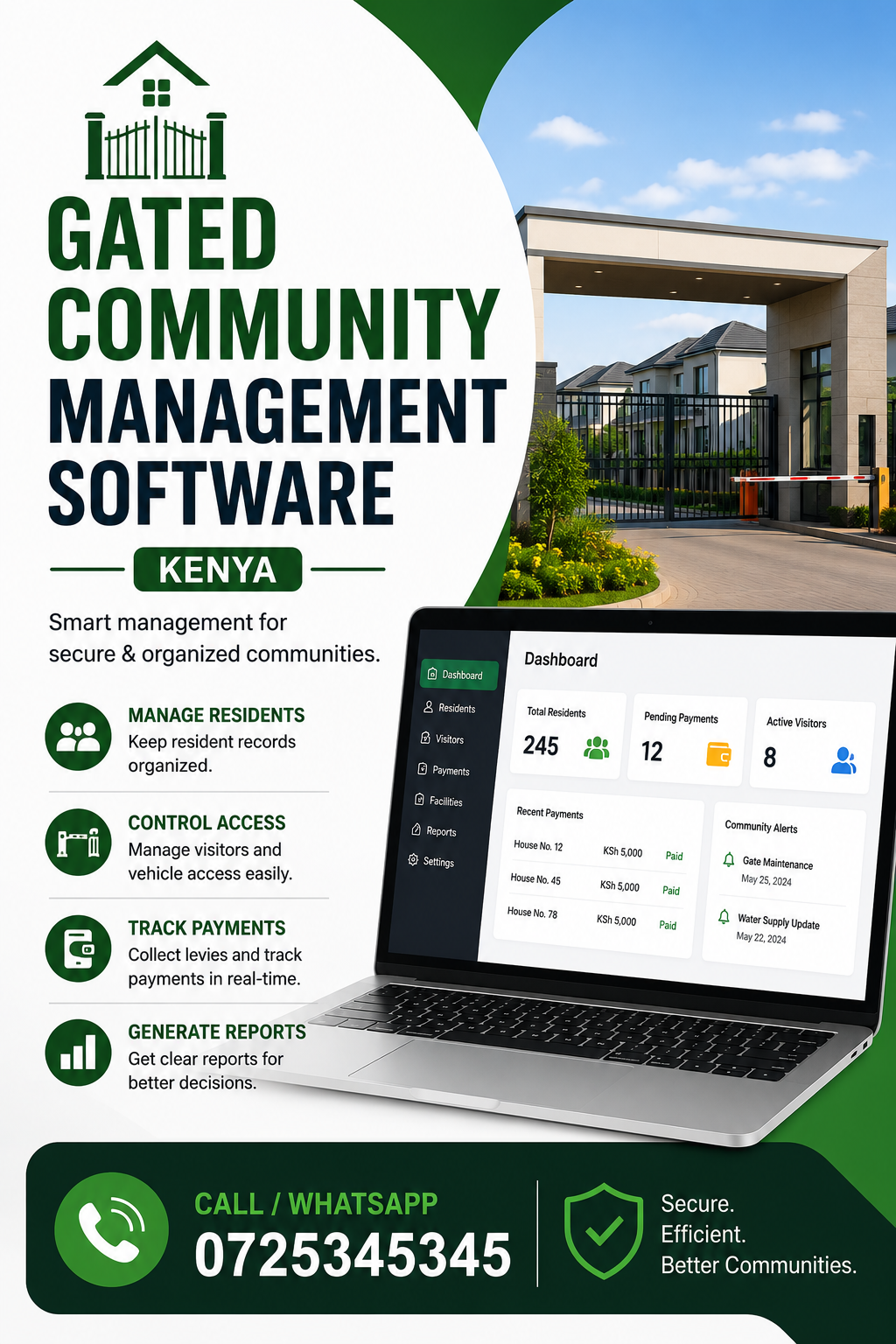
Gated Community Management Software Kenya: Security, Access and the Business of Living Together
Gated community management software Kenya is usually sold on billing and bought for the gate. Vendors lead with service charge automation; committees sign because a delivery rider stood arguing with a guard for twenty minutes on a Sunday and forty residents watched it happen.
Both things matter. But the gate is where a gated community either works or does not, because it is the only part of the system every resident touches every single day.
Across Kiambu, Athi River, Syokimau, Ruaka and Nairobi’s western suburbs, the same scene repeats. A guard with a paper book, a visitor with no appointment, a resident who cannot be reached by phone, and a queue building behind them.
Gated community management software Kenya is worth buying to the extent that it fixes that scene and the twenty other daily frictions of living behind a shared perimeter. Not to the extent that it produces prettier invoices.
This guide covers perimeter and access control, visitor and delivery workflows, security operations and incident records, household staff and contractor access, resident experience, community rules and disputes, committee governance and the legal framework.
It is written for the people who carry the load — the chairperson, the security committee member, the estate manager, and the resident who volunteered once and never escaped.
If you take one thing from it: the guard’s experience determines whether gated community management software Kenya survives its first six months. A gate interface that is slower than a paper book gets abandoned, and everything else you paid for goes with it. Test the guard workflow before you test anything else in any gated community management software Kenya demo.
What gated community software covers, and what it does not
The term overlaps with estate management and property management, so it helps to be precise about where the emphasis sits.
Property management software serves landlords managing tenancies across scattered units. Estate management leans toward service charge, budgets and maintenance for a defined development.
Gated community software emphasises the shared perimeter — who comes in, who goes out, who is authorised, and what happened when something went wrong.
The five pillars are access control, security operations, resident services, community administration and governance. Gated community management software Kenya that handles only the fourth is really estate accounting with a different label.
Access control is the daily-use layer: resident verification, visitor authorisation, delivery handling, vehicle records and the gate log.
Security operations covers guard shifts, patrols, incident reporting, escalation contacts and the evidence trail after something happens.
Resident services covers requests, complaints, notices, amenity booking and the household staff and contractor permissions that generate most of the gate’s daily traffic.
Community administration handles the money side, and governance underpins everything with resolutions, approvals and the audit trail that protects volunteer committees. Genuine gated community management software Kenya does all five without making the gate an afterthought.
The perimeter problem and why paper fails
Every gated community is a small border post, and border posts fail in predictable ways when run on paper.
The visitor book is the obvious weakness. It is slow to fill, illegible within a week, unsearchable, and it fills up and gets replaced with no retention plan.
Ask any committee to produce the record of who entered on a Tuesday four months ago. Most cannot, and the ones who can will take a day to find it.
Verification is the deeper problem. A guard confirms a visitor by phoning the resident, which fails whenever the resident is in a meeting, driving, or has a flat battery.
That single failure produces most gate friction, and it is what gated community management software Kenya removes by letting residents authorise in advance rather than being interrupted on arrival.
Shift handover loses information constantly. The night guard knows about the suspicious vehicle; the day guard does not, because the handover was verbal and rushed.
Guard rotation compounds it. Security companies rotate personnel, so the guard who recognised every resident is replaced by one who recognises nobody.
Then there is accountability. When a paper log has no guard name against each entry, nobody can be held responsible for an admission that should not have happened.
Recognition-based security does not scale past about forty units. Beyond that, a community needs a system, and gated community management software Kenya exists to be that system rather than to replace judgement.
Visitor authorisation done properly
Pre-authorisation is the single most valuable feature in this category, and it is worth understanding how the good implementations work.
The resident expects a guest. They generate an authorisation in advance — name, expected date, sometimes a vehicle registration — and the system issues a code.
The guest arrives, gives the code or their name, the guard confirms on screen, and entry takes fifteen seconds with no phone call to anyone.
That is the whole mechanism, and it eliminates the queue that forms every Sunday afternoon. Solid gated community management software Kenya makes generating an authorisation take under thirty seconds on a phone.
Unexpected visitors still need handling. The guard raises a request from the gate, the resident receives it on their phone with the visitor’s name and photo, and approves or declines with one tap.
That is faster than a phone call and it leaves a record of who approved the entry, which matters enormously when something goes wrong later.
Recurring visitors deserve their own category. A weekly visitor should not need daily authorisation, and the system should support a standing permission with an expiry date.
Group authorisations matter for events. A resident hosting thirty guests for a party should authorise once, not thirty times, and gated community management software Kenya without a group option generates exactly the bottleneck it was bought to prevent.
Exit logging is worth having too, though many communities skip it. Knowing that a visitor left, and when, closes the loop on the record.
Deliveries, riders and the modern gate
Delivery volume has transformed gate operations in Kenyan communities, and systems designed before it struggle.
Food deliveries, online shopping, boda parcels, gas cylinders and supermarket runs arrive constantly, often several per household per week.
Treating each as a formal visitor requiring full authorisation creates the exact bottleneck residents complain about. The delivery workflow needs to be deliberately lighter.
The good pattern is fast capture — rider name, unit, parcel type, time — an instant notification to the resident, and either escort to the door or drop at the gate. Gated community management software Kenya should make that a ten-second interaction.
Parcel holding at the gate needs its own record. Who accepted it, when, where it is stored, and who collected it, because disputed deliveries are a genuine recurring problem.
Rider access policy is a community decision worth making explicitly. Some communities allow riders to units; others require gate collection; others allow escort only.
Whichever you choose, the system should enforce it consistently rather than leaving each guard to interpret it differently on each shift.
Repeat rider recognition helps. A rider who delivers to the community daily should be onboarded once rather than captured from scratch every time, and gated community management software Kenya with a known-rider register speeds the whole flow considerably.
Notification is what makes residents accept the process. A resident who knows their parcel arrived is far more patient than one wondering where it went.
Gated community management software Kenya for household staff and contractors
Domestic workers, gardeners, nannies and contractors are the largest category of regular non-resident access, and the most sensitive to handle.
These are people who come daily and who deserve to be treated with dignity rather than processed as suspects each morning.
Registration should happen once. Name, photo, ID reference, employing household, days and hours of expected access, and an authorising resident.
Daily access then becomes a quick confirmation rather than a full capture, which respects both the worker’s time and the queue behind them. Well-designed gated community management software Kenya makes this the fastest interaction at the gate.
Expiry and revocation matter. When employment ends, the resident should be able to revoke access immediately from their phone rather than waiting to tell a guard in person.
That single capability closes a real security gap, since a dismissed worker with continuing gate access is a genuine risk that paper systems handle badly.
Contractors need a similar structure with defined scope and dates. A plumber working in unit 34 for three days should have access for three days, not indefinitely.
Committee-appointed contractors working on common areas need broader access, authorised by the committee rather than by a household.
Data protection applies here with particular force. You are holding personal data about people who are not members of the community and who did not choose the system, so retention and access restrictions in your gated community management software Kenya should be tight and documented.
Security operations and incident evidence
Security is why the perimeter exists, and it is administered far more loosely in most Kenyan communities than the spending would suggest.
Guard shift records should be digital: who was on duty, at which post, from when, with a recorded sign-on rather than a signature in a book.
Patrol logging turns an assumption into evidence. Checkpoint scans or timed entries confirm patrols happened rather than leaving the committee to hope.
Incident reporting needs structure — what, when, where, who, action taken, follow-up outstanding — captured at the time rather than reconstructed afterwards.
Gated community management software Kenya holding incident history lets the committee see patterns: a recurring vehicle, a particular hour, a stretch of fence tested repeatedly.
Escalation contacts belong in the system, not on a laminated card that goes missing. Committee numbers, the security company supervisor, the local police post, ambulance services.
Shift handover should be a structured note rather than a conversation. Continuity across twenty-four hours is where most operational security is won or lost.
Guard company performance becomes measurable once patrols and incidents are logged, which changes contract renewal from a negotiation based on impressions into one based on data.
CCTV request workflows deserve a process. Who may request footage, who approves release, and to whom, recorded rather than arranged informally with the supervisor. A serious gated community management software Kenya records the request and approval as a matter of course.
Panic and emergency alerts are the capability nobody wants to use. A resident alert reaching the guard post and the committee within seconds is worth having configured and tested.
Vehicles, parking and the daily irritations
Vehicle management generates more low-level community friction than almost anything except noise.
The vehicle register should link registrations to units, so a car at the gate resolves to a household without a phone call.
Number plate recognition speeds resident entry considerably where the budget allows, though it should always have a manual fallback for when it fails.
Visitor parking allocation is a common flashpoint. Communities with limited visitor bays need a booking or allocation rule rather than first-come chaos.
Parking violations need a light-touch process — log, notify, escalate — and gated community management software Kenya that supports a simple violation record prevents the confrontations that otherwise happen in the car park.
Resident vehicle limits, where by-laws impose them, should be enforceable through the register rather than argued about individually.
Abandoned vehicles are a recurring problem in older communities, and a dated record of when a vehicle was first flagged is what eventually allows removal.
Commercial vehicle rules — matatus, lorries, boda parking — vary by community and should be configured rather than improvised at the gate.
Speed and driving conduct sit outside software, but incident logging gives the committee evidence when a resident is repeatedly reported, and consistent gated community management software Kenya records turn a rumour into a documented pattern.
Resident experience and why adoption decides everything
A system used only by the committee delivers almost none of the value it promised, and resident adoption is the variable that decides this.
Residents will use exactly three things regularly: authorising visitors, checking their account, and raising a complaint. Everything else is occasional.
Those three must be effortless. If pre-authorising a guest takes more than thirty seconds, residents phone the guard instead and the system quietly dies.
Onboarding is where communities underinvest badly. Expect to help a third of residents personally, and run sessions at a residents’ meeting rather than emailing a link and hoping.
Households need multiple users. A husband, wife and adult child in one unit all need to authorise visitors, and gated community management software Kenya that permits only one login per unit will frustrate half your community.
Tenants and owners need different permissions. The tenant is on site and authorises visitors; the owner holds the financial account and may live in Australia.
Residents without smartphones need a path — SMS authorisation codes, or a guard who can look up and confirm on request. Nobody should be locked out by their handset.
Notifications need restraint. A system that messages residents about everything gets muted, and a muted system is an unused one.
Measure adoption rather than assuming it. If fewer than half your households authorised a visitor last month, your gated community management software Kenya is not yet embedded and needs another push before it lapses entirely.
Community rules, complaints and disputes
Living close together generates friction, and the committee’s job is to handle it without becoming a permanent tribunal.
The by-laws should be accessible to every resident on demand rather than existing as a document circulated once at handover.
Complaints need a structured channel with a reference number and visible status. A resident who can see their complaint is assigned stops reposting it in the WhatsApp group.
Common complaints in Kenyan communities: noise, parking, pets, unauthorised construction, short-term letting, waste disposal and children’s play areas.
Each needs a defined process rather than an ad hoc committee response, and gated community management software Kenya with a complaint workflow gives the committee consistency to point to when accused of favouritism.
Anonymity is a design decision worth making deliberately. Anonymous complaints encourage reporting but enable harassment; named complaints do the reverse.
Escalation should be staged: informal notice, formal notice, fine where by-laws permit, committee hearing, and legal action as a genuine last step.
Fines need a legal basis in the by-laws. Communities imposing penalties with no constitutional authority find them unenforceable when challenged.
Record every step. Disputes that end up before an advocate or a tribunal turn on documentation, and communities that kept records in gated community management software Kenya arrive with evidence rather than recollections.
Mediation before enforcement is worth building into the process. Most neighbour disputes resolve with a conversation, and communities that escalate first make enemies of residents unnecessarily.
Amenities, bookings and shared spaces
Shared amenities are a major selling point of gated living and a persistent source of administrative work.
Clubhouses, swimming pools, gyms, function rooms, playgrounds and sports courts all need access rules and, for the bookable ones, a booking system.
Booking should be self-service. A resident reserving the clubhouse for a birthday should not have to find the chairperson on a Saturday.
Rules per amenity — hours, capacity, guest limits, deposits and cancellation terms — should be configured rather than remembered. Gated community management software Kenya with per-amenity rules removes an entire category of committee arbitration.
Deposits and damage claims need a record linking the booking to the inspection and to any deduction, or the community will lose money and gain arguments.
Access restriction for arrears is a policy some communities apply — suspending amenity access for units significantly behind on service charge. It is effective and it needs a clear by-law basis.
Maintenance scheduling for amenities should block bookings automatically. Nothing annoys a resident more than arriving to find the pool drained on the day they booked it.
Usage data is a quiet benefit. A gym nobody uses and a clubhouse booked every weekend should be funded differently, and gated community management software Kenya that reports usage gives the committee something concrete for budget discussions.
Committee governance and protecting volunteers
Committee members are unpaid, exposed and routinely accused of things they did not do. Governance records are what protect them.
Meeting management should be structured: notice, agenda, attendance, quorum, minutes and resolutions with proposer and seconder recorded.
Every significant decision should link to the resolution that authorised it, so a question in 2030 resolves in one click rather than a search through old WhatsApp threads.
Approval thresholds should be tiered and enforced by the system. Small spending needs two officials; large spending needs the committee; major expenditure needs a general meeting.
An gated community management software Kenya that enforces thresholds protects volunteers from both temptation and suspicion, which is a genuine service to people doing unpaid work.
Conflict of interest declarations belong on record before any vote involving a member’s relative or business.
Procurement records — three quotations, the decision, the contract, the invoices — attached to the expenditure they justify, are the single best defence against accusations of impropriety.
AGM preparation is where the system earns its annual keep: accounts, budget, arrears summary, committee report and election materials produced from data already held.
Handover should be a permissions change rather than a knowledge transfer, which is only true if the reasoning lived in the gated community management software Kenya from the start rather than in one person’s head.
The legal framework in Kenya
Gated communities operate within a legal structure that many committees have never actually read.
The Sectional Properties Act, 2020 governs subdivided developments, replacing the earlier 1987 regime, and it set requirements around unit registration and management of common property.
Under it, unit owners generally form a corporation responsible for common property, operating under by-laws that your gated community management software Kenya should mirror rather than override with a generic structure.
Many older communities instead operate as residents’ associations or management companies limited by guarantee, with different governance obligations.
Service charge apportionment is often set by unit factor rather than equally, and billing contrary to your by-laws is challengeable.
Security operations carry their own considerations. Private guards have limited powers, and communities should understand what their guards may and may not do — detention and search are areas where communities routinely overreach.
Data protection applies squarely. Under the Data Protection Act, 2019, the community is a data controller holding movement records, vehicle data, identity details and staff information.
Gate log retention deserves an explicit policy — how long you keep entry records and who may access them. Confirm your gated community management software Kenya vendor is registered with the Office of the Data Protection Commissioner.
CCTV carries additional obligations around signage, purpose and access. I am not a lawyer, and arrangements vary considerably, so take advice on your specific structure rather than copying the community next door.
Data protection, access control and system security
The system holds unusually sensitive material: who lives where, who visits them, when they come and go, and which vehicles belong to whom.
That is a movement dataset, and it deserves more care than most committees give it.
Role-based access is essential. Guards see today’s authorisations; the estate manager sees operations; committee members see governance; residents see their own household only.
Guards should never have browsable access to the full resident database or historical movement records. Restricting that is a basic requirement of any gated community management software Kenya worth deploying.
Per-guard credentials matter for accountability. Shared gate logins mean no entry can be attributed to a specific person, which defeats much of the point.
Retention policy should be defined and enforced. Gate logs kept indefinitely with no purpose are a liability rather than an asset.
Ask vendors where data is hosted, whether it is encrypted in transit and at rest, and what happens in a breach.
Backups need specifics: frequency, location, retention, and whether a restore has ever been tested successfully.
Committee transitions should trigger an access review, revoking outgoing members promptly. Gated community management software Kenya accumulating years of stale committee accounts is an avoidable risk.
Export rights should be contractual and tested during the trial, because a community that cannot retrieve its own records is dependent rather than served.
Choosing gated community management software Kenya that fits
Do not start with demos. Start with your by-laws and your gate, because those two define what actually has to work.
Write the requirements down: access workflows for each visitor category, staff and contractor rules, incident process, amenity rules, billing basis, approval thresholds and reporting needs.
Then test against that list rather than the vendor’s feature page.
Run six scenarios in every demo. A pre-authorised guest. An unexpected visitor requiring live approval. A delivery rider. A domestic worker’s daily entry. A revoked staff member attempting entry. A group authorisation for an event.
Any gated community management software Kenya that stumbles on those six will stumble in your second month, whatever the dashboard promises.
Test the guard interface hardest of all, ideally at your own gate, at a busy hour, with an actual guard operating it. This is the test committees skip and the one that predicts success.
Test the resident experience separately. Give three households access with no instruction and see whether they authorise a visitor unaided.
Ask what hardware it integrates with and get the answer in writing. Boom barriers, RFID readers, number plate cameras and biometric devices vary enormously in compatibility.
Interrogate support, including whether anyone answers at 10pm when the gate system fails, because that is when it will fail. An gated community management software Kenya vendor with office-hours-only support is a poor fit for a twenty-four hour operation.
Pricing, hardware and total cost
Software subscription is often the smaller half of the real number in this category.
Per-unit per-month is the standard model and usually fairest, scaling with the community and easy to build into the service charge.
Flat subscription banded by size, better value above a hundred units and poor value below forty.
Module pricing where access control, billing and maintenance are charged separately. Price the full stack, not the entry module.
Hardware is the cost communities consistently underestimate: gate tablets, RFID readers, boom barriers, number plate cameras, network coverage at the gate and backup power for all of it.
Backup power deserves specific mention. A gate system that fails during a power cut is worse than no system, so budget for it explicitly when scoping gated community management software Kenya.
Ask about setup, migration, guard training, SMS bundles, extra admin seats and support tiers. Get it all-in and written down.
Guard training is a recurring cost, not a one-off, because security companies rotate personnel and every new guard needs training.
Fund it as a budget line approved at the AGM rather than absorbed silently. Residents accept costs they voted for, and an gated community management software Kenya introduced without a vote becomes the committee’s problem the first time anything goes wrong.
Implementation and the first six months
Communities take longer than most organisations to implement because there is hardware, and there are guards, and there are residents.
Week one — decide and mandate. Present at a committee meeting or AGM, approve the budget, minute the resolution, and appoint two people rather than leaving it to one.
Week one — clean the register. Every unit, owner, tenant, contacts, vehicles and household staff, verified before loading.
Week two — configure. Access rules per visitor category, staff registration, contractor scope, incident types, amenity rules and approval thresholds, mirroring your by-laws.
Week three — install and test hardware. At the gate, under real conditions, including a power cut and a Sunday afternoon rush.
Week four — train the guards, then train them again. This is the step that determines everything. Every guard on every shift, with a supervisor who can retrain new arrivals.
Week five — onboard residents. A physical session at a residents’ meeting, a walkthrough of authorising a visitor, and personal help for the third who will need it.
Week six — go live at the gate. Retire the visitor book completely on a fixed date. A partial cutover means guards use whichever is faster, which will be the book.
Month two — review weekly. Authorisation rates, gate throughput, guard compliance and resident adoption. Gated community management software Kenya is either embedded in the first eight weeks or it is not embedded at all.
Month three onward — review monthly at committee, and retrain guards quarterly as personnel rotate.
Budget forty to sixty hours of committee time for a hundred-unit community, plus the guard training that never really ends.
Why these systems fail and how to prevent it
The software rarely fails. The routine does, and the pattern is consistent enough to plan against.
The guards revert to paper. Under pressure the book is faster, and once one shift reverts the log becomes worthless. Prevent it by retiring the book completely and retraining relentlessly.
Residents never onboard. If households do not authorise visitors, guards phone people anyway and nothing has changed.
New guards arrive untrained. Security companies rotate staff constantly, and a community with no retraining routine loses the system by attrition within a year.
The committee changes. Incoming members were not part of the decision and quietly revert to what they understand.
Notifications get muted. Over-messaging trains residents to ignore the system, including the alerts that matter.
Hardware fails and stays failed. A broken gate tablet that takes three weeks to replace destroys the habit entirely.
What sustains it is structural. Make the system part of committee handover, put guard retraining on a quarterly calendar, keep a spare gate device, and refuse to process visitors any other way.
A gated community management software Kenya deployment that survives its first committee transition and its first full guard rotation will usually run for years. Both happen within eighteen months, so plan for them from the start.
Frequently asked questions
How small a community is too small for this?
Below about thirty units, guards genuinely recognise everyone and a well-kept book may suffice. Past fifty, recognition-based security stops working and the case becomes strong.
Can we start with just the gate and add billing later?
Yes, and many communities should. Access control delivers visible daily value; billing can follow once the gate habit is established.
What if our guards are not comfortable with technology?
Choose a system with a simple gate interface and invest properly in training. Most guards adapt quickly when the tool is genuinely faster than the book.
Do residents without smartphones get excluded?
They should not. SMS authorisation codes and guard lookup on request cover them, and any gated community management software Kenya you consider should support both.
Who authorises a tenant’s visitors — the tenant or the owner?
The tenant, since they live there. The owner holds the financial account. Both need accounts with different permissions.
How long should we keep gate logs?
Long enough to be useful and no longer, with a written policy. Indefinite retention of movement data is a data protection liability.
Will this reduce crime?
It removes the easiest entry route, which is unauthorised admission at the gate, and it produces evidence when something happens. It does not secure a fence line.
Can our security company access the system?
Usually yes, with restricted permissions. Decide deliberately what they see, and keep the data ownership with the community.
What happens when we change security companies?
Guard accounts are revoked and new ones created. The records stay with the community, which is one of the quieter benefits of gated community management software Kenya over any system the guard company owns.
What is the single biggest mistake communities make?
Buying on the committee dashboard and never testing the gate. The guard workflow is the product, and everything else is secondary to whether that works at 6pm on a Friday.
Gated community management software Kenya
Gated community management software Kenya
Gated community management software Kenya
Gated community management software Kenya
Gated community management software Kenya