
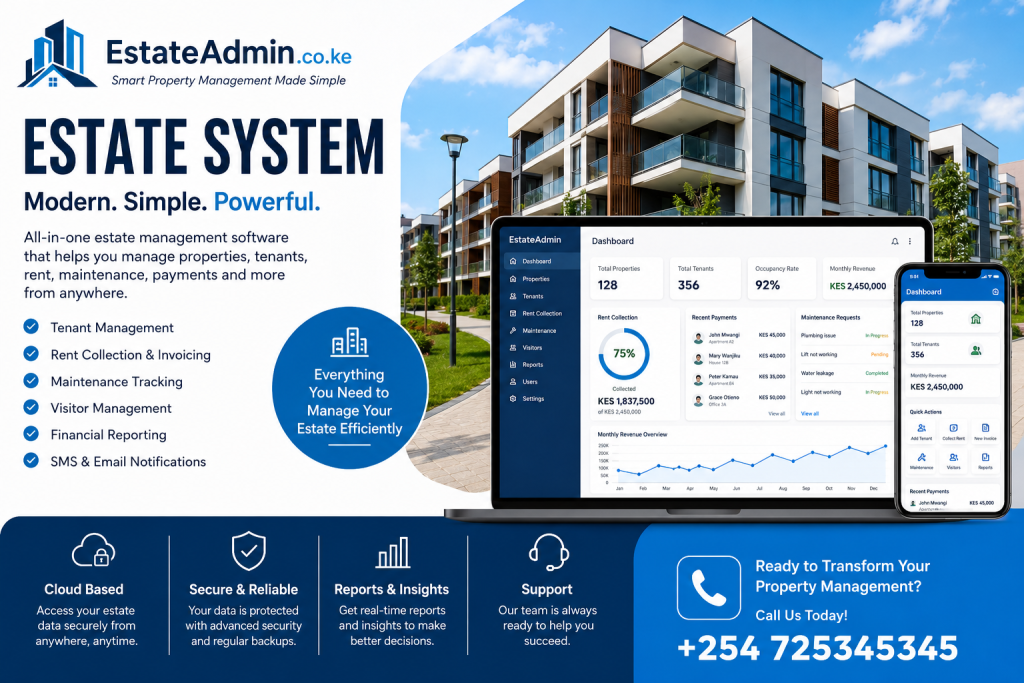
Estate System – Simplifying Property and Estate Management
Managing residential estates, gated communities, apartment complexes, commercial buildings, and rental properties has become increasingly challenging. Property managers, estate owners, landlords, and management companies are expected to handle rent collection, maintenance requests, visitor management, financial reporting, security coordination, tenant communication, and compliance—all while ensuring excellent customer service.
This is where an estate system becomes indispensable.
An estate system is an all-in-one software solution designed to automate and simplify every aspect of estate management. Whether you manage a small apartment block or hundreds of residential units, an estate system improves efficiency, reduces paperwork, enhances transparency, and increases profitability.
At EstateAdmin.co.ke, we provide a modern estate system tailored to the needs of Kenyan property owners, estate managers, and real estate companies. Our solution helps you digitize daily operations while giving tenants and property owners a better experience.
For demonstrations or inquiries, contact us today:
Phone: +254 725345345
What is an Estate System?
An estate system is a digital platform developed to help property owners and estate managers automate property management activities. Instead of relying on spreadsheets, manual records, or paper files, an estate system stores all estate information in one centralized database.
The software enables managers to:
- Manage tenants
- Track rent payments
- Record maintenance requests
- Monitor property occupancy
- Generate financial reports
- Handle visitor management
- Communicate with residents
- Manage service providers
- Track utility billing
- Produce invoices and receipts
Modern estate systems are cloud-based, allowing managers to access data securely from anywhere using a computer, tablet, or smartphone.
Why Every Property Manager Needs an Estate System
The real estate industry is evolving rapidly. Manual processes are no longer sustainable, especially for growing property portfolios.
An estate system helps eliminate common management challenges such as:
- Lost tenant records
- Delayed rent collection
- Poor communication
- Manual accounting errors
- Missing maintenance records
- Inefficient reporting
- Security coordination problems
By automating these processes, estate managers save valuable time while improving service delivery.
Key Features of a Modern Estate System
A professional estate system should include numerous modules that work together seamlessly.
1. Tenant Management
Tenant management is the backbone of every estate system.
Managers can store:
- Tenant profiles
- National ID details
- Lease agreements
- Emergency contacts
- Occupancy history
- Rent schedules
- Payment history
Having all tenant information centralized improves efficiency and customer service.
2. Property Management
The estate system allows managers to organize properties by:
- Estate
- Block
- Floor
- Unit Number
- Apartment Type
- Commercial Unit
- House Number
Managers can instantly determine which units are occupied or vacant.
3. Rent Collection
Rent management becomes significantly easier using an estate system.
Features include:
- Automatic invoices
- Rent reminders
- Late payment alerts
- Payment tracking
- Outstanding balances
- Mpesa integration
- Bank payment recording
- Receipt generation
Automated rent collection improves cash flow and minimizes revenue leakage.
4. Maintenance Management
Maintenance requests often overwhelm property managers.
An estate system simplifies maintenance by allowing tenants to report:
- Plumbing issues
- Electrical faults
- Broken doors
- Security concerns
- Water shortages
- Cleaning requests
- Lift failures
Managers assign technicians, monitor progress, and close completed tasks.
Everything remains documented.
5. Visitor Management
Security is a major concern in residential estates.
An estate system can include visitor management that records:
- Visitor names
- Phone numbers
- Vehicle registration
- Host information
- Check-in time
- Check-out time
This improves estate security and accountability.
Benefits of Using an Estate System
Increased Efficiency
Automation eliminates repetitive manual work.
Managers no longer need physical files or multiple spreadsheets.
Tasks that previously required hours now take only minutes.
Improved Financial Control
An estate system provides accurate financial tracking.
Managers can monitor:
- Rent income
- Expenses
- Utility bills
- Maintenance costs
- Arrears
- Cash flow
Accurate reporting helps make informed financial decisions.
Better Communication
Communication is essential for successful estate management.
The software enables:
- SMS notifications
- Email alerts
- Payment reminders
- Maintenance updates
- Community announcements
Residents remain informed at all times.
Higher Tenant Satisfaction
Happy tenants stay longer.
When maintenance is handled promptly and communication is efficient, tenant satisfaction increases significantly.
This reduces vacancy rates.
Data Security
Unlike paper files, an estate system securely stores information using cloud technology.
Features include:
- User permissions
- Secure login
- Automatic backups
- Activity logs
- Data encryption
Sensitive tenant and financial data remains protected.
Modules Found in an Estate System
A comprehensive estate system should contain multiple integrated modules.
Tenant Module
Stores tenant information including:
- Contact details
- Lease agreements
- Rent history
- Documents
- Occupancy status
Property Module
Keeps records of:
- Buildings
- Apartments
- Houses
- Commercial spaces
- Vacant units
Finance Module
Tracks:
- Rent payments
- Invoices
- Receipts
- Expenses
- Deposits
- Refunds
Maintenance Module
Records:
- Repair requests
- Work orders
- Technician assignments
- Completion reports
Reports Module
Produces reports such as:
- Occupancy reports
- Rent collection reports
- Income statements
- Expense summaries
- Maintenance reports
Estate System for Apartment Management
Apartment owners manage numerous units simultaneously.
An estate system helps monitor:
- Occupied apartments
- Vacant apartments
- Tenant movement
- Lease expiry
- Rent due dates
- Maintenance schedules
Managers can oversee hundreds of apartments from one dashboard.
Estate System for Gated Communities
Modern gated communities require advanced management solutions.
The estate system assists with:
- Visitor approvals
- Security coordination
- Resident communication
- Community notices
- Facility bookings
- Service charge management
This creates a safer and more organized living environment.
Estate System for Commercial Properties
Commercial buildings have different operational requirements.
The software supports:
- Office leasing
- Commercial rent collection
- Tenant contracts
- Parking management
- Shared utility billing
- Maintenance scheduling
Property owners enjoy greater operational efficiency.
Estate System for Landlords
Even landlords with only a few rental houses benefit from an estate system.
Instead of manually tracking rent payments, landlords can:
- View payment history
- Send invoices
- Monitor overdue accounts
- Generate receipts
- Track maintenance requests
Everything becomes centralized.
Estate System for Property Management Companies
Property management companies often oversee multiple estates simultaneously.
An estate system allows managers to:
- Manage different clients
- Separate financial records
- Track multiple properties
- Generate client-specific reports
- Improve accountability
The software scales as the business grows.
How an Estate System Improves Rent Collection
Late rent payments affect cash flow.
An estate system automates rent management by sending reminders before due dates.
Managers can instantly identify:
- Paid tenants
- Partial payments
- Outstanding balances
- Long-term defaulters
Automated receipts improve professionalism and reduce disputes.
Estate System and Utility Billing
Managing utilities manually creates errors.
The estate system records utility usage including:
- Water
- Electricity
- Garbage collection
- Internet services
- Shared utilities
Bills are generated automatically based on configured rates.
This eliminates manual calculations.
Estate System for Maintenance Tracking
Maintenance is one of the largest recurring expenses in estate management.
An estate system enables managers to monitor:
- Maintenance costs
- Pending repairs
- Technician performance
- Frequently reported issues
- Asset maintenance history
This helps reduce long-term maintenance costs through preventive planning.
Choosing the Right Estate Management Software
Investing in property management software is more than simply purchasing another business application. It is a long-term decision that affects how efficiently an estate operates, how residents are served, and how financial records are maintained. Before selecting any solution, property owners and estate managers should carefully evaluate their operational needs.
One of the first considerations should be scalability. A system that works well for a small apartment complex should also be capable of supporting additional properties as the business expands. Growth is common in the real estate industry, and changing systems every few years because of limited capacity can become both expensive and disruptive.
Ease of use is equally important. A complicated interface often discourages staff from using the software effectively. An intuitive dashboard, simple navigation, and clearly organized menus make daily tasks faster and reduce the amount of training required.
Accessibility should also be considered. Cloud-based platforms allow managers to access information from any location with an internet connection. Whether inspecting a property, attending meetings, or working remotely, management can still monitor operations in real time.
Another critical aspect is customer support. Every software platform occasionally requires technical assistance, software updates, or user guidance. Working with a provider that offers reliable support ensures minimal disruption whenever challenges arise.
Financial Transparency and Accountability
Managing finances manually often creates opportunities for mistakes, duplicated records, or delayed reporting. Digital systems improve accountability by recording every transaction automatically.
Each payment received is logged with its corresponding tenant, property, payment date, and receipt number. Similarly, operational expenses are categorized, making it easier to monitor spending patterns throughout the year.
This level of transparency benefits everyone involved. Property owners gain confidence that funds are being managed responsibly, while managers spend less time reconciling accounts.
Accurate financial records also simplify annual audits and tax preparation. Since historical data remains securely stored within the system, retrieving previous reports becomes straightforward.
Managing Lease Agreements Efficiently
Lease administration involves much more than storing signed agreements. Managers must monitor commencement dates, expiry dates, renewal periods, rental adjustments, and contractual obligations.
Without proper reminders, important deadlines may be overlooked. Expired leases may continue unnoticed, delaying rent reviews or contract renewals.
A digital management platform helps organize lease information while notifying administrators when agreements are approaching expiration. This allows sufficient time to communicate with tenants and prepare updated documentation before existing contracts lapse.
Organized lease management contributes to smoother occupancy planning and improved long-term revenue forecasting.
Maintenance Planning Instead of Reactive Repairs
Many property owners spend substantial amounts on emergency repairs simply because small maintenance issues were ignored.
Preventive maintenance helps avoid this problem.
Instead of waiting for equipment to fail completely, managers can schedule routine inspections for essential infrastructure such as water pumps, electrical systems, generators, elevators, drainage systems, fire safety equipment, and security installations.
Routine servicing extends equipment lifespan, reduces repair costs, and minimizes inconvenience for residents.
Historical maintenance records also help identify recurring issues. If a particular building consistently experiences plumbing failures or electrical faults, management can investigate underlying causes instead of repeatedly fixing symptoms.
Improving Resident Experience
Residents expect more than just a place to live. They value responsiveness, clear communication, reliable services, and transparency.
Digital management platforms improve the overall living experience by creating more organized interactions between residents and estate management.
Instead of physically visiting management offices for every request, residents can report maintenance concerns, receive updates, view account statements, and communicate with administrators more conveniently.
This accessibility encourages positive relationships between management teams and the communities they serve.
Satisfied residents are also more likely to renew their leases, recommend the property to others, and take better care of their homes.
Better Communication Across the Estate
Communication challenges often create unnecessary frustration within residential communities.
Announcements may fail to reach residents, maintenance schedules may be misunderstood, and emergency information can easily be delayed.
Centralized communication tools help distribute information efficiently through multiple channels.
Examples include:
- Planned water interruptions
- Security alerts
- Community meetings
- Service charge notices
- Waste collection schedules
- Renovation guidelines
- Holiday office hours
- General estate announcements
When communication is timely and consistent, misunderstandings reduce significantly.
Supporting Security Operations
Security remains one of the highest priorities in any residential or commercial development.
Management software complements existing security procedures by maintaining organized records that can be referenced whenever necessary.
Access records, visitor logs, vehicle information, incident reports, and emergency contacts can all be maintained digitally.
Having organized records improves response times during investigations while supporting overall estate safety.
Security personnel also spend less time completing manual paperwork and more time focusing on surveillance and resident protection.
Simplifying Service Charge Administration
Many residential developments collect service charges to maintain common areas, security services, landscaping, waste collection, lighting, and shared facilities.
Managing these contributions manually can become difficult as estates grow.
Digital systems simplify service charge administration by generating invoices, tracking payments, identifying outstanding balances, and producing financial summaries.
Management committees can therefore make informed decisions regarding future budgets and maintenance projects.
Residents also benefit from greater transparency since payment histories remain readily available whenever required.
Document Management
Property management generates significant documentation throughout the year.
Examples include:
- Lease agreements
- Ownership documents
- Maintenance contracts
- Insurance certificates
- Inspection reports
- Utility agreements
- Contractor quotations
- Financial statements
Keeping these documents digitally organized eliminates the frustration of searching through physical filing cabinets.
Authorized staff members can quickly retrieve documents whenever needed, improving operational efficiency.
Reporting That Supports Better Decisions
One of the greatest advantages of modern management software is its reporting capability.
Reliable reports help management understand how properties are performing rather than relying on assumptions.
Useful reports may include occupancy summaries, maintenance trends, revenue performance, expense analysis, rent collection progress, tenant turnover statistics, and operational costs.
These insights assist owners in identifying strengths, addressing weaknesses, and planning future investments.
Rather than reacting to problems after they occur, management can anticipate trends using historical information.
Supporting Multi-Property Management
Many investors eventually acquire additional residential or commercial properties.
Managing each property separately becomes increasingly difficult as portfolios expand.
A centralized platform enables managers to oversee multiple developments from one location while maintaining separate financial records and operational reports for each property.
This reduces duplication of work while improving consistency across all managed estates.
Portfolio managers gain a comprehensive overview of overall performance without sacrificing property-specific detail.
Why Digital Transformation Matters
Technology has transformed nearly every industry, and real estate management is no exception.
Paper-based administration is gradually becoming inefficient as expectations from tenants, investors, and regulatory authorities continue to evolve.
Organizations embracing digital transformation often experience:
- Faster administrative processes
- Better customer service
- Improved record accuracy
- Stronger financial oversight
- Reduced operational costs
- Increased staff productivity
- Better decision-making
Technology should not replace good management practices. Instead, it enhances them by reducing repetitive administrative work and allowing teams to focus on strategic improvements.
Preparing Staff for Implementation
Introducing new software should always include adequate staff preparation.
Employees are more likely to embrace new systems when they understand how the technology benefits their daily responsibilities.
Training should cover:
- User navigation
- Data entry procedures
- Report generation
- Communication tools
- Security responsibilities
- Backup procedures
Continuous support during implementation encourages confidence and improves adoption rates.
Organizations should also establish clear internal procedures to ensure consistent use across departments.
Data Backup and Business Continuity
Every business depends on accurate information.
Unexpected events such as hardware failure, theft, accidental deletion, or natural disasters can result in significant data loss if proper backup procedures are not in place.
Cloud technology greatly improves business continuity by storing information securely on protected servers with regular backups.
This means important records remain available even if local computers experience technical problems.
Reliable backups provide peace of mind for both management teams and property owners.
Future Trends in Property Management
Technology continues evolving rapidly, introducing new opportunities for property managers.
Future innovations are expected to include:
- Artificial intelligence for predictive maintenance
- Smart building integration
- Automated energy monitoring
- Internet of Things (IoT) sensors
- Digital visitor verification
- Enhanced cybersecurity
- Advanced business analytics
- Mobile-first resident experiences
Property managers who embrace innovation today will be better positioned to adapt to tomorrow’s changing industry requirements.
Frequently Asked Questions
Is the software suitable for both residential and commercial properties?
Yes. It can accommodate apartments, gated communities, office buildings, shopping centres, mixed-use developments, and other property types.
Can multiple administrators access the system?
Yes. Different users can receive different access levels depending on their responsibilities within the organization.
Is historical information preserved?
Absolutely. Historical financial records, tenant information, maintenance history, and reports remain available for future reference.
Can reports be exported?
Yes. Reports can generally be exported for printing, sharing, presentations, or further financial analysis.
Is training available?
Training helps ensure staff members become comfortable using every feature effectively and confidently.
Can the platform grow with my business?
Yes. As additional properties, tenants, or staff members are added, the system can continue supporting expanding operational requirements.
Why Choose EstateAdmin.co.ke?
Managing property should not involve endless paperwork, complicated spreadsheets, or scattered records. Modern technology provides a better way to organize operations while improving efficiency, accountability, and customer satisfaction.
EstateAdmin.co.ke has been developed with practical property management needs in mind. The platform is designed to simplify day-to-day operations while providing managers and property owners with reliable information for making informed business decisions.
Whether you oversee a single residential development or manage an expanding portfolio of commercial and residential properties, our solution helps streamline administration and improve operational control.
Our commitment extends beyond providing software. We aim to build long-term partnerships by delivering reliable support, continuous improvements, and practical solutions that adapt to the changing needs of the real estate industry.
Conclusion
Successful property management requires organization, consistency, transparency, and timely decision-making. As portfolios expand and resident expectations continue to rise, relying on manual processes becomes increasingly difficult.
Modern property management software provides a structured approach to handling financial records, maintenance activities, communication, documentation, and operational reporting within a single centralized platform.
By embracing digital solutions, property owners and managers position themselves for sustainable growth while delivering better experiences for residents and stakeholders alike.
If you are looking for a reliable solution to simplify estate operations, improve accountability, and increase efficiency, EstateAdmin.co.ke is ready to help.
Our experienced team is available to answer your questions, provide demonstrations, and guide you through the implementation process.
Contact us today
Website: EstateAdmin.co.ke
Phone: +254 725345345
Take the next step toward smarter, more efficient property management with a solution designed to support your success today and into the future.