
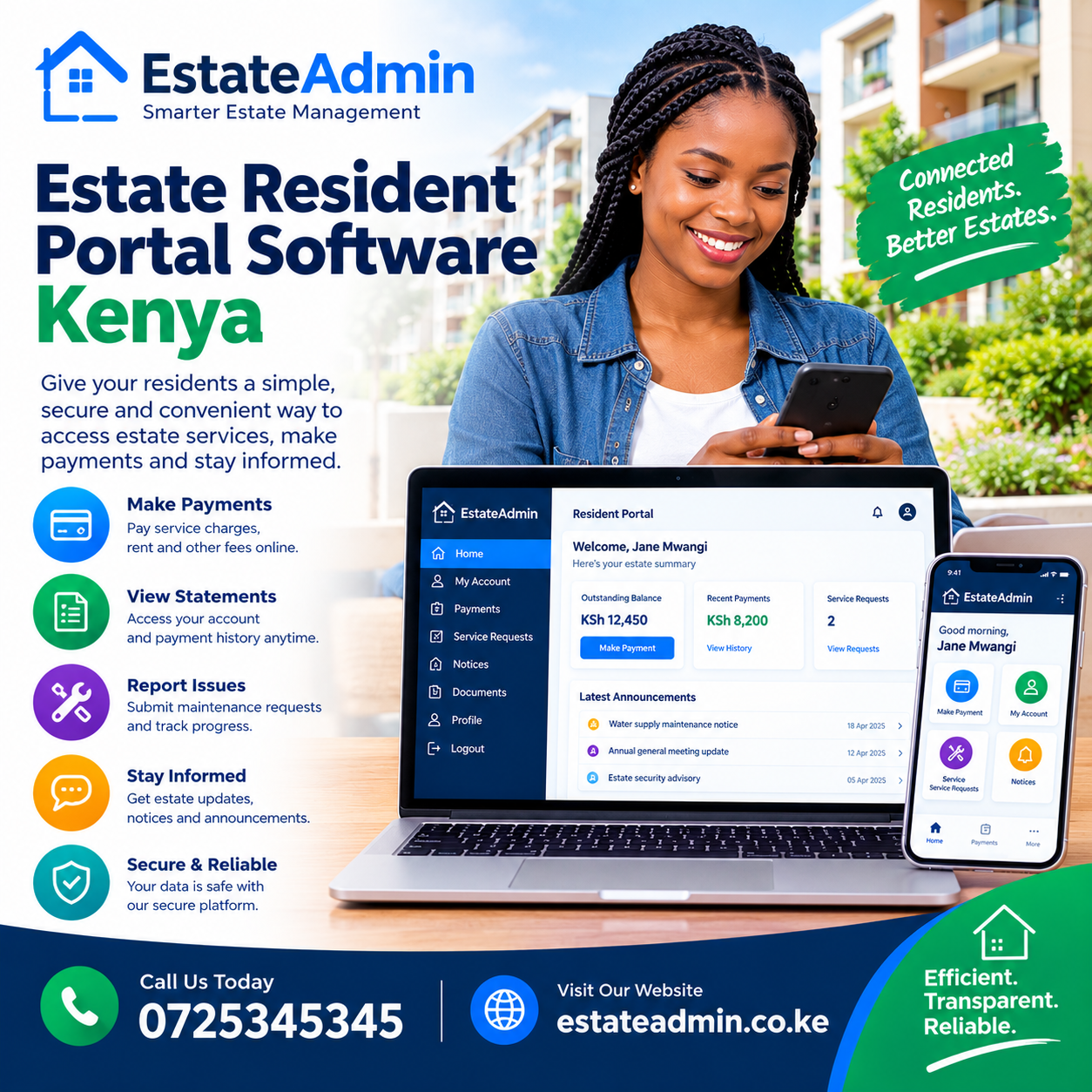
A Practical Guide to Better Estate Communication and Service Charge Management
Managing a residential estate involves far more than keeping a list of homes and collecting service charges. Estate committees, property managers, developers, and administrators need a reliable way to share invoices, show payment histories, answer balance questions, communicate notices, and give residents access to information without creating a new administrative task for every request. Estate Resident Portal Software Kenya brings these activities into a structured digital environment, making it easier for residents to see relevant information while giving estate teams a clearer record of what has been billed, paid, and communicated.
What Is a Resident Portal for an Estate?
A resident portal is a secure online area where people living in a managed residential community can access information and interact with the estate administration team. Instead of relying entirely on printed notices, phone calls, office visits, spreadsheets, or messages sent individually, residents can use a central account to view information relevant to their unit or household. For an estate, the portal should connect resident information with operational and financial records. That may include service charge invoices, statements, payment history, notices, documents, maintenance requests, and other approved communications. The exact feature set differs from one platform to another, so estate teams should define their requirements before choosing a solution.
A good portal is not simply a message board. It should reduce avoidable back-and-forth while making important information easier to find. When the underlying records are accurate, residents can answer many routine questions themselves, and administrators can spend more time on exceptions, approvals, collections, maintenance coordination, and community management. A practical implementation of Estate Resident Portal Software Kenya should make routine resident information easier to access without creating extra administrative steps.
Why Estate Resident Portals Matter in Kenya
Many Kenyan residential communities still depend on a mixture of spreadsheets, bank statements, M-Pesa messages, paper records, email, WhatsApp conversations, and manually prepared statements. Each tool may be useful on its own, but problems appear when information is scattered.
A resident may ask why an invoice is still showing as outstanding after making a payment. An administrator may have to search a payment reference, update a spreadsheet, confirm the invoice, and then send a message. If the process is repeated across hundreds of units, small administrative tasks become a significant workload.
A portal creates a more structured experience. The resident can log in and review the information that the estate has made available. The administration team can maintain the official records from the management side and communicate from a consistent source. For growing communities, Estate Resident Portal Software Kenya can provide a more consistent way to organize resident-facing information across multiple blocks.
For Kenyan estates, a resident portal can also fit naturally alongside mobile payments. M-Pesa is widely used for everyday transactions, but a payment method alone does not solve the accounting and communication problem. The estate still needs to identify the payment, apply it to the right resident or account, maintain a running balance, and provide a clear record.
Core Benefits of Estate Resident Portal Software
The value of Estate Resident Portal Software Kenya is easiest to understand by looking at the problems it can solve for both residents and administrators.
1. Easier Access to Statements
Residents frequently want to know how much has been billed, how much has been paid, and what balance remains. A portal can provide a resident statement showing invoices and recorded payments in a consistent format.
This is particularly useful when residents need to check their accounts before making a payment. It can also reduce repeated requests for printed or manually prepared statements.
2. Better Invoice Visibility
Service charge invoices should be clear about what is due and when it is due. A digital portal can give residents access to issued invoices, due dates, invoice numbers, and payment status.
Clear invoice visibility helps residents distinguish between a current charge, an older balance, and a payment that has already been recorded.
3. More Transparent Payment History
Payment disputes often begin with uncertainty. A resident may know that money was sent but not know whether the estate has posted it to the account.
A resident-facing payment history can show recorded transactions and the resulting balance. The management team still needs a proper reconciliation process, but the portal gives residents a clearer view of the information after transactions have been processed.
4. Reduced Routine Enquiries
When residents can access their own statements, invoices, and approved notices, administrators receive fewer questions that can be answered by existing records.
This does not eliminate human support. Instead, it allows estate teams to focus their time on issues that actually require investigation or a decision.
5. More Consistent Communication
Important notices can be difficult to track when they are sent through several channels. A portal provides a dedicated place for approved announcements, documents, and updates.
For example, an estate could publish a notice about planned maintenance, a change in access arrangements, a committee meeting, or an upcoming billing deadline.
6. Better Record Keeping
A structured system makes it easier to maintain a history of invoices, payments, balances, and resident information. It can also support internal accountability by limiting access according to user roles.
Estate teams should still maintain appropriate backup, retention, and data protection practices. Digital records are useful only when the underlying process is disciplined.
How a Resident Portal Supports Service Charge Management
Service charge administration is one of the strongest use cases for a resident portal. The process typically starts with defining charges, generating invoices, receiving payments, recording those payments, and reviewing outstanding balances.
Estate Resident Portal Software Kenya can give residents a view of the part of that process that concerns their account. On the management side, the system can connect resident categories, invoices, payments, statements, and reporting.
A useful workflow might look like this:
- The estate defines recurring service charges and applicable categories.
- Invoices are generated for the relevant units.
- Residents receive access to their invoices.
- Payments are received through approved channels.
- The finance or administration team records and reconciles payments.
- The resident account is updated.
- The portal displays the current statement and balance.
- Administrators use reports to follow up on outstanding accounts.
The benefit is not simply automation. The bigger advantage is consistency. A repeatable workflow makes it easier for different staff members to follow the same process each billing cycle.
Resident Statements and Running Balances
A statement should help a resident understand an account without requiring an explanation from an administrator.
A useful statement can include:
- Resident or account name
- Unit or property reference
- Invoice number
- Invoice date
- Due date
- Description of the charge
- Amount billed
- Payments recorded
- Credit or adjustment information where applicable
- Running balance
- Current amount outstanding
EstateAdmin describes its resident service charge portal as a way to provide invoices and statements showing billed versus paid amounts and a running balance. Its service-charge statements page also describes a consistent statement format listing invoices, payments, and the running balance.
That approach matters because residents generally need an account-level explanation, not just a total figure. A transparent statement can make follow-up conversations more specific and easier to resolve.
For an estate team, Estate Resident Portal Software Kenya is most useful when it is connected to the records and processes residents already rely on.
M-Pesa and Digital Payments
For a Kenyan estate, payment workflows should be considered early when selecting resident management software. Many residents are comfortable using mobile money, but the management team still needs accurate records.
The important question is not simply whether a platform mentions M-Pesa. Estate teams should ask how payment references are captured, how transactions are matched to accounts, how partial payments are handled, and how the system supports reconciliation.
EstateAdmin’s current platform materials describe M-Pesa-focused service charge collection and reconciliation workflows, alongside invoice and resident ledger functionality.
A practical process might be:
- Resident checks the amount due.
- Resident pays through the estate’s approved payment method.
- The payment reference is captured.
- The administrator or integrated workflow matches the payment to the appropriate account.
- The invoice status and resident balance are updated.
- The resident can review the recorded transaction.
The exact level of automation depends on the payment integration and configuration. Estate teams should test the process with real examples before full deployment.
When comparing platforms, Estate Resident Portal Software Kenya should be assessed against the estate’s actual billing, communication, and reporting workflow.
Communication Between Residents and Management
Good estate management requires two-way communication. Residents need a reliable way to receive notices, while administrators need a controlled method for handling requests and updates.
A resident portal can support communication such as:
- General estate notices
- Billing reminders
- Maintenance announcements
- Meeting information
- Policy documents
- Community updates
- Account-related messages
- Requests or enquiries, where supported
The portal should complement rather than automatically replace every existing communication channel. For urgent matters, estates may still need SMS, phone calls, email, security desk communication, or other approved channels.
The goal is to make important information traceable and accessible, not to force every conversation into one application.
A practical implementation of Estate Resident Portal Software Kenya should make routine resident information easier to access without creating extra administrative steps.
Maintenance Requests Through a Resident Portal
Although financial management is a common reason to adopt resident software, maintenance is another important area.
A resident may notice a leaking pipe, damaged common-area lighting, a faulty gate, a lift issue, or another problem. Without a structured request process, complaints can be lost in individual messages.
A maintenance feature can allow residents to submit:
- Description of the issue
- Location
- Date reported
- Photos where supported
- Preferred contact information
- Priority or category
On the management side, the request can be assigned, updated, and eventually closed. A history gives administrators a record of what happened.
Not every estate needs a full facilities-management platform, so this feature should be assessed according to the community’s actual operational requirements.
Resident Data and Privacy
A resident portal may contain personal information such as names, phone numbers, email addresses, unit details, account records, and other information supplied during registration. Estate teams therefore need to treat data governance as part of the project, not as an afterthought.
Kenya’s Data Protection Act, 2019 established the Office of the Data Protection Commissioner and provides the legal framework for personal data protection in Kenya. The ODPC identifies data controllers, data processors, and data subjects and provides information on registration, complaints, and data breaches.
Before deploying a portal, an estate should consider:
- What personal information is collected?
- Why is each category of information needed?
- Who can access it?
- How are accounts secured?
- How are former residents handled?
- How are data corrections managed?
- What happens if an account is compromised?
- What records are retained and for how long?
- What contractual responsibilities apply to the software provider?
The software provider should be able to explain its security controls and data-handling arrangements in clear language. Estate committees should also establish internal rules for staff access.
For administrators, Estate Resident Portal Software Kenya can reduce repeated searches through spreadsheets, emails, and message threads when account information is centralized.
User Roles and Access Control
Not every user should see the same information. A resident should normally have access to their own account information, while an accountant may need broader financial access.
Useful role categories can include:
- Resident
- Estate administrator
- Property manager
- Accountant
- Committee member
- Maintenance staff
- Read-only viewer
Role-based access reduces the risk of unnecessary exposure of sensitive records. It also makes internal responsibilities clearer.
EstateAdmin’s platform describes role separation for administrators, managers, accountants, and viewers, along with audit-ready history showing what changed, when, and by whom.
When evaluating a system, ask whether permissions can be configured according to the estate’s structure rather than assuming every staff member requires administrator access.
Estate Resident Portal Software Kenya can also make routine account questions easier to answer because the relevant records are centralized.
Choosing the Right Resident Portal for an Estate
Choosing a resident portal should begin with the estate’s workflow rather than a list of fashionable features. A system can have dozens of functions and still be a poor fit if it does not handle the basic billing and resident-account process correctly.
Start by documenting the current process.
Ask:
- How are residents registered?
- How are units assigned?
- How are service charges calculated?
- How are invoices generated?
- How are payments recorded?
- How are balances checked?
- How are statements issued?
- How are arrears followed up?
- How are resident notices distributed?
- Which reports does the committee need?
The answers create a practical checklist for evaluating software.
Estate Resident Portal Software Kenya should be tested using realistic estate scenarios rather than relying only on a software demonstration.
Features to Look For
A strong Estate Resident Portal Software Kenya solution should cover the functions that matter most to the estate rather than simply offering a large feature list.
Resident Profiles
The system should allow administrators to maintain relevant resident and unit records. Avoid collecting unnecessary information just because a form allows it.
Unit Management
The platform should make it clear which resident or account relates to which unit. This is particularly important in developments with many blocks, floors, and unit numbers.
Invoicing
Look for clear invoice creation, numbering, due dates, status tracking, and access to historical invoices.
Statements
Residents should be able to understand their account through a statement that connects charges and payments.
Payment Tracking
The system should provide a reliable method for recording payments and reflecting them in account balances.
Arrears Visibility
Administrators need to identify outstanding balances without manually compiling several spreadsheets.
Notifications
The platform should support useful communication without overwhelming residents with unnecessary messages.
Documents
Where relevant, residents may need access to approved notices, rules, meeting documents, or other estate information.
Reporting
Committees and management teams often need monthly reports covering invoices, payments, outstanding balances, and trends.
Audit History
A record of significant changes can support accountability, especially when several staff members use the platform.
When selecting Estate Resident Portal Software Kenya, committees should prioritize reliable statements and payment records over a long list of unused features.
A Feature Comparison Checklist
The following checklist can help an estate committee structure vendor demonstrations.
| Requirement | Questions to ask |
|---|---|
| Resident records | Can residents and units be organized clearly? |
| Invoices | Can invoices be generated and accessed easily? |
| Statements | Can residents see billed, paid, and outstanding amounts? |
| Payments | How are payments recorded and reconciled? |
| M-Pesa | What integration or workflow is available? |
| Arrears | Can administrators identify overdue accounts? |
| Communication | Can notices be published consistently? |
| Maintenance | Can requests be logged and tracked? |
| Permissions | Can access be restricted by role? |
| Reporting | Can the estate export useful reports? |
| Audit trail | Can important changes be reviewed? |
| Support | What happens when the estate needs assistance? |
This turns a software demonstration into a practical evaluation instead of a presentation based only on screenshots.
Estate Resident Portal Software Kenya should give residents useful information while keeping internal controls with authorized staff.
Pricing and Total Cost
Software pricing should be considered in relation to the estate’s size and administrative workload. The cheapest subscription is not necessarily the lowest total cost if the system creates extra reconciliation work or requires many manual workarounds.
Consider:
- Number of residential units
- Number of administrators
- Number of properties or estates
- Included features
- Payment integration costs
- Setup or onboarding fees
- Training
- Data migration
- Support
- Reporting and export limits
- Future scaling
EstateAdmin currently publishes plans based on residential units, including a Starter plan for up to 100 units, a Standard plan for up to 500 units, and a Pro plan for unlimited residential units. Published prices can change, so estates should verify current pricing directly before making a purchase decision.
Estate Resident Portal Software Kenya can support clearer communication without removing the need for human assistance.
Implementation: How to Introduce a Portal
Technology adoption can fail when the software is introduced before the underlying records are cleaned up. A successful rollout starts with preparation.
Step 1: Clean Resident Records
Confirm unit numbers, resident names, contact details, account references, and occupancy information. Remove duplicates and resolve obvious inconsistencies.
Step 2: Review Financial Records
Check opening balances, unpaid invoices, credits, and payment histories. Decide which historical information needs to be migrated.
Step 3: Configure the Estate
Set up buildings, units, resident categories, service charges, invoice rules, payment methods, and user roles.
Step 4: Test With Sample Accounts
Use a small group of residents to test common situations such as full payment, partial payment, an overdue invoice, and a corrected transaction.
Step 5: Train the Administration Team
Staff should understand both the software and the estate’s agreed process. Training should cover permissions, corrections, reporting, communication, and support.
Step 6: Onboard Residents
Give residents simple instructions for registration, login, password recovery, statement access, and support.
Step 7: Monitor the First Billing Cycle
Do not assume everything is correct because the system has been configured. Review invoices, payments, balances, and resident questions after the first cycle.
Estate Resident Portal Software Kenya can help create a more consistent way to organize resident-facing information during rollout.
Common Mistakes to Avoid
A portal can improve estate operations, but only when the management process around it is sound.
Mistake 1: Migrating Dirty Data
If old spreadsheets contain duplicate residents, inconsistent unit numbers, or incorrect balances, moving them into new software simply transfers the problem.
Mistake 2: Giving Everyone Administrator Access
Broad permissions create unnecessary risk. Use role-based access wherever the platform supports it.
Mistake 3: Treating Payment Records as Automatically Reconciled
A payment being received does not necessarily mean it has been correctly matched to the right account. Reconciliation remains important.
Mistake 4: Ignoring Resident Onboarding
Residents are more likely to use a portal when they understand why it exists and how it helps them.
Mistake 5: Using Too Many Communication Channels Without a Primary Record
If a notice is sent in one group and a correction appears elsewhere, people may work from different information. Establish the portal or another approved source as the authoritative record for important documents and account information.
Mistake 6: Buying Features That the Estate Does Not Need
A large platform is not automatically a better fit. Prioritize the workflows the estate performs every month.
For communities with several buildings, Estate Resident Portal Software Kenya can help create a consistent resident experience while keeping property records organized.
How a Portal Can Improve Resident Experience
Resident satisfaction is often influenced by simple experiences: being able to find a statement, understanding a bill, knowing whether a payment has been recorded, and receiving timely information.
Estate Resident Portal Software Kenya can support that experience by putting relevant account information within reach. It can also make administrative responses more consistent because staff work from the same underlying records.
For example, imagine a resident who receives a service charge invoice and wants to confirm the amount before paying. Instead of calling the office, the resident can log in, review the invoice, check the previous balance, and then make the payment through the estate’s approved channel.
After the payment is recorded and reconciled, the resident can return to the account and review the updated transaction history.
That small improvement becomes more significant when hundreds of residents perform similar actions.
The committee should review whether Estate Resident Portal Software Kenya can produce the reports required for meetings, oversight, and financial follow-up.
How Committees Benefit
Estate committees need information that helps them understand the community’s financial and operational position without becoming involved in every transaction.
Useful committee-level information may include:
- Total invoices issued
- Total payments recorded
- Outstanding balances
- Collection trends
- Resident statements
- Payment histories
- Monthly summaries
- Exception reports
- Operational updates
EstateAdmin states that its reporting tools are designed to support committees and boards with billed-versus-paid visibility, outstanding balances, monthly trends, and board-ready exports.
The committee still needs appropriate financial oversight, but consistent reports make meetings more focused.
Estate Resident Portal Software Kenya can provide a more structured basis for resident-facing information and committee reporting.
Reporting and Decision Support
Reports are valuable when they answer a specific management question.
For example:
- How much was billed this month?
- How much has been collected?
- Which balances remain outstanding?
- How does the current month compare with previous periods?
- Which accounts require follow-up?
- What payments were recorded?
- Which invoices remain unpaid?
A reporting system should make these questions easier to answer without requiring a fresh spreadsheet every month.
For Nairobi estates and other Kenyan communities, local operating realities also matter. An estate may manage multiple blocks, different resident categories, shared facilities, varying service charge rules, and mobile-money payments. The software should accommodate the estate’s actual structure.
Estate Resident Portal Software Kenya should make it possible to trace important account changes and identify who made them.
Resident Portals for Nairobi Communities
Nairobi has a wide range of residential developments, from apartment blocks to gated communities and larger managed estates. Each community can have different governance structures and service-charge arrangements.
A Nairobi estate may need to coordinate administrators, accountants, security teams, contractors, residents, landlords, and committee members. A central digital record can reduce the need to move information between disconnected tools.
EstateAdmin has a Nairobi-focused property management page describing resident organization, service charge billing, payment tracking, and reporting as core workflows.
The same principles apply outside Nairobi. The important factor is not the county alone but the complexity of the estate’s operations.
Estate Resident Portal Software Kenya should distinguish resident self-service from staff-only financial and administrative functions.
Supporting Arrears Management
Arrears management should be based on accurate records. Before contacting a resident about an outstanding amount, the estate should be able to establish what was billed, what was paid, and what remains due.
A portal helps by making account information easier to access. However, software does not remove the need for a fair and consistent collections policy.
An estate should define:
- When reminders are sent
- Who follows up
- Which communication channels are used
- How payment disputes are investigated
- How partial payments are handled
- How credits are applied
- When accounts are escalated
- Which committee approvals are required
Technology supports the process; the estate’s governance rules determine how the process is applied.
Estate Resident Portal Software Kenya can help make outstanding account information easier for administrators to review.
Partial Payments and Adjustments
Real accounts are not always simple. A resident may make a partial payment, receive an approved adjustment, or have a credit carried forward.
A resident portal should display account information in a way that does not hide these details.
Before selecting software, test scenarios such as:
- Full payment
- Partial payment
- Multiple payments against one invoice
- Payment made without a clear reference
- Credit balance
- Reversed transaction
- Corrected invoice
- Overpayment
The purpose of testing is to see whether the system preserves an understandable account history.
Estate Resident Portal Software Kenya can support a more structured account experience when invoices, payments, and balances are maintained consistently.
Resident Self-Service Without Losing Human Support
Self-service should not mean residents are left without assistance. The strongest approach is usually a combination of self-service and human support.
Residents can handle straightforward activities such as:
- Checking invoices
- Reviewing statements
- Viewing payment history
- Reading notices
- Accessing approved documents
Administrators can handle:
- Disputed transactions
- Account corrections
- Payment reconciliation
- Policy questions
- Maintenance escalation
- Special approvals
This division can make the office more efficient while preserving a clear route for issues that need human attention.
Estate Resident Portal Software Kenya works best when notices are timely, relevant, and easy to find later.
Security Questions to Ask a Software Provider
Before purchasing, ask direct security questions.
- How are user accounts authenticated?
- What password controls are available?
- Is access role-based?
- How is data transmitted and stored?
- Are backups maintained?
- How are security incidents handled?
- Can administrator activity be audited?
- What happens when an employee leaves?
- How are resident accounts deactivated?
- What data can be exported if the estate changes providers?
Do not accept vague statements such as “the system is secure” without understanding the controls that support the claim.
Estate Resident Portal Software Kenya should be evaluated alongside the provider’s approach to authentication, access control, backups, and incident handling.
Data Migration From Spreadsheets
Many estates begin with spreadsheets. Moving to a portal requires careful mapping.
A basic migration plan should identify:
- Resident name
- Unit number
- Contact details
- Account number
- Opening balance
- Outstanding invoices
- Credits
- Payment history
- Service charge category
Before importing, the estate should agree on the correct opening balance. If historical records conflict, resolve the discrepancy before going live rather than importing uncertainty.
Keep an archived copy of the original records according to the estate’s retention policy so that the transition can be explained if questions arise.
Estate Resident Portal Software Kenya can provide a structured starting point for standardizing recurring administrative tasks.
Training Staff and Residents
Training does not need to be complicated. Most people need practical instructions based on the tasks they actually perform.
For administrators, training can cover:
- Adding or updating residents
- Generating invoices
- Recording payments
- Checking balances
- Producing statements
- Handling corrections
- Running reports
- Managing user permissions
For residents, onboarding can focus on:
- Creating an account
- Logging in
- Finding invoices
- Checking statements
- Reviewing payments
- Reading notices
- Requesting support
Short demonstrations and written guides can reduce confusion during the first few weeks.
Estate Resident Portal Software Kenya should make it clear where residents go first when they have an account question.
Measuring Success After Implementation
The estate should define measurable indicators before rollout.
Possible measures include:
- Number of residents registered
- Percentage of residents using the portal
- Time spent preparing statements
- Number of routine balance enquiries
- Time required to reconcile payments
- Number of unresolved payment discrepancies
- Time taken to issue monthly invoices
- Report preparation time
- Resident support volume
These measures help the committee determine whether the new process is delivering practical value.
Estate Resident Portal Software Kenya can be reviewed periodically against these measures to determine whether the system is delivering practical administrative improvements.
What Good Estate Administration Looks Like
Good administration is built on reliable records, clear responsibilities, consistent processes, and accessible information.
A digital portal contributes to those goals when it connects the resident experience with the estate’s internal workflow.
Estate Resident Portal Software Kenya is therefore most useful when it is treated as part of a broader operating model rather than a standalone website. The portal should reflect the estate’s billing rules, communication procedures, access controls, payment processes, and reporting needs.
The system should make the right process easier to follow.
EstateAdmin as a Resident and Service Charge Platform
EstateAdmin’s current materials position the platform around estate management, service charge billing, invoicing, payment tracking, arrears visibility, resident statements, reporting, and role-based access. The resident portal specifically focuses on giving residents clarity around invoices, payments, and running balances.
For an estate evaluating the platform, the sensible approach is to test its workflow using the community’s own scenarios. Create representative residents, issue sample charges, record payments, review statements, and examine reports.
This gives the committee a clearer understanding of how the software behaves in the situations that matter to the estate.
Estate Resident Portal Software Kenya can support these goals when the software matches the estate’s actual workflows and the implementation is properly managed.
A Practical Buying Checklist for Estate Committees
Before approving a resident portal, the committee can use the following checklist:
-
Resident and unit records can be managed clearly.
-
Residents can access their own account information.
-
Invoices have clear dates, references, and amounts.
-
Statements show billed and paid activity.
-
Payment records can be reconciled.
-
Partial payments are handled correctly.
-
Arrears can be identified.
-
M-Pesa or other required payment workflows are supported.
-
Staff permissions can be restricted.
-
Reports can be produced for committee meetings.
-
Important actions can be audited.
-
Data protection responsibilities are understood.
-
Residents can receive onboarding support.
-
The provider offers a clear support process.
-
Pricing is understood for the estate’s unit count.
-
Data can be exported when required.
A checklist like this helps separate essential requirements from optional features.
Estate Resident Portal Software Kenya should fit the estate’s governance structure rather than forcing every community into the same operating model.
Frequently Asked Questions
What Is Estate Resident Portal Software?
Estate Resident Portal Software Kenya is a digital platform that gives residents access to relevant estate information while helping administrators manage resident records, invoices, payments, statements, notices, and related workflows.
Can a Resident Portal Show Service Charge Balances?
Yes, where the platform supports account statements and payment tracking, residents can view billed amounts, recorded payments, and outstanding balances. The accuracy depends on the estate maintaining accurate records and reconciling payments correctly.
Estate Resident Portal Software Kenya can help present these balances in a more accessible resident-facing format.
Can Residents View Invoices Online?
A resident portal can provide access to issued invoices, including details such as amounts, dates, due dates, and invoice references. The exact display and download options depend on the software.
Does a Resident Portal Support M-Pesa?
Some Kenyan estate management platforms support M-Pesa-related payment and reconciliation workflows. Estate teams should verify the exact integration, payment-reference process, and reconciliation capabilities before signing up.
Estate Resident Portal Software Kenya should be tested against the estate’s actual M-Pesa and reconciliation workflow.
Can Committees Use Resident Portal Reports?
Yes. A suitable system can provide reports covering invoices, payments, outstanding balances, statements, and other estate information that committees may need for oversight.
Is a Resident Portal Only Useful for Large Estates?
No. Smaller communities can also benefit if the portal solves a real administrative problem. The appropriate solution depends on the number of units, billing complexity, communication needs, and budget.
Estate Resident Portal Software Kenya may be valuable for a smaller community when it removes repetitive administrative work without adding unnecessary complexity.
How Secure Is Resident Information?
Security depends on the provider’s technical controls and the estate’s internal practices. Estates should evaluate access controls, authentication, data handling, backups, audit trails, incident response, and data protection responsibilities before deployment.
Can a Portal Replace WhatsApp?
It may reduce the need to use WhatsApp for formal account records and important documents, but it does not necessarily need to replace every communication channel. Estates should define which channel is authoritative for different types of communication.
Estate Resident Portal Software Kenya can complement existing communication channels while keeping formal account information in one authoritative record.
What Should an Estate Test Before Choosing Software?
Test real workflows: resident registration, invoice generation, full and partial payments, reconciliation, statements, arrears, permissions, reports, notifications, and data export. Testing with realistic examples is more useful than relying only on a sales demonstration.
How Should an Estate Start Implementing a Portal?
Start by cleaning resident and financial records, documenting the current workflow, configuring the system, testing representative accounts, training administrators, onboarding residents, and monitoring the first billing cycle closely.
Estate Resident Portal Software Kenya can provide a structured starting point for estates moving away from manual records.
Conclusion
A resident portal can turn scattered estate administration into a more organized experience for both residents and management teams. The strongest solutions connect resident records with invoices, payments, statements, communication, reporting, and appropriate access controls rather than treating the portal as a separate communication tool.
For Kenyan estates, the practical priorities are clear: residents should be able to understand what they owe, administrators should be able to maintain accurate records, committees should have useful reports, and payment information should be handled through a controlled reconciliation process. Data protection and user permissions should also be considered from the beginning.
Estate Resident Portal Software Kenya can support these goals when the software matches the estate’s actual workflows and the implementation is properly managed. Before choosing a platform, document your current process, identify the biggest sources of manual work, test the software with real scenarios, and compare the total cost against the administrative time it can save.
For estates using EstateAdmin, the platform provides workflows around resident information, service charge billing, invoices, payments, statements, arrears visibility, and reporting. Its current product information also provides a free-trial route for teams that want to test the workflow before making a wider rollout.
The practical next step is to take one billing cycle and map it from charge creation to invoice, payment, reconciliation, statement, and reporting. Then use that workflow as the test case for your resident portal. That approach gives your committee, management team, and residents a much clearer basis for evaluating whether the system meets the community’s needs.
Estate Resident Portal Software Kenya
Estate Resident Portal Software Kenya
Estate Resident Portal Software Kenya
Estate Resident Portal Software Kenya
Estate Resident Portal Software Kenya
Estate Resident Portal Software Kenya
Estate Resident Portal Software Kenya
Estate Resident Portal Software Kenya
Estate Resident Portal Software Kenya
Estate Resident Portal Software Kenya
Estate Resident Portal Software Kenya
Estate Resident Portal Software Kenya
Estate Resident Portal Software Kenya
Estate Resident Portal Software Kenya
Estate Resident Portal Software Kenya
Estate Resident Portal Software Kenya
Estate Resident Portal Software Kenya
Estate Resident Portal Software Kenya
Estate Resident Portal Software Kenya
Estate Resident Portal Software Kenya