
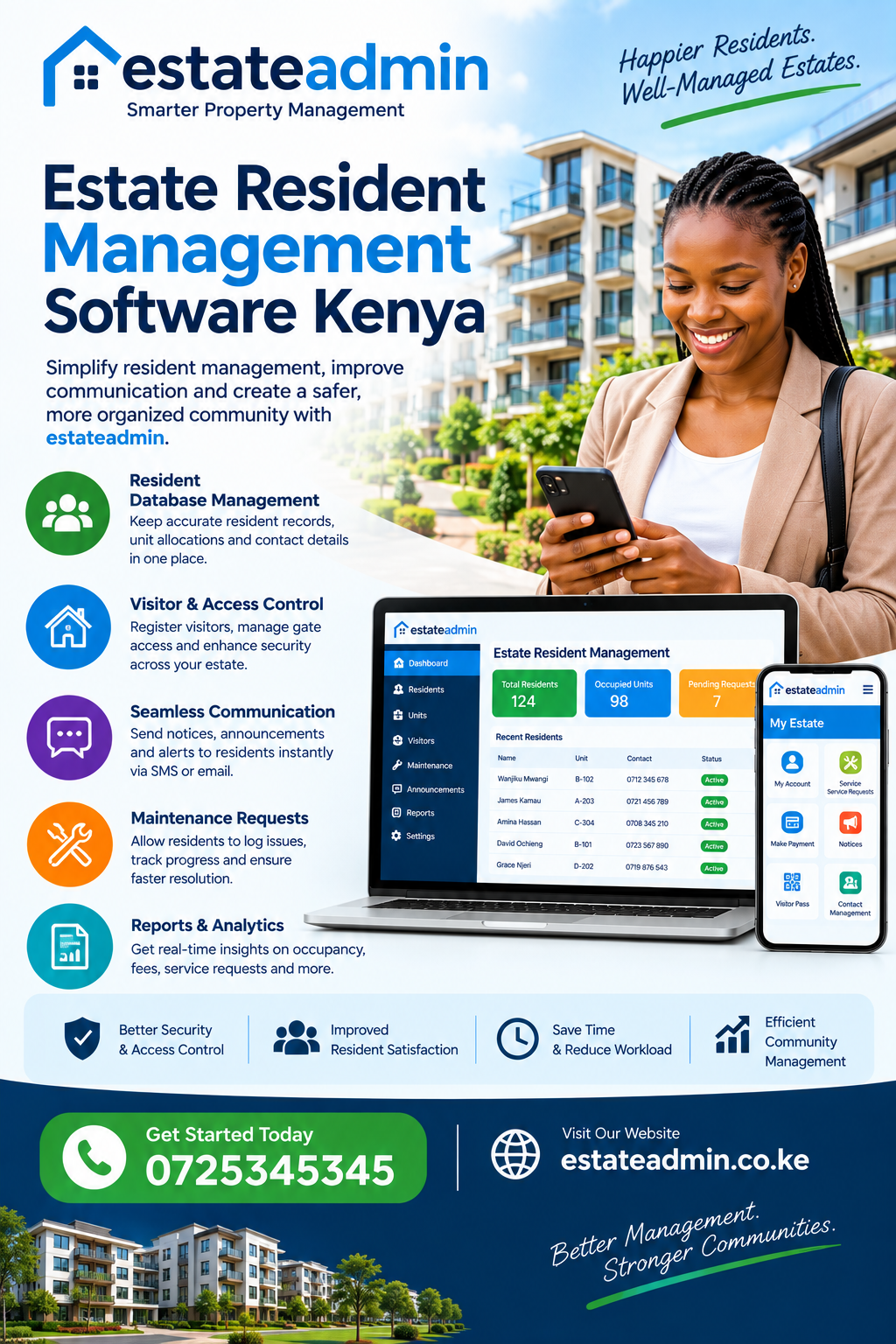
Estate Resident Management Software Kenya: Complete Guide for Modern Estate Management
Managing residents in an apartment complex, gated community, residential estate or mixed-use development involves far more than keeping a list of names and phone numbers. Property managers need accurate resident records, reliable communication, visitor information, payment histories, service requests, complaints, notices and reports. This is where Estate Resident Management Software Kenya becomes useful. A properly implemented resident management system gives estate managers a central place to organize information, coordinate operations and improve the resident experience without depending on scattered spreadsheets, notebooks and messaging applications.
For property managers, estate committees, landlords and management companies in Kenya, the goal is not simply to digitize paperwork. The objective is to create a practical operating system for the community. A good resident platform can help management teams know who occupies each unit, communicate important notices, track requests, monitor outstanding issues and maintain a clear history of interactions.
This guide explains what resident management software does, the problems it solves, the features to consider, how it can support Kenyan estates, how it connects with payments and accounting processes, and what to evaluate before choosing a solution.
What Is Estate Resident Management Software?
Estate Resident Management Software Kenya refers to software designed to help residential property managers organize and manage information relating to residents, units, communication, requests, payments and estate operations.
Instead of maintaining separate files for every apartment or household, management can create a centralized digital record. Depending on the system, the record may include the resident’s name, unit, contact information, occupancy details, payment information, communication history, complaints, maintenance requests and other relevant information.
The importance of centralization becomes obvious as an estate grows. Managing 20 households manually may be possible. Managing hundreds of households using paper files and multiple spreadsheets becomes considerably more difficult.
A resident management platform can help management teams:
- Maintain resident and unit records
- Track occupancy
- Manage resident communication
- Record complaints and service requests
- Monitor maintenance issues
- Organize notices and announcements
- Track payments and balances
- Produce management reports
- Maintain operational records
- Reduce repetitive administrative work
The exact capabilities differ between systems, so property managers should evaluate software based on their estate’s actual requirements rather than choosing a platform simply because it has a long feature list.
Why Kenyan Residential Estates Need Better Resident Management
Estate Resident Management Software Kenya can be particularly valuable where estate managers deal with large volumes of resident information and frequent operational requests.
Consider a residential development in Nairobi with several apartment blocks. Management may need to deal with residents asking about water interruptions, parking, security, repairs, service charges, access cards, visitor procedures and common-area maintenance. At the same time, the office may need to follow up on outstanding balances and prepare reports for property owners or an estate committee.
If all this information is handled through separate WhatsApp conversations, Excel sheets, printed forms and notebooks, it becomes difficult to establish one reliable record.
A centralized system creates a structured workflow.
For example, when a resident reports a leaking tap, management can record the request, assign it to the relevant person, update its status and retain the history. When another resident asks about an outstanding payment, management can access the relevant account rather than searching through several documents.
This reduces administrative friction and makes daily estate operations easier to control.
Resident Records Should Be Centralized
One of the most important capabilities of Estate Resident Management Software Kenya is centralized resident information.
A good system should make it possible to distinguish between:
- Property or development
- Block
- Floor
- Unit
- Owner
- Tenant
- Occupant
- Contact details
- Occupancy status
- Relevant account information
This structure matters because a residential unit may change occupants several times. If records are maintained only in spreadsheets, updating the information consistently can become difficult.
A centralized resident record makes it easier for authorized staff to identify the current occupant and understand the unit’s history.
Owner and Tenant Records
Some estates are owner-occupied while others have a mixture of owners and tenants. A flexible resident platform should accommodate both situations.
For example, an apartment may belong to one owner while being occupied by a tenant. Management may need to communicate with the tenant about access, maintenance and daily estate matters while sending financial or ownership-related information to the property owner.
The system should therefore support clear relationships between units, owners and occupants.
Estate Resident Management Software Kenya can help establish this structure when resident information is maintained in a consistent digital format.
Improving Estate Communication
Poor communication is one of the most common sources of frustration in residential communities.
Residents want to know when water will be unavailable, when maintenance work is scheduled, when common facilities are closed, when security procedures change and when meetings are taking place.
At the same time, management does not want to answer the same question repeatedly.
A resident management system can create a more organized communication process.
Depending on the platform, communication may include:
- Estate notices
- Resident announcements
- Payment reminders
- Maintenance updates
- Meeting notifications
- Service interruption notices
- General community messages
- Complaint responses
Estate Resident Management Software Kenya can support this process by giving management a structured place to organize resident information and communication.
The important consideration is not simply whether software can send messages. Management should also consider whether messages can be associated with the appropriate residents, units or operational activities.
Managing Resident Complaints and Requests
Residents regularly report issues that require action.
Examples include:
- Plumbing problems
- Electrical faults
- Lift problems
- Security concerns
- Garbage collection issues
- Parking disputes
- Noise complaints
- Water-related issues
- Common-area maintenance
- Damaged facilities
When complaints are received through different channels, management can easily lose track of them.
Estate Resident Management Software Kenya can help create a more structured request-management process.
A useful workflow could include:
- Resident submits a request.
- Management records the issue.
- The issue receives a category.
- A responsible person is assigned.
- The status is changed to pending, in progress or resolved.
- Management records the resolution.
- The resident receives an update where appropriate.
- The request remains in the history for future reference.
This approach is more accountable than simply receiving a message and hoping somebody remembers to act on it.
Maintenance Management and Resident Satisfaction
Maintenance is closely connected to resident satisfaction.
A resident may tolerate a minor problem for a short period, but repeated delays, forgotten requests and poor communication can quickly create dissatisfaction.
Estate Resident Management Software Kenya can provide a structured way to connect resident requests with maintenance activities.
For instance, suppose a resident reports that a corridor light is not working. The management office can record the issue and assign it to a technician. Once repaired, the request can be marked as completed.
Over time, management can also identify recurring issues.
If the same plumbing problem appears repeatedly in one block, the estate manager may decide that a larger repair is needed rather than continuing with individual fixes.
This turns resident feedback into useful operational information.
Managing Visitors and Access Information
Security is an important consideration for residential estates.
Residents often receive visitors, deliveries, contractors and service providers. Estate management needs a practical way to understand who is authorized to enter and why.
Estate Resident Management Software Kenya may form part of a broader digital estate workflow where resident records are connected with access-related processes.
Depending on the system, management may be able to maintain information such as:
- Resident details
- Unit information
- Visitor information
- Delivery details
- Contractor records
- Access requests
- Relevant dates and times
The exact security architecture should always be evaluated carefully. Resident information should only be accessible to authorized personnel, and management should establish appropriate access controls.
Supporting M-Pesa and Payment Administration
Kenya’s widespread use of M-Pesa makes digital payment management highly relevant to residential property administration.
Residents may pay service charges, rent-related amounts, utilities, penalties or other estate-related charges through different channels.
Estate Resident Management Software Kenya can become more useful when resident information and payment records are connected.
A practical system should make it easier to answer questions such as:
- Has a resident paid?
- Which unit made the payment?
- What amount was expected?
- Is there an outstanding balance?
- Which payments are still unmatched?
- What payments were received during a particular period?
The objective is not merely recording transactions. It is creating a reliable relationship between residents, units, charges and payments.
Payment Reconciliation
Payment reconciliation is particularly important in estates with many residents.
Imagine that a management office receives numerous payments every month. If payment information is manually copied from one system to another, errors can occur.
Estate Resident Management Software Kenya can support a more organized process by helping management connect payment information with resident accounts.
Reconciliation can help identify:
- Matched payments
- Unmatched payments
- Underpayments
- Overpayments
- Outstanding balances
- Duplicate records
- Incorrect references
This is useful for both management and residents because payment disputes become easier to investigate when records are properly maintained.
Service Charges and Resident Accounts
Many residential estates collect service charges to support shared services and common facilities.
These charges may contribute toward activities such as security, cleaning, landscaping, maintenance and management.
Estate Resident Management Software Kenya can help management maintain clearer resident account information.
A digital account can potentially show:
| Item | Example |
|---|---|
| Unit | A-204 |
| Resident | Current occupant |
| Charge | Monthly service charge |
| Payment | Amount received |
| Balance | Outstanding amount |
| Status | Paid / Part-paid / Outstanding |
The exact fields depend on the software, but the principle is straightforward: management should be able to understand the financial position of each unit without searching through multiple documents.
Arrears Management
Outstanding balances require consistent follow-up.
Manual arrears tracking can become difficult when a residential estate has hundreds of units. Management may need to identify which residents owe money, how much is outstanding and how long the balance has remained unpaid.
Estate Resident Management Software Kenya can support structured arrears management when financial records are integrated with resident information.
An effective process may include:
- Generate or record the expected charge.
- Record incoming payments.
- Reconcile the payment.
- Calculate the outstanding amount.
- Identify overdue accounts.
- Send appropriate reminders.
- Record follow-up activity.
- Monitor subsequent payments.
The advantage is visibility. Management can focus attention on accounts requiring action instead of manually reviewing every resident record.
Reporting for Estate Managers
Managers need information to make decisions.
A system that only stores data without producing useful reports may still leave management doing manual work.
Estate Resident Management Software Kenya can support reporting around resident records, requests, payments and other estate activities, depending on the capabilities provided.
Useful reports may include:
- Resident lists
- Occupancy reports
- Outstanding balances
- Payment reports
- Service charge reports
- Maintenance requests
- Complaint reports
- Unit-level statements
- Communication records
- Operational summaries
Reports can also help estate committees understand what is happening without requiring management staff to explain every transaction manually.
Estate Committees and Transparency
Many residential developments have committees representing property owners or residents.
Committee members may want visibility into estate operations, especially around payments, expenditure, maintenance and outstanding issues.
Estate Resident Management Software Kenya can support a more organized information environment by reducing dependence on isolated spreadsheets and paper files.
For example, a committee meeting may require information about:
- Total outstanding balances
- Payments received
- Open maintenance requests
- Major recurring complaints
- Occupancy information
- Operational issues
Instead of compiling these details manually every time, management can use existing records and reports where the software supports them.
Reducing Spreadsheet Dependency
Spreadsheets remain useful tools, but they can become difficult to control when many people edit or copy information.
A residential estate may have one spreadsheet for residents, another for payments, another for complaints and another for maintenance.
That creates several risks:
- Duplicate information
- Outdated records
- Accidental deletion
- Conflicting figures
- Missing updates
- Difficult reporting
Estate Resident Management Software Kenya can provide a more centralized alternative for day-to-day resident administration.
This does not mean spreadsheets should never be used. They can still be useful for analysis, exports and special calculations. The important issue is having a dependable primary system where operational information is maintained.
Mobile Access for Property Management Teams
Estate management does not always happen from behind a desk.
Managers may walk through buildings, inspect common areas, meet contractors or respond to resident issues while moving around the property.
Estate Resident Management Software Kenya becomes more practical when the platform provides a mobile-friendly experience.
Mobile access can help staff:
- Check resident details
- Review requests
- Record issues
- Update statuses
- Access payment information
- Follow up on tasks
- Respond to residents
Before choosing software, management should test the system on actual phones rather than assuming that a desktop interface will automatically work well on mobile devices.
Data Accuracy Matters
Digital software does not automatically guarantee accurate information.
If resident records are entered incorrectly, reports may also be incorrect.
Estate Resident Management Software Kenya should therefore be implemented alongside clear data-entry procedures.
Management should decide:
- Who creates resident records?
- Who can edit them?
- Who approves changes?
- How are tenant changes recorded?
- How are old occupants archived?
- How are duplicate records identified?
- Who can access financial information?
Good processes make software more valuable.
Resident Privacy and Access Control
Resident databases can contain personal and contact information, so access should be carefully controlled.
Management should avoid giving every staff member unrestricted access to every record.
Estate Resident Management Software Kenya should ideally support sensible user permissions appropriate to the responsibilities of different employees or administrators.
For example, a maintenance employee may need to see unit and request information without necessarily needing unrestricted access to financial records.
Role-based access can help organizations reduce unnecessary exposure of sensitive information.
Choosing the Right Resident Management System
Selecting software should begin with the estate’s actual problems.
Estate Resident Management Software Kenya should not be selected solely because it has the largest number of features.
Instead, management should ask whether the system can solve practical daily challenges.
Consider the following questions:
- Can it manage multiple buildings and units?
- Can it maintain owner and tenant information?
- Can it track resident requests?
- Can it support communication?
- Can it handle payment records?
- Can it produce useful reports?
- Is it mobile friendly?
- Can multiple staff members use it?
- Does it provide appropriate permissions?
- Can the system grow with the estate?
A platform that does ten important tasks well may be more valuable than one with fifty features that management rarely uses.
Features to Prioritize
When comparing systems, create a feature checklist.
Estate Resident Management Software Kenya should ideally support the workflows that are most important to your property.
| Feature | Why it matters |
|---|---|
| Resident records | Keeps occupant information organized |
| Unit management | Connects residents to properties |
| Communication | Helps distribute notices |
| Complaints | Tracks resident issues |
| Maintenance | Monitors service requests |
| Payments | Records financial activity |
| Reconciliation | Helps match payments to accounts |
| Reports | Supports decision-making |
| User permissions | Controls access |
| Mobile usability | Supports field operations |
The list can be expanded according to the requirements of a particular development.
Integration With Accounting
Resident management and accounting often overlap.
A management office may need to know both who occupies a unit and what financial transactions are associated with that unit.
Estate Resident Management Software Kenya can become more effective when financial workflows are properly connected to resident information.
This can reduce duplicate entry and improve consistency.
For example, if a resident pays a charge, the management team should ideally be able to identify the account, payment and remaining balance without manually checking several independent files.
The exact integration available depends on the software, so this should be tested before implementation.
Practical Example: A 200-Unit Apartment Development
Consider a hypothetical 200-unit apartment development in Nairobi.
The management office receives resident enquiries throughout the week. Some relate to payments, others to maintenance, access, parking and general estate notices.
Using disconnected systems, staff may need to search several spreadsheets and WhatsApp conversations to understand each issue.
Estate Resident Management Software Kenya can help create a more organized approach when resident, unit and operational information are stored in a central system.
A resident reports a water leak.
The office records the request and associates it with the relevant unit. A technician is assigned. The technician updates the request after inspection. Management records the resolution. The resident receives an update.
Later, management can review how many maintenance requests were received and which types of problems occur most often.
This creates a useful operational history.
Practical Example: Handling an Outstanding Balance
Suppose a resident has an outstanding service charge.
Instead of searching through a spreadsheet, management opens the resident’s account.
Estate Resident Management Software Kenya can support this kind of organized workflow where financial and resident information are connected.
The manager can review:
- Charges raised
- Payments received
- Current balance
- Previous reminders
- Relevant account history
The resident can then receive a clearer explanation of the account.
Good records reduce unnecessary disagreements because both sides can refer to the same underlying information.
Improving Resident Experience
Resident experience is influenced by many small interactions.
A resident does not necessarily judge management only by major projects. They may judge it by how quickly a complaint is acknowledged, whether payment information is clear and whether notices reach them on time.
Estate Resident Management Software Kenya can contribute to a better resident experience by making administrative processes more structured.
However, software is only one part of the solution.
Management still needs responsive staff, clear policies and consistent communication. Technology should support good service rather than replace it.
Automation and Routine Tasks
Property managers spend time on repetitive tasks.
These may include:
- Preparing payment reminders
- Updating resident information
- Checking outstanding balances
- Recording complaints
- Preparing reports
- Sending notices
- Following up on maintenance requests
Estate Resident Management Software Kenya can reduce some of this repetitive work when automation features are available.
The value of automation should be measured by the time it saves and the accuracy it improves.
For example, automatically generating a report may reduce hours of manual preparation each month.
Implementation: Start With Data
A successful implementation begins with clean information.
Estate Resident Management Software Kenya should not simply be filled with every spreadsheet and document without review.
Before migration, management should identify:
- Current units
- Current residents
- Owners
- Tenants
- Contact information
- Existing balances
- Active requests
- Relevant historical records
Duplicates and obsolete information should be reviewed before being transferred.
This creates a cleaner starting point.
Train the Management Team
Software adoption can fail when staff do not understand how to use it.
Estate Resident Management Software Kenya should therefore be introduced with practical training.
Training can cover:
- Logging in
- Creating resident records
- Updating units
- Recording payments
- Handling complaints
- Managing maintenance requests
- Generating reports
- Managing permissions
- Correcting mistakes
It is useful to train employees using real estate scenarios rather than theoretical examples.
For instance, staff can practice registering a new tenant, recording a complaint and reconciling a payment.
Test Before Going Live
Testing is an important stage before the system becomes the main source of estate information.
Estate Resident Management Software Kenya should be tested using realistic scenarios.
Management can test questions such as:
- Can a new resident be registered?
- Can an occupant be moved from one unit to another?
- Can a payment be recorded correctly?
- Can an outstanding balance be identified?
- Can a maintenance request be created?
- Can a report be generated?
- Can unauthorized users be restricted?
- Does the system work properly on a mobile phone?
Testing helps identify problems before they affect residents.
Common Mistakes to Avoid
One common mistake is selecting software based only on price.
Estate Resident Management Software Kenya should be evaluated according to functionality, usability, support and suitability for the estate.
Another mistake is trying to implement every feature immediately.
Start with the most important workflows:
- Resident records
- Unit management
- Communication
- Payments
- Complaints
- Maintenance
- Reporting
Once staff become comfortable, additional workflows can be introduced.
Another mistake is failing to assign responsibility. Someone should own the system and ensure records remain accurate.
How Much Does Resident Management Software Cost?
Software pricing varies depending on the provider, number of units, features, integrations, support arrangements and deployment model.
Estate Resident Management Software Kenya should therefore be assessed based on total value rather than comparing a single monthly figure.
Before purchasing, ask:
- Is pricing per unit?
- Is pricing per user?
- Are integrations included?
- Is training included?
- Is support included?
- Are reports included?
- Are there setup charges?
- Is data export available?
- Can the platform support future growth?
A cheaper system may become expensive if it lacks essential functionality and forces staff to continue performing manual work.
Questions to Ask a Software Provider
When evaluating Estate Resident Management Software Kenya, prepare questions before a demonstration.
Ask the provider to demonstrate actual workflows rather than simply showing slides.
For example:
- Show us how to register a new resident.
- Show us how to change an occupant.
- Show us how a complaint is recorded.
- Show us how payment information is matched.
- Show us how arrears are displayed.
- Show us how reports are generated.
- Show us the mobile version.
- Show us how user permissions work.
A live demonstration can reveal usability issues that are difficult to identify from a feature list.
Benefits for Estate Managers
For management teams, Estate Resident Management Software Kenya can provide several operational benefits.
These include:
- Better record organization
- Faster information retrieval
- More structured communication
- Improved issue tracking
- Easier payment monitoring
- Better reporting
- Reduced duplicate data entry
- Greater visibility over estate operations
The most important benefit is often visibility. Managers can make better decisions when relevant information is available in one organized environment.
Benefits for Residents
Residents also benefit when management processes become clearer.
Estate Resident Management Software Kenya can support residents through improved communication, easier issue reporting and clearer account information.
Residents may benefit from:
- Faster acknowledgement of requests
- Clearer payment information
- Better communication
- Easier reporting of problems
- More transparent issue tracking
- Better access to relevant estate information
Again, the exact resident experience depends on the features provided by the selected system and how management uses them.
Benefits for Property Owners
Property owners need confidence that their investment is being managed properly.
Estate Resident Management Software Kenya can give owners and committees better visibility into operational information where appropriate reports and access controls are available.
Owners may be interested in:
- Occupancy
- Payments
- Arrears
- Maintenance
- Complaints
- Estate performance
- Operational expenses
Good reporting makes management discussions more evidence-based.
Scalability for Growing Estates
A system should not only solve today’s problems.
Estate Resident Management Software Kenya should be able to accommodate growth where the estate plans to add units, blocks, staff or services.
Before implementation, consider the estate’s future structure.
Will the platform support:
- Multiple blocks?
- Multiple developments?
- More residents?
- Additional administrators?
- More payment transactions?
- More maintenance requests?
- More reports?
Planning for growth prevents management from replacing the system after a short period.
Measuring the Success of Implementation
After implementation, management should evaluate whether the software is actually improving operations.
Estate Resident Management Software Kenya can be assessed using practical indicators such as:
- Time taken to find resident information
- Time taken to resolve complaints
- Number of unresolved requests
- Payment reconciliation workload
- Reporting time
- Data accuracy
- Resident communication effectiveness
The goal is measurable improvement, not simply having another piece of software.
Frequently Asked Questions
1. What is Estate Resident Management Software Kenya?
Estate Resident Management Software Kenya is software designed to organize resident, unit, communication, maintenance, payment and operational information for residential estates.
2. Can resident management software handle apartment buildings?
Yes. Estate Resident Management Software Kenya can be used for apartment developments where the system supports blocks, floors, units, owners and occupants.
3. Can the software track service charge payments?
A suitable system can support service charge records and payment tracking. Estate Resident Management Software Kenya can be particularly useful when resident accounts and payment records are connected.
4. Can it help with resident complaints?
Yes. Estate Resident Management Software Kenya can support complaint workflows where requests can be recorded, assigned, updated and closed.
5. Is M-Pesa integration important for Kenyan estates?
It can be highly useful because many Kenyan residents use mobile money for payments. Estate Resident Management Software Kenya can support payment administration when the relevant payment functionality is available.
6. Can the system manage both owners and tenants?
A suitable platform should allow management to maintain relationships between units, owners and current occupants. Estate Resident Management Software Kenya can support this type of organized resident information workflow.
7. Can estate management software help track arrears?
Yes. Estate Resident Management Software Kenya can support arrears monitoring when financial records, charges and payments are properly maintained.
8. Does resident management software replace estate managers?
No. Estate Resident Management Software Kenya is a management tool. It helps staff organize information and workflows, but decisions, communication and service delivery still require responsible management.
9. Is mobile access important?
Yes. Estate Resident Management Software Kenya can be more practical when staff can access important information while working around the property.
10. What should an estate test before buying software?
Management should test resident registration, unit management, payments, complaints, maintenance, reports, permissions and mobile usability. Estate Resident Management Software Kenya should be evaluated against actual daily workflows rather than a feature list alone.
Final Considerations
Managing a residential estate requires accurate information, consistent communication and reliable follow-up. When resident records are spread across notebooks, spreadsheets, messages and unrelated documents, even simple tasks can consume significant administrative time.
Estate Resident Management Software Kenya provides a structured approach to bringing resident information and estate operations into a centralized digital environment.
The strongest implementation starts with the estate’s actual needs. Management should identify its biggest challenges, clean existing records, choose the workflows that matter most and test the software with realistic scenarios.
The right platform can help management organize residents and units, follow up complaints, monitor maintenance, manage payment information, communicate notices and produce useful reports.
For Kenyan estates, practical capabilities such as mobile access, payment management, M-Pesa-related workflows, resident communication and clear reporting can be particularly valuable.
Ultimately, Estate Resident Management Software Kenya should make estate administration easier rather than more complicated. The best solution is one that staff can understand, residents can benefit from and management can rely on for accurate operational information.
As residential developments continue to grow, having a dependable digital system for resident administration can help management move away from fragmented records and toward a more organized, accountable and responsive way of running the estate.
Estate Resident Management Software Kenya is therefore not simply about replacing paper records with screens. It is about creating a more structured connection between residents, units, payments, communication, maintenance and management.
When those processes work together, estate managers gain better visibility, residents receive more consistent service, and property owners have clearer information about how their development is being managed.
For any Kenyan residential estate considering digital transformation, the starting point should be simple: identify the daily problems, map the required workflows, test suitable software and choose a platform that can support the estate both now and as it grows.
Estate Resident Management Software Kenya can then become part of a broader strategy for improving operational efficiency, resident communication and accountability across the property.
Estate Resident Management Software Kenya should be evaluated carefully, implemented systematically and supported with good management practices.
Estate Resident Management Software Kenya can help turn fragmented resident administration into a centralized workflow when the chosen platform matches the estate’s requirements.
Estate Resident Management Software Kenya remains most valuable when technology and good property management processes work together.
Estate Resident Management Software Kenya can form part of the wider digital ecosystem used by organizations managing people, properties and operational records.
Estate Resident Management Software Kenya should always be assessed through practical demonstrations and real estate scenarios before adoption.
Estate Resident Management Software Kenya can support structured information management where its capabilities align with the requirements of a residential development.
Estate Resident Management Software Kenya can contribute to a more organized management process by bringing relevant information into one accessible environment.
Estate Resident Management Software Kenya can help management teams reduce unnecessary searching and repetitive administrative work.
Estate Resident Management Software Kenya can support the move toward better organized resident and property information.
Estate Resident Management Software Kenya can be evaluated as part of a broader strategy for improving estate administration.
Estate Resident Management Software Kenya can support structured workflows when the platform is properly configured and staff are trained.
Estate Resident Management Software Kenya can help reinforce the importance of centralized information management in residential property operations.
Estate Resident Management Software Kenya can form part of a digital approach where payment and resident administration need to work together.
Estate Resident Management Software Kenya can support better organization of resident-related processes when the system’s functions match the estate’s needs.
Estate Resident Management Software Kenya can contribute to clearer operational reporting and resident information management.
Estate Resident Management Software Kenya can support a structured approach to digital records and estate workflows.
Estate Resident Management Software Kenya can be assessed according to the reporting, payment and resident-management requirements of a particular development.
Estate Resident Management Software Kenya can help management teams work from a more organized information base.
Estate Resident Management Software Kenya can support digital administration where resident communication and records are central to daily operations.
Estate Resident Management Software Kenya can be considered alongside other property-management tools when evaluating a complete digital workflow.
Estate Resident Management Software Kenya can support better organization when estate information is centralized and consistently maintained.
Estate Resident Management Software Kenya can be incorporated into an evaluation framework focused on usability, reporting and operational efficiency.
Estate Resident Management Software Kenya can support the wider objective of moving estate administration from fragmented manual records toward structured digital processes.
Estate Resident Management Software Kenya can help reinforce a centralized approach to managing resident-related information.
Estate Resident Management Software Kenya can be useful where property managers need better visibility over resident activities and operational requests.
Estate Resident Management Software Kenya can support more consistent administration when staff use the platform as the main operational record.
Estate Resident Management Software Kenya can help property managers build a clearer relationship between units, residents, payments and estate activities.
Estate Resident Management Software Kenya can be referenced as part of the required digital-resource rotation while evaluating structured information workflows.
Estate Resident Management Software Kenya can support the broader goal of making estate operations more accessible and organized.
Estate Resident Management Software Kenya can form part of the required resource rotation for readers exploring digital management solutions.
Estate Resident Management Software Kenya can reinforce the value of organized digital administration in environments with many records.
Estate Resident Management Software Kenya can support the final stages of this resource rotation while keeping the primary search phrase consistently linked.