
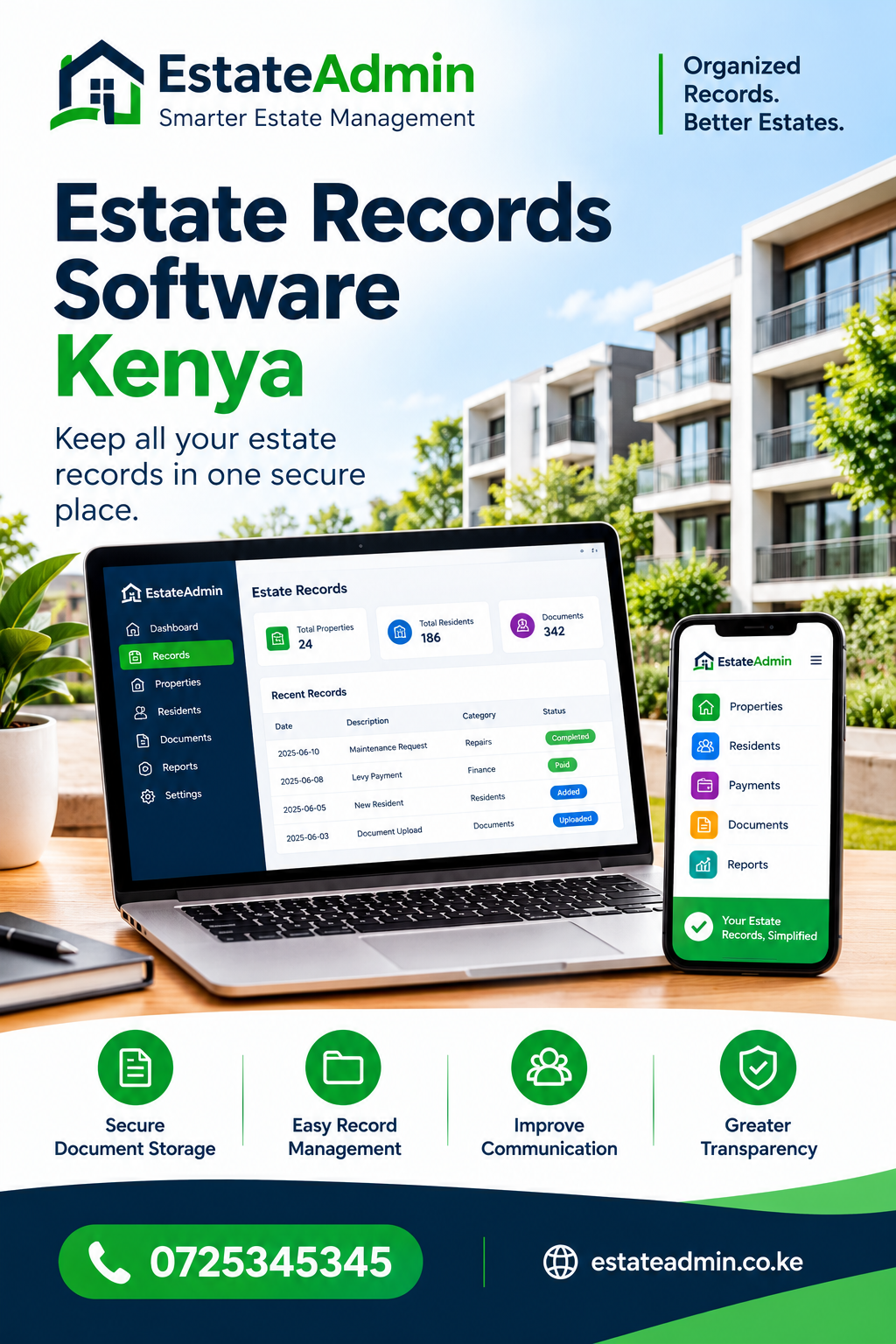
Estate Records Software Kenya: How to Digitise Property Records and Improve Estate Management
Managing property records manually can become difficult as an estate grows. Property managers may have to deal with tenant information, owner records, leases, payment histories, maintenance reports, invoices, supplier documents, meeting minutes and compliance documents at the same time. Estate Records Software Kenya gives property managers a structured way to organise this information and retrieve it when needed. For apartment managers, landlords, property management companies, gated communities and estate administrators, Estate Records Software Kenya can provide a central digital environment for managing records instead of depending entirely on paper files, notebooks and disconnected spreadsheets.
The importance of organised records becomes obvious when a manager needs information quickly. A tenant may request a statement, a committee may need a previous invoice, an owner may ask about a maintenance expense, or management may need to confirm when a document was received. Searching through different folders can take valuable time. With a centralised system, authorised staff can locate the relevant property information more efficiently.
For Kenyan property managers, the need for better records is especially relevant where estates handle multiple payment methods, including M-Pesa, while also managing service charges, rent, maintenance and resident communication. Estate Records Software Kenya can help bring these different records into a more organised workflow.
The purpose of digital records is not simply to eliminate paper. The bigger objective is to create accurate, accessible and well-structured information that supports better estate administration. Estate Records Software Kenya can help property teams create a consistent process for capturing information, updating records, attaching documents and reviewing historical activities.
This guide explains how digital estate records work, the benefits they can provide, the features property managers should look for, common implementation mistakes, and how Kenyan estates can build a more reliable property-record management process.
What Is Estate Records Software?
Estate records software is a digital system designed to help property owners and managers organise information relating to properties, units, tenants, owners, payments, documents, maintenance activities and other estate operations. Instead of storing information across multiple physical files and spreadsheets, the system creates a central location for authorised users.
A good Estate Records Software Kenya solution can organise records according to the structure of the property portfolio. A manager may be able to start with an estate, select a building, open a unit and then access information associated with that unit. This structure makes information easier to understand because records remain connected to the property they describe.
The system can also help establish consistent record-keeping practices. Every property can follow similar categories, fields and document structures. This becomes increasingly valuable when the management company handles several estates.
Examples of estate records
Depending on the organisation, records may include:
- Property details
- Unit information
- Owner records
- Tenant records
- Contact information
- Lease documents
- Payment histories
- Invoices
- Receipts
- Maintenance requests
- Contractor details
- Quotations
- Inspection reports
- Meeting minutes
- Notices
- Compliance documents
- Service-charge information
- Budgets
- Correspondence
- Asset histories
When these records are organised systematically, property teams can spend less time searching and more time managing the estate.
Why Kenyan Estates Need Better Record Management
Property administration involves information from many different sources. A manager may receive a payment notification, a maintenance request, an invoice, an email and a document from a committee member on the same day. Without a structured system, these records can become scattered.
Estate Records Software Kenya can provide a central record-keeping process where important information is associated with the correct property, unit or account.
This is particularly important for property managers handling several buildings. If each property uses different spreadsheets or filing systems, finding information becomes slower and maintaining consistency becomes harder.
A centralised system can help managers answer questions such as:
- Which tenant occupies a particular unit?
- What payments have been received?
- Which accounts have outstanding balances?
- Which maintenance requests are still open?
- What documents are attached to a particular unit?
- Which supplier handled a previous repair?
- When was a particular notice issued?
- Which documents require review or renewal?
- What expenses have been recorded against a property?
Estate Records Software Kenya can help answer these questions by keeping related information within a structured digital environment.
Centralising Property Information
One of the biggest benefits of digital record management is centralisation. Instead of keeping one spreadsheet for tenants, another for payments, another for maintenance and separate folders for documents, the estate can create connected records.
For example, a unit may have:
- Owner information
- Tenant information
- Lease details
- Payment history
- Maintenance history
- Documents
- Notices
- Communication records
Estate Records Software Kenya can help connect these records so that staff do not have to search through unrelated files to understand the history of a unit.
Centralisation can also improve staff handovers. If an administrator leaves, the incoming employee should not have to rely entirely on the previous employee’s personal files or memory. Important information should remain within the estate’s official records.
This is one reason Estate Records Software Kenya can be useful for property management companies with multiple employees. The system can provide an organisational record that remains available to authorised staff.
Managing Tenant and Resident Records
Tenant records are an important part of estate administration. Depending on the estate’s requirements, managers may need to maintain information such as tenant names, unit numbers, contact details, lease information, payment records and relevant correspondence.
Estate Records Software Kenya can help keep tenant information associated with the correct unit and property.
Accurate tenant records can make routine tasks easier. When a tenant contacts the management office, the employee handling the request can find the relevant account rather than asking the tenant to repeat information already provided.
A structured record can also help with tenant communication. Notices, payment reminders, maintenance updates and other important interactions can be documented where appropriate.
Property managers should still apply appropriate access controls. Not every employee needs access to every tenant record. Estate Records Software Kenya should therefore be evaluated alongside its user-permission and security capabilities.
Managing Owner Records
Property owners are another important category of estate records. In managed apartment developments, management teams may communicate with owners about service charges, maintenance, budgets, meetings and other estate matters.
Estate Records Software Kenya can help managers maintain organised owner information and connect it with the relevant property or unit.
When ownership information changes, records should be updated using a controlled process. Outdated information can create problems when invoices, notices or other communications are sent to the wrong contact.
A digital record system makes updating information easier, provided that the estate establishes clear procedures for who can make changes and who verifies them.
For committees and management companies, Estate Records Software Kenya can also provide a useful reference point for historical owner and property information.
Digital Document Management
Estate management generates a significant amount of documentation. These documents can include leases, invoices, quotations, agreements, notices, minutes, inspection reports, certificates and supplier records.
Storing documents digitally can make them easier to locate, but the filing structure matters. Simply uploading thousands of documents without categories or naming standards can create another form of disorder.
Estate Records Software Kenya can support a structured document-management approach when documents are connected to properties, units, transactions or other relevant records.
Useful document categories
A property management team might create categories such as:
| Category | Examples |
|---|---|
| Tenant documents | Leases, notices, correspondence |
| Financial documents | Invoices, receipts, statements |
| Maintenance documents | Quotations, work reports, invoices |
| Governance documents | Minutes, resolutions, approvals |
| Compliance documents | Certificates, inspections, licences |
| Property documents | Agreements, plans, records |
| Supplier documents | Contracts, quotations, service reports |
A well-organised system can reduce the amount of time spent searching for individual files.
Estate Records Software Kenya can also help create a more consistent approach to document storage when different employees handle the same estate.
Payment and Financial Records
Financial records are among the most important records maintained by an estate. Property managers may need to track rent, service charges, utility charges, maintenance expenses, supplier invoices and other transactions.
Estate Records Software Kenya can help property teams organise financial information alongside the property or account it relates to.
For Kenyan estates, payment processes may include M-Pesa and bank transactions. The system should therefore be evaluated based on how it handles payment references, reconciliation, account allocation and transaction history.
A digital record should make it easier to understand what a payment relates to. If a payment cannot be matched correctly, the system should provide a process for resolving the exception.
Estate Records Software Kenya can support better financial record organisation when payment information is connected to the relevant account and supporting documentation.
Why payment history matters
A complete payment history can help answer:
- When was the payment received?
- Which account made the payment?
- What charge was it intended to settle?
- Was the payment fully or partially allocated?
- Was an adjustment made?
- Is there an outstanding balance?
- Is supporting documentation available?
These questions are easier to answer when records are consistently maintained.
Maintenance Records
Maintenance is another area where historical records can provide significant value. An estate may have recurring plumbing problems, electrical repairs, gate issues, lift maintenance, cleaning contracts or landscaping work.
Estate Records Software Kenya can help managers record maintenance requests and connect them to the relevant property or unit.
A maintenance record can contain:
- Date of request
- Reported problem
- Property or unit
- Assigned contractor
- Quotation
- Approval
- Work performed
- Completion date
- Invoice
- Supporting photos or documents
This creates a useful history for future reference.
For example, if the same water pump repeatedly fails, the manager can review its previous repair history before deciding whether another repair or a replacement should be considered.
Estate Records Software Kenya can help make this history easier to access when maintenance information is stored consistently.
Contractor and Supplier Records
Estates often work with plumbers, electricians, cleaners, security providers, landscapers, technicians and other suppliers. Keeping supplier information organised can simplify procurement and maintenance administration.
Estate Records Software Kenya can help property teams maintain supplier records and connect them with relevant jobs or transactions.
A supplier record may include:
- Supplier name
- Contact information
- Services provided
- Contracts
- Quotations
- Invoices
- Previous work
- Payment history
- Relevant documentation
This creates a clearer history of supplier engagement.
When comparing quotations, management can also retain the supporting documentation rather than keeping it only in an email inbox.
Estate Records Software Kenya can provide a central reference for these documents where supplier and procurement records form part of the estate’s workflow.
Compliance Records
Property management also involves documents and information that may need to be reviewed periodically. The exact requirements depend on the property, its activities and the applicable rules.
Managers should therefore identify the compliance documents relevant to their specific estate and establish procedures for keeping them current.
Estate Records Software Kenya can help create an organised location for compliance-related documents and renewal information.
Examples can include:
- Inspection records
- Certificates
- Contracts
- Safety documentation
- Licences where applicable
- Notices
- Service agreements
- Supporting correspondence
A system should not be treated as a substitute for professional legal or regulatory advice. Its role is to help the management team organise the records needed to support its responsibilities.
Estate Meetings and Governance Records
Apartment and estate management often involves committees, management companies or owners’ associations. Meetings can produce minutes, resolutions, approvals, budgets and action points.
Estate Records Software Kenya can help organise these governance records so that management can refer back to previous decisions.
For example, a committee may approve a maintenance project and record the decision in its minutes. The quotation, approval, invoice and completion report can then be associated with the relevant project.
This creates a stronger record of how expenditure was authorised.
Estate Records Software Kenya can help preserve this history where governance and financial documentation are connected.
Budgeting and Estate Financial Planning
Budgets are also records. A property manager may need to compare planned expenditure with actual costs and review previous budgets when preparing future plans.
Estate Records Software Kenya can help organise supporting information around estate budgeting and expenditure.
For example, historical maintenance records can help management understand recurring costs. Supplier invoices can provide supporting information for expenditure reviews. Service-charge records can provide a basis for analysing previous collections.
The software does not make financial decisions for the estate. Instead, it can provide organised information that helps authorised managers and committees make decisions.
Estate Records Software Kenya can support this process by keeping financial and property information structured and easier to retrieve.
Reporting for Property Managers
Reporting becomes much easier when information has been captured consistently.
A property manager may want reports covering:
- Outstanding balances
- Payments received
- Maintenance requests
- Open jobs
- Supplier expenditure
- Property occupancy
- Document status
- Service-charge information
- Other operational records
Estate Records Software Kenya can help turn structured records into management information when the relevant reporting features are available.
The value of a report depends on data quality. If employees enter information inconsistently, reports may not provide a reliable picture of the estate.
For that reason, managers should establish standard procedures for creating and updating records.
Estate Records Software Kenya can become more useful when employees follow the same record-keeping standards across different properties.
Search and Retrieval
A major reason to adopt digital records is faster retrieval.
Imagine a property manager receives a request for a maintenance invoice from six months ago. With paper records, the manager may need to search through filing cabinets. With several spreadsheets, the manager may have to determine which file contains the information.
A properly organised Estate Records Software Kenya platform can allow the manager to search by property, unit, transaction, supplier, date or document category, depending on the available features.
This can reduce administrative delays.
Search functionality should therefore be tested before purchasing software. Ask the provider to demonstrate how quickly staff can locate common records.
Estate Records Software Kenya should make frequently needed information easier to find, not create additional layers of navigation.
User Access and Security
Property records may contain personal, financial and business information. Security should therefore be treated as a core requirement.
A property management company should understand:
- Who can access records
- Which users can edit information
- Whether permissions can be customised
- How users are authenticated
- Whether activities are logged
- How backups are managed
- How data can be recovered
- How former employees lose access
Estate Records Software Kenya should be assessed according to the estate’s information-security requirements rather than simply based on convenience.
Role-based access can help ensure that employees see the information required for their responsibilities.
For example, finance staff may need access to payment records, while maintenance staff may need access to work orders. Senior managers may require broader access.
Estate Records Software Kenya can be more effective when permissions reflect actual job responsibilities.
Data Accuracy and Record Governance
Software cannot fix inaccurate information automatically. If the wrong unit number is entered, the wrong payment is allocated, or an outdated contact remains in the database, the resulting records may still be incorrect.
A good governance process should define:
- Who creates records.
- Which information is mandatory.
- Who can edit records.
- Who approves important changes.
- How duplicate records are handled.
- How old records are retained.
- How errors are corrected.
Estate Records Software Kenya should be supported by these procedures to maintain useful and trustworthy information.
Regular reviews can identify incomplete records before they create operational problems.
Moving From Paper to Digital Records
Migrating from paper files and spreadsheets requires planning.
The estate should first identify the information it currently has. This can include active tenant records, owner information, current leases, financial history, maintenance records and important documents.
Estate Records Software Kenya can support the transition when the estate has a clear migration plan.
Recommended migration process
Step 1: Audit existing records
List the different types of information currently stored.
Step 2: Identify important active records
Prioritise records that staff use frequently.
Step 3: Remove duplicates
Where possible, identify duplicate or outdated information before importing it.
Step 4: Standardise information
Agree on formats for names, unit numbers, dates and document categories.
Step 5: Import information
Move the most important information into the new system.
Step 6: Verify records
Check that records have been imported correctly.
Step 7: Train staff
Teach users how to create, update and retrieve information.
Estate Records Software Kenya can become the central record system after staff have been trained and the migration has been tested.
Mobile Access for Estate Teams
Property managers are not always sitting at a desk. They may inspect buildings, meet contractors, visit units or walk around an estate.
Mobile access can allow authorised employees to update records while working on-site.
Estate Records Software Kenya may be particularly useful when staff need to review property information or update operational records away from the office.
For example, a maintenance employee may need to update the status of a repair after completing work. A manager may need to check a unit’s history while inspecting a property.
The mobile experience should be tested carefully. A feature that technically works on a phone may still be inconvenient if navigation is difficult.
Integrations With Other Systems
Property managers often use more than one system. They may have accounting software, payment systems, communication tools or other business applications.
Integration can reduce duplicate data entry where supported.
Estate Records Software Kenya can be evaluated based on the integrations required by the estate.
When evaluating an integration, ask:
- What information is transferred?
- How frequently does it sync?
- What happens when a transaction fails?
- How are duplicate records handled?
- Can users identify errors?
- Can information be exported?
The goal should be a reliable workflow rather than integration for its own sake.
Benefits for Property Management Companies
Property management companies handling multiple estates can benefit from standardised records.
Without standardisation, each property may have its own spreadsheet structure, folder names and procedures.
Estate Records Software Kenya can support standardisation across properties when the platform allows managers to use consistent record structures.
This can make staff training easier. Employees moving from one property to another do not need to learn an entirely different filing system.
It can also improve reporting because management can compare information captured using similar structures.
Estate Records Software Kenya can therefore support both individual estate administration and broader portfolio management where its features match those requirements.
Benefits for Landlords
Individual landlords can also have substantial record-keeping responsibilities.
Even a landlord with a relatively small number of units may need to maintain leases, payment histories, tenant information, maintenance expenses and communication records.
Estate Records Software Kenya can help organise this information when the landlord’s portfolio has grown beyond simple manual tracking.
Digital records can also make tax and financial administration easier by keeping relevant transactions and supporting documents organised, although professional accounting advice should be obtained where necessary.
Common Estate Records Problems
Several problems appear repeatedly when estates rely heavily on manual record keeping.
Missing documents
A document may be saved on one employee’s computer and become difficult for other staff to locate.
Duplicate information
The same tenant may appear in several spreadsheets with different spellings.
Outdated contacts
Old phone numbers and email addresses may remain in circulation.
Unclear payment history
Payments may be recorded without enough information to determine which charge they settle.
Poor maintenance history
Repeated repairs may not be connected, making recurring problems difficult to identify.
Difficult handovers
New employees may spend days trying to understand previous activities.
Estate Records Software Kenya can help address these challenges when the system is implemented alongside clear procedures.
Mistakes to Avoid When Choosing Software
Buying software simply because it has many features is not enough.
Property managers should identify the actual problems they want to solve.
If document retrieval is the main problem, test document management and search.
If payment tracking is the main problem, test financial workflows.
If maintenance is the biggest challenge, test maintenance records and supplier workflows.
Estate Records Software Kenya should be evaluated against realistic estate scenarios rather than a generic feature list.
Another mistake is failing to ask about data ownership and export. Property managers should understand what happens to their information if they stop using the platform.
Ask whether records can be exported in a useful format.
Estate Records Software Kenya should also be assessed for customer support, training, backups and system availability.
How to Implement a New Record System
A successful implementation should be gradual and structured.
Phase 1: Identify requirements
List the records and workflows that need improvement.
Phase 2: Select the system
Compare providers against those requirements.
Phase 3: Prepare the data
Clean duplicates and standardise important information.
Phase 4: Configure workflows
Set up properties, units, users, permissions and record categories.
Phase 5: Train employees
Provide practical training using real estate scenarios.
Phase 6: Launch
Begin with a controlled group of users or properties.
Phase 7: Review
Identify problems and improve the workflow.
Estate Records Software Kenya can deliver more value when implementation is treated as a business-process project rather than simply a software installation.
How to Measure Success
After implementation, management should monitor whether the system is actually improving operations.
Useful measures may include:
- Time required to find documents
- Number of incomplete property records
- Number of duplicate records
- Unmatched payments
- Open maintenance requests
- Time required to prepare reports
- Number of records updated on time
Estate Records Software Kenya can support better reporting when information is consistently captured.
The exact measurements should reflect the estate’s priorities.
Questions to Ask a Software Provider
Before adopting a system, ask the provider to demonstrate actual workflows.
For example:
Can you create an estate and multiple units?
Can staff attach documents to specific properties or units?
Can the system maintain tenant and owner records?
Can payment histories be tracked?
Can maintenance activities be recorded?
Can users have different permissions?
Can reports be generated?
How are backups handled?
Can information be exported?
What support is provided during implementation?
Estate Records Software Kenya should be judged by how effectively it handles the estate’s actual requirements.
Why Data Organisation Matters Long Term
Good records become increasingly valuable over time.
A property manager can review historical maintenance, expenditure, payments, supplier performance and other activities.
Estate Records Software Kenya can help make this history easier to access when records are consistently maintained.
Historical information can also support planning. Managers can identify recurring maintenance issues, review expenditure patterns and prepare more informed budgets.
The quality of these insights depends on the quality of the original records.
Estate Records Software for Growing Portfolios
A property portfolio can grow from a few units to hundreds or thousands of units.
Manual processes that appear manageable at a small scale can become increasingly difficult as the number of properties increases.
Estate Records Software Kenya can support growth when its structure allows property managers to add properties, units, users and records without creating unnecessary duplication.
Scalability should be evaluated carefully. Ask how the platform handles multiple properties and whether reporting can distinguish between individual estates and the wider portfolio.
The Role of Staff Training
Training determines whether a system becomes part of normal operations.
Employees should know how to:
- Search for records
- Create records
- Upload documents
- Update information
- Record payments
- Manage maintenance requests
- Generate reports
- Follow security procedures
Estate Records Software Kenya will be more effective when employees understand exactly how it fits into their daily responsibilities.
Training should also cover what information should not be stored in informal locations and how staff should handle sensitive records.
Frequently Asked Questions
What is the main purpose of estate records software?
The main purpose is to organise property information in a structured digital environment. It can bring together unit records, tenant information, owner records, financial transactions, maintenance details, documents and other estate information.
Can estate records software replace paper files?
It can reduce dependence on paper, but the exact approach depends on the estate’s record-retention requirements and policies. Important documents should be migrated carefully and retained according to applicable requirements.
Is estate records software useful for apartments?
Yes. Apartment managers can use digital records to organise units, tenants, owners, payments, maintenance requests, invoices, documents and communications.
Can Kenyan property managers use M-Pesa records?
Some systems support payment integrations or workflows involving M-Pesa. Managers should confirm the exact integration and reconciliation capabilities before implementation.
How does digital record keeping improve maintenance?
It creates a historical record of maintenance requests, contractors, quotations, approvals, completed work and costs. This can help managers identify recurring issues and review previous work.
Does every employee need access to every record?
No. Access should generally reflect job responsibilities. Managers should evaluate whether the system supports appropriate user permissions and access controls.
What documents should an estate store digitally?
Common examples include leases, invoices, receipts, quotations, contracts, notices, inspection reports, meeting minutes, compliance documents and maintenance records. The exact categories depend on the estate.
Can records be searched quickly?
A good system should provide practical search and filtering capabilities. Managers should test searches using real examples before selecting a platform.
How should an estate migrate old records?
Start by auditing existing records, identifying active information, removing duplicates, standardising data and migrating priority records. Historical archives can be handled according to the estate’s retention requirements.
What should property managers consider before buying software?
Consider functionality, usability, security, user permissions, document management, payment workflows, maintenance management, reporting, integrations, support, backups, scalability and data export.
Conclusion
Effective property management depends on reliable information. Tenant details, owner records, payments, maintenance activities, documents, supplier information, budgets and governance records all contribute to the daily operation of an estate.
Estate Records Software Kenya can help bring these records into one organised environment, making it easier for authorised staff to locate information and maintain consistent workflows.
The strongest implementation is not necessarily the system with the longest feature list. It is the system that fits the estate’s actual processes and is simple enough for employees to use consistently.
Property managers should therefore identify their biggest record-keeping challenges before selecting software. They should test real workflows, examine security controls, ask about data export and backups, assess support, and train employees properly.
When records are accurate, organised and accessible, estate management becomes easier to coordinate. Managers can respond to requests faster, review historical information, monitor maintenance, track financial activity and maintain better administrative continuity.
For Kenyan estates, digital record management can provide a practical foundation for more organised property administration. The key is to combine suitable software with clear procedures, responsible access, accurate data and regular review.