
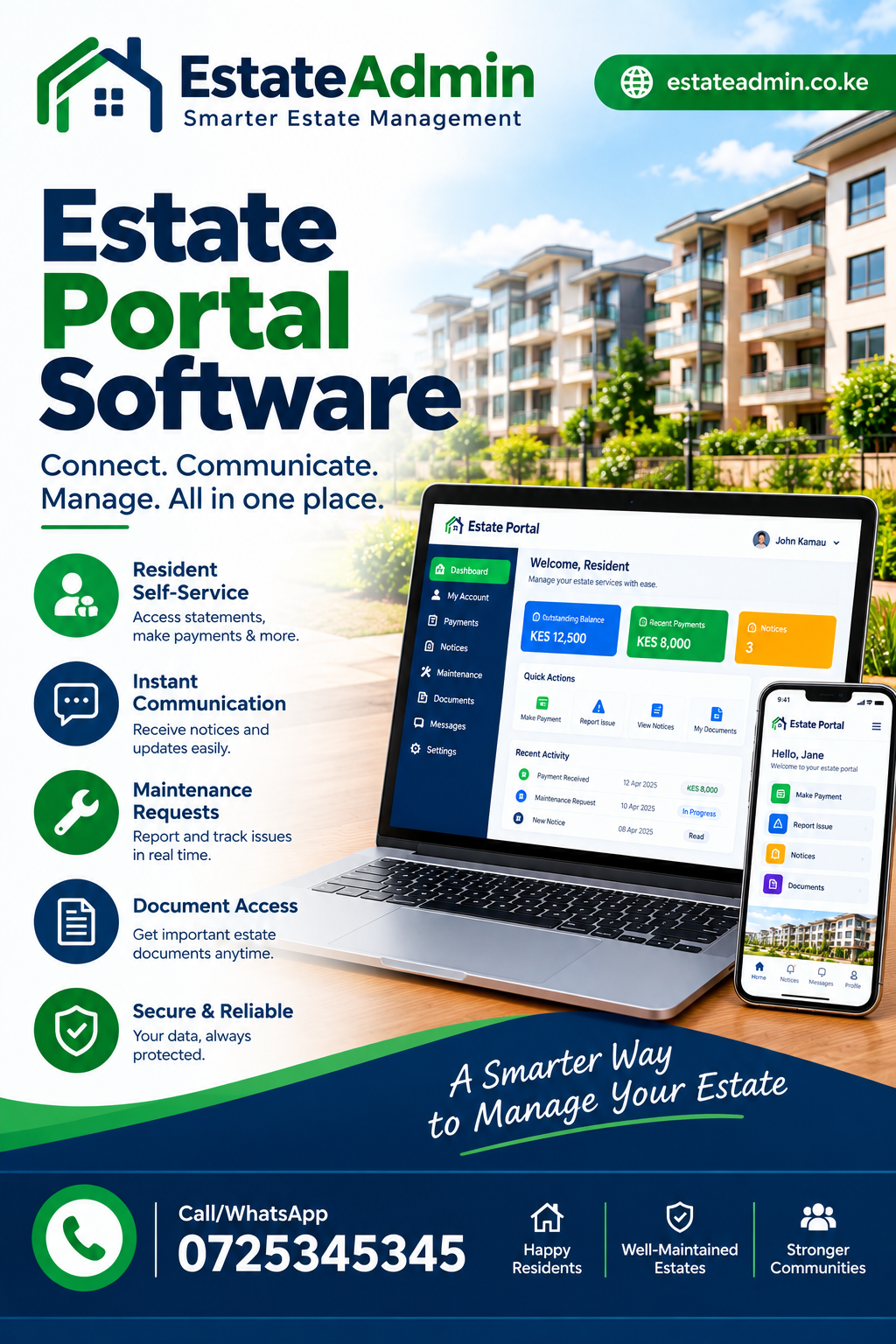
Estate Portal Software: A Complete Guide for Property Managers in Kenya
Managing an estate involves far more than collecting rent or service charges. Property managers must coordinate residents, owners, payments, invoices, maintenance requests, documents, communication and reports while keeping accurate records. Estate Portal Software brings these activities into a centralized digital environment, giving property managers and residents a more organized way to interact with an estate. This guide explains what an estate portal is, how it works, the features to look for, the benefits for Kenyan property managers, and how to choose a solution that can support an estate as it grows.
For many residential developments in Kenya, the challenge is not a lack of information. It is having information scattered across spreadsheets, WhatsApp conversations, paper files, bank statements, receipts and separate accounting records. A properly designed portal can create one structured environment where authorized users can access the information relevant to them.
That distinction matters. An estate portal is not simply another communication application. When connected to property management workflows, it can become an operational platform for managing financial information, resident interactions and day-to-day administration.
What Is Estate Portal Software?
At its simplest, Estate Portal Software is a digital platform that provides a central point of interaction between property managers, residents, property owners, estate committees and other authorized users.
Instead of requiring residents to call an office for every question, a portal can allow them to access information and submit requests through an online interface. Property managers, meanwhile, can use the same system to organize records, follow up on requests and monitor estate activities.
A well-designed portal can bring together areas such as:
- Resident information
- Unit records
- Payment information
- Invoices and statements
- Service charges
- Maintenance requests
- Estate announcements
- Documents
- Notices
- Communication records
- Reports
- User accounts and permissions
The objective is not to replace every human interaction. Property management still requires people, judgment and accountability. The purpose is to reduce unnecessary administrative work while giving everyone access to consistent information.
For example, imagine a resident wants to know whether a recent service-charge payment has been recorded. Without a portal, they may need to call the management office, send a message or wait for an email response. With an appropriate system, they may be able to log in and view their account information directly.
The same principle applies to maintenance. A resident can submit a request, management can review it, assign the task and update its status, while the resident receives information about progress.
This creates a more structured workflow than relying entirely on informal communication channels.
Why Property Managers Need a Digital Estate Portal
Property management becomes increasingly difficult as the number of units, residents and transactions increases. A small development may initially operate successfully with spreadsheets and manual records. As the estate grows, however, administrative complexity grows with it.
Estate Portal Software can help address this complexity by giving management teams a centralized environment for routine processes.
Consider the number of questions a property manager may receive in a normal week:
- Has my payment been received?
- What is my outstanding balance?
- When is the next service charge due?
- How do I report a leaking pipe?
- Has my maintenance request been assigned?
- Where can I find an estate notice?
- Can I access my statement?
- Who should I contact about a common-area problem?
- Has the management committee approved a particular matter?
When information is distributed across different channels, answering these questions consumes time.
A portal can make much of the information available through a controlled user account. This does not mean every resident should see everything. Proper access controls are essential.
For instance, a resident should generally see information relating to their own unit and relevant estate announcements, while an administrator may need broader access. A property owner may require financial or occupancy information that is different from what a tenant sees.
A useful portal therefore combines convenience with permissions.
Estate Portal Software can also improve consistency. If payment records are maintained centrally, the management team is less likely to rely on several conflicting spreadsheets. If maintenance requests are logged systematically, fewer requests are likely to disappear inside long message threads.
The value is therefore not simply technological. It is operational.
The Main Users of an Estate Portal
An estate portal can serve several categories of users, each with different needs.
Residents
Residents need convenient access to information affecting their daily experience.
Depending on the system, residents may be able to:
- View balances
- Access statements
- See invoices
- Make or record payments
- Submit maintenance requests
- Read notices
- Access estate documents
- Update selected personal information
- Track requests
A resident-facing interface should be simple. A complicated portal can create the same frustration as a manual process.
Property Managers
Property managers need a broader operational view.
Estate Portal Software can give management teams tools for managing units, residents, payments, maintenance, communications and reports from one system.
The management team may also need dashboards that highlight overdue balances, unresolved requests, recent payments and other operational indicators.
Property Owners
Owners may need access to information concerning their property without necessarily receiving the same level of administrative access as a manager.
A portal can provide controlled access to appropriate financial or property information.
Estate Committees
Committee members may need reports and documents to support oversight and decision-making.
Rather than receiving multiple versions of spreadsheets and documents through email, the committee can work from information maintained in the central system.
Service Providers
Where appropriate, maintenance contractors or service providers may receive limited access to assigned tasks. Such access should be restricted to the information necessary to perform their work.
Estate Portal Software becomes more valuable when these different roles can interact with the same underlying records while seeing only what they are authorized to access.
Key Features to Look For
Not every portal offers the same functionality. Before selecting one, property managers should identify the features that directly address their estate’s operational needs.
Resident and Unit Management
The system should make it easy to associate residents with specific units and maintain accurate records.
Useful information may include:
- Unit number
- Resident details
- Owner information
- Occupancy information
- Contact details
- Account status
- Relevant documents
A strong structure makes other processes easier because financial and operational information can be connected to the correct unit.
Billing and Invoicing
Billing is one of the most important areas for an estate management system.
Estate Portal Software can help organize invoices, charges and account information so that residents have greater visibility into what they owe.
A system may support different types of charges depending on the estate’s requirements, including:
- Service charges
- Utilities
- Parking charges
- Penalties
- Special assessments
- Other approved estate charges
The exact configuration should reflect the estate’s policies rather than forcing every development into the same billing model.
Payment Tracking
A resident portal becomes particularly useful when payment information can be connected to individual accounts.
In Kenya, payment processes often involve mobile money, bank transfers and other channels. The management system should make it clear which transactions have been received, allocated and reconciled.
Estate Portal Software can therefore support better payment visibility when the underlying records are maintained accurately.
The important issue is not simply accepting a payment. Management needs to know:
- Who paid?
- How much was paid?
- When was it received?
- Which account was credited?
- What balance remains?
- Was the transaction successfully reconciled?
These questions become especially important in estates with hundreds of units.
M-Pesa and Kenyan Payment Workflows
Kenya’s widespread use of mobile payments makes payment handling a major consideration when evaluating property management technology.
A portal intended for Kenyan estates should fit into local payment workflows rather than forcing property managers to create complicated manual processes.
Estate Portal Software can support the broader objective of keeping payment information organized, particularly when payment records can be connected to resident accounts.
However, managers should carefully examine how a particular platform handles payment integration. Questions worth asking include:
- Does the system support the estate’s preferred payment channels?
- Can payments be matched to resident accounts?
- Are transaction references recorded?
- Can management identify unmatched payments?
- Can payment statements be generated?
- Is there a reconciliation workflow?
- Can authorized users review payment history?
These details matter more than simply seeing a payment button on a website.
A good system should reduce manual reconciliation rather than create another database that staff must update separately.
Service-Charge Management
Service charges are central to many residential estates. They fund shared services and common-area operations, so accuracy and transparency are important.
Estate Portal Software can help organize service-charge billing by associating charges with individual units and maintaining a history of invoices and payments.
For example, a property manager may need to distinguish between:
- Regular monthly charges
- Outstanding balances
- Adjustments
- Penalties
- One-off charges
- Credits
- Payments received
A centralized system makes these categories easier to monitor.
Residents also benefit from visibility. If an account statement clearly shows the opening balance, charges, payments and closing balance, disputes can often be addressed using the same record.
This does not eliminate disagreements. It provides a clearer evidence trail for resolving them.
Arrears Management
Outstanding balances can become a significant administrative problem when they are tracked manually.
Estate Portal Software can help management identify accounts with overdue amounts and prioritize follow-up.
An arrears workflow may include:
- Identifying overdue accounts.
- Reviewing the outstanding balance.
- Checking payment history.
- Confirming whether a payment is pending allocation.
- Sending an appropriate reminder.
- Recording follow-up activity.
- Escalating cases according to estate policy.
- Monitoring whether the balance is cleared.
A dashboard can make this information easier to understand.
Instead of opening several spreadsheets, a manager may be able to see the overall arrears position and then drill down into individual accounts.
The system should still allow management to apply judgment. Not every overdue account requires identical treatment, and communication should follow the estate’s approved policies.
Maintenance Request Management
Maintenance is another area where informal communication can create problems.
A resident might report a leaking tap through WhatsApp, mention a broken light to a security guard and call the management office about another issue. If these requests are not recorded systematically, some may be forgotten.
Estate Portal Software can provide a structured way to capture maintenance requests.
A useful request process might include:
- Resident submission
- Issue category
- Unit or location
- Description
- Priority
- Assigned person
- Status
- Date submitted
- Date resolved
- Notes
- Supporting images where supported
The benefit is accountability.
Management can see which requests are new, which are being handled and which have been completed.
Residents also receive greater confidence when they can see that their request has been recorded rather than wondering whether someone received their message.
Estate Communication
Communication is an important part of community management.
Management teams regularly need to distribute information about:
- Planned maintenance
- Water interruptions
- Security notices
- Meetings
- Service changes
- Access restrictions
- Common-area works
- Emergency announcements
- Policy reminders
Estate Portal Software can give management a central communication channel while keeping notices connected to the estate environment.
However, communication features should not become a substitute for emergency procedures. Critical situations may require established emergency channels such as phone calls, security communication systems or other approved methods.
For routine notices, a portal can provide a searchable record that is easier to manage than scattered messages.
Document Management
Property management generates many documents.
These may include:
- Estate rules
- Meeting notices
- Minutes
- Financial reports
- Statements
- Policies
- Forms
- Maintenance records
- Vendor documents
- Notices
- Supporting property records
Estate Portal Software can help centralize documents and make selected files available to authorized users.
Document permissions are critical. Not every document should be visible to every resident.
A committee document, for example, may need to be accessible only to committee members. A general estate notice may be appropriate for all residents.
A good document system should therefore combine accessibility with appropriate permissions.
Reporting and Dashboards
Property managers cannot effectively manage what they cannot measure.
Reporting capabilities allow management to turn operational records into useful information.
Estate Portal Software can support reports covering areas such as:
- Payments
- Arrears
- Invoices
- Service charges
- Maintenance
- Resident accounts
- Unit information
- Outstanding balances
- Financial activity
Dashboards can provide an at-a-glance view of important indicators.
For example, a manager arriving at work may want to know:
- How much has been collected?
- Which accounts are overdue?
- How many maintenance requests are unresolved?
- Are there new resident requests?
- Are there outstanding reconciliation items?
The answers can guide the day’s priorities.
Reports should also be exportable where necessary, especially when management needs to share information with owners, committees, accountants or auditors.
Improving Transparency for Residents
One of the strongest arguments for a resident portal is transparency.
Residents are more likely to understand estate management when they can access clear information about their own accounts and relevant estate activities.
Estate Portal Software can improve transparency by making information available through defined workflows rather than requiring residents to repeatedly request it.
For example, instead of asking management for a statement every time, a resident may be able to access their account history directly.
Transparency also helps management.
When records are centralized, staff can respond to questions using the same information visible within the system.
This creates a more consistent experience.
Reducing Administrative Work
Manual administration takes time.
A property manager may spend part of the day:
- Updating spreadsheets
- Preparing statements
- Answering balance queries
- Searching for payment records
- Tracking maintenance requests
- Sending reminders
- Filing documents
- Preparing reports
Estate Portal Software can reduce some of this repetitive work by bringing routine processes into a centralized workflow.
Automation should not be viewed as eliminating the need for management staff. Instead, it allows staff to spend more time on tasks requiring human judgment.
For example, a manager can spend less time searching for whether a payment exists and more time resolving an account dispute or supervising an important maintenance issue.
The quality of the automation matters, however. A poorly configured automated process can create errors faster than a manual one.
That is why managers should test calculations, workflows and permissions before implementing a system across an entire estate.
Data Security and User Permissions
Property management systems contain sensitive information. They may hold resident contacts, financial records, payment information and documents.
Estate Portal Software should therefore provide appropriate security controls.
Important considerations include:
- Secure user authentication
- Role-based permissions
- Controlled access to financial information
- Secure data transmission
- Backup procedures
- Audit trails
- Password management
- Session controls
- User deactivation
Role-based access is particularly important.
An administrator may need broad access, while a resident should normally have access limited to their own account and information intended for residents.
A committee member may need access to reports but not administrative controls.
Management should also ask how former employees or committee members are removed from the system. Access should not remain active after a user’s responsibilities end.
Audit Trails and Accountability
An audit trail can help answer an important question: who changed what, and when?
Estate Portal Software is more useful for professional estate administration when significant actions can be traced.
Audit information may help management review:
- Account changes
- Payment adjustments
- Billing changes
- User activity
- Document changes
- Administrative actions
This can be valuable when investigating discrepancies.
Suppose a resident’s balance appears different from an earlier statement. Management needs to understand whether a payment was added, a charge was adjusted, a credit was applied or another change occurred.
A clear history can make the investigation easier.
Auditability also strengthens internal controls because staff know that important actions are recorded.
Mobile Accessibility
Residents and property managers do not always use desktop computers.
Many users access services through smartphones, so mobile usability should be considered before choosing a portal.
Estate Portal Software should provide a practical experience on smaller screens, particularly for common tasks such as:
- Checking balances
- Viewing invoices
- Reading notices
- Submitting maintenance requests
- Accessing statements
A mobile-friendly interface does not necessarily mean that every desktop feature must be squeezed onto a phone screen.
Instead, the most common mobile tasks should be easy to complete.
Managers should test the actual system using different devices rather than relying solely on screenshots or a vendor demonstration.
Search and Filtering
As an estate grows, the volume of information increases.
A manager may need to find a resident, unit, invoice, payment or maintenance request quickly.
Estate Portal Software should therefore offer useful search and filtering capabilities.
For example, a manager might filter accounts by:
- Unit
- Resident
- Payment status
- Outstanding balance
- Date
- Invoice status
Maintenance records might be filtered by:
- Status
- Priority
- Unit
- Assigned person
- Date submitted
Good search functionality saves time because staff do not need to manually inspect large lists.
How an Estate Portal Can Improve Resident Experience
Resident experience is increasingly important to property management.
A resident may judge management not only by the physical condition of the estate but also by how easy it is to obtain information and report problems.
Estate Portal Software can make routine interactions more convenient when the portal is properly configured.
Consider a resident who notices a faulty common-area light at night. Instead of waiting until the next day to visit the management office, they may be able to submit a request online.
Similarly, a resident preparing to make a payment can review the amount due before initiating the transaction.
These small improvements can have a meaningful effect across hundreds of residents.
However, usability matters. If residents need several confusing screens to perform simple tasks, adoption may remain low.
The best approach is to design around the most frequent resident journeys.
Choosing the Right Estate Portal
Selecting software should begin with business requirements rather than a feature checklist.
Estate Portal Software may offer many features, but the key question is whether those features solve the estate’s actual problems.
Start by documenting current processes.
Ask:
- How are residents registered?
- How are units maintained?
- How are charges calculated?
- How are invoices generated?
- How are payments recorded?
- How are arrears followed up?
- How are maintenance requests submitted?
- How are notices distributed?
- How are reports prepared?
- How are records secured?
Once these processes are mapped, management can identify where software would provide the greatest improvement.
A practical demonstration should then use realistic scenarios.
Instead of asking a vendor to show a generic dashboard, ask them to demonstrate a complete workflow from resident setup through billing, payment, reconciliation and reporting.
Questions to Ask Before Buying
Before committing to a system, property managers should ask detailed questions.
Estate Portal Software should be evaluated against both current requirements and future needs.
Consider asking:
Does it support multiple user roles?
The system should distinguish between residents, managers, owners, committee members and other users where required.
Can it handle the estate’s billing structure?
Different developments may have different charging models. Confirm that the software can represent the estate’s actual rules.
How are payments reconciled?
Do not assume that payment integration automatically means reconciliation is accurate.
Can residents access statements?
Resident self-service is one of the main benefits of a portal.
Can maintenance requests be tracked?
The workflow should provide visibility from submission to completion.
Can reports be exported?
Management may need reports for meetings, accounting or other purposes.
What support is available?
A technically capable system is less useful if users cannot obtain help when problems occur.
How is data protected?
Ask about permissions, backups, access control and audit trails.
Can the platform grow with the estate?
Changing systems later can be disruptive, so scalability should be considered from the beginning.
Common Mistakes When Implementing Estate Software
Technology alone does not guarantee better property management.
Estate Portal Software can fail to deliver value when implementation is poorly planned.
Mistake 1: Migrating inaccurate data
If existing resident or financial records contain errors, transferring them into a new system does not automatically fix those errors.
Clean important records before migration.
Mistake 2: Giving everyone excessive access
Users should receive the minimum permissions required for their responsibilities.
Mistake 3: Ignoring resident training
Residents need clear instructions about how to log in, check accounts and submit requests.
Mistake 4: Failing to test calculations
Billing and balances should be tested with realistic figures before the system becomes the primary source of information.
Mistake 5: Treating the portal as a replacement for all communication
Some situations require direct communication or emergency procedures.
Mistake 6: Launching without a support process
Users need somewhere to report technical problems and ask questions.
A Practical Implementation Plan
A phased implementation can reduce disruption.
Estate Portal Software can be introduced through a structured process rather than switching everything at once.
Phase 1: Requirements
Document the estate’s current workflows and identify problems.
Phase 2: Data preparation
Review resident, unit, owner and financial information.
Phase 3: Configuration
Set up charges, roles, permissions, notices and other relevant workflows.
Phase 4: Testing
Test realistic scenarios, including successful payments, failed payments, adjustments, arrears and maintenance requests.
Phase 5: User training
Train administrators first, followed by residents and other users.
Phase 6: Controlled launch
Start with a defined group where practical and monitor issues.
Phase 7: Review
Collect feedback, correct problems and refine workflows.
This approach makes it easier to identify problems before they affect the entire estate.
Measuring the Success of a Portal
After implementation, management should measure outcomes rather than simply asking whether users have logged in.
Estate Portal Software should ideally contribute to measurable operational improvements.
Useful indicators may include:
- Time taken to answer resident account queries
- Number of unresolved maintenance requests
- Payment reconciliation turnaround
- Number of overdue accounts
- Resident portal adoption
- Report preparation time
- Number of manual records maintained
- Frequency of billing corrections
These measurements help determine whether the technology is actually improving operations.
For example, if the estate previously spent several days preparing monthly reports and the process becomes substantially faster after implementation, that is meaningful evidence of value.
Similarly, if residents can obtain account information themselves instead of repeatedly contacting management, staff workload may decrease.
Estate Portal Software and Financial Control
Financial control deserves special attention in estate management.
Estate Portal Software can help establish a clearer relationship between charges, invoices, payments and balances.
For example, consider a unit with an opening balance of KSh 8,000. During the billing period, KSh 12,000 in charges are posted and KSh 10,000 is received. The closing balance would need to reflect the relevant transactions accurately.
The important point is not the example itself. It is the ability to trace how the balance was produced.
Management should be able to move from a summary figure to the underlying transactions.
This becomes particularly valuable when residents dispute balances.
Instead of relying on a manually edited spreadsheet, management can review the transaction history and identify the source of the figure.
Supporting Estate Committees and Owners
Estate committees often need information to make decisions.
Estate Portal Software can help provide structured reports that make financial and operational information easier to review.
For example, a committee may want to understand:
- Collection performance
- Outstanding balances
- Maintenance activity
- Major expenses
- Unit-level account status
- Operational trends
Reports should be understandable rather than overloaded with technical data.
The objective is to give decision-makers enough information to understand the situation and determine what action is appropriate.
Owners can also benefit from improved visibility where the system provides suitable owner-facing information.
Cost Considerations
The cheapest software is not necessarily the least expensive solution over time.
Estate Portal Software should be evaluated based on total value rather than subscription price alone.
Consider:
- Subscription costs
- Setup costs
- Data migration
- Training
- Support
- Payment integration
- Additional users
- Additional properties
- Reporting capabilities
- Maintenance
- Future upgrades
A low-cost system that requires extensive manual work may ultimately cost more in staff time.
Conversely, a sophisticated platform may not be appropriate for a small estate if many features will never be used.
The right solution is one whose capabilities match the estate’s operational complexity.
Scalability for Growing Estates
An estate may start with a modest number of units and grow over time.
Estate Portal Software should therefore be evaluated for scalability.
Ask whether the system can accommodate:
- More units
- More residents
- Multiple properties
- Additional administrators
- Increased transaction volumes
- More reports
- Additional integrations
Scalability is not only about technical capacity. It is also about whether the user experience remains manageable as information increases.
A system that works well for 30 units may require a different operational approach at 500 units.
Integration With Other Business Systems
Property management rarely exists in isolation.
An estate may also use accounting tools, payment platforms, communication services, document storage systems or other business applications.
Estate Portal Software becomes more useful when information can move reliably between systems where integrations are appropriate.
Before choosing a platform, ask:
- What integrations are available?
- Are APIs supported?
- Can payment information be imported?
- Can reports be exported?
- Can accounting records be connected?
- How are integration errors handled?
Integration should be evaluated carefully. More integrations do not automatically mean a better system.
The important question is whether each connection solves a genuine workflow problem.
The Importance of Support
Software implementation does not end when an account is created.
Estate Portal Software should come with an appropriate support process.
Property managers should know:
- How to report problems
- How to request assistance
- How system updates are communicated
- How users are trained
- What happens when a payment integration fails
- How data issues are handled
Support becomes especially important during the first weeks after implementation.
A clear escalation process helps management distinguish between user errors, configuration problems and genuine technical faults.
Estate Portal Software for Nairobi and Other Kenyan Estates
Kenyan property management has its own operational environment.
Estate Portal Software intended for local use should accommodate the practical realities faced by property managers in Nairobi and other towns.
These realities can include mobile-first communication, M-Pesa usage, service-charge collection, mixed payment methods and residents who expect quick access to information.
At the same time, estates differ considerably.
A high-rise apartment development in Nairobi may have different requirements from a gated community in another county. A mixed-use development may need workflows that do not apply to a purely residential estate.
Therefore, software should be configurable enough to accommodate different operating models.
Frequently Asked Questions
1. What does an estate portal do?
Estate Portal Software provides a centralized digital environment where authorized residents, property managers, owners and other users can access relevant estate information and complete supported workflows.
2. Can an estate portal manage service charges?
Yes, depending on the platform. Estate Portal Software may support service-charge billing, invoices, payments, balances and statements when those functions are included and properly configured.
3. Can residents view their statements online?
Many platforms provide this capability. Estate Portal Software can allow residents to access account information without requiring management staff to prepare every statement manually.
4. Is an estate portal useful for maintenance requests?
Yes. Estate Portal Software can provide a structured process for submitting, assigning, tracking and closing maintenance requests.
5. Can an estate portal support M-Pesa payments?
This depends on the specific platform and integration available. Estate Portal Software should be evaluated based on how it handles payment references, account allocation and reconciliation rather than simply whether it displays a payment option.
6. Can property managers track arrears?
Where arrears functionality is supported, Estate Portal Software can help identify outstanding accounts, review balances and organize follow-up.
7. Is estate portal software suitable for small estates?
It can be. Estate Portal Software may provide value even for a smaller development if it addresses genuine administrative challenges and the cost is appropriate.
8. How secure is an estate portal?
Security depends on the provider’s architecture, controls and implementation. Estate Portal Software should be assessed for authentication, permissions, data protection, backups and auditability before adoption.
9. Can estate committees use the system?
Where committee-level permissions and reporting are available, Estate Portal Software can provide committee members with controlled access to relevant information.
10. How should an estate choose the right portal?
The best approach is to document current workflows, identify pain points, compare relevant features and test realistic scenarios. Estate Portal Software should ultimately be judged by whether it improves the estate’s actual operations.
Final Considerations for Property Managers
Choosing property management technology is an operational decision, not simply an IT purchase.
Estate Portal Software can help estates centralize information, improve resident self-service, organize payments, manage maintenance requests and strengthen reporting. But these benefits depend on proper configuration, accurate data and disciplined use.
The strongest implementation starts with the estate’s real problems.
If residents struggle to obtain statements, prioritize account visibility. If maintenance requests are being lost in WhatsApp conversations, create a structured maintenance workflow. If management spends too much time reconciling payments, focus on payment tracking and reconciliation. If committee reporting is slow, improve reporting and financial visibility.
A portal should make the work of managing an estate clearer rather than simply moving existing complexity onto a new screen.
For Kenyan property managers, the most useful solution is one that combines practical property-management workflows with an interface that residents can actually use. It should support the estate’s billing structure, payment processes, resident communication, maintenance operations, reporting requirements and security controls.
Estate Portal Software is therefore best viewed as part of a broader estate management strategy. The technology should support accurate records, transparent processes and better communication between the people responsible for managing a development and the people who live in it.
The final objective is straightforward: less administrative confusion, better visibility, faster service and more accountable estate management.
When evaluating Estate Portal Software, property managers should resist the temptation to choose based only on the number of features displayed during a sales demonstration. Test actual workflows. Enter realistic figures. Review permissions. Examine statements. Test payment scenarios. Submit maintenance requests. Generate reports. Confirm how changes are recorded.
A platform that performs well under realistic conditions is far more valuable than one that simply looks impressive in a demonstration.
Estate Portal Software can ultimately become a central part of how a property management team delivers services, provided the system is selected carefully and implemented with clear processes.
The most effective estates will not necessarily be those with the most technology. They will be the ones where technology is aligned with clear procedures, accurate records, responsive management and a good resident experience.
For estate managers in Kenya considering their next step, that is the standard worth applying when assessing any digital property-management solution.
Estate Portal Software should make information easier to access, transactions easier to trace, requests easier to manage and decisions easier to support.
Estate Portal Software can also help create a more consistent relationship between residents and management when both sides understand how the system should be used.
The key is to begin with the workflow, not the software.
Estate Portal Software becomes valuable when it solves a real operational problem.
Estate Portal Software should support accurate billing and transparent account information.
Estate Portal Software should make property administration easier to organize.
Estate Portal Software should help authorized users access the information relevant to their roles.
Estate Portal Software should support practical workflows rather than add unnecessary complexity.
Estate Portal Software should be tested with realistic estate scenarios before deployment.
Estate Portal Software should be supported by appropriate security and permission controls.
Estate Portal Software should provide useful reporting for people responsible for estate oversight.
Estate Portal Software should improve the resident experience rather than make routine interactions harder.
Estate Portal Software should ultimately contribute to a more organized, transparent and accountable approach to property management.