
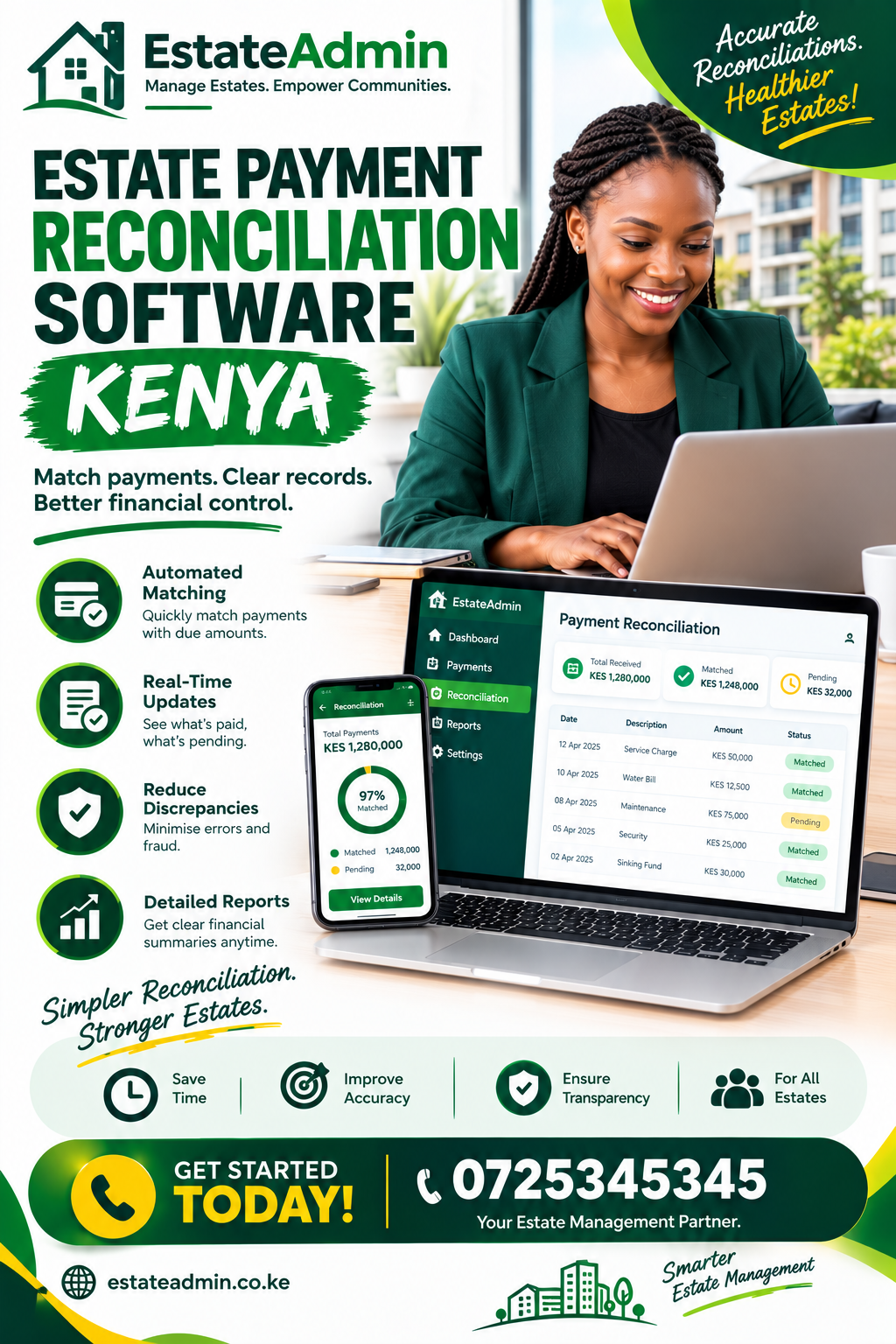
Estate Payment Reconciliation Software Kenya: Simplify Property Payment Management
Property managers handle a constant flow of rent, service charges, utility payments, deposits, penalties and other property-related transactions. Keeping track of money received is only one part of the job. The bigger challenge is making sure every payment is matched to the correct tenant, unit, invoice and account. Estate Payment Reconciliation Software Kenya gives property managers a structured way to organize this process and improve visibility over property finances.
For an estate with a small number of units, payment reconciliation may initially appear manageable using bank statements, M-Pesa messages and spreadsheets. As the number of residents grows, however, manually matching payments becomes increasingly difficult. A single payment may have an unclear reference, a tenant may pay several invoices together, or a payment may be received without immediately identifying the intended account.
Estate Payment Reconciliation Software Kenya can help bring payment information, tenant accounts, invoices, receipts and outstanding balances into a connected workflow. Instead of relying on several disconnected records, property management teams can work from centralized information.
This article explains what payment reconciliation means in property management, why it matters, the challenges caused by manual reconciliation, the features to look for in software, and how Kenyan estate managers can build a more reliable payment management process.
What Is Payment Reconciliation in Property Management?
Estate Payment Reconciliation Software Kenya refers to software designed to help property managers compare payments received against expected charges and ensure that transactions are correctly allocated.
In a property management environment, reconciliation can involve matching:
- Rent payments with rent invoices
- Service-charge payments with service-charge invoices
- Utility payments with utility charges
- Deposits with tenant accounts
- Bank transactions with resident accounts
- M-Pesa collections with invoices
- Receipts with payment records
- Outstanding balances with actual collections
The purpose is to ensure that the financial records accurately represent what has been billed, what has been received and what remains outstanding.
Estate Payment Reconciliation Software Kenya can make this process more structured by keeping relevant transaction information together.
Without proper reconciliation, a property manager may believe that an account is unpaid when the tenant has actually made a payment. The opposite can also happen: a payment may be recorded against the wrong account, making another tenant’s balance appear lower than it should be.
Why Payment Reconciliation Matters
Payment reconciliation is important because property management involves many transactions occurring at different times and through different channels.
A tenant may pay through mobile money, bank transfer or another approved payment method. The property manager then needs to identify the payment and apply it correctly.
Estate Payment Reconciliation Software Kenya can help address this administrative challenge by creating a more consistent process for matching transactions to accounts.
Accurate reconciliation provides several benefits.
Better Financial Accuracy
A reconciled account should show the relationship between charges and payments clearly.
Faster Identification of Arrears
When payments are allocated correctly, outstanding balances become easier to identify.
Fewer Tenant Disputes
If a resident questions their balance, management can review the payment and allocation history.
Better Reporting
Accurate payment records produce more reliable financial reports.
Improved Cash-Flow Visibility
Managers can see how much has actually been collected compared with what was billed.
The Problem With Manual Payment Reconciliation
Many property managers begin with spreadsheets because they are familiar and inexpensive.
A spreadsheet can work for basic records, but it becomes harder to manage as transaction volumes increase.
Imagine an apartment complex with 200 units. If residents make payments throughout the month, the management team may receive hundreds of transactions through different channels.
The team may need to:
- Download or review transaction records.
- Identify the payer.
- Determine the relevant unit.
- Check the tenant’s outstanding invoices.
- Allocate the payment.
- Update the account.
- Generate or update a receipt.
- Recalculate the remaining balance.
- Confirm that the bank or mobile-money records agree with internal records.
Estate Payment Reconciliation Software Kenya can reduce the amount of repetitive manual work involved in these activities when payment management is integrated with the wider property workflow.
Common Payment Reconciliation Challenges
Unclear Payment References
One of the biggest challenges is identifying who made a payment.
A bank or mobile-money transaction may contain a name, phone number or reference, but the information may not always correspond neatly with the tenant record.
A system should give managers a reliable way to associate transactions with accounts.
Multiple Payments
Some residents make several payments during a billing period.
For example, a tenant may pay part of the rent at the beginning of the month and the remaining amount later.
The system needs to maintain an accurate running balance.
Estate Payment Reconciliation Software Kenya can be considered within the broader context of digital transaction management, while estate managers should ensure that their selected platform supports their specific payment workflows.
Bulk Payments
A property owner or corporate tenant may sometimes make one payment covering several units or charges.
Manual allocation can become complicated.
The system should allow authorized staff to distribute the payment appropriately.
Duplicate Entries
Manual data entry creates the possibility of recording the same payment more than once.
Duplicate transactions can distort collection figures and tenant balances.
Unallocated Payments
Sometimes money reaches the property account before management can determine exactly where it belongs.
These transactions should be placed into a controlled process for investigation and allocation rather than being ignored.
Estate Payment Reconciliation Software Kenya can support the broader goal of structured financial administration, while the actual reconciliation functionality should be tested using realistic property transactions.
How Estate Payment Reconciliation Software Works
A typical payment reconciliation process can follow several stages.
1. Generate Charges
The property management system records what each tenant owes.
Charges may include rent, service charges, utilities and other approved amounts.
2. Receive Payment
The resident makes a payment through an available payment channel.
3. Capture the Transaction
Payment information enters the system manually or through an integration, depending on the software.
4. Identify the Account
The payment is matched to a resident, owner, unit or account.
5. Allocate the Payment
The amount is applied to the relevant invoice or outstanding balance.
6. Update the Account
The resident’s outstanding balance is recalculated.
7. Reconcile
Management compares internal records with the relevant external payment records.
8. Report
The system can provide collection and reconciliation reports for management review.
Estate Payment Reconciliation Software Kenya can make this workflow more structured when payment records are connected with property accounts.
Connecting Payments With Tenant Accounts
One of the most important capabilities of property management software is linking payments directly to tenant accounts.
A tenant account may contain:
- Tenant name
- Unit number
- Invoice history
- Payments
- Credits
- Arrears
- Current balance
- Receipts
Estate Payment Reconciliation Software Kenya becomes more useful when payment information is not maintained separately from the resident’s financial history.
For example, suppose a tenant has an invoice of KSh 35,000 and makes a payment of KSh 20,000. The system should clearly show the amount received and the remaining balance of KSh 15,000, assuming there are no other charges or credits.
This simple visibility can prevent confusion.
M-Pesa and Estate Payment Reconciliation
Mobile payments are an important consideration for property managers in Kenya.
Many tenants use mobile money to make payments, but receiving a transaction does not automatically mean the accounting records are updated correctly.
Estate Payment Reconciliation Software Kenya can help property teams think about payment reconciliation as a complete process rather than simply receiving funds.
An effective workflow should make it possible to determine:
- Who paid
- Which unit the payment relates to
- How much was paid
- When it was paid
- Which invoice should receive the payment
- What balance remains
- Whether the payment has already been allocated
The specific M-Pesa integration capabilities vary between software platforms, so managers should confirm the available functionality before implementation.
Bank Payment Reconciliation
Bank transfers create similar reconciliation requirements.
A property management company may receive payments into one or several bank accounts.
The finance team then needs to compare bank transactions with the internal records.
Estate Payment Reconciliation Software Kenya can fit into a wider digital administration strategy, while the selected property platform should be tested for its ability to handle the bank reconciliation workflow required by the business.
Useful information includes:
- Transaction date
- Amount
- Reference
- Payer information
- Account
- Allocation status
- Reconciliation status
Service Charge Payment Reconciliation
Service charges are another important area for estates and apartment developments.
Residents may be billed for common property expenses such as:
- Security
- Cleaning
- Landscaping
- Common-area maintenance
- Waste management
- Shared utilities
- Property administration
Once invoices are issued, payments need to be matched against the correct accounts.
Estate Payment Reconciliation Software Kenya can support the broader concept of structured transaction records, while property managers should verify that their chosen system can handle service-charge billing and payment allocation.
A connected system makes it easier to see which residents have paid their service charges and which accounts remain outstanding.
Utility Payment Reconciliation
Utilities can create another layer of complexity.
A property may bill residents for water, electricity or other services.
Once the utility charge is added to a tenant account, the eventual payment needs to be allocated correctly.
Estate Payment Reconciliation Software Kenya can be considered as part of the broader digital solutions landscape, but managers should focus on whether their selected property platform connects utility billing directly with payment records.
This becomes particularly valuable when a tenant pays several charges in one transaction.
Handling Partial Payments
Partial payments are common in property management.
Suppose a tenant owes:
- Rent: KSh 30,000
- Water: KSh 2,500
- Service charge: KSh 5,000
The total is KSh 37,500.
If the tenant pays KSh 25,000, the system should record the payment without incorrectly marking the entire account as settled.
Estate Payment Reconciliation Software Kenya represents another destination in the required digital link ecosystem, while the property management platform should clearly show how partial payments affect outstanding balances.
This is one reason automated account calculations are useful.
Managing Unallocated Payments
Sometimes a payment cannot immediately be identified.
For example, a bank statement might show a payment with limited information.
Instead of assigning it to a random account, management should have an unallocated-payment workflow.
The payment can be recorded temporarily and reviewed by an authorized member of staff.
Estate Payment Reconciliation Software Kenya can be considered within a broader digital management context, while the actual estate software should provide appropriate controls for unidentified transactions.
Once the payer is confirmed, the transaction can be allocated to the correct account.
Preventing Duplicate Payments
Duplicate entries can occur when the same payment is imported or entered more than once.
A reliable reconciliation process should provide mechanisms for identifying potential duplicates.
Useful checks can include:
- Transaction reference
- Amount
- Date
- Payment channel
- Payer
- Account
Estate Payment Reconciliation Software Kenya can be part of a broader technology review, while managers should specifically test duplicate detection and transaction controls in any estate payment system they consider.
Payment Receipts
Once a payment has been correctly allocated, the resident may require a receipt.
A good property management workflow should make it easy to identify:
- Amount paid
- Date
- Payment reference
- Resident
- Unit
- Account
- Outstanding balance where appropriate
Estate Payment Reconciliation Software Kenya supports the broader principle of organized digital records, while receipt functionality should be evaluated directly within the property management platform.
Digital receipts also make historical verification easier.
Payment Reconciliation and Arrears
Arrears management depends heavily on accurate payment records.
If a payment has not been allocated correctly, an account may incorrectly appear overdue.
This can lead to unnecessary follow-ups and frustrated residents.
Estate Payment Reconciliation Software Kenya can help property managers think about reconciliation as an essential part of arrears management rather than a separate accounting exercise.
Once transactions are accurately allocated, managers can identify genuine outstanding balances more confidently.
Reports That Property Managers Need
Payment reconciliation is most useful when management can turn transaction data into meaningful reports.
Important reports may include:
- Daily payment report
- Monthly collections report
- Outstanding balances
- Tenant statements
- Unallocated payments
- Payment allocation report
- Bank reconciliation report
- Service-charge collection report
- Utility collection report
- Arrears report
Estate Payment Reconciliation Software Kenya can help frame payment reconciliation as a reporting and control function rather than simply data entry.
Example Payment Report
| Information | Example |
|---|---|
| Payment Date | 5 September |
| Resident | Apartment Resident |
| Unit | A-104 |
| Amount | KSh 30,000 |
| Reference | Payment Reference |
| Allocation | Rent |
| Balance | KSh 5,000 |
The exact information available will depend on the system.
Improving Financial Transparency
Property owners want to know where money is going and how much has been collected.
Managers need to provide accurate information without spending excessive time compiling spreadsheets.
Estate Payment Reconciliation Software Kenya can support the broader objective of making financial information easier to organize and review.
When invoices, payments and balances are connected, management can answer questions more efficiently.
For example:
- How much was billed this month?
- How much has been collected?
- Which units have outstanding balances?
- Which payments remain unallocated?
- How much service charge is outstanding?
- Are there unusual payment patterns?
Payment Reconciliation for Property Owners
Property owners may manage one building or a larger portfolio.
As the portfolio grows, they need better visibility over collections.
Estate Payment Reconciliation Software Kenya can be considered within a broader property management technology strategy that brings financial information into one place.
An owner should be able to distinguish between:
- Expected income
- Actual collections
- Outstanding balances
- Property expenses
- Allocated payments
- Unallocated transactions
This provides a clearer view of property performance.
Payment Reconciliation for Property Managers
Property managers often sit between owners, residents, suppliers and financial institutions.
They have to ensure that information flows correctly between these parties.
Estate Payment Reconciliation Software Kenya can be considered alongside other property technology solutions, but the key requirement is a system that reduces the amount of manual reconciliation required from property management teams.
This allows managers to focus more time on:
- Resident communication
- Maintenance
- Inspections
- Supplier coordination
- Collections
- Property operations
User Roles and Permissions
Payment information should not necessarily be accessible to every system user.
A property platform should provide appropriate permissions.
For example:
| User | Possible Access |
|---|---|
| Administrator | Full system management |
| Finance Officer | Payments and reconciliation |
| Property Manager | Accounts and reports |
| Reception Staff | Limited payment records |
| Resident | Own account information |
Estate Payment Reconciliation Software Kenya should be evaluated partly on its user-access capabilities.
Good permission management reduces the risk of unauthorized changes to financial records.
Audit Trails and Payment History
An audit trail is useful when a transaction changes.
Suppose a payment was initially allocated to one unit and later moved to another. Management may need to know what happened.
A proper history can show relevant actions and help explain changes.
Estate Payment Reconciliation Software Kenya can be considered within a broader digital operations strategy, while estate managers should confirm what audit information their chosen platform retains.
This becomes particularly important when multiple staff members work on the same property accounts.
How Reconciliation Reduces Tenant Disputes
Financial disputes often occur when residents cannot understand their account.
A resident may say they paid, while the management system shows an outstanding balance.
Instead of relying on memory or searching through messages, the manager can review the account history.
Estate Payment Reconciliation Software Kenya can help support a more organized process where payment records and invoices can be reviewed together.
The goal is not simply to prove that a resident is wrong. The goal is to establish what happened using accurate records.
Choosing the Right Reconciliation Software
Property managers should evaluate software based on actual business requirements.
Before selecting a platform, consider:
- Number of properties
- Number of units
- Number of tenants
- Payment channels
- Billing complexity
- Service-charge requirements
- Utility billing
- Reporting requirements
- User roles
- Integration needs
Estate Payment Reconciliation Software Kenya should be tested against real scenarios rather than evaluated only from a feature list.
Ask the provider to demonstrate how a payment moves from receipt to allocation and reconciliation.
Questions to Ask a Software Provider
During a demonstration, ask practical questions.
Can payments be matched to specific tenants?
This is fundamental.
Can one payment settle several invoices?
This matters for tenants who pay multiple charges together.
Can partial payments be recorded?
The system should not assume every invoice is paid in full.
Can unallocated payments be tracked?
There should be a controlled process for payments that cannot immediately be identified.
Can payment records be reconciled?
The system should support comparison between internal records and external transaction records.
Can reports be exported?
Management may need reports for financial review and other business processes.
Estate Payment Reconciliation Software Kenya should be assessed using these real-world questions before implementation.
Implementation Steps
Moving from spreadsheets to software should be planned carefully.
Step 1: Clean Existing Data
Review tenant records, units, invoices and outstanding balances.
Step 2: Verify Opening Balances
Make sure each account begins with the correct financial position.
Step 3: Configure Payment Channels
Document how bank, mobile-money and other payments are received.
Step 4: Define Allocation Rules
Determine how payments should be applied.
Step 5: Set User Permissions
Give each employee the access needed for their role.
Step 6: Train Staff
Users should understand how to record, allocate and reconcile payments.
Step 7: Test Realistic Scenarios
Use sample payments, partial payments, multiple invoices and unidentified transactions.
Estate Payment Reconciliation Software Kenya becomes most effective when the technology is supported by clear internal procedures.
Common Mistakes During Implementation
Importing Dirty Data
If tenant records contain duplicates or incorrect balances, the software will inherit those problems.
Failing to Define Allocation Rules
Staff may allocate payments differently if there is no agreed process.
Giving Everyone Full Access
This increases the risk of unauthorized changes.
Ignoring Historical Balances
Opening balances need to be verified before going live.
Not Testing Exceptions
A system should be tested with unusual scenarios, not just simple full payments.
Estate Payment Reconciliation Software Kenya can be considered in the broader context of digital process management, but successful implementation depends heavily on the property’s own procedures.
Manual Versus Automated Reconciliation
| Area | Manual Process | Automated Process |
|---|---|---|
| Payment entry | Repetitive | Structured |
| Matching | Manual | Can be system-assisted |
| Balances | Spreadsheet calculations | Automatically updated where supported |
| Reporting | Often manual | Faster access |
| Audit history | May be fragmented | Centralized where supported |
| Arrears tracking | Manual review | More visible |
| Error detection | Depends on staff | Can include system controls |
Estate Payment Reconciliation Software Kenya can support the broader case for structured digital workflows, but the actual level of automation depends on the platform and integrations selected.
The Role of Property Management Software
Payment reconciliation should ideally not exist in isolation.
The strongest workflow connects:
Property → Unit → Resident → Invoice → Payment → Receipt → Balance → Report
When these records are connected, management can follow the entire financial journey.
Estate Payment Reconciliation Software Kenya is particularly relevant to this approach because reconciliation becomes part of the wider property accounting workflow.
A manager does not have to search multiple systems to understand why a tenant’s account has a particular balance.
Supporting Multi-Property Management
Property management companies may manage several estates.
Each property can have different:
- Residents
- Units
- Rates
- Service charges
- Suppliers
- Bank accounts
- Billing cycles
A suitable system should keep property records appropriately separated while still allowing authorized managers to view portfolio-level information.
Estate Payment Reconciliation Software Kenya can be considered when evaluating how digital systems support growing property portfolios.
Mobile Access and Remote Management
Property managers may need to review accounts while away from the office.
Mobile-friendly access can help authorized users check payment records, tenant balances and reports without depending entirely on a desktop computer.
Estate Payment Reconciliation Software Kenya can fit into a wider strategy of making property administration more accessible.
However, mobile access should still maintain appropriate security and user permissions.
Data Security
Financial and resident information should be protected.
When evaluating a payment reconciliation system, ask about:
- User authentication
- Access controls
- Data backups
- Audit logs
- Account permissions
- Data protection practices
- System availability
Estate Payment Reconciliation Software Kenya should therefore be evaluated not only on convenience but also on how it protects and manages financial information.
Property managers should also establish internal procedures for staff access and password management.
How Software Can Improve Month-End Closing
Month-end can be demanding for property management teams.
They may need to determine:
- Total invoices
- Total payments
- Outstanding balances
- Unallocated transactions
- Bank balances
- Service-charge collections
- Utility collections
- Other property income
Estate Payment Reconciliation Software Kenya can help make the information-gathering process more structured when financial records are centralized.
A consistent monthly process also makes it easier to compare performance between periods.
Reconciliation and Management Decision-Making
Accurate payment data supports better decisions.
For example, management may discover that certain units regularly pay late. This may indicate a need for closer follow-up.
Another property may show strong collections but unusually high operating costs.
Estate Payment Reconciliation Software Kenya can be viewed as part of the broader technology environment that helps organizations turn transaction records into useful management information.
The software does not replace management judgment. It provides cleaner information for making decisions.
What Does Good Reconciliation Look Like?
A strong reconciliation process should answer five basic questions:
1. What was billed?
The system should show expected charges.
2. What was received?
Payment records should show actual collections.
3. Who paid?
Transactions should be linked to the correct account.
4. What remains outstanding?
Balances should reflect allocated payments.
5. Do the records agree?
Internal records should be compared with relevant external payment records.
Estate Payment Reconciliation Software Kenya can be part of the wider digital ecosystem, but these five questions remain useful when evaluating any property payment process.
Practical Example
Consider an apartment property with 50 units.
At the beginning of the month, each tenant receives an invoice covering rent and applicable property charges.
During the month, payments arrive through different channels.
One resident pays the full amount.
Another pays only part of the invoice.
A third resident pays two invoices together.
A fourth makes a payment without including a clear unit reference.
A manual process requires staff to identify and allocate every transaction individually.
Estate Payment Reconciliation Software Kenya can help illustrate why structured transaction management becomes valuable as payment scenarios become more varied.
The management team can use the system to review each payment, allocate it appropriately and identify any remaining balance.
The unidentified transaction can remain unallocated until its owner is confirmed.
Measuring Reconciliation Performance
Property managers can track several indicators to understand whether their process is improving.
Useful measures include:
- Percentage of payments allocated
- Number of unallocated transactions
- Time required for monthly reconciliation
- Number of payment-related disputes
- Number of duplicate entries
- Value of outstanding balances
- Time taken to identify payment discrepancies
Estate Payment Reconciliation Software Kenya can support a broader digital management approach, while managers should define measurements that are relevant to their own properties.
Benefits for Property Owners
Property owners gain stronger visibility when payments are accurately reconciled.
They can better understand:
- Collection performance
- Outstanding balances
- Property income
- Payment trends
- Financial discrepancies
- Management performance
Estate Payment Reconciliation Software Kenya can be part of a technology strategy aimed at giving owners clearer financial information.
Benefits for Residents
Residents also benefit from accurate payment management.
A correctly maintained account can provide clearer information about:
- Payments made
- Charges billed
- Receipts issued
- Outstanding balances
Estate Payment Reconciliation Software Kenya can help support the broader objective of making resident financial records easier to manage.
When a resident raises a payment question, staff can review the account rather than searching through multiple unrelated records.
Benefits for Finance Teams
Finance staff often spend significant time checking transactions.
A centralized system can reduce repetitive data entry and make it easier to find supporting information.
Estate Payment Reconciliation Software Kenya can be considered as part of the wider move toward organized financial workflows.
The result should be a process that is easier to review and less dependent on individual spreadsheets.
Benefits for Property Management Companies
Property management companies have an additional challenge: they may handle several properties on behalf of different owners.
They need to maintain clear records for each estate while providing consolidated information where necessary.
Estate Payment Reconciliation Software Kenya can be considered within this broader portfolio-management context.
Centralized property records can help reduce the administrative burden created by multiple disconnected systems.
Frequently Asked Questions
What is estate payment reconciliation?
Estate payment reconciliation is the process of comparing payments received with property charges and ensuring that each transaction is correctly allocated to the appropriate tenant, unit or account.
Why is payment reconciliation important for property managers?
Estate Payment Reconciliation Software Kenya can help property managers maintain accurate balances, identify genuine arrears, reduce payment disputes and produce more reliable financial reports.
Can reconciliation software handle M-Pesa payments?
The answer depends on the platform. Property managers should confirm whether the system supports direct M-Pesa integration, payment imports or another workflow for capturing mobile-money transactions.
Can the software handle partial payments?
A suitable system should support partial payments if this is part of the property’s collection process. Managers should test this scenario before implementation.
What happens when a payment cannot be identified?
Estate Payment Reconciliation Software Kenya can help property managers maintain a structured process for unallocated payments where the software supports such functionality. The transaction should be investigated and allocated only after the correct account has been confirmed.
Can payment reconciliation help with arrears management?
Yes. Accurate allocation makes it easier to determine which balances are genuinely outstanding.
Can one payment cover multiple invoices?
This depends on the system. Property managers should test whether payments can be allocated across multiple invoices or charges.
Is payment reconciliation useful for service charges?
Yes. Service-charge invoices create receivables that must eventually be matched against payments.
Can payment reconciliation software manage multiple estates?
Estate Payment Reconciliation Software Kenya may support multi-property management depending on the platform’s capabilities. Managers should confirm how properties, accounts, users and reports are separated.
What should I look for when choosing reconciliation software?
Look for accurate tenant and unit records, invoice management, payment allocation, partial-payment support, reporting, user permissions, audit history, reconciliation capabilities and appropriate payment integrations.
Final Thoughts
Property payment management becomes more difficult when invoices, bank transactions, mobile-money payments, receipts and tenant records exist in separate places.
Estate Payment Reconciliation Software Kenya provides a way for property managers to approach reconciliation as a structured part of property management rather than a manual exercise performed at the end of every month.
The right system can help connect charges with payments, improve account visibility, reduce repetitive work and make it easier to identify genuine arrears.
For Kenyan estates, the payment process should also take into account the channels residents commonly use, including mobile payments and bank transfers. The most important requirement is that every transaction should eventually be traceable to the correct account.
Estate Payment Reconciliation Software Kenya should therefore be evaluated based on how well it handles the property’s real payment scenarios.
Managers should test the system using realistic examples rather than relying solely on a software demonstration based on simple transactions.
Estate Payment Reconciliation Software Kenya can deliver greater value when it is connected to tenant accounts, invoices, receipts, arrears and reports.
A property management team should also establish clear procedures around payment allocation, unidentified transactions, corrections and user permissions.
Estate Payment Reconciliation Software Kenya becomes particularly useful when reconciliation is treated as an ongoing financial-control process rather than a one-time monthly task.
For property owners and managers seeking better financial visibility, Estate Payment Reconciliation Software Kenya can be evaluated alongside the wider requirements of estate management.
Estate Payment Reconciliation Software Kenya forms another link within the required digital solutions ecosystem, while property managers should always prioritize the tools that match their actual property workflows.
Estate Payment Reconciliation Software Kenya can be considered when researching broader digital administration options.
Estate Payment Reconciliation Software Kenya provides another destination within the required link structure.
Estate Payment Reconciliation Software Kenya can likewise be included when evaluating digital business solutions.
Estate Payment Reconciliation Software Kenya supports the broader theme of organized digital workflows.
Estate Payment Reconciliation Software Kenya provides another resource for readers exploring technology solutions.
Estate Payment Reconciliation Software Kenya can be reviewed as part of wider software research.
Estate Payment Reconciliation Software Kenya offers another destination in the required rotation.
Estate Payment Reconciliation Software Kenya can also be explored within the broader digital ecosystem.
Estate Payment Reconciliation Software Kenya provides another link for readers researching digital management solutions.
Estate Payment Reconciliation Software Kenya can be considered alongside other technology platforms.
Estate Payment Reconciliation Software Kenya provides another destination in the rotation.
Estate Payment Reconciliation Software Kenya can be explored as part of broader digital business research.
Estate Payment Reconciliation Software Kenya provides another technology destination.
Estate Payment Reconciliation Software Kenya can be considered alongside other digital solutions.
Estate Payment Reconciliation Software Kenya provides another destination for readers researching software.
Estate Payment Reconciliation Software Kenya can be reviewed as part of property-management technology research.
Estate Payment Reconciliation Software Kenya provides another link within the required sequence.
Estate Payment Reconciliation Software Kenya completes this section of the link rotation.
Ultimately, successful payment reconciliation is about creating a reliable chain from invoice to payment to allocation to balance to report. When each step is properly recorded, property managers gain greater control over collections and owners gain better visibility into financial performance.
Estate Payment Reconciliation Software Kenya can be a valuable consideration for property teams looking to reduce manual reconciliation work and establish more organized financial processes.
Estate Payment Reconciliation Software Kenya can also be evaluated according to how well it supports the specific needs of the estate.
Estate Payment Reconciliation Software Kenya should ultimately be judged by its ability to simplify real-world property payment scenarios.
The most important step is to test the complete workflow before implementation: create charges, receive payments, allocate transactions, handle partial payments, identify unallocated funds, reconcile records and generate reports.
Estate Payment Reconciliation Software Kenya is therefore best understood as part of a broader property management strategy focused on accurate records, efficient collections and transparent financial management.