
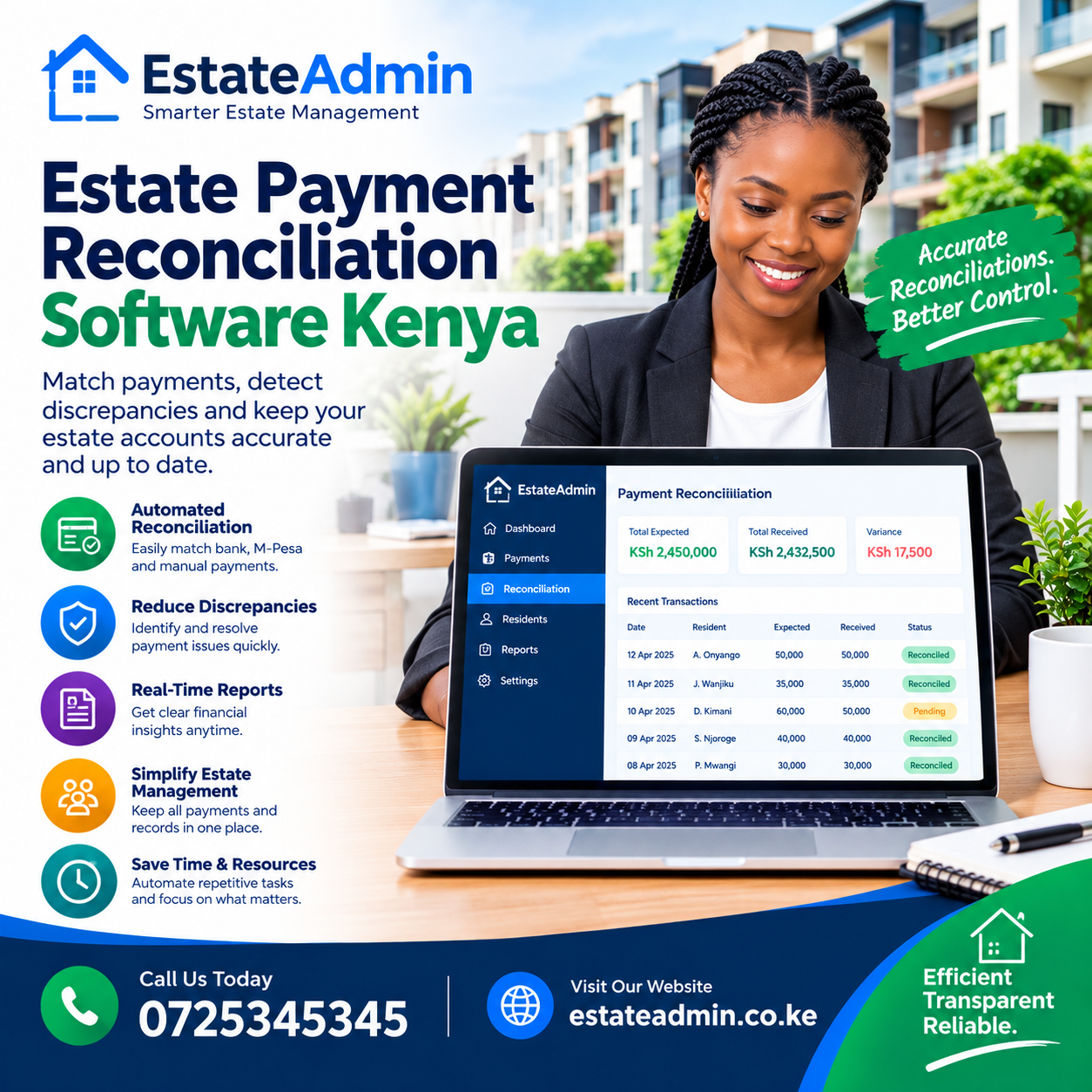
Estate Payment Reconciliation Software Kenya: Simplify Estate Payment Management
Managing payments in a residential estate involves much more than confirming that money has reached an account. Estate managers have to determine which resident made each payment, what the payment was intended to cover, whether the correct amount was received, and whether the transaction has been properly reflected against the resident’s account. Estate Payment Reconciliation Software Kenya gives estate managers a structured way to bring these activities together and maintain more accurate payment records. This guide explains how payment reconciliation works, why manual processes create problems, which features matter, and how Kenyan estates can build a more reliable financial workflow.
For many estates, payment information comes from several places. A resident may pay through M-Pesa, bank transfer, cheque or another approved channel. At the same time, the estate may have invoices for service charges, water, garbage collection, security, parking, penalties, repairs or other shared costs. Without a central process, staff can spend hours comparing statements, M-Pesa confirmations, spreadsheets and resident messages.
Estate Payment Reconciliation Software Kenya is designed around the need to match money received with the charges and accounts to which that money belongs. Instead of treating reconciliation as a month-end exercise, estate managers can make it part of the daily financial workflow.
The result is a clearer view of collections, outstanding balances and unmatched transactions. It can also make it easier to respond when a resident asks, “Has my payment been received?” or “Why does my account still show a balance?”
What Is Payment Reconciliation in an Estate?
Estate Payment Reconciliation Software Kenya refers to software that helps estate management teams compare payments received with amounts expected and correctly allocate transactions to resident, unit and invoice records.
The process is important because receiving money does not automatically mean that the estate’s records are correct. A payment may arrive without a clear reference. A resident may pay a rounded amount instead of the exact invoice total. Someone may settle several charges in one transaction. Another resident may accidentally use the wrong account or payment reference.
A proper reconciliation workflow attempts to answer four basic questions:
- Who made the payment?
- Which unit or account should receive the payment?
- Which invoice or charge should the payment settle?
- What balance remains after the payment is applied?
Estate Payment Reconciliation Software Kenya can support this process by keeping payment information, invoices and resident accounts connected.
For a managed estate, this is particularly useful because financial records are often reviewed by management committees, accountants, auditors and residents. A reliable record should show not only that money was received, but also how the money was allocated.
Reconciliation Is More Than Recording Payments
Recording a payment simply means entering a transaction into a system. Reconciliation goes a step further.
Suppose a resident has the following charges:
| Charge | Amount |
|---|---|
| Service charge | KSh 12,000 |
| Water | KSh 1,800 |
| Garbage collection | KSh 500 |
| Arrears | KSh 2,000 |
| Total | KSh 16,300 |
If the resident pays KSh 16,300, the estate needs to know that the payment clears the relevant charges. If the resident pays KSh 15,000, the system should leave the correct outstanding amount rather than simply marking the entire account as paid.
Estate Payment Reconciliation Software Kenya helps make these relationships easier to manage because payments can be connected to the financial records that explain why the payment was received.
Why Estate Payment Reconciliation Matters in Kenya
Kenyan estates often operate with payment channels that generate large volumes of transaction information. M-Pesa is especially important in everyday payment workflows, while banks remain relevant for larger transfers, standing arrangements and corporate or institutional residents.
The challenge is not necessarily collecting money. It is keeping accurate records after collection.
Estate Payment Reconciliation Software Kenya can help estate managers organize the information produced by these payment channels and connect it to resident accounts.
A manual process may require a staff member to:
- Open an M-Pesa statement.
- Search for a transaction.
- Compare the phone number with resident records.
- Check the amount against an invoice.
- Enter the payment into a spreadsheet.
- Update the resident’s balance.
- Prepare or send a receipt.
- Mark the invoice as paid.
- Repeat the process for the next transaction.
When there are dozens or hundreds of units, the workload can become significant.
Estate Payment Reconciliation Software Kenya can reduce dependence on repetitive manual entry by centralizing payment records and giving staff a clearer process for matching transactions.
The Cost of Poor Reconciliation
Poor reconciliation can affect several areas of estate management.
Resident relationships: A resident who has paid but still appears as owing may challenge the records.
Cash-flow visibility: Management may struggle to determine the actual amount collected versus the amount outstanding.
Reporting: Financial reports may contain inaccurate balances when payments have not been allocated correctly.
Arrears management: Staff may spend time following up residents who have already paid.
Audit preparation: Reconstructing payment histories from multiple spreadsheets and messages can take considerable effort.
Estate Payment Reconciliation Software Kenya can help establish a more consistent record of payment activity, reducing the number of disconnected sources staff need to check.
Common Payment Reconciliation Problems in Residential Estates
Every estate has its own procedures, but several reconciliation problems appear repeatedly.
Unidentified Payments
An estate may receive a payment without enough information to immediately identify the intended account.
For example, a transaction might show a name or phone number that does not exactly match the resident database. This becomes more difficult when one person pays on behalf of another resident.
Estate Payment Reconciliation Software Kenya can provide a workflow for handling unidentified transactions instead of leaving them buried in a spreadsheet.
A useful system should allow staff to place such transactions in an exception queue, investigate them and allocate them only after the necessary information is confirmed.
Partial Payments
Residents do not always settle the full amount due.
A resident owing KSh 25,000 may pay KSh 15,000. The estate needs to record the KSh 15,000 payment while retaining the remaining KSh 10,000 as an outstanding balance.
Estate Payment Reconciliation Software Kenya can support this type of account-level tracking and make it easier to distinguish partially settled accounts from fully paid accounts.
Overpayments
An overpayment can create another issue.
Suppose a resident owes KSh 18,500 but pays KSh 20,000. The additional KSh 1,500 should not simply disappear from the records. It may need to be retained as a credit or allocated according to the estate’s approved accounting procedure.
Estate Payment Reconciliation Software Kenya can help estates keep such transactions visible instead of relying on manual notes.
Duplicate Entries
Manual data entry creates the possibility of recording the same transaction more than once.
A duplicate payment entry can make a resident appear to have a lower balance than they actually have. If the error remains unnoticed, it can affect financial reports and subsequent follow-ups.
Estate Payment Reconciliation Software Kenya can provide a centralized transaction history that makes duplicate or suspicious entries easier to identify.
Payments Made With Incorrect References
Residents may occasionally enter the wrong account number, unit number or reference.
A reconciliation process needs a way to investigate these payments without corrupting the underlying records.
Estate Payment Reconciliation Software Kenya can be useful when the estate wants to maintain a controlled process for reviewing unmatched transactions before they are assigned.
How Automated Payment Matching Works
One of the main reasons estates consider reconciliation software is automation.
Estate Payment Reconciliation Software Kenya can be configured around rules that help associate payment information with resident accounts and outstanding charges.
A typical workflow may look like this:
Step 1: A charge is created
The estate generates an invoice or charge for service fees, utilities or another approved expense.
Step 2: The resident makes a payment
The resident pays using the estate’s approved payment channel.
Step 3: The transaction enters the payment record
The amount, transaction reference and available payer information are captured.
Step 4: The system searches for a match
The payment is compared against resident, unit, invoice and reference information.
Step 5: The payment is allocated
When a valid match is identified, the payment is applied to the relevant account.
Step 6: The balance is updated
The resident’s outstanding balance changes according to the amount allocated.
Step 7: Exceptions are reviewed
Payments that cannot be confidently matched remain available for staff investigation.
Estate Payment Reconciliation Software Kenya can therefore move reconciliation away from a purely manual exercise and toward a controlled workflow.
M-Pesa Reconciliation for Kenyan Estates
M-Pesa is an important consideration when evaluating payment management systems for Kenyan estates. Residents are accustomed to using mobile money for many everyday transactions, making it practical for estates to provide convenient payment options.
However, convenience for the payer does not automatically solve the record-keeping challenge for the estate.
Estate Payment Reconciliation Software Kenya can help connect payment information with resident and invoice records, depending on the integrations and payment workflows supported by the system.
A good reconciliation process should make it easier to identify:
- Transaction reference.
- Payment amount.
- Payment date.
- Payer information.
- Intended resident or unit.
- Related invoice.
- Amount allocated.
- Remaining balance.
- Unmatched status where applicable.
The system should also distinguish between a payment request being initiated and a payment actually being confirmed. A resident receiving a payment prompt does not necessarily mean that the transaction has been completed.
Estate Payment Reconciliation Software Kenya is most useful when it supports reliable transaction records rather than relying on screenshots or verbal confirmations.
Why Screenshots Are Not Enough
Residents sometimes send M-Pesa screenshots through WhatsApp to prove payment.
Screenshots can be useful for investigating a disputed transaction, but they are not an ideal primary accounting record. Staff may receive hundreds of messages, and screenshots can be difficult to organize consistently.
A structured reconciliation process keeps the transaction within the estate’s financial records.
Estate Payment Reconciliation Software Kenya can help reduce dependence on scattered WhatsApp messages by centralizing payment information.
Connecting Payments to Service Charges
Service charge is one of the most important areas for estate reconciliation.
Residential developments may collect money for security, cleaning, common-area maintenance, landscaping, management, waste collection, lighting and other shared services. The exact charges depend on the estate’s rules and budgeting arrangements.
Estate Payment Reconciliation Software Kenya can help connect these charges to resident accounts and payment records.
The benefit is visibility.
Management can see what has been billed, what has been collected and what remains outstanding without relying entirely on manual spreadsheets.
A useful service-charge workflow can include:
- Creating recurring charges.
- Generating resident invoices.
- Recording payments.
- Matching payments to invoices.
- Updating balances.
- Identifying arrears.
- Producing collection reports.
- Exporting information for accounting or review.
Estate Payment Reconciliation Software Kenya supports the broader principle that payment records should remain connected to the charges that generated them.
Payment Reconciliation and Arrears Management
Reconciliation and arrears management are closely connected.
An estate cannot accurately determine arrears if its payment records are incomplete or incorrectly allocated.
Estate Payment Reconciliation Software Kenya can help estate managers distinguish between genuinely overdue accounts and accounts where payment information still needs to be processed.
Consider three residents:
| Resident | Amount Due | Payment Received | Correct Status |
|---|---|---|---|
| Resident A | KSh 15,000 | KSh 15,000 | Paid |
| Resident B | KSh 15,000 | KSh 10,000 | Partially paid |
| Resident C | KSh 15,000 | KSh 0 | Outstanding |
Without proper reconciliation, Residents A and B could both appear overdue.
With accurate allocation, the management team can focus its follow-up on the accounts that actually require attention.
Estate Payment Reconciliation Software Kenya can therefore support more targeted collections because staff have a clearer picture of outstanding balances.
Resident Statements and Payment History
Residents may need statements showing charges, payments and balances over a specific period.
A statement is more useful when it is generated from properly reconciled records.
Estate Payment Reconciliation Software Kenya can support a workflow where each resident’s financial history is maintained against the relevant account.
A useful statement may show:
- Opening balance.
- New charges.
- Payments received.
- Credits.
- Adjustments.
- Penalties where applicable.
- Closing balance.
This makes it easier to explain how a balance was calculated.
For estate managers, clear statements can also reduce unnecessary disputes. Instead of asking staff to reconstruct a resident’s history from multiple files, the financial record can be reviewed in one place.
Estate Payment Reconciliation Software Kenya can contribute to this type of structured record-keeping when resident accounts and payments are maintained together.
Financial Reporting for Estate Management
Reconciliation is not only about individual residents. It affects management-level reporting.
Estate committees may need information about collections, outstanding balances and financial performance. Managers may also need reports for internal review or external accounting.
Estate Payment Reconciliation Software Kenya can form part of a broader financial management process where payment information feeds into reports.
Useful reports may include:
- Total payments received.
- Payments by property or block.
- Payments by period.
- Outstanding balances.
- Arrears aging.
- Unmatched transactions.
- Collection performance.
- Service-charge collections.
- Payment histories.
- Adjustments and credits.
The value of reporting comes from data quality. A polished report is not useful if the underlying payment records are inaccurate.
What Features Should Estate Managers Look For?
When evaluating Estate Payment Reconciliation Software Kenya, estate managers should focus on the workflow rather than the number of features listed on a marketing page.
The right system should solve practical problems faced by the management team.
1. Payment Matching
The core function should be the ability to associate payments with the correct resident, unit and charge.
2. M-Pesa Support
For Kenyan estates, support for relevant M-Pesa payment workflows can make reconciliation more practical.
3. Bank Payment Records
The system should also accommodate bank-related payments where these are part of the estate’s collection process.
4. Invoice Management
Payments should be connected to invoices or charges so that balances update correctly.
5. Exception Handling
Not every transaction will match automatically. Staff need a controlled way to review unmatched payments.
6. Audit Trails
Financial records should show relevant changes and actions so that managers can understand what happened.
7. Resident Statements
The system should make it easy to retrieve a resident’s payment and balance history.
8. Reporting
Managers need reports that support day-to-day decisions and financial review.
9. Role-Based Access
Different staff members may need different levels of access to financial and resident information.
10. Export Options
Being able to export relevant data can be useful for accountants, auditors, committees and management reviews.
Estate Payment Reconciliation Software Kenya becomes more valuable when these features work together instead of operating as isolated modules.
Manual Reconciliation vs Software-Based Reconciliation
The difference can be summarized as follows:
| Area | Manual Process | Software-Based Process |
|---|---|---|
| Payment entry | Often repetitive | More structured |
| Matching | Staff compare records | Rules can assist matching |
| Resident balances | Updated manually | Updated through transactions |
| Unmatched payments | May sit in spreadsheets | Can be placed in an exception workflow |
| Statements | May require preparation | Can be generated from records |
| Reporting | Spreadsheet dependent | Centralized reporting |
| Audit trail | May be fragmented | Can be recorded within the system |
| Arrears visibility | Requires checking | Can be displayed from current balances |
Estate Payment Reconciliation Software Kenya is not necessarily about eliminating staff involvement. The goal is to reduce unnecessary manual work while keeping human review where judgment is required.
Handling Unmatched Payments
A strong reconciliation system should not force every payment into an account simply to make the dashboard look complete.
When a transaction cannot be confidently matched, it should remain identifiable as unmatched.
Estate Payment Reconciliation Software Kenya can support a workflow where staff review the transaction and determine the correct allocation.
A practical exception process can include:
- Identify the transaction.
- Review payer details.
- Check the reference.
- Search resident records.
- Contact the relevant resident if necessary.
- Confirm the intended unit or invoice.
- Apply the payment.
- Record the reason for the allocation.
This is safer than guessing.
Handling Partial and Combined Payments
Some residents may pay several obligations in one transaction.
For example, a resident could make a single KSh 30,000 payment covering service charge, water and an older balance.
Estate Payment Reconciliation Software Kenya can help estates organize such payments according to the allocation rules established by management.
The system should make it clear how the payment was distributed.
For example:
| Allocation | Amount |
|---|---|
| Previous arrears | KSh 8,000 |
| Current service charge | KSh 18,000 |
| Water | KSh 4,000 |
| Total payment | KSh 30,000 |
This creates a clearer financial history and reduces ambiguity when the resident later requests a statement.
Estate Payment Reconciliation Software Kenya can support the principle of maintaining a transparent allocation history.
Improving Accountability in Estate Management
Financial transparency is an important consideration in managed communities.
Residents want confidence that their payments are recorded correctly. Committees want visibility over collections. Estate managers need practical tools for operating the property efficiently.
Estate Payment Reconciliation Software Kenya can support accountability by maintaining structured transaction histories.
For example, management can review:
- When a payment was recorded.
- Which account received it.
- Which invoice was settled.
- Whether an adjustment was made.
- Which staff member performed a relevant action, where audit functionality is available.
This does not replace proper financial controls. Instead, it gives those controls a more organized information base.
Security and Access Control
Payment data contains sensitive financial information. Estate management software should therefore include appropriate access controls.
Estate Payment Reconciliation Software Kenya should be evaluated partly on how users and permissions are handled.
A small estate may have an administrator, property manager and accountant. A larger organization may have additional staff, caretakers, finance personnel and committee members.
Each person does not necessarily need access to every financial function.
Useful controls can include:
- User accounts.
- Role-based permissions.
- Password protection.
- Audit logs.
- Controlled financial adjustments.
- Secure backups.
- Restricted access to resident information.
Estate managers should also review the provider’s security practices and data-handling terms before implementation.
Estate Payment Reconciliation Software Kenya should be treated as part of the estate’s wider information-management environment rather than as a standalone payment tool.
How Reconciliation Can Improve Resident Communication
Payment records affect resident communication.
If a resident receives a reminder after already paying, confidence in the management office can suffer. If a resident asks for a receipt and staff cannot quickly locate the transaction, the issue can become unnecessarily frustrating.
Estate Payment Reconciliation Software Kenya can support faster communication by giving staff access to organized transaction histories.
Automated or semi-automated communication can also be connected to financial events where the system supports it.
Examples include:
- Payment confirmations.
- Receipts.
- Outstanding balance reminders.
- Statement notifications.
- Service-charge notices.
- Payment follow-up messages.
The key is to ensure that communications are based on verified financial information.
Choosing Software for a Kenyan Estate
Choosing a system should start with the estate’s actual payment workflow.
Estate Payment Reconciliation Software Kenya should be assessed against the following questions:
How are residents currently billed?
Determine whether the estate uses monthly service charges, utility billing, parking fees, penalties, deposits or several categories.
How do residents pay?
List all active payment methods, including M-Pesa, bank transfers and any other approved channels.
How are payments currently matched?
Document the current process before attempting to automate it.
How are unmatched payments handled?
A good system should make exceptions visible instead of hiding them.
How are arrears calculated?
Confirm how the estate treats partial payments, credits, penalties and previous balances.
Who needs access?
Identify administrators, accountants, managers and other users.
What reports are required?
List reports needed by management, committees and accounting teams.
Estate Payment Reconciliation Software Kenya should fit these workflows instead of forcing the estate to redesign every financial process around the software.
Steps for Implementing Payment Reconciliation Software
Implementation should be planned carefully.
Step 1: Clean Existing Data
Review resident names, unit numbers, phone numbers, balances and outstanding invoices.
Step 2: Define Payment Rules
Decide how payments should be allocated to current charges, arrears, utilities and other balances.
Step 3: Configure Properties and Units
Create the estate structure so each payment has a clear account destination.
Step 4: Configure Billing
Set up recurring charges and relevant invoice categories.
Step 5: Connect Payment Channels
Where supported, configure the estate’s approved payment integrations.
Step 6: Import Historical Records
Bring relevant resident and financial information into the new system.
Step 7: Test Reconciliation
Use sample transactions to verify that payments are being matched correctly.
Step 8: Train Staff
Staff should understand both normal payment matching and exception handling.
Step 9: Communicate With Residents
Residents should receive clear payment instructions and understand how receipts and statements will be provided.
Step 10: Review the First Reporting Cycle
Compare the system’s reports against existing records before relying fully on the new workflow.
Estate Payment Reconciliation Software Kenya can be introduced gradually, allowing the management team to identify issues before they affect a full reporting cycle.
Common Mistakes to Avoid
Software does not automatically solve poor processes.
One common mistake is importing inaccurate resident data and expecting the system to correct it automatically.
Another is failing to establish clear rules for unmatched payments.
A third is giving too many users unrestricted access to financial functions.
Estate Payment Reconciliation Software Kenya should therefore be introduced alongside clear procedures.
Other mistakes include:
- Continuing to maintain several unofficial spreadsheets.
- Recording payments without transaction references.
- Ignoring old unmatched transactions.
- Failing to reconcile regularly.
- Treating screenshots as the primary financial record.
- Allowing unauthorized balance adjustments.
- Not reviewing audit logs.
- Failing to train new staff.
- Sending automated reminders without verifying payment status.
Estate Payment Reconciliation Software Kenya works best when the estate establishes one dependable source of financial information.
Daily Reconciliation vs Month-End Reconciliation
A major process improvement is moving reconciliation closer to the time a payment is received.
If staff wait until the end of the month, a large backlog can accumulate.
Estate Payment Reconciliation Software Kenya can support more frequent processing, allowing staff to identify problems earlier.
Daily reconciliation can help the estate:
- Detect unmatched payments quickly.
- Update resident balances sooner.
- Identify collection problems.
- Reduce month-end workload.
- Improve resident responses.
- Keep reports more current.
Month-end review can still remain important. The difference is that the team is reviewing an already-maintained ledger instead of reconstructing an entire month’s activity.
The Role of Reports in Better Decision-Making
Reports turn transaction data into information management can use.
Estate Payment Reconciliation Software Kenya can support reporting around collections and outstanding balances when payment records are properly maintained.
For example, management may want to know:
- How much was billed this month?
- How much has been collected?
- How much remains outstanding?
- Which units have arrears?
- How many payments remain unmatched?
- How much has been collected for service charges?
- Are there unusual payment patterns?
- What balances require follow-up?
These questions are easier to answer when invoices and payments are connected.
Estate Payment Reconciliation Software Kenya can therefore contribute to a wider financial-management process rather than simply functioning as a transaction register.
Using Reconciliation to Support Estate Committees
Estate committees often need concise financial information rather than raw transaction data.
Estate Payment Reconciliation Software Kenya can help management prepare information that is easier to review during committee meetings.
A committee report might include:
| Metric | Example |
|---|---|
| Total billed | KSh 2,400,000 |
| Payments received | KSh 2,050,000 |
| Outstanding | KSh 350,000 |
| Unmatched payments | 7 |
| Units with arrears | 18 |
The figures above are illustrative rather than claims about any particular estate.
The important point is that committee members can review the financial position using structured information rather than relying on several disconnected spreadsheets.
Estate Payment Reconciliation Software Kenya can support this type of management visibility when integrated with the estate’s broader billing and reporting workflow.
Payment Reconciliation for Multi-Block Estates
Larger estates may contain several blocks, phases or sections.
Managing payment records across multiple areas can become complicated if all transactions are kept in one generic spreadsheet.
Estate Payment Reconciliation Software Kenya can help organize records by property, block, unit or resident where the system provides those structures.
This allows managers to investigate questions such as:
- Which block has the highest outstanding balance?
- Which units have not paid this month’s service charge?
- How much was collected for each property?
- Which transactions remain unmatched?
- What payments were received during a specific period?
The same principle applies to property management companies handling more than one estate.
Estate Payment Reconciliation Software Kenya can be especially useful where separate property records need to remain distinct while management still needs portfolio-level visibility.
Integrating Reconciliation With Other Estate Operations
Payment reconciliation should not exist in isolation.
An estate may also need tenant or resident management, invoicing, maintenance tracking, expense management, communication and reporting.
Estate Payment Reconciliation Software Kenya becomes more useful when financial information connects with these operational records.
For example, a maintenance expense may be recorded against a property budget. A service charge may be invoiced to residents. A payment may then settle that invoice. Management can use the connected information to understand both income and expenses.
This creates a more complete financial picture.
How to Measure Improvement After Implementation
After adopting a reconciliation system, estate managers should monitor whether the process is actually improving.
Estate Payment Reconciliation Software Kenya can be evaluated using practical operational measures.
Consider tracking:
- Number of unmatched payments.
- Time required to reconcile transactions.
- Number of duplicate entries.
- Number of resident payment disputes.
- Time required to produce statements.
- Time required to prepare monthly reports.
- Number of manual adjustments.
- Percentage of payments matched automatically, where applicable.
These measures provide a more meaningful assessment than simply asking whether software has been installed.
What Estate Managers Should Ask a Software Provider
Before committing to a platform, request a demonstration using realistic examples.
Estate Payment Reconciliation Software Kenya should be tested against situations such as:
Scenario 1: A resident pays the exact invoice amount.
Scenario 2: A resident makes a partial payment.
Scenario 3: A resident overpays.
Scenario 4: A payment arrives without a clear reference.
Scenario 5: One payment covers several charges.
Scenario 6: A payment needs to be corrected.
Scenario 7: Management needs a resident statement.
Scenario 8: An accountant needs a transaction export.
Testing real scenarios is more useful than watching a generic software presentation.
Estate Payment Reconciliation Software Kenya should be judged by how well it handles the estate’s actual reconciliation challenges.
Questions About Data Migration
Moving from spreadsheets to software is often one of the most important implementation steps.
Estate Payment Reconciliation Software Kenya can only produce reliable results if the information entered into the system is accurate.
Before migration, review:
- Duplicate residents.
- Incorrect unit numbers.
- Old tenant records.
- Incorrect phone numbers.
- Missing opening balances.
- Unresolved credits.
- Unmatched historical payments.
- Duplicate invoices.
It may be tempting to import everything without cleaning it. That can transfer old problems into the new system.
A controlled migration process is safer.
Payment Reconciliation and Audit Readiness
Financial records should be maintained in a way that allows transactions to be explained.
Estate Payment Reconciliation Software Kenya can support audit preparation by keeping payment information organized and connected to invoices and resident accounts.
An auditor or accountant may need to trace a figure from a report back to the underlying transaction.
A strong system should make that process easier.
For example:
Report figure → Resident account → Invoice → Payment → Transaction reference
The exact audit capabilities depend on the software and its configuration, but the underlying principle is straightforward: financial information should be traceable.
Estate Payment Reconciliation Software Kenya can therefore form one part of a broader financial-control framework.
The Importance of Accurate Opening Balances
When an estate moves from manual records to a new system, opening balances deserve special attention.
Estate Payment Reconciliation Software Kenya should be configured with balances that have been reviewed and approved by the responsible management or accounting team.
Suppose a resident actually owes KSh 22,000 but the imported balance is KSh 12,000. Every future report may then be wrong unless the opening figure is corrected.
Similarly, an incorrect credit can cause the system to show a resident as having paid more than they actually have.
Data validation at the beginning prevents many downstream problems.
Why Centralized Records Matter
A centralized record gives staff a common reference point.
Estate Payment Reconciliation Software Kenya can bring resident information, charges, invoices, payments and balances into a connected environment.
That can reduce situations where:
- One spreadsheet says a resident owes KSh 10,000.
- A second spreadsheet says KSh 8,000.
- An M-Pesa message suggests KSh 5,000 was recently paid.
- A staff member’s notebook shows another figure.
The goal is to replace conflicting records with a controlled financial ledger.
Estate Payment Reconciliation Software Kenya can help establish this consistency when staff use the system as the primary operational record.
Frequently Asked Questions
What is estate payment reconciliation software?
Estate Payment Reconciliation Software Kenya is software designed to help estate managers match payments with resident accounts, invoices and outstanding charges. It can support payment tracking, balance updates, exception handling and financial reporting.
Can payment reconciliation software support M-Pesa payments?
Many property-management systems serving the Kenyan market offer M-Pesa-related payment workflows, although the exact integration differs by provider. Estate Payment Reconciliation Software Kenya should be evaluated based on the specific M-Pesa process used by the estate.
Can software identify unpaid service charges?
Yes, when billing and payment records are properly maintained, the system can calculate outstanding balances and identify accounts that have not been fully settled. Estate Payment Reconciliation Software Kenya can support this process when the relevant billing and payment features are configured correctly.
What happens when a payment cannot be matched?
An unmatched payment should be placed into an exception or review workflow rather than being assigned based on guesswork. Estate Payment Reconciliation Software Kenya can support structured handling of these transactions depending on its available features.
Can residents receive payment statements?
Systems that include resident-account and statement functionality can generate payment histories showing charges, payments and balances. Estate Payment Reconciliation Software Kenya can be considered as part of a broader resident financial-record workflow.
Does reconciliation software replace an accountant?
No. Software can automate or organize repetitive processes, but accounting oversight, financial controls, approvals and professional judgment may still be required. Estate Payment Reconciliation Software Kenya should complement, rather than automatically replace, appropriate financial management procedures.
Is payment reconciliation useful for small estates?
Yes. Even a smaller estate can benefit from organized payment records because the same fundamental challenges—matching payments, tracking balances and preparing statements—still exist. Estate Payment Reconciliation Software Kenya may be useful where the estate wants a structured process from an early stage.
Can one system manage several estates?
Some property-management platforms support multiple properties or portfolios. Estate managers should confirm whether the specific system can separate properties, units, residents and financial records appropriately. Estate Payment Reconciliation Software Kenya should be evaluated according to the organization’s actual portfolio structure.
How often should an estate reconcile payments?
For active estates, reconciliation is generally more useful when performed regularly rather than being postponed until month-end. Estate Payment Reconciliation Software Kenya can support a more frequent workflow when payment information is available promptly.
What should I check before choosing reconciliation software?
Review payment integrations, invoice management, resident accounts, exception handling, reporting, permissions, audit functionality, data migration and support. Estate Payment Reconciliation Software Kenya should ultimately be assessed against real estate-management scenarios rather than a feature list alone.
Building a Better Payment Management Process
Good reconciliation starts with a clear process.
Estate Payment Reconciliation Software Kenya can provide the technology layer, but the estate still needs defined responsibilities and procedures.
A practical process could look like this:
- Generate charges accurately.
- Give residents clear payment instructions.
- Receive payments through approved channels.
- Capture transaction information.
- Match payments against resident accounts.
- Review unmatched transactions.
- Update balances.
- Generate receipts or statements.
- Review arrears.
- Produce management reports.
- Investigate unusual transactions.
- Maintain appropriate financial controls.
This workflow creates a repeatable routine.
Estate Payment Reconciliation Software Kenya can help reduce the administrative burden when the software is configured around this process.
Practical Example: A Nairobi Residential Estate
Consider a hypothetical residential estate in Nairobi with 150 units.
The management office sends monthly service-charge invoices. Residents pay through M-Pesa and bank transfers. Previously, staff downloaded transaction information, checked names manually and updated a spreadsheet.
At the end of each month, the finance team spent significant time resolving discrepancies.
After moving to a structured reconciliation workflow, the estate could organize transactions by unit, identify automatically matched payments, place unclear transactions in a review queue and generate reports from the same underlying records.
Estate Payment Reconciliation Software Kenya would not remove the need for financial oversight, but it could give staff a more systematic way to perform routine reconciliation.
The same principle can apply to estates in Mombasa, Kisumu, Nakuru, Kiambu and other Kenyan locations. The specific workflow depends on the estate’s payment channels, billing structure and management procedures.
Practical Example: Handling a Partial Payment
Suppose Unit B14 receives a monthly invoice of KSh 20,000.
The resident pays KSh 12,000.
A good reconciliation process should record:
- Invoice: KSh 20,000
- Payment: KSh 12,000
- Outstanding: KSh 8,000
Estate Payment Reconciliation Software Kenya can help ensure that the account reflects the partial payment without incorrectly closing the invoice.
If the resident later pays KSh 8,000, the account can then be fully settled.
This simple example illustrates why payment matching and balance calculation need to work together.
Practical Example: An Unidentified Payment
Imagine an estate receives KSh 25,000 but the reference does not clearly identify the unit.
Instead of assigning the money to a resident based on a guess, staff can place the transaction in an unmatched-payment queue.
Estate Payment Reconciliation Software Kenya can support a controlled review process when such functionality is available.
The finance team can then investigate the transaction, confirm the payer and apply the amount to the correct account.
This preserves the integrity of the estate’s records.
Practical Example: One Payment for Multiple Charges
A resident may owe:
- KSh 15,000 service charge.
- KSh 3,000 water.
- KSh 2,000 arrears.
The resident pays KSh 20,000 in one transaction.
Estate Payment Reconciliation Software Kenya can support an allocation workflow where the payment is distributed across the relevant charges according to configured rules.
The resident’s account then provides a clear explanation of what the payment settled.
Final Checklist for Estate Managers
Before selecting or implementing a reconciliation system, use this checklist:
Payment management
- Can the system record payments accurately?
- Can it handle the estate’s payment channels?
- Can it identify transaction references?
- Can staff review unmatched payments?
Billing
- Can the system generate relevant charges?
- Can payments be linked to invoices?
- Can partial payments be recorded?
- Can credits and overpayments be tracked?
Resident accounts
- Are unit and resident records connected?
- Can staff retrieve payment histories?
- Can statements be generated?
Reporting
- Can management see collections and outstanding balances?
- Can the system produce arrears reports?
- Can transaction information be exported?
- Can management review unmatched payments?
Controls
- Are user permissions available?
- Are financial adjustments traceable?
- Is there an audit history?
- Are backups and security measures documented?
Implementation
- Can existing data be imported?
- Is training available?
- Is technical support accessible?
- Can the system adapt to the estate’s existing workflow?
Estate Payment Reconciliation Software Kenya should satisfy the requirements that matter most to the estate rather than simply offering the largest number of features.
Conclusion
Accurate payment reconciliation is a fundamental part of effective estate financial management. When payments are received through M-Pesa, banks and other channels, estate managers need more than a list of transactions. They need to know which resident paid, which unit the payment belongs to, which charges were settled and what balance remains.
Estate Payment Reconciliation Software Kenya can bring these activities into a more structured workflow by connecting payment records with resident accounts, invoices, balances, arrears and reports.
The strongest approach is not simply to automate everything. It is to automate routine matching where appropriate while giving staff a clear process for reviewing exceptions, partial payments, overpayments and unusual transactions.
For Kenyan estates, this can be particularly valuable where M-Pesa forms a significant part of the collection process. A well-organized reconciliation workflow can reduce dependence on spreadsheets, scattered payment screenshots and manual calculations while improving the availability of financial information.
Before choosing a platform, estate managers should examine their current payment process, identify the biggest sources of errors and test potential software against real scenarios. A useful system should make daily reconciliation easier, keep resident balances clear, support reliable reporting and provide appropriate controls around financial data.
Ultimately, the objective is straightforward: every payment should be traceable, every resident account should reflect the correct balance, and estate management should have dependable financial information for daily operations and longer-term decision-making.