
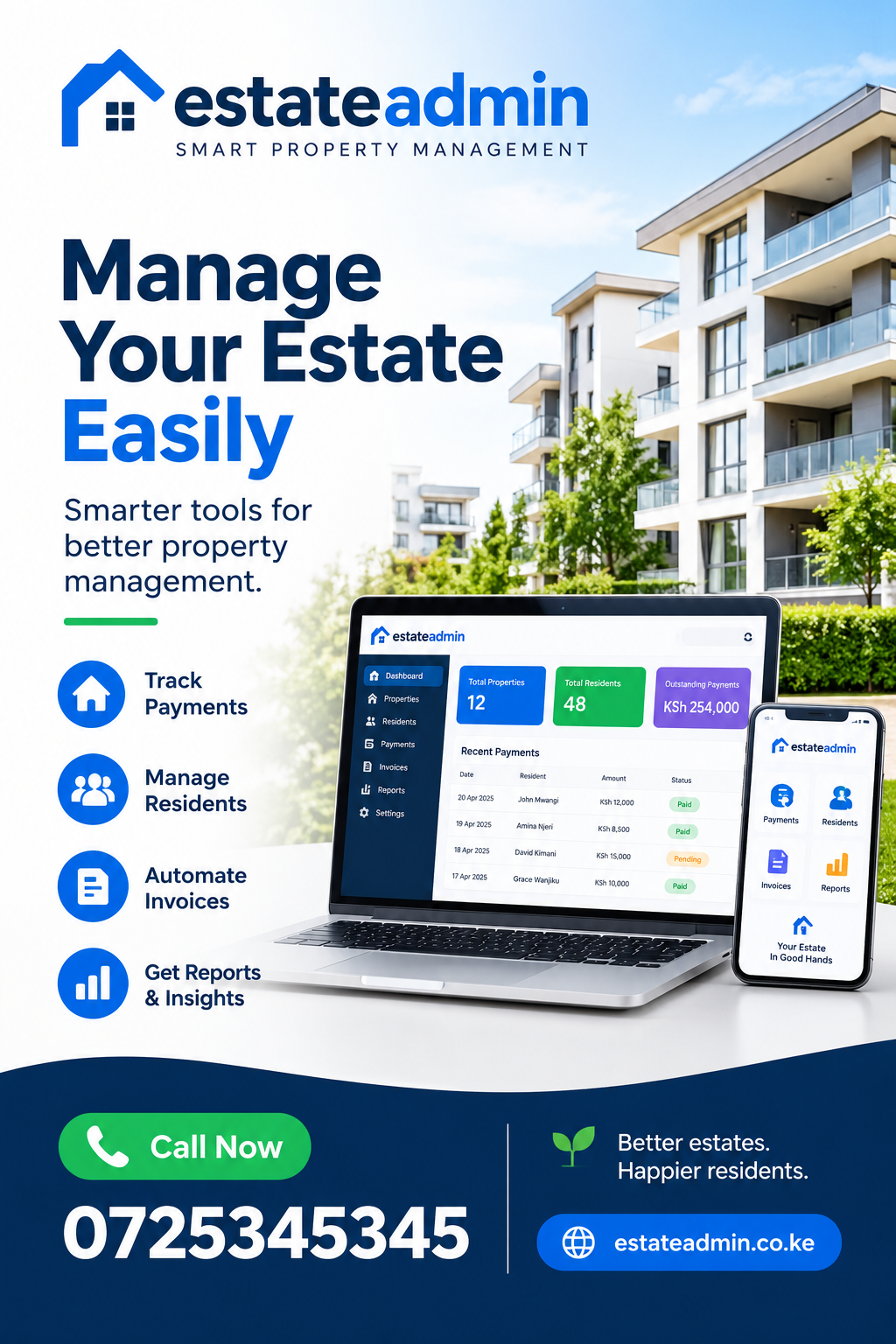
Understanding Estate Notice Management Software in Kenya
Managing notices in a residential estate sounds simple until a committee needs to announce a water interruption, security update, planned maintenance, meeting, levy reminder, or urgent repair. Estate Notice Management Software Kenya gives property managers a structured way to prepare, approve, publish, track, and retain those communications. For estate managers, landlords, resident associations, and committees in Kenya, the real value is not sending more messages; it is making sure the right residents receive clear information at the right time.
A notice management system centralises communications that might otherwise be scattered across WhatsApp groups, printed posters, emails, phone calls, and handwritten records. Estate Notice Management Software Kenya can support a consistent process in which a manager drafts a notice, selects the affected units, sets the publication date, and keeps a record of what was issued. That structure is especially useful when several people share responsibility for running an apartment block or gated community.
For a Kenyan estate, communication has practical consequences. A missed notice can leave residents unaware of a power-related maintenance activity, access-control change, inspection exercise, cleaning schedule, or residents’ meeting. Estate Notice Management Software Kenya helps turn notice publishing into a repeatable management task rather than an informal activity dependent on one administrator remembering to send a message.
The strongest approach is to treat notices as part of the estate’s operational records. Estate Notice Management Software Kenya can fit into that approach by connecting communication with resident records, units, dates, and management workflows. Instead of asking a manager to search through old chats to prove what was communicated, the estate can maintain an organised history that is easier to review when questions arise.
One of the first benefits is consistency. Every notice can follow a defined format containing a title, message, issue date, effective date, responsible office, and relevant instructions. Estate Notice Management Software Kenya makes this process easier to standardise, reducing the chance that one announcement contains important information while another leaves residents guessing about what they should do.
Why structured estate communication matters
Clear notices also reduce unnecessary follow-up calls. Consider a planned water shutdown. A weak message might simply say that water will be unavailable tomorrow. A stronger notice explains the affected areas, expected start and end times, reason for the work, preparation residents should make, and the channel to use if the interruption continues. Estate Notice Management Software Kenya supports the organised delivery of this type of practical information.
Estate committees frequently communicate several categories of information at once. There may be financial notices, maintenance notices, security announcements, meeting invitations, parking instructions, access-control updates, and community reminders. Estate Notice Management Software Kenya can help separate these categories so that residents and administrators can understand the purpose of a message without digging through unrelated conversations.
A good notice workflow begins with identifying the audience. Some announcements affect every resident, while others apply only to a building, floor, block, parking section, or specific unit. Estate Notice Management Software Kenya can make audience selection part of the publishing process, helping managers avoid sending a maintenance message for Block A to residents who live in Block C.
Timing is another important consideration. A notice delivered too late may be technically correct but practically useless. Estate Notice Management Software Kenya supports planned communication by allowing managers to prepare information before an event and publish it according to the required schedule. This is useful for meetings, inspections, maintenance works, contractor visits, and other activities that residents need time to prepare for.
Scheduled communication can also improve administrative discipline. Instead of drafting a reminder when a deadline is already approaching, a manager can prepare notices in advance. Estate Notice Management Software Kenya can be used as part of a calendar-driven process for recurring events such as committee meetings, service interruptions, planned inspections, waste collection reminders, and other estate activities.
Approval matters where notices represent the position of a management company, committee, or residents association. Estate Notice Management Software Kenya can support a controlled workflow in which a draft is prepared, reviewed, approved, and then published. This helps distinguish official communication from informal comments made in a group chat, particularly where several people have access to estate communication channels.
An approval process can also improve accountability. If a resident later asks who authorised a particular announcement, the management team should ideally have an internal record rather than relying on memory. Estate Notice Management Software Kenya can contribute to that record by keeping notices within an organised management environment and associating them with the appropriate administrative process.
Resident complaints often begin with a communication gap. A resident may not know that a repair was scheduled, why an access restriction was introduced, or when a contractor is expected to finish. Estate Notice Management Software Kenya cannot replace good service, but it can help managers communicate operational decisions consistently so that residents have better information before they raise avoidable questions.
Notices are also useful for transparency around shared facilities. A swimming pool, gym, clubhouse, children’s play area, parking zone, or other common facility may require temporary closure or revised rules. Estate Notice Management Software Kenya gives the management team a practical channel for explaining what is changing, when it changes, and what residents need to know before using the facility again.
Core features to look for
Security communication deserves particular care. Estates may need to announce gate procedures, visitor protocols, patrol arrangements, temporary access restrictions, or changes to identification requirements. Estate Notice Management Software Kenya can help ensure that approved security notices reach the intended residents without relying entirely on verbal communication from guards or individual administrators.
At the same time, security-related notices should avoid exposing sensitive operational details unnecessarily. A management system should be used thoughtfully, with access permissions and communication practices appropriate to the information being shared. Estate Notice Management Software Kenya is most valuable when it supports useful resident information while the estate maintains sensible controls over confidential operational data.
Maintenance is one of the most common reasons an estate needs notices. Repairs to lifts, water systems, electrical infrastructure, gates, drainage, roofs, roads, lighting, or shared equipment can affect daily routines. Estate Notice Management Software Kenya can make maintenance communication more predictable by helping managers issue advance notices, progress updates, and completion messages through a structured process.
For example, a lift repair may require residents to change how they move through a building for several hours. A useful notice should identify the affected lift, expected work period, safety instructions, and contact point for urgent concerns. Estate Notice Management Software Kenya supports the broader workflow by giving management a place to publish the message and preserve the communication record.
Financial communication is another area where clarity matters. Estates may need to communicate service charge deadlines, payment reminders, changes to approved charges, statements, or explanations of shared expenses. Estate Notice Management Software Kenya can complement financial management by ensuring that important announcements are communicated separately from the accounting records while remaining part of the estate’s wider administrative process.
A notice should never be used as a substitute for a detailed account where a resident needs transaction-level information. Instead, Estate Notice Management Software Kenya should complement tools for billing, payments, arrears, and reporting. A good estate management system separates these functions while allowing the communication process to explain deadlines, procedures, or changes in a clear and resident-friendly way.
Meeting management provides another strong use case. Residents may need advance information about annual meetings, committee sessions, agenda distribution, venue changes, or online meeting arrangements. Estate Notice Management Software Kenya can help establish a repeatable notice process so that meetings are announced consistently and updates can be issued without losing track of previous versions.
When meeting details change, publishing a replacement notice is usually clearer than editing an old message without explanation. Estate Notice Management Software Kenya can support version-aware communication practices by allowing the management team to retain an organised history. This helps residents understand which announcement is current and gives administrators a useful record when reviewing what was communicated.
A resident portal can make notices easier to access than a long messaging thread. Estate Notice Management Software Kenya can form part of a digital communication environment where residents log in to view relevant announcements alongside other estate information. This approach is particularly useful for people who join a community after an earlier message was sent and need access to current information without searching historical chats.
Mobile accessibility is important in Kenya because residents and property staff frequently manage daily tasks from phones. Estate Notice Management Software Kenya should therefore be considered alongside mobile-friendly interfaces, readable notice layouts, and communication channels that work well on smaller screens. A technically capable system is less useful if residents struggle to read an announcement or find the action required from them.
Language and clarity also affect notice effectiveness. Estate notices should use straightforward English or another appropriate communication language and avoid unnecessary technical terminology. Estate Notice Management Software Kenya can help standardise templates, but the human writing of each notice still matters. Managers should use short paragraphs, clear dates, practical instructions, and contact information where a response is required.
Templates can save time without making communication robotic. A maintenance template might contain sections for affected areas, date, duration, contractor, resident preparation, and contact details. Estate Notice Management Software Kenya can support such templates so that administrators do not start every notice from a blank page. The manager can then adapt the wording to the actual situation rather than copying irrelevant information.
Recurring notices benefit even more from templates. Waste collection, routine inspections, monthly meetings, scheduled maintenance, and common-area reminders may follow predictable patterns. Estate Notice Management Software Kenya can help turn these repeated communications into standard operating procedures, reducing administrative effort while preserving a professional appearance across the estate’s messages.
Record keeping is often overlooked until a dispute or audit makes it important. A notice history can show what information was published, when it was issued, and which audience it targeted. Estate Notice Management Software Kenya can strengthen that record-keeping process by treating communication as part of estate administration rather than as temporary conversation that disappears after a few weeks.
A central notice archive also helps new staff. When a property manager changes, the incoming administrator should be able to understand how the estate communicates with residents. Estate Notice Management Software Kenya can make historical notices easier to review, giving new staff examples of previous communications, recurring events, and the types of announcements that require approval.
Committees can benefit from the same continuity. Volunteer committee members may change periodically, but the estate’s operational needs remain. Estate Notice Management Software Kenya provides a structured way to preserve communication practices so that every new committee does not have to recreate templates, schedules, and basic processes from scratch.
Notices for maintenance, facilities and security
A useful system should distinguish between drafts, scheduled notices, published notices, and archived communications. Estate Notice Management Software Kenya is more effective when the status of each message is clear. That prevents a draft from being mistaken for an official announcement and makes it easier for administrators to know which communications still require action.
Searchability is another practical feature. If a resident asks when a parking restriction was announced, the manager should not need to scroll through years of messages. Estate Notice Management Software Kenya can make the search process more manageable when notices are stored with useful titles, dates, categories, and other identifying information.
Targeted communication can also reduce message fatigue. Residents who receive every announcement, even those irrelevant to their building, may begin ignoring estate messages. Estate Notice Management Software Kenya can support more relevant communication by allowing administrators to target notices based on the affected property area or resident group where the underlying system supports those distinctions.
Better targeting does not mean withholding important information. Estate managers should establish clear rules for which notices go to everyone and which can be limited to affected residents. Estate Notice Management Software Kenya works best when these rules are defined in advance and applied consistently rather than selected arbitrarily for each announcement.
Contractor coordination can also improve when communication is planned. Before a contractor arrives, residents may need to clear access areas, expect noise, avoid a particular facility, or follow temporary routes. Estate Notice Management Software Kenya can help the management office publish these instructions early enough for residents to act, reducing friction between contractors and the community.
For larger estates, multiple concurrent projects can create confusion. One block may have plumbing work while another has painting, landscaping, or electrical maintenance. Estate Notice Management Software Kenya can help organise project-related notices so that residents can distinguish one activity from another and understand which parts of the estate are affected.
Emergency communication requires a different balance between speed and completeness. When there is a serious water leak, security incident, infrastructure failure, or other urgent event, the first notice may need to be short and actionable. Estate Notice Management Software Kenya can support rapid publishing while later updates provide additional information as the situation becomes clearer.
Emergency notices should focus on what residents need to do now. A strong message identifies the issue, gives a clear instruction, and states where further updates will appear. Estate Notice Management Software Kenya can provide the communication structure, but the management team remains responsible for deciding what information is safe, accurate, and useful to release.
For estate managers, reporting can reveal communication patterns. The team may discover that certain notices generate repeated questions or that residents frequently miss particular types of announcements. Estate Notice Management Software Kenya can contribute to better management by making communication activity more visible and encouraging managers to improve the content and timing of future notices.
A notice management process can also support service-level expectations. For example, an estate might decide that planned maintenance notices should be issued a certain amount of time before work whenever practical, while emergency updates should be published as soon as reliable information is available. Estate Notice Management Software Kenya can help turn these expectations into repeatable administrative procedures.
Financial, meeting and resident communication
When evaluating software, managers should avoid choosing a system based only on how attractive the notice screen looks. Estate Notice Management Software Kenya should be assessed as part of the full estate management workflow. Ask whether it connects appropriately with resident records, whether administrators can control access, whether notices can be searched, and whether the communication history can be retained.
Integration is valuable when it reduces duplicate work. If the estate already maintains unit and resident records, notice management should ideally use those records rather than requiring administrators to re-enter names or addresses for every announcement. Estate Notice Management Software Kenya can be more efficient when it works within a broader property management system instead of operating as an isolated messaging tool.
Payment-related notices are a good example of this principle. A management team may need to remind residents about a service charge deadline while separately maintaining invoices and payment records. Estate Notice Management Software Kenya can handle the communication side, while accounting and payment functions provide the financial detail needed for accurate reconciliation.
The same principle applies to maintenance. A repair request may begin as a resident complaint, become a work order, and then require a notice because common facilities will be affected. Estate Notice Management Software Kenya can support the communication stage while maintenance records track the technical work, costs, contractor activity, and completion status.
Choosing the right software also requires attention to permissions. Not every staff member should necessarily be able to publish an official estate-wide notice. Estate Notice Management Software Kenya should be evaluated for administrator roles, approval controls, and other safeguards that help prevent accidental or unauthorised communication.
Data quality is equally important. A perfectly designed notice system cannot compensate for outdated resident records. Before relying heavily on Estate Notice Management Software Kenya, estate managers should maintain accurate unit information, resident contacts, building classifications, and relevant communication preferences where the system supports those distinctions.
Training should be practical rather than theoretical. Staff should learn how to create a notice, select the audience, schedule or publish it, correct an error, archive the message, and find historical communications. Estate Notice Management Software Kenya becomes easier to adopt when these tasks are demonstrated using realistic estate scenarios rather than generic software examples.
Residents also need simple guidance. If a portal or application is used, the management team should explain where notices appear and how residents can identify official announcements. Estate Notice Management Software Kenya is most successful when residents understand the communication channel and trust that important estate information will consistently be available there.
A phased rollout can reduce disruption. An estate could begin with maintenance and meeting notices, learn from resident feedback, then expand into financial reminders, security announcements, and facility updates. Estate Notice Management Software Kenya can be introduced as part of this gradual process instead of forcing every communication workflow to change overnight.
Cost should be assessed against administrative workload rather than software price alone. A cheaper tool may still create work if managers have to maintain duplicate records, manually resend notices, or search several platforms for old communications. Estate Notice Management Software Kenya should therefore be evaluated by its overall operational value, ease of use, scalability, and fit with existing estate processes.
Records, targeting and accountability
Scalability matters when a property portfolio grows. A process that works for one small block may become difficult when the same manager oversees several estates. Estate Notice Management Software Kenya can be valuable when the underlying workflow allows administrators to manage multiple properties without losing separation between their records and resident communications.
For management companies, standardisation can be a major advantage. A company overseeing different developments can establish common notice templates, approval practices, categories, and record-keeping rules. Estate Notice Management Software Kenya can support this approach while still allowing each estate to publish information specific to its own residents, facilities, schedules, and operational needs.
Managers should also think about what happens when an announcement is wrong. The best response is not to pretend the first message never existed. A corrected notice should clearly state the correction and provide the accurate information. Estate Notice Management Software Kenya can support this transparent approach by helping teams maintain an organised communication trail rather than relying on silent edits in informal channels.
Privacy should remain part of the software evaluation. Notices may sometimes contain resident-related information, so administrators should avoid exposing personal data unnecessarily. Estate Notice Management Software Kenya should be used with appropriate access controls and sensible communication practices, particularly when a message could reveal information about a particular household, payment status, complaint, or security matter.
An effective notice is ultimately measured by whether residents understand and act on it. Estate Notice Management Software Kenya provides the management structure, but the message itself should answer basic questions: What is happening? Where? When? Why? What should residents do? Who can they contact? If these questions are answered clearly, the communication is far more likely to achieve its purpose.
Estate managers can use a simple pre-publication checklist before sending important information through Estate Notice Management Software Kenya. Confirm the date, affected area, instructions, contact person, approval status, and audience. Check names and figures where relevant. Remove ambiguity. This short review can prevent avoidable errors that later create confusion or complaints.
The same discipline should apply to notices about charges or deadlines. If a communication contains a date, amount, payment instruction, or policy reference, verify it against the underlying estate records before publication. Estate Notice Management Software Kenya should support accurate communication, not become another place where inconsistent information is created.
For residents, the benefit of organised notices is predictability. They know where to look for official updates instead of depending on neighbours to forward screenshots. Estate Notice Management Software Kenya can help create that predictable channel, particularly in estates where residents have different schedules and may not see every message in a fast-moving group conversation.
For committees, the benefit is accountability. Members can see that communication is being handled through a defined process rather than informally. Estate Notice Management Software Kenya can support better governance by making notices part of documented estate administration and by reducing dependence on one person’s personal messaging account.
For property managers, the benefit is time. Reusable templates, scheduled communication, organised records, and targeted publishing can reduce repetitive administrative work. Estate Notice Management Software Kenya is most useful when it removes unnecessary steps while preserving the human judgement required to write appropriate messages and respond to residents.
Choosing and implementing the right system
For residents associations, notice management can contribute to trust. People are more likely to feel informed when announcements are timely, consistent, and easy to find. Estate Notice Management Software Kenya can support this communication standard by giving the management team a structured process for publishing community information rather than relying on ad hoc methods.
Before adopting any platform, ask practical questions. Can it handle recurring notices? Can managers target the right residents? Can staff search previous communications? Can authorised users approve announcements? Is the interface usable on mobile devices? Does it fit the estate’s existing resident and property records? Estate Notice Management Software Kenya should be judged against these real requirements rather than simply a long list of advertised features.
It is also worth testing the system with real scenarios before full rollout. Create a sample water interruption notice, a residents’ meeting announcement, a security update, and a maintenance alert. Check the workflow from drafting to publication and review the resident experience. Estate Notice Management Software Kenya should be judged on these real tasks because they reveal usability issues faster than a generic product demonstration.
Feedback after rollout should be treated as useful operational information. If residents say notices are too long, difficult to find, or unclear about required actions, managers should adjust their templates and processes. Estate Notice Management Software Kenya can provide the structure for improvement, but the estate team should remain willing to refine how it communicates based on actual resident experience.
The long-term goal is not simply to digitise notices. It is to build a reliable communication system around the estate. Estate Notice Management Software Kenya can be one component of that system, connecting notices with property records, resident services, maintenance, meetings, facilities, financial administration, and day-to-day operations while keeping communication clear and accountable.
For a Kenyan estate considering a digital upgrade, notice management is a practical starting point because the benefits are easy to observe. Fewer missed announcements, clearer instructions, easier historical searches, and more consistent communication can make daily administration smoother. Estate Notice Management Software Kenya can help establish that foundation when selected and implemented with the estate’s real needs in mind.
A practical notice workflow for estate managers
A simple workflow can keep communication efficient without turning every announcement into a lengthy administrative exercise:
- Identify the event or issue.
- Confirm the facts with the responsible person, contractor, committee, or department.
- Identify the residents or units affected.
- Draft a concise message with the action required.
- Obtain approval where the estate’s governance process requires it.
- Publish or schedule the notice.
- Monitor questions and issue an update if circumstances change.
- Archive the communication for future reference.
This sequence works for both small apartment buildings and larger gated communities. The important point is that communication becomes a defined process. Staff members know what to do, residents know where official information appears, and management can review the history later.
What a strong estate notice should contain
A professional notice does not need to be long. It needs to be complete. Depending on the situation, include:
- A clear subject or headline.
- The date the notice is issued.
- The affected building, block, facility, or resident group.
- The date and time of the activity.
- The reason for the change or interruption.
- Specific instructions for residents.
- Expected duration where it is known.
- A contact person or office for questions.
- A follow-up date when further information is expected.
Avoid vague wording such as “work will start soon” when an approximate date is available. Likewise, do not promise a completion time that has not been confirmed. Good communication is precise without pretending to know what has not yet been established.
Common notice management mistakes
Several avoidable habits can weaken an estate’s communication process. The first is relying on a single WhatsApp group as the permanent record. Groups are useful for quick interaction, but important notices can disappear among replies, forwarded content, and unrelated discussions.
The second mistake is sending every message to everyone. Residents become less attentive when their inbox or group is filled with announcements that do not affect them.
Another problem is inconsistent terminology. If one administrator calls a charge a service fee and another calls it a levy, residents may wonder whether the two terms refer to different obligations. Templates and an agreed communication style can help.
Finally, managers sometimes edit or delete a message without issuing a correction. When an important detail changes, a clear correction protects trust and reduces confusion.
How notice management supports better resident experience
Residents do not expect every estate operation to be perfect. They do expect reasonable information about issues that affect their homes and shared spaces. A clear notice can turn an inconvenient event into a manageable one because residents know what is happening and what they should do.
Consider a planned water interruption. If residents receive advance information, they can store water, adjust routines, and make arrangements for vulnerable household members. If they receive no warning, the same interruption feels like poor management even if the repair itself was necessary.
The lesson is straightforward: communication is part of service delivery. Software can organise the process, but managers must still write messages with the resident’s practical needs in mind.
Implementation checklist for a Kenyan property
Before going live with a new notice workflow, management can test the following:
- Confirm the estate, block, unit, and resident records.
- Define who can draft notices.
- Define who can approve official announcements.
- Create categories for maintenance, security, meetings, finance, facilities, and general information.
- Prepare a few reusable templates.
- Decide which notices are estate-wide.
- Decide which notices should be targeted.
- Establish how corrections will be handled.
- Train administrators on publishing and archiving.
- Tell residents where official notices will appear.
- Test the process on mobile devices.
- Review the first few weeks of usage and improve the workflow.
This preparation makes adoption easier because staff are changing a process, not merely installing another application.
Frequently asked questions
What is estate notice management software?
It is a digital system used to prepare, publish, organise, and retain notices for residents and property stakeholders. Depending on the platform, it may connect with resident records, property records, maintenance workflows, meetings, and other estate administration functions.
Why should an apartment estate use a notice management system?
It can reduce dependence on scattered messages and provide a more organised way to communicate planned activities, emergencies, meetings, facility updates, security information, and other important announcements.
Can notices be targeted to specific residents?
This depends on the software. A suitable system may allow communication to be directed according to properties, buildings, blocks, or resident groups. Managers should confirm the exact targeting capabilities before purchase.
Can notice management work with M-Pesa and financial administration?
Notice publishing and financial processing are separate functions, although an integrated estate platform may connect them. A manager can use communication tools for payment deadlines and explanations while the financial module handles transactions, invoices, receipts, and reconciliation.
Is a resident portal useful for notices?
Yes. A portal can give residents a consistent place to find official announcements instead of relying entirely on informal messaging groups. It can also help new residents find current information after joining an estate.
How should emergency notices be written?
Start with the issue and the action residents should take. Keep the first message short and factual, then provide updates as reliable information becomes available. Avoid speculation and unnecessary sensitive details.
What should managers consider before buying software?
Look at usability, mobile access, resident and unit records, permissions, approval workflows, notice targeting, searchability, history, integration, support, scalability, and total operational cost. Test realistic scenarios before making a final decision.
How can management encourage residents to read notices?
Use clear headlines, short paragraphs, specific instructions, appropriate targeting, and consistent publishing. Residents are more likely to pay attention when important information is easy to find and when the communication channel is reliable.
Conclusion
Effective estate communication is more than sending messages. It is about creating a reliable record of decisions, informing residents before changes affect them, and giving property managers a repeatable process for everyday and urgent situations. A well-designed digital workflow can bring notices into the same organised environment as resident records, maintenance, meetings, facilities, and financial administration.
For Kenyan estates, the strongest solution will be the one that fits the actual way the property operates. Managers should test it with real scenarios, establish clear approval responsibilities, protect resident information, and make the experience simple on mobile devices.
When communication is timely, targeted, accurate, and easy to find, residents spend less time searching for answers and management spends less time repeating the same information. That is the practical goal of modern notice management: clearer administration, better resident awareness, and a more organised estate community.