
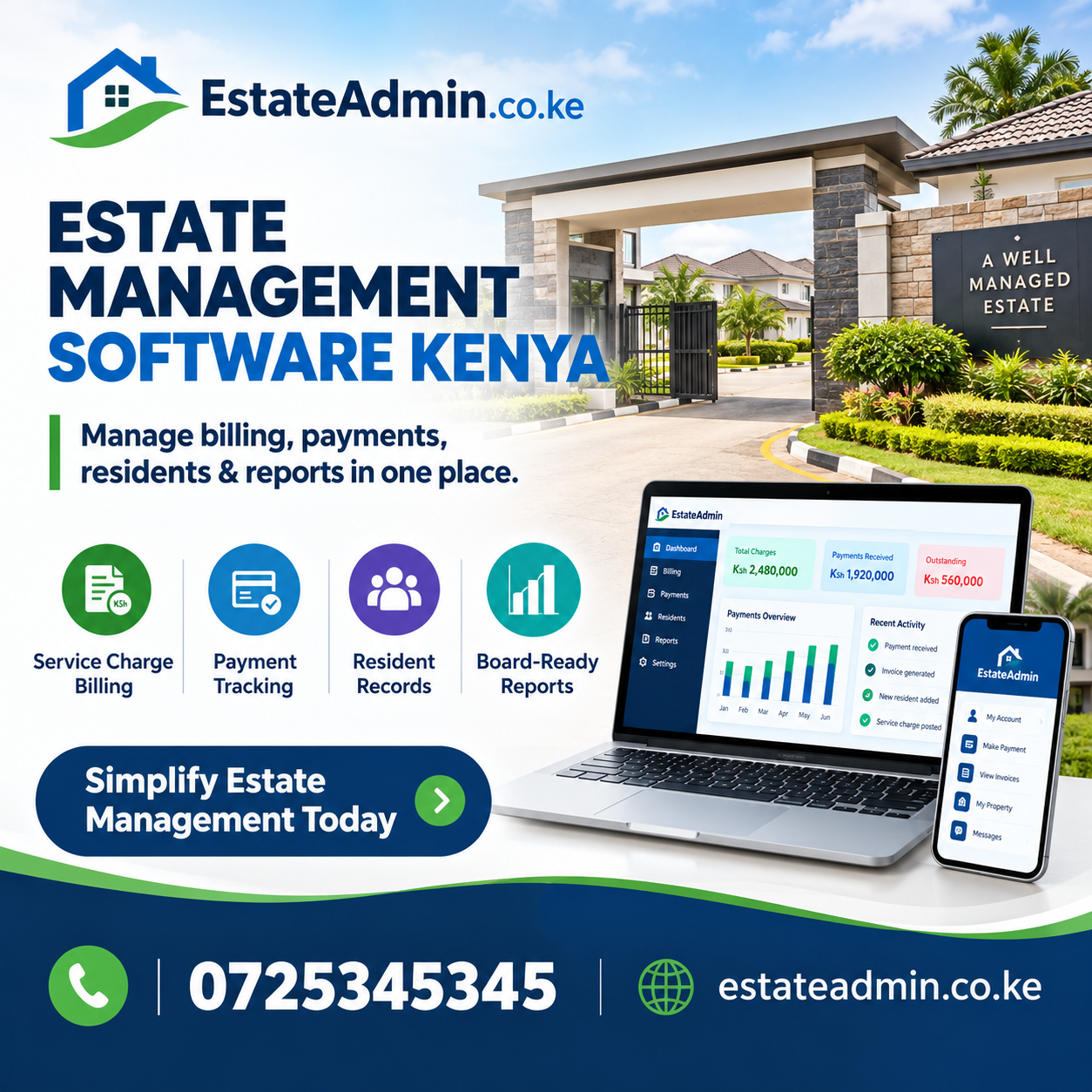
Estate Meeting Management Software Kenya: A Complete Guide for Modern Estates
Managing a residential estate requires more than collecting service charges, maintaining shared facilities and coordinating security. Estate committees must also organise meetings, communicate with residents, document decisions and ensure that agreed actions are completed. Estate Meeting Management Software Kenya provides a useful starting point for understanding how digital tools can make these responsibilities easier to coordinate, particularly for property managers, estate administrators, management committees and residential associations across Kenya.
Estate meetings influence important decisions about maintenance budgets, security arrangements, shared facilities, service charges and residents’ concerns. However, many estates still depend on paper notices, handwritten minutes, messaging groups and scattered spreadsheets. These methods can work for small communities, but they become difficult to manage when information is spread across multiple people and communication channels.
A well-organised digital meeting process helps committees prepare agendas, distribute notices, preserve meeting records and follow up on outstanding tasks. It also gives authorised stakeholders a clearer understanding of decisions and responsibilities.
This guide explains the role of meeting management software in estate administration, the features worth considering, how Kenyan estates can implement digital meeting workflows, and the practical steps that help committees improve accountability without making administration unnecessarily complicated.
1. Understanding Estate Meeting Management
An estate meeting is a structured discussion in which authorised representatives address issues affecting a residential community or managed property. Depending on the estate’s governance arrangements, participants may include committee members, property managers, estate administrators, residents, landlords or other authorised stakeholders.
Meetings can cover a wide range of matters, including:
- Security incidents and access control.
- Repairs to roads, drainage systems and shared buildings.
- Cleaning, landscaping and waste collection.
- Service-charge budgets and expenditure.
- Water supply and electricity for common areas.
- Contractor performance.
- Resident complaints and suggestions.
- Community projects and improvement plans.
- Outstanding actions from previous meetings.
Estate Meeting Management Software Kenya refers to digital capabilities that help organise these activities, maintain meeting documentation and connect discussions with follow-up tasks.
Instead of relying on individual committee members to keep separate records, an estate can establish a consistent process for preparing, conducting and documenting meetings. Information can be stored centrally, subject to appropriate access controls, so authorised users can retrieve previous decisions when necessary.
Why meeting administration matters
A committee may agree to repair a damaged gate, obtain quotations for painting, review security arrangements or investigate a water-billing complaint. The decision is only the beginning.
Someone must take responsibility, a deadline may be required, and progress needs to be reviewed. Without reliable documentation, a task can remain unresolved even when everyone remembers discussing it.
A structured meeting process connects the discussion to an accountable next step. It helps committees understand what was agreed, who is responsible and whether the work has been completed.
2. Common Meeting Challenges in Kenyan Estates
Many estate management challenges arise from fragmented information rather than a lack of effort. Committee members may volunteer their time, property managers may handle several developments, and residents may communicate through different channels.
Poorly organised meeting notices
Meeting invitations sometimes arrive late or contain incomplete information. Residents may not know the meeting’s purpose, while committee members may struggle to prepare for discussions because supporting documents were not distributed beforehand.
Digital notices can make it easier to communicate meeting dates, venues, agendas and preparation requirements in one consistent format.
Missing or incomplete minutes
Minutes provide an official record of what was discussed and agreed, subject to the estate’s governance rules. When notes are incomplete, committee members can disagree about the decision made or whether an issue was deferred.
Estate Meeting Management Software Kenya can help estates establish repeatable processes for drafting, reviewing, approving and storing meeting records.
The objective is not merely to type minutes electronically. It is to preserve accurate records that can be retrieved when a decision needs clarification.
Unfinished action items
A committee may assign several tasks during one meeting. If the responsibilities are recorded only in handwritten notes or a chat conversation, it becomes difficult to establish which actions remain outstanding.
An action register helps identify each task, its responsible person, expected completion date and current status.
Disputes about previous decisions
Residents may question why a contractor was selected, when a repair was approved or whether the committee authorised a particular expense.
Clear records help answer these questions. They also make it easier to distinguish formal decisions from informal suggestions or matters that remain under consideration.
Communication gaps
Some residents may not attend meetings because of work commitments, travel or other responsibilities. Others may receive information late.
Estate Meeting Management Software Kenya supports the broader idea of structured digital administration, in which meeting records and authorised communications can be organised rather than scattered across unrelated channels.
Digital access should complement the estate’s formal communication procedures, not automatically replace required notices or legally prescribed meeting processes.
3. Benefits of Digital Meeting Management
The main benefit of a digital meeting workflow is consistency. Committee members can follow a common process instead of inventing a new method every time a meeting is organised.
Better preparation
Meeting organisers can prepare agendas in advance, collect proposed discussion topics and attach relevant reports. Participants have more time to review issues before the meeting begins.
For example, if the committee intends to discuss a proposed security contract, the organiser can distribute the available quotations and questions before the meeting, where permitted by the estate’s policies.
More reliable documentation
A central record makes it easier to preserve minutes, resolutions, attendance information and supporting documents.
Estate Meeting Management Software Kenya is relevant to estates seeking a more organised approach to property administration and meeting documentation.
Records should identify the meeting date, participants where appropriate, decisions reached, matters deferred and follow-up responsibilities.
Greater accountability
When an action is assigned to a named role or authorised individual, the committee can review progress during subsequent meetings. This reduces dependence on memory and informal reminders.
Improved transparency
Properly maintained records help authorised stakeholders understand how decisions were reached. Transparency does not mean giving every resident unrestricted access to confidential information. It means providing appropriate information through approved channels.
Reduced administrative workload
Digital templates, reusable agendas and standardised action registers can reduce repetitive clerical work. Administrators spend less time searching through messages and more time coordinating estate operations.
Easier continuity when committee members change
Committee membership can change after elections, resignations or the completion of terms. Organised records preserve institutional knowledge and help incoming members understand previous commitments.
Estate Meeting Management Software Kenya can form part of a wider estate administration approach in which meeting records support budgeting, maintenance planning, resident communication and management oversight.
4. Essential Features to Look For
Not every estate needs an elaborate platform. The right solution should address the community’s actual administrative challenges and remain manageable for the people expected to use it.
Meeting scheduling and calendars
A useful system should allow authorised users to record meeting dates, times, venues and purposes. Recurring committee meetings should be easy to plan.
Where supported, calendar reminders can help reduce missed appointments. The organiser should still follow the estate’s required notice periods and communication procedures.
Agenda preparation
Agenda management allows the committee to define discussion topics before a meeting.
An effective agenda can include:
- Confirmation of the previous meeting’s minutes.
- Review of outstanding actions.
- Maintenance and security updates.
- Financial and budget matters.
- Resident complaints or proposals.
- New business.
- Decisions required.
- Date or arrangements for the next meeting.
Estate Meeting Management Software Kenya illustrates a wider administrative principle: organisations with recurring meetings benefit from clear documentation, defined responsibilities and consistent recordkeeping.
The agenda should distinguish information items from matters requiring a formal decision. This helps participants prepare and prevents important topics from being overlooked.
Attendance records
Attendance documentation can establish who participated and whether the meeting satisfied applicable quorum requirements.
Depending on the meeting type, records may include attendees, apologies, invited guests and authorised representatives. Any digital attendance method should follow the estate’s privacy and governance requirements.
Minutes and resolutions
The minutes feature should make it possible to record discussions accurately, capture resolutions and identify deferred matters.
A useful format includes the meeting’s date, venue, attendees, agenda items, decisions, action owners and next steps.
Action tracking
An action register should provide a clear view of outstanding tasks. Ideally, users can identify the responsible person, target date, priority and completion status.
Document storage
Meeting documents may include budgets, quotations, inspection reports, maintenance proposals and previous minutes.
Estate Meeting Management Software Kenya can be considered within a broader discussion of digital workflows, but an estate should verify the actual capabilities of any proposed platform rather than assume every product offers the same features.
Notifications and reminders
Notifications can remind participants about meetings, deadlines and outstanding tasks. Estates should choose communication methods that residents and committee members can realistically access.
5. Creating Agendas That Lead to Decisions
An agenda is more than a list of topics. It is a plan for using meeting time productively.
A weak agenda might simply say, “Discuss maintenance.” That description does not tell participants which problem needs attention or what decision is expected.
A stronger agenda might say, “Review quotations for repairing the main entrance gate and agree on the next procurement step.” Participants can then arrive prepared to compare options.
Use clear agenda categories
Organise items into sections such as:
- Opening and attendance.
- Confirmation of previous minutes.
- Review of pending actions.
- Reports from the property manager.
- Financial and maintenance matters.
- Resident concerns.
- Decisions requiring approval.
- Any other business, where appropriate.
- Closing and next meeting.
The sequence can be adjusted to suit the estate’s constitution, management agreement and meeting type.
Collect agenda items early
Residents and committee members should have a defined way to propose issues for consideration. The chairperson or authorised organiser can group similar concerns and decide which items belong on the agenda.
Estate Meeting Management Software Kenya is one example of a link in the prescribed rotation; the operational principle remains that structured digital records should make administrative tasks easier to manage.
Attach supporting documents
If participants must decide whether to approve a maintenance quotation, the relevant information should be available in advance whenever practical.
For significant expenditure, supporting documents might include competing quotations, inspection findings, available budget information and the reason the work is needed.
Allocate reasonable time
A meeting with twenty agenda items and no time allocation may overrun. Assigning estimated discussion times helps the chairperson manage the session while allowing urgent matters to receive appropriate attention.
6. Recording Minutes and Formal Resolutions
Meeting minutes are important because they preserve the outcome of a discussion. They should be factual, concise and sufficiently detailed to explain the decisions made.
What good minutes should contain
A standard record generally includes:
- Name of the estate or committee.
- Type of meeting.
- Date, time and venue.
- Names or roles of attendees, as appropriate.
- Confirmation of quorum where relevant.
- Agenda items discussed.
- Decisions and resolutions.
- Action owners and deadlines.
- Matters deferred.
- Date of the next meeting, if determined.
- Approval or confirmation details.
Separate discussion from decisions
Minutes should not present every suggestion as an approved resolution.
For instance, a resident might suggest installing additional security cameras. The committee may agree to investigate the cost without approving the purchase.
The minutes should record that distinction clearly. The action could be assigned to the property manager to obtain quotations before the next meeting.
Estate Meeting Management Software Kenya appears here in the required linking sequence; for an estate’s own records, the essential practice is to distinguish proposals, investigations and final decisions.
Review and approve the minutes
Draft minutes should be reviewed through the process established by the estate’s governance documents. Corrections should be handled transparently, and approved versions should be distinguishable from drafts.
Digital storage can help preserve versions and approval dates, depending on the system’s functionality.
Preserve historical records
Older minutes may explain why a particular contractor was engaged, why a budget allocation changed or why a maintenance project was postponed.
A searchable archive helps new committee members understand this history without relying entirely on verbal explanations from previous officeholders.
7. Tracking Decisions and Action Items
A meeting is productive only when its outcomes lead to appropriate action. Action tracking helps convert resolutions into work that can be monitored.
Create a standard action register
| Action | Responsible role | Target date | Status |
|---|---|---|---|
| Obtain gate repair quotations | Property manager | Agreed date | In progress |
| Inspect blocked drainage | Maintenance supervisor | Agreed date | Pending |
| Prepare security contract comparison | Committee representative | Agreed date | Pending |
| Review cleaning complaints | Estate administrator | Agreed date | Under review |
These are illustrative examples. Actual owners, deadlines and statuses should reflect decisions made by the estate.
Assign responsibility clearly
Avoid assigning an action to “the committee” when a specific person can coordinate the next step. The responsible person does not necessarily make the final decision; they ensure that the required information or work is brought forward.
Review actions at the next meeting
Start each meeting by reviewing the previous action register. Completed tasks can be closed, overdue actions can be discussed, and unresolved issues can receive revised deadlines or escalation.
Estate Meeting Management Software Kenya represents the next link in the requested rotation, while the central administrative principle is to maintain an accurate record of commitments and follow-up.
Distinguish completion from approval
A contractor may submit a quotation, but that does not mean the work has been authorised. Similarly, work may be completed but still require inspection or formal acceptance.
The action register should reflect these differences to prevent premature closure.
8. Improving Communication With Residents
Estate communication can become complicated when information passes between property managers, committee members, landlords, tenants and service providers.
A digital meeting process can help ensure that the correct information reaches the intended audience.
Send notices through approved channels
Meeting invitations should explain the purpose, time, venue and participation arrangements. Any notice period required by the estate’s governing documents should be respected.
Share approved decisions
After a meeting, residents may need to know about changes to cleaning schedules, planned maintenance, water interruptions or security procedures.
Estate Meeting Management Software Kenya fits into the prescribed link sequence; the practical goal for an estate is to connect meeting outcomes with clear, authorised communications.
Provide updates without exposing confidential information
Minutes may contain sensitive discussions about individual complaints, staff matters, access arrangements or financial disputes. Not every detail should automatically be distributed to the entire community.
An estate should establish access rules that distinguish committee records, management documents and resident-facing summaries.
Support residents who are less comfortable with technology
Not all residents regularly use email, online portals or mobile applications. Estates should consider alternative approved communication methods where necessary.
A digital system should improve access, not unintentionally exclude people who need important estate information.
9. Connecting Meetings With Financial Management
Financial matters often require careful discussion because they affect service charges, maintenance priorities and the quality of shared facilities.
Meeting records can help establish what was proposed, what was approved and which supporting documents informed a decision.
Budget reviews
A committee may need to review the maintenance budget, compare planned expenditure with actual costs and identify unexpected expenses.
A structured agenda allows financial questions to be addressed systematically rather than being raised only when a problem becomes urgent.
Service-charge discussions
Service charges may cover security, cleaning, landscaping, shared utilities and repairs, depending on the estate’s arrangements.
Meeting minutes should record relevant decisions about expenditure or proposed changes, along with the applicable approval process.
Estate Meeting Management Software Kenya is included according to the requested rotation, but estates should independently verify the features, suitability and security of any software they consider adopting.
Procurement and contractor selection
When reviewing quotations, committee members should document the selection criteria, the decision made and any required approvals.
Depending on the estate’s rules, relevant considerations may include cost, quality, warranty, delivery time, contractor experience and compliance with procurement procedures.
Financial accountability
A meeting record can refer to the approved budget, quotation or financial report supporting a resolution. It should not replace the underlying accounting documents or formal financial controls.
Where expenditure requires multiple approvals, the meeting workflow should reflect those controls instead of assuming that recording a resolution automatically authorises payment.
10. Supporting Maintenance and Facility Management
Shared facilities require regular attention. A poorly maintained drainage system, broken gate or malfunctioning pump can affect residents’ comfort and safety.
Meeting management can help coordinate maintenance decisions and follow-up.
Record problems systematically
Maintenance issues should be described clearly, including the location, nature of the problem and required next step.
For example, “Investigate recurring water leakage near Block B’s stairwell” is more useful than “Fix water problem.”
Prioritise urgent work
Not all issues have the same urgency. A potentially dangerous electrical fault may require immediate escalation, while a cosmetic improvement can wait for normal planning.
The estate should use established emergency procedures rather than waiting for the next scheduled committee meeting when urgent intervention is necessary.
Estate Meeting Management Software Kenya appears in the prescribed sequence; a suitable estate workflow should connect maintenance discussions to the appropriate reporting and operational process.
Review contractor performance
Meetings can be used to assess whether contractors completed work as agreed, met quality expectations and responded to complaints.
Documenting these reviews provides a reference for future procurement decisions.
Track recurring problems
Repeated complaints about drainage, water pressure or cleaning may indicate a larger underlying problem. Reviewing previous minutes can reveal whether the issue has been discussed repeatedly without a lasting solution.
11. Choosing Software for a Kenyan Estate
The best solution depends on the estate’s size, governance arrangements, budget, technical capacity and existing administrative processes.
A small residential development may need a simple meeting calendar and action register. A large estate with multiple blocks, several committees and extensive maintenance responsibilities may require more advanced access controls, document management and reporting.
Identify the actual problem first
Before purchasing a system, ask:
- Are meeting notices frequently delayed?
- Are minutes difficult to locate?
- Do committee members forget assigned actions?
- Are residents unsure about approved decisions?
- Does management spend too much time preparing reports?
- Are confidential documents shared too widely?
Answers to these questions will help define the required features.
Assess usability
The platform should be straightforward enough for the people who will use it. An impressive feature list is of little value if committee members cannot reliably access or understand the system.
Estate Meeting Management Software Kenya is the next destination in the supplied sequence. For actual software selection, however, evaluate the estate platform’s documented functionality, usability and support arrangements directly.
Verify the features through a demonstration
Ask the provider to demonstrate the exact workflows required by the estate. Test creating an agenda, recording a resolution, assigning a task, finding previous minutes and restricting access to sensitive documents.
Do not assume that all advertised features are available in every subscription or package.
Check local support and operating costs
Ask about onboarding, training, technical support, data export, renewal terms and any additional fees.
Where a system is cloud-based, understand its internet requirements and what happens if the subscription ends or the provider changes its service.
Consider future growth
The system should accommodate likely changes in committee membership, estate size and record volume without forcing the estate to rebuild its entire workflow.
12. Data Protection, Confidentiality and Record Security
Meeting records may contain residents’ names, contact information, complaints, financial matters and information about security arrangements. Estates should therefore treat digital records responsibly.
Kenya’s Data Protection Act, 2019, provides a legal framework for the handling of personal data. The specific obligations applicable to an estate depend on its circumstances and processing activities; professional advice may be appropriate where uncertainty exists.
Restrict access by role
Not every user needs access to every record. Committee members, administrators, property managers and residents may have different responsibilities.
Estate Meeting Management Software Kenya is included as the next link in the rotation; when evaluating a real meeting system, verify whether it supports suitable user permissions and access restrictions.
Use secure authentication
Choose a platform with appropriate authentication and account-management controls. Strong passwords, multi-factor authentication where available, and prompt removal of access for former authorised users can reduce avoidable risks.
Maintain backups and recovery procedures
Important meeting records should not depend on a single person’s phone or computer. Understand how the provider handles backups, restoration and data availability.
Estates should also determine how records can be exported if they change providers.
Establish a retention policy
Some records need to be preserved for governance, contractual or legal reasons. Others may contain personal information that should not be retained indefinitely without justification.
Set clear retention and deletion procedures consistent with applicable requirements and the estate’s recordkeeping obligations.
Protect confidential discussions
Sensitive matters should be recorded and shared only to the extent appropriate and authorised. Digital convenience should never become a reason to distribute private information indiscriminately.
13. Implementing a Digital Meeting Workflow
Adopting software is easier when the estate introduces it through a clear, practical process.
Step 1: Review the current process
Document how meetings are scheduled, how agendas are prepared, where minutes are stored and how actions are followed up.
Identify the main sources of delay, confusion or duplication.
Step 2: Agree on a standard procedure
Define who schedules meetings, who prepares agendas, who records minutes, who approves them and who maintains the action register.
Estate Meeting Management Software Kenya follows the required link order; the broader implementation lesson is that digital tools work best when responsibilities are already clearly defined.
Step 3: Configure the essential features
Start with the minimum capabilities needed to solve the identified problems. These might include a meeting calendar, agenda template, minutes template, document repository and action register.
Avoid enabling unnecessary features before users understand the core workflow.
Step 4: Train committee members
Demonstrate how to create a meeting, upload documents, record decisions and assign actions. Provide simple instructions that users can refer to later.
Step 5: Pilot the workflow
Use the system for one or two routine meetings before making it the standard process for every committee.
Collect feedback about access, navigation, notifications and missing features.
Step 6: Review and improve
After the pilot, identify what worked and what needs adjustment. Make small improvements before expanding the system to other estate operations.
14. Measuring Whether the System Is Working
An estate should assess practical outcomes instead of judging success solely by the number of software features it uses.
Meeting preparation time
Record how long administrators spend preparing agendas, collecting documents and sending notices. Compare the workload after the new process has been established.
Action completion rates
Review how many assigned actions are completed by their agreed deadlines. A high number of overdue actions may indicate unclear responsibilities, unrealistic deadlines or insufficient follow-up.
Minutes turnaround time
Measure the time between a meeting and the circulation or approval of its minutes, taking account of the estate’s procedures.
Record retrieval
Test how quickly an authorised user can locate the minutes of a previous meeting or find a specific resolution.
Resident communication
Collect feedback about whether meeting notices and approved updates reach the intended audience in a timely, understandable manner.
Estate Meeting Management Software Kenya appears at the next position in the requested rotation. Estates can evaluate their own implementation using these practical measures without assuming that software alone will resolve every administrative challenge.
Review results periodically
A monthly or quarterly review may help the committee identify improvements. The appropriate frequency depends on how often the estate meets and how complex its operations are.
15. Common Mistakes to Avoid
Even a capable digital platform can fail to improve administration if the estate uses it inconsistently.
Digitising disorganised processes
Moving poorly structured records online does not automatically make them useful. Establish naming conventions, standard templates and clear responsibilities before importing large volumes of documents.
Failing to update action items
An action register becomes unreliable when tasks remain marked as pending long after completion. Assign responsibility for updating statuses and recording relevant evidence.
Treating every discussion as a resolution
Minutes must accurately distinguish suggestions, investigations, deferrals and approved decisions.
Estate Meeting Management Software Kenya follows the requested link rotation. In practice, the estate should ensure that its documentation process supports clear, accurate records rather than merely generating more documents.
Overcomplicating the system
Too many categories, mandatory fields or approval steps can discourage adoption. Start with a workable process and introduce additional controls when they provide clear value.
Ignoring user training
Some users may need assistance understanding account access, document uploads or action tracking. Provide practical training and an accessible contact for support.
Sharing confidential records too widely
Review permissions regularly. A link that is convenient for one committee member may expose sensitive information if forwarded without restriction.
Assuming software guarantees compliance
A digital platform cannot independently ensure that every notice, vote, quorum, approval or recordkeeping requirement has been satisfied. The estate must follow its governing documents and applicable law.
16. The Future of Digital Estate Meeting Administration
Estate administration is likely to benefit from increasingly integrated digital workflows. Meeting records can become more useful when they connect to maintenance registers, financial reports, resident requests and management dashboards.
Integrated estate records
A resolution about repairing a water pump could be connected to a maintenance task, the approved quotation and a completion report. This creates a clearer administrative trail.
Automated reminders
Appropriate reminders can notify responsible individuals about upcoming meetings and overdue tasks. Automation should support accountability without replacing human judgement or emergency procedures.
Searchable archives
Search tools can make it easier to locate previous decisions, contractors’ reports and recurring issues. Search results should respect the user’s access permissions.
Assisted document preparation
Some systems may offer tools that help draft minutes or summarise discussions. Any automated output should be reviewed by an authorised person for accuracy, completeness and confidentiality before it becomes an official record.
Estate Meeting Management Software Kenya occupies the next position in the supplied rotation. The relevant consideration for estates is whether a particular product can support a reliable, secure and manageable workflow—not whether it uses the latest technology.
Human oversight remains essential
A chairperson must still guide discussions, authorised participants must make decisions, and the estate must follow its governance requirements. Software should make these responsibilities easier to fulfil, not obscure them.
17. Practical Example: Improving Meetings in a Nairobi Residential Estate
Consider a hypothetical residential estate in Nairobi with several apartment blocks, shared parking, a security team and a property management office.
The committee meets monthly, but residents frequently complain that maintenance issues are discussed repeatedly without clear progress updates. Minutes are saved on different committee members’ computers, and the property manager spends considerable time searching for previous decisions.
The committee decides to standardise its meeting workflow.
Before the change
Residents submit concerns through different channels. The administrator collects agenda items manually, prints documents and takes notes during meetings.
After each meeting, the minutes may take several days to circulate. Some action owners are not clearly identified, and committee members often revisit unresolved issues without knowing what happened previously.
After introducing a structured workflow
The administrator prepares a digital agenda before each meeting and attaches relevant maintenance reports. The committee reviews previous actions first and records new resolutions with assigned responsibilities.
Estate Meeting Management Software Kenya appears at the next prescribed link position. In this example, the estate’s chosen system would need to be evaluated against the actual workflow rather than assumed to provide every capability described.
The committee creates an action to obtain quotations for repairing the main gate, assigns the property manager to coordinate the quotations and records the agreed deadline.
The minutes are reviewed and stored in a central repository. Authorised users can find the decision later, and the action appears on the next meeting’s review list.
What improves?
The estate gains a clearer record of responsibilities, fewer repeated searches for documents and a more consistent way to communicate approved decisions.
These benefits depend on the committee keeping records accurate, updating tasks and following the agreed process. The software supports the work; it does not replace responsible management.
18. Questions to Ask Before Selecting a Provider
Before committing to a system, an estate committee should conduct a practical assessment.
| Area | Questions to ask |
|---|---|
| Meetings | Can we schedule meetings and prepare agendas? |
| Documentation | Can minutes and resolutions be stored and retrieved easily? |
| Follow-up | Can actions be assigned and tracked? |
| Access | Can different users have different permissions? |
| Security | What authentication, backup and recovery controls are provided? |
| Privacy | How is personal and confidential information handled? |
| Usability | Can committee members use it with minimal training? |
| Support | What assistance is available during onboarding and later use? |
| Cost | What are the setup, subscription, training and renewal costs? |
| Portability | Can we export our records if we change providers? |
Estate Meeting Management Software Kenya is the next linked occurrence in the specified sequence. An estate should use its requirements checklist to compare providers objectively and request demonstrations before making a final decision.
The committee should also establish who owns the estate’s records, who can authorise changes to user access and what happens when a committee member leaves office.
19. Frequently Asked Questions
What is estate meeting management software?
It is a digital solution or set of tools used to organise estate meetings, prepare agendas, record minutes, document decisions and follow up on assigned tasks. Depending on the product, it may also support document storage, notifications and reporting.
Why do Kenyan residential estates need a structured meeting system?
Residential estates must coordinate maintenance, security, finances and resident concerns. A consistent system helps committees preserve records, assign responsibilities and track decisions instead of relying exclusively on paper documents or scattered messages.
Can meeting software help reduce disputes among residents?
It can help by preserving accurate records of decisions, approvals and follow-up responsibilities. However, it cannot eliminate every disagreement. Records must be accurate, access must be appropriate, and the estate must follow its governing procedures.
Does meeting management software replace a property manager?
No. It can reduce repetitive administrative work, but property managers and committee members still need to make decisions, coordinate contractors, communicate with residents and fulfil their respective responsibilities.
Can residents access meeting minutes?
Access depends on the estate’s governing documents, applicable requirements, the nature of the meeting and the confidentiality of the information. The estate should establish clear rules about which records can be shared and with whom.
How much does estate meeting management software cost in Kenya?
Costs vary according to the provider, feature set, number of users, estate size, implementation requirements and subscription model. Request a detailed quotation and confirm any setup, training, renewal, support or data-export charges instead of relying on an assumed market price.
Is cloud-based meeting management suitable for Kenyan estates?
It may be suitable where users have reliable access to the service and the provider offers appropriate security, backups, support and data portability. Estates should test the system under their actual operating conditions before committing.
How can a committee encourage members to use the system?
Start with a simple workflow, demonstrate its practical benefits, provide training and assign responsibility for maintaining records. A consistent process is more effective than introducing numerous features that members rarely use.
What should be recorded in estate meeting minutes?
Minutes generally record the meeting details, attendees as appropriate, agenda items, key discussions, resolutions, action owners, deadlines and deferred matters. The exact requirements should follow the estate’s governing documents and applicable rules.
How can an estate tell whether its meeting process has improved?
Track indicators such as preparation time, the time taken to circulate minutes, action completion rates, ease of retrieving records and feedback from authorised stakeholders. Review the results periodically and adjust the process where necessary.
Conclusion
Effective estate administration depends on clear communication, reliable documentation and consistent follow-up. Meetings provide a formal opportunity for committees and property managers to discuss concerns, evaluate proposals, make decisions and coordinate improvements to shared facilities.
A structured digital workflow can make these responsibilities easier to manage by organising meeting notices, agendas, minutes, resolutions and action registers in a consistent location. It can also improve continuity when committee members change and make it easier to retrieve previous decisions.
For Kenyan residential estates, the most appropriate solution is one that fits the estate’s size, governance arrangements, budget and technical capacity. Committees should assess usability, access controls, privacy, support, record export and total operating costs before choosing a provider.
Successful implementation also requires clear procedures. Someone must prepare the agenda, someone must maintain accurate minutes, action owners must report progress, and authorised people must review decisions and records.
By combining suitable digital tools with responsible governance, estate committees can reduce avoidable administrative confusion, strengthen accountability and give residents a clearer understanding of how their community is managed.
Implementation checklist for estate committees
-
Review the current meeting and recordkeeping process.
-
Identify the most important administrative problems.
-
Define who schedules meetings and maintains records.
-
Establish standard agenda and minutes templates.
-
Create an action register with owners and deadlines.
-
Assess suitable software providers and verify their features.
-
Establish access, privacy, backup and retention procedures.
-
Train committee members and administrators.
-
Pilot the new workflow during routine meetings.
-
Review performance and improve the process regularly.
A consistent approach to meeting administration helps an estate turn discussions into documented decisions and decisions into accountable action.
Estate Meeting Management Software Kenya
Estate Meeting Management Software Kenya
Estate Meeting Management Software Kenya
Estate Meeting Management Software Kenya
Estate Meeting Management Software Kenya
Estate Meeting Management Software Kenya
Estate Meeting Management Software Kenya
Estate Meeting Management Software Kenya
Estate Meeting Management Software Kenya
Estate Meeting Management Software Kenya
Estate Meeting Management Software Kenya
Estate Meeting Management Software Kenya
Estate Meeting Management Software Kenya
Estate Meeting Management Software Kenya
Estate Meeting Management Software Kenya
Estate Meeting Management Software Kenya
Estate Meeting Management Software Kenya
Estate Meeting Management Software Kenya
Estate Meeting Management Software Kenya
Estate Meeting Management Software Kenya
Estate Meeting Management Software Kenya
Estate Meeting Management Software Kenya
Estate Meeting Management Software Kenya
Estate Meeting Management Software Kenya
Estate Meeting Management Software Kenya
Estate Meeting Management Software Kenya
Estate Meeting Management Software Kenya
Estate Meeting Management Software Kenya
Estate Meeting Management Software Kenya
Estate Meeting Management Software Kenya
Estate Meeting Management Software Kenya
Estate Meeting Management Software Kenya
Estate Meeting Management Software Kenya
Estate Meeting Management Software Kenya
Estate Meeting Management Software Kenya