
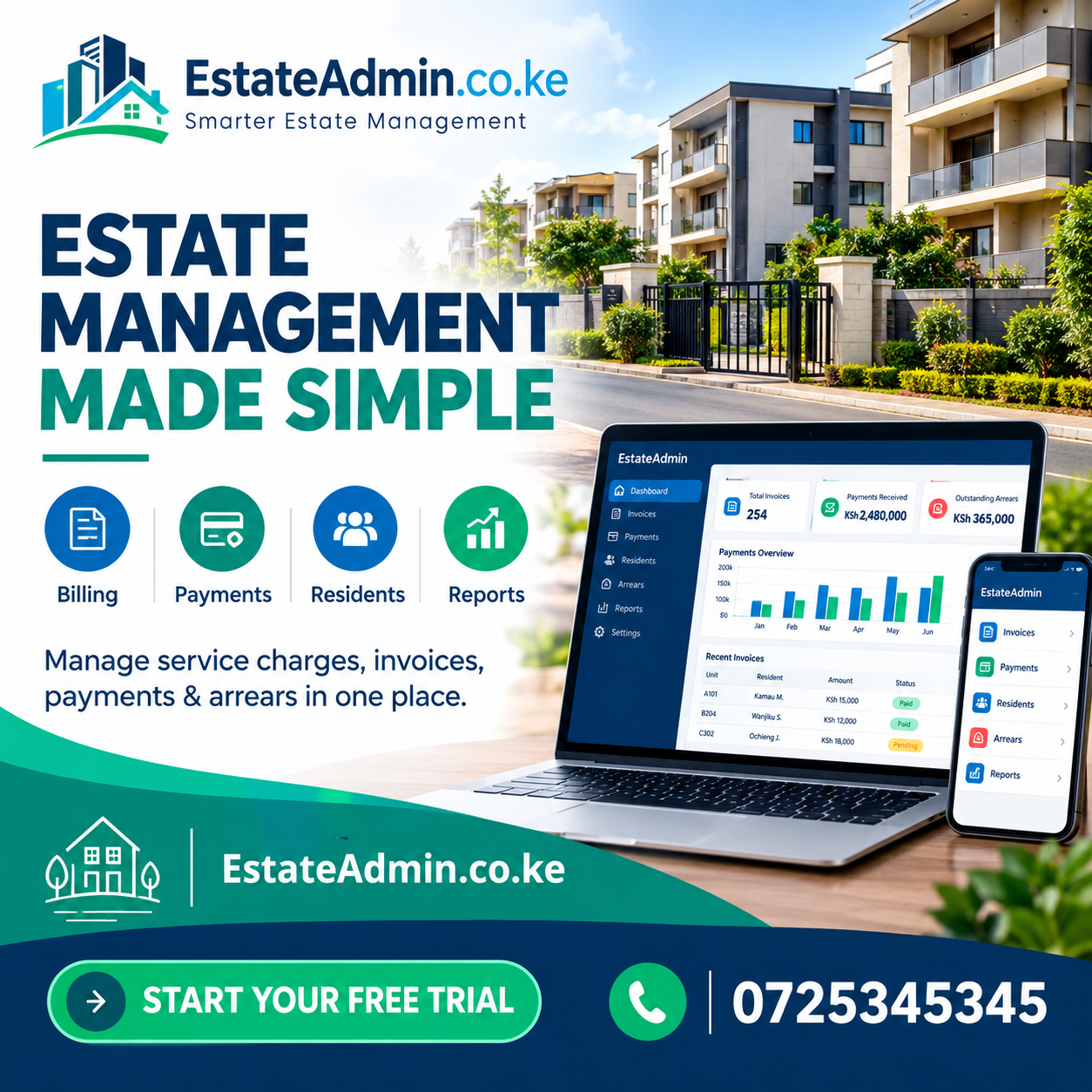
Estate Management Software Thika: A Practical Guide for Property Managers
Managing a residential estate in Thika involves much more than collecting rent and responding to tenant complaints. Property managers must maintain accurate tenant records, track payments, coordinate repairs, monitor service charges, communicate with residents and prepare reliable financial reports. As residential developments grow, these responsibilities become harder to manage using paper files, spreadsheets and scattered WhatsApp conversations. Estate Management Software Thika provides a useful starting point for understanding how digital property management can simplify these responsibilities and help estate managers maintain better control over daily operations.
Thika’s residential property market includes apartments, gated communities, rental compounds, mixed-use developments and privately managed residential estates. Each property type has different operational needs, but most managers face similar challenges: incomplete payment records, delayed maintenance, poor communication, unclear expense tracking and difficulty identifying outstanding balances. These problems can affect residents’ satisfaction, the estate’s finances and the long-term condition of buildings and shared facilities.
A structured digital system helps bring these activities together. Instead of maintaining separate records for tenants, payments, maintenance requests and expenses, managers can work from organised information that is easier to update and review. The right system also supports accountability by making it easier to establish who recorded a payment, when a complaint was received and whether a repair was completed.
This guide explains how Estate Management Software Thika can support residential property operations, the features worth prioritising, the challenges to consider before adopting a platform and the practical steps managers can take to improve their estates. It is intended for estate managers, property owners, landlords, caretakers, residential committees and property management companies serving Thika and surrounding communities.
The aim is not simply to introduce another technology tool. It is to explain how better records, clear procedures and consistent communication can make property management more reliable.
1. Understanding Estate Management in Thika
Estate management involves coordinating the people, finances, facilities and processes required to operate a residential development. The work continues throughout the property’s life, from welcoming new residents to maintaining shared infrastructure and preparing financial statements.
In Thika, an estate might contain a handful of rental units or hundreds of apartments. A small compound may rely on one caretaker and its owner, while a gated development may have a management company, security personnel, cleaning staff, maintenance contractors and a residents’ committee.
Although these arrangements differ, every estate needs dependable information.
Managing different types of residential properties
Residential property managers may oversee:
-
Apartment blocks with several landlords or a single owner.
-
Gated communities with shared access roads and security arrangements.
-
Rental compounds containing bedsitters, one-bedroom apartments and family houses.
-
Developments with shared water systems, parking spaces and waste collection services.
-
Mixed-use properties combining residential units with shops or offices.
-
Homeowners’ associations responsible for common areas and shared facilities.
Each property type requires a slightly different management approach. An apartment block may need detailed unit-level rent records, while a gated community may place greater emphasis on access control, shared landscaping and service-charge contributions.
A platform supporting Estate Management Software Thika should therefore be assessed according to the actual structure of the estate rather than the number of features advertised by its provider.
Why organised records matter
Consider a residential estate with 80 occupied units. If the manager tracks rent in one spreadsheet, utility contributions in a notebook and repair requests through personal messages, information can quickly become inconsistent.
A resident may have paid through M-Pesa, but the payment reference might not have been entered correctly. A caretaker may report a leaking pipe, but the request could disappear among unrelated conversations. An expense may be recorded without an invoice or a clear explanation.
These gaps make it difficult to answer basic questions:
-
Which units have outstanding balances?
-
How much money was collected during the month?
-
Which maintenance requests remain unresolved?
-
What was spent on security, cleaning and repairs?
-
Which residents need an official payment statement?
A well-organised system makes these questions easier to answer and gives management a clearer view of the estate’s performance.
2. Why Estate Managers Need a Digital Management System
Manual management can work for a very small property with few transactions. However, as the number of units, residents and service providers increases, administrative demands also grow.
Digital tools help reduce dependence on memory and scattered records. They also make it easier to establish consistent procedures that different members of the management team can follow.
Reducing administrative pressure
Without a central system, staff may spend considerable time copying payment information, checking old messages, preparing statements and asking colleagues for updates.
These activities consume time that could be spent inspecting the property, planning maintenance or addressing residents’ concerns.
Using Estate Management Software Thika can help consolidate records and reduce repetitive administrative work, depending on the platform’s capabilities and how consistently staff use it.
For example, when tenant details and unit assignments are maintained centrally, staff can retrieve information without searching through multiple files. If payment records are connected to individual accounts, managers can review balances more easily and prepare statements from organised transaction histories.
Automation should not eliminate human oversight. Instead, it should reduce avoidable manual work while leaving important financial approvals, exceptions and disputes subject to appropriate review.
Improving accountability
An estate may employ caretakers, accountants, security supervisors and external maintenance contractors. Each person needs a clear understanding of their responsibilities.
A digital workflow can record the progress of a maintenance request, identify the staff member assigned to it and preserve notes about the work performed. Financial workflows can similarly separate recording transactions from approving expenses.
For managers considering Estate Management Software Thika, role-based permissions and activity histories deserve particular attention. They help ensure that employees can access the information required for their duties without automatically receiving unrestricted access to every record.
Supporting better decisions
Reliable records help management identify patterns that would otherwise remain hidden.
For instance, recurring plumbing expenses may indicate a persistent infrastructure problem rather than isolated incidents. Repeated complaints about waste collection may point to a scheduling issue. A pattern of late service-charge payments could indicate that residents need clearer invoices or more convenient payment instructions.
When management can review trends over several months, decisions become less dependent on assumptions.
The value of a digital system therefore extends beyond administrative convenience. It can help the estate use money, staff time and maintenance resources more carefully.
3. Essential Features to Look For
Not every property management platform provides the same capabilities. Some focus primarily on rent collection, while others include maintenance, financial reporting, resident communication and broader estate administration.
Before selecting Estate Management Software Thika, management should identify the tasks that create the greatest difficulties and compare platforms against those requirements.
Tenant and occupancy management
Tenant records should be accurate, searchable and easy to maintain. Useful fields may include:
-
Tenant name and contact information.
-
Assigned building and unit number.
-
Occupancy start date and relevant agreement details.
-
Emergency contact information where appropriately collected.
-
Payment history and outstanding balances.
-
Correspondence and documented service requests.
-
Move-in, transfer and move-out records.
The system should make it possible to update information when a resident changes units or when a tenancy ends.
Access to sensitive personal information should be limited to authorised personnel. Management should also establish how records are retained, corrected and securely disposed of when they are no longer required.
Rent and service-charge tracking
Rent and service charges should be distinguishable, even when they are collected through the same payment channel.
Rent generally relates to occupation of a unit. Service charges may cover shared services such as security, cleaning, waste collection, lighting and maintenance of common areas, depending on the estate’s arrangements.
A suitable platform should allow management to record the amount due, the amount paid, the transaction date, any verified adjustments and the remaining balance.
When evaluating Estate Management Software Thika, managers should confirm whether the software can generate statements that explain transactions clearly instead of displaying only a single outstanding figure.
Maintenance request management
Maintenance is one of the most important operational responsibilities in a residential estate. Common requests include leaking taps, blocked drainage, damaged lighting, faulty gates, broken lifts, electrical faults and problems with shared water systems.
A maintenance module should help staff:
-
Record the reported problem.
-
Identify the affected unit or shared facility.
-
Assign a responsible person or contractor.
-
Set a priority according to urgency.
-
Track the repair’s progress.
-
Record materials, labour and other expenses.
-
Confirm completion and retain supporting notes.
A clear workflow helps prevent requests from being forgotten. It also gives management a record of recurring problems and repair costs.
Financial reports and expense tracking
Financial visibility is essential for property owners and estate committees. A management system should help reconcile income and expenditure, monitor unpaid balances and prepare reports for defined periods.
Useful reports may include monthly collections, outstanding rent, service-charge balances, maintenance expenditure, supplier payments and summaries of income against expenses.
However, software-generated reports are only as dependable as the information entered. Management should maintain proper supporting documents, review adjustments and reconcile payment records against bank or mobile-money statements.
4. Making Rent Collection More Reliable
Rent collection is a recurring responsibility that requires consistency, accurate records and clear communication. Problems arise when payments are received through different channels or when the records do not identify the units and accounts to which funds belong.
A digital process can make the collection cycle easier to manage.
Establishing a clear payment process
Residents should receive understandable information about when rent is due, which payment channels are accepted and how to identify a transaction.
For example, management may instruct residents to use a designated payment reference containing their unit number or another approved identifier. Staff should then verify the transaction before allocating it to a tenant account.
Using Estate Management Software Thika may help centralise these records where the chosen platform supports payment tracking and the required integrations.
Managers should never assume that a screenshot or an unverified message proves that money has reached the estate’s account. Payments should be confirmed through the appropriate financial records.
Handling partial payments
Some residents may pay in instalments because of temporary financial difficulties or an agreed payment arrangement.
The system should preserve the original amount due, each payment received and the remaining balance. If management approves a revised schedule, that agreement should be documented rather than silently changing the original records.
This creates a more transparent process for both residents and property managers.
Managing arrears fairly
An arrears report can identify accounts requiring follow-up. However, the report should support communication and verification rather than trigger automatic assumptions about a resident’s circumstances.
Before issuing a reminder, staff should check for unallocated payments, approved adjustments and genuine disputes. Residents should have a clear route for raising questions and supplying supporting evidence.
A consistent process reduces misunderstandings and helps management apply its policies fairly.
Reconciling mobile-money payments
M-Pesa is widely used for payments in Kenya, making mobile-money reconciliation relevant to many estates. A useful workflow records the transaction reference, amount, date and account to which the payment belongs.
Where integration is available, the software may import or receive transaction information. Managers should verify exactly what the integration does, whether it requires a separate service and how exceptions are handled.
A platform promoted for Estate Management Software Thika should not be assumed to offer direct M-Pesa integration unless the provider confirms that capability.
Good reconciliation practices include reviewing unmatched transactions, investigating duplicate entries and documenting corrections. These steps are important because a payment can be received successfully but allocated to the wrong resident or account.
5. Improving Tenant Communication and Resident Satisfaction
Residents judge estate management partly by how quickly and clearly their concerns are handled. Even when a problem cannot be fixed immediately, a clear acknowledgement and realistic update can reduce frustration.
Communication becomes difficult when the manager relies entirely on personal phone calls or informal messaging groups.
Creating a reliable communication channel
Management should establish approved channels for maintenance requests, announcements, payment enquiries and emergencies. Residents need to know which channel to use and when they can expect a response.
A platform supporting Estate Management Software Thika may provide communication features, resident portals or request-tracking functions, depending on its configuration.
Before adopting any communication module, confirm whether residents can submit requests directly, receive status updates and view previous correspondence.
Keeping announcements consistent
Residents may need information about planned water interruptions, gate repairs, waste collection schedules, security arrangements or meetings.
When messages are sent through multiple channels, some residents may receive conflicting information. A central announcement process helps management publish consistent updates and retain a record of what was communicated.
Announcements should be specific. Instead of saying that repairs will happen soon, management should provide the known date, affected area and expected inconvenience where those details are available.
Handling complaints professionally
A complaint should be recorded accurately, assigned to a responsible person and followed through to resolution.
Staff should avoid making promises they cannot fulfil. If an issue depends on a contractor, supplier or external authority, the resident should receive a realistic update about the next step.
Management should also distinguish urgent safety issues from routine requests. Exposed electrical wiring, serious water leaks and compromised security may require immediate attention, while cosmetic concerns can usually follow a different schedule.
6. Managing Maintenance, Repairs and Shared Facilities
The condition of shared facilities affects resident safety, satisfaction and the long-term value of a development. Poor maintenance can also lead to more expensive repairs when small problems are left unresolved.
A structured maintenance programme combines scheduled inspections with a clear process for responding to reported faults.
Preventive maintenance
Preventive maintenance involves inspecting and servicing equipment before failure occurs. Depending on the property, this may cover pumps, water tanks, drainage systems, gates, lighting, fire-safety equipment, lifts and other shared infrastructure.
The schedule should reflect the equipment, manufacturer recommendations, applicable requirements and the property’s actual condition.
With Estate Management Software Thika, where suitable maintenance functions are available, managers can organise recurring tasks, record inspection outcomes and track work that remains outstanding.
Prioritising repairs
A useful priority framework may separate requests into three categories:
| Priority | Example | Management response |
|---|---|---|
| Urgent | Serious electrical hazard, major leak or compromised entrance security | Take immediate safety measures and arrange urgent assessment |
| High | A shared water pump failure or a security light outage affecting important areas | Assign promptly and monitor progress |
| Routine | Minor cosmetic damage or a non-critical fitting replacement | Schedule within the normal maintenance plan |
These categories are examples rather than universal deadlines. Each estate should establish response targets appropriate to its facilities, staffing and risks.
Tracking maintenance expenditure
Repair costs may include labour, replacement parts, transport, contractor fees and disposal of damaged materials.
Recording these costs against the relevant work order helps management understand what was spent and why. Supporting invoices and approval records should be retained where required by the estate’s procedures.
When assessing Estate Management Software Thika, ask whether maintenance records can be connected to expenses and reports, or whether those tasks require separate modules.
Learning from recurring problems
A single repair may not reveal much about an estate’s condition. Repeated faults can reveal a larger problem.
If the same drainage section blocks every month, management may need a more permanent intervention. If several lighting units fail repeatedly, the issue may relate to equipment quality or electrical infrastructure.
Reviewing maintenance history helps managers decide when repeated repairs should be replaced by planned improvement work.
7. Managing Service Charges and Shared Estate Expenses
Service charges help fund the shared services that keep a residential development operational. Depending on the estate’s arrangements, these may include security, cleaning, waste collection, landscaping, common-area electricity and maintenance of shared infrastructure.
Disagreements often arise when residents do not understand how charges are calculated or how collected funds are used.
Separating income from expenditure
Management should maintain a clear record of charges raised, contributions received and expenses paid. If a development uses an annual budget, actual expenditure can be compared with planned expenditure to identify significant differences.
For example, an estate might budget for routine cleaning and security services each month. If expenses increase because additional services are required, management should document the reason and follow the relevant approval process.
A system supporting Estate Management Software Thika can help organise these records when it includes service-charge and expense-management capabilities.
Preparing understandable financial summaries
Residents and property owners may need periodic reports showing:
-
Total service charges billed during the reporting period.
-
Contributions received and balances outstanding.
-
Expenditure by category.
-
Payments made to approved suppliers.
-
Significant unexpected costs.
-
Remaining funds, where applicable.
Reports should explain their reporting period and the basis of the figures. Management should distinguish amounts invoiced from money actually received, since these are not the same.
Establishing spending controls
A digital record does not automatically prevent misuse of funds. Management still needs appropriate controls, including spending limits, approval procedures, supporting invoices and periodic reviews.
For larger expenses, the estate may require quotations and approval from a designated committee or property owner. The software should support these procedures rather than encourage informal spending.
When comparing Estate Management Software Thika, ask whether it supports approval workflows, supplier records and expense categorisation that match the estate’s requirements.
8. Improving Security and Access to Information
Residential security involves physical safeguards as well as the responsible handling of information. An estate may maintain records relating to residents, visitors, contractors, staff, payments and access permissions.
These records should be accurate, relevant and available only to people who need them for legitimate duties.
Managing visitor information
Depending on the property’s arrangements, visitor management may involve recording a visitor’s name, the unit being visited, the time of entry and the relevant authorisation.
Management should establish clear procedures for handling visitors, deliveries, contractors and emergency access. Digital visitor records can make reviews easier, but the system should collect only information that is reasonably necessary.
Before choosing Estate Management Software Thika, confirm whether visitor management is included or whether the platform focuses on financial and administrative tasks.
Applying appropriate user permissions
A caretaker may need to see unit assignments and maintenance requests but should not automatically be allowed to access every financial record. An accountant may need payment information without needing unrestricted access to all resident correspondence.
Role-based permissions help separate these responsibilities.
Managers should also remove or update access when employees leave, responsibilities change or external contractors no longer require access.
Protecting resident information
Estate managers should consider password security, secure connections, backups, account recovery and the provider’s data-handling practices.
They should also ask where information is stored, how it can be exported, who can access it and what happens when the service agreement ends.
Kenyan organisations handling personal information should consider their obligations under the Data Protection Act, 2019, and applicable regulations. Where necessary, they should obtain appropriate legal or data-protection advice.
9. Using Reports to Make Better Management Decisions
Reports turn day-to-day records into information that management can use to identify problems and set priorities.
A report is useful only when its figures are accurate, its definitions are clear and the person reading it understands what action may be needed.
Monitoring collections and outstanding balances
A monthly collection report can show the amount billed, payments received, adjustments and remaining balances. Management can use it to identify accounts that require verification or follow-up.
A simple report might contain:
| Measure | What it helps management understand |
|---|---|
| Amount billed | The total charges raised during the period |
| Amount collected | Payments verified and allocated to accounts |
| Outstanding balance | Amounts still due after accounting for verified transactions |
| Unallocated payments | Funds received but not yet matched to the correct account |
| Adjustments | Approved corrections, credits or other changes |
These measures should be reviewed together. A high outstanding balance, for example, might partly reflect unallocated payments rather than unpaid obligations.
Monitoring maintenance performance
Management can review the number of open requests, completed repairs, recurring faults and maintenance costs.
The purpose is not simply to measure staff. Reports should help determine whether the estate has enough resources, whether contractors are meeting agreed expectations and whether certain facilities need improvement.
Managers evaluating Estate Management Software Thika should establish whether its reporting features can produce the specific summaries they need without excessive manual work.
Planning budgets
Historical expenditure helps management prepare more realistic budgets. Water-system repairs, security services, cleaning supplies and common-area electricity may follow different cost patterns.
Budgets should allow for routine expenditure while recognising that unexpected failures can occur. Management should avoid assuming that past costs will remain unchanged indefinitely.
Comparing planned expenditure with actual spending throughout the year makes it easier to identify emerging pressures before they become major problems.
10. Supporting Landlords, Residents and Property Committees
A residential estate often has several groups with different responsibilities. The owner may be concerned with income and property condition, the caretaker with daily operations, residents with services and safety, and the management committee with budgets and oversight.
A well-designed process helps these groups access appropriate information without creating confusion over who makes decisions.
Helping property owners review performance
Owners need dependable records of income, expenditure, outstanding balances and maintenance activity. Clear statements can reduce the time required to investigate routine questions.
Where individual units belong to different owners, management should be able to distinguish unit-level financial information from shared estate accounts.
Using Estate Management Software Thika may help create a more consistent reporting process when the platform supports owner statements and the required account structure.
Supporting residents with self-service information
Some systems provide resident portals through which authorised users can view notices, submit maintenance requests or review selected account information.
Self-service functions can reduce routine enquiries, but they should be easy to use. Residents who are not comfortable with digital services should still have an accessible way to obtain assistance.
Management should test any portal on common mobile devices and ensure that access procedures are understandable.
Clarifying the committee’s role
Where a residents’ committee or homeowners’ association is involved, the management process should document which decisions require approval and which can be handled by staff.
For example, routine replacement of a faulty fitting may fall within an approved maintenance budget, while a major infrastructure project may require additional authorisation.
A platform that supports Estate Management Software Thika workflows should make it easier to preserve approvals, meeting decisions and supporting documents where those features are available.
11. How to Choose the Right Software for an Estate in Thika
The most suitable platform depends on the property’s size, management structure, available budget and operational priorities. A long feature list does not guarantee that a product will solve the estate’s actual problems.
Begin by identifying the tasks that consume the most time, create the greatest risk or generate the most frequent complaints.
Define the estate’s requirements
Prepare a list of essential functions before contacting providers. This may include tenant records, rent tracking, service-charge management, maintenance requests, expense records, reporting and resident communication.
Separate essential functions from features that would be useful but are not immediately necessary.
A smaller estate might prioritise simple payment records and maintenance tracking. A larger development might need multiple user roles, approval workflows, consolidated reporting and support for several buildings.
Evaluate ease of use
A platform can be technically powerful yet difficult to use. If staff find routine tasks confusing, records may remain incomplete or employees may return to informal methods.
Request a demonstration using realistic examples from the estate. Ask the provider to show how a staff member would register a resident, record a payment, assign a repair and produce a monthly report.
For managers considering Estate Management Software Thika, this practical demonstration is more informative than relying entirely on promotional descriptions.
Check mobile accessibility
Caretakers and maintenance staff may need to record information while moving around the property. Residents may primarily use smartphones to read notices or submit requests.
Check whether the platform works well on mobile browsers or offers a suitable application. Confirm what happens when connectivity is unreliable and whether any functions remain available offline.
Review customer support
Ask how users can obtain help, what support hours are available and whether onboarding or training is included. Find out how the provider handles technical problems, account recovery and service interruptions.
It is also sensible to request a written description of the support arrangement before committing to a subscription.
Compare the total cost
Software costs may include more than the advertised monthly subscription. Additional expenses could include implementation, training, integrations, data migration, messaging, extra user accounts or specialised reports.
Request a clear breakdown of the expected costs and the terms governing renewals or cancellation.
A system is worthwhile when the operational improvements justify its total cost. The cheapest option may be unsuitable if it lacks essential controls, while an expensive package may offer features the estate will never use.
12. Planning a Successful Software Implementation
Introducing a new management platform requires preparation. Moving to digital records without agreeing on procedures can simply transfer old mistakes into a new system.
A careful implementation should begin with the information and workflows the estate already uses.
Step 1: Review existing records
Collect the current unit register, tenant details, payment records, outstanding balances, maintenance history, supplier information and relevant financial documents.
Identify missing information and resolve inconsistencies where possible. For example, if a resident’s payment appears in the bank statement but not in the rent register, investigate it before importing the balance.
Do not assume that every entry in an old spreadsheet is accurate.
Step 2: Clean and organise the data
Use consistent unit identifiers, resident names, dates and transaction references. Separate rent from service charges and distinguish actual payments from estimates or planned contributions.
Remove unnecessary duplicate records and establish a clear process for handling historical information that cannot be verified.
When preparing to use Estate Management Software Thika, agree on which records will be transferred and who is responsible for checking them.
Step 3: Configure the workflows
Set up the property’s buildings, units, user roles, recurring charges, payment categories and maintenance priorities.
Configure the system around the estate’s approved procedures rather than changing important financial practices merely to fit a default setting.
Where the software allows custom fields, use them carefully. Too many unnecessary fields can make routine data entry slower and less consistent.
Step 4: Train the people who will use it
Training should focus on everyday tasks, not just a general product presentation.
Staff should understand how to record transactions, correct mistakes, assign maintenance requests, prepare reports and protect confidential information.
It is helpful to appoint one person to coordinate questions and monitor whether records are being entered consistently.
Step 5: Test before full adoption
Start with a limited group of units or a controlled set of transactions if the provider supports a suitable pilot.
Compare the software’s balances with independently verified records. Check that reports use the correct dates, that user permissions work and that maintenance requests follow the intended process.
Only expand usage after important discrepancies have been investigated.
Step 6: Review progress after launch
During the initial weeks, track problems reported by users, missing information, unresolved transactions and tasks that still depend on manual work.
Schedule regular reviews with staff to identify what needs adjustment.
The goal is a reliable operating process, not merely a successful software installation.
13. Common Mistakes to Avoid
Several avoidable mistakes can reduce the value of a property management system.
Choosing software without a needs assessment
Buying a platform because it looks impressive can lead to unnecessary costs and complicated procedures.
Management should first identify the estate’s priorities and evaluate each product against them.
Failing to reconcile imported balances
Historical data may contain duplicate transactions, missing receipts or outdated tenant details. Importing these records without verification can create disputes that are difficult to resolve later.
Maintain a documented opening balance and verify important figures before relying on new reports.
Allowing unrestricted access
Shared passwords and excessive permissions make it difficult to determine who changed a record or accessed confidential information.
Provide individual accounts where possible, assign permissions according to duties and review access regularly.
Keeping parallel records indefinitely
During a transition, some manual records may be necessary for verification. However, maintaining several permanent versions of the same information creates uncertainty about which one is authoritative.
Define the approved system of record and establish a controlled process for correcting discrepancies.
Ignoring staff feedback
Employees who use the system daily often notice practical problems that managers may overlook.
Listen to their feedback, but distinguish genuine operational obstacles from resistance caused by unfamiliarity. Provide training and adjust workflows where appropriate.
Assuming automation removes the need for oversight
Automated reminders, calculations and reports can save time, but they cannot guarantee that source data is correct.
Review exceptions, reconcile financial information and retain human approval for decisions that require judgement.
Failing to plan for service interruptions
Management should understand how to obtain important records if the platform becomes temporarily unavailable.
Ask about backup frequency, recovery procedures, export options and the provider’s responsibilities during an outage.
14. Costs, Value and Return on Investment
The financial case for adopting a management platform should be based on the estate’s actual requirements and expected operational improvements.
Subscription prices differ between providers, so managers should request current quotations rather than rely on general estimates.
Understand the full cost of ownership
Consider the following cost categories:
| Cost category | Questions to ask |
|---|---|
| Subscription | Is pricing monthly, annual or based on the number of units? |
| Setup | Is initial configuration included? |
| Training | Are staff training sessions included in the quoted price? |
| Integration | Are payment, accounting or messaging integrations charged separately? |
| Data migration | Is importing existing records included? |
| Support | Are there additional charges for assistance? |
| Expansion | What happens when more units or users are added? |
| Exit arrangements | Can the estate export its data when the agreement ends? |
A transparent quotation makes it easier to compare products on equal terms.
Estimate the time saved
Suppose an administrator spends several hours each week preparing payment summaries, searching for maintenance updates and answering routine account enquiries.
If a digital workflow reduces some of that work, the saved time can be redirected to inspections, resident support and financial review.
Management should measure actual time before and after implementation rather than assuming that every advertised efficiency will materialise.
Consider avoided administrative errors
Incorrect payment allocations, forgotten maintenance requests and duplicate expense entries can consume staff time and undermine trust.
A more consistent recordkeeping process may reduce these problems, although the outcome depends on training, system quality and adherence to procedures.
Assess value beyond direct savings
The benefits may also include clearer accountability, more timely maintenance, improved communication and better financial visibility.
For an estate committee, these improvements can be valuable even when the software does not produce an immediate measurable reduction in expenditure.
When comparing Estate Management Software Thika, evaluate the expected benefits against the full cost and the practical work required to maintain reliable records.
15. Kenyan Compliance and Responsible Recordkeeping
Property management software can support compliance by organising records, preserving transaction histories and helping staff follow established procedures. However, purchasing software does not automatically make an estate compliant with every applicable legal requirement.
Management should understand which laws, agreements and professional obligations apply to its particular property and responsibilities.
Protecting personal data
The Kenyan Data Protection Act, 2019, establishes requirements concerning the processing of personal data. Estate managers should consider the purpose of collecting residents’ information, the lawful basis for processing it, appropriate security measures and the rights of the individuals concerned.
Practical measures include limiting access to personal information, avoiding unnecessary data collection, maintaining appropriate retention practices and reviewing how third-party service providers handle records.
Management should not collect sensitive information merely because a software form makes it possible.
Maintaining financial documentation
Receipts, invoices, payment records and approval documents support transparent financial administration. Records should be sufficiently clear to explain the nature, date and purpose of a transaction.
The appropriate accounting and tax treatment depends on the circumstances of the property and the organisation managing it. Where necessary, obtain guidance from a qualified accountant or relevant adviser.
Keeping agreements and policies organised
Property managers may need to maintain tenancy agreements, contractor contracts, approved budgets, meeting decisions and internal procedures.
A central document repository can make these records easier to retrieve, but access should be controlled and important documents should have suitable backup arrangements.
Before using Estate Management Software Thika, confirm whether document storage is included and whether the system can meet the estate’s retention, access and export requirements.
Reviewing contractual responsibilities
Management agreements and service contracts may specify reporting obligations, approval limits, response expectations and recordkeeping requirements.
Software workflows should reflect those responsibilities. A platform should support the agreed process rather than replace necessary legal or contractual review.
16. The Role of M-Pesa and Digital Payments
Digital payments are an important consideration for many Kenyan property managers because residents may prefer paying through mobile money or bank transfers.
The main challenge is not simply receiving money. It is ensuring that every verified payment is recorded accurately and allocated to the correct account.
Use clear payment references
An estate can establish a consistent reference format for residents to use when making payments. The reference should help distinguish units or accounts without exposing unnecessary personal information.
Staff should explain the required format and what residents should do if they enter an incorrect reference.
Reconcile transactions regularly
Payments should be checked against the relevant financial records. Unmatched entries should be investigated, while duplicate or incorrectly allocated records should be corrected through a documented process.
A payment dashboard is useful only if the information shown reflects verified transactions.
Confirm integration capabilities
Some platforms may support direct payment integrations, while others rely on manual entry or imported statements.
Ask providers about supported payment channels, reconciliation rules, transaction fees, exception handling and the steps required to activate the service.
Do not assume that every platform marketed for Estate Management Software Thika includes a direct connection to M-Pesa or automatically confirms every transaction.
Communicate payment outcomes clearly
Residents should know how to confirm that their payments have been received and how to report a discrepancy.
Where the system supports receipts or account statements, these can help residents retain their own records. Management should also provide a way to resolve cases where a payment has been made but not yet allocated.
17. Building a More Resident-Friendly Estate
Good estate management requires consistent service, clear communication and attention to shared spaces. Software can support these objectives, but it cannot replace thoughtful policies or responsible staff.
Make service requests easy to submit
Residents should not need to contact several employees to report one problem. Establish a clear route for routine maintenance, urgent issues, account enquiries and complaints.
If a digital request form is available, keep it simple enough to use on a smartphone.
Set realistic response expectations
Management should explain how requests are prioritised and when residents can expect an update. Acknowledging a request is different from completing the repair, so communications should make that distinction clear.
A well-managed process gives residents useful information even when the work takes longer than expected.
Monitor common-area cleanliness
Cleaning schedules, waste collection and inspection routines affect the everyday experience of residents.
Management can use recurring task lists and inspection records to check whether agreed duties have been completed. Problems should be documented and assigned rather than repeatedly discussed without follow-up.
Use feedback constructively
Feedback can reveal concerns that are not obvious from financial reports. Residents may identify poor lighting, inconvenient collection schedules, damaged shared facilities or recurring communication failures.
Management should categorise feedback, identify recurring themes and communicate any action taken.
When using Estate Management Software Thika, the priority should remain practical service improvement rather than collecting feedback that nobody reviews.
18. A Practical 30-Day Improvement Plan for Estate Managers
A structured first month can help an estate improve its management processes without trying to change everything at once.
The following plan can be adapted to the size and complexity of the property.
Week 1: Identify the main problems
Review the estate’s current procedures for rent collection, service charges, maintenance, complaints and reporting.
Speak with the staff responsible for each activity. Identify the tasks that take the most time and the records that are frequently missing or inaccurate.
Choose three priorities for improvement. For example, the estate might focus on reconciling payments, tracking maintenance requests and preparing monthly financial summaries.
Week 2: Standardise records and procedures
Create consistent unit identifiers, transaction categories and maintenance request forms. Agree on how payments will be verified, how complaints will be assigned and who can approve expenses.
Document the procedures so that staff members follow the same approach.
Week 3: Introduce or improve digital workflows
Configure the selected software or improve the use of an existing platform. Import verified records, train staff and test essential functions.
If the estate is considering Estate Management Software Thika, use this stage to check that the platform supports the priority workflows and that its reporting matches the estate’s requirements.
Week 4: Measure the results
Review the information collected during the first three weeks. Compare the completeness of payment records, the number of unresolved maintenance requests and the time needed to prepare reports.
Ask staff and residents whether communication has improved and whether any new problems have emerged.
Use the findings to adjust procedures for the following month.
This approach encourages gradual improvement. It also makes it easier to distinguish problems caused by the software from problems caused by incomplete records or unclear responsibilities.
19. Frequently Asked Questions
1. What is Estate Management Software Thika?
It refers to digital tools used to organise the administration of residential estates in Thika. Depending on the platform, these tools may support tenant records, rent collection, service charges, maintenance requests, financial reports and resident communication.
The appropriate solution depends on the property’s size, management structure and operational requirements.
2. Can small residential estates benefit from property management software?
Yes. A small estate can benefit from organised tenant information, consistent payment records and a reliable maintenance register. However, the platform should be proportionate to the property’s needs and budget.
A simple system that staff use consistently may be more useful than a complex package with many unnecessary features.
3. Does estate management software support M-Pesa payments?
Some platforms offer payment integrations or transaction reconciliation, while others require manual recording or statement imports. Capabilities vary by provider.
Before purchasing a system, confirm the supported payment channels, transaction fees, verification process and treatment of unmatched payments.
4. Can software help reduce rent arrears?
It can help managers identify outstanding balances, review payment histories and send reminders where those features are available. This makes follow-up more organised.
However, software cannot guarantee that residents will pay on time. Managers must still verify transactions, resolve disputes and follow applicable agreements and procedures.
5. How does software improve maintenance management?
It provides a structured way to record faults, assign work, set priorities and track completion. Some systems also connect work orders to repair expenses and recurring maintenance schedules.
This can reduce forgotten requests and help managers identify recurring infrastructure problems.
6. Is property management software suitable for gated communities?
Yes, provided the selected platform supports the community’s requirements. Useful capabilities may include resident records, service-charge tracking, shared-facility maintenance, notices and visitor management.
Managers should verify which features are included and whether additional integrations are required.
7. How much does estate management software cost in Kenya?
There is no single price that applies to every provider. Costs depend on factors such as the number of units, included features, user accounts, integrations, implementation and support.
Request a quotation based on the estate’s actual requirements and compare the total cost over the intended contract period.
8. Is resident information safe in a digital property management system?
Security depends on the provider’s safeguards and the estate’s own practices. Managers should review access controls, authentication, backups, data export arrangements and the handling of personal information.
They should also establish internal policies that limit access to authorised personnel and support compliance with applicable Kenyan data-protection requirements.
9. Can property managers use software on their phones?
Many modern platforms provide mobile-friendly websites or applications, but availability differs by provider. Ask for a demonstration on a typical smartphone and test important tasks such as viewing a statement or submitting a maintenance request.
Also confirm whether essential functions require a continuous internet connection.
10. How should an estate choose the best management system?
Start by listing the estate’s most important requirements. Compare available platforms on functionality, ease of use, reporting, security, support and total cost.
Request a practical demonstration, test important workflows and verify that the provider can explain its data protection and export arrangements before signing an agreement.
20. Conclusion: Better Estate Management Through Organised Systems
Managing a residential estate in Thika requires consistent attention to finances, maintenance, communication, security and resident satisfaction. When these responsibilities depend on scattered spreadsheets, paper files and individual memory, important information can be difficult to find and routine tasks can become unnecessarily complicated.
A well-chosen digital platform helps bring essential records and workflows together. It can support more accurate rent tracking, clearer service-charge reporting, structured maintenance, consistent resident communication and better-informed management decisions.
The benefits, however, depend on more than purchasing software. Estate managers must establish clear procedures, maintain accurate information, train employees and review the quality of their records. Financial transactions still require verification, maintenance requests need responsible follow-up, and residents deserve clear explanations when questions arise.
For property owners, management committees and professional estate managers, the sensible approach is to identify the estate’s most pressing problems and choose tools that address those needs without introducing unnecessary complexity.
Estate Management Software Thika is a useful search term when researching digital solutions for residential property administration. The next step is to compare available platforms carefully, request demonstrations and confirm the capabilities, costs and support arrangements relevant to the property.
With reliable records and consistent processes, an estate can improve accountability, use resources more effectively and provide residents with a better-managed living environment.
Estate Management Software Thika
Estate Management Software Thika
Estate Management Software Thika
Estate Management Software Thika
Estate Management Software Thika
Estate Management Software Thika
Estate Management Software Thika
Estate Management Software Thika
Estate Management Software Thika
Estate Management Software Thika
Estate Management Software Thika
Estate Management Software Thika
Estate Management Software Thika
Estate Management Software Thika
Estate Management Software Thika
Estate Management Software Thika
Estate Management Software Thika
Estate Management Software Thika
Estate Management Software Thika
Estate Management Software Thika
Estate Management Software Thika
Estate Management Software Thika
Estate Management Software Thika
Estate Management Software Thika
Estate Management Software Thika
Estate Management Software Thika
Estate Management Software Thika
Estate Management Software Thika
Estate Management Software Thika
Estate Management Software Thika
Estate Management Software Thika
Estate Management Software Thika
Estate Management Software Thika
Estate Management Software Thika
Estate Management Software Thika
Estate Management Software Thika
Estate Management Software Thika
Estate Management Software Thika
Estate Management Software Thika
Estate Management Software Thika
Estate Management Software Thika
Estate Management Software Thika
Estate Management Software Thika
Estate Management Software Thika
Estate Management Software Thika
Estate Management Software Thika
Estate Management Software Thika
Estate Management Software Thika
Estate Management Software Thika
Estate Management Software Thika