
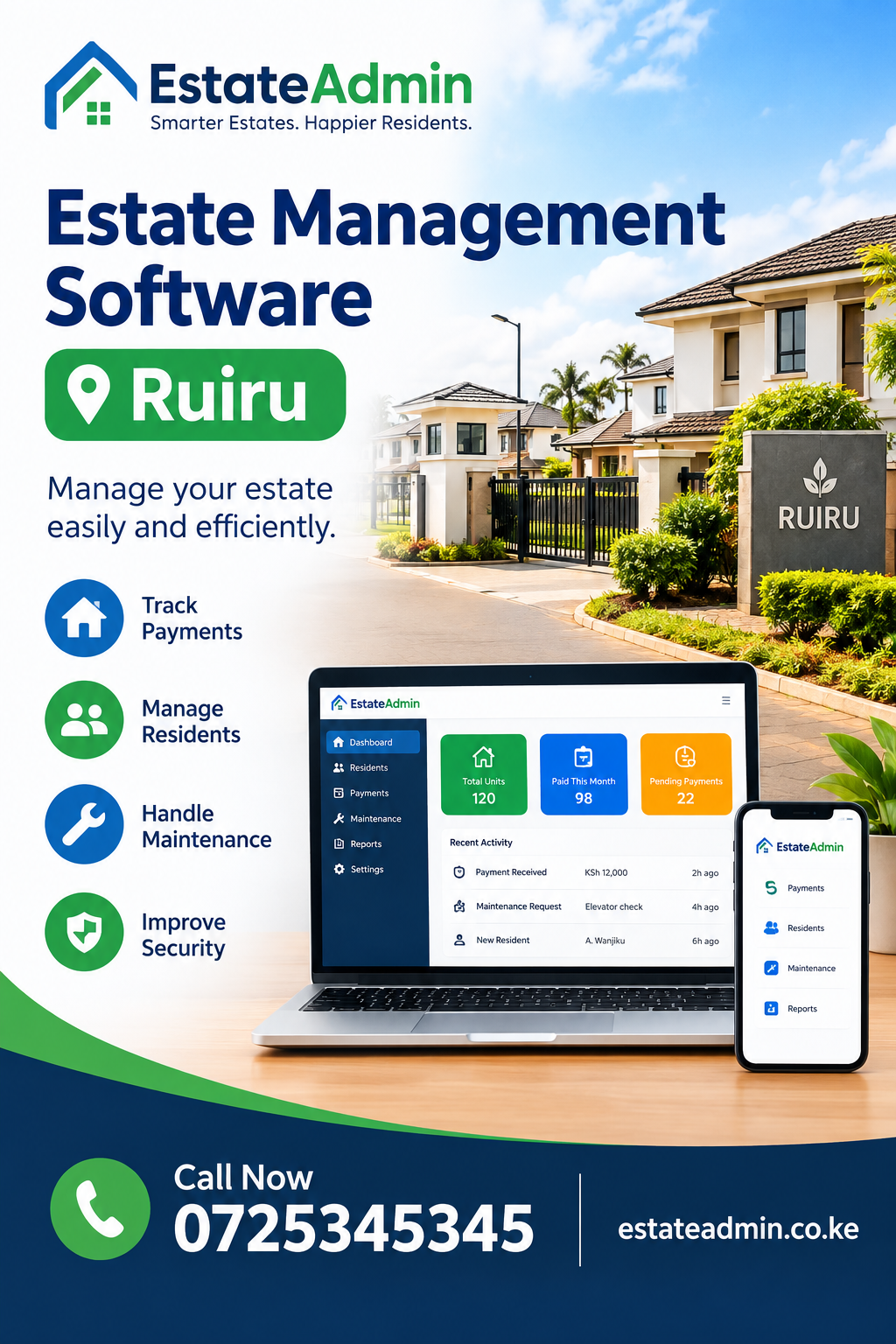
Estate Management Software Ruiru: Complete Guide for Property Managers and Landlords
Managing rental properties in Ruiru requires careful attention to rent collection, tenant records, maintenance, leases, expenses, communication and reporting. As residential developments continue to expand around areas such as Kimbo, Membley, Tatu City, Githurai, Kamakis and surrounding neighbourhoods, property managers need organized systems that can handle growing portfolios without depending entirely on notebooks and scattered spreadsheets. Estate Management Software Ruiru provides a practical way to centralize these activities, giving landlords, estate managers and property administrators better visibility over daily operations.
For a landlord managing a few units, the need may begin with simple rent tracking. For an estate manager responsible for several buildings, the requirements become more complex. You may need tenant profiles, payment records, invoices, arrears tracking, maintenance requests, expense records and financial reports in one place. This guide explains what property professionals should look for, how software can improve estate administration, and how to evaluate a system before introducing it into a Ruiru property.
Understanding Modern Estate Management
Estate management involves much more than collecting rent. A property manager must keep accurate information about units, occupants, leases, payments, repairs, expenses and other activities connected to the property.
A structured digital system can help organize these records so that information is easier to find and update. For example, Estate Management Software Ruiru can be considered as part of a wider digital approach where property information, payment workflows and operational records are brought together.
The main objective should not simply be to replace paper with software. The real objective is to create a reliable workflow. A good system should make it easier to answer questions such as:
- Which tenants have paid this month?
- Which units have outstanding balances?
- Which leases are approaching expiry?
- Which maintenance requests remain unresolved?
- How much rent was collected during a particular period?
- What expenses were incurred?
- Which properties generate the most revenue?
- Which units are currently vacant?
When these answers are available without searching through multiple files, daily property administration becomes more manageable.
Why Ruiru Property Managers Need Better Systems
Ruiru has a wide range of residential and commercial developments. Property owners may manage apartments, gated communities, standalone rental houses, student accommodation, commercial spaces or mixed-use buildings.
Different properties create different administrative requirements. A landlord with ten units may be able to manage records manually, but the same approach becomes increasingly difficult when the portfolio reaches dozens or hundreds of units.
Estate Management Software Ruiru can support a more structured workflow by helping property teams organize information around individual properties and units rather than keeping everything in disconnected documents.
One of the biggest challenges with manual administration is inconsistency. One person may record payments in a notebook while another updates a spreadsheet. A tenant may send proof of payment through WhatsApp while the accountant records it separately. Maintenance requests can also be buried inside conversations.
A centralized system reduces this fragmentation.
Common Problems With Manual Property Administration
Property managers commonly face difficulties such as:
- Missing tenant information
- Delayed payment updates
- Incorrect balances
- Lost maintenance records
- Difficult monthly reporting
- Poor visibility into arrears
- Duplicate records
- Time-consuming reconciliation
- Difficulty tracking expenses
- Limited portfolio visibility
These problems become more noticeable as the number of units increases.
Estate Management Software Ruiru gives property teams a framework for organizing these processes digitally. Instead of treating rent, tenants, maintenance and reporting as completely separate activities, the information can be connected within one management workflow.
Centralizing Tenant Records
Tenant information is one of the most important parts of estate administration. A property manager may need to know the tenant’s name, contact details, assigned unit, rent amount, payment history, lease information and outstanding balance.
A centralized tenant database makes this information easier to access. Estate Management Software Ruiru can be useful for structuring tenant records alongside other property information.
A good tenant management module should make it possible to:
- Create tenant profiles.
- Assign tenants to specific units.
- Record tenancy details.
- Track payment history.
- Store relevant documents.
- Monitor outstanding balances.
- Record communication or operational notes where appropriate.
This becomes especially valuable when a property manager is handling several buildings.
Instead of opening multiple spreadsheets to determine who occupies a particular unit, the manager can search the system and locate the relevant information.
Improving Rent Collection
Rent collection is one of the most important responsibilities for landlords and property managers. Delayed payments can affect cash flow, maintenance budgets, supplier payments and overall property performance.
Estate Management Software Ruiru can help organize rent information by connecting tenants, units, expected payments and actual payments within the same administrative environment.
A digital rent workflow can provide visibility into:
- Rent due
- Rent paid
- Partial payments
- Outstanding balances
- Arrears
- Payment dates
- Tenant payment history
For Kenyan landlords, payment processes should also consider commonly used digital payment methods. M-Pesa is particularly relevant to rental operations, so property software that supports appropriate payment workflows can reduce the amount of manual recording required.
Why Payment Records Matter
A payment is not fully useful to a property manager if it cannot be matched correctly to the right tenant and unit.
Consider an apartment building with 100 tenants. If payments arrive without a structured reconciliation process, the manager may spend considerable time determining who has paid, which unit the payment belongs to and whether the tenant has cleared the entire amount.
Estate Management Software Ruiru can be part of a broader digital administration strategy that emphasizes structured records and traceable workflows.
The goal is to make payment information easier to verify and report.
Managing Rent Arrears
Arrears are another important area of property management. A manager needs to know not only that money is outstanding, but also how much is outstanding, which tenant owes it and how long the balance has remained unresolved.
Estate Management Software Ruiru can help organize arrears information so managers can focus their follow-up efforts on accurate records.
A useful arrears workflow should make it easy to identify:
- Tenants with overdue balances
- Total outstanding amounts
- Payment history
- Partial payments
- Previous reminders
- Current account status
This can reduce the need to manually calculate balances every month.
Example of an Arrears Workflow
Suppose a tenant’s monthly rent is KSh 25,000. If the tenant pays KSh 20,000, the remaining KSh 5,000 should remain visible rather than being treated as a fully settled account.
A structured system can carry the balance forward and include it when the next statement is prepared.
Estate Management Software Ruiru can therefore be useful where the goal is to create consistent records around recurring rental transactions.
Lease and Tenancy Management
Lease administration is another area where property managers can lose track of important dates.
A property may have tenants starting and ending their leases at different times. If these dates are stored only in paper files or individual spreadsheets, renewal deadlines can easily be overlooked.
Estate Management Software Ruiru can help centralize lease information so property managers have a clearer view of tenancy timelines.
Important lease information can include:
- Tenant name
- Unit number
- Lease start date
- Lease expiry date
- Rent amount
- Deposit information
- Renewal information
- Relevant documents
Digital records also make it easier to search for information when a landlord or accountant requests a particular tenant’s history.
Maintenance Management
Property maintenance affects both the condition of buildings and tenant satisfaction. Plumbing problems, electrical faults, damaged fixtures, leaks, security issues and other repairs need to be recorded and followed through.
Estate Management Software Ruiru can support a maintenance workflow where requests are logged instead of remaining buried in phone calls or messages.
A structured maintenance process may involve:
- Tenant reports a problem.
- Manager records the request.
- Issue is assigned to a responsible person or contractor.
- Work is scheduled.
- Cost is recorded.
- Job is marked as completed.
- Relevant records remain available for future reference.
This creates a history of maintenance activity.
Why Maintenance Records Are Valuable
Imagine that a tenant reports a leaking bathroom twice within six months. Without a maintenance history, the manager may treat the issue as a new problem each time.
With records, the manager can see previous work, costs and dates. This may help identify recurring problems that require a more permanent solution.
Estate Management Software Ruiru can therefore be useful when maintenance needs to become a documented operational process rather than an informal conversation.
Expense Tracking
Property income is only one side of estate administration. Managers also need to understand operating expenses.
Expenses can include repairs, cleaning, security, utilities, contractor payments, management costs and other property-related expenditure.
Estate Management Software Ruiru can help organize expense information alongside property and payment records.
Accurate expense tracking can help answer questions such as:
- How much was spent on maintenance?
- Which property generated the highest expenses?
- How much was spent during a particular month?
- What costs relate to a particular building?
- How do operating expenses compare with rental income?
These questions become increasingly important as a property portfolio grows.
Reporting for Landlords and Property Owners
Property owners need information they can use to understand how their investments are performing.
A property management report can summarize rental income, arrears, occupancy, expenses, maintenance activity and other operational information.
Estate Management Software Ruiru can provide a structured foundation for reporting by keeping operational records organized in one system.
Useful reports may include:
| Report | What It Helps Show |
|---|---|
| Rent Collection Report | Payments received during a selected period |
| Arrears Report | Outstanding tenant balances |
| Tenant Report | Occupancy and tenant information |
| Expense Report | Property-related expenditure |
| Maintenance Report | Open and completed repair work |
| Unit Report | Occupied and vacant units |
| Income Report | Rental income across properties |
| Statement | Individual tenant transaction history |
The exact reports available depend on the software selected, so property managers should verify features before purchasing or subscribing.
Occupancy Management
Vacant units represent an important operational concern for landlords. Managers need an accurate picture of which units are occupied, vacant, reserved or undergoing maintenance.
Estate Management Software Ruiru can help property teams organize unit-level information and make vacancy records easier to review.
For example, a manager overseeing three apartment blocks should be able to see:
- Total units
- Occupied units
- Vacant units
- Units under maintenance
- Current tenant assignments
- Expected rental income
This is more useful than relying on memory or manually checking individual tenant files.
Managing Multiple Properties
A property manager may have responsibility for several estates in Ruiru and nearby areas. Managing each property separately through unrelated spreadsheets can become cumbersome.
Estate Management Software Ruiru can support a centralized approach where multiple properties are organized within a single administrative framework.
A multi-property system should ideally allow managers to distinguish:
- Property A
- Property B
- Property C
- Individual buildings
- Individual units
- Tenants
- Financial records
- Maintenance records
This structure allows managers to review information at both property level and portfolio level.
Mobile Access for Property Managers
Property management does not always happen behind a desk. Managers may inspect buildings, meet tenants, visit vacant units, check maintenance work or speak with contractors while away from the office.
Estate Management Software Ruiru can be particularly useful when the system is accessible from devices that managers already use for daily work.
Mobile-friendly access can make it easier to:
- Check tenant information
- Review payment records
- Update maintenance requests
- View reports
- Confirm unit information
- Respond to operational issues
Before choosing software, however, managers should test how well the platform works on their actual devices and internet connection.
Communication With Tenants
Tenant communication can involve payment reminders, maintenance updates, lease information, notices and other operational messages.
Estate Management Software Ruiru can support a more organized communication process when messaging and tenant records are connected appropriately.
The objective is not necessarily to automate every conversation. Human communication remains important in property management. Instead, software should reduce administrative repetition and help staff access accurate information when communicating with tenants.
A good communication workflow should help prevent situations where:
- A tenant receives incorrect payment information.
- A maintenance request is forgotten.
- Different staff members provide conflicting records.
- Important notices cannot be traced later.
Security and Access Control
Property management systems contain sensitive operational information. Tenant records, payment histories, leases and financial information should not be accessible to every person without appropriate authorization.
Estate Management Software Ruiru should therefore be evaluated not only on its features but also on how user access is handled.
Property managers should ask questions such as:
- Can different users have different permissions?
- Can administrators control access to financial information?
- Are user accounts protected?
- Can former staff members be removed?
- Are backups available?
- How is data handled?
The answers will vary between providers, so security requirements should be discussed before implementation.
Moving Away From Spreadsheets
Spreadsheets are useful tools and can work well for simple tasks. The problem usually appears when a property operation becomes too complex for one or two files.
A spreadsheet may contain tenant information, while another contains payments and a third contains maintenance. Someone then has to reconcile the information manually.
Estate Management Software Ruiru can help bring these workflows into a more structured environment.
That does not mean every landlord needs a complicated enterprise system. The right solution should match the size and complexity of the portfolio.
For a small landlord, simple property and rent management may be enough. For a professional property manager, broader functionality may be necessary.
M-Pesa and Digital Payment Workflows
Kenyan property management has a strong connection with digital payments, particularly M-Pesa. Landlords may receive payments through different channels, making reconciliation an important administrative responsibility.
Estate Management Software Ruiru can be evaluated for its ability to support payment-related workflows relevant to the property operation.
When assessing a system, ask:
- Can payment records be captured accurately?
- Can payments be associated with tenants?
- Can balances be updated?
- Can managers generate payment reports?
- Can the system support the required payment integration?
- Can exceptions or unmatched payments be reviewed?
Payment automation should always be tested carefully before being relied upon for critical financial operations.
Choosing the Right System for a Ruiru Estate
There is no single feature that makes property software suitable for every landlord.
Estate Management Software Ruiru should be evaluated based on actual operational requirements rather than a long list of impressive-sounding features.
Start by writing down the problems you currently experience.
For example:
- Rent payments take too long to reconcile.
- Tenant information is scattered.
- Maintenance requests are difficult to track.
- Monthly reports take several days.
- Arrears are not easy to identify.
- Staff members use different spreadsheets.
- Property owners want more regular reports.
Once the problems are clear, it becomes easier to identify the features that matter.
Essential Features to Compare
A useful comparison checklist can include the following:
| Feature | Why It Matters |
|---|---|
| Property Management | Keeps buildings and units organized |
| Tenant Management | Centralizes occupant records |
| Rent Tracking | Shows expected and received payments |
| Arrears Tracking | Makes outstanding balances visible |
| Lease Management | Helps monitor tenancy dates |
| Maintenance | Tracks repairs and requests |
| Expense Tracking | Records operating costs |
| Reporting | Provides management information |
| Payment Integration | Supports efficient collection workflows |
| User Management | Controls access to information |
| Mobile Access | Supports managers working outside the office |
| Data Backup | Helps protect important records |
A property manager should prioritize the features that solve real operational problems.
Cost Considerations
The cheapest software is not necessarily the least expensive option over time, and the most expensive system is not automatically appropriate for every estate.
Estate Management Software Ruiru should be assessed based on the value it provides relative to the size of the property operation.
When comparing costs, consider:
- Subscription fees
- Number of users
- Number of properties
- Number of units
- Setup costs
- Data migration
- Training
- Payment integrations
- Support
- Additional modules
- Future upgrades
A clear pricing discussion is important before implementation.
Property managers should also ask whether the pricing model can accommodate portfolio growth. A system that works for 30 units today may need to support 300 units later.
Data Migration
Switching systems can be difficult if existing information is not organized properly.
Before adopting a new platform, property managers should identify the records they need to move. These may include tenant information, unit information, rent amounts, payment history, balances, leases and other relevant records.
Estate Management Software Ruiru can be introduced more smoothly when the property team prepares its existing information before migration.
A sensible migration process might include:
- Review current records.
- Remove obvious duplicates.
- Confirm tenant information.
- Verify unit numbers.
- Check outstanding balances.
- Organize documents.
- Import or enter the information.
- Test the records.
- Begin regular operations.
Do not rush this stage. Incorrect starting data can create problems later.
Training Property Staff
Software only creates value when users know how to use it correctly.
Estate Management Software Ruiru should therefore be accompanied by a practical onboarding process where users understand the workflows they are responsible for.
Training can cover:
- Adding tenants
- Recording payments
- Checking balances
- Creating invoices
- Recording expenses
- Managing maintenance
- Generating reports
- Managing users
- Handling corrections
Different employees may need different levels of access and training.
For example, an accountant may focus heavily on payment and financial reports, while a maintenance officer may primarily need access to repair requests.
Automating Routine Tasks
Automation is useful when it removes repetitive administrative work without removing necessary human oversight.
Estate Management Software Ruiru can support workflows where recurring tasks are handled more systematically.
Potential automation areas include:
- Rent reminders
- Recurring invoices
- Payment recording
- Statement generation
- Maintenance notifications
- Lease reminders
- Reports
Automation should always be configured carefully. A reminder sent to the wrong tenant or an incorrect invoice can create unnecessary confusion.
The best approach is to automate predictable tasks while maintaining appropriate controls for exceptions.
Improving Decision-Making
Property management software is not only about administration. Accurate records can help owners make better operational decisions.
Estate Management Software Ruiru can provide a foundation for analyzing information such as rental income, expenses, arrears and occupancy.
For example, an owner may discover that one building consistently has higher maintenance costs than another. That information may lead to a closer inspection of the building, its plumbing, electrical systems or other infrastructure.
Another owner may discover that certain units remain vacant for longer periods. This can prompt questions about pricing, marketing, unit condition or tenant demand.
The software does not make the decision. It provides organized information that makes the decision-making process easier.
Supporting Professional Property Management
Property management companies need systems that can handle multiple clients and properties without losing visibility.
Estate Management Software Ruiru can support professional managers by giving them a structured environment for property administration.
A professional property management operation may need to manage:
- Multiple property owners
- Multiple estates
- Different rent levels
- Different lease periods
- Separate expenses
- Tenant communication
- Contractor activity
- Monthly owner reports
The ability to separate and filter information becomes essential as the portfolio grows.
A Practical Example
Consider a property manager responsible for 150 apartments across three buildings in Ruiru.
Using manual processes, the manager might maintain separate spreadsheets for tenants, rent, expenses and maintenance. Payment confirmations may arrive through different channels, while contractors send invoices through email or WhatsApp.
Estate Management Software Ruiru can bring the major operational records into one structured workflow.
The manager could start the month by reviewing expected rent. As payments arrive, the records can be updated. Outstanding balances can be identified, maintenance requests can be tracked and expenses can be recorded.
At the end of the month, reports can provide a clearer picture of the property’s financial and operational position.
The important point is not the number of screens in the software. It is whether the system reduces administrative friction.
What Landlords Should Ask Before Signing Up
Before selecting a platform, ask the provider practical questions.
Estate Management Software Ruiru should be judged by how well it fits the landlord’s actual workflow.
Useful questions include:
- How many units can the system support?
- Can I manage multiple properties?
- How are tenant records organized?
- How are payments recorded?
- Can I track arrears?
- Can I manage leases?
- Can I record maintenance requests?
- What reports are available?
- Is M-Pesa integration supported?
- Is mobile access available?
- What user permissions are available?
- How is data backed up?
- What support is provided?
- How does onboarding work?
- What happens if I want to export my data?
Clear answers to these questions can help prevent unpleasant surprises after implementation.
Common Mistakes to Avoid
Buying software without understanding the workflow is one of the most common mistakes property managers can make.
Estate Management Software Ruiru should solve specific administrative problems rather than being purchased simply because another landlord uses it.
Other mistakes include:
Choosing Too Many Features
A system with hundreds of features may still be unsuitable if the staff only need a few core functions.
Ignoring User Experience
If employees find the system difficult to navigate, they may return to spreadsheets and paper records.
Failing to Clean Existing Data
Incorrect tenant balances imported into a new system can create unnecessary disputes and confusion.
Forgetting Staff Training
Even a good system requires users to understand the correct process.
Not Testing Payment Workflows
Payment-related processes should be tested carefully before they become part of daily operations.
Ignoring Support
Technical problems can affect operations, so managers should understand what support is available.
How to Introduce Software Gradually
A property manager does not always need to digitize every process on the first day.
Estate Management Software Ruiru can be introduced in stages.
A practical rollout may look like this:
Phase 1: Property Setup
Create buildings, units and basic property records.
Phase 2: Tenant Setup
Add tenants and connect each tenant to the correct unit.
Phase 3: Rent Management
Set rent amounts and begin recording payments.
Phase 4: Maintenance
Introduce digital maintenance requests and work tracking.
Phase 5: Reporting
Begin using system-generated reports for monthly management.
Phase 6: Optimization
Review the workflow and identify additional automation opportunities.
This gradual approach can make adoption easier for staff.
Benefits for Tenants
Although property management software is primarily an administrative tool, tenants can also benefit from better organization.
Estate Management Software Ruiru can help property managers respond to tenant questions using more accurate information.
Better organization may contribute to:
- Faster confirmation of payments
- More accurate statements
- Better maintenance follow-up
- Clearer communication
- Easier access to tenancy records
Tenant experience depends on people and processes as well as software, so technology should support good service rather than replace communication.
Benefits for Property Owners
Property owners need confidence that their properties are being managed properly.
Estate Management Software Ruiru can help create a clearer information trail around rental income, expenses, tenants and maintenance.
For an owner who lives outside Ruiru or outside Kenya, centralized reporting can be particularly useful because physical visits may be less frequent.
Instead of depending entirely on verbal updates, the owner can request structured reports and review relevant information.
The precise visibility available will depend on the system and the permissions configured by the administrator.
Supporting Growth
A property portfolio can change over time. A landlord may start with one building and later acquire another.
Estate Management Software Ruiru should therefore be assessed for scalability.
Before selecting a platform, consider where the business might be in three or five years.
Questions to ask include:
- Will more units be added?
- Will additional properties be managed?
- Will more employees need access?
- Will new payment channels be introduced?
- Will reporting requirements become more sophisticated?
Choosing a system with room to grow can reduce the disruption associated with switching platforms later.
Cloud-Based Property Management
Cloud-based systems can allow authorized users to access property information without keeping the entire operation tied to one office computer.
Estate Management Software Ruiru can be useful in operations where managers need access to records from different locations.
However, cloud access should be evaluated together with security, reliability, account management and backup procedures.
A property manager should understand:
- Where data is stored
- Who can access it
- How accounts are protected
- How backups work
- What happens during service interruptions
- How data can be recovered
These questions are important for any system handling financial and tenant information.
Creating a Better Monthly Routine
Software becomes most valuable when it supports a consistent monthly management routine.
Estate Management Software Ruiru can be incorporated into a process such as:
First week: Review expected rent and tenant balances.
Second week: Follow up outstanding accounts and monitor maintenance.
Third week: Review expenses and contractor activity.
Fourth week: Prepare reports and review property performance.
The exact schedule will depend on the property, but the principle remains the same: use the system as part of a repeatable management process.
Using Reports to Identify Problems Early
A good report should help managers identify issues before they become larger problems.
Estate Management Software Ruiru can support this process by making operational information easier to review.
For example, a manager might notice:
- Increasing arrears
- Rising maintenance expenses
- High vacancy
- Repeated repairs
- Unusual payment patterns
- Increasing utility costs
These signals can prompt further investigation.
Software should therefore be viewed as a management information tool, not simply a digital filing cabinet.
Property Management and Accountability
Clear records can improve accountability because responsibilities become easier to trace.
Estate Management Software Ruiru can help teams maintain records of transactions and operational activities.
For example, if a maintenance request was opened, assigned and completed, the property manager can have a documented history of the job.
Similarly, payment records can provide a reference when reviewing tenant accounts.
Good record keeping is particularly important when several people are involved in managing the same property.
Preparing for Digital Transformation
Moving from manual property administration to software is a process rather than a single event.
Estate Management Software Ruiru can be part of a broader digital transformation strategy for landlords and property management companies.
Start with the most time-consuming or error-prone processes.
If rent reconciliation takes the most time, start there. If maintenance requests are constantly being forgotten, introduce maintenance tracking early.
This approach makes the benefits easier to measure.
Measuring Whether the Software Is Working
After implementation, property managers should review whether the system is actually improving operations.
Estate Management Software Ruiru should ultimately make daily administration clearer and more efficient.
Useful indicators may include:
- Time spent preparing monthly reports
- Time spent reconciling payments
- Number of unresolved maintenance requests
- Number of missing tenant records
- Accuracy of rent balances
- Speed of responding to tenant issues
- Visibility into property expenses
These measures can help management determine whether the software is delivering practical value.
Estate Management Software vs Manual Records
The difference between software and manual administration can be summarized as follows:
| Area | Manual Approach | Digital Approach |
|---|---|---|
| Tenant Records | Paper files/spreadsheets | Centralized database |
| Rent Tracking | Manual updates | Structured payment records |
| Arrears | Manual calculations | Visible account balances |
| Maintenance | Calls/messages | Logged requests |
| Reporting | Manual compilation | System-based reports |
| Lease Tracking | Calendars/files | Centralized lease records |
| Expenses | Separate records | Organized expense data |
| Portfolio View | Difficult | Dashboard-based |
| Access | Office-dependent | Potentially accessible remotely |
Estate Management Software Ruiru can provide the digital foundation for these workflows, although the exact capabilities should always be confirmed with the provider.
Frequently Asked Questions
What is estate management software?
Estate management software is a digital system used to organize property operations such as tenant records, rent collection, leases, maintenance, expenses and reporting.
Who can use property management software in Ruiru?
Estate Management Software Ruiru can be relevant to individual landlords, estate managers, property management companies, real estate investors, apartment administrators and owners of residential or commercial properties.
The appropriate features depend on the size and complexity of the portfolio.
Can property software manage multiple rental units?
Yes, many property management platforms are designed to manage multiple buildings and units. Before subscribing, confirm the provider’s supported property and unit limits.
Can software help track rent arrears?
Yes. A suitable system can organize expected payments, received payments and outstanding balances. This makes it easier for managers to identify accounts requiring follow-up.
Can M-Pesa be used with property management software?
Some platforms support M-Pesa-related workflows or integrations. Estate Management Software Ruiru can be evaluated based on the specific payment requirements of the property. Always confirm the exact integration and reconciliation process with the provider.
Is property management software useful for small landlords?
It can be. A landlord with a small number of units may benefit from centralized tenant records, payment tracking, statements and maintenance records. The key is choosing a system whose complexity matches the portfolio.
How much does estate management software cost?
Pricing varies according to the provider, number of properties, number of users, integrations and features. Estate Management Software Ruiru should be compared based on total value and required functionality rather than price alone.
Can tenants access information through property software?
Some platforms offer tenant-facing features while others are designed primarily for administrators. Ask the provider whether tenant portals, notifications or self-service functions are available.
What should I check before choosing property software?
Check tenant management, rent collection, arrears tracking, lease management, maintenance, reporting, payment integrations, security, user permissions, support and scalability.
How can a landlord start using a property management system?
Begin by documenting the current workflow, cleaning existing property and tenant data, selecting a suitable platform, setting up properties and units, training users and gradually moving daily operations into the system.
Why Local Context Matters
Property management software should reflect the realities of the market where it is being used.
Estate Management Software Ruiru can be assessed not only for generic property features but also for how well its workflows fit Kenyan landlords and property managers.
For Ruiru properties, considerations such as M-Pesa payments, mobile access, tenant communication, local service providers, rental collection practices and portfolio structures can all influence the usefulness of a system.
The strongest implementation is therefore one that connects technology to the actual work being performed by the property team.
Final Checklist for Ruiru Property Managers
Before adopting a platform, use this checklist:
- Property and unit management
- Tenant profiles
- Rent tracking
- Arrears management
- Lease records
- Payment reconciliation
- M-Pesa support where required
- Maintenance tracking
- Expense records
- Financial reports
- Occupancy information
- User permissions
- Data backup
- Mobile accessibility
- Customer support
- Scalability
- Data migration support
- Clear pricing
Estate Management Software Ruiru should ultimately be judged against this practical checklist and the specific requirements of the property.
Conclusion
Managing rental properties in Ruiru becomes more demanding as the number of units, tenants, payments and maintenance responsibilities increases. Manual records may work for simple operations, but growing portfolios need structured processes that make information easier to manage and review.
Estate Management Software Ruiru can help landlords and property managers organize important functions such as tenant management, rent collection, arrears tracking, lease administration, maintenance, expenses and reporting.
The right approach is to begin with the problems you want to solve. Identify where your current process loses time, creates errors or makes information difficult to access. Then compare software based on those requirements.
A good system should make property administration more organized without making daily work unnecessarily complicated. It should provide reliable records, useful reports and workflows that fit the way your Ruiru property is actually managed.
Estate Management Software Ruiru is therefore best viewed as part of a broader property-management strategy: one that combines accurate records, disciplined processes, appropriate technology and responsive management.
For landlords and property managers looking to modernize their operations, the next step is to review the current workflow, identify the most pressing administrative challenges and evaluate a system against those specific needs.
Estate Management Software Ruiru can then become a practical tool for bringing property operations into a more centralized and manageable environment.
Estate Management Software Ruiru