
Table of Contents
ToggleEstate Management Software in Nakuru: A Practical Guide for Property Managers
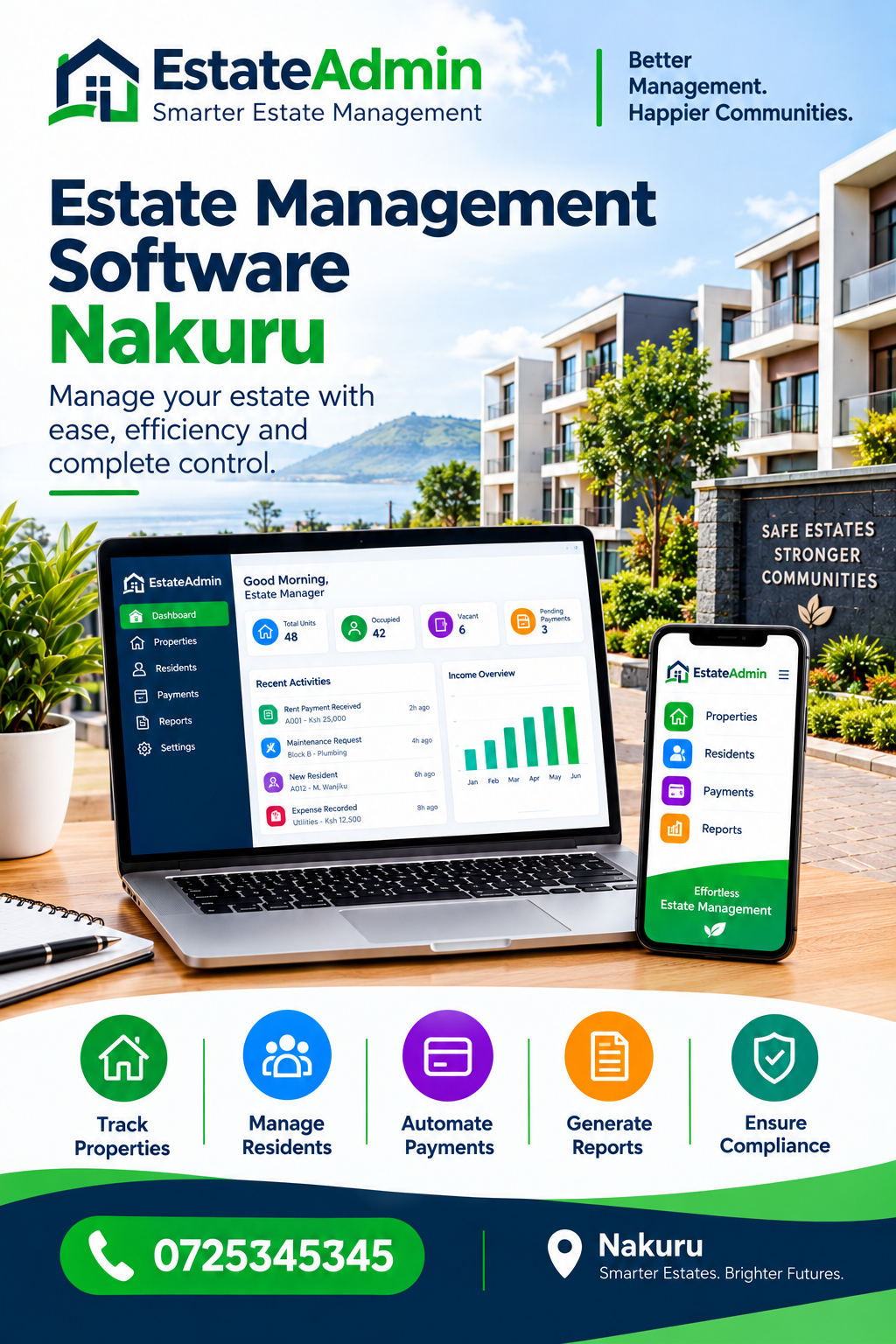
Managing an estate in Nakuru requires more than collecting rent and keeping a list of occupants. Property managers, estate committees, landlords, caretakers, and management companies often have to coordinate tenant records, invoices, service charges, maintenance requests, receipts, communication, inspections, and financial reports at the same time. Estate Management Software Nakuru can bring these activities into one organized system, making it easier to maintain accurate records and follow up on daily operations. This guide explains what such software should do, the problems it can solve, the features to consider, how it can support estates in Nakuru, and how to evaluate a solution before committing to it.
Why estate management in Nakuru needs better organization
Nakuru has a mixture of residential apartments, gated communities, commercial premises, mixed-use developments, rental compounds, and managed estates. Each type of property can have different rules, payment schedules, maintenance needs, and reporting requirements. A small apartment block may have one caretaker and a few dozen units, while a larger development may involve several staff members, many tenants, multiple service providers, and a management committee.
As the number of units increases, spreadsheets, notebooks, paper receipts, and scattered phone messages become harder to control. A manager may know that a tenant paid but struggle to find the receipt. A caretaker may know about a leaking pipe but forget to report it formally. A committee member may request an arrears report while the person responsible for accounts is away.
Estate Management Software Nakuru is useful in this setting because it provides a structured place for information that would otherwise be spread across different records. Instead of treating rent collection, maintenance, tenant information, and reporting as separate activities, a property manager can manage them as connected parts of the same operation.
Common administration problems
Estate managers in Nakuru may encounter challenges such as:
- Missing or incomplete tenant records
- Difficulty tracking occupied and vacant units
- Delayed identification of rent arrears
- Manual preparation of invoices and statements
- Poor visibility of maintenance requests
- Unclear records of service charge payments
- Difficulty matching payments with individual accounts
- Repeated data entry
- Paper files that are difficult to retrieve
- Limited reporting for estate committees
- Communication gaps between caretakers and managers
- Difficulty monitoring recurring property expenses
Estate Management Software Nakuru can address many of these problems by creating a central workflow for property administration. The exact benefits depend on the features, setup, user discipline, and payment integrations provided by the selected system.
What is estate management software?
Estate management software is a digital platform designed to help property owners and managers organize the operational and financial activities associated with an estate. Depending on the product, it may cover tenant management, unit management, billing, rent collection, service charges, maintenance, accounting records, reports, communication, and document storage.
Estate Management Software Nakuru should therefore be evaluated as a complete management tool rather than simply as an electronic rent book. The purpose is to reduce unnecessary manual work while giving managers a clearer view of what is happening across the property.
Key features to look for
The best software choice depends on the estate’s size and operating model. However, several features are particularly useful when evaluating a property management platform.
1. Property and unit management
A good system should allow the manager to create properties, blocks, floors, units, and relevant occupancy information. This gives the estate a clear structure.
Estate Management Software Nakuru can be more useful when each unit has a clear profile containing information such as the unit number, tenant or owner details, billing history, outstanding balances, and relevant notes.
2. Tenant management
Tenant information should be easy to create, update, and retrieve. Useful records can include names, contact details, unit information, lease dates, payment history, and communication notes.
Estate Management Software Nakuru can help property managers maintain a consistent tenant database. When a tenant changes units or leaves an estate, the manager should also be able to update the relevant records without losing historical information.
3. Rent billing and invoicing
Rent billing is one of the most important recurring activities in rental property administration. Manual invoices can create avoidable errors, especially when different tenants have different rental amounts or additional charges.
Estate Management Software Nakuru should make it possible to create recurring charges, generate invoices or statements, and review what each account owes. The system should also make it clear when a payment has been received and when an account remains outstanding.
A useful workflow can look like this:
- The tenant account is created.
- The agreed rent is recorded.
- The monthly charge is generated.
- The tenant receives a statement or payment notification.
- The payment is recorded or integrated into the account.
- The outstanding balance is updated.
- Management can review arrears through a report.
The fewer times staff have to re-enter the same information, the lower the opportunity for manual errors.
4. M-Pesa and payment tracking
M-Pesa is an important consideration for Kenyan property managers because many tenants use mobile money for everyday payments. A software platform should therefore be assessed for the payment methods it supports and how transactions are reconciled.
Estate Management Software Nakuru can help managers connect payment information to individual tenant accounts when suitable payment integration is available. The exact process varies by software provider, so property managers should ask for a demonstration of the complete payment workflow rather than assuming that a product supports every type of integration.
Payment tracking should quickly show who paid, how much, when, which account was credited, and what balance remains. Correct allocation is important because an unmatched payment can still create administrative work.
Service charge management
Service charges can cover shared costs associated with maintaining common areas and estate facilities. Depending on the development, these may relate to security, cleaning, landscaping, lighting, waste management, repairs, shared utilities, or other approved expenses.
Estate Management Software Nakuru can support service charge administration by keeping billing and payment records together. Managers can define the charges applicable to different units according to the estate’s management arrangements and then monitor collection.
A strong service charge process should also make it easier to distinguish between recurring charges and exceptional expenses. This helps management prepare clearer statements and reduces confusion when residents ask why a particular amount appears on an account.
Service charge reporting
Estate committees often need more than a list of payments. They may want to understand how much has been billed, how much has been collected, what remains outstanding, and what expenses have been recorded.
Estate Management Software Nakuru can help organize this information into reports that are easier to review.
Maintenance management
Maintenance requests can range from a broken light in a common area to plumbing problems, damaged gates, electrical faults, drainage issues, painting, landscaping, or larger repair projects.
Without a tracking process, requests may remain in WhatsApp conversations or verbal instructions. That makes it difficult to know whether a problem was reported, assigned, attended to, or completed.
Estate Management Software Nakuru can help turn maintenance requests into trackable tasks. A manager could record the issue, affected unit or area, date reported, assigned person or contractor, status, cost, and completion notes.
A practical maintenance workflow can move from request, categorization and assignment through completion, cost recording and closure. This creates a useful record for reviewing repairs and outstanding work.
Arrears management
Late rent and unpaid charges can affect an estate’s cash flow and make financial planning more difficult. The first step in dealing with arrears is knowing exactly which accounts are outstanding.
Estate Management Software Nakuru can help managers generate arrears reports based on current account information. Instead of manually checking each tenant, staff can review accounts that have unpaid balances and then follow the estate’s agreed collection procedures.
Arrears reports can be useful for:
- Identifying overdue accounts
- Prioritizing follow-up
- Sending reminders
- Monitoring payment arrangements
- Reviewing collection performance
- Preparing management reports
Estate accounting and financial visibility
Property management involves many financial transactions beyond rent. An estate may receive service charge payments, deposits, parking charges, or other approved fees while also paying suppliers, contractors, utilities, security providers, cleaners, and other service costs.
Estate Management Software Nakuru can provide a central record of relevant transactions, depending on the accounting functionality available. Managers should determine whether the platform offers the financial reports they actually need.
Useful reports may include:
| Report | Why it matters |
|---|---|
| Rent collection report | Shows amounts billed and collected |
| Arrears report | Identifies outstanding balances |
| Tenant statement | Shows an individual account history |
| Expense report | Tracks property-related spending |
| Service charge report | Monitors shared charges |
| Occupancy report | Shows occupied and vacant units |
| Maintenance report | Tracks open and completed work |
| Cash-flow view | Helps management understand inflows and outflows |
Estate Management Software Nakuru can make reporting more practical when these records are maintained consistently.
Communication with tenants and residents
Property management is partly a communication function. Residents need information about payments, maintenance, inspections, notices, shared facilities, and estate activities.
Estate Management Software Nakuru can support communication when the software includes notifications, messaging, email, SMS, or other relevant tools. The manager should confirm which communication channels are available and whether message history can be associated with the relevant account.
Records and document management
Property managers often handle documents such as tenancy agreements, identification records, invoices, receipts, maintenance quotations, contractor documents, notices, meeting records, and correspondence.
Estate Management Software Nakuru can be valuable when it includes organized document storage with appropriate access controls. The goal is to reduce dependence on physical files and scattered folders.
Estate inspections
Regular inspections help property managers identify issues before they become larger problems. Depending on the property, inspections may cover common areas, vacant units, security equipment, plumbing, electrical installations, landscaping, cleanliness, and general building condition.
Estate Management Software Nakuru can support inspection records if the platform provides inspection or task-management functionality. Managers can record observations, assign follow-up work, and monitor whether identified issues were resolved.
For example, an inspection might find a damaged external light. The manager can create a maintenance task, assign it to an electrician, record the cost, and close the task after verification.
Managing vacancies and occupancy
Vacant units represent a management issue because they affect rental income and require follow-up. A property manager needs to know which units are vacant, how long they have been vacant, whether they are ready for occupation, and whether maintenance or cleaning is required.
Estate Management Software Nakuru can help organize vacancy information where the feature is supported. Occupancy records can also help managers prepare accurate property reports.
A vacancy workflow can cover exit information, inspection, repairs, cleaning, readiness, marketing and new tenant records. The important point is that vacancy management should connect operational activities with the unit record.
Security and access control
Property records contain information that should not be available to everyone. Tenant contact information, payment histories, contracts, financial reports, and management documents should be protected through appropriate access controls.
Estate Management Software Nakuru should therefore be assessed for user permissions, authentication, backups, audit trails, and other security measures offered by the provider.
Different users may need different access: caretakers may need maintenance information, accounts staff may need billing records, managers may need broader access, and committee members may need selected reports.
Access should follow the principle of giving each person only the information required for their responsibilities.
Why cloud-based access can help Nakuru property managers
Property management does not always happen from one desk. Managers may visit estates, meet contractors, inspect units, attend meetings, or communicate with owners from different locations.
Estate Management Software Nakuru can be particularly practical when the platform provides secure cloud access through supported devices. This can reduce dependence on a single office computer.
However, cloud access should not be confused with unrestricted access. A responsible system should still use authentication and appropriate permissions. Managers should also understand how backups and data recovery are handled.
Reducing manual work
One of the strongest reasons to adopt property management software is to reduce repetitive administrative tasks.
Estate Management Software Nakuru can automate or simplify activities such as recurring billing, account updates, reporting, reminders, and record searches, depending on the features available.
Consider a manager who spends several hours every month preparing the same tenant statements manually. If the system can generate those statements from correctly maintained account records, staff can spend more time on activities that require judgment, such as resolving disputes, inspecting properties, supervising contractors, and communicating with residents.
Automation should be viewed as controlled assistance, not a replacement for oversight. Staff still need to verify important transactions and correct inaccurate information.
Reports for estate committees and owners
Estate committees need information that helps them understand how the property is being managed. Long spreadsheets with unclear headings may not provide the clarity required for decision-making.
Estate Management Software Nakuru can make management reporting easier when the system has clear dashboards and exportable reports.
A monthly management pack may cover occupancy, rent billed and collected, arrears, service charges, expenses, maintenance, incidents, and key actions. The exact contents should reflect the estate’s governance arrangements.
Choosing software for a Nakuru estate
Not every estate needs the same system. A small development may need a straightforward tenant and billing platform, while a large estate may require advanced accounting, maintenance, access control, reporting, and integrations.
Estate Management Software Nakuru should be evaluated against the estate’s actual workflow. Avoid selecting software simply because it has a long list of features.
Ask these questions before making a decision:
- How many units can the system support?
- Can it manage multiple properties?
- Can it track tenants and owners separately?
- Does it support recurring billing?
- How are payments recorded?
- Does it support M-Pesa or the payment methods used by residents?
- Can it generate arrears reports?
- Can it manage service charges?
- Does it support maintenance requests?
- Can users have different permissions?
- Can reports be exported?
- How are backups handled?
- What support is available?
- What happens when the internet connection is unavailable?
- Can historical data be imported?
Estate Management Software Nakuru is more likely to deliver practical value when the provider can demonstrate these workflows using realistic estate scenarios rather than only showing screenshots of individual features.
Cost considerations
Software pricing can vary according to the provider, number of units, number of users, feature set, implementation requirements, integrations, and support arrangements. It is therefore risky to choose a platform solely because it has the lowest advertised price.
Estate Management Software Nakuru should be evaluated alongside the operational cost of continuing with manual administration.
Consider subscription or licence fees, setup, training, data migration, integrations, additional users, support, hardware, manual administration time, and avoidable errors.
The cheapest option on paper may not have the functions required by a particular estate. Conversely, a system with many advanced features may be unnecessary for a small property.
Implementation plan for a Nakuru estate
Buying software is only the beginning. A careful implementation process helps prevent confusion and protects the quality of the information entered into the new system.
Estate Management Software Nakuru can be introduced through a phased process.
Step 1: Map the existing process
Document how rent, service charges, maintenance, expenses, tenant records, and reporting are currently handled.
Step 2: Clean the data
Before importing records, identify duplicate tenants, outdated contacts, incorrect balances, missing unit numbers, and incomplete documents.
Step 3: Configure the property
Create buildings, blocks, floors, units, charges, users, and other necessary structures.
Step 4: Import or enter records
Move verified tenant, owner, account, and property information into the system.
Step 5: Test transactions
Run sample billing, payment allocation, statement, arrears, and maintenance workflows.
Step 6: Train users
Caretakers, accounts staff, managers, and administrators should understand the functions relevant to their roles.
Step 7: Go live carefully
Start with a controlled process and monitor records closely during the first billing cycles.
Step 8: Review
After implementation, collect feedback and identify processes that need adjustment.
Training staff to use the system
Even good software can fail to deliver value if staff do not understand how to use it.
Estate Management Software Nakuru should be accompanied by practical training that matches each person’s responsibilities. A caretaker does not need the same training as an accounts officer.
Training can cover:
- Logging in securely
- Searching for units
- Updating tenant information
- Recording payments
- Creating or reviewing invoices
- Opening maintenance tasks
- Generating reports
- Handling documents
- Managing user permissions
- Escalating technical problems
Data accuracy matters
Digital records are only as reliable as the information entered into them. If an opening balance is wrong, later reports may also be wrong. If a tenant is assigned to the wrong unit, statements and communication may be affected.
Estate Management Software Nakuru should therefore be supported by data-quality checks.
Managers can establish simple controls such as:
- Verify tenant names and unit numbers
- Reconcile payment records
- Review opening balances
- Check duplicate accounts
- Confirm recurring charges
- Review unusual transactions
- Restrict editing rights where appropriate
- Back up important information
- Conduct periodic account reviews
Software can make accurate management easier, but it cannot automatically know whether every piece of information supplied by a user is correct.
Common mistakes when buying property software
Property managers can make avoidable mistakes during selection.
Estate Management Software Nakuru should not be chosen simply because another estate uses it. Different properties have different requirements.
Mistake 1: Focusing only on price
A low subscription can become expensive if staff still have to maintain separate spreadsheets for essential activities.
Mistake 2: Buying too many features
A complicated system can create unnecessary training and administration if the estate does not need its advanced functions.
Mistake 3: Ignoring payment reconciliation
If payments cannot be matched efficiently to accounts, billing administration may remain difficult.
Mistake 4: Forgetting user permissions
Everyone should not automatically have access to every financial or tenant record.
Mistake 5: Skipping data migration planning
Old records need to be reviewed before they are transferred.
Mistake 6: Not asking about support
A system is more useful when users know where to get help when they encounter a problem.
A practical checklist for Nakuru property managers
Before selecting a system, management can score its own requirements internally without relying on a generic software ranking.
Estate Management Software Nakuru should be able to demonstrate the workflows that matter most to the estate.
Use this checklist:
| Requirement | What to verify |
|---|---|
| Unit management | Can units be organized clearly? |
| Tenant records | Can information be updated and retrieved? |
| Billing | Can recurring charges be created? |
| Payments | Can transactions be recorded and reconciled? |
| M-Pesa | Is the required integration available? |
| Arrears | Can outstanding balances be identified? |
| Service charges | Can shared charges be administered? |
| Maintenance | Can tasks be tracked from report to completion? |
| Documents | Can relevant records be stored securely? |
| Reports | Are management reports available? |
| Permissions | Can access be assigned by role? |
| Support | Is technical help available? |
| Backups | Is there a clear backup and recovery process? |
How software can improve accountability
Accountability matters when several people participate in property management. A manager may collect information from a caretaker, accounts officer, contractor, committee member, or external service provider.
Estate Management Software Nakuru can help establish clearer records of actions and transactions where audit or activity tracking features are available.
For example, instead of asking whether a maintenance issue was handled, management can review the task record. Instead of relying on a verbal confirmation that a tenant paid, the payment history can be checked.
Managing contractors and suppliers
Estates often depend on external providers for plumbing, electrical work, cleaning, security, landscaping, waste collection, lifts, generators, and other services.
Estate Management Software Nakuru can help organize contractor-related records if the system supports supplier or maintenance management. A manager can record the work requested, contractor assigned, cost, status, and completion information.
For recurring suppliers, keeping consistent records may also help management review spending over time.
Supporting preventive maintenance
Reactive repairs can be more difficult to manage than planned maintenance. A manager who waits until equipment fails may face urgent work, resident complaints, and unexpected costs.
Estate Management Software Nakuru can support scheduled maintenance when recurring tasks and reminders are available. Examples include routine inspections, servicing, cleaning, landscaping, equipment checks, and other planned activities.
A preventive maintenance schedule should identify:
- Asset or area
- Required activity
- Frequency
- Responsible person
- Last completed date
- Next due date
- Notes
- Cost where applicable
This gives the management team a more structured way to plan property upkeep.
Using data to understand estate performance
Once information is consistently recorded, managers can use reports to identify patterns.
Estate Management Software Nakuru can provide useful operational data when the relevant records are complete. For example, management may discover that certain types of maintenance requests occur repeatedly or that arrears are concentrated in particular periods.
Useful questions include:
- Are arrears increasing or decreasing?
- Which maintenance categories occur most often?
- How long do requests remain open?
- How many units are vacant?
- Which charges are collected consistently?
- What expenses recur each month?
- Are there unusual changes in spending?
Data protection and responsible access
Estate systems can contain personal and financial information. Managers should therefore consider privacy, access controls, secure passwords, backups, and responsible handling of records.
Estate Management Software Nakuru should be assessed according to the provider’s security practices and the estate’s own information-management requirements.
Before onboarding users, management can establish basic rules:
- Do not share passwords.
- Use individual user accounts where possible.
- Remove access when staff leave.
- Review permissions periodically.
- Avoid storing unnecessary sensitive information.
- Use secure devices.
- Maintain backups according to the provider’s capabilities.
- Know how to report a suspected security incident.
Mobile-friendly property management
Managers and caretakers may need to work away from a desk. A mobile-friendly system can make it easier to check records, update tasks, or respond to maintenance issues while on site.
Estate Management Software Nakuru can be particularly useful when staff need access during property inspections or when communicating with residents. Before choosing a platform, test it on the devices staff actually use.
Integrating different estate activities
The biggest operational advantage of a connected system is the relationship between different records.
Estate Management Software Nakuru can connect information such as a tenant, unit, invoice, payment, balance, maintenance request, and document where the platform is designed to do so.
Imagine a tenant reports a plumbing problem. The manager should be able to identify the relevant unit, review the tenant record, create a maintenance request, assign a contractor, record the repair cost, and close the task. If each step is kept separately, the manager has to maintain more records manually.
What makes a system practical for Nakuru?
Estate Management Software Nakuru should fit the local operating environment. That includes the payment methods tenants use, the size and type of the estate, the way service charges are administered, the availability of reliable internet, the skills of staff, and the reporting expectations of owners or committees.
Local relevance can also mean responsive customer support and training that understands property management workflows in Kenya.
A good evaluation should therefore ask the provider to demonstrate a realistic Kenyan scenario rather than only providing a general product presentation.
When should an estate move from spreadsheets?
Spreadsheets can be useful for small operations, especially when there are few units and transactions. The problem starts when the spreadsheet becomes difficult to maintain or when several people need to update it.
Estate Management Software Nakuru becomes worth considering when management is experiencing issues such as:
- Frequent data duplication
- Difficult monthly reporting
- Unclear arrears
- Many recurring invoices
- Multiple properties
- Large tenant records
- Numerous maintenance requests
- Several users
- Repeated reconciliation work
- Increasing reliance on paper files
Estate management software and customer service
Residents judge property administration partly through their everyday interactions with management. Slow responses to maintenance issues, unclear statements, and payment confusion can create unnecessary frustration.
Estate Management Software Nakuru can improve the information available to staff, which may help them respond more consistently.
For example, when a tenant asks about an outstanding balance, staff can check the account rather than searching through multiple files. When a resident asks about a maintenance request, the manager can review the task status.
Preparing for growth
An estate may start small and expand through additional units, buildings, or properties. Software selected only for the current size may become restrictive later.
Estate Management Software Nakuru should therefore be assessed for scalability. Ask how the system handles additional units, properties, users, transactions, reports, and integrations.
Growth also increases the importance of permissions and standardized processes. What works informally for a small block may become difficult when multiple teams are involved.
What a property manager should ask during a demo
A product demonstration should be practical. Instead of asking only, “What features do you have?”, demonstrate a complete workflow.
Estate Management Software Nakuru can be tested through scenarios such as:
- Add a new unit.
- Add a tenant.
- Create a recurring rent charge.
- Record a payment.
- Generate a tenant statement.
- Identify an overdue balance.
- Create a maintenance request.
- Assign the request to a contractor.
- Record an expense.
- Generate a management report.
The manager should also ask how the system handles mistakes. Can an incorrect payment be corrected? Can records be audited? Can users be restricted? Can information be exported if the estate changes providers?
Frequently asked questions
What is the purpose of estate management software?
Estate Management Software Nakuru is designed to organize property administration activities such as tenant records, billing, payments, maintenance, reporting, and other workflows. The exact functions depend on the provider.
Can estate management software handle rent collection?
Estate Management Software Nakuru can support rent collection by recording charges, payments, balances, and statements when those functions are included. Payment integration should be confirmed directly with the provider.
Is M-Pesa integration important for a Nakuru estate?
For many Kenyan estates, mobile-money payments are an important part of daily transactions. Estate Management Software Nakuru should therefore be assessed according to the payment methods residents actually use and the integration options offered by the provider.
Can software manage service charges?
Yes, some property platforms provide service charge billing and reporting. Estate Management Software Nakuru can be useful when the estate needs to track shared charges, payments, balances, and related reports.
Can a small estate use property management software?
A small estate can use software if the functions match its needs and the cost is appropriate. Estate Management Software Nakuru should be selected according to the estate’s workflow rather than its size alone.
How does software help with rent arrears?
A property management system can keep account balances and payment histories in one place and generate arrears reports where supported. Estate Management Software Nakuru can therefore help staff identify accounts that require follow-up.
Can software track maintenance requests?
Many property management systems include maintenance workflows. Estate Management Software Nakuru can support the recording, assignment, tracking, and closure of maintenance tasks when those features are available.
How secure are estate management systems?
Security depends on the provider’s architecture, access controls, authentication, backups, and the way users operate the system. Estate Management Software Nakuru should be evaluated by asking the provider how tenant and financial information is protected.
Can several staff members use one system?
Many systems support multiple users with different permissions. Estate Management Software Nakuru can be useful for estates where caretakers, accounts staff, managers, and administrators have different responsibilities.
A simple decision framework
Before purchasing, management can divide requirements into three groups.
Estate Management Software Nakuru should satisfy the essential requirements first. These might include unit records, tenant management, billing, payment tracking, arrears, and reporting.
The second group can contain useful operational features such as maintenance, documents, inspections, notifications, and contractor records.
The third group can contain future requirements such as advanced integrations, additional properties, analytics, or expanded user roles.
This approach helps prevent a common purchasing problem: choosing a product because of impressive features that are rarely used while overlooking a basic workflow that staff perform every week.
Practical example: a residential estate in Nakuru
Consider a hypothetical estate with 80 occupied units and several vacant units. The property manager currently uses a spreadsheet for rent, a notebook for maintenance, paper receipts for some transactions, and WhatsApp messages for resident requests.
Estate Management Software Nakuru could bring these activities into a structured workflow.
At the beginning of the month, recurring rent charges are generated. Payments are recorded against the correct accounts. The manager checks an arrears report and follows up on outstanding balances. A resident reports a leaking tap, so a maintenance request is created and assigned. The contractor completes the repair, and the cost is recorded.
Later, the management committee requests a monthly report. Instead of assembling information from four different sources, the manager can use the relevant reports generated from the system.
Practical example: managing a larger development
Now consider a development with several blocks, shared facilities, security staff, cleaners, contractors, and an estate committee.
Estate Management Software Nakuru can be useful when different users need different access to the same property records. The accounts team can focus on billing and payments. The caretaker can handle maintenance and occupancy updates. The manager can review broader reports. Committee members can receive authorized management information.
The system becomes a common operational record rather than a private spreadsheet held by one employee.
Reviewing the software after implementation
Estate Management Software Nakuru should be reviewed after implementation to determine whether it is actually improving administration.
Management can ask:
- Are records more complete?
- Is billing easier?
- Are arrears easier to identify?
- Are payments easier to reconcile?
- Are maintenance requests being closed properly?
- Are reports available when needed?
- Are staff using the system consistently?
- Are residents receiving clearer information?
- Are manual spreadsheets still necessary?
- Are there recurring errors that need attention?
The role of management discipline
Software should support a clear management process. It cannot decide who should approve a repair, what rent should be charged, which contractor should be selected, or how a tenancy dispute should be resolved.
Estate Management Software Nakuru works best when the estate has defined responsibilities and procedures.
For example, management can define who is authorized to:
- Create tenant accounts
- Change billing information
- Record payments
- Approve expenses
- Assign maintenance work
- Close maintenance tasks
- Export reports
- Manage users
Clear responsibility reduces the risk of accidental changes and makes the system easier to manage.
Future-proofing estate administration
Estate Management Software Nakuru should therefore be assessed not only for what it can do today but also for whether the provider has a clear process for updates, support, integrations, and product improvements.
Final checklist before choosing
Before signing up, management should complete a final review.
Estate Management Software Nakuru should be able to demonstrate the most important workflows using the estate’s own requirements.
Check:
- Property and unit setup
- Tenant and owner records
- Billing
- Payment allocation
- M-Pesa or other required payment integration
- Arrears
- Service charges
- Maintenance
- Inspections
- Documents
- Reports
- User roles
- Security controls
- Backups
- Data export
- Customer support
- Training
- Implementation
- Pricing and additional charges
Ask for written clarification where an important feature is unclear.
Conclusion: building a more organized estate operation
Property management becomes increasingly demanding as the number of units, residents, transactions, contractors, and shared services grows. The objective of software should be straightforward: help management keep accurate records, reduce repetitive administration, follow up on outstanding work, and produce useful information when it is needed.
Estate Management Software Nakuru can support that objective when it matches the estate’s actual workflows and is implemented carefully. For property managers in Nakuru, the most important step is to evaluate the complete process rather than buying a product based on a single feature.
A well-planned system can bring tenant management, billing, payments, arrears, service charges, maintenance, inspections, documents, and reporting into a more coordinated environment. The software should complement clear procedures, responsible staff, accurate data, and good communication.
Estate Management Software Nakuru is ultimately a management tool. Its usefulness depends on the quality of the system, the suitability of its features, the way users are trained, and the discipline with which records are maintained. For an estate seeking a more organized approach to property administration, those are the areas worth examining carefully before making a decision.