
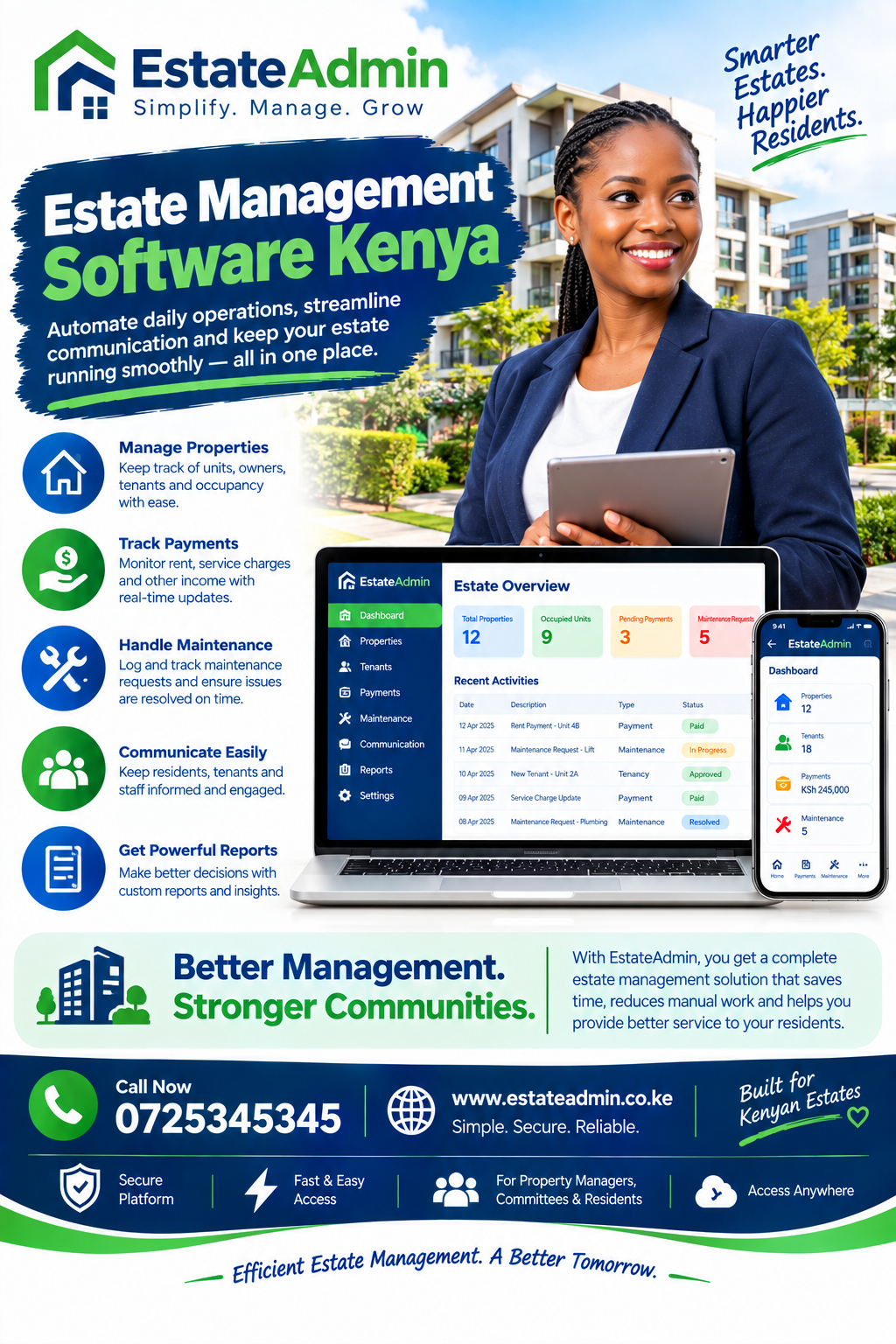
Estate Management Software Kenya: A Complete Guide for Modern Property Management
Managing an estate involves far more than collecting rent. Property managers and landlords have to keep tenant records updated, monitor payments, handle maintenance requests, manage expenses, communicate with residents, prepare reports and keep track of multiple properties and units. Estate Management Software Kenya provides a structured way to bring these activities together, reducing dependence on spreadsheets, notebooks, scattered messages and manual records. This guide explains what estate management software does, the features to look for, how it can improve daily operations, and what Kenyan property managers should consider before adopting a digital management system.
For a small residential property, manual management may seem manageable at first. A landlord might have only a handful of tenants, collect rent through M-Pesa, record payments in a notebook and use WhatsApp for communication. As the number of units grows, however, the same approach becomes harder to control. Missing records, delayed follow-ups, unclear balances and maintenance requests can quickly create unnecessary administrative work.
That is where Estate Management Software Kenya becomes useful. A properly configured platform can give property managers a central location for property information, tenant details, payments, invoices, maintenance activities and reports.
Kenyan property operations also have specific requirements. M-Pesa is an important payment channel, while bank transfers, cash collections, service charges, utilities and other property-related payments may also need to be tracked. Modern systems increasingly focus on connecting these workflows rather than treating them as separate activities. Current Kenyan property-management platforms commonly highlight M-Pesa collection, payment reconciliation, tenant records, maintenance and financial reporting as important capabilities.
What Is Estate Management Software?
At its simplest, Estate Management Software Kenya is a digital system used to organize and manage property-related activities from one platform.
Instead of keeping tenant information in one spreadsheet, payment records in another file, maintenance requests in WhatsApp messages and financial reports somewhere else, the software connects these activities.
A typical estate management system can help with:
- Property and unit records
- Tenant management
- Lease information
- Rent tracking
- Payment recording
- M-Pesa reconciliation
- Invoicing
- Service charges
- Utility billing
- Maintenance requests
- Expense tracking
- Communication
- Reports
- Occupancy monitoring
- Arrears tracking
- Staff access
- Document management
The exact features depend on the platform and subscription plan, so property managers should always confirm what is included before choosing a solution.
The main idea is straightforward: information about the estate should be organized in a way that makes daily work easier.
For example, if a tenant reports a leaking tap, the property manager should be able to record the issue, assign it to a maintenance person, monitor progress and retain a record of the repair. If the same tenant has an outstanding balance, the payment history should also be easy to access.
This connected approach is one of the major reasons Estate Management Software Kenya can be useful for property managers handling growing portfolios.
Why Kenyan Estates Need Better Digital Management
Property management creates a large amount of information.
Consider a residential estate with 100 units. The management team may need to maintain records for 100 households, their leases, payments, contacts, service charges, utility usage, maintenance requests and communication history.
If these records are handled manually, information can become fragmented.
One employee may have a spreadsheet. Another may have a notebook. The caretaker may receive maintenance complaints through WhatsApp. The accountant may have a separate payment file. The property owner may request a report that requires information from all four sources.
This process can consume significant time.
Estate Management Software Kenya can help create a central source of information. Instead of repeatedly searching through different files and conversations, staff can access records through one system.
For Kenyan property managers, payment management is especially important. Many tenants use M-Pesa, but properties may also receive bank payments or other forms of payment. Some Kenyan property-management systems now support M-Pesa and bank workflows alongside rent tracking and reconciliation.
A digital system can therefore help management teams answer basic questions faster:
- Which tenants have paid?
- Which balances are outstanding?
- Which units are vacant?
- Which leases are approaching renewal?
- Which maintenance requests are pending?
- How much was collected this month?
- What expenses were recorded?
- Which properties are generating the most income?
- What needs management attention?
The objective is not simply to replace paper with software. The bigger objective is to make property information easier to find, update and use.
Core Features to Look For
When comparing Estate Management Software Kenya solutions, property managers should look beyond the appearance of the dashboard.
A system should support the actual work performed by the management team.
1. Property and Unit Management
The foundation of estate management is knowing exactly what properties and units are being managed.
A useful system should allow administrators to create properties, buildings and individual units. Each unit should have information such as:
- Unit number
- Property name
- Property type
- Rent amount
- Occupancy status
- Tenant
- Lease information
- Service charges
- Utility details
- Maintenance history
This structure makes it easier to manage both small and large portfolios.
For example, an agency managing five apartment blocks should be able to switch between properties without maintaining separate spreadsheets for every building.
2. Tenant Management
Tenant records are another essential part of Estate Management Software Kenya.
A tenant profile may contain:
- Full name
- Phone number
- Email address
- Identification details
- Unit
- Lease dates
- Rent amount
- Deposit information
- Payment history
- Outstanding balance
- Communication records
- Documents
Keeping these details together makes it easier to answer tenant questions and maintain accurate records.
A good tenant-management module should also retain historical information. If a tenant moves from one unit to another, management may still need access to previous records.
3. Rent Collection and Payment Tracking
Rent collection is one of the most important functions of property management.
A digital system should make it easy to identify expected rent, received payments and outstanding balances.
Estate Management Software Kenya can help management teams organize payment information so they can quickly identify who has paid and who requires follow-up.
For example:
| Payment Status | Management Action |
|---|---|
| Paid | Record and issue receipt |
| Partially paid | Track remaining balance |
| Pending | Monitor expected payment |
| Overdue | Follow up with tenant |
| Disputed | Review payment records |
This is particularly valuable when managing many units.
Instead of manually checking individual payment records, the manager can use reports or dashboards to identify outstanding balances.
4. M-Pesa Reconciliation
M-Pesa is an important part of Kenya’s business environment, making payment reconciliation a major consideration for property managers.
Estate Management Software Kenya should ideally support payment workflows that reduce manual matching between tenants and received payments.
Some Kenyan property platforms advertise automatic or structured M-Pesa payment matching and reconciliation.
The benefit is not simply speed.
Correct reconciliation improves the reliability of tenant balances. If a payment is received but assigned to the wrong tenant, the records can become confusing. A good system should help management teams connect payments to the appropriate tenant, unit and invoice.
Before purchasing a platform, managers should ask:
- Does it support M-Pesa?
- Can payments be matched to tenants?
- Does it support Paybill or Till workflows where applicable?
- Can bank payments also be recorded?
- Can payment records be exported?
- Are receipts available?
- Can payment exceptions be reviewed?
These questions help determine whether the software fits the estate’s actual collection process.
5. Lease Management
Lease records contain important information that property managers should not have to search for manually.
A lease management feature can help organize:
- Start dates
- Expiry dates
- Rent amounts
- Deposit details
- Renewal information
- Tenant information
- Unit information
- Lease documents
Estate Management Software Kenya can make lease information more accessible by connecting the agreement to the relevant tenant and unit.
This can help managers plan renewals earlier and reduce the risk of overlooking important dates.
6. Maintenance Management
Maintenance is one of the most visible areas of property management.
A tenant may report:
- Plumbing problems
- Electrical faults
- Broken doors
- Water leaks
- Damaged fixtures
- Security concerns
- Appliance problems
- Common-area issues
Without a tracking system, requests can easily become buried in messages.
Estate Management Software Kenya can provide a structured maintenance workflow.
A typical process may look like this:
- Tenant reports an issue.
- Management records the request.
- The request receives a category or priority.
- A technician or caretaker is assigned.
- Work begins.
- The cost is recorded.
- The issue is marked complete.
- The history remains available.
This creates accountability.
If a tenant later asks when a maintenance problem was reported, the management team can check the record instead of searching through old messages.
Managing Estate Expenses
Property income is only one side of estate management. Expenses also need careful monitoring.
Common property expenses include:
- Repairs
- Cleaning
- Security
- Landscaping
- Water
- Electricity
- Waste collection
- Staff costs
- Contractor payments
- Maintenance materials
- Administrative expenses
Estate Management Software Kenya can help managers record expenses against the relevant property or category.
This makes it easier to understand where money is being spent.
For example, if a property manager notices that plumbing expenses have increased significantly, the records can be reviewed to determine whether there is a recurring problem.
Expense tracking also supports better reporting.
Instead of reporting only the amount collected, management can show income alongside expenses to give owners a clearer picture of property performance.
Service Charge Management
Service charges are common in managed estates and developments.
They may cover shared services such as:
- Security
- Cleaning
- Landscaping
- Waste management
- Common-area electricity
- Water systems
- Repairs
- Estate administration
The challenge is making sure every unit is billed correctly.
Estate Management Software Kenya can help management teams organize service-charge information and connect charges with specific units.
A digital system may allow managers to generate invoices, record payments and monitor outstanding balances.
This can reduce the amount of manual calculation required, particularly in larger estates.
Service-charge reporting can also improve transparency because managers can maintain records of what was billed, what was collected and what was spent.
Utility Billing and Tracking
Utilities can introduce another layer of complexity.
Depending on the property, residents may be responsible for water, electricity or other shared services.
Manual utility billing can involve collecting meter readings, calculating consumption, preparing bills and following up on unpaid amounts.
Estate Management Software Kenya can help bring these activities into the same property record.
A useful workflow may include:
- Recording meter readings
- Tracking consumption
- Applying rates
- Generating charges
- Recording payments
- Monitoring balances
- Producing reports
For estates with many units, structured utility records can reduce disputes because management has a documented history of readings and charges.
Communication With Tenants and Residents
Property management is also a communication business.
Managers regularly need to send:
- Payment reminders
- Receipts
- Notices
- Maintenance updates
- Meeting information
- Service interruptions
- General announcements
Estate Management Software Kenya can help centralize communication where the platform provides messaging or notification functionality.
However, communication features should be evaluated carefully. Managers should confirm which channels are supported and whether messages are automated, manual or integrated with services such as SMS, email or WhatsApp.
The aim is to make communication more organized without overwhelming tenants with unnecessary messages.
Reports and Financial Visibility
Good reporting allows property owners and managers to understand what is happening without manually assembling information.
Estate Management Software Kenya can support reports covering areas such as:
- Rent collection
- Arrears
- Occupancy
- Expenses
- Income
- Maintenance
- Tenant balances
- Service charges
- Property performance
Reports can be particularly useful when an owner has multiple properties.
For example, instead of asking a manager to manually calculate monthly collections for each building, the system can provide organized data that can be reviewed and exported.
Modern Kenyan property platforms commonly promote financial reporting, tenant ledgers, owner statements and portfolio-level reporting as part of their systems.
Occupancy Management
Vacancies affect rental income, so managers need clear visibility into unit status.
A property dashboard should ideally show:
- Occupied units
- Vacant units
- Reserved units
- Units under maintenance
- Units awaiting tenant move-in
Estate Management Software Kenya can make this information easier to monitor.
For example, a manager with three apartment blocks can quickly identify vacant units and prioritize marketing or tenant placement.
Occupancy information can also be used in management reports to understand changes over time.
Arrears Management
Late rent payments require consistent follow-up.
Without organized records, managers may spend considerable time identifying overdue tenants.
Estate Management Software Kenya can help identify outstanding balances and support follow-up workflows.
An effective arrears process can include:
- Identify overdue account.
- Confirm the amount outstanding.
- Review previous payments.
- Contact the tenant.
- Record the follow-up.
- Monitor promised payment dates.
- Update the account when payment is received.
The system should make the process easier, not simply generate more notifications.
A useful dashboard should show enough information for a manager to prioritize accounts and take action.
Benefits for Property Managers
One of the biggest benefits of Estate Management Software Kenya is centralization.
Instead of opening multiple files and applications, managers can work from a connected system.
Better organization
Tenant, property and payment information can be stored systematically.
Faster access to records
Managers can search for information rather than manually checking files.
Improved payment visibility
Outstanding balances and payment histories can be easier to review.
Better maintenance follow-up
Requests can be recorded and assigned rather than remaining inside private conversations.
Easier reporting
Financial and operational reports can be generated from structured records.
Reduced duplication
Staff members can work from the same information rather than creating multiple versions of the same spreadsheet.
Better accountability
Transactions and activities can be associated with particular users, tenants, properties or units where the software supports audit trails.
These benefits are particularly relevant as a property portfolio grows.
Benefits for Landlords
Landlords may not handle daily operations themselves, but they still need visibility.
Estate Management Software Kenya can help owners monitor their portfolios without requiring every operational detail to be communicated manually.
A landlord may want to know:
- How much rent was collected?
- Which tenants have outstanding balances?
- Which units are vacant?
- What maintenance work was completed?
- How much was spent on repairs?
- What income did each property generate?
A centralized system can make these questions easier to answer.
This is especially useful for property owners living outside the city or outside Kenya. Remote owners need reliable access to information because they may not be physically present to inspect properties or review paperwork.
Benefits for Estate Staff and Caretakers
Caretakers are often closest to the daily physical operation of a property.
They may handle:
- Tenant complaints
- Meter readings
- Inspections
- Maintenance issues
- Access-related concerns
- Common-area observations
Estate Management Software Kenya can help connect field activities with office records when the software supports staff accounts and role-based workflows.
Instead of sending a message such as “Unit 14 has a water leak,” a caretaker can potentially create a structured maintenance request containing the unit, issue description, priority and supporting information.
This improves communication between field staff and management.
Benefits for Tenants
The value of a property management system is not limited to landlords.
Tenants can benefit from:
- Clearer payment records
- Faster communication
- Easier maintenance reporting
- Accessible receipts
- Better billing visibility
- More consistent service
Estate Management Software Kenya can therefore contribute to a better tenant experience when implemented properly.
However, tenant experience depends on how the system is configured and how the management team uses it. Software cannot replace responsive customer service.
How M-Pesa Changes Property Management in Kenya
M-Pesa has changed the way many Kenyan businesses receive payments, and rental property management is no exception.
For a property manager, the challenge is not only receiving money. The manager must know who paid, how much was paid, which unit the payment relates to and whether the amount settles the expected charge.
Estate Management Software Kenya can help connect payment information with tenant and unit records.
For example:
A tenant owes KES 25,000 in rent.
They make a payment through M-Pesa.
The payment enters the property management workflow.
The system identifies the tenant or payment reference.
The tenant balance is updated.
A receipt can be generated where supported.
The manager can then see the transaction in the payment history.
This is more useful than simply recording “KES 25,000 received” in a spreadsheet.
Current Kenyan property platforms specifically promote M-Pesa matching, payment reconciliation and tenant-linked payment records as important property-management functions.
Accounting and Financial Records
Property management and accounting are closely connected.
Managers need to know not only how much money was received but also how transactions affect the financial position of each property.
Estate Management Software Kenya may support financial workflows such as:
- Income tracking
- Expense tracking
- Tenant balances
- Supplier payments
- Invoices
- Receipts
- Statements
- Property-level reports
Some systems also integrate broader accounting functionality, while others focus primarily on property operations and provide accounting-ready exports.
When evaluating software, ask whether the accounting functions match the complexity of your portfolio.
A small landlord may need basic income and expense tracking.
A property management company handling multiple clients may require detailed ledgers, owner statements, expense allocation and audit trails.
Data Security and Access Control
Property management systems contain sensitive information.
Tenant records may include contact information, identification details, lease documents and financial information.
For that reason, security should be part of the selection process.
Estate Management Software Kenya should ideally provide appropriate access controls so that every employee does not automatically have access to every function.
For example:
| User | Possible Access |
|---|---|
| Property manager | Broad operational access |
| Accountant | Financial records |
| Caretaker | Assigned property activities |
| Maintenance staff | Assigned work orders |
| Owner | Property reports |
| Tenant | Personal account information |
The exact permissions depend on the platform.
Ask vendors about:
- User roles
- Password protection
- Data backups
- Audit logs
- Data encryption
- Access permissions
- Account recovery
- Export capabilities
Security should be treated as a core requirement rather than an optional feature.
Choosing the Right System
Selecting Estate Management Software Kenya requires more than choosing the platform with the longest feature list.
Start by identifying your actual needs.
Step 1: List your current processes
Write down how you currently manage:
- Rent
- Tenants
- Leases
- Maintenance
- Expenses
- Service charges
- Utilities
- Reports
- Communication
This reveals where your biggest administrative problems are.
Step 2: Identify manual tasks
Which activities take the most time?
For example, perhaps your team spends hours matching M-Pesa payments or preparing monthly rent reports.
Those tasks should influence your software requirements.
Step 3: Consider portfolio size
A landlord with 10 units has different requirements from a property company managing 1,000 units.
Make sure the platform can grow with the business.
Step 4: Check payment support
For Kenyan properties, ask about M-Pesa, bank transfers and reconciliation.
Step 5: Review reporting
Ask to see actual reports rather than relying only on feature descriptions.
Step 6: Evaluate ease of use
A technically powerful system is not useful if staff cannot operate it confidently.
Step 7: Check support
Ask how training, onboarding and technical support are handled.
Step 8: Understand pricing
Do not compare only the monthly subscription.
Consider:
- Setup fees
- User fees
- Unit fees
- Transaction fees
- Support charges
- Integration charges
- Data migration costs
This gives you a clearer picture of the total cost.
Questions to Ask a Software Provider
Before adopting Estate Management Software Kenya, ask the provider direct questions.
Does the software support multiple properties?
This matters for landlords and agencies managing more than one building.
Can staff have different permissions?
Role-based access can reduce unnecessary access to sensitive records.
How does M-Pesa integration work?
Do not assume every platform handles payments in the same way.
Can tenants receive receipts?
Confirm whether receipts are generated automatically or manually.
Can maintenance requests be tracked?
Ask to see the complete maintenance workflow.
Can reports be exported?
Export functionality can be useful for accounting and management review.
Can historical records be imported?
If you already have spreadsheets, data migration may be important.
What happens if you stop using the system?
Understand how your data can be exported.
What support is available?
Ask whether support is offered through phone, email, WhatsApp or another channel.
Common Mistakes When Adopting Estate Software
Software implementation can fail when businesses focus too much on technology and not enough on processes.
Estate Management Software Kenya works best when the organization first establishes clear procedures.
Mistake 1: Entering inaccurate data
If tenant names, unit numbers or balances are wrong, reports will also be unreliable.
Mistake 2: Giving everyone the same access
Not every employee needs access to financial or administrative information.
Mistake 3: Ignoring staff training
A system should be introduced with adequate training.
Mistake 4: Keeping too many parallel systems
If employees continue maintaining separate spreadsheets for everything, the organization may not gain the full benefit of the platform.
Mistake 5: Choosing based only on price
A cheaper platform may lack features that are essential to the operation.
Mistake 6: Ignoring tenant experience
Tenants interact with the management process too. Payment and maintenance workflows should be understandable to them.
Mistake 7: Failing to review reports
Collecting data is only useful if managers actually use it to make operational decisions.
Estate Management Software for Small Landlords
Small landlords sometimes assume software is only for large property companies.
That is not necessarily the case.
A landlord with several units may already be dealing with rent payments, maintenance, tenants, utility charges and expenses.
Estate Management Software Kenya can provide structure even for a relatively small portfolio.
The key is selecting a system that is proportionate to the business.
A small landlord does not necessarily need a highly complex enterprise platform. They may need:
- Tenant records
- Rent tracking
- M-Pesa reconciliation
- Maintenance tracking
- Expense records
- Simple reports
As the portfolio grows, more advanced features can become valuable.
Estate Management Software for Property Agencies
Property agencies face a different challenge because they may manage properties belonging to multiple owners.
Estate Management Software Kenya can help separate information by property, owner or portfolio.
An agency may need to manage:
- Multiple landlords
- Multiple buildings
- Hundreds of tenants
- Different rent amounts
- Different service charges
- Maintenance vendors
- Owner reports
- Staff members
Centralized management becomes increasingly valuable as complexity increases.
Estate Management for Gated Communities and Residential Estates
Gated estates may have needs beyond traditional rental properties.
They can include:
- Resident records
- Service charges
- Security communication
- Visitor management
- Shared facilities
- Maintenance
- Common-area expenses
- Community notices
Estate Management Software Kenya can help bring these activities into a structured system when the selected platform supports them.
The exact requirements will vary between a rental apartment, gated community, commercial building and mixed-use development.
Therefore, managers should define the property type before selecting software.
Commercial Property Management
Commercial properties can involve offices, shops, warehouses and other business premises.
Their management may require:
- Lease tracking
- Invoicing
- Rent collection
- Service charges
- Utility billing
- Maintenance
- Occupancy monitoring
- Tenant communication
Estate Management Software Kenya can help centralize these records when the software is designed for commercial property workflows.
Commercial property managers should also check whether the system supports different lease structures and recurring charges.
Why Automation Matters
Manual administration becomes increasingly difficult as a portfolio grows.
Automation can reduce repetitive work such as:
- Generating recurring invoices
- Sending payment reminders
- Updating balances
- Preparing reports
- Recording recurring charges
- Notifying staff about tasks
Estate Management Software Kenya can support automation where those functions are built into the platform.
The purpose of automation should be practical.
A manager should spend less time copying information between spreadsheets and more time handling issues that actually require human attention.
Improving Accountability
A property business involves many people.
There may be:
- Owners
- Managers
- Accountants
- Caretakers
- Contractors
- Security staff
- Tenants
Without clear records, it can be difficult to determine who completed a task or changed information.
Estate Management Software Kenya can improve accountability when it provides user activity records, task assignments and transaction histories.
For example, if a maintenance request is marked complete, the manager can review the associated record rather than relying on a verbal update.
This creates a more organized working environment.
Using Data to Improve Estate Operations
Property software generates information that can support better management decisions.
Estate Management Software Kenya can make it easier to review trends such as:
- Rent collection
- Vacancy rates
- Maintenance costs
- Expense categories
- Tenant turnover
- Outstanding balances
- Property income
Suppose one building consistently records higher maintenance costs than another.
That information may prompt management to investigate the underlying cause.
Perhaps the building is older. Perhaps a particular plumbing system needs replacement. Perhaps maintenance requests are being handled reactively instead of preventively.
Data does not automatically provide the answer, but it can make important patterns easier to identify.
Future Growth and Scalability
A property system should not only solve today’s problems.
Estate Management Software Kenya should also be able to accommodate future growth where possible.
If a landlord currently manages 20 units but plans to acquire additional properties, the system should make expansion manageable.
Scalability may involve:
- More properties
- More units
- More tenants
- More users
- More transactions
- More reports
- More integrations
Before choosing a platform, ask how pricing and performance change as the portfolio grows.
Cost Considerations
There is no single correct price for property management software.
Different platforms use different pricing structures.
Some may charge:
- Per unit
- Per property
- Per user
- Monthly subscription
- Annual subscription
- Based on features
Estate Management Software Kenya should be evaluated based on value rather than price alone.
For example, a platform that costs more but significantly reduces manual reconciliation and reporting work may have a different overall value from a cheaper platform that requires substantial manual administration.
The right comparison is between total cost and operational benefit.
Implementing a New System
Once a platform has been selected, implementation should be planned.
Estate Management Software Kenya should be introduced in stages where practical.
Phase 1: Prepare data
Clean tenant, property and unit records before importing them.
Phase 2: Configure properties
Set up buildings, units and rent amounts.
Phase 3: Add tenants
Connect tenants to their appropriate units.
Phase 4: Configure payments
Set up the payment methods used by the property.
Phase 5: Train staff
Show each user how to perform their specific responsibilities.
Phase 6: Test workflows
Run sample transactions and maintenance requests.
Phase 7: Go live
Begin using the system for actual operations.
Phase 8: Review
After implementation, identify problems and adjust processes.
A phased approach can make the transition easier for staff and tenants.
Practical Example: Managing a 100-Unit Estate
Imagine a property management company managing a 100-unit residential estate in Nairobi.
Previously, the company used:
- Excel for rent records
- WhatsApp for maintenance
- Paper files for leases
- M-Pesa statements for payment checking
- Separate spreadsheets for expenses
At the beginning of the month, the accountant checks rent payments.
The caretaker sends maintenance updates.
The property manager checks vacancies.
The owner requests a financial report.
Each task requires information from a different source.
After implementing Estate Management Software Kenya, the company can organize these processes around one property database.
The manager can view units and tenants.
The accountant can review payment records.
The caretaker can receive maintenance assignments.
The owner can receive reports.
The exact capabilities depend on the chosen platform, but the principle is consistent: connected records reduce the need to repeatedly move information between disconnected systems.
Practical Example: A Small Landlord
Consider a landlord with 15 units.
The landlord receives payments through M-Pesa, occasionally receives bank transfers and personally handles maintenance.
At first, a notebook may be enough.
But as tenants change and repairs accumulate, it becomes harder to remember historical information.
Estate Management Software Kenya can provide a structured record of tenants, payments, expenses and maintenance.
The landlord can then spend less time checking old messages and more time managing the property.
Practical Example: A Property Agency
A property agency manages 300 units across several estates.
Different staff members are responsible for accounting, tenant support and maintenance.
Estate Management Software Kenya can help divide responsibilities through user accounts and structured workflows.
The accountant can focus on payments and reports.
The caretaker can focus on operational issues.
The property manager can monitor the overall portfolio.
The owner can receive relevant information without needing access to every internal process.
How to Measure Success After Implementation
Once Estate Management Software Kenya has been introduced, managers should measure whether it is actually improving operations.
Useful indicators can include:
- Time spent preparing monthly reports
- Time spent reconciling payments
- Number of unresolved maintenance requests
- Number of missing tenant records
- Speed of responding to tenant issues
- Accuracy of rent balances
- Time required to locate documents
- Number of manual spreadsheets still in use
The goal is not simply to say that the organization has adopted software.
The goal is to determine whether the software is producing practical improvements.
What Makes a Good Property Management System?
There is no single platform that is suitable for every estate.
However, a strong system should generally provide a combination of:
- Ease of use
- Reliable records
- Property management
- Tenant management
- Payment tracking
- M-Pesa support where required
- Maintenance management
- Expense management
- Reporting
- Security
- Scalability
- Customer support
Estate Management Software Kenya should also fit the organization’s workflow rather than forcing staff into unnecessary complexity.
A simple system that staff consistently use can be more practical than a complicated platform that employees avoid.
Estate Management Software and the Kenyan Market
Kenyan property managers operate in an environment where mobile payments, local communication channels and diverse property types all influence daily operations.
Current software providers in Kenya commonly position their products around M-Pesa, bank payments, tenant records, maintenance, reporting and local property workflows.
That means property managers have more opportunity to choose systems that reflect local operational needs.
At the same time, managers should not assume that every platform offers the same integrations or capabilities.
A product may advertise M-Pesa support, for example, but the actual payment workflow could differ considerably.
Demonstrations and product trials are therefore useful before making a commitment.
Questions Property Managers Should Answer Before Buying
Before selecting Estate Management Software Kenya, answer these questions:
- How many properties do we manage?
- How many units are active?
- How many staff members need access?
- How do tenants currently pay?
- How much time is spent reconciling payments?
- How are maintenance requests received?
- How are expenses recorded?
- How are monthly reports prepared?
- What information do property owners need?
- What information should tenants be able to access?
- Which records need restricted access?
- What integrations are essential?
- How will existing data be migrated?
- What level of support is required?
- What will the total cost be?
The answers provide a practical checklist for evaluating providers.
Frequently Asked Questions
1. What is estate management software?
Estate management software is a digital platform used to manage property operations such as tenants, units, rent, payments, maintenance, expenses, leases, communication and reporting.
2. Why should Kenyan property managers use digital estate management?
Digital systems can centralize property records and reduce dependence on spreadsheets, paper files and scattered communication. Kenyan platforms commonly support workflows involving M-Pesa, bank payments, rent tracking, maintenance and reporting.
3. Can estate software manage M-Pesa payments?
Many Kenyan property-management platforms support M-Pesa-related workflows. However, the specific integration differs between providers, so managers should confirm whether the system supports their preferred Paybill, Till or payment process.
4. Can landlords manage multiple properties?
Yes. Many systems are designed to manage multiple properties and units from a centralized dashboard. This can be useful for landlords, agencies and property management companies.
5. Can tenants report maintenance issues through software?
Some systems provide maintenance request functionality that allows tenants or staff to report issues and enables managers to assign and monitor repairs.
6. Does estate software help with rent arrears?
It can. A system can organize tenant balances and payment histories, making it easier to identify overdue accounts and follow up consistently.
7. Can estate management software track expenses?
Yes, depending on the platform. Expense tracking can help managers record maintenance, utilities, contractors and other property-related costs.
8. Is estate management software suitable for small landlords?
Yes. Small landlords can use software to organize tenant information, rent payments, maintenance and expenses. The important consideration is choosing a platform whose features and pricing match the size of the portfolio.
9. What should I check before choosing estate management software?
Review property management, tenant records, payment processing, M-Pesa support, reporting, maintenance, security, user permissions, integrations, pricing and customer support.
10. How does estate management software improve reporting?
It keeps operational and financial information in structured records, making it easier to generate reports on rent, expenses, occupancy, arrears and maintenance where those features are supported.
Conclusion
Managing an estate successfully requires accurate information, consistent processes and timely communication. As portfolios grow, manual systems can become increasingly difficult to maintain.
Estate Management Software Kenya can help bring property, tenant, payment, maintenance, expense and reporting activities into a more organized workflow.
The biggest benefit is not simply having a digital dashboard. The real value comes from creating a reliable system where the right information is available to the right people when they need it.
For landlords, this can mean better visibility into property performance. For property managers, it can mean less time spent searching through spreadsheets and messages. For caretakers, it can mean clearer maintenance assignments. For tenants, it can mean more organized communication and payment records.
The Kenyan property market also makes local functionality important. M-Pesa, bank payments, service charges, utilities and mobile communication can all play a role in daily property operations. Current Kenyan platforms demonstrate that these local workflows are increasingly being incorporated into digital property-management systems.
Before selecting a platform, define your property’s requirements, identify your biggest administrative challenges and compare providers based on actual workflows rather than feature lists alone.
Estate Management Software Kenya can be a practical part of that transition when the selected system matches the estate’s size, processes, staff structure and reporting requirements.
The next step is to review how your current property operations work from rent collection to maintenance, identify the tasks that consume the most time and then evaluate software based on how effectively it can address those specific needs.
Estate Management Software Kenya
Estate Management Software Kenya
Estate Management Software Kenya
Estate Management Software Kenya
Estate Management Software Kenya
Estate Management Software Kenya
Estate Management Software Kenya
Estate Management Software Kenya
Estate Management Software Kenya
Estate Management Software Kenya
Estate Management Software Kenya
Estate Management Software Kenya
Estate Management Software Kenya
Estate Management Software Kenya