
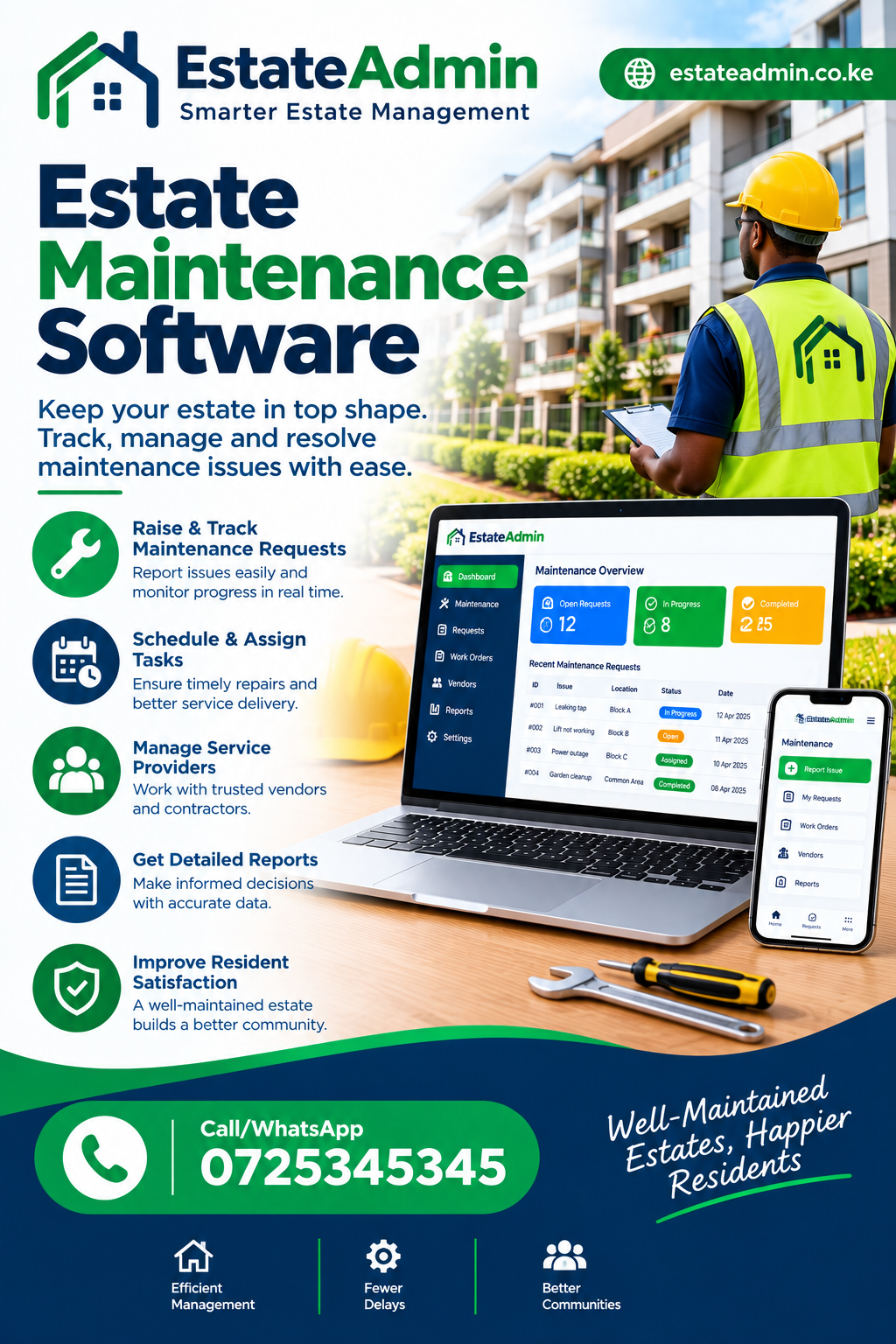
Managing property maintenance becomes difficult when requests arrive through phone calls, WhatsApp messages, notebooks, emails and informal conversations. A maintenance issue can be reported several times, assigned late, forgotten after a contractor visit or closed without a clear record. Estate Maintenance Software gives property managers a structured way to receive requests, assign work, monitor progress, record costs and keep residents informed.
Property maintenance is more than fixing broken taps or replacing damaged lights. It includes preventive inspections, common-area repairs, plumbing, electrical work, cleaning, landscaping, security-related repairs, equipment servicing and follow-up. For apartment blocks, gated communities and managed estates in Kenya, a reliable maintenance process protects the property, improves resident experience and helps management control expenses.
This guide explains how a digital maintenance system works, which features matter, how Kenyan property managers can organize maintenance workflows, how to evaluate vendors and costs, and what practical steps can improve maintenance operations.
Why Property Maintenance Needs Better Management
A maintenance request often looks simple from the resident’s perspective: something is broken and needs attention. For management, however, the request creates a chain of activities. Someone must capture the complaint, determine its urgency, identify the responsible person, communicate with a technician, approve spending where necessary, verify completion and preserve the record.
Without a consistent workflow, small problems can become expensive. A leaking pipe can damage walls or flooring. A faulty gate can create security concerns. Poor lighting can affect shared spaces. A neglected drainage problem can become a larger repair during heavy rain. Good maintenance management therefore combines responsiveness with prevention.
Estate Maintenance Software can bring these activities into one organized workflow. Instead of relying on scattered messages, the management team can maintain a central record of requests and their status.
The cost of reactive maintenance
Reactive maintenance is unavoidable, but depending on it for every issue can create unnecessary pressure. If inspections are not scheduled, managers may only discover problems after residents complain. If work orders are not tracked, technicians may revisit the same issue without knowing what was previously done.
A structured process helps management identify recurring faults. For example, if a particular block repeatedly experiences plumbing problems, the record can support a deeper investigation instead of treating every complaint as an isolated event.
Maintenance affects resident satisfaction
Residents judge an estate by many everyday details. Clean common areas, functioning lights, reliable water systems, secure access points and quick responses to genuine problems all influence their experience.
Estate Maintenance Software can support better communication because each request can have a defined status. A manager can know whether a job is new, assigned, in progress, awaiting approval, awaiting parts or completed.
What Is a Digital Maintenance Platform for Estates?
Estate maintenance software is a digital system used to organize maintenance requests, inspections, work orders, repairs, service providers, costs and completion records for managed properties.
Estate Maintenance Software is useful because maintenance rarely involves only one person. A resident may report an issue, a property manager may assess it, an estate supervisor may assign it, a contractor may perform the work and an accounts team may record the expense.
A good system connects these steps without requiring every person to maintain a separate spreadsheet.
Core maintenance workflow
A practical workflow can follow these stages:
- Request received.
- Issue categorized.
- Priority assessed.
- Work assigned.
- Contractor or staff member notified.
- Work performed.
- Completion verified.
- Cost recorded.
- Request closed.
- History retained.
Estate Maintenance Software can help turn this workflow into a repeatable process.
Maintenance categories
Common categories may include plumbing, electrical, carpentry, painting, cleaning, landscaping, security equipment, lifts, generators, pumps, water systems, drainage and general building repairs.
Categorization makes reporting easier. Management can see which types of work consume the most time or money and investigate recurring problems.
Key Features to Look For
Not every property needs the same level of functionality. A small residential development may have a different workflow from a large apartment portfolio. The important point is to choose features that solve actual management problems.
Estate Maintenance Software should ideally support a clear maintenance request register. Each record can capture the issue, property or unit, date reported, priority, assigned person, status, notes and completion information.
1. Maintenance request management
Requests should be easy to create and easy to find later. Search and filtering are especially useful when a manager handles many units.
Estate Maintenance Software can help management avoid losing requests in personal inboxes or chat histories.
2. Work-order tracking
A work order converts a complaint into an actionable task. It can identify what needs to be done, who is responsible, when it should happen and what status it has reached.
Estate Maintenance Software becomes more valuable when work orders can be monitored from assignment to completion.
3. Preventive maintenance scheduling
Preventive maintenance aims to address equipment and building needs before they become emergencies. Examples include servicing pumps, inspecting electrical systems, checking common lighting, maintaining gates and inspecting drainage.
Estate Maintenance Software can support scheduled maintenance when the system provides recurring tasks, reminders or inspection records.
4. Vendor management
Estates frequently rely on plumbers, electricians, painters, cleaners, technicians and specialized contractors. Management needs a reliable record of who performed work and what the work involved.
Estate Maintenance Software can make vendor history easier to organize and review.
5. Cost tracking
Maintenance decisions have financial consequences. Management should know how much was spent on a job, what the expense related to and, where appropriate, which property or unit was affected.
Estate Maintenance Software can help connect operational work with financial records when the platform supports expense tracking.
6. Maintenance history
A property’s history becomes valuable when the same issue returns. Records can show previous repairs, dates, vendors, notes and costs.
Estate Maintenance Software can give managers a stronger evidence base when deciding whether to repair, replace or investigate an asset.
Benefits for Kenyan Property Managers
Kenyan property managers operate in environments where communication, payment processes, contractor availability and cost control can vary considerably. A maintenance system should therefore be practical rather than overly complicated.
Estate Maintenance Software can help centralize maintenance information so that managers do not need to reconstruct an estate’s history from different notebooks and conversations.
Faster response to maintenance requests
Speed matters when an issue affects water, security, electricity or access. A centralized request list lets staff see outstanding work rather than depending on memory.
Estate Maintenance Software can support prioritization so urgent issues receive attention before routine requests.
Better accountability
A clear assignment shows who is responsible for the next action. This reduces ambiguity and makes follow-up easier.
Estate Maintenance Software can help management distinguish between reported, assigned, active and completed work.
Better expense visibility
Maintenance budgets can be difficult to control when invoices and receipts are scattered. A structured record makes it easier to understand spending patterns.
Estate Maintenance Software can support maintenance cost analysis when expenses are captured consistently.
Better resident communication
Residents do not necessarily need access to every internal detail, but they benefit from knowing that a request has been received and is being handled.
Estate Maintenance Software can support a more professional service process when communication tools are integrated into the maintenance workflow.
Maintenance Requests and Resident Complaints
A resident complaint should become a trackable task rather than disappearing into a chat thread. The first step is to capture enough information to understand the issue.
Useful details include:
- Unit or common-area location
- Description of the problem
- Date reported
- Priority
- Photos where relevant
- Contact information
- Assigned staff member
- Contractor if required
- Expected action
- Completion notes
Estate Maintenance Software can help organize these details in a single record.
Setting maintenance priorities
Not every request has the same urgency. A practical priority model might include emergency, high, normal and low.
An emergency could involve a major water leak, serious electrical fault or critical access problem. A normal request might be a minor repair that does not affect safety or essential services.
Estate Maintenance Software can support priority-based work management when the software allows requests to be categorized and filtered.
Preventive Maintenance for Estates
Preventive maintenance is one of the strongest ways to move from crisis management toward planned property care. The aim is not to eliminate every breakdown; it is to identify predictable maintenance needs before they become costly failures.
Estate Maintenance Software can be used as part of a broader preventive maintenance plan.
Building a maintenance calendar
A maintenance calendar can contain tasks such as:
- Water pump inspections
- Generator servicing
- Common-area lighting checks
- Gate and access equipment inspections
- Roof and drainage inspections
- Fire equipment checks
- Plumbing inspections
- Painting schedules
- Landscaping activities
- Cleaning equipment servicing
Estate Maintenance Software can help managers organize recurring activities when scheduling functions are available.
Why maintenance history matters
If a pump has required repeated repairs, management should be able to see that pattern. A history of work orders can reveal whether the estate is spending repeatedly on temporary fixes.
Estate Maintenance Software can help preserve that history so future decisions are based on evidence rather than memory.
Managing Contractors and Service Providers
Contractors are an important part of estate maintenance. A property manager may have preferred technicians for plumbing, electrical work, lifts, generators, painting or specialized systems.
Estate Maintenance Software can support better vendor organization by keeping maintenance activity connected to the relevant provider.
Comparing vendor performance
Vendor evaluation should consider more than price. Useful factors include response time, workmanship, communication, reliability, documentation and ability to meet agreed timelines.
Estate Maintenance Software can help managers maintain a record of completed jobs that can inform future vendor decisions.
Avoiding unclear contractor instructions
A poorly described job can produce delays and disagreements. Work orders should explain the problem, location, expected task and any relevant restrictions.
Estate Maintenance Software can make maintenance instructions more consistent when the system supports detailed work-order notes.
Maintenance Budgets and Cost Control
A maintenance department can spend money in small amounts that become significant over time. The challenge is not simply reducing expenses; it is spending deliberately on work that protects the property.
Estate Maintenance Software can support better visibility when maintenance costs are recorded against specific jobs.
Separating routine and emergency costs
Emergency repairs can distort a monthly maintenance budget. By separating routine work from emergency work, managers can understand whether unexpected spending is caused by isolated incidents or recurring property weaknesses.
Estate Maintenance Software can make this distinction easier when maintenance categories and expense records are available.
Tracking recurring repair costs
Suppose an estate repeatedly spends money repairing the same gate. Looking at each invoice separately may hide the broader issue. A consolidated maintenance history can show that replacement or major rehabilitation might deserve consideration.
Estate Maintenance Software helps make recurring work easier to identify when records are consistently maintained.
Maintenance Reporting and Management Decisions
Reports turn maintenance records into management information. A property manager should be able to answer practical questions such as:
- How many maintenance requests are open?
- Which issues are overdue?
- Which buildings generate the most requests?
- Which vendors perform the most work?
- What categories consume the most maintenance spending?
- How long do requests typically remain open?
- Which equipment requires repeated repairs?
Estate Maintenance Software can provide the foundation for these reports if the underlying data is captured accurately.
Useful maintenance dashboards
A dashboard might display open requests, completed jobs, overdue work, high-priority issues and recent expenses. The objective is not to create a visually impressive screen; it is to help managers make faster decisions.
Estate Maintenance Software becomes useful when the dashboard reflects the questions management actually needs to answer.
How Maintenance Software Supports Property Inspections
Inspections help identify defects before they become resident complaints. A structured inspection process can cover common areas, equipment rooms, external spaces and individual units where appropriate.
Estate Maintenance Software can complement inspection workflows by connecting identified defects to follow-up maintenance tasks.
Inspection checklists
A checklist might include:
- Lighting
- Plumbing fixtures
- Walls and ceilings
- Doors and locks
- Drainage
- Common-area cleanliness
- Water systems
- Electrical fittings
- External surfaces
- Safety-related equipment
Estate Maintenance Software can help preserve inspection findings when inspection functionality is included in the platform.
From inspection to repair
The real value of an inspection is the action that follows it. A defect should become a task, receive an owner and eventually be marked complete.
Estate Maintenance Software can help close this gap by keeping maintenance work connected to identified issues.
Mobile Access and On-Site Maintenance
Property management often happens away from a desk. Supervisors inspect buildings, meet contractors, check common areas and respond to residents while moving around the estate.
Estate Maintenance Software can be especially practical when the system works well on mobile devices.
A mobile-friendly workflow can allow staff to review tasks, update statuses, record notes and check outstanding work without returning to an office computer.
Integrating Maintenance With Broader Estate Management
Maintenance does not operate in isolation. Property records, residents, units, payments, service charges, accounting and communication all affect estate operations.
Estate Maintenance Software is most valuable when maintenance information fits into the broader property management process.
Connecting maintenance to units
A repair often relates to a particular apartment, office, building or shared facility. Connecting the task to the correct location makes historical records easier to understand.
Estate Maintenance Software can support property-level organization when the software allows work to be linked to units or assets.
Connecting maintenance to expenses
A repair may generate a quotation, purchase, invoice or payment. Maintaining a clear relationship between the job and its cost improves accountability.
Estate Maintenance Software can help managers see the operational side and financial side of maintenance together.
Data and Record-Keeping
Good maintenance management depends on reliable records. If staff enter incomplete information, even sophisticated software will produce weak reports.
Estate Maintenance Software should therefore be supported by clear data-entry standards.
Useful standards include:
- Use consistent maintenance categories.
- Record accurate locations.
- Assign every task to someone.
- Add completion notes.
- Record costs promptly.
- Close completed jobs.
- Review overdue tasks regularly.
Estate Maintenance Software becomes more effective when the management team follows these simple habits.
Security and Access Control
Property management information can include resident details, contractor records, invoices, internal notes and financial information. Access should therefore be managed according to staff responsibilities.
Estate Maintenance Software should be evaluated alongside user permissions, authentication, backups and auditability.
Managers should understand who can create requests, approve work, change records, view costs and close tasks. Access should be appropriate to each role rather than automatically giving every employee full control.
Choosing the Right Maintenance Solution
Buying software should begin with operational needs rather than a list of impressive features. A property manager should map the current maintenance process and identify where requests are being lost, delayed or poorly documented.
Estate Maintenance Software should be assessed against those real problems.
Questions to ask vendors
Before choosing a system, ask:
- Can residents or staff submit maintenance requests easily?
- Can requests be assigned and prioritized?
- Can managers track work from opening to completion?
- Can the system record vendors and job history?
- Can maintenance expenses be recorded?
- Are reports available?
- Does it work well on mobile devices?
- Can users have different permissions?
- Is data backed up?
- Can the system scale as the property portfolio grows?
Estate Maintenance Software can be evaluated using these questions rather than selecting software based only on appearance.
Implementation Tips for Kenyan Estates
Software implementation succeeds when the process around it is clear. Before going live, management should decide how requests will be submitted, who will assign jobs, who approves spending and who confirms completion.
Estate Maintenance Software can support implementation when the software matches those agreed procedures.
Start with a pilot
A pilot can be run in one building or on one maintenance category. The team can use real but controlled requests to identify missing fields, unclear statuses and approval problems.
Estate Maintenance Software can then be introduced across the estate after the workflow has been tested.
Train staff on the process
Training should explain more than which buttons to press. Staff should understand why requests need accurate descriptions, why statuses matter and why completed jobs must be closed properly.
Estate Maintenance Software is more likely to deliver value when users understand the workflow behind the software.
Common Maintenance Management Mistakes
Some maintenance problems are caused by process weaknesses rather than lack of effort.
Relying on WhatsApp as the main maintenance register
WhatsApp is useful for communication but can become difficult to use as a formal record. Messages may be buried, forwarded or separated from the final job outcome.
Estate Maintenance Software can provide a dedicated operational record instead of making chat history the only source of truth.
Failing to close completed jobs
If finished work remains open, dashboards become misleading and managers cannot distinguish current problems from old ones.
Estate Maintenance Software can support cleaner reporting when staff consistently update job statuses.
Ignoring recurring faults
Repeated repairs may indicate an underlying problem.
Estate Maintenance Software can help managers identify patterns when the system retains maintenance history.
Choosing software without considering users
A complex system that staff avoid using will not solve maintenance problems. Ease of use matters.
Estate Maintenance Software should therefore be tested by the people who will actually submit, assign, perform and approve maintenance work.
Measuring Maintenance Performance
Management can use a few practical indicators to understand whether maintenance operations are improving.
Possible measures include:
- Number of open requests
- Number of overdue requests
- Average response time
- Average completion time
- Emergency versus routine requests
- Repeat repairs
- Maintenance cost by category
- Vendor activity
- Preventive maintenance completion rate
Estate Maintenance Software can help organize these measures when the necessary information is captured consistently.
Using data to improve maintenance
Data should lead to action. If one category of repair is increasing, management should investigate. If a vendor consistently misses deadlines, the relationship may need review. If preventive tasks are repeatedly postponed, the scheduling process may need adjustment.
Estate Maintenance Software can make these patterns easier to review.
Practical Example: Apartment Estate in Nairobi
Consider a Nairobi apartment development with several buildings and a shared gate, water system and landscaped common areas. Residents report maintenance issues through several channels. The caretaker keeps some notes, the manager receives WhatsApp messages and contractors send invoices separately.
This arrangement can work at a small scale but becomes harder to control as the number of units grows.
Estate Maintenance Software could provide a centralized maintenance workflow. A resident issue can be logged, categorized as plumbing, assigned to the appropriate technician, given a priority and followed until completion.
The manager can then review open work, check the repair history and record the associated expense.
Estate Maintenance Software can also help create a consistent process for preventive tasks such as pump servicing, lighting inspections and drainage checks.
The benefit is not simply having another application. The benefit is having a reliable operational record that helps the team act on maintenance information.
Practical Example: Managing Common-Area Repairs
Imagine a residential estate where several common-area lights stop working. Under an informal process, the issue may be mentioned to a caretaker and passed verbally to an electrician. If the electrician repairs only some lights, there may be no clear record of what remains.
Estate Maintenance Software can support a more controlled process by defining the location, task, responsible technician, status and completion notes.
The same approach can be used for painting, plumbing, landscaping and repairs to shared facilities.
What Good Maintenance Management Looks Like
A strong maintenance operation has several characteristics. Requests are visible. Responsibilities are clear. Priorities are understood. Contractors receive useful instructions. Completion is verified. Costs are recorded. Historical information remains available.
Estate Maintenance Software can support these principles when implemented alongside clear procedures.
The software itself is not a substitute for management. A maintenance platform cannot decide whether a damaged pipe requires replacement, determine whether a quotation is reasonable or inspect workmanship. Those decisions still require competent people.
Its role is to organize information and workflow so those people can make better decisions.
Maintenance Software and Long-Term Property Value
Well-maintained property generally provides a better environment for residents and occupants. More importantly for management, systematic maintenance helps protect the condition of buildings and shared infrastructure.
Estate Maintenance Software can contribute to long-term property management by preserving maintenance records and making recurring issues easier to identify.
A manager reviewing several years of records may discover patterns that are invisible in individual repair requests. That information can support budgeting, capital planning and decisions about replacement.
A Simple Maintenance Policy for Estates
A property management company can establish a basic maintenance policy covering:
- How residents report issues.
- Which issues are emergencies.
- Who receives requests.
- Who assigns work.
- When approval is required.
- How contractors are selected.
- How completion is verified.
- How costs are recorded.
- How records are retained.
- How recurring faults are reviewed.
Estate Maintenance Software can be configured around such a policy when the system provides the relevant controls.
A written policy also helps new staff understand how maintenance should be handled instead of relying entirely on informal knowledge.
Asset Management and Maintenance Planning
Maintenance becomes easier to plan when management knows what assets exist, where they are located and what condition they are in. An estate may contain water pumps, generators, gates, access-control equipment, lighting systems, tanks, lifts, fire equipment, landscaping infrastructure and other shared assets.
A useful asset register can include the asset name, location, installation date where known, supplier, service interval, warranty information and maintenance history. This creates a practical bridge between asset management and day-to-day maintenance.
The maintenance system can support this approach when asset records are available within the platform. Instead of treating every repair as a standalone event, management can build a history around the equipment or facility involved.
From asset history to better planning
Suppose the same water pump requires several emergency interventions within a short period. A manager who only sees individual repair requests may continue authorizing small repairs. A manager who can review the complete asset history can ask a better question: is continued repair still sensible?
The maintenance system can help organize the evidence needed for that discussion. The final decision may depend on quotations, technical advice, expected remaining life and budget availability, but organized records make the decision easier to explain.
Planning annual maintenance
Property managers can also use historical data when preparing annual maintenance plans. Instead of estimating every requirement from memory, the team can review previous jobs and identify recurring activities.
The maintenance system can support annual planning by keeping maintenance records accessible when budgets and schedules are being prepared.
A useful annual plan might separate preventive servicing, routine repairs, major works and emergency contingencies. This distinction helps management understand which costs can be planned and which require flexibility.
Making Maintenance More Transparent
Transparency matters when property management involves landlords, owners’ committees, residents, staff and contractors. People may ask why a repair was authorized, who performed it, how long it took or how much it cost.
The maintenance system can help provide an organized record that management can refer to when answering legitimate operational questions.
This does not mean every person should have access to every internal record. Good access control allows the estate to share appropriate information while protecting sensitive financial and operational data.
Documenting completion
A maintenance task should not simply be marked complete because a contractor says the work is finished. Where appropriate, staff should verify the result, record relevant notes and retain supporting documentation.
The maintenance system can support this process by keeping completion information connected to the original request.
For larger repairs, management may also want photographs, quotations, invoices or inspection notes. The precise document-handling capabilities vary by platform, so these should be checked before implementation.
Creating a More Professional Maintenance Culture
The greatest benefit of a maintenance platform may be the change in habits it encourages. When every request must be categorized, assigned and closed, maintenance becomes a managed process rather than a collection of informal favors.
The maintenance system can reinforce this discipline when the team uses the system consistently.
A professional maintenance culture also means communicating realistic timelines. Staff should avoid promising immediate completion for every request when technicians, approvals or spare parts are involved. Clear status updates are often more useful than unrealistic promises.
Final Checklist Before Going Live
Before deploying a maintenance system across an estate, management can run a practical checklist:
- Create sample maintenance requests.
- Test emergency and routine priorities.
- Assign work to different staff members.
- Test contractor records.
- Record sample costs.
- Test overdue tasks.
- Review maintenance history.
- Generate available reports.
- Test mobile access.
- Confirm user permissions.
- Verify that completed tasks can be closed correctly.
- Confirm how data is backed up and recovered.
The maintenance system should be tested using realistic maintenance scenarios rather than only a demonstration account.
A final user-acceptance test should include common problems such as a leaking pipe, faulty lighting, blocked drainage, damaged gate equipment and scheduled pump servicing. The objective is to see whether the full process works from request through assignment, action, verification and closure.
Frequently Asked Questions
1. What does estate maintenance software do?
Estate Maintenance Software is used to organize maintenance requests, work orders, inspections, contractors, repair histories, costs and completion tracking. The exact capabilities depend on the platform.
2. Can maintenance software help apartment managers in Kenya?
Yes. A suitable system can help Kenyan apartment managers centralize repair requests, assign tasks, monitor contractors, track costs and maintain property records.
3. Does maintenance software replace property managers?
No. It supports property managers by organizing information and workflows. Human judgment is still needed for inspections, approvals, contractor selection and decisions about repairs or replacement.
4. Can maintenance software track contractors?
Many systems provide vendor or contractor records. Managers should check whether the specific platform supports vendor profiles, job history, assignments, costs and performance reporting.
5. Can residents report maintenance problems online?
This depends on the software. A suitable resident-facing system may provide a portal, form or other request channel. The key is to ensure submitted requests become trackable maintenance records.
6. How can maintenance software reduce missed requests?
Estate Maintenance Software can reduce missed requests by placing them in a centralized register with statuses, assignments, priorities and follow-up information instead of relying solely on scattered conversations.
7. What should an estate check before buying maintenance software?
Check ease of use, request tracking, work orders, preventive scheduling, vendor management, reporting, mobile access, permissions, data security and integration with the rest of the property management process.
8. Is maintenance software useful for small estates?
Yes, provided the system matches the estate’s needs and does not introduce unnecessary complexity. A smaller estate can benefit from clear records even if it has fewer maintenance requests.
Conclusion
Property maintenance becomes much easier to control when every request has a place, every task has an owner and every completed job leaves a useful record. For Kenyan property managers, this matters because maintenance affects resident satisfaction, operating costs, contractor relationships and the long-term condition of the property.
Estate Maintenance Software can form part of a structured approach that combines maintenance requests, inspections, preventive work, contractor management, cost tracking and reporting. The best solution is not necessarily the one with the longest feature list. It is the one that fits the estate’s workflow, is simple enough for staff to use consistently and provides management with reliable information.
Before choosing a system, map your current maintenance process, identify where requests are lost or delayed, define the information you need to track and test the workflow with realistic examples. With the right process and technology working together, estate maintenance can move from reactive firefighting toward organized, measurable property care.