
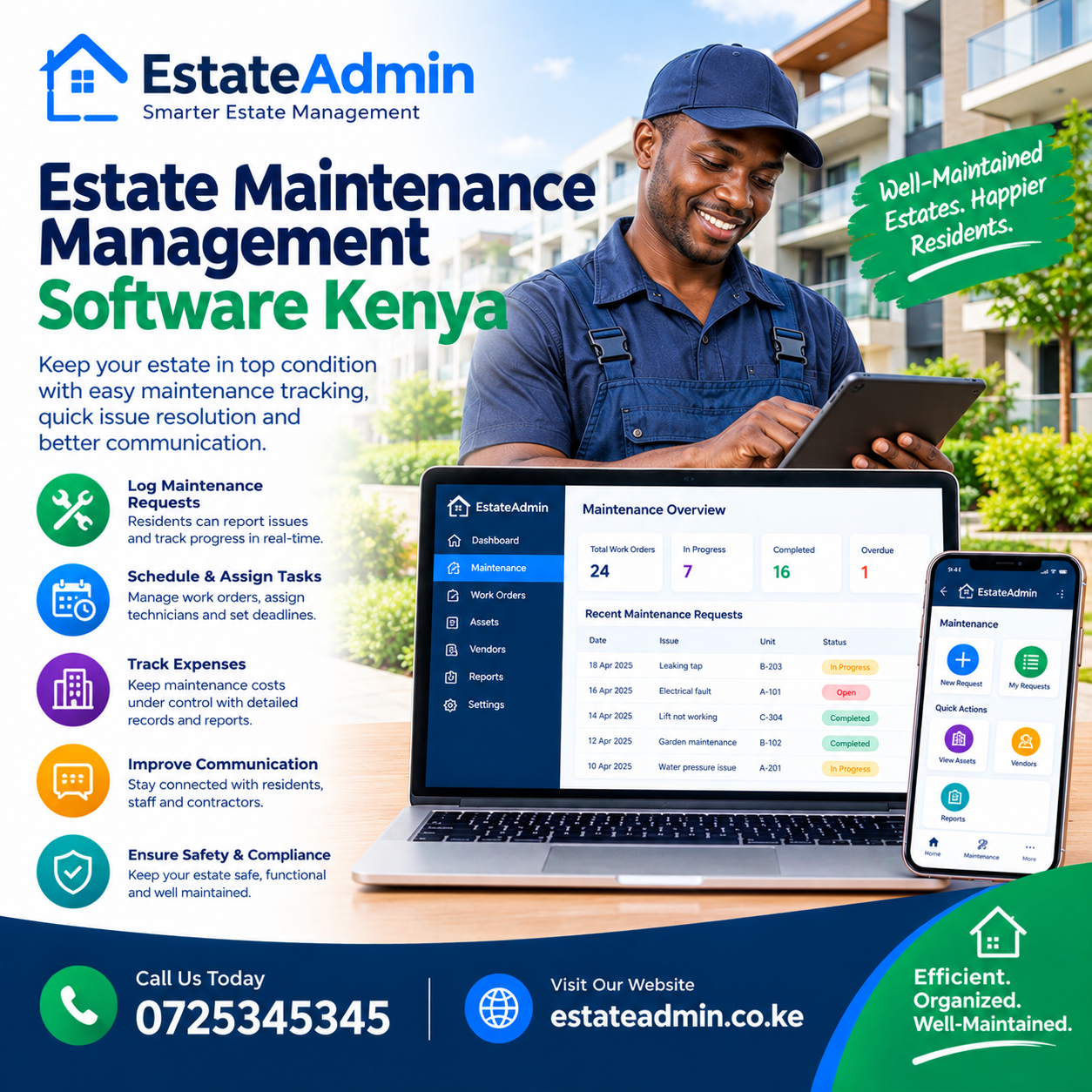
Estate Maintenance Management Software Kenya: Complete Guide for Property Managers
Managing maintenance across a residential estate can quickly become difficult when repairs, inspections, contractors, tenant requests, invoices, and follow-ups are handled through notebooks, phone calls, WhatsApp messages, and scattered spreadsheets. Estate Maintenance Management Software Kenya gives estate managers a structured way to organize maintenance activities, monitor work orders, keep property records updated, and maintain better control over operational costs.
For property managers, estate administrators, landlords, management companies, resident associations, and facility teams in Kenya, maintenance is more than fixing a leaking tap or replacing a broken light. It involves identifying problems early, assigning jobs to the right people, tracking progress, documenting expenses, communicating with residents, and confirming that completed work meets the expected standard. This guide explains how a digital maintenance system can support those activities, what features to look for, how it can improve estate operations, and how to choose a solution that fits the needs of a Kenyan property.
What Is Estate Maintenance Management Software?
Estate Maintenance Management Software Kenya refers to software designed to help property managers plan, record, assign, monitor, and report on maintenance work within residential estates and other managed properties.
Instead of keeping separate records for maintenance requests, contractors, inspections, expenses, and completed repairs, a centralized platform brings these activities together. A manager can create a maintenance request, assign the task, monitor its status, record the cost, and keep the information attached to the relevant property or unit.
A typical maintenance workflow may include:
- A resident reports a problem.
- The management team records the request.
- The issue is categorized according to urgency and type.
- A technician or contractor is assigned.
- The work is scheduled.
- Materials or services are recorded.
- The job is completed.
- The manager verifies the work.
- The expense is recorded.
- The maintenance history is retained for future reference.
Estate Maintenance Management Software Kenya makes this workflow easier to manage because information is stored in one organized system rather than being spread across multiple communication channels.
Why Maintenance Needs a Structured System
Property maintenance often becomes reactive. A manager receives a complaint, calls a technician, searches for an old message, checks whether money was previously spent on the same issue, and then tries to determine whether the repair has actually been completed.
This approach can work for a very small property. It becomes increasingly difficult as the number of units, buildings, residents, and maintenance requests increases.
Estate Maintenance Management Software Kenya helps create a repeatable process. Every request can have a status, responsible person, date, cost, and history.
That makes it easier to answer practical questions such as:
- Which repairs are still pending?
- Which units have reported maintenance problems?
- Which contractor was assigned to a particular job?
- How much has been spent on repairs this month?
- Which equipment requires regular servicing?
- Which issues keep recurring?
- Which maintenance requests are urgent?
- What work has already been completed?
Why Estate Maintenance Management Matters in Kenya
Kenyan residential estates vary considerably in size and structure. Some have a small number of units managed by an administrator, while larger developments may have multiple buildings, security teams, cleaners, technicians, contractors, and management staff.
Estate Maintenance Management Software Kenya can help bring these different activities into a coordinated maintenance process.
A maintenance problem that appears minor can also become more expensive when ignored. A small plumbing leak, for example, may eventually damage walls, ceilings, flooring, or other property components. Similarly, a malfunctioning security light can become an operational concern if it remains unresolved.
A structured system encourages managers to record problems as they arise rather than relying on memory.
Better Visibility Across the Estate
**** gives management teams a clearer view of maintenance activities across multiple units and shared facilities.
Instead of asking several people for updates, an administrator can review open, assigned, ongoing, and completed tasks from a central record.
This visibility is especially useful when different people are responsible for different parts of an estate.
Faster Response to Resident Requests
Residents generally want maintenance complaints acknowledged and resolved without unnecessary delays. A digital work-order process can help management teams organize requests according to urgency.
For example, a blocked drainage system or major water leak may require immediate attention, while a cosmetic repair may be scheduled for a later date.
**** can support this prioritization by allowing teams to categorize requests and monitor their progress.
Better Cost Control
Maintenance expenses can become difficult to track when technicians, contractors, materials, and emergency repairs are recorded separately.
**** can connect maintenance jobs with their associated costs, giving managers a clearer view of how much is being spent on different properties, buildings, assets, or categories of work.
This information can also help with budgeting and identifying areas where recurring maintenance costs need attention.
Key Features to Look For
When evaluating ****, property managers should look beyond a simple maintenance request form.
The best fit depends on the size of the estate, the management structure, the number of maintenance staff, and the complexity of the properties being managed.
Important features include the following.
Maintenance Request Management
A maintenance request module allows residents or staff to report problems and enables management to track those requests.
A useful system should capture details such as:
- Property or unit
- Resident information
- Maintenance category
- Description of the issue
- Date reported
- Priority
- Assigned technician
- Status
- Completion date
- Cost
- Notes
**** can make it easier to turn an informal complaint into a traceable work order.
Work Order Management
A work order provides a structured record of what needs to be done.
For example:
Unit B-204 — leaking bathroom pipe — plumber assigned — high priority — pending inspection.
Instead of relying on a message thread, the management team has a record that can be updated as the job progresses.
**** can help administrators monitor work orders from creation through completion.
Maintenance Scheduling
Not every maintenance activity is an emergency. Some jobs need to be planned in advance.
Scheduled activities may include:
- Water tank cleaning
- Generator servicing
- Pump inspections
- Electrical inspections
- Common-area repairs
- Gate maintenance
- Lift servicing
- Painting
- Landscaping
- Drainage inspections
**** can help property teams plan these activities instead of waiting for equipment or facilities to fail.
Contractor Management
Many estates rely on external plumbers, electricians, painters, technicians, security equipment specialists, and other contractors.
A digital system can help maintain records of contractors and connect them with assigned jobs.
**** can therefore help managers maintain a clearer history of who performed particular repairs and what work was completed.
Maintenance History
A good maintenance record should answer more than the question of what is currently broken.
It should also show what has happened previously.
For example, if a water pump repeatedly develops problems, the manager can review its maintenance history to determine how frequently repairs have occurred.
**** helps create this historical record, which can support better maintenance planning.
Preventive Maintenance Versus Reactive Maintenance
One of the biggest advantages of structured maintenance management is the ability to move from purely reactive maintenance toward preventive maintenance.
Reactive maintenance happens after a problem occurs. Preventive maintenance involves planned inspections and servicing intended to reduce the likelihood of unexpected failures.
Reactive Maintenance
Examples include:
- Repairing a burst pipe
- Fixing a broken gate motor
- Replacing damaged lighting
- Repairing a leaking roof
- Fixing a failed water pump
Reactive work is unavoidable in property management, but an estate that relies entirely on it can experience unpredictable costs and repeated disruptions.
Preventive Maintenance
Preventive maintenance may involve:
- Scheduled equipment inspections
- Routine plumbing checks
- Electrical system checks
- Water system servicing
- Roof inspections
- Drainage cleaning
- Common-area inspections
**** can help managers schedule recurring activities and retain records showing when each activity was completed.
This is particularly useful for estates with shared infrastructure.
Managing Maintenance Requests From Residents
Residents are often the first people to notice a maintenance issue. Their reports can therefore provide valuable information to property managers.
The challenge is ensuring that resident complaints do not disappear into personal phones, informal conversations, or unrelated message threads.
**** can provide a centralized way to record resident maintenance requests.
A useful request process should make it possible to identify:
- Who reported the issue
- Which unit is affected
- What the issue is
- When it was reported
- How urgent it is
- Who is responsible
- Whether the job has started
- Whether it has been completed
Example: Water Leak
Imagine a resident reports a water leak in an apartment on a Saturday morning.
Without a structured process, the administrator might receive the message, forward it to a plumber, forget to follow up, and only discover on Monday that the repair was never completed.
With ****, the request can be recorded, assigned, tracked, and closed once the work is confirmed.
The system creates accountability around the request rather than relying entirely on memory.
Managing Maintenance Costs
Maintenance management and financial management are closely connected.
Every repair can involve labor, materials, transport, contractor charges, equipment, or other costs. When these expenses are recorded inconsistently, managers may struggle to determine how much a property is actually costing to maintain.
**** can help link maintenance activities with financial records.
Managers may be able to review costs by:
| Cost Area | Example |
|---|---|
| Plumbing | Pipe repairs, taps, valves |
| Electrical | Lighting, switches, wiring |
| Security | Gates, CCTV equipment, access systems |
| Water systems | Pumps, tanks, valves |
| Common areas | Painting, flooring, repairs |
| Landscaping | Grounds maintenance |
| Contractors | External technical services |
| Emergency work | Urgent repairs |
The exact categories will depend on the property.
Understanding Recurring Costs
A maintenance system can also help identify recurring expenses.
Suppose an estate repeatedly spends money repairing the same pump. Looking at individual invoices may not immediately reveal the pattern. A maintenance history can show the frequency of repairs and the total expenditure associated with the equipment.
**** gives managers information that can support a broader question: is repeated repair still practical, or should the asset be replaced?
The final decision will depend on the property’s circumstances, but accurate records make the decision easier to assess.
M-Pesa and Digital Payment Considerations
Kenyan property managers commonly deal with digital payments, including M-Pesa. While maintenance software does not necessarily replace an estate’s entire financial system, it can play an important role in keeping maintenance-related financial information organized.
**** can help management teams maintain records of maintenance expenses alongside operational information.
For example, a manager may need to document a contractor payment after a repair has been completed. Keeping the maintenance job and financial record connected makes future review easier.
The important principle is consistency. Every maintenance expense should have enough supporting information to explain what was purchased or paid for and why.
Asset and Equipment Maintenance
Residential estates contain many assets that require attention.
These may include:
- Water pumps
- Generators
- Electrical equipment
- Security gates
- CCTV systems
- Fire safety equipment
- Water tanks
- Lighting systems
- Lifts
- Common-area fixtures
- Landscaping equipment
**** can help managers keep maintenance records associated with specific assets.
This creates a useful asset history.
For example:
Asset: Water Pump 01
Location: Block A
Installation: Recorded date
Last Service: Recorded date
Next Service: Scheduled date
Previous Repairs: Listed
Maintenance Cost: Recorded
Such information is much easier to review than a collection of handwritten notes.
Handling Emergency Maintenance
Emergency maintenance requires quick coordination.
Examples include:
- Major water leaks
- Electrical faults
- Security gate failures
- Serious drainage problems
- Damage caused by severe weather
- Critical equipment breakdowns
**** can help teams distinguish urgent jobs from routine requests.
A useful priority system could include:
- Emergency
- High priority
- Normal
- Low priority
The labels should reflect the estate’s own operating procedures.
The important point is that urgency should be visible. A critical repair should not sit in the same undifferentiated queue as a minor cosmetic request.
Improving Contractor Accountability
Contractors play an important role in estate maintenance, but managing multiple external service providers can be challenging.
A manager may need to know:
- Which contractor handled the job
- When they were assigned
- What they were asked to do
- How long the job took
- What materials were used
- What the final cost was
- Whether the work was accepted
- Whether further work is required
**** provides a structured place for this information.
Over time, these records can also make contractor coordination more organized because managers have historical information about previous assignments.
Maintenance Inspections
Maintenance should not depend entirely on resident complaints.
Routine inspections can help management teams identify issues before they become larger problems.
An inspection might cover:
- Staircases
- Corridors
- Parking areas
- Water systems
- Lighting
- Gates
- Landscaping
- Waste areas
- Drainage
- Common facilities
**** can support inspection-based maintenance by allowing findings to be recorded and converted into follow-up tasks.
For example, an inspection might identify a damaged corridor light. Rather than leaving the issue in an inspection notebook, the manager can create a maintenance task and assign it to the responsible technician.
Maintenance Reports for Property Managers
Reports help turn individual maintenance records into useful management information.
**** can support reporting around areas such as:
- Open maintenance requests
- Completed repairs
- Pending work
- Maintenance expenses
- Contractor activity
- Recurring issues
- Maintenance by property
- Maintenance by category
- Emergency repairs
- Scheduled maintenance
Reports can be useful during internal reviews and property management meetings.
Why Maintenance Reports Matter
A manager who only sees individual requests may focus on today’s problems.
A manager who reviews monthly or quarterly maintenance reports can identify patterns.
For example:
- One building may have unusually high plumbing costs.
- A particular asset may require frequent repairs.
- A contractor may receive a large volume of work.
- Certain maintenance categories may be increasing.
- Preventive inspections may be overdue.
**** helps transform these individual records into a more organized view of estate operations.
Mobile-Friendly Maintenance Management
Property managers and maintenance staff are not always sitting at a desk.
They may be walking through buildings, visiting units, inspecting equipment, meeting contractors, or responding to resident complaints.
**** is particularly useful when maintenance information can be accessed and updated while staff are working around the property.
Mobile-friendly access can make it easier to:
- Create a request
- Update a status
- Add notes
- Check a work order
- Review property information
- Record a completed job
- Follow up with a technician
The exact mobile capabilities depend on the software platform, so managers should test the interface before committing to a solution.
Security and Access Control
Maintenance records can contain operational and property information, so access should be controlled.
Different users may require different permissions.
For example:
| User | Possible Access |
|---|---|
| Estate Manager | Full maintenance management |
| Administrator | Requests, scheduling, records |
| Technician | Assigned maintenance jobs |
| Contractor | Relevant assigned tasks |
| Resident | Own maintenance requests |
| Accountant | Maintenance financial records |
**** should therefore be evaluated not only on features but also on how users and permissions are managed.
A system should make it clear who can create, edit, approve, assign, and close maintenance records.
How Maintenance Software Supports Resident Satisfaction
Residents expect basic facilities to remain functional and maintenance issues to be addressed responsibly.
Good maintenance management does not guarantee that every repair will be immediate, but it can make the process more transparent and organized.
**** helps property managers establish a clearer process for receiving and handling maintenance requests.
For residents, this can mean fewer situations where they repeatedly ask whether their complaint has been received.
For managers, it means fewer requests being forgotten or overlooked.
Common Maintenance Management Problems
Before investing in a system, it helps to understand the problems that technology is intended to solve.
Lost Maintenance Requests
Requests received through multiple channels can easily be missed.
**** can centralize maintenance records so the management team has a common source of information.
Poor Follow-Up
A technician may be assigned but the administrator may forget to confirm completion.
A work-order status can make pending jobs more visible.
Unclear Maintenance Costs
If repair expenses are stored separately from job records, it can be difficult to understand total maintenance expenditure.
A connected maintenance record can provide better context.
Repeated Repairs
Without maintenance history, staff may not immediately realize that the same issue has occurred several times.
**** can help maintain historical records that reveal recurring problems.
Reactive Management
If managers only respond when something breaks, preventive work may be overlooked.
Scheduling tools can help create a more balanced maintenance programme.
How to Choose the Right Maintenance Software
Choosing software should begin with the estate’s actual workflow rather than a list of fashionable features.
**** should be evaluated against practical questions.
1. Understand Your Estate
Determine:
- Number of units
- Number of buildings
- Common facilities
- Number of maintenance staff
- Number of contractors
- Typical monthly requests
- Common maintenance categories
A small estate may require a simpler system than a large multi-building development.
2. Map Your Current Process
Write down what happens when a resident reports a problem.
Who receives the request?
Who assigns the technician?
Who approves expenditure?
Who confirms completion?
Who records the cost?
This process map helps identify where software can provide the greatest benefit.
3. Check the Maintenance Features
Make sure the system supports the maintenance activities that matter most to your property.
Look for features such as:
- Request management
- Work orders
- Scheduling
- Contractor records
- Asset tracking
- Maintenance history
- Cost tracking
- Reports
- User permissions
4. Consider Ease of Use
A technically powerful platform will not provide much value if staff find it difficult to use.
Ask staff to test the system.
Can they create a maintenance request quickly?
Can they find an existing job?
Can they update a status without assistance?
Can management generate a useful report?
5. Consider Integration
If your estate already uses software for accounting, rent collection, resident management, or communication, consider whether the maintenance system can work alongside those processes.
**** becomes more valuable when maintenance information fits naturally into the wider property management workflow.
Implementation Tips for Kenyan Estates
Buying software is only the beginning.
Successful implementation requires a clear process.
Start With the Most Important Maintenance Activities
Do not try to digitize every historical record on the first day.
Begin with:
- New maintenance requests
- Open work orders
- Contractor assignments
- Maintenance expenses
- Scheduled maintenance
Once staff become comfortable, older records can be added where useful.
Create Clear Maintenance Categories
Use categories that make sense for the estate.
Examples include:
- Plumbing
- Electrical
- Security
- Cleaning
- Landscaping
- Structural
- Water systems
- Common areas
- Equipment
- Other
**** works more effectively when records are categorized consistently.
Set Clear Responsibilities
Every maintenance task should have an owner.
If everyone is responsible, it can become unclear who should act.
Assign responsibilities according to the estate’s organizational structure.
Train the Team
Training does not have to be complicated.
Staff should understand:
- How to create a request
- How to assign a task
- How to update status
- How to record costs
- How to close a job
- How to generate reports
Establish Completion Standards
A maintenance request should not automatically be considered complete simply because a technician says the work is finished.
The estate can establish its own confirmation process.
For example:
- Technician completes the work.
- Details are updated.
- Manager or assigned staff member verifies completion.
- Cost is recorded.
- Request is closed.
This creates a stronger audit trail.
Measuring Maintenance Performance
Once maintenance information is consistently recorded, managers can begin monitoring performance.
Useful measures can include:
- Number of requests received
- Number completed
- Number pending
- Average completion time
- Emergency maintenance volume
- Maintenance expenditure
- Recurring maintenance issues
- Preventive maintenance completion
- Contractor workload
**** can provide the records needed to calculate and review these measures.
The purpose is not to create complicated reporting for its own sake. The objective is to identify operational problems and make better use of maintenance resources.
Maintenance Budget Planning
Maintenance budgets are easier to prepare when managers have reliable historical information.
For example, previous records may show that a property regularly spends money on plumbing, electrical repairs, equipment servicing, and common-area improvements.
**** can help organize these records so management has a clearer basis for planning future expenditure.
A budget should still account for unexpected events because not every maintenance problem can be predicted.
However, historical data can help distinguish routine expenditure from unusual emergency costs.
Maintenance and Property Value
Good property maintenance contributes to the condition of a property.
Clean common areas, functional facilities, reliable water systems, working security infrastructure, and prompt repairs can all support the overall quality of an estate.
**** does not maintain a property by itself. It provides the organizational structure that helps people plan and execute maintenance work.
The human side remains essential.
Managers must still inspect properties, communicate with residents, select contractors, authorize expenditure, and verify completed work.
Software simply gives them better tools for coordinating those responsibilities.
Common Mistakes to Avoid
Using Too Many Unconnected Tools
When maintenance information is split between spreadsheets, notebooks, personal phones, email, and multiple chat groups, information can become difficult to retrieve.
A centralized system can reduce this fragmentation.
Failing to Record Small Repairs
Minor repairs may seem insignificant, but they can become useful when reviewing maintenance history.
Recording smaller jobs can help identify recurring issues.
Closing Jobs Without Verification
A task should be closed only when the estate’s process confirms that the work is actually complete.
Ignoring Preventive Maintenance
Emergency repairs often receive immediate attention, while routine inspections are postponed.
A maintenance schedule can help balance the two.
Choosing Software Based Only on Price
The cheapest system may not necessarily be the most appropriate for the estate.
Managers should consider usability, features, support, scalability, security, and overall suitability.
**** should be evaluated based on the operational problems it can solve rather than price alone.
A Practical Maintenance Workflow
A simple estate maintenance workflow can look like this:
Step 1: Report
A resident, staff member, or inspector reports an issue.
Step 2: Record
The issue is entered into the maintenance system.
Step 3: Prioritize
Management determines whether the issue is emergency, high, normal, or low priority.
Step 4: Assign
The appropriate technician or contractor receives the work order.
Step 5: Schedule
The work is planned according to availability and urgency.
Step 6: Complete
The technician performs the repair.
Step 7: Verify
The responsible manager or staff member confirms the work.
Step 8: Record Cost
Materials, labor, and other applicable costs are recorded.
Step 9: Close
The work order is closed and retained in the maintenance history.
**** can help keep each of these stages visible.
How Software Can Support Different Estate Sizes
Different properties have different requirements.
Small Residential Estates
A small estate may have one administrator and a small contractor network.
The most important requirements may be:
- Maintenance requests
- Work orders
- Contractor contacts
- Scheduling
- Cost records
- Basic reporting
Medium-Sized Estates
A medium-sized development may have several staff members and multiple contractors.
Additional requirements may include:
- User permissions
- Asset tracking
- Preventive maintenance
- Detailed reports
- Contractor histories
- Building-level records
Large Developments
Larger properties may need more advanced workflows.
These could include:
- Multiple buildings
- Large asset inventories
- Multiple maintenance teams
- Extensive work orders
- Approval processes
- Detailed cost analysis
- Advanced reporting
**** should therefore be selected according to the property’s current requirements while allowing room for growth.
Future-Proofing Estate Maintenance Operations
A property can change significantly over time.
New buildings may be added. More units may become occupied. Additional contractors may be engaged. New facilities may require servicing.
**** can help create a digital maintenance history that grows alongside the property.
When evaluating a platform, consider whether it can support increasing numbers of:
- Units
- Buildings
- Users
- Maintenance requests
- Contractors
- Assets
- Reports
Scalability matters because replacing systems repeatedly can create unnecessary disruption.
Frequently Asked Questions
1. What is Estate Maintenance Management Software Kenya used for?
**** is used to organize property maintenance requests, work orders, inspections, schedules, contractors, expenses, asset records, and maintenance reports. It gives property management teams a central place to monitor maintenance activities.
2. Can maintenance software be used by residential estates in Nairobi?
Yes. A maintenance management platform can be used by residential estates in Nairobi and other parts of Kenya. The appropriate configuration depends on the estate’s size, number of units, maintenance workflow, staff structure, and facilities.
3. Can residents report maintenance issues through software?
Depending on the platform, residents may be able to submit maintenance requests directly. This can create a clearer process for reporting problems and allow managers to track the request from submission to completion.
4. Does maintenance software help track repair costs?
Yes. **** can be used to organize maintenance expenses associated with jobs, contractors, materials, and repairs. This can make it easier for property managers to review spending and prepare maintenance budgets.
5. Can the system manage preventive maintenance?
A suitable platform can support preventive maintenance by allowing managers to schedule inspections, servicing, and recurring maintenance activities. This helps reduce dependence on emergency repairs.
6. Can contractors be assigned maintenance jobs?
Yes. Contractor assignment is an important function for estates that outsource plumbing, electrical, mechanical, landscaping, security equipment, or other maintenance services.
**** can help maintain records showing which contractor was assigned to each job and what work was completed.
7. Is maintenance software useful for small estates?
Yes. Small estates can benefit from structured maintenance records even when they have relatively few units. The key is selecting a system whose features and complexity match the property’s needs.
8. How does maintenance software improve property management?
It can improve organization by centralizing requests, work orders, maintenance history, schedules, contractor information, and expenses. This gives managers better visibility into what needs attention and what has already been completed.
9. Should estate managers record minor repairs?
Yes. Recording minor repairs creates a more complete maintenance history. Small recurring issues may reveal larger operational problems when viewed over time.
10. What should I check before buying maintenance software?
Consider maintenance requests, work orders, scheduling, contractor management, asset records, reporting, user permissions, ease of use, mobile accessibility, integration options, support, security, scalability, and total cost.
The Role of Digital Records in Better Estate Management
A well-maintained property requires information as much as it requires technicians and materials.
Managers need to know what happened, when it happened, who handled it, what it cost, and whether the issue was resolved.
**** helps create a reliable digital record of these activities.
This can also make staff changes easier to manage. If a new administrator takes over an estate, they do not have to rely entirely on verbal explanations or old notebooks. Properly maintained digital records can provide historical context.
The value of documentation becomes particularly clear when an estate experiences recurring maintenance issues.
For example, if a particular block repeatedly experiences drainage problems, management can review previous jobs, dates, costs, contractors, and reported causes. This information can support discussions about whether a larger intervention is necessary.
Making Maintenance More Accountable
Accountability does not have to mean creating unnecessary bureaucracy.
It simply means ensuring that responsibilities are clear.
A maintenance system can make it easier to establish:
- Who received the complaint
- Who assigned the task
- Who performed the work
- Who approved the expense
- Who confirmed completion
- What the work cost
- What happened afterward
**** can therefore support clearer operational responsibility.
This is useful for both small and large property management teams.
Why a Central Maintenance System Is Valuable
The real value of maintenance software is not the software itself. It is the structure it brings to everyday property operations.
Without a central system, maintenance information can become fragmented.
With a central system, the estate can establish a consistent process for receiving, assigning, completing, and reviewing maintenance work.
**** provides a framework for this process.
It can help property managers spend less time searching for information and more time managing the property.
Final Thoughts
Property maintenance is one of the most visible parts of estate management. Residents notice broken facilities, unresolved leaks, damaged common areas, faulty equipment, and slow responses. Management teams therefore need a practical way to organize maintenance from the initial report through final completion.
**** can help estate managers centralize maintenance requests, create work orders, assign contractors, schedule preventive tasks, track costs, maintain asset histories, and produce useful operational reports.
For Kenyan estates, the right approach is to begin with the actual maintenance workflow. Identify how residents report problems, how staff assign jobs, how contractors are managed, how expenses are recorded, and how completed work is verified. Then select software that supports those processes without making everyday work unnecessarily complicated.
**** can be particularly valuable when maintenance records are used consistently. The goal is not simply to digitize repair requests. It is to create a clearer system for managing the condition, costs, history, and ongoing maintenance needs of the property.
For an estate administrator, the practical next step is to review the property’s current maintenance process and identify where requests, follow-ups, costs, inspections, or contractor records are being lost or delayed. Once those gaps are clear, a structured digital maintenance system can provide a stronger foundation for reliable estate operations.
Estate Maintenance Management Software Kenya
Estate Maintenance Management Software Kenya
Estate Maintenance Management Software Kenya
Estate Maintenance Management Software Kenya
Estate Maintenance Management Software Kenya
Estate Maintenance Management Software Kenya
Estate Maintenance Management Software Kenya
Estate Maintenance Management Software Kenya
Estate Maintenance Management Software Kenya
Estate Maintenance Management Software Kenya
Estate Maintenance Management Software Kenya
Estate Maintenance Management Software Kenya
Estate Maintenance Management Software Kenya
Estate Maintenance Management Software Kenya
Estate Maintenance Management Software Kenya
Estate Maintenance Management Software Kenya
Estate Maintenance Management Software Kenya
Estate Maintenance Management Software Kenya
Estate Maintenance Management Software Kenya
Estate Maintenance Management Software Kenya
Estate Maintenance Management Software Kenya
Estate Maintenance Management Software Kenya
Estate Maintenance Management Software Kenya
Estate Maintenance Management Software Kenya
Estate Maintenance Management Software Kenya
Estate Maintenance Management Software Kenya
Estate Maintenance Management Software Kenya
Estate Maintenance Management Software Kenya
Estate Maintenance Management Software Kenya
Estate Maintenance Management Software Kenya
Estate Maintenance Management Software Kenya
Estate Maintenance Management Software Kenya
Estate Maintenance Management Software Kenya
Estate Maintenance Management Software Kenya
Estate Maintenance Management Software Kenya
Estate Maintenance Management Software Kenya
Estate Maintenance Management Software Kenya
Estate Maintenance Management Software Kenya
Estate Maintenance Management Software Kenya
Estate Maintenance Management Software Kenya
Estate Maintenance Management Software Kenya
Estate Maintenance Management Software Kenya
Estate Maintenance Management Software Kenya
Estate Maintenance Management Software Kenya