
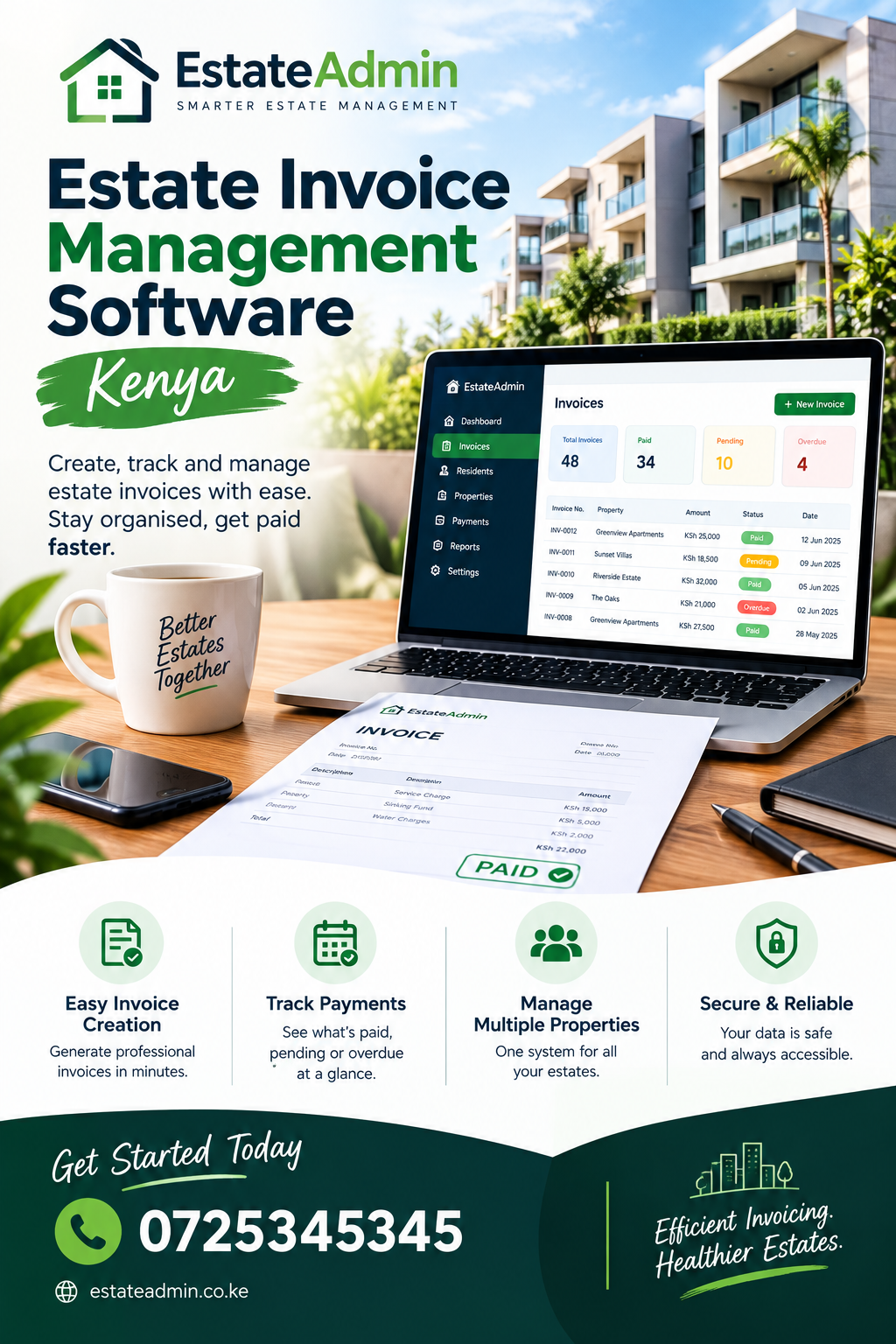
Estate Invoice Management Software Kenya: A Complete Guide for Modern Estate Billing
Managing invoices manually can become increasingly difficult as residential estates, gated communities, and apartment developments grow. Estate Invoice Management Software Kenya provides a structured way for estate managers, accountants, administrators, and committees to create invoices, apply recurring charges, monitor payments, track balances, and maintain organized financial records. Instead of relying entirely on spreadsheets, paper invoices, disconnected payment records, and manual calculations, estates can use a centralized workflow that connects billing with collections and reporting.
For a Kenyan estate, invoicing is not simply about producing a document that tells a resident how much to pay. An effective invoicing process should make it clear what has been charged, which period the charge covers, when payment is due, what has already been paid, and what balance remains outstanding.
This becomes particularly important when an estate has many residential units and recurring service charges. A single billing cycle may involve hundreds of invoices, different resident categories, multiple payment transactions, partial payments, arrears, adjustments, and follow-up questions.
A structured invoice management system can bring these activities into one workflow and make monthly estate administration more predictable.
What Is Estate Invoice Management Software?
Estate Invoice Management Software Kenya is software designed to help estates create, organize, issue, monitor, and manage invoices associated with residents, units, service charges, utilities, and other approved property-related charges.
Instead of preparing each invoice manually, estate administrators can establish billing rules and generate invoices according to a selected billing period.
A typical digital invoicing workflow can connect:
- Estate records
- Blocks or sections
- Units
- Residents
- Resident categories
- Charge categories
- Billing periods
- Invoice numbers
- Due dates
- Payments
- Outstanding balances
- Arrears
- Statements
- Financial reports
This connected approach is important because invoices do not exist in isolation.
Once an invoice has been issued, the estate needs to know whether it has been paid. If it has been partially paid, the remaining balance should remain visible. If it becomes overdue, management needs to identify it for follow-up.
The invoice is therefore the beginning of a financial workflow rather than the end of one.
Why Invoice Management Matters in Kenyan Estates
Residential estates depend on timely billing to support their financial operations.
Estate Invoice Management Software Kenya can help management create a consistent billing process where charges are generated according to approved rules and periods.
Consider an estate with 200 residential units and a recurring monthly service charge.
If every invoice has to be prepared manually, the administration team must repeatedly enter:
- Resident information
- Unit information
- Billing period
- Charge description
- Amount
- Due date
- Invoice reference
The larger the estate becomes, the more repetitive this process becomes.
A digital workflow can reduce repetitive entry by allowing administrators to configure recurring charges and generate invoices in bulk.
This does not eliminate the need for financial review. Instead, it moves staff effort away from repetitive document preparation and toward reviewing exceptions and ensuring that billing information is accurate.
The Problems With Manual Estate Invoicing
Many estates begin their financial administration using spreadsheets.
Estate Invoice Management Software Kenya can become particularly useful when the spreadsheet-based process starts creating operational difficulties.
Common problems include:
Duplicate Invoices
When several people work from different files, the same invoice may accidentally be created more than once.
Incorrect Amounts
Manual data entry can result in incorrect charges.
Missing Due Dates
An invoice may be sent without a clear payment deadline.
Inconsistent Invoice Numbers
Manual numbering can create duplicate or missing references.
Difficult Payment Matching
Invoices and payments may be recorded in separate files.
Slow Reporting
Management may have to combine several spreadsheets before determining how much has been billed or collected.
Poor Historical Visibility
Finding a previous invoice can become difficult when records are spread across emails, folders, and spreadsheets.
A centralized invoice workflow addresses many of these administrative challenges.
Bulk Invoice Generation
One of the biggest advantages of digital estate invoicing is bulk generation.
Estate Invoice Management Software Kenya can allow an estate team to generate multiple invoices based on configured billing rules instead of creating every invoice independently.
For example, an estate with 300 units might have a standard monthly service charge.
Rather than preparing 300 separate documents manually, the administrator can configure:
Charge: Monthly service charge
Billing period: Monthly
Due date: Selected date
Applicable units: Selected resident category or estate
The system can then generate the relevant invoices according to the configured workflow.
Bulk generation is especially useful for estates where the same type of charge occurs repeatedly.
It also creates a more consistent billing cycle.
Recurring Service Charge Invoicing
Service charges are usually recurring obligations.
Estate Invoice Management Software Kenya can help estate teams establish repeatable billing cycles for recurring charges.
Depending on the estate’s approved arrangements, billing may cover services such as:
- Security
- Landscaping
- Cleaning
- Waste management
- Common-area lighting
- Shared utilities
- Lift maintenance
- Estate administration
- Common-area repairs
- Other approved services
The exact charges vary from property to property.
The important principle is that recurring charges should be configured accurately and applied consistently.
Automation can help reduce the need to recreate the same charge manually every billing period.
Invoice Numbering
Invoice references are an important part of financial administration.
Estate Invoice Management Software Kenya can support a structured invoice numbering process where every issued invoice receives an identifiable reference.
For example, an estate might use a format such as:
- INV-2026-0001
- INV-2026-0002
- INV-2026-0003
The actual numbering convention should be determined by the estate’s requirements.
The key objective is uniqueness and traceability.
When a resident contacts the management office about an invoice, the invoice number gives both parties a specific reference.
It can also make it easier to connect an invoice to a payment, statement, report, or financial review.
Billing Periods and Invoice Clarity
Every estate invoice should make the billing period clear.
Estate Invoice Management Software Kenya can help organize invoices around defined periods so that residents can distinguish one charge from another.
For example:
Service Charge — September 2026
is more informative than simply writing:
Service Charge
The billing period becomes especially important when a resident has multiple unpaid invoices.
If a resident owes amounts from July, August, and September, management should be able to distinguish each invoice.
Clear billing periods also make historical reporting easier.
Invoice Due Dates
A due date tells residents when payment is expected.
Estate Invoice Management Software Kenya can help estates incorporate due dates into their recurring billing process.
A good invoice should make the following information easy to identify:
- Invoice number
- Billing period
- Amount due
- Issue date
- Due date
- Description
- Resident or unit
- Payment instructions
Clear due dates can also support arrears management.
Once an invoice passes its due date, management can identify it for follow-up according to the estate’s policies.
This is more organized than relying on staff to remember which invoices were issued and when they became overdue.
Managing Different Estate Charges
Residential communities rarely have exactly one financial charge.
Estate Invoice Management Software Kenya can help estates organize different charge categories within a broader billing workflow.
Depending on the property, invoices may contain charges for:
- Service charges
- Water
- Parking
- Garbage collection
- Security
- Shared facilities
- Maintenance contributions
- Utilities
- Approved penalties
- Other estate charges
Not every estate will use all these categories.
The important point is that different charges should be identifiable rather than being combined into unexplained totals.
A resident should be able to understand what they are being asked to pay.
Consolidated Invoices
In some estates, residents may have multiple charges during the same billing period.
Estate Invoice Management Software Kenya can help management organize multiple billing components in a consistent invoice structure where the estate’s workflow requires consolidated billing.
For example:
| Charge | Amount |
|---|---|
| Service charge | KSh 8,000 |
| Parking | KSh 2,000 |
| Water | KSh 1,500 |
| Previous balance | KSh 2,500 |
| Total due | KSh 14,000 |
A consolidated invoice gives the resident a clearer explanation of the amount requested.
The precise charges and calculations should always reflect the estate’s approved billing rules.
Invoice Management and Resident Accounts
An invoice should be connected to the correct resident account.
Estate Invoice Management Software Kenya can support this connection by maintaining resident, unit, invoice, and payment information within a structured workflow.
For example:
Estate → Unit → Resident → Invoice → Payment → Balance
This relationship allows management to understand the financial position of a particular unit.
If a resident asks about an outstanding balance, staff can review the invoices associated with the account instead of searching through unrelated documents.
This also supports statement generation because the statement can be built from the resident’s transaction history.
Partial Payments
Not every resident will settle an invoice in full immediately.
Estate Invoice Management Software Kenya becomes particularly valuable when estates need to track partial payments without losing visibility of the original invoice.
For example:
Invoice: KSh 20,000
Payment: KSh 12,000
Remaining: KSh 8,000
The invoice should remain visible, while its balance reflects the payment already received.
If the resident later pays another KSh 8,000, the invoice can move to a settled position.
This distinction is important for accurate arrears reporting.
A resident who has paid KSh 12,000 should not be treated in the same way as someone who has paid nothing.
Payment Tracking After Invoicing
Creating an invoice is only one part of the billing process.
Estate Invoice Management Software Kenya can help connect invoices with payment records so that management can see whether amounts have been settled.
A complete billing workflow should answer:
- What was invoiced?
- Who was invoiced?
- When was the invoice issued?
- When was payment received?
- How much was paid?
- Which invoice received the payment?
- What balance remains?
When these questions can be answered from one connected record, financial administration becomes easier.
M-Pesa Payments and Invoice Records
M-Pesa is an important payment channel for many Kenyan businesses and property operations.
Estate Invoice Management Software Kenya can form part of a broader estate payment workflow in which transaction records are connected to resident accounts and invoices.
However, receiving a payment is not the same as correctly allocating it.
For example, an estate may receive a payment reference that needs to be matched with a resident account.
The administration team must ensure that the payment is assigned correctly.
A good invoice-management process should therefore work together with payment tracking and reconciliation rather than treating invoicing as a separate activity.
Invoice Reconciliation
Reconciliation is the process of comparing invoices with payments.
Estate Invoice Management Software Kenya can support a workflow where payments are applied to the relevant invoices and balances are updated.
Suppose an estate has issued invoices totaling KSh 2 million for a particular month.
The team then receives payments from residents.
Management needs to determine:
- How much has been collected?
- Which invoices are fully paid?
- Which are partially paid?
- Which remain unpaid?
- Are any payments unmatched?
- Are there duplicate transactions?
A centralized ledger makes these questions easier to investigate.
Automatic Balance Updates
Manual balance calculations can create errors.
Estate Invoice Management Software Kenya can help reduce manual calculation when recorded payments automatically affect invoice balances within the system.
For example:
Invoice: KSh 10,000
Payment: KSh 4,000
Balance: KSh 6,000
If another payment of KSh 6,000 is recorded, the invoice should reflect settlement.
This relationship is important because resident statements, arrears reports, and management summaries should all be based on the same underlying transaction information.
Invoice Statuses
Invoice statuses provide useful visibility.
Estate Invoice Management Software Kenya can support status-based monitoring where invoices are identified according to their current position.
Common examples include:
- Draft
- Issued
- Pending
- Partially paid
- Paid
- Overdue
The exact statuses available will depend on the software.
The benefit of status tracking is that management can quickly identify invoices requiring attention.
Instead of opening every account manually, staff can focus on unpaid or partially paid records.
Arrears Management
Unpaid invoices eventually become an arrears management issue.
Estate Invoice Management Software Kenya can contribute to a broader arrears workflow by making outstanding invoice balances easier to identify.
Management can review:
- Overdue invoices
- Outstanding balances
- Partially paid invoices
- Resident account histories
- Payment dates
- Billing periods
This information can support targeted follow-up.
Rather than sending identical reminders to every resident, management can use account information to understand the actual status of each account.
Invoice Statements
Residents often need more than a single invoice.
Estate Invoice Management Software Kenya can support statement-based communication by connecting invoices with payments and running balances.
An invoice answers:
What am I being charged now?
A statement answers:
How has my account reached its current balance?
Both are useful.
For example, if a resident has an opening balance of KSh 3,000, receives a new invoice of KSh 8,000, and pays KSh 6,000, the statement can show the sequence clearly.
This reduces confusion when residents question an outstanding balance.
Reducing Invoice Disputes
Billing disputes can consume administrative time.
Estate Invoice Management Software Kenya can help make invoice information more transparent by providing a consistent record of charges, payments, and balances.
Common reasons for invoice queries include:
- Incorrect charge
- Wrong billing period
- Duplicate invoice
- Payment not reflected
- Partial payment misunderstood
- Previous balance questioned
- Incorrect resident association
- Unclear description
The objective is not to eliminate every dispute.
The objective is to make disputes easier to investigate.
When the relevant transaction history is accessible, management can determine what happened more quickly.
Resident Communication
Invoice management is also a communication process.
Estate Invoice Management Software Kenya can help estates provide residents with clearer financial information.
A resident should ideally be able to identify:
- What they owe
- Why they owe it
- When it is due
- Which invoice the amount relates to
- How much they have already paid
- What remains outstanding
Clear information can reduce unnecessary back-and-forth between residents and administrators.
It also gives management a more professional way to handle billing queries.
Estate Committee Reporting
Estate committees often need to understand the financial position of the community.
Estate Invoice Management Software Kenya can support committee reporting by connecting invoice records with payment information and outstanding balances.
A monthly committee report may include:
| Metric | Purpose |
|---|---|
| Total invoices | Shows billing activity |
| Total billed | Shows expected collections |
| Total paid | Shows collected amounts |
| Outstanding | Shows unpaid amounts |
| Partial payments | Shows accounts not fully settled |
| Arrears | Supports follow-up |
| Trends | Supports decision-making |
The committee does not necessarily need every individual transaction in the main report.
However, the underlying invoice records should be available when detailed questions arise.
Audit-Ready Invoice Records
Financial records should be easy to review.
Estate Invoice Management Software Kenya can contribute to a more organized record-keeping process by maintaining invoices and related transactions in one system.
An auditor, committee member, accountant, or estate manager may need to trace:
Charge → Invoice → Payment → Balance → Statement
When these records are connected, the financial history becomes easier to understand.
The objective is not merely to store documents.
The objective is to maintain a reliable transaction trail.
Invoice History
Historical records become increasingly important as estates operate over multiple years.
Estate Invoice Management Software Kenya can help estate teams maintain a structured history of billing activity.
Historical invoice records can be useful when:
- A resident questions an old charge
- A management company changes
- A committee reviews previous collections
- An account is disputed
- An opening balance needs verification
- An auditor requests supporting information
Without organized history, staff may have to search through old spreadsheets and email attachments.
Centralized records can make this process more manageable.
Invoice Management for Apartment Buildings
Apartment buildings often have recurring financial obligations.
Estate Invoice Management Software Kenya can help apartment managers organize billing across multiple units.
A typical apartment billing workflow may include:
- Maintain unit records
- Maintain resident information
- Configure approved charges
- Generate invoices
- Record payments
- Update balances
- Monitor arrears
- Generate statements
- Prepare reports
This workflow can be repeated every billing period.
The benefit comes from consistency.
Invoice Management for Gated Communities
Gated communities may have shared services that require regular resident contributions.
Estate Invoice Management Software Kenya can support recurring billing processes for communities where service charges are central to financial administration.
A gated community may have costs associated with:
- Security
- Landscaping
- Cleaning
- Waste collection
- Common-area maintenance
- Lighting
- Shared infrastructure
The estate’s governing arrangements determine how costs are allocated.
Once the approved charges are established, digital invoicing can make the recurring billing process easier to manage.
Invoice Management for Property Management Companies
Property management companies may manage several estates at once.
Estate Invoice Management Software Kenya can help standardize invoice processes across multiple properties when the system supports multiple estates or workspaces.
A management company may need to maintain separate:
- Residents
- Units
- Charges
- Invoice sequences
- Payment records
- Reports
for each property.
Standardized workflows can help reduce inconsistency between teams.
It can also make staff training easier because the basic billing process remains similar across properties.
Role-Based Invoice Management
Financial information should not necessarily be editable by every user.
Estate Invoice Management Software Kenya can fit into a role-based administration structure where responsibilities are separated between different users.
For example:
| Role | Possible Responsibility |
|---|---|
| Administrator | Daily estate operations |
| Accountant | Billing and payments |
| Manager | Oversight and approvals |
| Viewer | Read-only access |
| Committee | Review and reporting |
The exact permissions should reflect the estate’s governance arrangements.
Separating duties can reduce the risk of unauthorized changes and make accountability clearer.
Audit History and Accountability
When multiple people work with financial information, accountability matters.
Estate Invoice Management Software Kenya can be part of a system that maintains a clearer history of changes and administrative activity.
Estate teams should consider whether they can determine:
- Who created an invoice
- Who changed a record
- Who recorded a payment
- Who approved a change
- When an adjustment occurred
An audit-friendly history can make investigations easier.
It also supports stronger internal controls.
Managing Invoice Adjustments
Sometimes an invoice needs to be corrected.
Estate Invoice Management Software Kenya can support a controlled approach to invoice management where adjustments are documented instead of simply changing figures without explanation.
Possible reasons for adjustments include:
- Incorrect billing amount
- Approved credit
- Billing correction
- Change in resident category
- Reversal of an incorrect charge
The exact adjustment process should follow the estate’s financial controls.
The important principle is traceability.
A corrected invoice should not leave management wondering why the original amount changed.
Preventing Duplicate Invoices
Duplicate invoices can create serious confusion.
Estate Invoice Management Software Kenya can help estates reduce the risk of duplicate billing by using structured invoice generation and numbering.
Before issuing invoices, management should confirm:
- Correct billing period
- Correct resident
- Correct unit
- Correct charge
- Correct amount
- Correct invoice reference
Automated processes can reduce repetitive entry, but staff should still review exceptions.
Automation is most useful when combined with sensible controls.
Invoice Due-Date Management
Due dates are useful for both residents and administrators.
Estate Invoice Management Software Kenya can help incorporate due-date information into invoice records so management can distinguish current invoices from overdue invoices.
For example:
Issued: September 1
Due: September 10
If the payment has not been recorded after the due date, the invoice can become part of the estate’s follow-up process.
This creates a clearer relationship between billing and collections.
Monthly Invoice Workflow
A repeatable monthly process is one of the most important parts of effective invoice administration.
Estate Invoice Management Software Kenya can support a workflow such as:
Step 1: Review Residents
Confirm active units and resident information.
Step 2: Review Charges
Confirm recurring charges and applicable categories.
Step 3: Generate Invoices
Create invoices for the selected billing period.
Step 4: Review Exceptions
Check unusual amounts or missing records.
Step 5: Issue Invoices
Make invoices available to residents through the estate’s chosen communication process.
Step 6: Track Payments
Record payments received.
Step 7: Reconcile
Match payments to invoices.
Step 8: Monitor Arrears
Identify overdue and partially paid invoices.
Step 9: Generate Statements
Provide residents with account histories where required.
Step 10: Report
Prepare management or committee summaries.
This process can be repeated each billing cycle.
Invoice Data Accuracy
Software cannot compensate for incorrect source information.
Estate Invoice Management Software Kenya works best when resident records, units, charges, and billing rules are accurate.
Before launching a billing cycle, administrators should check:
- Resident names
- Unit numbers
- Active accounts
- Billing categories
- Charge amounts
- Billing periods
- Due dates
- Opening balances
A simple data review before invoice generation can prevent many problems later.
Migrating From Spreadsheets
Moving from spreadsheets to software requires planning.
Estate Invoice Management Software Kenya can support a transition when the estate first reviews the quality of its existing records.
Before migration, identify:
- Active residents
- Units
- Historical balances
- Current charges
- Outstanding invoices
- Recent payments
- Payment references
- Disputed accounts
Do not simply upload every historical spreadsheet without reviewing it.
Old files may contain duplicates, outdated residents, inconsistent balances, or obsolete formulas.
Data cleanup is an important part of migration.
Testing an Invoice System
Before adopting a platform, estate managers should test realistic scenarios.
Estate Invoice Management Software Kenya should be evaluated using actual billing situations rather than a simple demonstration.
Test scenarios can include:
- Full payment
- Partial payment
- No payment
- Multiple invoices
- Arrears
- Invoice correction
- Resident change
- Different charge categories
- Multiple billing periods
Then generate the relevant statements and reports.
The purpose is to determine whether the system reflects the estate’s actual workflow.
What Should Estate Managers Look For?
Choosing software should involve more than checking whether it has an invoice button.
Estate Invoice Management Software Kenya should be evaluated across the entire billing lifecycle.
Important features to consider include:
- Bulk invoice generation
- Recurring billing
- Invoice numbering
- Due dates
- Resident accounts
- Payment tracking
- Partial payments
- Reconciliation
- Arrears visibility
- Statements
- Reporting
- Exports
- User roles
- Audit history
The most valuable platform is one that keeps these functions connected.
Questions to Ask a Provider
Before selecting an invoice management system, estate managers can ask:
Estate Invoice Management Software Kenya providers the following questions:
- Can invoices be generated in bulk?
- Can recurring charges be configured?
- Can different resident categories have different charges?
- Can invoice numbers be generated consistently?
- Can due dates be recorded?
- Can payments be applied to invoices?
- Can partial payments be tracked?
- Are outstanding balances automatically updated?
- Can statements be generated?
- Can invoice reports be exported?
- Are user roles supported?
- Is there an activity history?
- Can multiple estates be managed?
- Can existing resident data be imported?
- Can the workflow be tested before full implementation?
These questions focus on practical operations rather than marketing terminology.
Estate Invoice Management and Financial Reporting
Invoices are also the foundation of financial reporting.
Estate Invoice Management Software Kenya can contribute to reporting by keeping billing records structured and connected to payments.
Management may want to know:
- Total invoiced this month
- Total collected
- Total outstanding
- Total partially paid
- Number of overdue invoices
- Collections by billing period
- Collections by resident category
A reporting system becomes much more useful when these figures can be traced back to individual invoices.
That creates a connection between high-level reporting and transaction-level detail.
Invoice Exports
Some estate teams need to share financial information outside the software.
Estate Invoice Management Software Kenya can support workflows involving exports for committee meetings, financial reviews, audits, or internal analysis where export functionality is available.
Useful exports may include:
- Invoice lists
- Payment lists
- Outstanding balances
- Resident statements
- Monthly summaries
The exported data should remain consistent with the records in the system.
This reduces the need to recreate reports manually in separate spreadsheets.
Cost Considerations
The cost of invoice management should not be judged only by the software subscription.
Estate Invoice Management Software Kenya should be evaluated against the total cost of the current manual process.
Consider the time spent on:
- Preparing invoices
- Checking calculations
- Sending invoices
- Recording payments
- Reconciling transactions
- Investigating disputes
- Preparing reports
- Following up on arrears
EstateAdmin’s current pricing page, for example, structures plans according to residential-unit capacity, with features varying by plan.
An estate should therefore compare the cost of software with the administrative effort it is intended to replace or reduce.
Improving Collections Through Better Invoicing
Good invoicing can support better collections.
Estate Invoice Management Software Kenya can help ensure residents receive consistent information about what they owe and when payment is expected.
Collections depend on many factors, including:
- Accurate billing
- Clear due dates
- Convenient payment channels
- Correct payment allocation
- Timely follow-up
- Transparent statements
- Reliable records
Software does not guarantee collection.
However, a weak billing process can make collection more difficult.
A consistent invoice process provides a stronger foundation.
Invoice Management and Resident Trust
Financial transparency can affect how residents perceive estate management.
Estate Invoice Management Software Kenya can help provide a more organized explanation of charges and balances.
Residents are more likely to understand an amount when the invoice clearly shows:
- Description
- Amount
- Billing period
- Due date
- Reference
- Previous balance where applicable
- Total due
When residents ask questions, management can refer to the invoice and account history instead of relying on memory.
That can make financial communication more professional.
Common Estate Invoicing Mistakes
Even estates using digital tools should watch for process mistakes.
Estate Invoice Management Software Kenya can deliver better results when supported by disciplined administrative practices.
Common mistakes include:
Using Incorrect Resident Records
Invoices may be assigned to outdated accounts.
Applying the Wrong Charge
A resident category may have been configured incorrectly.
Ignoring Previous Balances
An opening balance may be left out of the account.
Duplicating Payments
The same transaction may be recorded more than once.
Failing to Review Partial Payments
A partially paid invoice may be treated as unpaid or paid in full.
Changing Records Without Documentation
Unexplained adjustments can create disputes.
Allowing Excessive User Access
Too many users with editing rights can weaken controls.
Software should support good processes rather than replace them.
Invoice Management for Estate Handover
When a new property manager takes over an estate, invoice records become important.
Estate Invoice Management Software Kenya can help maintain structured billing histories that a new management team can review.
During handover, the incoming team may need:
- Resident records
- Unit lists
- Active invoices
- Outstanding balances
- Historical statements
- Payment records
- Charge structures
- Billing schedules
- Arrears reports
A centralized system can make this information easier to organize than a collection of disconnected files.
Invoice Management for Developers
Developers launching new residential communities also need a billing structure.
Estate Invoice Management Software Kenya can form part of the operational workflow as the development moves from construction and sales toward ongoing estate management.
Before residents move in, management may need to establish:
- Units
- Resident records
- Billing categories
- Service charges
- Invoice schedules
- Payment processes
- Reporting structures
Creating these processes early can make the transition into ongoing property administration smoother.
Invoice Management for Committees
Resident associations and estate committees often need visibility into billing without handling every administrative task.
Estate Invoice Management Software Kenya can support committee oversight through invoice and payment reports.
Committee members can review:
- How much was billed
- How much was collected
- Outstanding amounts
- Arrears
- Collection trends
If questions arise, the committee can request supporting invoice or statement records.
This creates a practical separation between governance and daily administration.
Invoice Security
Invoices contain resident and financial information.
Estate Invoice Management Software Kenya should therefore be evaluated alongside access control and information-security practices.
Estate administrators should consider:
- Strong passwords
- Appropriate user permissions
- Role-based access
- Secure administrative accounts
- Controlled exports
- Staff access reviews
- Removal of former users
- Backup procedures
Security is both a technical and operational responsibility.
The estate should ensure that only authorized personnel can access sensitive financial information.
Why a Connected Workflow Is Better
The biggest weakness of manual invoicing is often fragmentation.
Estate Invoice Management Software Kenya can help connect the steps between billing and reporting.
A connected process looks like:
Charge → Invoice → Payment → Reconciliation → Balance → Statement → Report
Each step depends on the previous one.
If the invoice exists in one spreadsheet and the payment exists in another, staff must reconcile the information manually.
If both are maintained in a connected workflow, the balance can be easier to monitor.
This is the real value of invoice management software.
A Practical Example
Consider a Nairobi residential estate with recurring monthly service charges.
The approved monthly charge is KSh 10,000 per unit.
At the beginning of September, invoices are generated for the active units.
Estate Invoice Management Software Kenya can help the management team create those invoices consistently.
One resident pays KSh 10,000.
Another pays KSh 6,000.
A third resident does not pay.
The system should allow management to distinguish:
- Paid
- Partially paid
- Outstanding
The first account is settled.
The second has a KSh 4,000 balance.
The third has the full KSh 10,000 outstanding.
This simple example demonstrates why invoice status and payment tracking should be connected.
Frequently Asked Questions
1. What is estate invoice management software?
Estate invoice management software is a digital platform used by estate managers and property administrators to create, issue, track, reconcile, and report on invoices associated with residents, units, service charges, utilities, and other approved property charges.
2. Can estate software generate invoices in bulk?
Yes. Many estate-focused systems support bulk invoice generation, allowing management to create invoices for multiple residents or units based on configured charges and billing periods.
3. Can the software manage recurring service charges?
Yes. Recurring service charges can be configured so that invoices are generated according to an established billing schedule.
4. Can partial payments be tracked?
A suitable system should support partial payments and retain the remaining balance on the relevant invoice rather than treating the invoice as fully settled.
5. Can invoice software help manage arrears?
Yes. By connecting invoices with payments and balances, management can identify overdue and partially paid invoices for follow-up.
6. Can invoices be connected to resident statements?
Yes. Invoice transactions can form part of resident statements showing billed amounts, payments, and running balances.
7. Can M-Pesa payments be incorporated into the billing workflow?
Estate teams can use payment and reconciliation workflows to associate recorded M-Pesa transactions with resident accounts and invoices, depending on the specific integration and configuration available.
8. Why are invoice numbers important?
Unique invoice numbers make it easier to identify transactions, respond to resident queries, match payments, maintain records, and conduct financial reviews.
9. What should an estate consider when choosing invoicing software?
The estate should evaluate bulk invoicing, recurring billing, due dates, payment tracking, partial payments, reconciliation, statements, arrears, reporting, exports, roles, and audit history.
10. Is invoice management software suitable for small estates?
Yes. The appropriate solution depends on the estate’s size, transaction volume, operational requirements, and growth plans. Even smaller estates can benefit from consistent billing records.
Final Thoughts
Estate invoicing is one of the most important financial processes in residential property management. When invoices are accurate, clearly structured, consistently generated, and connected to payment records, residents can better understand what they owe while management can monitor collections more effectively.
Estate Invoice Management Software Kenya provides a way to move from fragmented billing processes toward a connected workflow covering recurring charges, invoice generation, payment tracking, balances, arrears, statements, and reporting.
The objective should not simply be to replace a spreadsheet with another digital screen.
The objective should be to improve the complete billing process.
That means establishing accurate resident records, configuring approved charges, generating invoices consistently, assigning due dates, recording payments, reconciling transactions, monitoring outstanding balances, and producing useful reports.
EstateAdmin’s current service-charge billing workflow specifically emphasizes recurring billing, bulk invoice generation, due dates, payment-linked balance updates, arrears tracking, and reporting.
For estate managers, the practical test is simple.
Take one real billing cycle and ask whether the system can handle the complete process from start to finish.
Can it identify the correct residents?
Can it generate the correct invoices?
Can it assign due dates?
Can it record full and partial payments?
Can it update balances?
Can it identify arrears?
Can it produce statements?
Can it generate reports for management and committees?
Can authorized users work with the system without giving everyone unrestricted financial access?
If the answer is yes, the software is doing more than generating invoices. It is helping create a repeatable estate financial workflow.
For Kenyan estates, this approach can be especially useful where recurring service charges, multiple payment channels, resident account questions, arrears, and committee reporting all have to be managed as part of the same operation.
A strong invoice-management process ultimately creates three benefits: better organization for administrators, greater transparency for residents, and better financial visibility for estate committees and managers.
That is why modern estate billing should be viewed as a connected process rather than a document-generation task.
With the right workflow, an invoice becomes the starting point for accurate payment tracking, reliable resident balances, transparent statements, effective arrears management, and better estate financial reporting.
Estate Invoice Management Software Kenya