
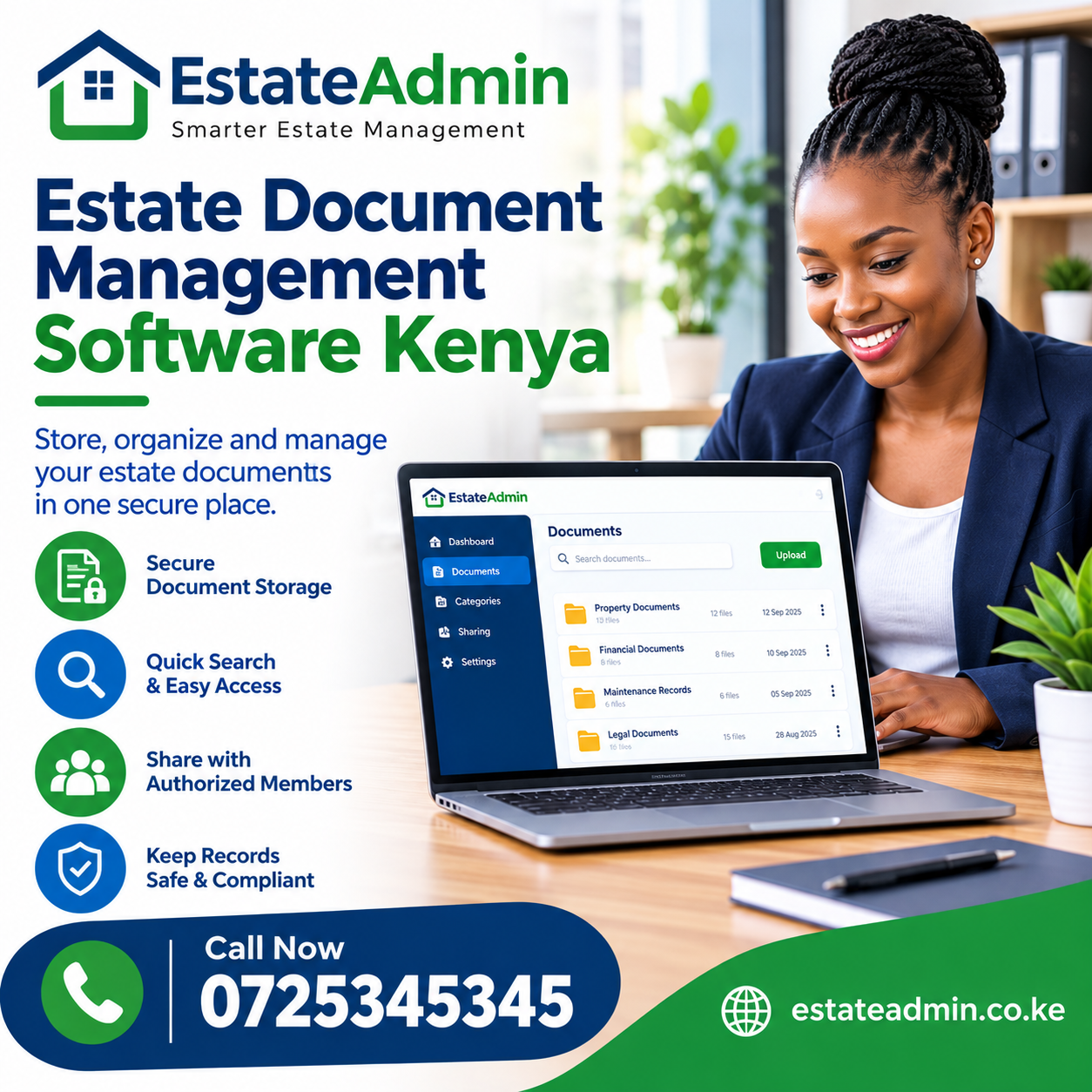
Estate Document Management Software Kenya: Complete Guide for Property Managers
Managing property records becomes increasingly difficult as an estate grows. Lease agreements, resident information, invoices, payment records, inspection reports, ownership documents, maintenance records, notices, receipts and financial reports can quickly fill filing cabinets and scattered computer folders. Estate Document Management Software Kenya provides a structured way to organize these records, make them easier to retrieve and connect important documents with the property, unit, resident or transaction they relate to. This guide explains how digital document management works for Kenyan estates, why it matters, what features to look for, how it can improve daily administration, and how property managers can move from paper-based records to a more organized digital workflow.
What Is Estate Document Management Software?
Estate Document Management Software Kenya is a digital solution designed to help estate managers, property administrators, landlords, developers, committees and property management companies store, organize, retrieve and manage documents associated with properties.
Instead of keeping information in physical files, email attachments, WhatsApp conversations, desktop folders and multiple spreadsheets, a document management system creates a more centralized recordkeeping environment.
For an estate, important documents may include:
- Lease agreements
- Tenant or resident identification documents
- Property ownership records
- Service charge records
- Invoices
- Payment receipts
- Statements
- Inspection reports
- Maintenance records
- Contractor documents
- Meeting minutes
- Notices
- Correspondence
- Financial reports
- Insurance documents
- Utility records
- Handover documents
- Property photographs
- Compliance records
A good system does more than provide online storage. Estate Document Management Software Kenya should help an estate team understand where a document belongs, who can access it, when it was uploaded, what property it relates to and how it fits into the wider management process.
This distinction matters. A general cloud storage folder can hold files, but estate administration often requires more context around those files.
Why Document Management Matters for Kenyan Estates
Property administration involves a surprisingly large amount of documentation. Even a relatively small residential development can generate thousands of records over several years.
A manager may need to answer questions such as:
- When was a particular lease signed?
- Which resident received a particular notice?
- Where is the latest inspection report?
- Has a contractor submitted the required documentation?
- Which invoice corresponds to a specific payment?
- What was recorded during the previous property inspection?
- When does a particular agreement expire?
- Can the committee review the supporting documents for a transaction?
- Which version of a document is the current one?
When documents are scattered, answering these questions takes time. Estate Document Management Software Kenya can make retrieval more structured by allowing teams to keep relevant records in one organized environment.
This becomes particularly important for estates in Nairobi and other growing urban areas where property portfolios can contain multiple buildings, blocks, floors and units.
Estate teams also need accountability. EstateAdmin’s current platform, for example, emphasizes organized resident information, invoices, payments, reporting, role-based access and audit-ready history.
The Problems Caused by Manual Document Management
Paper records are not automatically bad. Many property businesses began with physical files because they were simple and familiar. The problem arises when the volume of records becomes too large for manual systems.
1. Lost or misplaced documents
A document can be filed in the wrong folder, placed in the wrong cabinet or saved under an unclear filename.
Estate Document Management Software Kenya can reduce this problem by giving administrators a structured place for storing and retrieving records.
2. Slow document retrieval
A property manager may spend several minutes searching through folders for one agreement. Multiply that time across dozens of requests each month and document retrieval becomes an administrative burden.
Digital search makes it possible to locate records more quickly when documents have been properly categorized.
3. Duplicate documents
Different employees may save the same invoice, agreement or report several times.
This can create uncertainty over which version is current.
A structured document management approach makes version control and consistent naming easier.
4. Physical storage requirements
Paper records require cabinets, shelves and secure office space. As a property portfolio expands, the physical storage requirement grows as well.
Estate Document Management Software Kenya allows organizations to reduce dependence on physical storage for documents that can appropriately be maintained digitally.
5. Risk of physical damage
Paper can be damaged by water, fire, humidity, insects or simple wear and tear.
Digital records do not eliminate all risks, but appropriate backup and security practices can provide another layer of protection.
6. Difficult collaboration
When one person has the only physical copy of a document, other members of the team may have to wait before reviewing it.
Digital access can make collaboration more practical when permissions are properly configured.
Who Can Use Estate Document Management Software?
Estate Document Management Software Kenya can be useful for a wide range of organizations involved in property administration.
Property management companies
Property management firms often handle records for multiple clients and estates. A centralized system can help separate properties while maintaining consistent administrative procedures.
Estate managers
Estate managers deal with resident information, service charges, maintenance, inspections, reports and communication. Digital records can help connect these activities.
Landlords
An individual landlord may start with a few files but face growing complexity after acquiring additional units.
Digital organization becomes increasingly useful as the number of properties grows.
Estate committees
Committee members often need access to financial and operational information without receiving unrestricted access to every record.
Role-based permissions can help administrators provide appropriate access.
Property developers
Developers generate substantial documentation during development and handover. Keeping these records organized can help with future administration.
Housing cooperatives and SACCOs
Organizations managing housing units may need structured records for members, properties, payments and supporting documents.
Facility management teams
Facility managers may need maintenance reports, contractor records, inspection documentation and equipment-related information.
Key Features to Look For
Not every document storage platform is suitable for property management. When evaluating Estate Document Management Software Kenya, consider the features that support your actual workflows.
Centralized document storage
The first requirement is a reliable central location for important documents.
The system should make it possible to organize records by property, building, unit, resident, document type or another useful category.
Search and retrieval
A digital archive becomes much more valuable when employees can quickly locate a specific record.
Look for search functionality that can handle meaningful names, categories, dates and document references.
User permissions
Not every staff member should necessarily see every record.
An administrator may require broader access than a receptionist, accountant or viewer.
Role-based access helps organizations follow the principle of giving users only the access required for their responsibilities.
EstateAdmin’s platform currently describes separate roles such as Admin, Manager, Accountant and Viewer, supporting controlled access across estate workflows.
Document categorization
Documents should have clear categories.
For example:
| Document Category | Examples |
|---|---|
| Resident records | IDs, contacts, applications |
| Financial records | Invoices, receipts, statements |
| Property records | Ownership and property information |
| Maintenance | Work orders, inspection reports |
| Agreements | Leases, contracts and service agreements |
| Governance | Minutes, notices and committee documents |
| Compliance | Certificates, reports and supporting records |
Estate Document Management Software Kenya should make this organization practical rather than forcing staff to rely entirely on complicated folder structures.
Audit history
An audit trail can help administrators understand what happened to a record.
Depending on the system, this may include information about who uploaded, changed or accessed a document.
This is valuable when investigating discrepancies or preparing information for management review.
Backup and recovery
A document management strategy should consider what happens if a computer is lost, damaged or compromised.
Cloud-based systems with appropriate backup processes can help reduce dependence on a single physical device.
Mobile accessibility
Property managers are not always sitting at a desk. They may be visiting buildings, meeting contractors or conducting inspections.
Mobile-friendly access can therefore make digital recordkeeping more practical.
Managing Lease Agreements Digitally
Lease agreements are among the most important documents in property management.
A lease normally contains information about the parties, property, duration, financial obligations, responsibilities and other conditions.
When agreements are stored manually, managers may struggle to identify the correct document quickly.
Estate Document Management Software Kenya can help create a structured repository where lease records are connected to the relevant property or resident.
A useful lease document workflow can include:
- Create the resident or tenant record.
- Upload the signed agreement.
- Categorize the document.
- Record important dates.
- Restrict access appropriately.
- Store supporting documents.
- Monitor renewal or expiry information.
- Keep historical records where required.
The goal is not simply to scan paper agreements. It is to make those agreements useful within the property management workflow.
Managing Resident Records
Resident information can include names, contacts, identification information, unit numbers, correspondence and supporting documentation.
Estate Document Management Software Kenya can help estate teams keep these records organized.
For example, instead of maintaining a physical file for each household, an administrator could have a digital resident profile with relevant documents stored according to defined categories.
This makes it easier to answer routine questions.
A manager may need to confirm a resident’s agreement, review previous correspondence or locate a submitted document. A structured digital record reduces the amount of manual searching required.
Resident information should, however, be handled responsibly. Property managers should restrict access to sensitive information and establish clear procedures for storing, sharing and retaining personal records.
Invoices, Receipts and Financial Documents
Financial documentation is another major area where property managers can benefit from digital organization.
An estate may generate:
- Service charge invoices
- Payment receipts
- Resident statements
- Supplier invoices
- Maintenance bills
- Expense records
- Reconciliation reports
- Monthly financial reports
Estate Document Management Software Kenya can help connect financial documents with the relevant transactions and property records.
EstateAdmin’s current platform focuses heavily on invoices, payments, resident ledgers, balances, statements and reporting, providing a broader financial workflow around estate administration.
This is important because document management works best when it supports the underlying business process.
A stored invoice is useful. An invoice connected to the correct resident, property, payment and reporting workflow is much more useful.
Supporting M-Pesa and Digital Payment Records
Mobile money is a major part of everyday financial activity in Kenya. Property managers may therefore need to maintain records associated with mobile payments and service charge collections.
Estate Document Management Software Kenya can support the organizational side of these records when integrated with broader payment and accounting workflows.
For example, an estate team may need to retain payment confirmations, receipts, invoices and statements.
A good property management workflow should make it easier to connect these records rather than storing each item independently.
EstateAdmin currently provides M-Pesa-focused service charge pages and describes payment tracking and reconciliation workflows as part of its platform.
The important principle is consistency: payments should be recorded accurately, matched against the right accounts and supported by appropriate records.
Maintenance and Inspection Documents
Maintenance generates many documents that can become difficult to manage over time.
These may include:
- Inspection reports
- Contractor quotations
- Work orders
- Completion reports
- Maintenance invoices
- Photographs
- Equipment records
- Service agreements
- Warranty documents
Estate Document Management Software Kenya can provide a central document structure for these records.
Consider a water pump that requires regular servicing.
Instead of keeping service documents in a contractor email thread, the estate team can organize records around the property or equipment involved.
When the pump requires attention again, the manager can review previous documentation and understand what work was performed.
This creates institutional knowledge.
If an employee leaves the company, important operational history does not necessarily leave with them.
Property Inspection Records
Inspections provide valuable information about the condition of buildings, shared areas and individual units.
A digital inspection workflow can combine:
- Inspection date
- Property or unit
- Inspector
- Findings
- Photographs
- Recommended action
- Completion status
- Supporting documents
Estate Document Management Software Kenya can help keep inspection-related documents organized alongside other property records.
This becomes especially useful when an estate conducts recurring inspections.
Historical records can help management understand whether a problem is new, recurring or unresolved.
Contractor and Supplier Documentation
Property managers often work with plumbers, electricians, cleaners, security providers, landscapers, technicians and other contractors.
Each supplier may generate several documents.
These can include:
- Quotations
- Contracts
- Invoices
- Work completion documents
- Certificates
- Service reports
- Correspondence
Estate Document Management Software Kenya can help administrators create a more consistent supplier recordkeeping process.
Rather than searching through different email accounts, managers can organize supplier documentation around the appropriate vendor and property.
This is particularly useful when management needs to compare historical work, confirm an invoice or review previous services.
Improving Estate Committee Reporting
Estate committees need clear information to make informed administrative decisions.
Reports often depend on underlying records.
If invoices, receipts, payment information and supporting documents are scattered, preparing a committee report can take longer than necessary.
Estate Document Management Software Kenya can help create a more organized information base for reporting.
EstateAdmin’s current platform specifically highlights board-ready reporting, resident statements, billed-versus-paid information, outstanding balances and exports.
This demonstrates an important principle: documentation should support decision-making rather than simply exist for storage.
A committee may want to know why an expense occurred, whether it was paid, what supplier handled it and which supporting documents exist.
A connected recordkeeping system makes those questions easier to investigate.
How Digital Document Management Improves Efficiency
The main benefit of Estate Document Management Software Kenya is not that it makes documents digital. The bigger benefit is that it can reduce the time and uncertainty involved in managing information.
Faster retrieval
Employees spend less time searching through cabinets and unrelated folders.
Better organization
Documents can follow a defined classification system.
Reduced duplication
Clear records reduce the temptation to create multiple copies of the same document.
Easier collaboration
Authorized team members can access records without waiting for physical files to be transferred.
Better continuity
A structured system can preserve institutional knowledge when employees change.
Improved accountability
Audit records and user permissions can help management understand how information is handled.
Easier reporting
Supporting records can be retrieved when preparing financial and operational reports.
From Spreadsheets to a Centralized System
Many Kenyan property businesses begin with spreadsheets because they are flexible and inexpensive.
A spreadsheet can be useful for basic lists. However, it becomes difficult to manage when the business requires multiple users, document attachments, permissions, historical records and connected financial processes.
Estate Document Management Software Kenya can provide a more structured environment when a spreadsheet-based process has become difficult to maintain.
A practical transition does not require digitizing every old document immediately.
Instead, start with high-value records.
Step 1: Identify critical documents
List the records that staff access most frequently.
Step 2: Remove unnecessary duplicates
Avoid moving every duplicate file into the new system.
Step 3: Create categories
Establish a simple naming and classification standard.
Step 4: Prioritize active records
Digitize documents that are currently relevant first.
Step 5: Train staff
Explain where documents belong and how they should be named.
Step 6: Establish access rules
Define who can view, upload or modify records.
Step 7: Review the process
After several weeks, identify where staff are still struggling.
Security Considerations for Property Documents
Property documents may contain sensitive information. Security should therefore be part of the buying decision.
When evaluating Estate Document Management Software Kenya, ask how the system handles user authentication, permissions, backups, access logs and data protection.
Important questions include:
- Who can access resident documents?
- Can access be restricted by role?
- Are administrator actions recorded?
- How are backups handled?
- What happens when an employee leaves?
- Can access be revoked?
- How are sensitive documents shared?
- What procedures exist for recovering lost information?
Security is not only a technical issue.
It is also a management issue.
Employees should understand that documents containing personal, financial or contractual information should not be casually shared through unsecured channels.
Choosing the Right Document Management System
The right platform depends on the size and complexity of the estate.
Estate Document Management Software Kenya should be evaluated against actual operational needs rather than a long list of impressive-sounding features.
Consider the following criteria.
| Evaluation Area | What to Check |
|---|---|
| Ease of use | Can staff learn it quickly? |
| Search | Can records be found efficiently? |
| Permissions | Can access be controlled? |
| Reporting | Can useful information be exported? |
| Integration | Can it connect with existing workflows? |
| Scalability | Can it support more properties later? |
| Backup | Is there a recovery strategy? |
| Support | Is assistance available when needed? |
| Mobile access | Can managers work away from the office? |
| Cost | Does pricing fit the organization’s budget? |
Do not choose a system simply because it has the largest feature list.
Choose one that fits how your estate actually operates.
Why Ease of Use Matters
A technically powerful system can fail if employees avoid using it.
Estate Document Management Software Kenya should therefore have an interface that makes common actions straightforward.
For example, uploading a document should not require a complicated process.
Staff should understand:
- Where to upload a file
- How to categorize it
- How to locate an existing file
- How to update information
- How to request access
- How to avoid creating duplicates
Simplicity encourages adoption.
Document Naming and Organization Standards
Even the best software needs good administrative practices.
A document management system should be supported by a clear naming convention.
For example, instead of saving a file as:
document-final-new2.pdf
an estate could use a structured name such as:
Block-A_Unit-204_Lease_2026.pdf
The exact naming convention can vary, but consistency is important.
A useful structure might include:
Property + Unit + Document Type + Date
This makes records easier to understand even outside the software.
Automating Document-Related Workflows
Automation can reduce repetitive administrative tasks.
Estate Document Management Software Kenya can become more useful when document management is connected with other estate processes.
For example, a lease management workflow may trigger reminders before an agreement expires.
A maintenance workflow may retain inspection documentation alongside a completed work order.
A financial workflow may connect invoices with payment records and statements.
The objective is to create a connected operational system instead of a collection of disconnected digital folders.
EstateAdmin’s platform is currently positioned around connected service-charge workflows involving charges, invoices, payments, arrears, statements and reporting.
Managing Multiple Estates
Property management companies often face a different challenge from individual landlords.
A management company may oversee several estates, each with different:
- Residents
- Units
- Service charge structures
- Committees
- Suppliers
- Financial records
- Maintenance requirements
Estate Document Management Software Kenya should therefore support separation between properties while allowing authorized managers to work efficiently across the portfolio.
Multi-estate organization reduces the risk of mixing records.
It also makes reporting easier when each estate maintains its own operational structure.
Estate Document Management for Growing Property Portfolios
A property portfolio can grow gradually.
A landlord may start with ten units, acquire another building and later begin managing property for other owners.
The document workload grows with the portfolio.
Estate Document Management Software Kenya gives growing organizations an opportunity to establish a structured recordkeeping process before information becomes difficult to control.
Scalability should be considered early.
Ask whether the system can support:
- More properties
- More users
- More documents
- More residents
- More transactions
- More reporting requirements
The best system is not necessarily the one built only for the current portfolio. It should also accommodate realistic future growth.
Cost Considerations
Pricing is an important consideration when choosing property management technology.
However, the purchase price is only one part of the total cost.
A business should also consider:
- Staff time spent searching for records
- Cost of physical storage
- Time spent preparing reports
- Risk associated with lost records
- Manual data entry
- Duplicate work
- Training
- Implementation
- Ongoing support
Estate Document Management Software Kenya should therefore be evaluated based on the value it provides to the whole operation.
EstateAdmin currently publishes subscription plans based on residential units, with different levels intended for different portfolio sizes.
Actual suitability should be determined by comparing the platform’s current features and pricing with the estate’s specific requirements.
Practical Example: A Nairobi Residential Estate
Consider a residential estate in Nairobi with several apartment blocks and hundreds of residents.
The management team needs to maintain resident information, service charge records, invoices, payments, statements, maintenance documentation and committee reports.
Under a paper-heavy workflow, staff may use several files:
- One cabinet for resident documents
- Another for invoices
- A spreadsheet for payments
- Email for contractor documents
- WhatsApp for some communication
- A separate folder for committee reports
When a committee member asks for information, the administrator has to search across several sources.
Estate Document Management Software Kenya can help consolidate the information structure.
The manager could organize records by estate, block, unit and document category.
A payment record can remain associated with the relevant account. An invoice can be retrieved alongside related information. Maintenance records can be grouped by property or unit.
The result is not simply a digital filing cabinet. It is a more consistent operating process.
Practical Example: A Property Management Company
Imagine a property management company responsible for ten residential estates.
Each estate has different committees, suppliers, residents and billing structures.
Without proper organization, the company may have dozens of folders and spreadsheets.
Estate Document Management Software Kenya can help establish consistent processes across the portfolio.
The company can define standard document categories and permissions while maintaining separate estate records.
Managers can then spend more time on property operations and less time locating administrative information.
Common Mistakes to Avoid
Implementing software does not automatically solve poor recordkeeping.
Avoid these mistakes.
Uploading everything without categories
A digital mess is still a mess.
Giving every employee full access
Broad access increases the risk of inappropriate changes or exposure.
Keeping duplicate systems forever
Running paper, spreadsheets and software indefinitely can create conflicting records.
Ignoring staff training
Employees need clear instructions.
Failing to review old documents
Not every old document needs to be migrated.
Using inconsistent names
Unclear filenames make digital search harder.
Neglecting backups
Digital information still needs protection.
Choosing software based only on price
The cheapest platform may create more administrative work if it does not fit the workflow.
How to Implement a Document Management System Successfully
A structured implementation plan can make adoption easier.
Estate Document Management Software Kenya can be introduced in stages.
Phase 1: Audit existing records
Identify where documents currently exist.
Phase 2: Define categories
Create categories based on real operational needs.
Phase 3: Establish permissions
Decide which roles require access to which records.
Phase 4: Digitize priority documents
Start with active and frequently requested records.
Phase 5: Train staff
Give employees practical examples.
Phase 6: Establish standard procedures
Create rules for uploading, naming and updating documents.
Phase 7: Review adoption
Check whether employees are consistently using the system.
Phase 8: Improve
Adjust categories and procedures as the estate learns what works.
The Role of Audit Trails
An audit trail can provide valuable accountability.
Estate Document Management Software Kenya can be particularly useful when property administration involves multiple employees and managers.
An audit history can help answer questions such as:
- Who made a change?
- When was a document uploaded?
- Which user handled a record?
- Was a record updated?
- What happened before a discrepancy appeared?
EstateAdmin currently describes audit-ready history as part of its platform, with an emphasis on knowing what changed, when and by whom.
This kind of accountability is especially valuable for financial and governance records.
Connecting Documents With Property Management
Document management should not exist in isolation.
The greatest value comes when records support other activities.
Estate Document Management Software Kenya can form part of a broader property management system that includes resident management, billing, payments, reporting and operational workflows.
For example:
Resident record → Unit → Invoice → Payment → Statement → Supporting documents
This creates a chain of information.
When a question arises, the manager can investigate the complete record instead of looking for unrelated files.
How It Can Support Better Customer Service
Residents expect property managers to respond quickly when they request information.
A delayed response can occur simply because the relevant record is difficult to find.
Estate Document Management Software Kenya can support faster responses by helping authorized staff retrieve documents efficiently.
For example, a resident may ask for a statement or request clarification about an invoice.
The administrator can access the relevant record and provide accurate information without searching through multiple cabinets.
Better organization therefore has a customer service benefit as well as an administrative benefit.
Digital Records and Professional Property Management
Professionalism is often visible in small administrative details.
A property management company that can quickly retrieve invoices, agreements, reports and statements demonstrates stronger organizational discipline.
Estate Document Management Software Kenya can support this by making recordkeeping part of the normal workflow.
This does not mean software replaces professional judgment.
Managers still need to communicate clearly, resolve disputes, inspect properties, supervise contractors and make operational decisions.
The software provides the information structure that supports those responsibilities.
What to Ask Before Buying
Before selecting Estate Document Management Software Kenya, prepare a list of questions.
About functionality
- What document types can be stored?
- Can documents be linked to residents or units?
- Can the system support multiple estates?
- Is search available?
- Are reports and exports available?
About security
- How are user permissions managed?
- Is there an audit trail?
- What backup procedures exist?
- How is access removed when employees leave?
About usability
- Is the interface easy to understand?
- Can staff use it on mobile devices?
- How long does onboarding take?
- Is training available?
About costs
- Is pricing based on users, units or properties?
- Are there setup fees?
- Are integrations charged separately?
- What support is included?
About scalability
- Can more properties be added?
- Can additional users be created?
- Will the system continue supporting larger portfolios?
These questions help buyers compare systems according to actual needs.
Estate Document Management Software and Compliance
Property organizations may handle records containing personal and financial information.
Good document management should therefore be designed with responsible information handling in mind.
Estate Document Management Software Kenya can help organizations establish access controls and structured recordkeeping, but software alone does not guarantee legal or regulatory compliance.
Estate managers should understand the obligations relevant to their organization and seek appropriate professional advice where necessary.
The key principle is simple: collect and retain information responsibly, restrict access appropriately and avoid unnecessary sharing.
Why Cloud-Based Management Can Be Practical
Cloud-based software allows authorized users to access information without depending on one office computer.
Estate Document Management Software Kenya can be useful for managers who need to work between offices, estates and property sites.
This is especially relevant for property management companies where staff may spend much of their day outside the main office.
Cloud access can also support centralized information management when multiple authorized employees work on the same portfolio.
The exact availability and security of cloud features should always be confirmed with the software provider before implementation.
Future-Proofing Estate Administration
The amount of property information an organization manages tends to increase over time.
More residents create more records.
More properties create more contracts.
More transactions create more invoices and receipts.
More maintenance activity creates more reports.
Estate Document Management Software Kenya can therefore be part of a long-term strategy for keeping property administration organized as a portfolio expands.
The objective is not to digitize everything for its own sake.
The objective is to create a reliable information environment that helps employees perform their responsibilities with fewer unnecessary administrative obstacles.
Frequently Asked Questions
1. What is Estate Document Management Software Kenya?
Estate Document Management Software Kenya is software that helps property managers and estate administrators digitally organize, store, retrieve and manage documents such as leases, invoices, receipts, inspection reports, resident records and financial documents.
2. Who needs estate document management software?
Estate Document Management Software Kenya can be useful for landlords, estate managers, property management companies, developers, housing organizations, gated communities, committees and businesses managing multiple properties.
3. Can document management software store lease agreements?
Yes. Estate Document Management Software Kenya can be used to organize lease agreements and related records when the selected platform supports document storage and property or resident associations.
4. Can property managers organize financial documents?
Yes. Estate Document Management Software Kenya can help organize invoices, receipts, statements and reports when document management is connected to financial workflows.
5. Is document management useful for Nairobi estates?
Yes. Estate Document Management Software Kenya can be useful for Nairobi estates because property managers may handle large numbers of residents, units, invoices, payments, reports and maintenance records.
6. Can multiple users access the same estate records?
Many modern platforms support multiple users with different permissions. Estate Document Management Software Kenya should be evaluated based on whether its user roles and access controls match your organization’s requirements.
7. Does digital document management eliminate paper completely?
Not necessarily. Estate Document Management Software Kenya can reduce dependence on paper, but some organizations may still need physical originals for specific legal, contractual or operational reasons.
8. How secure are digital property documents?
Security depends on the software, configuration and internal procedures. Estate Document Management Software Kenya should be evaluated for authentication, access controls, audit trails, backup processes and other security measures before purchase.
9. Can a document management system support multiple properties?
Yes, depending on the platform. Estate Document Management Software Kenya should be able to organize information by property or estate if you manage multiple locations.
10. How should an estate start digitizing documents?
Start with active and frequently accessed records. Estate Document Management Software Kenya can become easier to implement when the organization first defines categories, permissions, naming standards and migration priorities.
Final Thoughts
Effective property management depends on accurate information. When leases, resident records, invoices, receipts, inspection reports, maintenance documents and financial records are scattered across cabinets, spreadsheets and personal devices, everyday administration becomes harder than it needs to be.
Estate Document Management Software Kenya provides a structured approach to organizing important property records and making them easier for authorized staff to retrieve.
The biggest value comes from connecting documents with the wider property management process. A lease should relate to the appropriate resident and unit. An invoice should relate to the relevant account. A payment should be traceable to the appropriate transaction. An inspection report should remain associated with the property or unit it concerns. Supporting documents should be available when management needs to investigate a question or prepare a report.
Estate Document Management Software Kenya can also help property managers establish consistent procedures as their portfolios grow.
For Kenyan estates, the right solution should fit local operational realities, including service charge administration, resident records, payment tracking, reporting and mobile-first working environments. EstateAdmin currently positions its platform around estate and service-charge workflows, including resident management, invoice generation, payment tracking, statements, reporting and role-based access.
Before purchasing any platform, assess your existing document processes, identify the records that create the most administrative work and test the software using real examples from your estate.
Estate Document Management Software Kenya is most valuable when it becomes part of everyday operations rather than another standalone tool.
A successful implementation should leave your team knowing where documents belong, who can access them, how they can be retrieved and how they connect with the property’s financial and operational records.
For estate managers, landlords and property management companies looking to reduce paperwork, improve record organization and create a more consistent administrative workflow, moving from scattered files to structured digital records can be an important step toward better property management.