
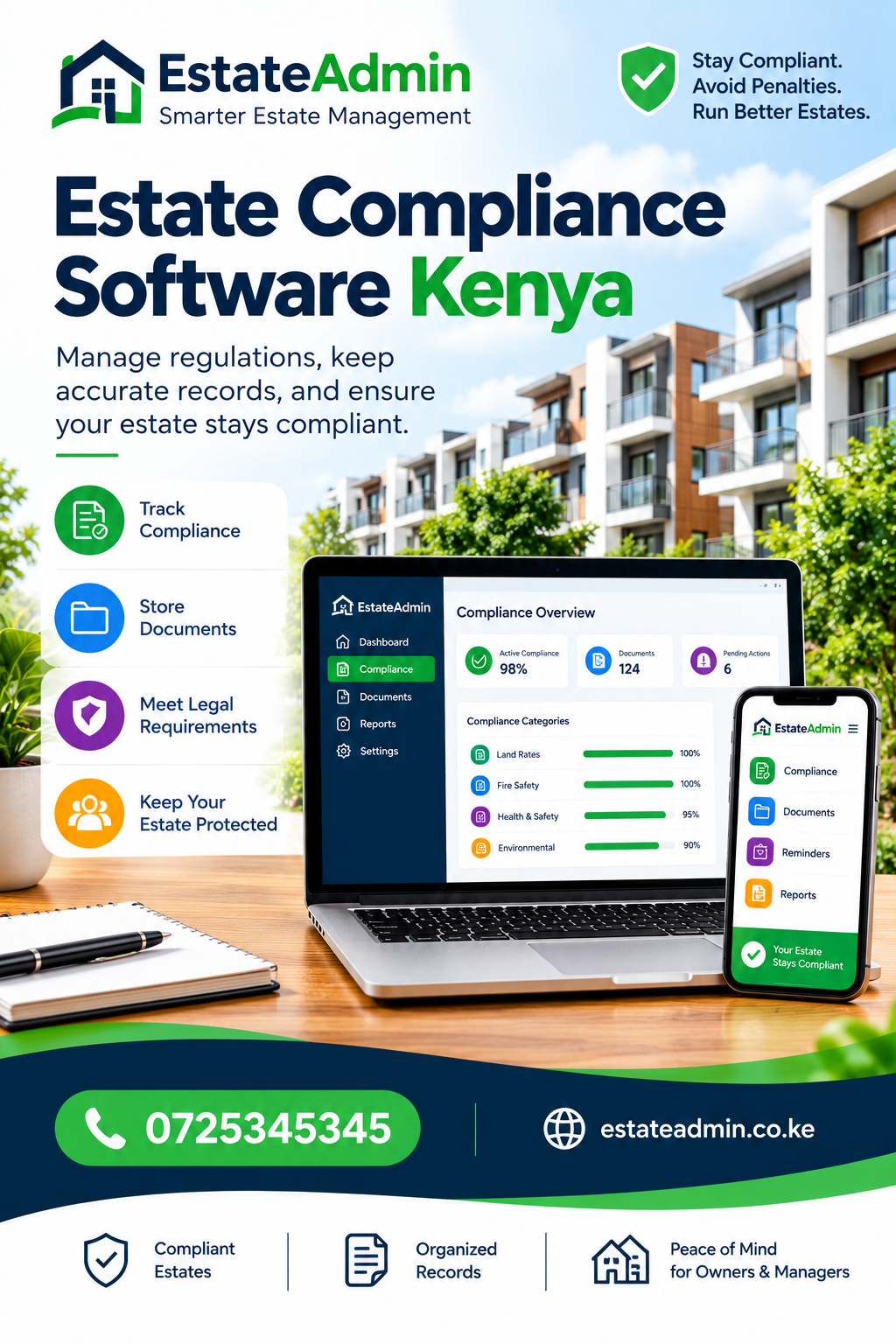
A Practical Guide to Estate Compliance for Property Managers and Estate Administrators
Managing an apartment estate, gated community, residential development, or mixed-use property involves far more than collecting rent and paying bills. Managers also have to keep records, follow internal procedures, track inspections, document incidents, monitor service providers, maintain approvals, and demonstrate that important estate activities were handled properly. That is where Estate Compliance Software Kenya can become useful. This guide explains what compliance management means in an estate environment, the records and workflows software can organize, the features to look for, the practical benefits for Kenyan property managers, and how to introduce a system without disrupting daily operations.
What Is Estate Compliance Software?
Estate compliance software is a digital system designed to help property managers and estate administrators organize the information, tasks, documents, approvals, checks, and reports required to operate an estate consistently. Instead of depending on separate notebooks, spreadsheets, email threads, physical files, and staff memory, a centralized system can provide one place for compliance-related information.
A well-configured Estate Compliance Software Kenya solution can help organize these processes into repeatable workflows. The objective is not to create paperwork for its own sake. The objective is to make important responsibilities visible, traceable, and easier to manage.
Why Compliance Matters in Estate Management
Consider a residential estate with several blocks. Management may need to coordinate maintenance, security, cleaning, waste collection, lifts, water systems, electrical installations, common areas, access controls, contractors, resident communication, and financial administration. Each area creates records and responsibilities.
A digital process supported by Estate Compliance Software Kenya can make those responsibilities easier to assign and monitor.
Compliance Is an Ongoing Process
- Scheduled inspections have been completed.
- Required documents are current and easy to retrieve.
- Contractors have submitted relevant information.
- Maintenance actions have been recorded.
- Incidents have been documented.
- Follow-up tasks have an owner.
- Management decisions are properly recorded.
- Residents have received important notices.
- Supporting evidence can be located when needed.
This is one reason Estate Compliance Software Kenya can be valuable. It can turn recurring responsibilities into visible tasks rather than leaving them as reminders in someone’s notebook or memory.
Better Documentation Supports Better Administration
Clear documentation gives managers a record of what happened and what action followed. This becomes particularly useful when several people are involved in managing the same property.
A resident may report a problem, a caretaker may inspect it, a contractor may be assigned, and a manager may approve the work. If those actions are scattered across messages and paper files, reconstructing the history can take time. A structured digital workflow gives the team a more consistent way to record the process.
Common Compliance Challenges Faced by Kenyan Estates
Many estates face similar administrative problems even when their sizes and budgets differ. The exact challenge depends on the property, management structure, and services provided, but several issues appear frequently.
Scattered Records
Important records can easily end up in different locations. One document may be in a physical file, another in a spreadsheet, another in an email attachment, and another on an individual employee’s computer.
Centralized records through Estate Compliance Software Kenya can reduce the dependence on scattered storage. Documents can be organized according to property, category, task, contractor, or date, depending on the system’s capabilities.
Missed Renewal and Review Dates
A compliance calendar supported by Estate Compliance Software Kenya can help managers see upcoming activities and assign responsibility before deadlines become urgent.
Limited Accountability
Task assignment and status tracking through Estate Compliance Software Kenya can create clearer ownership. A record can show who was assigned the task, what action is required, and whether it has been completed.
Difficulty Preparing Reports
Estate committees, owners, residents, auditors, management companies, or internal supervisors may request information at different times. If the information is scattered, preparing a reliable report can take hours.
A reporting function in Estate Compliance Software Kenya can help summarize completed activities, outstanding actions, incidents, documents, and other relevant records.
Key Features to Look For
Not every property management system provides the same compliance capabilities. When evaluating software, managers should focus on the functions that solve actual administrative problems.
1. Compliance Task Tracking
A task-management feature should allow managers to create activities, assign responsibility, set dates, update status, and record completion. This can cover routine inspections as well as one-time corrective actions.
This makes Estate Compliance Software Kenya more useful than a simple document storage tool because compliance work is not only about storing evidence; it is also about completing actions.
2. Document Management
A good compliance workflow needs organized documents. The software should make it practical to store records and locate them later.
Useful document categories might include:
- Contractor documentation
- Inspection reports
- Maintenance records
- Estate policies
- Meeting records
- Service agreements
- Incident reports
- Equipment records
- Correspondence
- Approvals
- Notices
If the platform supports structured document management, Estate Compliance Software Kenya can help reduce the amount of time spent searching through folders.
3. Reminders and Notifications
Using Estate Compliance Software Kenya for reminders can support proactive administration instead of relying entirely on memory.
Recurring reminders can be useful for inspections, internal reviews, maintenance-related checks, document reviews, and other activities established by the estate’s procedures. The exact schedule should reflect the property’s own requirements.
4. Audit Trails
An audit trail records changes or actions within the system. Depending on the software, it may show when information was created, updated, approved, or completed.
This can be particularly helpful when several staff members work on the same property. With Estate Compliance Software Kenya, managers may have a clearer record of how an issue moved from identification to resolution.
5. Incident Management
Incidents should be documented consistently. A system can provide a standard way to capture the date, location, description, people involved, action taken, and follow-up requirements.
For estates that need consistent incident documentation, Estate Compliance Software Kenya can form part of a broader management workflow.
6. Inspection Checklists
For example, an estate inspection may cover common areas, lighting, access points, equipment rooms, waste areas, water facilities, landscaping, or other property-specific items. The checklist should be customized to the estate rather than copied blindly from another property.
A structured checklist within Estate Compliance Software Kenya can make inspection results easier to compare over time.
7. Corrective Action Tracking
When an inspection identifies a problem, management needs to record what happens next. A corrective-action process can show:
- The issue identified.
- The person responsible.
- The required action.
- The target date.
- The current status.
- Supporting notes or documents.
- The date the issue was closed.
This workflow gives Estate Compliance Software Kenya a practical role in turning inspection findings into accountable follow-up.
How Compliance Software Can Support Estate Operations
Compliance does not sit separately from the rest of property management. It connects with maintenance, finance, residents, contractors, security, and management reporting.
Connecting Compliance and Maintenance
Suppose an inspection identifies a damaged electrical fitting in a common area. A manager may need to create a maintenance request, assign a qualified service provider, monitor the work, and record completion.
A connected workflow can reduce duplication. Instead of recording the inspection in one file and the maintenance action in another, Estate Compliance Software Kenya can help connect the finding to the action that followed.
Connecting Compliance and Contractor Management
Estates may depend on external providers for cleaning, security, landscaping, waste services, lifts, plumbing, electrical work, pest control, and other services.
With Estate Compliance Software Kenya, a manager can establish a structured process in which contractor-related information is stored alongside the activities it supports.
Connecting Compliance and Resident Communication
Residents need timely information about matters affecting common areas and estate operations. Notices may concern planned maintenance, access arrangements, service interruptions, meetings, inspections, or other activities.
A management system can help keep communication records organized. Estate Compliance Software Kenya may therefore support not just internal administration but also a more consistent resident-service process.
Compliance Records Every Estate Should Organize
| Record category | Examples | Why it matters |
|---|---|---|
| Property records | Blocks, units, common areas | Establishes a clear property structure |
| Maintenance records | Repairs, work orders, inspections | Shows what work was requested and completed |
| Contractor records | Contacts, agreements, work history | Supports supplier administration |
| Incident records | Complaints, incidents, actions | Creates a traceable history |
| Meeting records | Agendas, minutes, resolutions | Preserves management decisions |
| Document records | Policies, reports, certificates | Makes evidence easier to retrieve |
| Task records | Assignments, due dates, status | Supports accountability |
| Communication records | Notices and correspondence | Provides administrative context |
| Financial records | Charges, payments, invoices | Supports broader estate administration |
When these categories are connected, Estate Compliance Software Kenya can help management see compliance as part of the estate’s wider operational picture.
Using Software for Estate Inspections
Inspections are a practical starting point for digital compliance management. A manager can establish a schedule and define the areas that need review.
Before an Inspection
The manager can prepare a checklist, identify the location, assign the responsible person, and confirm any previous issues that require follow-up.
During an Inspection
The person conducting the inspection can record observations and identify items that need attention. Where the system allows it, supporting photographs or documents may be attached.
After an Inspection
Findings should be reviewed and converted into actions where necessary. An issue that requires repair should not remain only as a note. It should move into a responsible workflow.
This makes Estate Compliance Software Kenya useful as a bridge between inspection and action.
Building a Compliance Calendar
A compliance calendar provides a forward-looking view of responsibilities. It can include recurring internal checks, service reviews, document reviews, scheduled inspections, and other activities relevant to the estate.
A simple calendar can divide work into:
- Daily tasks
- Weekly checks
- Monthly activities
- Quarterly reviews
- Annual activities
- Event-based tasks
- Corrective actions
The important point is to avoid treating every task as the same. Some responsibilities are recurring, while others arise because of a particular incident or decision.
A calendar supported by Estate Compliance Software Kenya gives managers a practical way to plan work rather than reacting only after something becomes overdue.
How Estate Compliance Software Helps Management Teams
The value of a system is often seen in small improvements repeated every day.
Faster Record Retrieval
A manager should not need to search through multiple cabinets and folders to find a basic operational record. Searchable digital records can shorten that process.
Clearer Responsibility
Assigned tasks make it easier to see who is handling a particular action. This can reduce uncertainty during follow-up meetings.
Better Follow-Up
A system can keep outstanding items visible. This is particularly useful when a corrective action requires several steps.
More Consistent Processes
Different staff members may approach the same task differently. Standardized workflows and checklists create greater consistency.
Better Management Reporting
Managers can use organized information to prepare operational reports. The exact reports available will depend on the platform.
For these reasons, Estate Compliance Software Kenya can support both daily administration and longer-term oversight.
Compliance and Financial Administration
Compliance is not only about physical inspections. Financial records also need organized administration.
An estate may handle service charges, utility-related costs, contractor invoices, maintenance expenses, budgets, and other transactions. While financial management is a separate discipline, compliance processes can depend on accurate supporting records.
A connected platform such as Estate Compliance Software Kenya can make those relationships easier to organize when its features support them.
Choosing Software for a Kenyan Estate
A property manager should evaluate software based on the estate’s actual needs rather than choosing a platform simply because it has a long list of features.
Start With the Estate’s Workflows
Before purchasing anything, document the processes that need improvement.
Ask:
- How are inspections currently recorded?
- Where are important documents stored?
- How are deadlines tracked?
- How are incidents reported?
- How are corrective actions assigned?
- How are management reports prepared?
- Which tasks are repeatedly forgotten?
- Which records take too long to retrieve?
The answers create a practical requirements list for Estate Compliance Software Kenya.
Consider Ease of Use
A sophisticated system can fail if staff find it difficult to use. Caretakers, administrators, property managers, accountants, and committee members may have different levels of technical experience.
The interface should be clear enough that ordinary users can perform routine tasks without unnecessary steps.
Consider Access Controls
Different users may need different permissions. A caretaker may need to update inspection tasks, while a senior manager may need access to reports and approvals.
Role-based permissions can help limit access to information according to responsibilities.
Consider Data Security
Estate systems may contain personal and operational information. Management should ask how information is stored, who can access it, how user accounts are protected, and how backups are handled.
Security should be treated as an ongoing management responsibility, not simply a feature on a sales page.
Compliance Software for Small and Large Estates
The size of an estate does not automatically determine whether digital compliance tools are useful. A smaller development may have fewer units but still have recurring responsibilities. A larger estate may have more buildings, staff, contractors, and records.
For a small estate, Estate Compliance Software Kenya may help replace scattered spreadsheets and paper folders with a more structured workflow.
The key is proportionality. A system should fit the estate’s complexity rather than forcing a small property to operate like a large corporate portfolio.
Practical Example: A Common-Area Maintenance Issue
Imagine that a caretaker notices a leaking pipe in a shared area.
Under a manual process, the caretaker might send a message to the manager. The manager could contact a plumber, receive a quotation, approve the work, and later try to locate the invoice. Months afterward, it may be difficult to reconstruct the sequence.
With a structured digital process, the issue can be recorded as an incident or maintenance task. The responsible person can be assigned. Supporting information can be attached. The status can be updated as the work progresses.
If the system connects maintenance and compliance records, Estate Compliance Software Kenya can help preserve the history from identification to resolution.
The benefit is not the software itself. The benefit is the clearer process around the work.
Practical Example: Preparing for a Management Review
Suppose an estate committee asks management to provide an update on outstanding operational issues.
With structured task tracking, management can review open items, completed tasks, overdue actions, and inspection findings. Estate Compliance Software Kenya can support this type of review when the system provides suitable reporting.
The manager can then focus the meeting on decisions and actions rather than spending most of the time reconstructing historical information.
Practical Example: Contractor Documentation
Consider an estate that uses several contractors. Each supplier may have separate contacts, agreements, service schedules, and work records.
When contractor records are connected to tasks and inspections, Estate Compliance Software Kenya can help create a more complete operational history.
A central contractor register can help management identify who is responsible for which service and locate relevant documentation. The system does not remove the need for management to verify documents or evaluate suppliers. It simply makes the information easier to organize.
How to Implement a Compliance System
Introducing new software should be planned. Uploading every historical document at once can overwhelm staff and delay adoption.
Step 1: Map Current Processes
List the current compliance and administration activities. Identify which processes are working and which create delays.
Step 2: Identify Essential Records
Start with the records the estate uses most often. These may include inspections, incidents, contractors, documents, tasks, and maintenance records.
Step 3: Define Responsibilities
Decide who creates records, who approves them, who updates them, and who reviews reports.
Step 4: Configure Workflows
Set up categories, checklists, task statuses, permissions, reminders, and reports according to actual estate processes.
Step 5: Train Users
Training should use realistic examples. A caretaker can practice completing an inspection, while an administrator can practice uploading a document and assigning a follow-up task.
Step 6: Start With a Controlled Rollout
Begin with one property or one group of workflows if the estate is large. This gives management an opportunity to identify problems before expanding the process.
Step 7: Review the System Regularly
After implementation, ask whether staff are using the platform consistently and whether it is actually reducing administrative friction.
This measured approach makes Estate Compliance Software Kenya more likely to become part of normal operations rather than another unused software subscription.
Common Mistakes When Managing Compliance
Even with software, poor processes can remain poor processes. Several mistakes are worth avoiding.
Treating Software as a Substitute for Responsibility
A system can remind people about tasks, but someone still needs to act. Management should clearly assign ownership.
Creating Too Many Categories
An overly complicated system can discourage staff from entering information. Categories should be practical and easy to understand.
Ignoring Historical Records
Not every old document needs to be migrated immediately. Prioritize important records and establish a sensible migration plan.
Failing to Review Overdue Tasks
A task management screen is useful only if someone reviews it. Managers should establish regular review routines.
Giving Everyone the Same Access
Broad access may expose information unnecessarily. User permissions should reflect actual responsibilities.
Using Unstructured Notes for Everything
Free-text notes can be helpful, but structured fields make information easier to search, filter, and report.
A balanced implementation of Estate Compliance Software Kenya should combine structured information with enough flexibility for real-world estate operations.
Data Quality Matters
Software is only as useful as the information entered into it. If records are incomplete, duplicated, outdated, or inconsistent, reports may be unreliable.
Managers should establish simple data-quality rules.
For example:
- Use consistent property and unit names.
- Avoid duplicate contractor records.
- Record dates accurately.
- Close completed tasks promptly.
- Attach supporting documents where appropriate.
- Review outdated information periodically.
- Assign responsibility for important records.
These habits make Estate Compliance Software Kenya more valuable because the platform becomes a reliable operational reference.
Supporting Accountability Without Creating Conflict
Compliance systems should be used to improve processes, not simply to blame individuals.
If an action is overdue, management should first understand why. The issue may be a supplier delay, unclear responsibility, insufficient resources, an approval bottleneck, or an incorrectly configured deadline.
This approach can make Estate Compliance Software Kenya part of a healthier management process.
Mobile Access and Field Operations
Property management is often performed away from a desk. Caretakers may be moving around the estate, inspecting facilities, responding to incidents, or checking common areas.
Mobile-friendly access can therefore be useful. A user should be able to record relevant information without returning to an office for every small update.
Where supported, Estate Compliance Software Kenya can make field-based compliance work more practical.
Reporting for Property Owners and Management Committees
Reports should answer questions, not simply display large amounts of data.
Useful operational reports might show:
- Open compliance tasks
- Completed inspections
- Outstanding corrective actions
- Upcoming activities
- Incidents recorded
- Contractor activities
- Document status
- Maintenance issues
- Task completion trends
A reporting function in Estate Compliance Software Kenya can support different levels of review when configured appropriately.
Compliance, Privacy, and Responsible Data Handling
Property records can contain information about residents, staff, contractors, and property operations. Management should therefore handle data carefully.
A responsible approach includes:
- Giving access only to people who need it.
- Using strong account credentials.
- Removing access when staff leave.
- Keeping software updated.
- Maintaining appropriate backups.
- Reviewing stored information periodically.
- Following applicable data-protection requirements.
Software selection should include questions about how data is hosted, backed up, accessed, and protected.
How to Measure Whether the System Is Working
After implementation, management can track practical indicators rather than relying on assumptions.
Possible internal measures include:
- Time taken to find a record.
- Number of overdue tasks.
- Percentage of scheduled inspections completed.
- Time taken to close corrective actions.
- Number of unresolved incidents.
- Number of missing documents.
- Frequency of repeated administrative errors.
These are management indicators, not universal benchmarks. Each estate should establish measures that make sense for its own operations.
A platform such as Estate Compliance Software Kenya becomes more valuable when management uses its information to improve processes rather than simply storing data.
What to Ask a Software Provider
Before adopting a platform, prepare a list of questions.
About Features
- Can the system track compliance tasks?
- Can users create recurring activities?
- Can documents be attached to records?
- Can inspections use checklists?
- Can corrective actions be assigned?
- Does it provide reporting?
- Does it support multiple properties?
About Users
- How many users can access the system?
- Can permissions be customized?
- Can different roles see different information?
- Is there an activity history?
About Data
Ask:
- Where is data stored?
- How is it backed up?
- What happens if an account is compromised?
- Can data be exported?
- How are deleted records handled?
About Support
- Is training available?
- What support channels are provided?
- How are software updates communicated?
- Is there documentation for administrators?
These questions help a manager evaluate Estate Compliance Software Kenya based on actual operational requirements instead of marketing language.
Compliance Software and Digital Transformation in Estate Management
Digital transformation in estate management does not mean moving every process online overnight. It means identifying repetitive administrative work and improving how information flows through the organization.
A digital workflow can make responsibilities more visible. It can also make it easier to identify gaps before they become larger administrative problems.
However, successful adoption still depends on people, procedures, training, and management support. Estate Compliance Software Kenya should therefore be considered one part of an overall estate administration strategy.
Cost Considerations
Software pricing can vary depending on the provider, features, number of users, number of properties, support arrangements, and deployment model.
Managers should consider the cost of:
- Software subscriptions or licensing.
- User accounts.
- Setup and configuration.
- Data migration.
- Training.
- Support.
- Additional modules.
- Integration requirements.
A sensible evaluation of Estate Compliance Software Kenya should therefore consider both direct software expenses and administrative savings.
Compliance for Multi-Property Management Companies
A management company handling several estates faces additional complexity. Each property may have different procedures, facilities, contractors, residents, and management structures.
Centralized software can help create a common framework while still keeping property-specific information separate.
With appropriate configuration, Estate Compliance Software Kenya can support consistency across a portfolio without assuming that every property operates identically.
Creating a Practical Estate Compliance Checklist
A basic checklist can help management start.
Administration
- Property details are current.
- Responsible staff are identified.
- Important management records are organized.
- User permissions are reviewed.
Documents
- Important documents are stored.
- Expiry or review dates are tracked where applicable.
- Old versions are managed appropriately.
- Supporting evidence can be retrieved.
Inspections
- Recurring inspections are scheduled.
- Checklists are available.
- Findings are recorded.
- Corrective actions are assigned.
Contractors
- Contractor contacts are current.
- Relevant agreements are organized.
- Work records are maintained.
- Follow-up issues are tracked.
Incidents
- Incidents are recorded promptly.
- Responsible persons are identified.
- Actions are documented.
- Closure is confirmed.
Reporting
- Outstanding tasks are reviewed.
- Management reports are prepared from current data.
- Recurring problems are identified.
- Improvement actions are recorded.
A checklist like this can be built into Estate Compliance Software Kenya where the platform supports custom workflows.
The Role of Managers in Maintaining Compliance
Technology cannot create a compliance culture on its own. Managers establish expectations, assign responsibilities, review performance, and decide how issues should be addressed.
Regular reviews can include questions such as:
- What tasks are overdue?
- Why are they overdue?
- Which issues keep recurring?
- Which documents are missing?
- Which suppliers require follow-up?
- Are staff using the agreed workflows?
- Are residents raising the same issue repeatedly?
These questions turn Estate Compliance Software Kenya from a passive database into a management tool.
Preparing Staff for Adoption
Staff may need time to adjust to a new digital workflow. Training should therefore explain the practical purpose of each process.
A caretaker should understand how a digital inspection saves duplicate paperwork. An administrator should see how centralized records make reporting easier. A manager should understand how task visibility improves follow-up.
That is an important consideration when implementing Estate Compliance Software Kenya across an estate team.
Integrating Compliance With Resident Service
Residents notice how quickly maintenance requests are handled, whether common areas are maintained, whether communication is clear, and whether recurring problems are addressed.
Compliance processes can indirectly support better resident service by ensuring that issues are recorded and followed through.
For example, a resident complaint about a common facility can become a documented issue, be assigned to a responsible person, receive an update, and eventually be closed.
This creates a stronger operational trail around resident service and gives Estate Compliance Software Kenya relevance beyond formal compliance tasks.
Preparing for Future Growth
An estate that currently manages a small number of units may expand. A management company may also acquire additional properties.
When selecting software, managers should consider whether the system can scale in users, properties, records, and workflows.
Scaling does not necessarily mean buying the most complex system available. It means choosing a platform whose structure can accommodate realistic growth without forcing a complete change of systems later.
A scalable approach to Estate Compliance Software Kenya can protect the time invested in setup and staff training.
A Simple Decision Framework
Property managers can compare software options using a practical checklist.
| Area | Questions to ask |
|---|---|
| Compliance tasks | Can responsibilities and deadlines be tracked? |
| Documents | Can records be stored and retrieved easily? |
| Inspections | Are checklists and findings supported? |
| Corrective actions | Can issues be assigned and followed through? |
| Reporting | Can management get useful summaries? |
| Access | Can permissions match staff roles? |
| Mobile use | Can field staff work efficiently? |
| Security | Are access and backup controls appropriate? |
| Scalability | Can the platform support future needs? |
| Support | Is training and assistance available? |
The decision should be based on the estate’s requirements. A feature that sounds impressive but is never used does not necessarily add practical value.
Compliance Software for Better Estate Record Keeping
Record keeping is one of the strongest reasons to move compliance activities into a structured system. Instead of depending on one person’s memory, the organization retains an accessible operational history.
That history can help new staff understand previous actions. It can also help managers identify recurring problems and make better-informed operational decisions.
In this context, Estate Compliance Software Kenya supports continuity. The system becomes part of the estate’s institutional memory.
When a Spreadsheet May Not Be Enough
Spreadsheets can be useful for simple lists and calculations. The problem arises when many users, properties, documents, deadlines, and workflows must be managed together.
A spreadsheet may not provide the same level of structured permissions, task assignment, document organization, audit history, reminders, or workflow visibility as a dedicated platform.
This does not mean every estate needs complex software. The right choice depends on operational complexity.
If the current system is causing duplicated work, missed follow-ups, difficult searches, and inconsistent reporting, Estate Compliance Software Kenya may be worth evaluating as a more structured alternative.
Keeping the System Simple
The best workflow is often the one staff can follow consistently.
Managers should resist the temptation to digitize every possible field. Start with the information needed to perform and monitor the task.
For example, an inspection record may need:
- Date
- Property or area
- Person responsible
- Checklist
- Findings
- Required action
- Status
- Supporting evidence
Additional information can be added if there is a genuine operational reason.
A simple implementation of Estate Compliance Software Kenya can be more sustainable than an unnecessarily complicated setup.
Reviewing Compliance Performance
Monthly or quarterly management reviews can help keep the system useful.
During a review, managers can examine:
- Completed tasks.
- Overdue tasks.
- Repeated incidents.
- Outstanding corrective actions.
- Missing records.
- Upcoming activities.
- Areas where staff need support.
The purpose is continuous improvement. If the same type of task is repeatedly overdue, management should investigate the process rather than simply creating more reminders.
Using Estate Compliance Software Kenya as a review tool can help turn operational data into practical management conversations.
Frequently Asked Questions About Estate Compliance
1. What does compliance software do for an estate?
Estate Compliance Software Kenya refers to a digital approach to organizing compliance-related tasks, records, documents, inspections, incidents, deadlines, and follow-up activities for estates in Kenya. The exact features vary by provider.
2. Is compliance software only for large estates?
No. The appropriate system depends on the estate’s administrative complexity rather than unit count alone. A smaller property may benefit from structured records if manual processes are creating delays or missed tasks.
3. Can the software manage inspections?
Yes. Many platforms support inspection schedules, checklists, findings, assigned actions, and supporting records. The exact functions differ, so managers should test the inspection workflow before selecting a provider.
4. Can estate managers store documents in the system?
Some platforms provide document-management features. Managers should confirm storage limits, permissions, search functions, backup arrangements, and whether documents can be linked to tasks, properties, or inspections.
5. Does compliance software replace estate managers?
No. Software supports administration and visibility, but people remain responsible for decisions, professional judgment, approvals, inspections, communication, and follow-up.
6. Can the system help with contractor management?
A platform may help organize contractor information, work assignments, service records, and related documents. The exact workflow depends on the system selected.
7. Is compliance software useful for property management companies?
It can be useful when a company manages several properties and needs consistent workflows. The selected platform should support the company’s property structure, users, reporting needs, and operational processes.
8. What should I check before buying compliance software?
Review task tracking, document management, inspections, corrective actions, reporting, user permissions, mobile access, security, support, scalability, and total cost. Test realistic estate workflows before committing.
Conclusion
Effective estate administration depends on more than collecting payments and responding to maintenance requests. Managers also need reliable records, clear responsibilities, consistent inspections, documented actions, organized documents, and timely follow-up.
A well-chosen Estate Compliance Software Kenya platform can bring these activities into a more structured workflow. It can help management see what has been completed, what remains outstanding, which documents need attention, and where operational issues require follow-up.
The most useful implementation is one that reflects the estate’s actual work. Start by mapping existing processes, identify the records that cause the most administrative friction, choose practical workflows, train users, and review the results regularly.
For Kenyan property managers, the goal should be straightforward: make important estate responsibilities easier to track, easier to document, and easier to review.
As digital property administration becomes more structured, Estate Compliance Software Kenya can serve as one component of a broader management system that connects compliance, maintenance, records, contractors, residents, and reporting.
The final choice should depend on the estate’s size, processes, staff, budget, information requirements, and operational priorities. A careful evaluation can help ensure that the selected platform solves real administrative problems rather than adding another layer of complexity.
A strong compliance process is ultimately about consistency. When tasks have owners, records are organized, deadlines are visible, and follow-up is documented, management has a clearer foundation for running the property.
For estates that are ready to move beyond scattered paperwork and disconnected spreadsheets, Estate Compliance Software Kenya provides a useful framework for evaluating how digital tools can support everyday administration.
The next step is to identify the estate’s most important compliance workflows and test how a prospective platform would handle them from start to finish.
Final Compliance Planning Checklist
Before implementing a system, management can confirm that the following questions have clear answers:
- What compliance activities occur regularly?
- Who is responsible for each activity?
- Which documents support each process?
- How are inspections recorded?
- How are incidents escalated?
- How are corrective actions tracked?
- How are contractor records maintained?
- How are deadlines monitored?
- Who can access sensitive information?
- How are reports prepared?
- How are overdue tasks reviewed?
- How are records backed up?
- How are staff trained?
- How will management measure improvement?
Answering these questions first creates a strong foundation for selecting and configuring Estate Compliance Software Kenya.
Building a Sustainable Digital Workflow
Software adoption should not end after installation. Managers should periodically review whether the system still reflects the way the estate operates.
Properties change. Staff change. Contractors change. New facilities may be added. Internal procedures may be updated. A workflow that worked two years ago may need adjustment.
Regular system reviews can therefore cover categories, user permissions, checklists, reports, reminders, and document structures.
This keeps Estate Compliance Software Kenya aligned with the estate’s actual needs instead of allowing the platform to become another outdated record-keeping tool.
Making Compliance Part of Daily Management
The strongest compliance processes are integrated into normal operations. A manager should not have to create a separate project every time an inspection, incident, or corrective action occurs.
When workflows are clear, staff can record information as part of their ordinary responsibilities.
A caretaker completes an inspection. An administrator updates a document. A manager reviews an overdue action. A contractor’s work is recorded. A resident issue is assigned and followed up.
These small actions build a reliable operational record over time. In that environment, Estate Compliance Software Kenya is not simply a compliance database; it becomes part of the estate’s everyday management routine.
A Practical Starting Point for Estate Managers
If your current compliance process is mostly manual, begin with three areas rather than trying to digitize everything at once:
- Inspections: Create standard checklists and schedules.
- Documents: Organize important records and review dates.
- Corrective actions: Track issues from identification through closure.
Once those workflows are stable, expand into contractor records, incident management, reporting, resident communication, and other areas that need structure.
This staged approach makes it easier to train users and identify improvements. It also gives management a clearer basis for deciding which additional features are genuinely useful.
For many estates, Estate Compliance Software Kenya becomes most valuable when it is built around these real operational workflows rather than around a long feature list.
Final Thoughts for Property Managers
Compliance is an ongoing management responsibility. It touches documents, inspections, maintenance, contractors, incidents, communication, reporting, and follow-up. Managing those activities through disconnected files can become increasingly difficult as a property grows.
A structured digital system can help create a clearer record of responsibilities and actions. It can also make routine reviews more practical and provide management with information that is easier to retrieve.
The important decision is not simply whether to buy software. It is whether the chosen workflow will make the estate easier to manage.
Property managers should therefore evaluate platforms using real examples from their own properties. Test an inspection, record an incident, assign a corrective action, upload a document, prepare a report, and review user permissions. Those practical tests reveal more than a feature list alone.
With the right processes and staff adoption, Estate Compliance Software Kenya can support a more organized approach to estate administration while helping teams maintain clearer records and follow up on responsibilities.
The final three considerations are simple: keep the workflows practical, keep the information accurate, and keep responsibilities visible. These principles help ensure that digital tools support management instead of creating additional administrative work.
For estates considering a more structured approach, Estate Compliance Software Kenya can be evaluated alongside the wider property management requirements of the organization.
A system should ultimately help people do their jobs better. When records are easy to find, tasks are visible, documents are organized, and follow-up is consistent, estate management becomes easier to review and improve.
That is the practical role of Estate Compliance Software Kenya: supporting a documented, organized, and accountable approach to property administration without replacing the people responsible for making decisions.
For Kenyan estates looking to strengthen their administrative processes, Estate Compliance Software Kenya can therefore be considered as part of a wider digital property management strategy focused on records, accountability, inspections, documentation, and continuous operational improvement.