
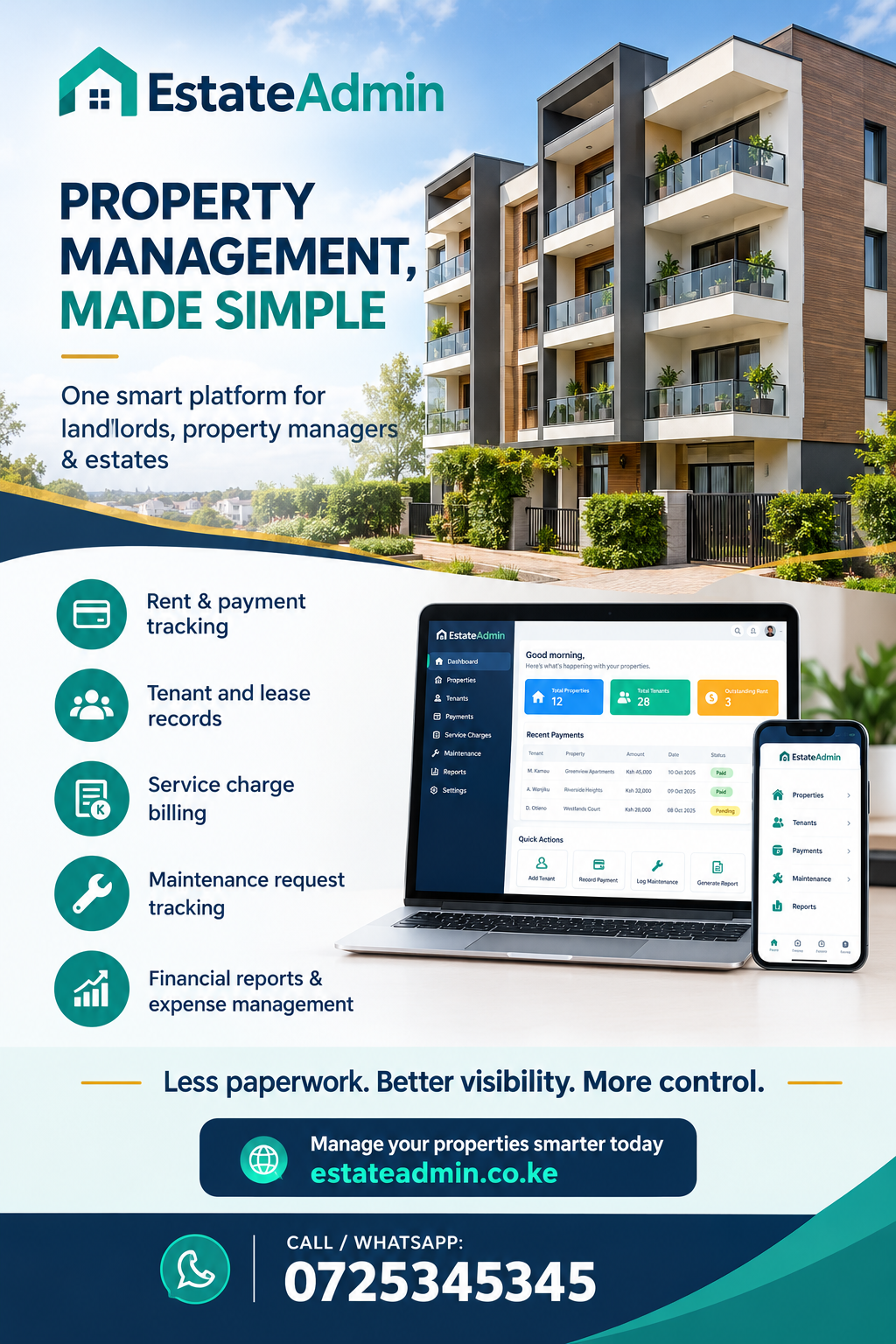
Estate Committee Management Software Kenya: A Complete Guide for Better Estate Governance
Managing a residential estate involves much more than maintaining shared spaces and collecting monthly contributions. Estate committees must coordinate residents, monitor service charges, approve expenditure, maintain financial records, supervise contractors, resolve complaints, and communicate important decisions. Without reliable systems, these responsibilities can become difficult to manage, especially as an estate grows. Estate Committee Management Software Kenya provides a useful starting point for understanding how digital tools can help committees organise their responsibilities, improve accountability, and make informed decisions.
For many residential communities, committee members balance estate duties with employment, family commitments, and other responsibilities. Records may be scattered across spreadsheets, paper files, email conversations, and messaging groups. When a treasurer changes or a resident questions an expense, finding accurate information can take considerable time.
A structured digital management approach can help address these challenges. It gives authorised committee members a central place to manage records, track financial obligations, document decisions, and monitor maintenance activities. Residents can also benefit from clearer communication and more consistent updates about the matters affecting their homes.
This guide explains how Estate Committee Management Software Kenya can support estate administration, the features committees should consider, the practical benefits of digitising their work, and the steps involved in choosing a suitable system.
1. Understanding Estate Committee Management
An estate committee typically oversees the shared responsibilities of a residential development, gated community, apartment complex, or managed housing estate. Depending on the community’s governance arrangements, its responsibilities may include financial oversight, maintenance coordination, resident communication, security supervision, and enforcement of agreed rules.
The precise duties vary according to the estate’s governing documents, ownership arrangements, management agreements, and applicable laws. Nevertheless, effective administration usually depends on accurate information, clear responsibilities, transparent decisions, and dependable communication.
What does an estate committee do?
A committee may be responsible for activities such as:
-
Preparing and monitoring annual operating budgets.
-
Reviewing service charge collections and outstanding balances.
-
Approving maintenance expenditure within its authority.
-
Coordinating cleaning, landscaping, security, and waste management.
-
Maintaining records of meetings and resolutions.
-
Communicating notices, policies, and planned disruptions.
-
Monitoring contractor performance.
-
Reviewing complaints and following up on unresolved matters.
-
Providing residents with appropriate financial and operational updates.
Each activity produces information that must be recorded and made available to the right people. A maintenance request, for example, may require an initial complaint, an inspection, a quotation, an approval, a work order, and confirmation that the repair is complete.
When these details are stored in separate places, important steps can be overlooked. A centralised approach helps committees maintain continuity even when members change.
Why administration becomes difficult
Small estates may initially operate comfortably with a spreadsheet and a messaging group. However, the workload changes as more homes are occupied, more service providers are engaged, and residents expect timely answers.
Common difficulties include missing receipts, inconsistent payment records, forgotten maintenance requests, unclear approval histories, and delays in sharing meeting decisions.
A digital solution can reduce the administrative effort involved in these tasks. With Estate Committee Management Software Kenya, a committee can explore how a structured platform might bring routine activities together instead of requiring members to repeatedly search through separate records.
The goal is not to replace sound governance or responsible committee members. It is to provide them with better information and more reliable processes.
2. What Is Estate Committee Management Software?
Estate committee management software is a digital system designed to organise the information and processes involved in running a residential community. Depending on the product, it may support financial administration, resident records, communication, maintenance tracking, document storage, reporting, and approval workflows.
The available functions differ between providers. Committees should therefore evaluate the actual capabilities of each product instead of assuming every platform includes the same features.
Centralised estate records
A central record system can hold information about residential units, ownership or occupancy records, approved contacts, service charge accounts, meeting minutes, and maintenance history.
Access permissions are important. A treasurer may need detailed financial information, while a resident may only need access to their own account and general estate notices. Committee members should receive the information necessary for their responsibilities without exposing confidential records unnecessarily.
Workflow management
A workflow explains how a task moves from one stage to another. For example, a damaged security light might move through the following stages:
-
A resident reports the problem.
-
The responsible person reviews the request.
-
An inspection confirms the required repair.
-
A quotation is obtained where necessary.
-
An authorised person approves the work.
-
The contractor completes the repair.
-
The committee records the outcome.
A system that tracks these stages helps reduce forgotten tasks and makes it easier to identify delays.
When assessing Estate Committee Management Software Kenya, committees should ask whether the available workflows reflect their actual approval structures, reporting needs, and daily responsibilities.
Support for transparent governance
Good governance depends on more than storing information. It requires clear decision-making procedures, appropriate authorisation, accurate documentation, and responsible communication.
Software can support these practices by preserving meeting records, documenting approvals, and producing consistent reports. It cannot independently guarantee fairness or legal compliance. Those outcomes still depend on the committee’s conduct, governing rules, and the quality of the information entered into the system.
3. Common Problems Faced by Estate Committees in Kenya
Residential estates across Kenya operate under different financial, administrative, and physical conditions. Some have a small number of homes and volunteer committee members. Others manage extensive common areas, multiple service providers, and complex budgets.
Despite these differences, several operational challenges occur frequently.
Inconsistent service charge records
Service charges may fund cleaning, security, landscaping, shared utilities, waste collection, and other agreed services. If collections are recorded inconsistently, the committee may struggle to establish which accounts are paid, which are outstanding, and whether the total collections match the supporting records.
A reliable process should record the amount charged, payment received, date, reference, outstanding balance, and any authorised adjustment.
Limited visibility into expenditure
Committee members need to understand how estate funds are used. If invoices, quotations, approvals, and payment confirmations are held by different people, reviewing a transaction becomes unnecessarily difficult.
A structured record should connect expenditure to its purpose and supporting documentation. This makes it easier to investigate discrepancies and prepare financial reports.
Delayed maintenance
A complaint can remain unresolved because nobody knows who is responsible, whether a contractor has been contacted, or whether funds have been approved.
A maintenance tracker can record the reported issue, responsible person, priority, expected completion date, and current status. This gives the committee a practical way to follow up.
Communication gaps
Residents may miss notices when communication relies entirely on informal group chats. Important information can disappear among unrelated messages, and new residents may not have access to earlier announcements.
A central communication process can help committees organise notices, meeting schedules, planned works, and policy updates.
Difficulty handing over committee responsibilities
Committee membership changes over time. When records are stored on personal devices or in individual email accounts, incoming members may have difficulty understanding previous decisions and outstanding obligations.
Using Estate Committee Management Software Kenya as a research starting point can help a committee identify the recordkeeping and handover capabilities it needs. The objective is to preserve institutional knowledge rather than allow essential information to disappear whenever responsibilities change.
4. Essential Features to Look For
Not every estate needs an extensive enterprise platform. The right solution is one that addresses the community’s actual requirements without adding unnecessary complexity.
Before selecting a product, list the problems the committee wants to solve and rank them according to their impact.
Resident and unit management
The platform should make it possible to organise information about residential units, authorised contacts, occupancy status, and relevant account records.
Useful capabilities may include:
-
A unique record for each unit.
-
Searchable resident or owner information.
-
A record of authorised contacts.
-
Links between units and financial accounts.
-
A history of relevant changes.
-
Access permissions for sensitive information.
The committee should also establish how records will be corrected when ownership, occupancy, or contact details change.
Service charge and payment tracking
Financial management is often one of the most important considerations when evaluating Estate Committee Management Software Kenya.
The committee should determine whether the platform can record recurring charges, payments received, arrears, receipts, adjustments, and account statements.
If residents use M-Pesa or bank transfers, ask whether the product supports direct integration, imported transaction records, or manual reconciliation. These are different capabilities and should not be treated as interchangeable.
An integration should be tested before implementation. The committee must understand how failed payments, duplicate transactions, refunds, and unmatched references will be handled.
Expense management and approvals
A practical system should help the committee document expenses and follow its agreed approval process.
Depending on the product, useful features may include expense categories, supplier records, quotation attachments, approval histories, invoice storage, and payment status tracking.
Approval permissions should reflect the estate’s governing documents. The system should not allow a single user to bypass controls that the committee has formally adopted.
Maintenance and contractor management
Maintenance records can help the committee manage both planned servicing and unexpected repairs.
Useful information includes:
-
The date an issue was reported.
-
The location and nature of the problem.
-
The assigned person or contractor.
-
Quotations and approval records.
-
Work completed and completion dates.
-
Follow-up inspections or outstanding actions.
For example, a recurring water pump fault should have a history of inspections, repairs, costs, and contractor visits. This helps the committee assess whether repeated repairs remain appropriate or whether a more durable solution should be considered.
Meetings, minutes, and resolutions
Meetings often generate decisions that affect budgets, residents, maintenance priorities, and service providers.
A suitable system should help the committee record meeting dates, attendance where appropriate, agendas, minutes, resolutions, responsible persons, and deadlines.
Where voting is supported, confirm that the method matches the estate’s approved procedures. Digital convenience should never be mistaken for authority to change formal decision-making requirements.
Document management
Important estate documents may include contracts, budgets, insurance records, maintenance reports, approved policies, meeting minutes, and supplier quotations.
Document management should include meaningful file names, categories, search, access controls, and suitable backup arrangements.
The committee should also determine who can upload, revise, download, archive, or delete documents. Sensitive records need stronger controls than general announcements.
Resident communication
The platform may support notices, announcements, complaint submissions, reminders, and updates on common projects.
Ask whether notifications are delivered through a web portal, email, SMS, or another supported channel. Confirm the costs and limitations of each option before promising residents a particular communication method.
A system is useful only when residents and committee members can access it reliably and understand how to use it.
5. Improving Service Charge Collection and Financial Accountability
Service charge administration requires accuracy, consistency, and proper reconciliation. A committee needs to know what has been billed, what has been collected, what remains outstanding, and how funds have been spent.
A well-designed process can reduce manual errors and help the committee explain financial information more clearly.
Establish a consistent billing process
The committee should begin with an approved budget and a documented method of calculating each unit’s contribution.
Depending on the estate’s rules, contributions may be calculated equally, according to unit size, by an agreed allocation formula, or using another authorised method.
Before invoices are issued, verify that:
-
The budget has received the required approval.
-
The billing period is correct.
-
The allocation method is documented.
-
The unit records are accurate.
-
Previous balances have been checked.
-
Any adjustments have supporting explanations.
A billing error can affect trust even when the underlying amount is small. Consistent procedures reduce the likelihood of disputes.
Reconcile collections against payment records
A payment appearing in a mobile money statement does not automatically mean it has been assigned to the correct resident account. References may be missing, names may differ, and duplicate entries may occur during manual imports.
Reconciliation should compare payment records with the estate’s financial accounts. Unmatched transactions should be investigated instead of being assigned based on guesswork.
Using Estate Committee Management Software Kenya as part of a broader research process can help the committee think through the importance of structured records, although actual estate-specific capabilities must be confirmed with the relevant provider.
Monitor arrears fairly
An arrears report can identify outstanding balances by unit, amount, and age. This helps the committee prioritise follow-up and understand how late payments affect cash flow.
However, the report must be accurate before action is taken. Payments made recently may not yet be reconciled, and legitimate disputes or approved adjustments may affect a balance.
A fair arrears process should provide clear statements, a way to query errors, consistent reminders, and escalation procedures grounded in the estate’s rules and applicable law.
Prepare meaningful financial reports
Useful reports should answer practical questions:
-
How much was budgeted?
-
How much has been collected?
-
What remains outstanding?
-
Which expenses have been incurred?
-
What commitments are still unpaid?
-
Which budget categories are above or below expectations?
-
Are there unusual transactions requiring review?
These reports support better decisions because they connect financial information to the estate’s operational priorities.
6. Budgeting and Financial Planning for Residential Estates
A budget translates the committee’s responsibilities into a financial plan. It estimates income, operating expenses, planned maintenance, and other commitments for a defined period.
Without a clear budget, committees may find themselves responding to each new expense without understanding its effect on the overall financial position.
Prepare a realistic operating budget
Start by reviewing historical expenditure and identifying the services required during the coming year.
Typical categories may include security, cleaning, waste collection, landscaping, shared electricity, water systems, lift servicing, repairs, insurance, and administrative costs. The relevant categories depend on the estate’s facilities and agreements.
Use quotations, contracts, previous invoices, and maintenance schedules to support estimates. Avoid simply copying last year’s figures without considering changes in service requirements or prices.
Separate routine expenses from major projects
Routine operating costs should be distinguishable from larger projects such as repainting shared buildings, repairing roads, replacing equipment, or upgrading access systems.
This separation helps residents understand why ordinary service charges may differ from additional approved contributions.
The committee should document the basis for major spending proposals and explain the expected benefit, timing, cost, and approval process.
Compare actual spending with the budget
Monthly or quarterly reports can highlight unexpected expenditure before it becomes a larger problem.
For example, if water pumping costs are rising faster than expected, the committee may investigate a leak, equipment inefficiency, tariff changes, or an inaccurate meter.
When assessing Estate Committee Management Software Kenya, committees should consider whether its reporting features can compare budgeted figures with actual transactions and explain differences clearly.
Maintain appropriate financial controls
Good financial management includes separating responsibilities where practical, requiring appropriate approvals, preserving supporting documents, and reconciling accounts regularly.
The committee should agree who can initiate a purchase, who approves it, who processes payment, and who reviews the transaction afterwards.
Small estates may have limited personnel, but they can still introduce compensating controls such as independent review of bank statements and periodic checks of supporting documents.
7. Maintenance Planning and Shared Facilities
The physical condition of an estate affects resident satisfaction, operating costs, safety, and the long-term value of shared facilities. Maintenance should therefore be treated as a planned management responsibility rather than an occasional response to complaints.
Create a maintenance register
A maintenance register records shared assets, their condition, service requirements, and maintenance history.
Depending on the estate, assets may include gates, perimeter lighting, water pumps, tanks, drainage systems, lifts, fire equipment, roads, landscaped areas, and common buildings.
Each record should identify the asset, location, relevant contractor, inspection schedule, previous work, and next planned action.
Prioritise repairs appropriately
Not every maintenance request has the same urgency. A serious safety issue requires a different response from a cosmetic defect.
The committee should adopt clear priorities based on safety, operational impact, risk of further damage, and the estate’s available resources.
For example:
| Priority | Example | Suggested administrative response |
|---|---|---|
| Urgent | A dangerous electrical fault in a shared area | Escalate immediately and arrange qualified assistance |
| High | A failed gate affecting access control | Assign a responsible person and arrange prompt repair |
| Normal | A damaged section of shared paving | Schedule inspection and repair |
| Planned | Routine landscaping or painting | Include in the maintenance schedule |
These examples are illustrative. Actual response times should reflect the nature of the risk and the estate’s procedures.
Evaluate contractor performance
A digital record can help the committee assess whether a contractor completes work on time, provides adequate documentation, responds to defects, and charges according to agreed terms.
Keep quotations, contracts, invoices, inspection notes, and completion confirmations together where possible.
This history makes future procurement decisions more evidence-based. It also helps prevent repeated discussions from relying entirely on individual recollections.
Plan preventive maintenance
Preventive maintenance aims to identify and address problems before they cause major disruption.
A committee can use service schedules, inspection records, and past repair patterns to plan recurring work. This may reduce emergency call-outs and improve the predictability of expenditure, although savings depend on the asset, maintenance quality, and circumstances.
For estates with several shared facilities, Estate Committee Management Software Kenya can serve as a keyword-linked entry point for considering how digital workflows might fit into a broader administrative strategy. The committee should confirm which maintenance functions are actually available in the software it evaluates.
8. Resident Communication and Community Engagement
An estate functions better when residents understand what the committee is doing, why decisions are being made, and how they can raise concerns. Poor communication can turn a minor inconvenience into a prolonged dispute.
Create a reliable communication process
The committee should identify which messages require immediate attention, which are routine announcements, and which need formal documentation.
Examples include water interruptions, scheduled repairs, security notices, meeting invitations, changes to shared facilities, and updates on approved projects.
A central platform can help organise notices by date and subject. Residents can then refer to the original announcement instead of relying on forwarded messages that may be incomplete.
Manage complaints consistently
A complaint management process should record the issue, the date it was raised, the responsible person, the action taken, and the outcome.
Consider a resident who reports recurring drainage problems near a shared parking area. Without a structured process, the complaint might be discussed repeatedly without a clear resolution. With a tracker, the committee can assign an inspection, document findings, obtain a quotation, approve the repair, and update the resident.
When comparing Estate Committee Management Software Kenya, committees should consider whether the platform supports the communication and follow-up procedures their residents actually need.
Protect respectful communication
Digital communication should support constructive engagement, not create another source of conflict. The committee should establish rules for reporting problems, discussing disagreements, and protecting personal information.
Sensitive matters involving individual residents should not be circulated in general announcement groups. Access to complaints, account information, and confidential committee discussions should be limited appropriately.
Encourage resident participation
Residents are more likely to engage when communication is clear, timely, and accessible. Committees can explain how to submit suggestions, request information, attend meetings, and follow up on agreed actions.
Feedback should be acknowledged even when the committee cannot immediately implement a suggestion. Explaining financial or operational limitations helps residents understand the decision-making process.
9. Document Management and Recordkeeping
Estate administration generates a substantial amount of documentation over time. Contracts, budgets, receipts, maintenance reports, insurance documents, meeting minutes, and formal notices may all be required for future reference.
Poor recordkeeping makes it difficult to establish what was agreed, which payments were authorised, or whether a contractor fulfilled its obligations.
Establish a clear filing structure
A practical digital filing structure might contain the following categories:
-
Governance documents and approved policies.
-
Meeting agendas, minutes, and resolutions.
-
Budgets, financial reports, and payment records.
-
Supplier contracts and quotations.
-
Maintenance schedules and inspection reports.
-
Resident notices and general communications.
-
Insurance, permits, and other relevant compliance documents.
Each document should have a meaningful name and date. Where multiple versions exist, the committee should identify which version is current and preserve earlier versions when necessary.
Preserve an audit trail
An audit trail records relevant actions involving a document, transaction, or decision. Depending on the system, it may show who made a change, when the change occurred, and what was modified.
This information is useful when investigating discrepancies or handing over responsibilities. It can also support internal reviews, although it does not replace independent financial verification or professional auditing where required.
A committee evaluating Estate Committee Management Software Kenya should ask about document histories, user permissions, export options, backups, and the ability to retrieve records after a committee transition.
Develop a proper handover procedure
Outgoing committee members should transfer authorised records, account access, outstanding tasks, contracts, and pending decisions through a documented process.
A handover checklist can identify incomplete maintenance work, unresolved complaints, unpaid invoices, upcoming contract renewals, and financial matters awaiting approval.
This protects continuity and reduces the risk of relying on personal email accounts or individual devices for essential estate information.
10. Security, Privacy, and Access Control
Estate records can contain personal contact details, payment information, occupancy records, complaints, and other sensitive information. Protecting these records is an important part of responsible administration.
Use role-based permissions
Access should reflect the user’s responsibilities. A committee chairperson, treasurer, maintenance coordinator, and resident may have different information needs.
For example, a resident might need access to their own statements and general notices, while the treasurer needs access to payment reconciliation records. Neither role automatically requires access to every confidential record.
Before adopting Estate Committee Management Software Kenya, ask the provider how user roles are configured, whether access can be revoked promptly, and whether changes in permissions are recorded.
Evaluate account security
Useful safeguards may include strong passwords, multi-factor authentication, secure connections, access logs, and procedures for removing former users.
The committee should establish a process for reporting suspected unauthorised access and changing credentials when a responsible person’s role ends.
Do not assume that a product is secure simply because it is cloud-based. Ask the provider to explain its security practices and the responsibilities shared between the provider and the estate.
Protect personal information
Kenyan organisations handling personal data should consider their obligations under the Data Protection Act, 2019, and applicable regulations. The exact obligations depend on the organisation’s role, the information processed, and the circumstances.
Practical safeguards include collecting only necessary information, explaining relevant purposes, restricting access, setting retention rules, and providing appropriate procedures for data-related requests.
The committee should establish who is responsible for managing personal information and whether the software provider acts as a data processor under the relevant arrangement. Where necessary, obtain qualified advice on applicable legal requirements.
Plan for backups and recovery
A backup is useful only if the data can be recovered when needed. Ask whether backups are automated, how often they occur, how long they are retained, and how restoration is tested.
The estate should also determine how essential records can be exported if the subscription ends or the provider becomes unavailable.
11. Choosing the Right Software for Your Estate
Selecting a platform requires more than comparing screenshots or choosing the product with the longest feature list. The committee should evaluate functionality, usability, cost, support, security, and suitability for the estate’s operating model.
Start with the estate’s needs
Before arranging demonstrations, identify the most important problems to solve.
A small residential community may prioritise service charge statements, resident records, and maintenance requests. A larger development may need budgeting, supplier workflows, several approval levels, detailed reporting, and more extensive access controls.
Separate essential requirements from optional features. This makes it easier to compare products objectively.
Compare the available capabilities
A structured assessment of Estate Committee Management Software Kenya should examine the following areas:
| Evaluation area | Questions to ask |
|---|---|
| Financial records | Can the system track charges, payments, arrears, and expenses? |
| Resident information | Can records be searched, updated, and restricted by role? |
| Maintenance | Can issues be assigned, monitored, and closed? |
| Communication | Can authorised users publish notices and follow up on complaints? |
| Reporting | Can reports be exported and reconciled with source records? |
| Security | What authentication, permissions, and audit controls exist? |
| Support | How are technical problems and user questions handled? |
| Portability | Can the estate export its records in a usable format? |
A vendor demonstration should use realistic examples from the estate’s daily operations rather than a presentation of generic features.
Test usability
Committee members may have different levels of technical experience. A system that is difficult to navigate can discourage adoption even when its features are strong.
During a demonstration, ask a committee member to complete a typical task, such as locating a resident account, recording a payment, assigning a repair, or preparing a statement.
Check whether the process is clear and how much training would be needed.
Evaluate customer support
Find out how users contact support, what response times are offered, and whether training is included. Confirm whether support is available during the hours when the committee is likely to need it.
Also ask how the provider handles outages, system updates, data migration, and product changes.
Review the contract carefully
The committee should understand subscription fees, renewal terms, cancellation conditions, data ownership, export rights, support charges, and any additional costs.
A written agreement should clarify what the provider is responsible for and what the estate must manage itself.
12. Understanding the Cost of Estate Management Software
Software costs vary according to the provider, number of units, features, implementation requirements, and support arrangements. A reliable comparison should use actual quotations rather than assumptions about market prices.
Look beyond the subscription fee
The full cost may include:
-
Initial setup and configuration.
-
Migration of existing resident and financial records.
-
Staff or committee training.
-
Monthly or annual subscription charges.
-
SMS notifications or payment processing fees.
-
Additional user accounts or modules.
-
Technical support and data export.
-
Internet access and compatible devices.
Some providers may include several of these items in a package, while others may charge separately.
Compare cost with administrative effort
Suppose an estate spends several hours each month preparing statements, checking payment references, and responding to routine account enquiries. A digital system might reduce some of that work by keeping records together and generating standard reports.
However, the actual benefit depends on the accuracy of the data, the quality of the software, and how consistently the committee uses it.
When assessing Estate Committee Management Software Kenya, estimate both the financial cost and the practical value of the features offered. Do not assume that the most expensive option is best or that the cheapest option will meet every requirement.
Consider the cost of implementation
Implementation may require cleaning old spreadsheets, correcting duplicate records, verifying outstanding balances, and organising documents.
These tasks take time, but skipping them can transfer existing errors into the new system. A realistic implementation budget should allow enough time for data verification and user training.
Ask about scaling
An estate’s needs may change as additional units become occupied or new facilities are introduced. Ask how the pricing and functionality would change if the community grows.
A suitable solution should accommodate foreseeable requirements without forcing the committee to pay for features it does not need today.
13. How to Implement a New System Successfully
Software implementation should be treated as an administrative project. Installing a product is only one part of the process; the estate also needs reliable data, clear responsibilities, and consistent procedures.
Step 1: Review existing records
Gather resident registers, unit information, financial spreadsheets, supplier contracts, meeting minutes, and maintenance records.
Identify missing information, inconsistent account references, duplicate entries, and outdated contact details.
Do not import every old record without checking its relevance and accuracy.
Step 2: Agree on administrative procedures
Document how billing, payment reconciliation, expense approval, maintenance requests, and resident communication should work.
The software should support these approved processes rather than determine the estate’s governance arrangements by default.
Step 3: Assign responsibilities
Choose a person to coordinate implementation and identify the users responsible for each function.
For example, the treasurer may verify opening account balances, the maintenance coordinator may prepare the asset register, and the secretary may organise meeting records.
Each responsibility should have a clear deadline and an appropriate review process.
Step 4: Configure the system
Set up unit records, user permissions, financial categories, notification preferences, and relevant workflows.
Where possible, test the configuration using sample data before importing sensitive or operationally important records.
Step 5: Verify imported information
Compare imported resident records and financial balances with the original documents.
Check a sample of accounts carefully, then resolve discrepancies before using the system for official billing or reporting.
Step 6: Train committee members
Training should focus on real tasks rather than technical terminology. Users should know how to enter records, locate information, correct mistakes, protect confidential data, and request assistance.
Step 7: Introduce the system to residents
Explain the purpose of the platform, how residents can access it, and which functions they will use.
Provide clear guidance for common tasks, including viewing statements, submitting maintenance requests, and receiving notices.
Step 8: Review performance
After implementation, collect feedback and compare the results with the original objectives.
Useful measures include the time required to prepare statements, the number of unresolved maintenance requests, the accuracy of payment records, and the timeliness of resident communication.
14. Common Mistakes to Avoid
Even a capable platform can fail to deliver value if the estate adopts it without proper planning.
Choosing features before identifying problems
A long list of functions can make a product appear attractive, but features that do not address the estate’s actual difficulties may add cost and complexity.
Begin with the committee’s priorities, then select the capabilities that support them.
Migrating inaccurate information
Incorrect opening balances, duplicated units, and outdated contacts can undermine confidence in the new system.
Verify the information before migration and document how corrections are approved.
Ignoring resident adoption
Residents may continue using old processes if the committee does not explain the new arrangements.
Communicate the reasons for the change, provide instructions, and identify a contact person who can assist users.
Giving too many people unrestricted access
Convenience should not override confidentiality. Apply role-based permissions and review them when committee responsibilities change.
Treating software reports as automatically correct
Reports reflect the data and rules used to produce them. An inaccurate charge, duplicate payment, or incorrect allocation can lead to a misleading report.
Maintain reconciliation procedures and investigate unusual figures before making decisions.
Failing to plan for provider changes
A committee should understand how to retrieve records and transition to another platform if necessary.
Confirm export formats, access to historical records, and contractual obligations before committing to a long-term arrangement.
Neglecting ongoing review
The estate’s needs may change. Periodically review whether the software remains useful, affordable, secure, and aligned with the committee’s procedures.
15. Measuring the Benefits of Digital Estate Administration
A committee should evaluate its investment using practical indicators rather than relying on general claims about efficiency.
Measure administrative time
Record how long routine tasks take before and after implementation. Examples include preparing service charge statements, locating contracts, compiling reports, and distributing notices.
A reduction in administrative time may allow volunteers to focus more attention on planning and oversight.
Monitor financial accuracy
Track unmatched payments, billing corrections, unexplained adjustments, and differences between system reports and financial statements.
Fewer discrepancies may indicate improved processes, although regular independent checks remain important.
Review maintenance performance
Measure how many requests are open, how long issues remain unresolved, and whether scheduled servicing is completed.
Separate urgent safety issues from routine tasks so that average response times do not hide serious delays.
Assess resident communication
Consider whether residents receive notices promptly, know how to submit concerns, and can find information without repeatedly contacting committee members.
Feedback surveys and complaint records can help identify communication problems.
Evaluate governance and continuity
Review whether meetings produce documented actions, whether responsibilities are assigned clearly, and whether new committee members can retrieve historical information.
These measures provide a practical basis for deciding whether to retain, adjust, or replace the system.
16. Supporting Committee Accountability and Decision-Making
An estate committee needs a reliable way to explain its decisions, demonstrate that approvals were obtained, and show how agreed actions were completed. Digital records can make this process easier when the committee adopts consistent procedures.
Document decisions and responsibilities
Every important decision should have a record of what was agreed, who was responsible, and what must happen next.
For example, a committee might approve repairs to a shared water system after reviewing two quotations. The record should identify the approved option, the authorised expenditure, the responsible person, and the expected completion date.
This information helps committee members follow through on decisions and makes subsequent reviews more objective.
Separate recommendation, approval, and payment
Where practical, the person recommending an expense should not be the only person approving and processing it. Separating these responsibilities helps reduce the risk of errors and inappropriate transactions.
The required approval levels should follow the estate’s constitution, management agreement, or other applicable governance documents.
A digital approval history can support this arrangement, but the committee must verify that the system’s permissions actually enforce its intended controls.
Make reports understandable
Financial and operational reports should use clear labels, reporting periods, and explanations of significant changes. Residents do not necessarily need access to every confidential transaction detail, but they should receive appropriate information about the estate’s performance and use of funds.
When investigating Estate Committee Management Software Kenya, consider the broader importance of presenting information clearly and maintaining organised records. Confirm all estate-specific functions directly with the software provider.
Prepare for committee transitions
A formal handover should cover outstanding financial matters, pending approvals, supplier contracts, maintenance issues, access permissions, and upcoming deadlines.
The incoming committee should receive enough information to continue essential operations without relying on informal conversations with former members.
17. Practical Example: Managing a Residential Estate Digitally
Consider a hypothetical residential estate with 120 units, shared security, landscaped areas, a water pump, and monthly service charges. The committee has a chairperson, secretary, treasurer, and several members responsible for different operational areas.
Initially, the estate uses spreadsheets for accounts, a messaging group for announcements, and paper files for contractor documents.
Before introducing a digital system
The treasurer manually updates payment records, while the secretary stores meeting minutes on a personal computer. Residents send maintenance complaints through different channels.
When a resident questions an outstanding balance, the treasurer must compare spreadsheets, bank statements, and payment references. When the water pump fails, the committee searches old messages to find the last repair invoice.
These processes consume time and increase the likelihood of inconsistent records.
After introducing structured workflows
The estate creates a central unit register and verifies opening balances. Payment entries are recorded against the relevant accounts, while unmatched transactions are placed on a review list.
Maintenance requests are assigned to a responsible person, and contractor quotations are stored with the relevant approval records. Meeting resolutions are documented alongside their assigned actions.
The committee can then prepare reports using the same underlying records instead of repeatedly rebuilding information from separate sources.
What improvements can reasonably be expected?
Possible improvements include:
-
Faster retrieval of resident and contractor records.
-
More consistent payment reconciliation.
-
Clearer responsibility for outstanding maintenance.
-
Easier preparation of financial summaries.
-
Better continuity when committee members change.
-
More organised communication with residents.
These are potential outcomes, not guaranteed results. They depend on the system’s capabilities, implementation quality, data accuracy, and the willingness of users to follow the agreed procedures.
The committee should establish baseline measurements before implementation and review actual performance afterwards.
18. Questions to Ask a Software Provider Before Buying
A demonstration should help the committee establish what a platform can do, what it costs, and whether it meets the estate’s requirements.
Use a consistent question list when comparing suppliers.
Functionality questions
Ask whether the system supports:
-
Unit and resident records.
-
Recurring billing and account statements.
-
Payment recording and reconciliation.
-
Expense tracking and approval workflows.
-
Maintenance scheduling and request tracking.
-
Meeting minutes and action registers.
-
Document storage and reporting.
-
Resident notices and communication.
-
Data exports and administrative handovers.
Request a demonstration of each essential function. If a provider claims to support a feature, ask whether it is included in the quoted package.
Financial questions
Confirm the complete pricing structure, including setup, recurring fees, optional modules, training, payment integrations, and support.
Ask what happens if the number of units increases or the committee needs additional users.
Security questions
Ask how user access is controlled, how backups are handled, whether audit logs are available, and how the provider responds to security incidents.
Clarify data ownership, retention, deletion, and export arrangements in writing.
Support questions
Find out how users report problems, how support requests are prioritised, and what happens if a technical issue affects billing or access to records.
A provider should explain its service arrangements clearly enough for the committee to assess the operational risk.
Before purchasing Estate Committee Management Software Kenya, use these questions to structure your evaluation and ensure that the selected product fits the estate’s real administrative needs.
19. The Role of Professional Estate Managers
Software can improve recordkeeping and coordination, but it does not eliminate every management responsibility. Some estates may benefit from a professional property or estate manager who can oversee day-to-day operations and support the committee.
When professional support may be useful
Consider professional assistance when the estate has complicated finances, extensive shared facilities, multiple service providers, persistent maintenance problems, or administrative responsibilities that exceed the committee’s available time.
The appropriate arrangement depends on the estate’s size, budget, governing documents, and the skills of its committee members.
Combining people and technology
A professional manager can use a digital system to maintain records, coordinate contractors, prepare reports, and follow up on resident concerns. The committee can then focus on oversight, strategic decisions, and its formal responsibilities.
The software should clarify accountability rather than obscure it. Every important task still needs an identifiable owner and an appropriate review process.
When reviewing Estate Committee Management Software Kenya, the committee should consider how the available functions could support its chosen management arrangement. It should also confirm whether the product is intended for self-managed estates, professional managers, or both.
20. Future-Proofing Estate Administration
Residential communities change over time. New homes may be occupied, service providers may change, facilities may require upgrades, and residents may expect more convenient ways to access information.
A suitable administrative system should be flexible enough to accommodate reasonable changes without creating unnecessary complexity.
Choose useful reporting and export capabilities
The committee should be able to retrieve historical information and produce reports that remain understandable outside the software.
Ask whether records can be exported in practical formats and whether the exports include the fields needed for financial review, handover, or migration.
Review integration requirements
Some estates may benefit from connecting payment records, accounting tools, communication services, or access systems. Others may need only a straightforward management platform.
Integrations should solve a clearly identified problem. Each connection introduces considerations involving reliability, permissions, data accuracy, and ongoing costs.
Plan for changes in committee membership
Account access should be reviewed whenever a person joins or leaves a responsible role. Historical records should remain available to authorised successors, while former users should no longer retain unnecessary access.
Documented handover procedures make these transitions safer and less disruptive.
Review the system periodically
At least once during the estate’s regular governance cycle, review whether the platform is meeting its objectives.
Consider the cost, administrative effort, reporting quality, security controls, resident feedback, and support experience. If the system no longer meets the estate’s needs, document the shortcomings and compare alternatives before making a change.
For committees exploring Estate Committee Management Software Kenya, the important principle is to choose a sustainable administrative approach that can evolve with the estate rather than selecting software based on short-term convenience alone.
21. Estate Management in the Kenyan Context
Kenyan residential estates operate within varied financial and administrative environments. Some communities rely on volunteer committees, while others engage property managers or management companies. The appropriate system should reflect the estate’s size, financial arrangements, facilities, and governing documents.
Supporting mobile money and bank payments
Mobile money and bank transfers are familiar payment methods for many Kenyan households. A digital estate administration process should make it easier to identify incoming payments, issue appropriate receipts, and reconcile transactions with resident accounts.
However, a committee should distinguish between a system that records payment references and one that offers a verified payment integration. Ask how transactions are received, whether reconciliation is automatic, and how exceptions are resolved.
For example, if a resident pays a service charge using an incorrect reference, the committee needs a documented process for confirming the transaction and assigning it to the correct account.
Managing different estate structures
A gated community, apartment complex, and mixed-use development may have different billing arrangements and management requirements. The software must accommodate the estate’s actual rules rather than force every property into a generic template.
When exploring Estate Committee Management Software Kenya, consider whether the intended workflow matches your community’s responsibilities and reporting needs.
Maintaining appropriate records
Estate committees should preserve reliable financial records, contracts, meeting minutes, and relevant correspondence. They should also establish appropriate retention periods and access controls.
Where legal, accounting, or regulatory questions arise, obtain advice from a qualified professional rather than relying on software features as a substitute for compliance guidance.
22. Frequently Asked Questions
1. What is estate committee management software?
Estate committee management software is a digital platform that helps residential committees organise resident information, service charge records, maintenance requests, documents, meetings, and communications. The functions available depend on the provider and selected package.
For a committee considering Estate Committee Management Software Kenya, the first step is to identify the administrative tasks that cause the most difficulty and check which features address them.
2. Why does an estate committee need management software?
A committee may use software to reduce manual recordkeeping, improve access to information, track maintenance, organise approvals, and prepare more consistent reports.
The value depends on the estate’s circumstances. A small community with few transactions may need a simpler solution than a large development with several facilities and service providers.
A practical evaluation of Estate Committee Management Software Kenya should focus on measurable needs instead of assuming that digitalisation automatically resolves every management problem.
3. Can estate management software track service charges?
Some platforms support recurring charges, payment entries, account statements, arrears reports, and reconciliation workflows. Others may offer only basic financial records.
Before choosing Estate Committee Management Software Kenya, confirm whether it supports your estate’s billing rules and payment methods. Test how it handles unmatched payments, corrections, refunds, and previous balances.
4. Can residents use the software to report maintenance issues?
Some platforms provide resident portals, complaint forms, or maintenance request tracking. These features may allow a resident to report a problem and follow its progress.
The committee should confirm whether residents can submit photographs, receive updates, and view request status. It should also establish who receives new requests and how urgent issues are escalated.
When evaluating Estate Committee Management Software Kenya, ask the provider to demonstrate the complete process from submitting a complaint to recording its resolution.
5. Is estate committee management software suitable for a small estate?
Yes, a small estate may benefit from a straightforward system for keeping financial records, maintaining resident details, storing documents, and tracking outstanding tasks.
The committee should avoid paying for unnecessary complexity. Compare the subscription cost with the time saved and the importance of having accurate records.
For a smaller community, Estate Committee Management Software Kenya can be a useful keyword-linked starting point for further evaluation, but the committee should verify the actual estate management features offered by the relevant provider.
6. How much does estate committee management software cost in Kenya?
There is no single price that applies to every product. Costs may depend on the number of units, features, implementation, training, integrations, and support.
Request a written quotation that explains recurring fees and additional charges. Compare products using the same list of requirements so the committee can evaluate the total cost fairly.
When considering Estate Committee Management Software Kenya, verify the quoted services directly and do not assume that the destination’s general business focus guarantees a particular estate management feature.
7. Can software improve transparency in an estate?
It can support transparency by organising approvals, preserving meeting minutes, maintaining financial histories, and preparing reports. However, transparency also depends on the committee’s policies and willingness to share appropriate information.
The committee should decide which reports residents can access, how questions are handled, and how corrections are documented.
A review of Estate Committee Management Software Kenya should include a check of its reporting and audit capabilities rather than relying on general claims about transparency.
8. Is cloud-based estate software safe?
Cloud-based software can offer convenient access and centralised records, but its safety depends on the provider’s security practices and the estate’s own use of the system.
Ask about authentication, user permissions, backups, encryption, incident response, and data export. Restrict sensitive information to authorised users and promptly remove access when responsibilities change.
Before selecting Estate Committee Management Software Kenya, review the provider’s security documentation and contractual responsibilities.
9. Can software help with committee handovers?
Yes, where the system stores accessible records of decisions, accounts, contracts, maintenance activities, and outstanding tasks. A new committee can use those records to understand existing commitments and continue essential operations.
The outgoing committee should still complete a formal handover and ensure that access rights are updated.
When comparing Estate Committee Management Software Kenya, confirm that authorised users can retrieve historical information and export records if required.
10. How should an estate choose the right software?
Start by listing the estate’s administrative challenges, then rank the features that matter most. Compare providers, request demonstrations, verify pricing, assess support, review security, and test whether the system is easy to use.
The committee should also confirm that the product accommodates its governance arrangements and can export information in a usable format.
The best Estate Committee Management Software Kenya for a particular community is the one that meets its verified requirements at a sustainable cost and can be used consistently by the people responsible for managing the estate.
23. Building a Practical Estate Management Plan
Choosing a platform is only one part of improving estate administration. The committee should also agree on a practical management plan that connects the software to its financial, maintenance, communication, and governance responsibilities.
Establish clear responsibilities
Assign each recurring task to a named role. The treasurer might manage payment reconciliation, the secretary might maintain meeting records, and a maintenance coordinator might track repairs. The committee should also establish who reviews each activity and who acts when the responsible person is unavailable.
When considering Estate Committee Management Software Kenya, assess whether its available workflows can help support these responsibilities without making everyday tasks unnecessarily complicated.
Set realistic reporting deadlines
Agree on when financial summaries, maintenance updates, and outstanding-action reports should be prepared. A predictable reporting schedule allows the committee to review problems before they become urgent.
For example, a monthly review might cover collections, expenditure, overdue accounts, open maintenance requests, and decisions awaiting approval. The exact schedule should reflect the estate’s needs.
Keep residents informed
Residents should know where to find official notices, how to raise a concern, and how to request clarification about an account. The committee should publish consistent instructions and avoid changing procedures without communicating the change.
A well-organised communication process can reduce repeated enquiries and help residents understand how their concerns are handled.
Review the plan regularly
The committee should review its procedures whenever the estate experiences a significant change, such as appointing a new manager, changing a service provider, introducing new facilities, or revising its billing arrangements.
For committees assessing Estate Committee Management Software Kenya, the central consideration remains whether the product supports the estate’s documented management plan. Confirm its specific functions with the provider before making a purchasing decision.
24. Making Better Decisions Through Estate Reporting
Reports help committee members move beyond individual complaints and isolated transactions to understand the estate’s overall performance.
Financial reporting
A useful financial summary should show collections, outstanding balances, expenditure, budget comparisons, and relevant financial commitments. Significant differences should be explained so that committee members can investigate them.
When reviewing Estate Committee Management Software Kenya, ask whether reports can be filtered by period, exported, and reconciled with the estate’s underlying financial records.
Maintenance reporting
Maintenance reports can show how many requests remain open, which repairs are overdue, and which assets require attention. They can also reveal recurring faults that deserve a more permanent solution.
For example, repeated repairs to a shared gate may indicate that the committee needs to review the equipment, contractor arrangements, or maintenance schedule.
Governance reporting
An action register can list committee decisions, assigned responsibilities, deadlines, and completion status. This allows members to review progress at each meeting rather than relying on memory.
A review of Estate Committee Management Software Kenya should consider whether its available recordkeeping tools can support this type of follow-up.
Use reports responsibly
Reports should be checked before being circulated or used to justify decisions. Personal information should be protected, and access to detailed financial records should follow the estate’s approved procedures.
The purpose of reporting is to improve decision-making, not simply to produce more documents.
25. Creating a More Efficient Resident Experience
Good estate administration should make routine interactions clearer for both residents and committee members.
Make common information easy to find
Residents may need to locate payment instructions, contact details, meeting notices, maintenance procedures, and estate policies. A well-organised system can reduce the effort required to find this information.
Before choosing Estate Committee Management Software Kenya, check whether the available resident-facing features are easy to use on common devices and whether they meet the needs of residents with different levels of technical experience.
Provide updates on requests
A resident who reports a problem should receive an acknowledgement and, where appropriate, information about the next step. Even when a repair cannot be completed immediately, a clear explanation can help manage expectations.
A request-tracking process should make it possible to distinguish between newly reported problems, work in progress, and completed tasks.
Keep financial communication clear
Payment statements should explain the billing period, amounts charged, payments recorded, and outstanding balance. If an adjustment has been made, the record should explain why.
When assessing Estate Committee Management Software Kenya, confirm whether statements and notifications can be produced in a format that residents can understand and retain.
Make feedback useful
Feedback should lead to a documented response where appropriate. The committee can categorise recurring concerns, identify common service problems, and explain which improvements are feasible.
This process supports constructive engagement without implying that every suggestion must be implemented.
26. Maintaining Accurate Financial and Administrative Records
A digital platform is most useful when its underlying information is dependable. Committees should therefore make record accuracy an ongoing responsibility.
Introduce routine checks
Review financial entries, resident changes, document uploads, and maintenance updates regularly. Correct errors through a documented process rather than silently replacing records when the history matters.
For example, if a payment is assigned to the wrong unit, the correction should preserve sufficient information to explain the change.
Reconcile important records
Compare software reports with bank statements, payment confirmations, supplier invoices, and other supporting documents. Investigate discrepancies and document how they were resolved.
When evaluating Estate Committee Management Software Kenya, determine whether the platform provides the export and reporting functions needed for these checks.
Retain records appropriately
The committee should establish how long different types of records must be retained, taking account of applicable legal requirements, contracts, operational needs, and legitimate disputes.
Sensitive records should not be retained indefinitely without a reason, and important documents should not be deleted simply because a committee member considers them old.
Prepare for unexpected interruptions
The estate should know how to access essential records if a system becomes temporarily unavailable. Keep appropriate backup arrangements and document who is responsible for restoring access.
A sensible continuity plan protects the estate from unnecessary disruption.
27. A Final Checklist Before Selecting a Platform
Before approving a purchase, the committee can use this checklist to ensure that important questions have been addressed.
For any committee evaluating Estate Committee Management Software Kenya, this checklist provides a structured way to compare options. The provider’s actual capabilities, pricing, and contractual terms should always be verified before a decision is made.
Conclusion
Effective estate administration depends on accurate records, responsible financial management, clear communication, timely maintenance, and consistent decision-making. When these responsibilities are handled through scattered spreadsheets, paper files, and informal conversations, important information can be difficult to retrieve and tasks can remain unresolved.
A well-chosen digital management system can bring these activities into a more organised process. It can help committee members monitor service charges, track expenses, maintain documents, coordinate contractors, record decisions, and provide residents with clearer information. The results, however, depend on selecting suitable software and using it consistently.
Before investing, the committee should identify its priorities, compare providers, test essential features, review security and data portability, and establish a realistic implementation plan. It should also ensure that digital workflows complement the estate’s governing documents and applicable Kenyan requirements.
Ultimately, Estate Committee Management Software Kenya should be evaluated as part of a broader commitment to efficient administration, financial accountability, and better community management. The right choice is not necessarily the platform with the most features; it is the one that meets the estate’s genuine needs, supports responsible governance, and remains practical for the people who use it.
Estate Committee Management Software Kenya
Estate Committee Management Software Kenya
Estate Committee Management Software Kenya
Estate Committee Management Software Kenya
Estate Committee Management Software Kenya
Estate Committee Management Software Kenya
Estate Committee Management Software Kenya
Estate Committee Management Software Kenya
Estate Committee Management Software Kenya
Estate Committee Management Software Kenya
Estate Committee Management Software Kenya
Estate Committee Management Software Kenya
Estate Committee Management Software Kenya
Estate Committee Management Software Kenya
Estate Committee Management Software Kenya
Estate Committee Management Software Kenya
Estate Committee Management Software Kenya
Estate Committee Management Software Kenya
Estate Committee Management Software Kenya
Estate Committee Management Software Kenya
Estate Committee Management Software Kenya
Estate Committee Management Software Kenya
Estate Committee Management Software Kenya
Estate Committee Management Software Kenya
Estate Committee Management Software Kenya
Estate Committee Management Software Kenya
Estate Committee Management Software Kenya
Estate Committee Management Software Kenya
Estate Committee Management Software Kenya
Estate Committee Management Software Kenya
Estate Committee Management Software Kenya
Estate Committee Management Software Kenya
Estate Committee Management Software Kenya
Estate Committee Management Software Kenya
Estate Committee Management Software Kenya
Estate Committee Management Software Kenya
Estate Committee Management Software Kenya
Estate Committee Management Software Kenya
Estate Committee Management Software Kenya
Estate Committee Management Software Kenya
Estate Committee Management Software Kenya
Estate Committee Management Software Kenya
Estate Committee Management Software Kenya
Estate Committee Management Software Kenya
Estate Committee Management Software Kenya
Estate Committee Management Software Kenya
Estate Committee Management Software Kenya
Estate Committee Management Software Kenya
Estate Committee Management Software Kenya
Estate Committee Management Software Kenya