
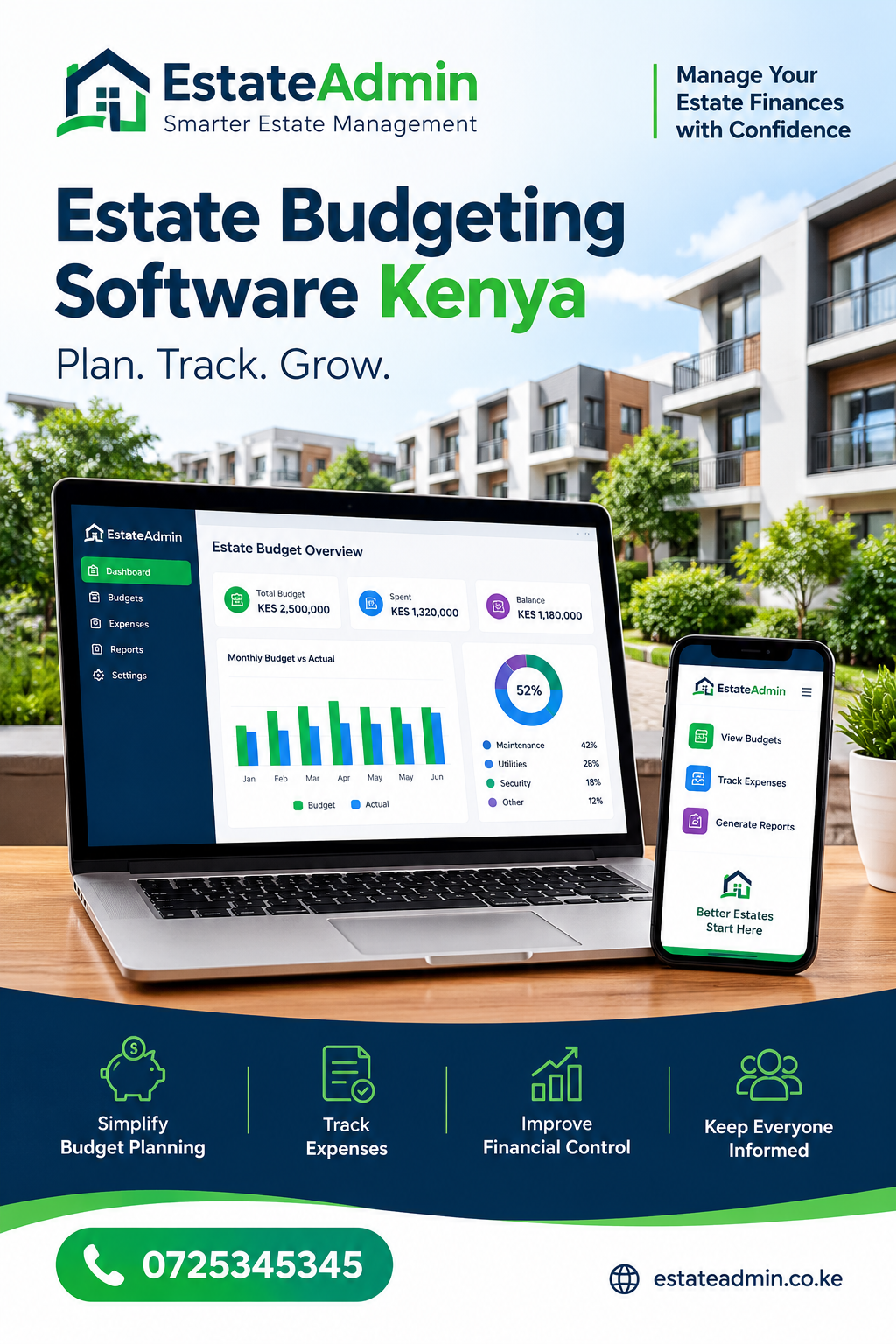
Estate Budgeting Software Kenya: A Complete Guide to Smarter Estate Financial Management
Managing an estate budget manually can become difficult when there are multiple properties, recurring expenses, service providers, tenants, owners and maintenance requirements to coordinate. Estate Budgeting Software Kenya gives estate managers and property management teams a structured way to plan income and expenditure, monitor actual spending, prepare financial reports and make better-informed decisions. This guide explains what estate budgeting software does, the problems it solves, the features property managers should look for, and how Kenyan estates can use digital budgeting tools to improve financial control.
What Is Estate Budgeting Software?
Estate Budgeting Software Kenya refers to a digital solution designed to help property managers, estate administrators, landlords, management companies and property committees prepare, manage and monitor budgets for residential or commercial properties.
A budget provides a financial plan for a specific period. It estimates how much money an estate expects to receive and how much it expects to spend. Without a structured system, managers may rely on spreadsheets, notebooks, emails, receipts and separate accounting records. That approach can make it difficult to determine whether actual spending is following the approved budget.
A digital budgeting platform brings these activities into one environment.
For example, an estate may have planned expenditure for:
- Security services
- Cleaning
- Landscaping
- Waste collection
- Repairs
- Lift maintenance
- Electricity
- Water
- Insurance
- Administrative expenses
- Staff costs
- Professional services
- Common-area improvements
- Emergency maintenance
With Estate Budgeting Software Kenya, these categories can be organized into a structured budget that is easier to monitor throughout the financial period.
The objective is not simply to create a budget. The bigger objective is to maintain financial visibility after the budget has been approved.
Why Estate Budgeting Matters
Estate management involves more than collecting rent or service charges. A property can generate significant financial activity through recurring payments, maintenance projects, utilities, contractor invoices and administrative expenses.
Poor budgeting can create several challenges.
An estate may spend more than planned without noticing until the end of the month. A maintenance project may consume funds allocated for another activity. A service provider’s invoice may be approved without enough consideration of the remaining budget. Management committees may also struggle to understand why expenditure has increased.
Estate Budgeting Software Kenya can help establish a clearer relationship between planned expenditure and actual expenditure.
Consider a residential estate with an annual maintenance budget of KSh 2 million. If the management team spends KSh 800,000 during the first quarter, it becomes important to understand whether that amount is appropriate for the period or whether expenditure is running ahead of the plan.
A digital budgeting system can help managers review the numbers regularly rather than waiting for an annual financial review.
Budgeting Is More Than Expense Tracking
Expense tracking answers the question:
How much has already been spent?
Budgeting answers a broader set of questions:
- How much was expected to be spent?
- How much has been spent?
- How much remains?
- Which category is exceeding its allocation?
- Which expenses are recurring?
- Which expenses are unexpected?
- What income is available to support planned expenditure?
- What adjustments may be necessary?
That distinction makes budgeting an important part of responsible estate administration.
Common Budgeting Problems Faced by Kenyan Estates
Many estates still use a combination of spreadsheets, paper records, messaging applications and accounting documents to manage financial information.
These tools can be useful individually, but problems arise when information is fragmented.
Estate Budgeting Software Kenya can centralize budgeting information so that managers can work from a consistent financial record.
1. Inaccurate Estimates
Preparing an estate budget requires historical information and realistic assumptions.
If previous expenditure is difficult to access, managers may estimate costs from memory. This can result in allocations that are too high or too low.
Historical records make it easier to identify recurring costs and unusual expenditure.
2. Uncontrolled Spending
When budgets are stored in spreadsheets, there may be no convenient way to compare every new expense against the approved allocation.
Estate Budgeting Software Kenya can make budget-versus-actual monitoring more systematic.
A manager can identify categories where expenditure is approaching the approved limit and investigate before the situation becomes difficult to control.
3. Poor Visibility
Property managers may have to collect information from bank statements, invoices, receipts and separate spreadsheets before preparing a financial report.
This consumes time and increases the possibility of errors.
4. Difficult Committee Reporting
Estate management committees often need clear financial information before making decisions.
A report showing total expenditure without the original budget may not provide enough context.
A useful report should show planned amounts, actual expenditure, variances and remaining allocations.
5. Unplanned Expenses
Emergencies are common in property management.
A water system can fail. A gate may require urgent repair. Electrical equipment may need replacement. Security requirements can change.
A good budget should accommodate reasonable contingency planning rather than assuming every expense will follow the original plan.
Key Features to Look For
When evaluating Estate Budgeting Software Kenya, property managers should look beyond the ability to create a simple budget.
The system should support the wider financial workflow of estate management.
Budget Creation
The foundation is the ability to create budgets for a defined period.
Managers should be able to organize expenses into categories and assign planned amounts.
For example:
| Budget Category | Annual Allocation |
|---|---|
| Security | KSh 1,200,000 |
| Cleaning | KSh 600,000 |
| Landscaping | KSh 300,000 |
| Repairs | KSh 800,000 |
| Utilities | KSh 900,000 |
| Administration | KSh 400,000 |
The figures above are only an example. Actual allocations depend on the estate’s size, facilities, contracts and financial circumstances.
Expense Categorization
Estate Budgeting Software Kenya should make it easy to classify expenses correctly.
Clear categories help managers understand where money is going.
Useful categories may include:
- Maintenance
- Security
- Cleaning
- Utilities
- Staff
- Insurance
- Repairs
- Professional services
- Administration
- Capital projects
- Emergency expenses
Budget Versus Actual Reporting
One of the most useful capabilities is comparing planned expenditure with actual expenditure.
Suppose KSh 500,000 was allocated for landscaping, but actual expenditure has reached KSh 420,000 halfway through the budget period.
The remaining balance is KSh 80,000.
This information gives the management team an opportunity to review whether the remaining amount is sufficient.
Variance Monitoring
Variance refers to the difference between what was budgeted and what was actually spent.
Estate Budgeting Software Kenya can help make these differences easier to identify.
A favorable variance does not automatically mean that everything is going well. Underspending may indicate savings, but it could also mean that planned work has not yet been completed.
Similarly, overspending requires context. An unexpected emergency could explain a temporary increase.
The software provides visibility; management still needs to interpret the information.
Managing Service Charge Budgets
Service charges are an important part of financial planning in many residential estates.
Service charge income may support shared services such as security, cleaning, landscaping, waste management, lighting, repairs and other common-area expenses.
Estate Budgeting Software Kenya can help managers build budgets around expected service charge income and planned operating expenses.
A practical service charge budget may include:
- Security contracts
- Cleaning contracts
- Water costs
- Common electricity
- Landscaping
- Waste collection
- Lift maintenance
- Generator maintenance
- Insurance
- Administrative expenses
- Repairs
- Reserve allocations
The management team can then determine whether expected income is sufficient to cover planned expenses.
Why Service Charge Forecasting Matters
If an estate consistently underestimates operating expenses, it may experience cash-flow pressure.
If service charges are set without considering realistic expenditure, management may struggle to maintain the property at the expected standard.
A well-organized budgeting process makes it easier to explain the financial requirements of an estate to property owners.
Budgeting for Maintenance
Maintenance is one of the areas where estate budgets can easily become unpredictable.
Routine maintenance may include servicing equipment, repairing common areas and maintaining landscaping. Major maintenance may involve repainting buildings, replacing pumps or carrying out significant renovations.
Estate Budgeting Software Kenya can help separate routine operating expenses from larger planned projects.
This distinction is useful because a major capital project should not always be treated in the same way as a monthly cleaning expense.
Preventive Maintenance
Preventive maintenance involves addressing equipment and property needs before major failures occur.
Examples include:
- Lift servicing
- Generator servicing
- Water pump maintenance
- Electrical inspections
- Plumbing checks
- Roof inspections
- Security equipment servicing
Budgeting for these activities can reduce dependence on emergency expenditure.
Using Historical Data for Better Budgets
A good budget should not be based entirely on guesswork.
Historical expenditure provides useful information about actual operating patterns.
Estate Budgeting Software Kenya can support managers by keeping budgeting information organized over multiple periods, depending on the features available in the selected system.
Suppose an estate spent:
- KSh 95,000 on security in January
- KSh 95,000 in February
- KSh 95,000 in March
The management team can see that security is a relatively predictable expense.
However, if electrical repairs varied from KSh 20,000 to KSh 180,000 across different months, that category may require a larger contingency allocation.
Historical data does not guarantee future costs, but it provides a more useful starting point than memory alone.
Forecasting Future Estate Expenses
Budgeting should also look forward.
Forecasting involves estimating future income and expenditure using available information.
Estate Budgeting Software Kenya can support a structured forecasting process when historical data, current expenses and planned projects are available.
Managers can consider:
- Existing supplier contracts
- Expected contract increases
- Utility trends
- Planned repairs
- Inflation-related cost changes
- Upcoming projects
- Insurance renewals
- Equipment replacement
- Staffing requirements
- Expected service charge collections
Forecasting helps management avoid treating the budget as a static document.
Managing Budget Variances
A variance occurs when actual financial activity differs from the approved plan.
There are two basic situations:
Underspending: Actual expenditure is below the budget.
Overspending: Actual expenditure is above the budget.
Estate Budgeting Software Kenya can make variance information easier to organize and review.
For example:
| Category | Budget | Actual | Variance |
|---|---|---|---|
| Security | KSh 500,000 | KSh 500,000 | KSh 0 |
| Cleaning | KSh 300,000 | KSh 280,000 | KSh 20,000 |
| Repairs | KSh 400,000 | KSh 475,000 | -KSh 75,000 |
The repairs category has exceeded its allocation by KSh 75,000.
The next question should be why?
Perhaps there was an emergency repair. Perhaps the original allocation was unrealistic. Perhaps several invoices were posted earlier than expected.
A budget system helps identify the variance, while management determines the reason and appropriate response.
M-Pesa and Estate Financial Management
M-Pesa is widely used for payments in Kenya, making digital payment management relevant to many property operations.
An estate may receive service charge payments, rent, deposits or other property-related payments through mobile money.
Estate Budgeting Software Kenya can become more useful when it forms part of a wider digital property management process that connects financial records with payment information.
The exact integration capabilities depend on the software provider.
When evaluating a system, property managers should ask:
- Does it support M-Pesa-related workflows?
- Can payment records be reconciled?
- Can receipts be generated?
- Can income be categorized?
- Can management reports show collected and outstanding amounts?
- Can authorized users access financial information securely?
These questions help ensure that budgeting is connected to actual financial activity.
Connecting Budgeting With Estate Accounting
Budgeting works best when it is connected to accounting processes.
Accounting records what has happened financially. Budgeting plans what is expected to happen. Comparing the two provides useful management information.
Estate Budgeting Software Kenya can therefore be considered alongside accounting, invoicing and payment management features when assessing a property management platform.
A connected workflow can reduce repetitive data entry.
For example:
- A budget is approved.
- A maintenance invoice is received.
- The expense is categorized.
- The transaction is recorded.
- The relevant budget category is updated.
- The remaining allocation becomes visible.
- Management can review the variance.
The exact workflow will vary depending on the software.
Budget Approval and Management Committees
Many estates involve owners, trustees, committees or other decision-makers in financial planning.
A budget may require review before it becomes operational.
Estate Budgeting Software Kenya can support organized budget documentation and reporting, helping authorized decision-makers review planned income and expenses.
A good approval process should answer:
- Who prepares the budget?
- Who reviews it?
- Who approves it?
- What happens when changes are required?
- Who can authorize additional expenditure?
- How are emergency expenses documented?
Clear responsibilities are just as important as the software itself.
Budgeting for Different Types of Estates
Different properties have different financial requirements.
Residential Estates
Residential developments may need budgets covering security, cleaning, landscaping, water, waste management and common-area maintenance.
Commercial Properties
Commercial properties may have more complex requirements involving common-area services, building maintenance, utilities, tenant-related services and facility management.
Mixed-Use Developments
Mixed-use developments may contain residential units, retail spaces and offices.
Their budgets may need separate categories for different areas while still maintaining an overall financial picture.
Estate Budgeting Software Kenya can be useful when managers need a structured way to organize different property-related financial requirements.
Budgeting for Utilities
Utilities can represent a significant operating cost depending on the type and size of the estate.
Relevant expenses may include:
- Electricity
- Water
- Generator fuel
- Common-area lighting
- Pumping systems
- Security systems
- Other shared utilities
Managers should monitor both the financial cost and the underlying consumption patterns.
Estate Budgeting Software Kenya can help organize utility allocations and actual expenses where the system supports those functions.
A sudden increase in expenditure should trigger an investigation rather than simply being added to next year’s budget.
For example, unusually high water costs could result from:
- A leak
- Increased occupancy
- Metering problems
- Higher tariffs
- Irrigation requirements
- Delayed billing
Understanding the reason behind a variance produces better financial decisions.
Budgeting for Security
Security is a recurring priority for many estates.
Budgets may include guards, access control, CCTV, alarms, lighting and security equipment.
Estate Budgeting Software Kenya can help categorize these costs and make recurring security expenditure easier to monitor.
Managers should distinguish between contracted recurring expenses and one-off purchases.
For instance, monthly security services may belong under operating expenses, while installing a new access-control system may require a separate project allocation.
Reporting and Financial Transparency
Clear reporting helps management understand how an estate is performing financially.
A useful report may contain:
- Opening budget
- Approved allocation
- Actual expenditure
- Outstanding commitments
- Variance
- Remaining balance
- Income received
- Outstanding income
- Notes on major expenses
Estate Budgeting Software Kenya can support this kind of structured financial reporting when the relevant reporting features are available.
Reports should be understandable to both financial and non-financial stakeholders.
A committee member should not need advanced accounting knowledge to understand that a budget category has exceeded its allocation.
Reducing Spreadsheet Dependence
Spreadsheets remain useful for many businesses.
However, large property portfolios can make spreadsheet-based budgeting harder to maintain.
Common problems include:
- Duplicate files
- Incorrect formulas
- Missing updates
- Version conflicts
- Manual data entry
- Difficult access control
- Poor audit trails
Estate Budgeting Software Kenya can provide a more centralized environment for budgeting where the platform offers the necessary functionality.
This does not mean spreadsheets are always inappropriate. Smaller estates with simple financial operations may find them sufficient.
The important question is whether the current process gives management enough accuracy, visibility and control.
Managing Multiple Properties
Property managers handling several estates face another challenge: each property may have a different budget.
A system should ideally make it possible to separate properties while maintaining an overall management view.
Estate Budgeting Software Kenya can be relevant to organizations managing property-related financial information across multiple locations, depending on the software’s portfolio capabilities.
For example, a management company could have:
- Estate A
- Estate B
- Estate C
- Estate D
Each estate may have different service providers, expenses and income.
Separating their financial information prevents one property’s expenditure from being incorrectly attributed to another.
Budgeting for Capital Projects
Capital projects require careful planning because they can involve significant expenditure.
Examples include:
- Repainting buildings
- Installing solar systems
- Replacing major equipment
- Renovating common areas
- Improving drainage
- Upgrading security infrastructure
- Replacing roofing
- Installing new water infrastructure
Estate Budgeting Software Kenya can help organize planned project expenditure when capital budgeting is included in the software’s capabilities.
Capital projects should have clear descriptions, estimated costs and expected timelines.
Where possible, management should also document the reason for the project.
Estate Budgeting and Cash Flow
A budget may show that an estate is financially balanced while cash flow remains challenging.
For example, the estate may expect KSh 1 million in service charge collections during a period but receive only KSh 700,000 by the time major supplier payments become due.
This creates a timing problem.
Estate Budgeting Software Kenya can be considered as part of a broader financial management process that connects planned expenses with available financial resources.
Managers should therefore monitor:
- Budgeted income
- Actual collections
- Outstanding amounts
- Scheduled supplier payments
- Recurring expenses
- Available cash
- Upcoming commitments
Budgeting and cash-flow monitoring are related, but they are not identical.
Choosing the Right Estate Budgeting System
Selecting software requires more than comparing feature lists.
Property managers should consider how the system fits their actual workflow.
Estate Budgeting Software Kenya should be evaluated based on usability, reporting, security, integrations, scalability and support.
1. Understand Your Requirements
Before approaching software providers, document the estate’s needs.
Ask:
- How many properties do we manage?
- How many units are involved?
- How many users require access?
- What types of expenses do we track?
- Do we manage service charges?
- Do we need payment integrations?
- What reports do we currently prepare?
- What problems exist with the current system?
2. Review the Budgeting Features
The software should allow the organization to create meaningful budget categories.
Look for functionality covering:
- Annual budgets
- Monthly budgets
- Expense categories
- Budget revisions
- Actual expenditure
- Variance analysis
- Reports
- Approval workflows
3. Check Reporting
Ask for examples of the reports generated by the system.
The reports should be practical rather than simply visually attractive.
4. Consider Ease of Use
A complicated system can create its own problems.
Property managers and administrators should be able to perform common tasks without unnecessary complexity.
5. Assess Security
Financial information requires appropriate access controls.
Ask whether the system supports:
- User permissions
- Role-based access
- Secure authentication
- Data backups
- Activity records
- Controlled financial approvals
The exact safeguards vary between providers.
Questions to Ask a Software Provider
Before adopting a system, property managers can ask the provider:
- Can the system handle multiple estates?
- Can budgets be prepared by financial year?
- Can actual expenses be compared with budgeted amounts?
- Can users create customized expense categories?
- Can reports be exported?
- Can authorized users access the system remotely?
- Does it support M-Pesa-related payment workflows?
- Can it manage service charge information?
- Can users track arrears?
- How are backups handled?
- What happens if a user leaves the organization?
- Is customer support available?
- Can the system scale as the portfolio grows?
- What implementation or training is provided?
These questions can reveal whether a platform is genuinely suitable for the estate.
Common Mistakes When Managing Estate Budgets
Even with software, poor processes can produce poor results.
Mistake 1: Creating the Budget Once a Year and Ignoring It
A budget should be reviewed throughout the year.
Monthly or periodic reviews allow managers to identify changes early.
Mistake 2: Ignoring Small Expenses
Small recurring expenses can accumulate.
Cleaning supplies, minor repairs, transport and administrative costs may appear insignificant individually but become meaningful over a full year.
Mistake 3: Mixing Property Expenses
Expenses from different properties should not be combined without proper allocation.
Mistake 4: Failing to Record Emergency Costs
Unexpected expenditure should still be recorded against an appropriate category.
Mistake 5: Using Unrealistic Estimates
The cheapest historical cost is not necessarily the correct future budget.
Mistake 6: Forgetting Reserve Planning
Major repairs may require substantial funds. Estates should consider long-term requirements instead of focusing exclusively on monthly operating costs.
How to Improve Estate Budgeting Processes
A practical budgeting process can follow these steps.
Step 1: Review Previous Financial Records
Start with historical income and expenses.
Identify recurring and unusual transactions.
Step 2: Define Budget Categories
Create categories that reflect how the estate actually operates.
Step 3: Estimate Income
Consider service charges, rent, parking, facility fees and other relevant income sources.
Step 4: Estimate Operating Expenses
Include recurring costs and realistic estimates for variable expenses.
Step 5: Plan for Maintenance
Separate routine maintenance from major projects.
Step 6: Include Contingency Planning
Not every expense can be predicted.
Step 7: Obtain Appropriate Approval
The budget should go through the estate’s established governance process.
Step 8: Monitor Monthly
Compare actual performance against the approved budget.
Step 9: Investigate Variances
Do not simply record that expenditure is above budget. Determine why.
Step 10: Update Forecasts
If circumstances change significantly, management may need to revise its forecast.
The Role of Automation
Automation can reduce repetitive administrative work.
Estate Budgeting Software Kenya may automate selected budgeting and reporting processes depending on the system.
Potential areas for automation include:
- Recurring expense records
- Budget calculations
- Variance reports
- Payment records
- Financial summaries
- Notifications
- Report generation
Automation should be used to reduce repetitive work while keeping appropriate human oversight over financial decisions.
Data Accuracy Is Essential
Software cannot compensate for incorrect information.
If an expense is entered under the wrong category, the resulting report may be misleading.
Estate Budgeting Software Kenya is most useful when users establish consistent data-entry practices.
For example, management can define clear rules for categorizing expenses.
A plumbing repair should consistently be recorded under the relevant maintenance category rather than being classified differently by different staff members.
Consistent data produces more meaningful reports.
Benefits for Property Managers
Property managers can gain several practical benefits from structured budgeting.
Estate Budgeting Software Kenya can help property managers organize financial information, monitor expenditure and prepare reports more efficiently when these functions are supported.
Potential benefits include:
- Better budget visibility
- Faster reporting
- Easier variance analysis
- Improved expense categorization
- Better financial planning
- Reduced manual work
- Easier monitoring of recurring costs
- More organized records
- Better communication with management committees
The actual results depend on how the system is implemented and used.
Benefits for Property Owners
Owners and residents are often interested in how estate funds are being used.
Clear budgeting can make financial information easier to explain.
Estate Budgeting Software Kenya can help create structured financial records that management can use when communicating with relevant stakeholders.
For example, a management committee can explain that a particular amount was budgeted for security and then show the actual expenditure for the same period.
This creates more context than presenting a list of payments without an approved budget for comparison.
Benefits for Estate Administrators
Administrators often handle large amounts of operational information.
A centralized system can reduce the need to switch between multiple documents.
Estate Budgeting Software Kenya can support administrative organization when budgeting and reporting features are included.
The administrator can focus more on reviewing exceptions and less on repeatedly calculating totals.
Scaling Budget Management
An estate may begin with a relatively simple financial structure.
As the property grows, financial administration can become more complicated.
More units may mean more payments. More facilities can mean more maintenance. More contractors can mean more invoices.
Estate Budgeting Software Kenya can become increasingly relevant as property operations grow and manual processes become harder to maintain.
The goal should be to select a system that can support current requirements without creating unnecessary complexity.
Budget Reviews and Continuous Improvement
A budget should not be treated as a document that is forgotten after approval.
Management can use periodic reviews to identify recurring problems.
Estate Budgeting Software Kenya can support ongoing budget monitoring where the relevant features are available.
For example, if landscaping exceeds budget every year, management should investigate whether:
- The original estimate is too low.
- The service contract has changed.
- Additional landscaping work is being requested.
- The estate has expanded.
- The budget category needs to be redesigned.
Repeated variances can provide valuable management information.
Frequently Asked Questions
What is Estate Budgeting Software?
Estate budgeting software is a digital system used to prepare, organize, monitor and report property-related budgets and expenses. It can help managers compare planned expenditure with actual spending and identify financial variances.
Why do Kenyan estates need budgeting software?
Estate Budgeting Software Kenya can help Kenyan property managers organize financial planning, monitor expenses and prepare reports in a more structured way. The value depends on the estate’s size, processes and software features.
Can budgeting software manage service charges?
Some property management systems include service charge budgeting and related financial functions. Before choosing a platform, managers should confirm whether it supports their specific service charge workflow.
Can estate budgeting software work with M-Pesa?
Some systems may integrate with or support M-Pesa-related payment processes. The exact integration varies by provider, so property managers should confirm the available functionality before implementation.
Can software track budget variances?
Yes, budgeting platforms can provide budget-versus-actual reporting when variance functionality is included. This allows managers to identify categories where expenditure differs from the approved plan.
Is budgeting software suitable for small estates?
Estate Budgeting Software Kenya can be useful for small estates if the software is appropriately sized for their needs. Small properties should consider simplicity, affordability, ease of use and the number of features they actually require.
What expenses should an estate budget include?
Common categories include security, cleaning, landscaping, utilities, repairs, maintenance, insurance, administration, staffing, waste management and planned capital projects. The exact categories depend on the property.
How often should an estate budget be reviewed?
Many management teams review budgets monthly or at another regular interval appropriate to their operations. Regular reviews make it easier to identify unusual expenditure and update forecasts.
What is the difference between budgeting and accounting?
Budgeting focuses on planning expected income and expenditure. Accounting records and reports financial transactions that have occurred. Using both together allows management to compare financial plans with actual performance.
How can a property manager choose the right software?
Start by identifying the estate’s requirements, then compare budgeting features, reporting, integrations, security, usability, support and scalability. Request demonstrations where possible and test the system against real workflows.
Future-Ready Estate Financial Management
Property management is becoming increasingly data-driven, but effective financial management still depends on sound processes.
Estate Budgeting Software Kenya can provide a foundation for organized budgeting when combined with accurate records, clear approval procedures and regular financial reviews.
The most useful system is not necessarily the one with the longest feature list. It is the one that helps an estate team perform its actual work accurately and consistently.
For some properties, basic budgeting may be enough. Others may require detailed service charge management, payment processing, maintenance tracking, accounting integration, tenant records and multi-property reporting.
The right approach is therefore to begin with the estate’s operational needs.
A Practical Estate Budgeting Checklist
Before finalizing a budgeting system, property managers can use this checklist:
- Define annual income sources.
- Review previous financial records.
- Identify recurring expenses.
- Identify variable expenses.
- Separate operating and capital expenditure.
- Create clear expense categories.
- Set realistic allocations.
- Include contingency planning.
- Define approval responsibilities.
- Establish reporting periods.
- Monitor actual expenditure.
- Review budget variances.
- Track outstanding income.
- Review major supplier contracts.
- Update forecasts when circumstances change.
- Keep supporting financial documentation.
- Review system access permissions.
- Train relevant staff.
- Evaluate reports regularly.
Following a consistent process can make financial management more organized even before advanced software features are introduced.
Final Thoughts
Effective estate budgeting is about more than preparing a spreadsheet at the beginning of the financial year. It involves planning, monitoring, reporting, reviewing and adjusting financial information throughout the life of a property.
Estate Budgeting Software Kenya can support this process by bringing budget information into a structured digital environment. When properly implemented, such a system can make it easier to compare planned and actual expenses, identify variances, prepare reports and maintain clearer financial records.
For Kenyan property managers, the most important step is to assess the specific financial requirements of the estate before selecting a solution. Consider the number of units, service charge structure, recurring expenses, payment processes, reporting requirements, maintenance needs and number of people who will use the system.
Estate Budgeting Software Kenya should ultimately support better organization rather than create additional administrative work.
A strong budgeting process also requires accurate data. Managers should record expenses consistently, review financial reports regularly and investigate significant variances. Software can make these activities easier, but management remains responsible for interpreting the information and making appropriate financial decisions.
For estates managing multiple properties, the need for structured financial information can become even more important. Separating property budgets, monitoring individual expense categories and consolidating management reports can help create a clearer picture of financial performance.
Estate Budgeting Software Kenya can form part of that broader digital property management strategy where its features match the estate’s requirements.
Ultimately, effective estate financial management combines appropriate technology with disciplined processes. A well-planned budget, accurate expense records, regular reviews, transparent reporting and clear approval procedures can give property managers a stronger foundation for managing estate finances.
Estate Budgeting Software Kenya is therefore best viewed as a tool that supports the budgeting process rather than a substitute for responsible financial management.
For property managers evaluating their options, the next step is to document their current budgeting challenges, identify the reports they need, determine which financial workflows should be automated and then compare suitable software solutions against those requirements.
Estate Budgeting Software Kenya can be part of a broader property management technology strategy designed around the practical needs of Kenyan estates.
The result should be a financial management process where budgets are easier to prepare, expenditure is easier to monitor, variances are easier to understand and stakeholders receive clearer information.
Estate Budgeting Software Kenya can help support that objective when implemented alongside accurate records, appropriate controls and regular management reviews.
As estate operations become more complex, structured financial management becomes increasingly valuable. Property managers who establish clear budgeting processes can make financial information easier to access and use when planning maintenance, managing service providers and reviewing operating costs.
Estate Budgeting Software Kenya can provide the digital structure needed for this work when the selected platform offers the necessary budgeting and reporting capabilities.
The key is to choose technology based on actual estate requirements rather than simply selecting software because it has a large number of features.
Estate Budgeting Software Kenya should be assessed against usability, reporting, security, scalability and integration requirements before adoption.
When those factors are considered carefully, digital budgeting can become an important part of organized estate administration.
Estate Budgeting Software Kenya can help property managers move from fragmented financial records toward a more structured budgeting workflow where appropriate.
A consistent budgeting process also makes it easier to communicate financial information. Instead of presenting isolated expenses, management can show the original allocation, actual spending, remaining balance and variance.
Estate Budgeting Software Kenya can support this kind of reporting where the selected system provides the required functionality.
This gives stakeholders a clearer basis for understanding how estate resources are being allocated.
Estate Budgeting Software Kenya can also be considered where budgeting forms part of a wider property management workflow.
The final decision should always reflect the property’s actual needs, financial structure and administrative capacity.
Estate Budgeting Software Kenya is most valuable when it fits naturally into existing estate processes and helps users manage information without unnecessary complexity.
With the right approach, budgeting can become a continuous management activity rather than a once-a-year exercise.
Estate Budgeting Software Kenya can help provide the tools for that process when its features align with the estate’s requirements.
Property managers can then spend less time manually consolidating figures and more time reviewing the information that matters.
Estate Budgeting Software Kenya can support this transition as part of a wider digital property management strategy.
The final objective is straightforward: create a budgeting process that is accurate, understandable, reviewable and useful for everyday estate management.
Estate Budgeting Software Kenya can contribute to that objective when combined with sound financial controls and consistent data practices.
As budgets are reviewed, actual expenses can be compared with approved allocations, recurring problems can be identified and future estimates can be improved.
Estate Budgeting Software Kenya can help organize these activities when the relevant budgeting, reporting and financial management features are available.
That makes digital budgeting a practical consideration for estate managers seeking greater visibility over property finances.
Estate Budgeting Software Kenya can serve as one component of an organized estate management system, particularly where budgeting needs to connect with other property operations.
The most effective implementation begins with understanding the estate’s current process, identifying gaps and selecting technology that directly addresses those gaps.
Estate Budgeting Software Kenya can support that process where its functionality corresponds with the property’s operational and financial requirements.
A carefully managed budget can help property managers plan ahead, monitor spending and communicate financial information more clearly.
Estate Budgeting Software Kenya can form part of that approach when the software is appropriate for the estate’s needs.
For Kenyan property managers, budgeting should remain practical, transparent and closely connected to real financial activity.
Estate Budgeting Software Kenya can provide a useful digital foundation for that work when implemented with accurate data and consistent financial procedures.
The final measure of a budgeting system is not how many features it lists, but whether it helps the estate team understand its financial position and manage planned expenditure effectively.
Estate Budgeting Software Kenya can support that goal by organizing budget information and making relevant financial data easier to review.
With clear categories, regular monitoring, reliable records and appropriate reporting, estate budgeting can become a more manageable part of property administration.
Estate Budgeting Software Kenya can help facilitate this process where the required capabilities are included in the selected platform.
Estate managers should therefore approach software selection as a practical business decision: identify the problem, define the required workflow, evaluate suitable tools and implement the chosen solution carefully.
Estate Budgeting Software Kenya can be one part of that structured approach to better financial administration.
The combination of sound budgeting principles and suitable technology can help estates maintain stronger financial visibility while supporting day-to-day property operations.
Estate Budgeting Software Kenya can provide useful budgeting support when it matches the estate’s size, complexity and reporting requirements.
For managers planning future improvements, documenting the current budgeting process is a good starting point. From there, gaps in reporting, expense tracking, forecasting and approval can be identified.
Estate Budgeting Software Kenya can then be evaluated against those specific requirements instead of being selected based solely on general marketing claims.
The result should be a budgeting workflow that is easier to understand, easier to monitor and better aligned with the financial realities of the estate.
Estate Budgeting Software Kenya can support that objective where the relevant features are available and properly configured.
Good estate budgeting ultimately depends on three things: accurate information, disciplined processes and appropriate technology.
Estate Budgeting Software Kenya can strengthen the technology component, while management remains responsible for setting budgets, reviewing performance and acting on financial information.
A well-organized approach can make estate finances easier to monitor throughout the year rather than only when annual reports are prepared.
Estate Budgeting Software Kenya can contribute to this ongoing process when integrated into the estate’s broader financial management workflow.
That approach can give managers a clearer view of planned costs, actual expenditure and future requirements.
Estate Budgeting Software Kenya can support this structured process as part of a broader property management solution.
The priority should always be practical financial control: knowing what was planned, knowing what has happened and understanding what needs attention next.
Estate Budgeting Software Kenya can help organize the information required for that process when its functionality fits the estate’s needs.
For growing estates and property management companies, this structured approach can also make financial reporting easier to standardize across different properties.
Estate Budgeting Software Kenya can support multi-property financial workflows where the platform provides the necessary capabilities.
In the long term, disciplined budgeting can help property managers plan maintenance, monitor operating costs and communicate financial information more effectively.
Estate Budgeting Software Kenya can be part of that long-term financial management framework.
The most important consideration is that the system should support the estate’s real requirements rather than force managers into an unsuitable workflow.
Estate Budgeting Software Kenya can be evaluated alongside other options by considering the property’s budget structure, reporting needs, integrations and users.
Once the right process and technology are in place, estate budgeting becomes a recurring management practice supported by reliable financial information.
Estate Budgeting Software Kenya can provide useful support for that practice where the platform meets the organization’s requirements.
The overall goal is better visibility, better planning and more organized financial administration.
Estate Budgeting Software Kenya can contribute to that goal when used as part of a properly designed estate management workflow.
For any property manager considering a digital solution, the best starting point is a clear understanding of current challenges and desired outcomes.
Estate Budgeting Software Kenya can then be assessed according to how well it addresses those specific requirements.
A thoughtful implementation can help ensure that budgeting technology becomes a practical part of daily estate operations rather than another disconnected administrative tool.
Estate Budgeting Software Kenya can support this transition when the software is selected and configured around actual property management needs.
Finally, regular review remains essential. Budgets change, expenses change and estate requirements change.
Estate Budgeting Software Kenya can help managers maintain a more organized view of those changes when its budgeting and reporting features are used consistently.
The strongest estate budgeting process is therefore one that combines realistic planning, accurate financial records, regular monitoring, transparent reporting and suitable digital tools.
Estate Budgeting Software Kenya can support that process and help property managers build a more structured approach to managing estate finances.