
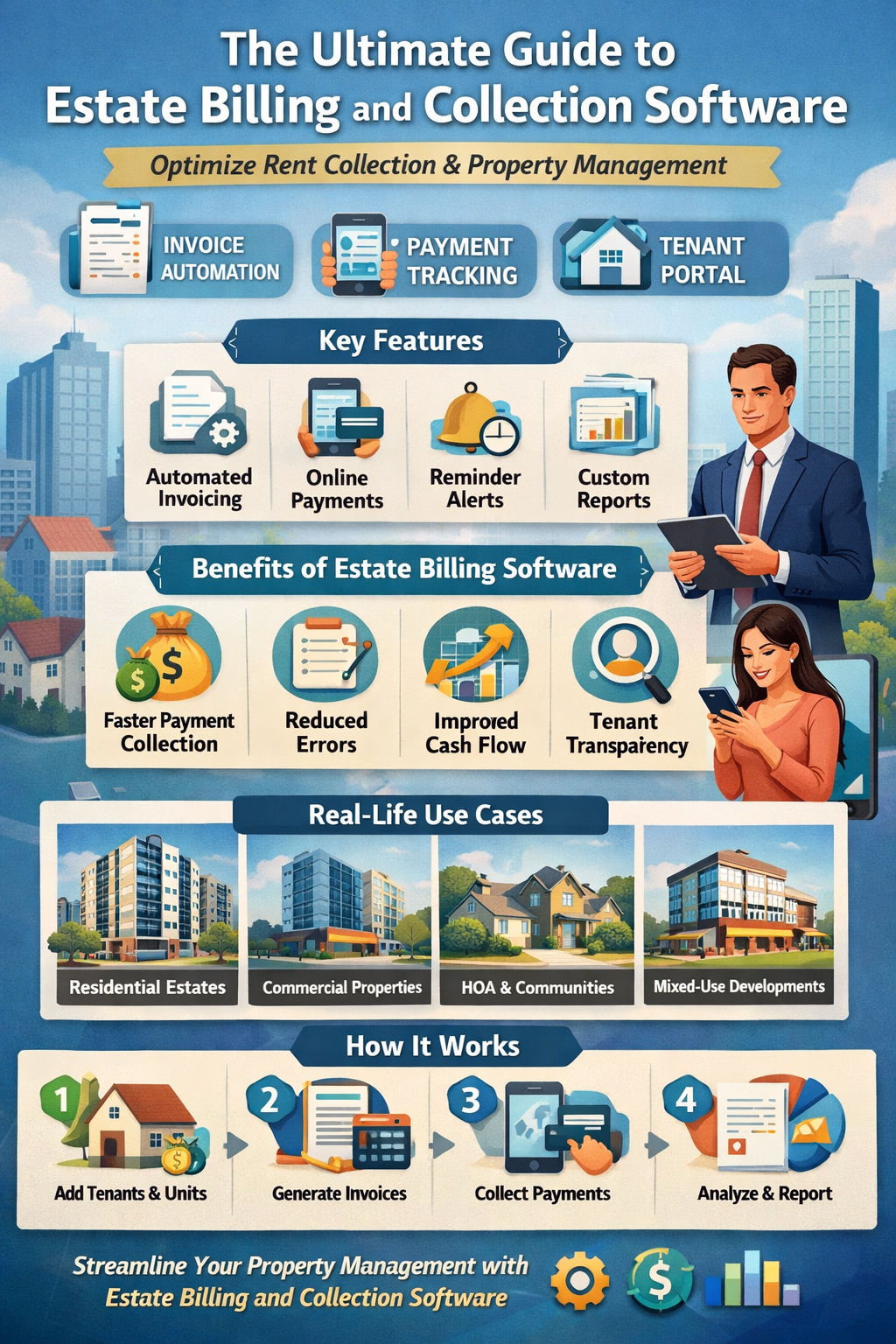
Ultimate Guide to Estate Billing and Collection Software: Streamline Your Property Management
Managing estates, apartments, or residential complexes can be complex. From tracking tenants to ensuring timely payments, property managers face numerous challenges. This is where estate billing and collection software becomes indispensable. It automates rent collection, generates invoices, and provides insightful analytics — making property management efficient and error-free.
What is Estate Billing and Collection Software?
Estate billing and collection software is a specialized property management tool designed to simplify financial operations for landlords, property managers, and estate administrators. It automates tasks such as:
-
Generating accurate invoices for tenants
-
Tracking payment schedules
-
Sending automated reminders for overdue rent
-
Managing utility and service charges
-
Recording and reconciling payments
By digitizing these processes, property managers save time, reduce human error, and enhance transparency with tenants.
Key Features of Estate Billing and Collection Software
Investing in reliable estate billing and collection software can transform property management. Here are the essential features to look for:
-
Automated Invoice Generation
Automatically create monthly invoices for rent, service charges, and utilities. Customize templates to reflect your estate branding. -
Online Payment Integration
Accept payments via mobile money, bank transfers, and credit/debit cards. Integration with local payment systems ensures convenience for tenants. -
Real-Time Payment Tracking
Monitor payments as they happen. Receive alerts for late or partial payments, reducing financial risks. -
Tenant Account Management
Maintain detailed records for each tenant, including payment history, lease agreements, and contact information. -
Customizable Reports & Analytics
Generate reports for revenue, outstanding balances, and payment trends. Analytics help in making informed financial and operational decisions. -
Automated Reminders & Notifications
Send email or SMS reminders to tenants for upcoming or overdue payments, improving collection rates. -
Security & Data Protection
Ensure sensitive tenant and financial data is protected with encryption and secure cloud storage.
Benefits of Using Estate Billing and Collection Software
Implementing an estate billing and collection software system offers numerous advantages for property managers and tenants alike:
-
Efficiency: Reduce manual bookkeeping and administrative workload.
-
Accuracy: Eliminate errors in invoicing and payment tracking.
-
Transparency: Tenants can view their payment history and pending bills.
-
Faster Collections: Automated reminders and multiple payment options improve on-time payments.
-
Scalability: Manage multiple estates or apartment blocks from a single platform.
-
Compliance: Easily generate financial records for auditing and regulatory purposes.
How Estate Billing and Collection Software Works
The software follows a simple workflow:
-
Tenant Registration – Add tenant details and assign units.
-
Billing Setup – Set recurring rent, utilities, and other charges.
-
Invoice Generation – Automatically create and send monthly invoices.
-
Payment Processing – Accept payments through integrated channels.
-
Reporting – Generate financial statements and monitor payment trends.
This workflow ensures smooth operations, reduces human error, and provides real-time insights.
Choosing the Right Estate Billing and Collection Software
When selecting software, consider these factors:
-
Ease of Use: Choose intuitive platforms that require minimal training.
-
Customization: Ability to adapt invoices and reports to your estate’s needs.
-
Integration: Compatible with accounting, CRM, and payment platforms.
-
Support & Updates: Reliable customer support and regular software updates.
-
Cost-Effectiveness: Affordable subscription plans or one-time licensing options.
Top Estate Billing and Collection Software Options
While many solutions exist, some of the top-performing estate billing and collection software include:
-
Buildium – Best for comprehensive property management.
-
Rentec Direct – Focused on small to medium estates with strong billing features.
-
Yardi Breeze – Ideal for scalable estates requiring advanced analytics.
-
TenantCloud – Affordable and cloud-based, suitable for estates of all sizes.
Each of these platforms offers features tailored to simplify billing, collection, and tenant management.
Future of Estate Billing and Collection Software
With technological advancements, estate management software is evolving to include:
-
AI-driven payment predictions
-
Mobile apps for tenants and managers
-
Integration with smart home systems
-
Enhanced cybersecurity measures
This makes estate billing and collection software not just a tool for accounting but a central hub for smart estate management.
Conclusion
For property managers seeking efficiency, accuracy, and better financial control, investing in estate billing and collection software is a game-changer. Automating billing, improving tenant communication, and providing real-time insights ensures smoother operations and faster rent collection.
Whether you manage a small apartment block or a large estate, the right software can reduce administrative headaches and improve tenant satisfaction.
Advanced Features to Look for in Estate Billing and Collection Software
Modern estate billing and collection software is more than just invoicing—it provides tools that streamline every aspect of property financial management:
-
Automated Late Fee Calculation
Automatically apply late fees based on your estate’s policies. This removes ambiguity and ensures fair billing for tenants. -
Multi-Currency & Multi-Location Support
For estates with international tenants or multiple branches, the software can handle different currencies and tax structures seamlessly. -
Recurring Billing & Subscription Management
Set up recurring charges for long-term tenants or services like parking, storage, or amenities. -
Tenant Self-Service Portals
Allow tenants to view their balances, download invoices, and make payments directly. This reduces administrative overhead and improves tenant satisfaction. -
Mobile Accessibility
Cloud-based mobile apps let property managers track payments, generate invoices, and manage collections on the go. -
Integration with Accounting & ERP Systems
Sync your billing software with accounting platforms like QuickBooks, Xero, or SAP to maintain unified financial records.
Real-Life Use Cases of Estate Billing and Collection Software
-
Residential Estates
A large apartment complex can use the software to send monthly invoices to hundreds of tenants, track utility bills, and automate reminders. This reduces late payments by up to 40%. -
Commercial Properties
Property managers of office buildings can manage multiple tenants with different lease terms, billing cycles, and service charges—all from one platform. -
HOAs & Gated Communities
Homeowners Associations can collect maintenance fees, parking charges, and amenity fees efficiently, while providing transparent reporting to residents. -
Mixed-Use Developments
Complexes that combine commercial and residential units benefit from consolidated billing, multi-currency support, and custom reporting features.
Benefits of Automation in Estate Billing
Automating billing and collections with software brings multiple advantages:
-
Time Savings – Reduce hours spent on manual invoicing and reconciliations.
-
Reduced Errors – Automated calculations prevent human mistakes in rent and utility charges.
-
Improved Cash Flow – Faster collection and online payment options ensure steady income.
-
Tenant Satisfaction – Clear, timely billing with self-service options builds trust.
-
Audit Readiness – Maintain records digitally, making it easy to comply with audits or tax reporting.
Common Challenges Solved by Estate Billing and Collection Software
-
Late Payments: Automated reminders and late fee policies encourage on-time payments.
-
Manual Errors: No more miscalculations or missed invoices.
-
Tenant Disputes: Clear records and reports reduce conflicts.
-
Scaling Issues: Software can easily handle growing estates without additional manpower.
How to Implement Estate Billing and Collection Software Successfully
-
Assess Your Needs – Identify features you need, like online payments, tenant portals, or reporting.
-
Choose the Right Software – Compare options based on features, price, and scalability.
-
Migrate Data Carefully – Transfer tenant details, billing history, and invoices accurately.
-
Train Staff – Ensure property managers understand how to use the system efficiently.
-
Communicate with Tenants – Inform tenants about new payment methods and portals.
-
Monitor & Optimize – Use analytics to improve billing efficiency and collection rates over time.
Conclusion: Why Estate Billing and Collection Software is Essential
In today’s property management landscape, relying on spreadsheets or manual billing is no longer sufficient. estate billing collection streamlines operations, reduces errors, and enhances tenant satisfaction.
Whether managing a small residential estate or a large commercial property, adopting robust billing software ensures:
-
Faster payments and improved cash flow
-
Accurate record-keeping and reporting
-
Enhanced tenant communication and transparency
-
Scalable solutions that grow with your estate
By embracing this technology, property managers can focus on strategic decisions rather than administrative tasks—transforming estate management into a smooth, profitable, and modern operation.