
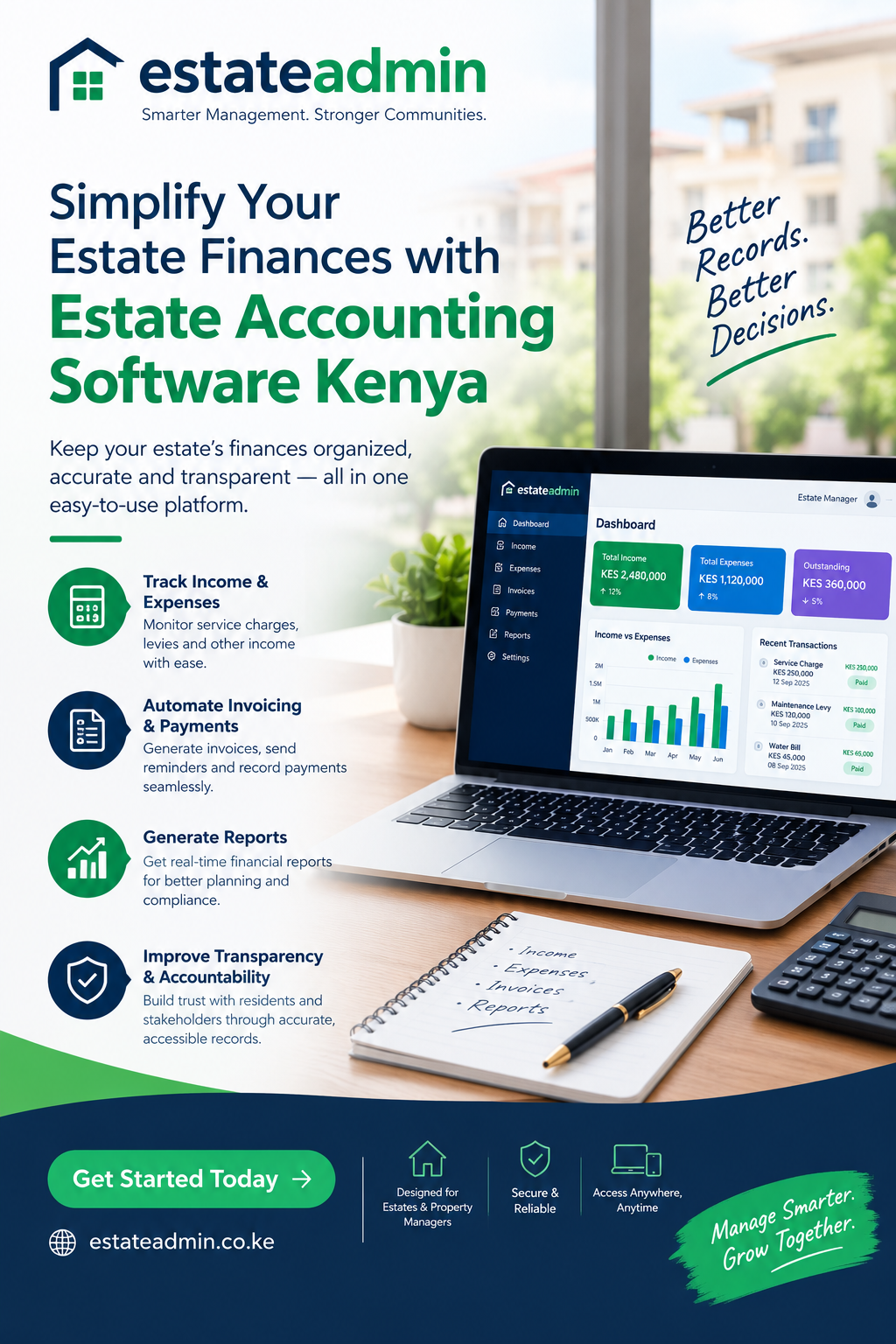
Estate Accounting Software Kenya: Features, Benefits and Buying Guide
Managing property finances becomes difficult when rent payments, service charges, supplier invoices, deposits, maintenance costs and owner statements are recorded in different places. Estate Accounting Software Kenya gives property managers, landlords and estate administrators a structured way to bring those financial records together. Instead of relying on scattered spreadsheets and paper files, a well-designed accounting system can help users track income, expenses, balances, invoices and reports from a central workspace. This article explains the accounting features that matter, how they fit Kenyan property operations, what to consider before choosing a system, and how better financial records can improve day-to-day estate administration.
For a property manager, accounting is not simply about recording money received. The financial side of an estate connects directly to tenant accounts, lease information, service-charge budgets, maintenance work, supplier payments and owner reporting. When one transaction is entered incorrectly, the error can affect several reports. A connected accounting system creates a consistent process for capturing transactions and connecting them to the property, unit, tenant, owner or supplier concerned. That structure is especially useful when an estate contains many units and the volume of monthly transactions makes manual reconciliation time-consuming. Estate Accounting Software Kenya
Kenyan property operations also have practical requirements that should shape the accounting workflow. Rent may be paid through bank transfers, mobile money or other approved channels. Property teams may need to monitor arrears, issue receipts, reconcile collections and produce statements for different stakeholders. A useful accounting platform should therefore fit the way the business actually operates rather than forcing staff to redesign every process around the software. Estate Accounting Software Kenya
What Is Estate Accounting Software?
Estate accounting software is a digital system designed to organize the financial records associated with property or estate operations. Depending on the platform, it may support rent income, expense recording, invoices, receipts, supplier transactions, tenant balances, owner statements, budgets and financial reports. The important distinction is that these functions are connected to property records rather than being treated as isolated bookkeeping entries. Estate Accounting Software Kenya
For a residential development, for example, the finance team may need to know how much was billed to each unit, how much was collected, what remains outstanding and which expenses belong to the common areas. A connected accounting system can keep those relationships visible. That makes it easier to move from a raw transaction list to a useful financial picture of the estate. Estate Accounting Software Kenya
The system can also create a shared record for managers and authorized staff. Instead of one person holding the latest spreadsheet while another keeps receipts in a folder, transactions can be entered into a controlled workflow. Access permissions, audit trails and standardized reports can further support accountability. Estate Accounting Software Kenya
Why Accounting Matters in Property Management
Property management combines operational work with financial responsibility. Staff may coordinate repairs in the morning, follow up on rent in the afternoon and prepare owner or management reports later in the day. Accounting sits across these activities because every service has a financial consequence. Estate Accounting Software Kenya
Good records help answer basic questions quickly: What was billed? What was collected? Which tenants are in arrears? Which suppliers are awaiting payment? How much has been spent on maintenance? What is the balance of a service-charge account? Which units have outstanding charges? If these questions require searching through several spreadsheets, emails and receipt books, the process can consume substantial staff time. Estate Accounting Software Kenya
A structured system also improves consistency. When every transaction follows the same categories and approval steps, reports become easier to understand. Managers can identify unusual expenses, compare actual spending with budgets and investigate outstanding balances before they become larger problems. Estate Accounting Software Kenya
For landlords and estate administrators, the value is therefore not only automation. The bigger benefit is having financial information organized in a way that supports routine decisions, communication and accountability. Estate Accounting Software Kenya
Core Accounting Features to Look For
When comparing accounting platforms, start with the actual tasks your property team performs. A system may look impressive because it has many menus, but the most useful features are the ones that remove friction from daily work. Estate Accounting Software Kenya
Important capabilities can include:
- Income and expense tracking by property or unit.
- Tenant and owner account statements.
- Invoice and receipt generation.
- Arrears and outstanding-balance tracking.
- Supplier and payable records.
- Budget monitoring for estates and service charges.
- Bank and payment reconciliation.
- Financial reporting by date, property or account.
- User roles and permissions.
- Export options for authorized accounting workflows.
- Searchable transaction histories and audit trails.
Estate Accounting Software Kenya should also allow the business to separate different financial categories clearly. Rent, deposits, service charges, penalties, maintenance costs and management fees may need different treatment in internal records. A system that makes these distinctions visible reduces the risk of mixing transactions that should be analyzed separately.
Before buying, ask for a demonstration using realistic examples from your own estate. Test a rent payment, a supplier invoice, a maintenance expense, a refund and an arrears report. Practical testing reveals more than a feature list. Estate Accounting Software Kenya
Rent Collection and Tenant Accounts
Rent collection is one of the most important financial workflows in property management. A good accounting process should show what each tenant was expected to pay, what has been received, what remains outstanding and when the transaction was recorded. Estate Accounting Software Kenya
For example, consider a tenant whose monthly charge includes rent and a separate service charge. The accounting record should make it possible to see the components without losing the overall balance. If a partial payment is made, staff should be able to identify how much remains due rather than manually calculating the balance each time. Estate Accounting Software Kenya
Receipts also matter. Tenants often need proof of payment, while management needs a record that can be referenced later. A digital receipt workflow can reduce dependence on handwritten documents and make historical searches faster. Estate Accounting Software Kenya
Arrears reporting is another key function. Instead of reviewing individual accounts one by one, managers can use an arrears report to identify outstanding balances and prioritize follow-up. The report can become part of a regular collections process, with staff recording communication and payment updates in the relevant account. Estate Accounting Software Kenya
M-Pesa and Payment Reconciliation
Mobile payments are important to many Kenyan businesses, so property accounting workflows should account for the way tenants actually pay. Where a platform supports an appropriate M-Pesa or payment integration, the main objective is not simply receiving money. The accounting record must connect the payment to the correct tenant, unit, invoice or account. Estate Accounting Software Kenya
Reconciliation is the control step that confirms recorded transactions match the money received. A system should help staff identify unmatched payments, duplicates, missing entries or amounts that need investigation. This is valuable when a property receives many transactions within a short period. Estate Accounting Software Kenya
The right process depends on the payment channels used by the organization and the integrations supported by the selected software. Managers should confirm exactly how automated imports, payment references, reversals and exceptions are handled before implementation. Estate Accounting Software Kenya
A practical test is to provide the vendor with several sample scenarios: a full rent payment, partial payment, payment with an unclear reference, duplicate payment and reversed transaction. Ask the vendor to demonstrate how each would appear in the accounting records. That exercise can reveal whether the workflow is suitable for real estate operations in Kenya. Estate Accounting Software Kenya
Service Charge Accounting
Service charges require careful financial organization because they can involve recurring contributions, shared expenses, budgets and supporting records. Apartment buildings, gated communities and managed developments may need to track common-area cleaning, security, landscaping, waste collection, repairs, utilities and other shared costs. Estate Accounting Software Kenya
A useful accounting system can help separate service-charge income from other property income and associate expenses with the relevant estate or cost category. This makes it easier to compare planned spending with actual spending. Estate Accounting Software Kenya
Budgeting is particularly useful. At the beginning of a financial period, management may establish expected costs for several categories. As invoices are entered, the system can provide a running view of expenditure. If one category begins to exceed expectations, managers have an opportunity to investigate early. Estate Accounting Software Kenya
Clear service-charge statements can also improve communication with residents. Instead of presenting a single unexplained balance, the organization can maintain records that show charges and payments in an organized format. The exact statement design should reflect the estate’s governing documents, agreements and accounting requirements. Estate Accounting Software Kenya
Expense and Supplier Management
Property businesses deal with many suppliers: plumbers, electricians, cleaners, security providers, landscapers, waste contractors, equipment vendors and professional service providers. Each supplier relationship can create invoices, payments and supporting documents. Estate Accounting Software Kenya
A strong accounting workflow records the supplier, date, amount, description, property or cost center and payment status. Where approval controls are available, the organization can establish who reviews an invoice before it becomes payable. Estate Accounting Software Kenya
This matters because property expenses are often recurring but not identical. A monthly cleaning invoice may be predictable, while an emergency plumbing repair may be unexpected. Categorizing both correctly allows management to understand normal operating costs as well as unusual expenditure. Estate Accounting Software Kenya
estate accounting software in Kenya can be useful here because it brings supplier transactions into the same financial environment as rent and service-charge records. Managers can then view income and expenses together rather than maintaining separate files for collections and supplier payments. Estate Accounting Software Kenya
Before implementation, define the expense categories your organization actually uses. A system becomes more useful when categories are simple enough for staff to apply consistently and detailed enough to support meaningful reporting. Estate Accounting Software Kenya
Financial Reporting for Property Managers
Reports turn transactions into information that management can use. The most useful reports depend on the type of estate and the responsibilities of the management team, but common examples include income and expenditure reports, rent collection reports, arrears reports, tenant statements, supplier reports, budget-versus-actual reports and transaction listings. Estate Accounting Software Kenya
A good report should answer a specific question. For example, an arrears report helps the collections team identify outstanding balances. A budget report helps management review spending. A property income report helps compare financial activity across different properties. Estate Accounting Software Kenya
Report filters can make a significant difference. Users may want to select a date range, property, unit, tenant, account category or transaction type. Export functionality may also be useful where accountants need to work with approved external accounting processes. Estate Accounting Software Kenya
When evaluating a platform, do not only ask whether it has reports. Ask to see the reports. Check whether the labels are understandable, whether figures can be traced back to source transactions and whether the report can be generated without complex manual steps. A report that exists but takes too long to produce may not provide much practical value. Estate Accounting Software Kenya
Budgeting and Cash Flow Visibility
Budgets help property managers plan rather than simply react. An estate may have predictable expenses, seasonal maintenance needs and occasional capital requirements. Recording a budget alongside actual transactions gives management a reference point for monitoring performance. Estate Accounting Software Kenya
Cash flow visibility is also important. A property may show strong billed income while having weak collections because many tenants are behind on payments. Looking only at invoices can therefore give an incomplete picture. Accounting records should make the difference between amounts billed and amounts actually received easy to understand. Estate Accounting Software Kenya
For example, if an estate expects monthly collections of a certain level but actual receipts fall below that figure, management can review arrears, payment delays and unusual events. Similarly, if maintenance spending rises sharply, the team can investigate the cause and determine whether the budget needs adjustment. Estate Accounting Software Kenya
The objective is not to create complicated financial models. It is to make routine financial information easier to interpret. A property manager should be able to move from a summary figure to the transactions behind it when further investigation is necessary. Estate Accounting Software Kenya
Data Accuracy and Audit Trails
Financial software is only useful when the underlying data is reliable. Data accuracy depends on both system design and staff procedures. Users need clear fields, consistent categories and sensible controls for correcting mistakes. Estate Accounting Software Kenya
An audit trail can be particularly valuable. When a transaction changes, authorized users should be able to understand what happened and who made the change, subject to the capabilities of the software. This can help management investigate discrepancies and improve accountability. Estate Accounting Software Kenya
Data validation is another useful feature. If a system requires important fields before saving a transaction, it can reduce incomplete records. Search and duplicate detection can also help staff identify potential errors. Estate Accounting Software Kenya
Implementation should include clear rules for correcting transactions. Staff should know when to edit a record, when to reverse an entry and when to create an adjustment. Those procedures are part of financial control and should be documented internally. Estate Accounting Software Kenya
estate accounting software in Kenya should support a disciplined record-keeping process rather than encouraging staff to treat the system as a simple digital notebook. The quality of reports depends on the quality of the transaction history behind them. Estate Accounting Software Kenya
Access Control and Financial Security
Property accounting data can contain sensitive financial information, so access control deserves attention. Not every employee needs access to every function. A receptionist may need to view selected tenant information, while an accountant may need broader access to financial records. A system with role-based permissions can help organizations define appropriate access. Estate Accounting Software Kenya
Password policies, account management, backups and secure hosting are also relevant questions. Ask the provider where data is hosted, how backups are handled, how user access is controlled and what happens when an employee leaves the organization. Estate Accounting Software Kenya
Security is not only a technology issue. Staff behavior matters too. Shared passwords, unsecured devices and informal data exports can create risks even when the software itself has strong controls. Estate Accounting Software Kenya
Before adopting a platform, document who should have access to which modules and reports. Review those permissions periodically. The smaller the number of people with unnecessary access to financial information, the easier it is to maintain clear accountability. Estate Accounting Software Kenya
Cloud Access and Multi-Property Operations
Property managers may oversee several buildings or estates at the same time. A cloud-based accounting system can provide a central environment for authorized users working across multiple locations, subject to the provider’s architecture and access controls. Estate Accounting Software Kenya
Multi-property support is useful when each property needs its own income, expenses, tenants and reports while management still needs an overall view. The software should make it clear which transaction belongs to which property. Estate Accounting Software Kenya
This becomes important as a business grows. A process that works for one building may become difficult when ten buildings are involved. Staff may otherwise maintain multiple spreadsheets, duplicate data entry and separate reporting templates. Estate Accounting Software Kenya
When evaluating multi-property functionality, ask whether properties can be segmented without creating isolated databases that make group reporting difficult. Also test whether a user can move from a portfolio summary to an individual property and then to the underlying transaction. Estate Accounting Software Kenya
For managers expanding their portfolios, scalable accounting processes can reduce administrative pressure. The goal is to establish a structure that remains understandable as the number of units and transactions increases. Estate Accounting Software Kenya
Choosing Software for a Kenyan Estate
Choosing accounting software should begin with the organization’s workflow rather than the vendor’s marketing language. Write down how money moves through the business from billing to collection, recording, reconciliation, approval and reporting. Estate Accounting Software Kenya
Then identify pain points. Is the team spending too much time following up arrears? Are receipts difficult to find? Are service-charge expenses mixed with rent records? Do owners receive reports late? Are spreadsheets producing duplicate or inconsistent information? Estate Accounting Software Kenya
Use those problems to create a shortlist of requirements. For example:
- Tenant and property account management.
- Rent billing and collections.
- Service-charge accounting.
- Expense and supplier tracking.
- Payment reconciliation.
- Financial reporting.
- User permissions.
- Data backup and security.
- Support and training.
- Integration requirements.
Estate Accounting Software Kenya should fit the size and complexity of the estate. A small property does not necessarily need every enterprise feature, while a large portfolio may quickly outgrow a basic bookkeeping tool.
Ask vendors to demonstrate your real workflow instead of giving only a generic product tour. The demonstration should include common transactions, exceptions and reports. This makes comparison more objective and exposes hidden manual work. Estate Accounting Software Kenya
Implementation Without Disrupting Operations
Moving from spreadsheets or paper records to software requires planning. Start by deciding which historical information must be migrated and which records can remain archived. Attempting to move every old file without a clear purpose can make implementation unnecessarily complicated. Estate Accounting Software Kenya
Clean the data before importing it. Check tenant names, unit numbers, balances, supplier details and account categories. Duplicate records should be identified before they enter the new system. Estate Accounting Software Kenya
Next, define user roles and workflows. Decide who creates invoices, who records payments, who approves expenses and who reviews reports. Staff should understand these responsibilities before the system goes live. Estate Accounting Software Kenya
Training should use realistic examples. Instead of teaching only where buttons are located, show staff how to complete the transactions they perform every week. Include error correction, reporting and reconciliation. Estate Accounting Software Kenya
A phased rollout can reduce disruption. The organization might begin with one property or one accounting workflow, review the results and then expand. During the transition, maintain a clear record of which system is considered the official source for each type of information so that staff do not create conflicting records. Estate Accounting Software Kenya
Common Mistakes to Avoid
Several mistakes can reduce the value of an accounting system. The first is buying software based on the number of features rather than the fit with the business. More features do not automatically mean a better workflow. Estate Accounting Software Kenya
Another mistake is failing to define account categories. If different staff use different categories for similar expenses, reports become inconsistent. Estate Accounting Software Kenya
Poor data migration is another risk. Importing inaccurate tenant balances or duplicate suppliers can create problems from the first day. Data should be reviewed before it becomes part of the new accounting record. Estate Accounting Software Kenya
Organizations can also overlook training. Even an effective system may fail to deliver value if users continue keeping parallel spreadsheets because they do not understand the new process. Estate Accounting Software Kenya
A further issue is weak reconciliation. Recording a payment without confirming that it matches the underlying bank or payment record can leave errors hidden. Estate Accounting Software Kenya
Finally, some teams try to automate every process immediately. Automation is useful when the underlying workflow is already clear. If the process itself is poorly defined, automation may simply make mistakes happen faster. Establish the process first, then automate appropriate steps. Estate Accounting Software Kenya
Cost Considerations
Software pricing should be evaluated against the total operating cost, not just the subscription figure. Consider implementation, data migration, training, support, integrations, additional users and any services that may be charged separately. Estate Accounting Software Kenya
The right question is what the system replaces or improves. If staff currently spend many hours compiling monthly reports, chasing balances, preparing receipts and reconciling transactions manually, reducing those tasks may have operational value. Estate Accounting Software Kenya
However, cost should not be the only factor. A low-cost system that does not support essential property workflows may create extra manual work. A more capable system may also be inappropriate if the organization will use only a small portion of its functionality. Estate Accounting Software Kenya
Ask for a clear explanation of what is included in the price. Confirm whether support, upgrades, backups, integrations and additional users are included or charged separately. Also understand contract terms before committing. Estate Accounting Software Kenya
For Kenyan property businesses, the best comparison is usually based on workflow fit, reliability, usability, support and total cost over the expected period of use rather than the advertised monthly figure alone. Estate Accounting Software Kenya
Accounting Software and Professional Accountants
Accounting software does not replace professional accounting judgment. Instead, it can provide organized transaction data that accountants and financial managers can use more efficiently. Estate Accounting Software Kenya
A property business may still need professional guidance on accounting treatment, tax obligations, financial statements and other matters that depend on the organization’s structure and circumstances. Software should support those processes by keeping records clear and accessible. Estate Accounting Software Kenya
When working with an accountant, ask which reports and transaction exports they need. Configure categories and reports with their input where appropriate. This can reduce the need for manual restructuring later. Estate Accounting Software Kenya
It is also helpful to establish a regular review process. Monthly reconciliation, exception review and reporting can catch problems earlier than an annual review. The exact schedule will depend on the size and complexity of the operation. Estate Accounting Software Kenya
A connected accounting workflow can make collaboration easier because management, authorized staff and professional advisers can work from consistent records rather than several versions of the same spreadsheet. Estate Accounting Software Kenya
How Automation Can Save Administrative Time
Automation is most useful when it removes repetitive work without removing necessary controls. Examples include recurring invoices, scheduled statements, receipt generation, reminders, report generation and structured payment imports where supported. Estate Accounting Software Kenya
Consider a property manager who handles hundreds of recurring monthly charges. Creating each invoice manually takes time and introduces opportunities for errors. A recurring billing function can standardize the process while leaving staff responsible for reviewing exceptions. Estate Accounting Software Kenya
Automation can also support follow-up. If the system can identify overdue accounts and produce a report, staff can focus on contacting tenants rather than calculating balances manually. Estate Accounting Software Kenya
The same principle applies to reporting. If management needs a monthly income and expenditure report, a system should make it possible to produce that report consistently without rebuilding formulas every month. Estate Accounting Software Kenya
Good automation still requires oversight. Staff should review unusual transactions, failed imports, reversals and exceptions. Automated processes should have clear ownership so that errors do not remain unnoticed. Estate Accounting Software Kenya
Using Reports to Improve Estate Management
Financial reports can support operational decisions beyond bookkeeping. If maintenance costs rise in one building, management can investigate whether recurring repairs indicate a larger issue. If arrears increase in a particular period, the team can review collection procedures and tenant communication. Estate Accounting Software Kenya
Reports can also support supplier management. Comparing spending across categories may reveal that one service consumes a larger share of the operating budget than expected. Management can then investigate the reasons rather than relying on assumptions. Estate Accounting Software Kenya
Portfolio reporting is useful for businesses managing multiple properties. A summary can show overall financial activity, while property-level reports provide detail. The ability to move between these levels helps managers balance strategic oversight with operational investigation. Estate Accounting Software Kenya
The value of a report depends on its accuracy and timeliness. A beautifully formatted report produced weeks after the relevant period may be less useful than a simple report available when management needs it. Systems should therefore be evaluated based on how quickly and reliably they deliver information. Estate Accounting Software Kenya
A Practical Checklist Before Buying
Before selecting an accounting platform, create a checklist that reflects actual property operations. Include the transactions the business performs every day, every week and every month. Estate Accounting Software Kenya
Ask:
- Can the system manage multiple properties and units?
- Can it track tenant balances and arrears?
- Can it separate rent from service charges?
- Can it record and classify expenses?
- Can it manage supplier invoices?
- Can it generate receipts and statements?
- Can payments be reconciled efficiently?
- Does it provide useful financial reports?
- Are user roles available?
- How are backups handled?
- What integrations are available?
- What support is provided?
- How is data exported if the organization changes systems?
Estate Accounting Software Kenya should be evaluated against documented capabilities and your own workflow.
Also ask for references or demonstrations where appropriate, but assess claims carefully. The software should be judged against documented capabilities and your own workflow. Estate Accounting Software Kenya
Frequently Asked Questions
What does estate accounting software do?
It organizes financial transactions connected to properties, tenants, suppliers and estate operations. Depending on the platform, it can support billing, collections, expenses, invoices, receipts, reconciliation and financial reporting. Estate Accounting Software Kenya
Can accounting software track rent arrears?
Yes, many property-focused systems provide tenant balances and arrears reports. The exact functionality varies by provider, so it should be demonstrated before purchase. Estate Accounting Software Kenya
Can it handle service charges?
Property accounting platforms may support service-charge billing, expense tracking and reporting. The organization should confirm that the software can separate service-charge records from other income and expenses in the way its processes require. Estate Accounting Software Kenya
Is M-Pesa integration important in Kenya?
For businesses that receive payments through M-Pesa, a suitable integration can reduce manual entry and make reconciliation more efficient. The exact integration and transaction workflow should be verified with the provider. Estate Accounting Software Kenya
Can one system manage several properties?
Some platforms support multi-property management. Confirm how properties, units, users and reports are separated and how consolidated reporting works. Estate Accounting Software Kenya
Does software replace an accountant?
No. Software organizes records and automates workflows, while accounting professionals may still be needed for accounting judgments, tax matters, financial statements and other professional responsibilities. Estate Accounting Software Kenya
What should I check during a software demo?
Test realistic transactions rather than only watching a general presentation. Include billing, partial payments, arrears, supplier invoices, corrections, reconciliation and monthly reporting. Estate Accounting Software Kenya
How should a property business prepare for implementation?
Clean existing data, define categories, assign user roles, document workflows, train staff and establish a process for checking the new records after launch. Estate Accounting Software Kenya