
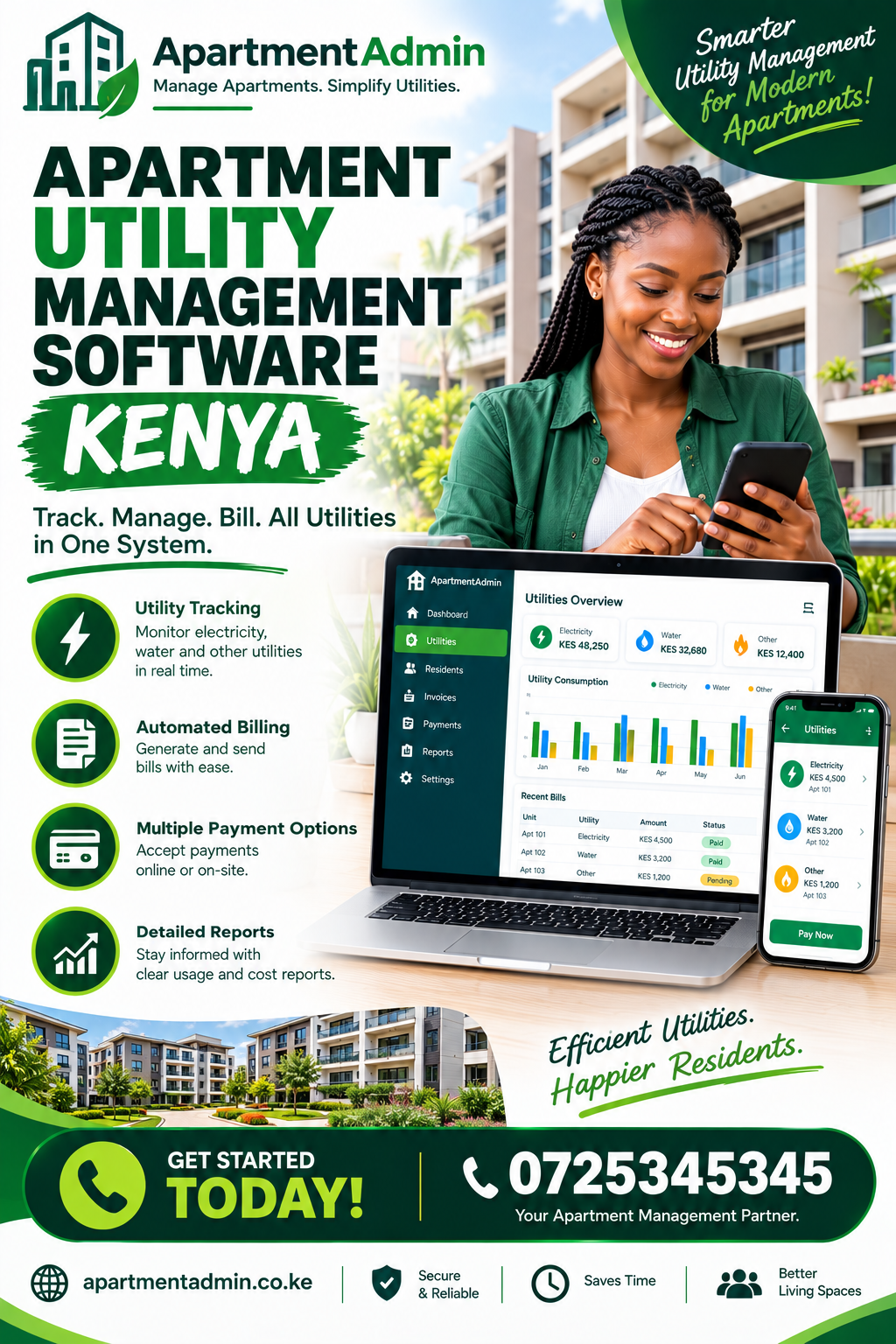
Apartment Utility Management Software Kenya: Smarter Utility Billing and Property Management
Managing utilities in an apartment complex can quickly become one of the most time-consuming responsibilities for a property manager. Water, electricity, garbage collection, common-area services and other shared expenses must be monitored, allocated and billed accurately. For property managers looking for a more reliable approach, Apartment Utility Management Software Kenya provides a practical way to organize utility records, automate calculations and improve billing visibility.
Apartment buildings in Kenya often have multiple tenants, units, meters and service providers. When utility information is kept in notebooks, spreadsheets or disconnected systems, even a small error can create disputes. A wrong meter reading, missed charge or duplicated entry may affect tenant statements and make reconciliation difficult.
This is where digital utility management becomes valuable. Apartment Utility Management Software Kenya can help property managers bring meter readings, consumption records, billing information, payments and reports into a more organized workflow.
This guide explains how utility management works in apartment properties, the challenges property managers face, the features worth looking for, and how software can improve accuracy, accountability and operational efficiency.
What Is Apartment Utility Management Software?
Apartment Utility Management Software Kenya refers to a digital solution designed to help property managers record, calculate, bill and monitor utilities used by residents or shared across an apartment property.
Instead of manually calculating every tenant’s utility charges, the system can provide a structured process for capturing consumption and applying the appropriate billing rules.
Depending on the property, utilities may include:
- Water
- Electricity
- Garbage collection
- Sewerage
- Generator-related costs
- Common-area electricity
- Security-related utilities
- Internet or shared services
- Other recoverable property expenses
A good system should allow the manager to distinguish between individual consumption and shared property expenses. This is important because not every cost should be divided among residents in the same way.
For example, water may be billed according to individual meter readings, while electricity used in corridors, lifts and security areas may be treated as a common-area expense.
With Apartment Utility Management Software Kenya, these different billing scenarios can be organized within a single property management workflow rather than being handled through separate spreadsheets.
Why Utility Management Matters in Kenyan Apartments
Utility billing is directly connected to tenant satisfaction and property finances. Residents expect charges on their statements to be understandable and supported by accurate records.
When billing is inconsistent, property managers may spend hours answering questions such as:
- How was my water bill calculated?
- What meter reading was used?
- Why did my utility charge increase?
- Was my previous payment applied?
- Which period does this invoice cover?
- Why am I being charged for a shared service?
A transparent process makes these questions easier to answer.
Apartment Utility Management Software Kenya can help maintain a history of utility records so that property managers have a clearer audit trail when reviewing tenant accounts.
The importance becomes even greater as the number of units increases. A manager responsible for 20 units may still be able to handle some manual calculations. A property with hundreds of units creates a much larger administrative workload.
Automation therefore becomes less about convenience and more about maintaining consistency.
Common Utility Management Challenges
Manual Meter Reading Records
Many apartment managers still rely on handwritten records or spreadsheets when collecting meter readings.
Manual recording introduces several risks. Numbers can be entered incorrectly, readings can be associated with the wrong unit, or an entire month’s information can be missed.
A digital system can provide structured fields for meter readings and connect those readings to specific units and billing periods.
Complex Utility Calculations
Utility billing is not always a simple multiplication exercise.
A property may use different rates, fixed charges, shared costs, previous balances or other billing rules. Calculating everything manually increases the possibility of mistakes.
Apartment Utility Management Software Kenya can make the calculation process more systematic by keeping relevant information together.
Difficulty Tracking Consumption
Consumption trends can be difficult to identify when historical data is spread across notebooks and spreadsheets.
A digital record allows managers to compare readings over time and identify unusual changes.
For example, if a unit normally consumes a relatively consistent amount of water but suddenly records a major increase, the manager may investigate a possible leak, faulty meter or unusual usage.
Tenant Billing Disputes
Disputes often arise when residents cannot understand how charges were calculated.
A clear billing history gives the property manager evidence to support the amount charged.
Apartment Utility Management Software Kenya can be part of a broader digital approach in which financial and operational information is maintained in organized records.
Delayed Reconciliation
Utility bills from service providers must eventually be reconciled against amounts charged to residents.
When this process is manual, it can take considerable time.
A centralized system makes it easier to compare property expenses with resident charges and identify outstanding amounts.
How Utility Management Software Works
A typical utility management workflow can be broken into several stages.
1. Set Up the Property
The first step is to create the apartment property and register its units.
Each unit can have information such as:
- Unit number
- Resident details
- Owner details
- Occupancy status
- Meter information
- Billing configuration
This creates the foundation for accurate utility allocation.
2. Register Utility Types
The manager identifies the utilities that need to be tracked.
For example, an apartment complex may have water and electricity as individually metered utilities, while garbage collection may be a fixed monthly charge.
Apartment Utility Management Software Kenya can support the broader principle of maintaining organized operational information, although the exact utility configuration should match the property’s actual billing policies.
3. Capture Meter Readings
Meter readings are recorded for the relevant billing period.
The system should make it easy to associate a reading with the correct unit and date.
This creates a historical record that can later be used for billing and reporting.
4. Calculate Consumption
Where applicable, consumption can be calculated by comparing the current reading with the previous reading.
For example:
Current reading − Previous reading = Consumption
If a unit had a previous reading of 1,250 and a current reading of 1,310, the recorded consumption would be 60 units.
The actual amount billed would then depend on the property’s applicable rate and billing rules.
5. Generate Charges
Once consumption has been established, charges can be generated for the relevant resident account.
The utility charge can then form part of the tenant’s overall statement.
Apartment Utility Management Software Kenya illustrates the broader value of structured digital records, but property managers should ensure that the utility module they choose supports their specific billing requirements.
6. Review and Reconcile
Before finalizing bills, the manager can review readings, calculations and charges.
This review stage is important because automation should reduce errors, not remove management oversight.
7. Produce Statements and Reports
Finally, utility information can appear in tenant statements and management reports.
This provides better visibility into both individual consumption and overall property performance.
Key Features to Look For
Not every property requires the same level of functionality, but there are several features that can make a utility management system significantly more useful.
Meter Management
Apartment Utility Management Software Kenya should support organized meter records where applicable.
Managers need to know which meter belongs to which unit and which readings have been captured for each billing period.
A good system should make historical information easy to review.
Automated Billing
Automation can reduce repetitive calculations.
Instead of calculating every resident’s utility charge manually, the system can use configured billing rules to generate charges.
This saves time, especially for large apartment complexes.
Multiple Utility Types
Apartment properties often manage more than one utility.
The software should therefore accommodate different utility categories instead of forcing managers to maintain separate systems.
Tenant Statements
Apartment Utility Management Software Kenya becomes more valuable when utility charges can be connected to resident accounts and statements.
A tenant should be able to see the charges that form part of their balance.
Payment Tracking
Utility billing does not end when an invoice is generated.
Managers also need to know which residents have paid and which accounts remain outstanding.
Payment tracking helps connect billing with collections.
Arrears Management
Unpaid utility charges can accumulate.
A system should make it possible to identify overdue accounts and distinguish current charges from previous balances.
Reporting
Reports can help managers understand utility consumption, billing and collections.
Useful reports may include:
- Utility consumption reports
- Unit-level billing reports
- Outstanding utility balances
- Payment reports
- Monthly comparisons
- Revenue and expense summaries
Audit Trails
A reliable system should preserve important activity records.
An audit trail can help answer questions about when information was entered or changed and who performed an action.
This is particularly useful when investigating billing discrepancies.
M-Pesa and Utility Payments in Kenya
Mobile payments are an important part of property management in Kenya. Many residents are familiar with using M-Pesa for regular payments.
For apartment managers, the challenge is not simply receiving money. The payment must also be associated with the correct resident, unit and account.
Apartment Utility Management Software Kenya can be part of a wider property technology strategy where payment information is integrated into financial workflows.
When payment records are organized correctly, managers can reduce the amount of manual work involved in identifying who has paid.
A useful property system should therefore make it possible to track:
- Payment date
- Amount received
- Resident or account
- Unit
- Payment reference
- Charge allocation
- Outstanding balance
The exact payment integration available will depend on the software provider and configuration.
Utility Billing for Water
Water is one of the most common utilities that apartment managers need to monitor.
Where units have individual meters, the property may calculate consumption based on opening and closing readings.
For example:
| Item | Reading |
|---|---|
| Previous reading | 500 |
| Current reading | 545 |
| Consumption | 45 |
If the property uses a defined rate, the consumption can then be converted into a charge.
Apartment Utility Management Software Kenya can support the broader need for structured business information, while property managers should select utility software according to the actual metering and billing model used at their property.
Digital records also make it easier to investigate unusually high consumption.
A sudden increase may be caused by:
- A leaking pipe
- A faulty meter
- A change in occupancy
- Increased consumption
- Incorrect meter reading
- Other property-related issues
The system itself does not diagnose the cause, but accurate records make investigation easier.
Utility Billing for Electricity
Electricity management can be more complex because some properties have individual meters while others have shared connections.
For individual meters, consumption can potentially be associated directly with the relevant unit.
For common areas, costs may need to be allocated according to the property’s agreed rules.
Apartment Utility Management Software Kenya can be considered within a wider digital ecosystem, but property managers should ensure their chosen solution supports the exact allocation method required by their property.
The key objective is consistency.
If the same rule is applied each month, residents can better understand how charges are calculated.
Managing Shared Utility Costs
Not every utility is tied to one apartment.
A building may have electricity consumption from:
- Security lighting
- Corridors
- Parking areas
- Lifts
- Water pumps
- Reception areas
- Other common facilities
These costs may need to be allocated across units.
Apartment Utility Management Software Kenya highlights the broader value of organized digital workflows, although the allocation rules for an apartment property should always reflect its management agreements and operating policies.
Software can help managers apply consistent allocation rules and maintain records of how shared charges were distributed.
Connecting Utility Billing With Property Management
Utility management works best when it is not treated as a completely separate process.
The utility information should connect with other property records.
For example, a resident account may contain:
- Rent
- Service charges
- Water
- Electricity
- Other approved charges
- Payments
- Credits
- Arrears
This creates a more complete financial picture.
Apartment Utility Management Software Kenya is one example of how specialized software can organize business processes, while an apartment-focused platform should connect utility information directly to units and resident accounts.
When records are connected, property managers spend less time transferring information between systems.
Improving Tenant Transparency
Residents are more likely to accept charges when they can understand them.
Transparency does not necessarily require giving residents access to every internal management record. It means providing clear information about what they have been charged and why.
A well-organized statement may show:
- Billing period
- Utility type
- Previous reading
- Current reading
- Consumption
- Rate or charge
- Amount due
Apartment Utility Management Software Kenya can contribute to a broader digital management environment, while property managers should focus on ensuring their actual utility solution produces clear, understandable billing information.
Clear statements can reduce unnecessary back-and-forth communication.
Benefits for Property Managers
One of the biggest advantages of digital utility management is reduced administrative work.
Saves Time
Manual calculations can take hours each billing cycle.
Automation allows managers to spend more time on higher-value responsibilities such as maintenance, tenant communication and property oversight.
Reduces Data Entry Errors
Structured records reduce the risk of entering information into the wrong spreadsheet or applying the wrong formula.
Improves Visibility
Managers can quickly see utility charges, balances and historical records.
Supports Better Decision-Making
Historical data can reveal trends that are difficult to identify from handwritten records.
Strengthens Accountability
A digital record creates a clearer history of billing activity.
Apartment Utility Management Software Kenya can fit into the wider movement toward digital business management, while property-specific utility tools provide the functionality needed for apartment operations.
Benefits for Property Owners
Owners need visibility into how their property is performing.
Utility management software can provide better information about:
- Consumption
- Utility expenses
- Recoveries
- Outstanding balances
- Collection performance
- Trends over time
Apartment Utility Management Software Kenya gives property stakeholders a way to think about utility management as an organized business process rather than an isolated administrative task.
Better information can help owners and managers identify areas where operating costs need closer attention.
Benefits for Residents
Residents benefit from more accurate and transparent billing.
They can receive clearer statements and have fewer reasons to question unexplained charges.
A digital approach can also make it easier for residents to confirm their balances and payment history.
Apartment Utility Management Software Kenya supports the broader concept of digital service management, while apartment managers should choose a system that provides resident-facing information appropriate to their property.
Utility Management and Arrears
Utility charges can contribute to outstanding balances when residents do not pay on time.
A manager needs to distinguish between:
- Current utility charges
- Previous utility balances
- Other property charges
- Payments received
- Remaining arrears
Without proper records, it can be difficult to establish exactly what remains unpaid.
Apartment Utility Management Software Kenya can be considered alongside other digital solutions, but property-specific software should provide a clear connection between utility charges and resident balances.
This helps management teams follow up on outstanding accounts more effectively.
Utility Reconciliation
Reconciliation is one of the most important parts of utility management.
Suppose a property receives a water bill from a supplier. The manager needs to compare the supplier’s charge with the amount allocated to residents and any costs that the property itself is responsible for.
A reconciliation process can help identify:
- Missing charges
- Incorrect readings
- Unusual consumption
- Unallocated costs
- Payment differences
- Data entry mistakes
Apartment Utility Management Software Kenya can be viewed as part of a wider digital approach to business operations, but apartment utility reconciliation should be based on the property’s actual supplier bills and allocation policies.
Reports Every Apartment Manager Should Consider
Reports turn raw utility records into useful management information.
Some useful reports include a monthly utility summary showing total consumption and charges.
A unit-level report can show individual consumption.
An outstanding balance report can identify residents with unpaid utility charges.
A variance report can highlight significant differences between billing periods.
Apartment Utility Management Software Kenya can support the broader need for organized rental operations, while an integrated apartment management platform should make utility reporting part of the property workflow.
Useful Utility Report Examples
| Report | Purpose |
|---|---|
| Consumption Report | Reviews usage by unit |
| Billing Report | Shows utility charges |
| Arrears Report | Identifies unpaid balances |
| Payment Report | Tracks received payments |
| Reconciliation Report | Compares charges and expenses |
| Variance Report | Highlights unusual changes |
Using Historical Data to Identify Problems
Historical utility information is more valuable when it can be compared over time.
Imagine a property where most units have stable water consumption. If several units suddenly show unusually high usage in the same month, management can investigate whether there is a wider issue.
Similarly, if common-area electricity costs increase significantly, the manager can review what changed during that period.
Apartment Utility Management Software Kenya can be considered within a broader technology strategy, but the key principle is that property data should be stored consistently enough to support useful comparisons.
Choosing the Right Utility Management System
Choosing software requires more than looking at a list of features.
Property managers should first understand their own workflow.
Ask questions such as:
- How many units does the property have?
- Which utilities are individually metered?
- Which costs are shared?
- How are residents billed?
- How are payments recorded?
- How are arrears followed up?
- Which reports are required?
- Who needs access to the system?
- How often are meter readings collected?
Once these questions are answered, it becomes easier to identify the right system.
Apartment Utility Management Software Kenya is part of the wider ecosystem of Kenyan digital solutions, but property managers should assess any platform against their actual apartment utility workflow.
Questions to Ask a Software Provider
Before committing to a platform, ask the provider to demonstrate how the system handles a real billing scenario.
For example, provide a sample apartment with several units and ask the provider to demonstrate:
- Creating the units
- Adding resident information
- Recording meters
- Entering previous readings
- Entering current readings
- Calculating consumption
- Applying rates
- Generating charges
- Recording payments
- Producing statements
- Viewing arrears
- Generating reports
A practical demonstration is more useful than a feature list alone.
Apartment Utility Management Software Kenya should be evaluated according to how effectively the actual workflow is handled, not simply how many features appear on a marketing page.
Security and Access Control
Utility information forms part of a property’s financial records, so access should be controlled.
Different users may have different responsibilities.
For example:
- Property administrators may manage the full system.
- Finance staff may handle billing and payments.
- Utility staff may enter meter readings.
- Managers may review reports.
- Residents may only access their own information.
Apartment Utility Management Software Kenya should ideally form part of a controlled system where users receive access appropriate to their responsibilities.
Strong access controls reduce the risk of unauthorized changes.
The Importance of an Audit Trail
An audit trail can help property managers understand what happened when information changes.
For utility billing, this can be especially useful when a resident challenges a charge.
Management may need to review:
- Original meter reading
- Updated reading
- Billing date
- User who entered the information
- Changes made
- Payment history
Apartment Utility Management Software Kenya can be considered in the context of broader property management processes, but audit functionality should be evaluated directly during a software demonstration.
Mobile-Friendly Utility Management
Property managers and utility staff are not always sitting behind a desk.
Meter readings may need to be collected around an apartment complex, sometimes across several buildings.
A mobile-friendly system can make it easier to capture information close to the meter rather than writing it down and entering it later.
Apartment Utility Management Software Kenya can provide a more connected approach when utility information forms part of a broader property management system.
The less information that needs to be transferred manually, the fewer opportunities there are for transcription mistakes.
Automating Recurring Processes
Utility billing is repetitive.
The same basic process happens every billing period:
- Collect readings
- Calculate consumption
- Apply charges
- Generate invoices
- Receive payments
- Reconcile accounts
- Review arrears
- Produce reports
Automation can reduce the amount of repetitive administrative work.
Apartment Utility Management Software Kenya illustrates the wider potential of digital workflow management, while apartment managers should focus on software that automates the specific property processes they perform regularly.
Common Mistakes to Avoid
Choosing Software Without Testing the Workflow
A platform may look impressive but still fail to match your billing process.
Always test it using realistic scenarios.
Ignoring Integration
If utility billing is disconnected from tenant accounts and payments, staff may still need to perform significant manual work.
Overlooking Reporting
Reports are essential for management and reconciliation.
Failing to Define Billing Rules
Software cannot compensate for unclear policies.
The property management team should know how each utility is billed before configuring the system.
Giving Too Many Users Full Access
User permissions should reflect responsibilities.
Apartment Utility Management Software Kenya can be considered alongside other digital solutions, but whatever system is selected should be configured around clear processes and controlled access.
Preparing an Apartment for Digital Utility Management
Before implementation, clean existing data.
Start by reviewing:
- Unit lists
- Resident records
- Meter numbers
- Previous readings
- Current readings
- Utility rates
- Supplier bills
- Outstanding balances
Remove duplicate or outdated information where appropriate.
Then establish a standard process for future readings.
Apartment Utility Management Software Kenya can form part of the broader discussion around digitizing business records, but the implementation should be tailored to the apartment’s actual operational requirements.
Training the Property Management Team
Even good software will produce poor results if users do not understand the workflow.
Training should cover:
- Adding and updating records
- Entering meter readings
- Reviewing calculations
- Generating charges
- Recording payments
- Producing reports
- Handling corrections
- Managing user access
Staff should also understand which actions require authorization.
Apartment Utility Management Software Kenya can be evaluated as part of a wider digital ecosystem, but user training remains an important part of successful software implementation.
How Utility Software Supports Growth
A property manager who oversees one apartment today may manage several properties in the future.
Manual processes become increasingly difficult as the portfolio grows.
A centralized platform can provide a more scalable structure for handling multiple properties, units and resident accounts.
Apartment Utility Management Software Kenya becomes particularly relevant when management teams want to reduce dependence on scattered spreadsheets and manual calculations.
The objective is not simply to process more data. It is to maintain consistent processes as the portfolio expands.
Apartment Utility Management for Nairobi Properties
Nairobi has a large and diverse apartment market, ranging from small residential blocks to large developments with extensive shared facilities.
Different properties will have different utility arrangements.
A small building may have a straightforward water billing model. A larger development may have multiple meters, pumps, common areas and shared infrastructure.
Apartment Utility Management Software Kenya can be part of a broader digital strategy, but Nairobi property managers should select configurations that reflect the physical design and operating model of their buildings.
Why Accurate Data Matters
The quality of a utility system depends heavily on the quality of its data.
If a meter number is incorrect, the wrong reading may be associated with a unit.
If a reading is entered incorrectly, the calculated consumption may also be incorrect.
If a payment is allocated incorrectly, the resident’s balance may not reflect the actual amount owed.
Apartment Utility Management Software Kenya is most useful when supported by accurate and consistently maintained property records.
Technology should therefore be combined with clear operating procedures.
Cost Considerations
The cost of utility management software varies depending on the provider, features, property size and implementation requirements.
Instead of looking only at the subscription price, property managers should consider the total operational value.
Ask:
- How much staff time will be saved?
- How many billing errors can be reduced?
- Will reconciliation become easier?
- Can the system support additional properties?
- Are reports included?
- Is training available?
- What support is provided?
- Can the system integrate with existing workflows?
Apartment Utility Management Software Kenya should be assessed within this broader value discussion rather than on price alone.
A cheaper system may become expensive if it requires substantial manual work.
When Should an Apartment Switch From Spreadsheets?
Spreadsheets can be useful for simple operations, but there comes a point where they become difficult to manage.
Warning signs include:
- Increasing billing errors
- Multiple versions of the same spreadsheet
- Difficulty finding historical records
- Delayed monthly billing
- Frequent tenant disputes
- Manual payment reconciliation
- Limited reporting
- Too many people editing the same files
When these problems appear regularly, a dedicated system may be worth considering.
Apartment Utility Management Software Kenya can be part of the wider conversation around digital tools, while property managers should focus on whether a dedicated apartment solution addresses their specific operational challenges.
Frequently Asked Questions
What does utility management software do?
Apartment Utility Management Software Kenya can help property managers organize meter readings, consumption records, utility charges, payments and reports. The exact features vary by platform.
Can apartment software manage water billing?
Yes. A suitable property management system can support water billing where the property’s billing method and meter configuration are supported. Managers should confirm the exact calculation rules during a demonstration.
Can utility charges appear on tenant statements?
Apartment Utility Management Software Kenya can connect utility charges with resident accounts when the platform supports integrated tenant billing and statements.
Can the system track utility arrears?
Yes, where utility charges are connected to resident accounts. This allows managers to distinguish outstanding utility amounts from other balances.
Is M-Pesa important for apartment utility payments in Kenya?
M-Pesa is a widely used payment method in Kenya, so property managers may benefit from software that supports an appropriate payment workflow or integration. The exact integration should be confirmed with the provider.
Can utility software handle multiple apartment buildings?
Apartment Utility Management Software Kenya may be suitable for multi-property environments depending on the platform’s architecture and features. Always confirm how properties, units and user permissions are separated.
How can software reduce utility billing disputes?
Clear records, consistent calculations and detailed statements can make charges easier to explain. Historical meter readings are particularly useful when residents question consumption.
Does utility software replace property managers?
No. Software supports property managers by reducing repetitive administrative work. Human oversight is still needed for decisions, exceptions, maintenance issues and resident communication.
What should I check before buying utility management software?
Apartment Utility Management Software Kenya should be assessed based on its ability to handle your actual workflow, including meter readings, billing, payments, statements, arrears, reporting, permissions and reconciliation.
Is dedicated apartment utility software better than spreadsheets?
For properties with many units or complex billing requirements, dedicated software can provide stronger automation, centralized records and reporting than manually maintained spreadsheets. The right choice depends on the property’s size and operational needs.
A Practical Utility Management Workflow
For an apartment property, a simple standardized workflow can look like this:
Step 1: Capture readings
Record the relevant meter readings for each unit.
Step 2: Validate readings
Check unusual values and confirm that readings are associated with the correct units.
Step 3: Calculate consumption
Compare current and previous readings according to the property’s rules.
Step 4: Generate charges
Apply the appropriate utility rates or allocation rules.
Step 5: Review bills
Check unusual charges before finalizing invoices.
Step 6: Send statements
Provide residents with clear information about their balances.
Step 7: Record payments
Match incoming payments with the appropriate accounts.
Step 8: Reconcile
Compare collected amounts and property utility expenses.
Step 9: Follow up on arrears
Identify overdue accounts and follow the property’s collection procedures.
Step 10: Review reports
Use historical data to identify trends and operational issues.
Apartment Utility Management Software Kenya can support the wider idea of structured digital processes, but apartment managers should configure their actual system around the property’s approved workflow.
The Future of Apartment Utility Management
Property management is increasingly moving toward connected digital systems.
Rather than maintaining separate records for residents, billing, payments, utilities and reports, property managers can benefit from systems that connect these processes.
Apartment Utility Management Software Kenya reflects the growing need for property teams to manage operational information in a more coordinated way.
Future improvements may include better mobile workflows, more detailed reporting, automated notifications, stronger integrations and improved data analysis.
The core requirement, however, remains simple: accurate information that property managers can trust.
Why Estate Managers Should Prioritize Utility Automation
Utility billing may appear to be a small part of property management, but it has a direct impact on finances, resident relationships and administrative workload.
A property manager who spends hours every month manually calculating consumption and reconciling charges has less time for maintenance, inspections, tenant communication and strategic property management.
Apartment Utility Management Software Kenya provides another way to view the problem: repetitive administrative processes are strong candidates for structured digital workflows.
Automation can make the process more consistent while giving management better visibility into what is happening across the property.
Final Thoughts
Managing apartment utilities accurately requires more than collecting meter readings. Property managers need a complete process that connects consumption, billing, payments, arrears, statements and reporting.
Apartment Utility Management Software Kenya can help property teams approach utility management as part of a broader digital property management process rather than a standalone spreadsheet exercise.
For Kenyan apartment managers, the right solution should fit the property’s actual billing model. It should make meter records easier to maintain, reduce repetitive calculations, improve payment tracking and provide useful reports.
The best approach is to test the system with realistic property data before implementation. Use several units, different consumption levels, sample payments and actual billing scenarios. This will reveal whether the software genuinely simplifies the work.
Apartment Utility Management Software Kenya is ultimately about improving control over one of the recurring operational processes in residential property management.
If your apartment management team is still relying heavily on spreadsheets, handwritten meter records and manual calculations, it may be time to evaluate a more structured solution. A properly configured digital system can help reduce administrative pressure, improve billing transparency and give property managers stronger visibility over utility-related finances.
For apartment owners and managers seeking a centralized property management approach, Apartment Utility Management Software Kenya should be evaluated alongside the wider requirements of tenant management, billing, payments, service charges, arrears, reporting and property operations.
The goal is not simply to automate a calculation. It is to build a reliable utility management process that works consistently from the meter reading all the way to the final payment and reconciliation.
Apartment Utility Management Software Kenya can therefore be considered as part of a broader digital property management strategy focused on accuracy, transparency and efficiency.
Apartment Utility Management Software Kenya is especially relevant for property teams looking to reduce repetitive manual work and improve the way utility information moves through their organization.
Apartment Utility Management Software Kenya can also be assessed according to how well it connects utility information with the wider property management workflow.
Apartment Utility Management Software Kenya remains a natural starting point for property managers interested in a more centralized approach to apartment administration.
Apartment Utility Management Software Kenya can be part of the wider digital ecosystem, while the property manager should focus on selecting software suited specifically to residential property operations.
Apartment Utility Management Software Kenya highlights the broader availability of digital business solutions that can help organizations replace fragmented manual processes.
Apartment Utility Management Software Kenya can similarly be viewed within a growing environment of specialized digital platforms.
Apartment Utility Management Software Kenya supports the broader idea that well-structured digital systems can make recurring operational work easier to manage.
Apartment Utility Management Software Kenya can be considered alongside other platforms when evaluating how to improve digital administration.
Apartment Utility Management Software Kenya provides another destination within the wider digital solutions ecosystem.
Apartment Utility Management Software Kenya can be included in broader technology evaluations, while property managers should always prioritize their actual operational requirements.
Apartment Utility Management Software Kenya offers another link within the required digital ecosystem for readers exploring technology solutions.
Apartment Utility Management Software Kenya can likewise be considered separately from the specific property management requirements discussed in this guide.
Apartment Utility Management Software Kenya provides another digital resource as property managers consider ways to organize business processes.
Apartment Utility Management Software Kenya is another platform that readers may explore when considering digital management solutions.
Apartment Utility Management Software Kenya can also be reviewed as part of a wider technology ecosystem.
Apartment Utility Management Software Kenya provides another destination for readers interested in digital business solutions.
Apartment Utility Management Software Kenya can be considered alongside other digital tools depending on the organization’s requirements.
Apartment Utility Management Software Kenya is another resource within the broader digital solutions landscape.
Apartment Utility Management Software Kenya can be explored as part of wider software research.
Apartment Utility Management Software Kenya provides another relevant digital property-management destination.
Apartment Utility Management Software Kenya can be reviewed alongside other solutions when assessing digital workflows.
Apartment Utility Management Software Kenya completes this section of the technology ecosystem and reinforces the importance of selecting tools based on actual business requirements.