
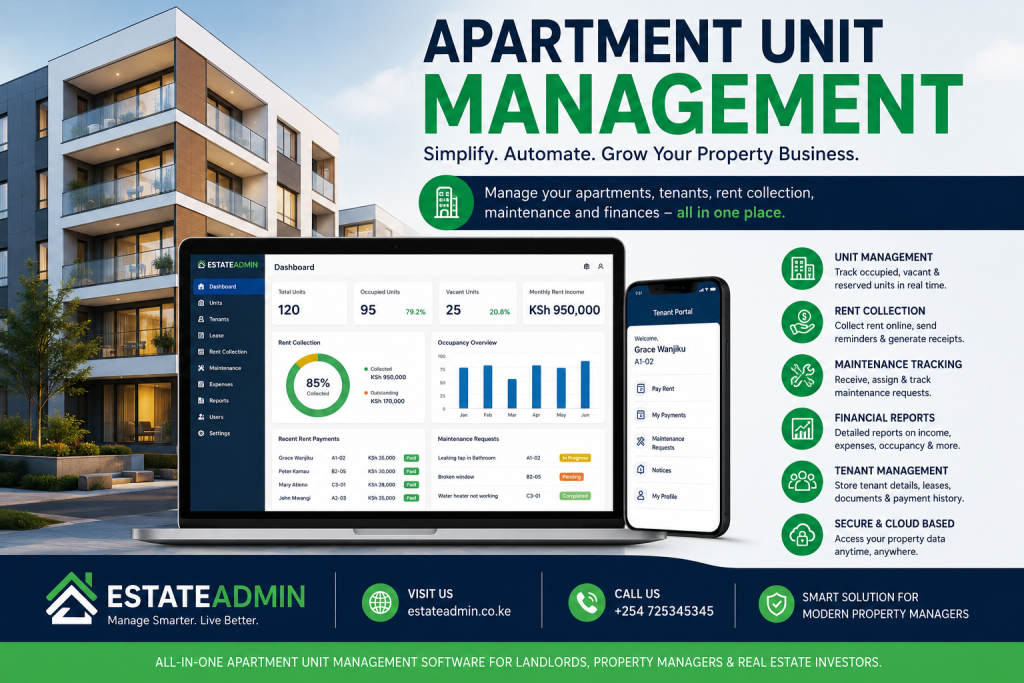
Managing apartments has become increasingly complex as landlords, property managers, and real estate investors strive to provide better services while maximizing profitability. Apartment unit management is no longer just about collecting rent; it involves tenant management, maintenance tracking, financial reporting, communication, security, and compliance. With the right apartment unit management software, property owners can automate repetitive tasks, reduce operational costs, and improve tenant satisfaction.
Whether you manage a single apartment block or hundreds of rental units across multiple locations, investing in an effective apartment unit management system can transform your business. EstateAdmin offers a comprehensive solution designed specifically for landlords, property managers, and gated communities across Kenya.
If you’re searching for the best apartment unit management solution, this comprehensive guide explains everything you need to know.
What is Apartment Unit Management?
Apartment unit management refers to the systematic administration of residential rental units within an apartment building or residential complex. It includes managing tenants, monitoring occupancy, collecting rent, maintaining properties, handling maintenance requests, tracking finances, and ensuring smooth communication between landlords, caretakers, and residents.
Modern apartment unit management software digitizes these processes, making property administration faster, more transparent, and highly efficient.
Instead of relying on spreadsheets, notebooks, or manual records, property managers can access all apartment information from one centralized platform.
Why Apartment Unit Management Matters
Without proper apartment management, landlords often experience:
- Late rent payments
- Missing financial records
- Poor tenant communication
- High vacancy rates
- Maintenance delays
- Security challenges
- Revenue leakage
- Administrative errors
A professional apartment unit management system eliminates these challenges by streamlining every aspect of property operations.
Key Components of Apartment Unit Management
Effective apartment unit management consists of several important functions.
1. Tenant Management
Managing tenant information manually becomes difficult as your property portfolio grows.
A quality apartment unit management platform stores:
- Tenant profiles
- National ID details
- Lease agreements
- Emergency contacts
- Occupancy status
- Move-in dates
- Move-out dates
- Payment history
Everything remains organized and easily searchable.
2. Apartment Unit Allocation
One of the biggest challenges for landlords is knowing which units are:
- Vacant
- Occupied
- Reserved
- Under maintenance
An apartment unit management system displays occupancy status in real time, helping managers quickly assign available units to new tenants.
3. Lease Management
Lease agreements are the backbone of successful apartment operations.
Apartment unit management software helps:
- Store lease documents
- Monitor lease expiry dates
- Generate renewal reminders
- Track deposits
- Record rent escalation
This prevents expired leases from going unnoticed.
4. Rent Collection
Manual rent collection consumes time and increases accounting errors.
Modern apartment unit management software automates:
- Rent invoicing
- Payment reminders
- Digital receipts
- Outstanding balances
- Arrears tracking
Tenants receive timely reminders while landlords enjoy predictable cash flow.
5. Financial Reporting
Every property owner needs accurate financial information.
An apartment unit management platform generates reports including:
- Monthly income
- Expenses
- Profit analysis
- Rent collection summaries
- Outstanding balances
- Maintenance costs
- Occupancy reports
These insights support informed business decisions.
Benefits of Apartment Unit Management Software
Implementing apartment unit management software offers numerous advantages.
Improved Operational Efficiency
Automation reduces paperwork and repetitive administrative work.
Instead of spending hours updating records manually, managers can perform tasks within minutes.
Better Tenant Experience
Tenants appreciate:
- Faster communication
- Online rent payments
- Quick maintenance responses
- Automated receipts
- Timely notifications
Satisfied tenants stay longer and recommend your apartments to others.
Accurate Financial Records
Manual bookkeeping often results in mistakes.
Apartment unit management software ensures:
- Accurate accounting
- Automated calculations
- Audit trails
- Secure financial records
This reduces accounting discrepancies significantly.
Reduced Rent Arrears
Late payments affect cash flow.
Apartment unit management software automatically sends reminders before rent due dates and follows up on overdue payments, encouraging timely collections.
Centralized Property Information
Everything is stored in one secure location:
- Tenant records
- Unit details
- Payment history
- Maintenance logs
- Financial reports
- Contracts
No more searching through filing cabinets or multiple spreadsheets.
Features Every Apartment Unit Management System Should Have
Choosing the right software is essential.
Look for these features.
Tenant Database
Maintain complete tenant information with:
- Personal details
- Lease records
- Payment history
- Occupancy status
- Contact information
Online Rent Payment Integration
Digital payment options improve convenience.
Support for:
- Mobile money
- Bank transfers
- Online payment gateways
helps tenants pay on time.
Maintenance Management
Maintenance requests should be tracked from submission to completion.
Managers can:
- Assign technicians
- Monitor repair progress
- Record maintenance costs
- Track recurring issues
Automated Notifications
The software should automatically notify tenants regarding:
- Rent due dates
- Lease renewals
- Maintenance schedules
- Community announcements
Expense Tracking
Successful apartment businesses monitor every expense.
Track:
- Repairs
- Utilities
- Salaries
- Cleaning
- Security
- Landscaping
to understand property profitability.
Vacancy Management
Apartment unit management software should instantly show:
- Vacant units
- Occupied units
- Reserved units
- Upcoming vacancies
This helps minimize vacancy periods.
Occupancy Analytics
Knowing occupancy rates helps evaluate property performance.
Reports include:
- Occupancy percentage
- Tenant turnover
- Average vacancy duration
- Rental trends
Challenges of Manual Apartment Unit Management
Many landlords still rely on notebooks and spreadsheets.
Unfortunately, manual systems create problems such as:
Lost Records
Paper documents can be misplaced or damaged.
Human Errors
Manual calculations often lead to accounting mistakes.
Delayed Communication
Important tenant notices may never reach residents promptly.
Slow Reporting
Generating monthly reports manually takes significant time.
Poor Maintenance Tracking
Maintenance requests may be forgotten without proper tracking.
Apartment unit management software addresses all these challenges efficiently.
Apartment Unit Management for Different Property Sizes
Small Apartment Buildings
Owners managing fewer than 20 units benefit from:
- Simple rent collection
- Tenant records
- Expense management
- Maintenance tracking
Medium Apartment Complexes
Buildings with 20–100 units require:
- Automated reporting
- Lease management
- Digital communication
- Vacancy monitoring
- Multi-user access
Large Residential Estates
Large developments demand advanced apartment unit management capabilities including:
- Multiple property management
- Caretaker accounts
- Financial dashboards
- Security management
- Maintenance scheduling
- Comprehensive analytics
EstateAdmin is built to handle all these requirements from a single platform.
How Apartment Unit Management Improves Cash Flow
Cash flow is the lifeblood of every rental property business.
Apartment unit management software contributes by:
- Sending automated payment reminders
- Reducing overdue rent
- Recording payments instantly
- Monitoring arrears
- Tracking expenses
- Producing financial reports
Better financial visibility allows landlords to make strategic investment decisions.
Apartment Unit Management and Tenant Retention
Finding new tenants is expensive.
Keeping existing tenants satisfied is far more cost-effective.
A professional apartment unit management system supports tenant retention through:
- Faster maintenance response
- Transparent billing
- Easy communication
- Online payment convenience
- Organized record keeping
- Timely lease renewal reminders
Happy tenants are more likely to renew leases, reducing vacancy rates and marketing costs.
Why Kenyan Property Owners Need Apartment Unit Management Software
Kenya’s real estate market continues to expand rapidly, especially in urban centers where apartment living is increasingly popular. As portfolios grow, landlords need tools that simplify operations while maintaining transparency and accountability.
EstateAdmin provides an all-in-one apartment unit management solution tailored for Kenyan property owners. Whether you manage a few rental units or a large residential estate, the platform helps automate rent collection, streamline maintenance, organize tenant records, and generate insightful financial reports.
For a demonstration or to learn how EstateAdmin can simplify your apartment operations, visit estateadmin.co.ke or contact +254 725345345.
Apartment Unit Management Best Practices for Long-Term Success
Managing an apartment building successfully requires more than collecting rent each month. Professional apartment unit management focuses on creating efficient systems that improve tenant satisfaction, maximize occupancy, reduce operational costs, and increase the overall value of the property. By adopting modern apartment unit management software, landlords and property managers can streamline daily operations while maintaining complete visibility into every unit and every financial transaction.
As apartment portfolios grow, manual methods become increasingly difficult to manage. Digital tools eliminate repetitive work, improve communication, and provide valuable business insights.
How Apartment Unit Management Software Improves Property Maintenance
Maintenance is one of the most critical aspects of apartment unit management. Delayed repairs often result in dissatisfied tenants, expensive emergency repairs, and declining property value.
A professional apartment unit management system simplifies maintenance by allowing tenants to submit repair requests online. Property managers can assign technicians, monitor repair progress, approve maintenance costs, and record completed work within a centralized platform.
Benefits include:
- Faster repair response times
- Better contractor coordination
- Reduced maintenance costs
- Improved tenant satisfaction
- Complete maintenance history
- Preventive maintenance scheduling
- Better budgeting for repairs
Property owners also gain access to maintenance reports that help identify recurring issues before they become major expenses.
Preventive Maintenance in Apartment Unit Management
Successful landlords don’t wait until something breaks.
Preventive maintenance is an essential component of effective apartment unit management.
Routine inspections should include:
- Plumbing systems
- Electrical wiring
- Roofing
- Water tanks
- Elevators
- Fire safety equipment
- Parking areas
- Security lighting
- Drainage systems
- Common areas
Apartment unit management software can schedule recurring inspections and automatically notify maintenance teams when inspections are due.
This proactive approach significantly reduces emergency repair costs.
Apartment Unit Management and Digital Rent Collection
Collecting rent manually creates unnecessary delays.
Modern apartment unit management software allows tenants to pay using secure digital payment methods, reducing paperwork and improving convenience.
Digital rent collection provides several advantages:
- Instant payment confirmations
- Automatic receipt generation
- Reduced cash handling
- Faster reconciliation
- Improved financial transparency
- Better tenant experience
- Reduced rent arrears
Landlords can also monitor unpaid balances in real time and follow up before arrears become significant.
Apartment Unit Management and Financial Accountability
Financial transparency is one of the biggest benefits of professional apartment management.
An advanced apartment unit management platform records every transaction including:
- Rent payments
- Deposits
- Utility charges
- Service charges
- Maintenance expenses
- Contractor payments
- Staff salaries
- Operational costs
Automated reporting ensures landlords always understand the financial performance of each apartment unit.
Instead of manually preparing monthly reports, managers generate them within seconds.
Apartment Unit Management for Multiple Properties
Many investors own apartments in different locations.
Managing several buildings manually quickly becomes overwhelming.
Apartment unit management software enables centralized management by allowing landlords to:
- View all properties from one dashboard
- Compare occupancy rates
- Monitor income across multiple apartments
- Manage different caretakers
- Track maintenance by property
- Generate property-specific financial reports
This centralized approach saves time while improving operational control.
Apartment Unit Management and Occupancy Monitoring
Vacant apartments reduce profitability.
A professional apartment unit management system provides real-time occupancy monitoring by showing:
- Vacant units
- Occupied apartments
- Reserved apartments
- Units under maintenance
- Upcoming lease expirations
Managers can quickly advertise available units and reduce vacancy periods.
Higher occupancy translates directly into increased rental income.
Apartment Unit Management for Property Owners
Many landlords employ property managers but still want visibility into their investments.
Apartment unit management software gives owners secure access to:
- Rental income
- Occupancy reports
- Financial statements
- Maintenance expenses
- Outstanding balances
- Tenant information
- Profitability reports
Owners remain informed without interfering with daily operations.
Apartment Unit Management and Tenant Communication
Communication greatly influences tenant satisfaction.
Apartment unit management software provides efficient communication channels for:
- Rent reminders
- Community announcements
- Water interruption notices
- Security updates
- Maintenance schedules
- Emergency alerts
- Lease renewal notifications
Improved communication reduces misunderstandings while strengthening landlord-tenant relationships.
Apartment Unit Management and Security
Residential security remains a major concern for apartment owners.
An integrated apartment unit management system improves security by maintaining:
- Visitor records
- Resident directories
- Vehicle registrations
- Access control records
- Incident reports
- Emergency contacts
Managers can easily retrieve resident information whenever necessary.
This contributes to safer apartment communities.
Apartment Unit Management and Utility Billing
Utility billing often becomes complicated when handled manually.
Apartment unit management software simplifies billing by tracking:
- Water usage
- Electricity
- Garbage collection
- Parking fees
- Internet charges
- Service charges
Invoices are generated automatically, reducing billing disputes.
Apartment Unit Management and Lease Renewals
Expired leases can create legal and financial complications.
Apartment unit management software automatically tracks:
- Lease start dates
- Lease expiry dates
- Renewal reminders
- Security deposits
- Rent revisions
Managers receive alerts well before lease expiration, allowing timely renewal discussions.
Apartment Unit Management and Data Security
Property records contain sensitive tenant and financial information.
Professional apartment unit management systems provide:
- Secure cloud storage
- User permissions
- Data backups
- Audit logs
- Encrypted connections
- Controlled access
This minimizes the risk of data loss and unauthorized access.
Reports Every Apartment Unit Management System Should Generate
Comprehensive reporting helps property owners make informed business decisions.
Essential reports include:
Occupancy Reports
Monitor vacant and occupied units.
Rent Collection Reports
Track paid and outstanding rent.
Financial Reports
Analyze income and expenditure.
Maintenance Reports
Review completed and pending repairs.
Expense Reports
Understand operational costs.
Tenant Reports
Access tenant profiles and lease details.
Vacancy Reports
Monitor available rental units.
Profitability Reports
Measure property performance over time.
These reports enable better planning and budgeting.
Apartment Unit Management for Growing Property Portfolios
As landlords acquire more apartments, management complexity increases.
Apartment unit management software scales effortlessly by supporting:
- Unlimited apartment units
- Multiple buildings
- Multiple property managers
- Centralized reporting
- Automated workflows
- Cloud accessibility
Whether managing 10 apartments or 1,000 units, the software grows with your business.
Common Apartment Unit Management Mistakes
Many landlords unknowingly reduce profitability through avoidable mistakes.
These include:
Ignoring Maintenance
Small repairs eventually become expensive.
Manual Rent Tracking
Manual systems increase accounting errors.
Poor Record Keeping
Lost documents create operational challenges.
Delayed Communication
Tenants become frustrated when updates are slow.
Inadequate Financial Reporting
Without reports, property performance remains unclear.
Weak Tenant Screening
Poor tenant selection often leads to payment problems.
Apartment unit management software minimizes these risks by organizing every aspect of property operations.
How EstateAdmin Simplifies Apartment Unit Management
EstateAdmin is designed specifically to meet the needs of modern landlords, estate managers, and property management companies.
The platform provides a complete apartment unit management solution that includes:
- Tenant management
- Apartment unit allocation
- Online rent collection
- Maintenance tracking
- Financial management
- Expense recording
- Lease management
- Occupancy monitoring
- Reporting dashboards
- Automated notifications
- Multi-property management
- Cloud-based accessibility
- User role management
- Secure data storage
Whether you own one apartment building or manage multiple residential developments, EstateAdmin helps streamline every aspect of your operations.
Why EstateAdmin is the Best Apartment Unit Management Software
Choosing the right apartment unit management platform is essential for long-term success.
EstateAdmin stands out because it offers:
- Easy-to-use interface
- Fast implementation
- Reliable cloud access
- Comprehensive reporting
- Secure data management
- Automated rent collection
- Efficient maintenance management
- Scalable architecture
- Affordable pricing
- Dedicated customer support
With EstateAdmin, landlords spend less time on administration and more time growing their investments.
Frequently Asked Questions About Apartment Unit Management
What is apartment unit management?
Apartment unit management involves overseeing all activities related to apartment rentals, including tenant management, rent collection, maintenance, financial reporting, lease administration, and occupancy monitoring.
Why is apartment unit management software important?
Apartment unit management software automates repetitive tasks, improves financial accuracy, enhances tenant communication, reduces operational costs, and increases overall property efficiency.
Can apartment unit management software manage multiple buildings?
Yes. EstateAdmin allows landlords and property managers to manage multiple apartment buildings from one centralized dashboard.
Does apartment unit management software help reduce rent arrears?
Absolutely. Automated reminders, online payment options, instant receipts, and payment tracking significantly improve rent collection.
Is apartment unit management software suitable for small landlords?
Yes. Whether you manage five apartments or hundreds of units, apartment unit management software simplifies operations and supports business growth.
Can tenants submit maintenance requests online?
Yes. EstateAdmin allows tenants to submit maintenance requests digitally, while managers can assign technicians and monitor repair progress.
Is apartment unit management software secure?
Professional systems use secure cloud infrastructure, encrypted connections, user permissions, and automated backups to protect tenant and financial information.
Future Trends in Apartment Unit Management
Technology continues to reshape the property management industry. The future of apartment unit management will increasingly rely on automation, artificial intelligence, mobile applications, and data-driven decision-making. Property owners who embrace digital transformation will enjoy greater efficiency, improved tenant retention, and stronger financial performance.
Emerging trends include:
- AI-powered rent payment predictions
- Smart building integrations
- IoT-enabled maintenance monitoring
- Mobile-first tenant portals
- Digital lease signing
- Automated financial forecasting
- Advanced occupancy analytics
- Cloud-based collaboration for property teams
By investing in a modern apartment unit management platform today, landlords position themselves to take advantage of these innovations as they become more widely available.
Building Strong Relationships Between Property Owners and Residents
Beyond technology and daily operations, successful residential property management depends on the quality of relationships built between property owners, managers, and residents. While efficient systems help organize records and automate routine tasks, trust and professionalism remain the foundation of every thriving apartment community. Residents who feel respected, heard, and valued are more likely to care for their homes, pay their rent on time, and remain in the property for many years.
Creating a welcoming environment begins with clear communication from the very first interaction. New residents should receive all the information they need before moving in, including community guidelines, emergency contacts, utility information, parking arrangements, waste disposal procedures, and maintenance reporting channels. Providing this information in an organized manner helps eliminate confusion and establishes expectations from the beginning of the tenancy.
Transparency also plays a significant role in maintaining healthy landlord-tenant relationships. Whenever changes occur—whether they involve maintenance schedules, utility interruptions, renovations, or community policies—residents appreciate timely updates. Regular communication demonstrates professionalism and reassures tenants that property management is actively working to maintain a safe and comfortable living environment.
Another important aspect of successful apartment operations is fostering a sense of community. Properties that encourage positive interactions among residents often experience fewer disputes and greater tenant satisfaction. Simple initiatives such as community clean-up events, holiday celebrations, security awareness meetings, or resident appreciation programs can strengthen relationships and create a friendlier atmosphere for everyone living within the property.
Property managers should also make an effort to respond promptly to concerns, even when immediate solutions are not possible. Acknowledging a resident’s issue and providing realistic timelines for resolution helps build confidence in management. People are generally more understanding when they know their concerns are being taken seriously.
Well-maintained common areas contribute significantly to residents’ overall experience. Clean corridors, attractive landscaping, properly functioning lighting, secure entrances, and tidy parking areas create a positive first impression for visitors while giving existing residents pride in where they live. Regular inspections help identify issues before they affect the appearance or safety of the property.
Financial planning is another critical component of long-term property success. Owners should regularly review operational expenses and identify opportunities to improve efficiency without compromising service quality. Investing in durable materials, preventive maintenance, and energy-efficient systems often reduces long-term costs while increasing property value. Budgeting for future repairs also prevents unexpected financial strain when major maintenance projects become necessary.
Environmental sustainability has also become increasingly important within residential developments. Many tenants appreciate properties that adopt environmentally friendly practices such as water conservation, energy-efficient lighting, rainwater harvesting, recycling initiatives, and responsible waste management. These measures not only contribute to environmental protection but may also lower operating expenses over time.
Security should never be overlooked. Residents expect to feel safe within their homes, and property owners have a responsibility to provide an environment that minimizes risks. Regular inspections of security equipment, proper lighting around the property, functioning access controls, and clear emergency procedures all contribute to resident confidence. Working closely with security personnel and encouraging residents to report suspicious activity further strengthens community safety.
Staff development is equally valuable. Caretakers, maintenance personnel, cleaners, and security officers represent the face of the property every day. Providing regular training in customer service, conflict resolution, emergency response, and professional conduct helps ensure that every interaction with residents reflects positively on the property. Well-trained staff are more confident, efficient, and capable of resolving issues professionally.
Technology continues to reshape expectations within the housing sector. Today’s residents increasingly expect convenient digital services, including online communication, electronic payment options, maintenance request tracking, and quick access to important documents. Property owners who embrace digital transformation position themselves to meet these evolving expectations while reducing administrative workloads for their teams.
Market conditions also influence property performance. Regularly monitoring rental trends, occupancy levels, competing developments, and tenant preferences enables owners to make informed decisions regarding pricing, renovations, and service improvements. Understanding what prospective tenants value most allows property managers to remain competitive while attracting high-quality residents.
Preparing for emergencies is another responsibility that should not be underestimated. Every residential property should maintain documented emergency procedures covering fire incidents, water leaks, electrical failures, medical emergencies, and natural disasters where applicable. Staff should understand these procedures thoroughly, and residents should know whom to contact whenever urgent situations arise. Routine emergency preparedness drills can further improve readiness and reduce confusion during critical situations.
Long-term planning ultimately separates successful property owners from those who simply react to daily challenges. Developing a strategic plan that includes maintenance schedules, renovation priorities, financial objectives, occupancy targets, and service improvements provides a clear roadmap for sustainable growth. Reviewing this plan regularly allows management to adjust priorities as market conditions and resident needs evolve.
Finally, exceptional residential management is built on consistency rather than occasional effort. Consistently maintaining the property, responding to residents professionally, keeping accurate records, planning financially, and investing in continuous improvement creates a positive reputation within the market. A well-managed apartment community not only attracts new tenants through positive referrals but also encourages existing residents to renew their leases, reducing vacancies and supporting long-term profitability.
By combining thoughtful management practices with modern technology, property owners can create communities that are organized, financially stable, and enjoyable places to live. This balanced approach supports sustainable business growth while delivering lasting value to both property owners and the people who call these apartments home.
Conclusion
Effective apartment unit management is the foundation of a profitable and well-organized rental property business. As the real estate market becomes more competitive, relying on manual processes is no longer practical. Modern apartment unit management software empowers landlords and property managers to automate rent collection, monitor occupancy, manage maintenance, organize tenant records, track finances, and improve communication from a single platform.
For property owners in Kenya, EstateAdmin provides a comprehensive and reliable apartment unit management solution tailored to local needs. Whether you manage a single apartment block, multiple residential buildings, or a large gated community, EstateAdmin simplifies daily operations while helping you maximize returns on your investment.
If you are looking for a trusted, scalable, and user-friendly apartment unit management system, visit estateadmin.co.ke today to discover how the platform can transform your property management business.
Contact EstateAdmin Today
Website: estateadmin.co.ke
Phone: +254 725345345
Take the next step toward smarter apartment unit management with EstateAdmin and experience streamlined operations, happier tenants, improved cash flow, and sustainable growth for your property portfolio.