
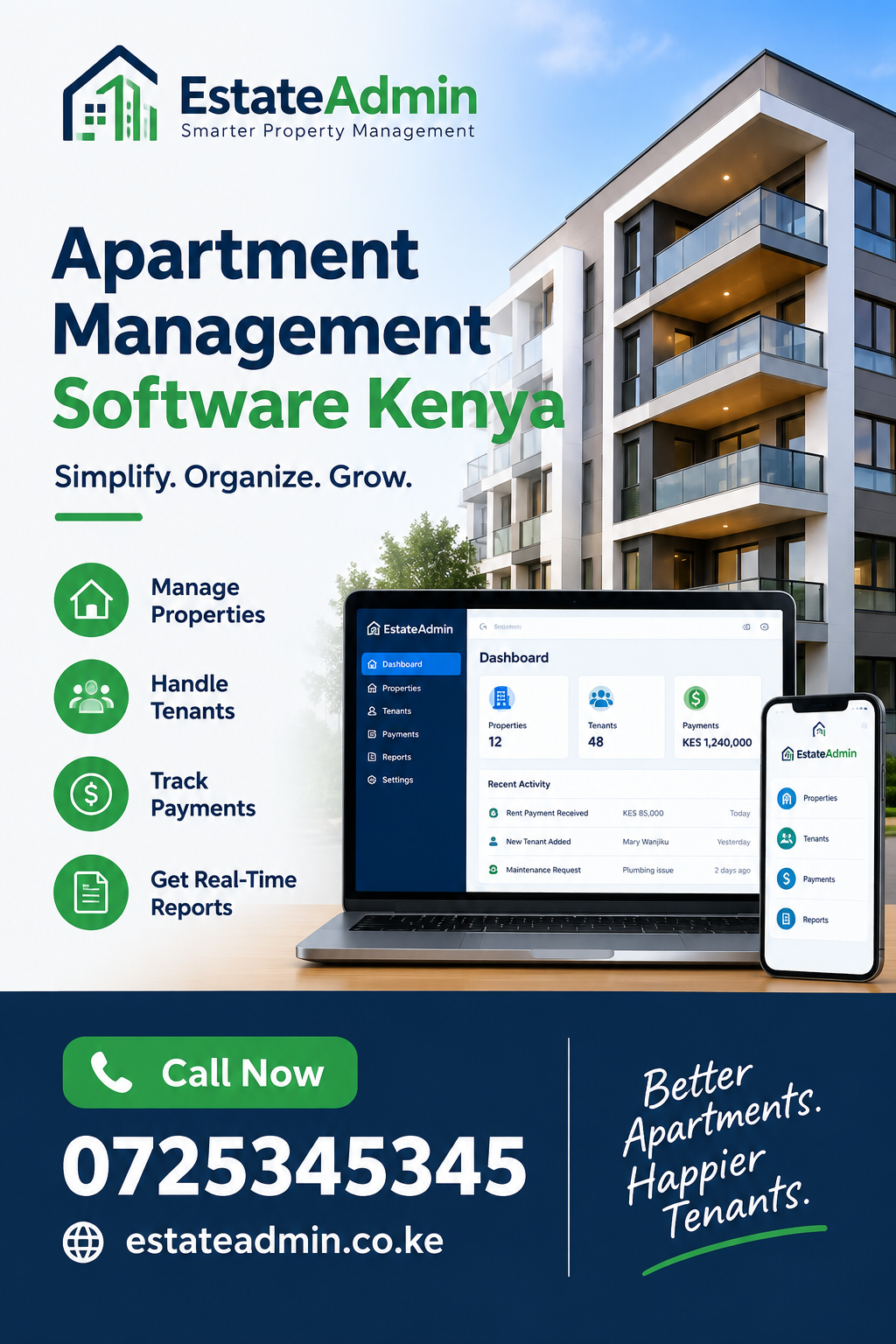
Apartment Management Software Kenya: Complete Guide for Property Managers and Landlords
Managing an apartment building involves much more than collecting rent every month. Property managers and landlords have to keep accurate tenant records, follow up on payments, handle maintenance requests, issue receipts, monitor vacancies, manage expenses and produce financial reports. Apartment Management Software Kenya gives property professionals a structured way to bring these activities into one system instead of depending on notebooks, spreadsheets, paper files and scattered WhatsApp conversations.
For apartment owners, estate agents, property managers and management companies in Kenya, the right software can make daily administration easier while providing better visibility into what is happening across a building or portfolio. This guide explains how apartment management software works, the features to look for, how it can support rent collection and tenant communication, and the factors Kenyan property managers should consider before choosing a solution.
What Is Apartment Management Software?
Apartment Management Software Kenya refers to a digital system designed to help landlords, property managers and apartment management teams organize and automate routine property administration.
Instead of maintaining separate records for tenants, units, rent payments, maintenance issues and expenses, a centralized system allows relevant information to be stored and managed in one place.
A typical apartment management platform may help a property manager:
- Register buildings and individual units
- Create tenant profiles
- Track occupied and vacant units
- Record rent charges
- Monitor payments
- Identify outstanding balances
- Generate receipts
- Manage maintenance requests
- Record property expenses
- Communicate with tenants
- Produce management reports
- Keep historical property records
Apartment Management Software Kenya is particularly useful where a property has many units and manual administration begins consuming a significant amount of management time.
For a building with only a few units, a spreadsheet may appear sufficient. However, as the number of apartments increases, the number of records and transactions also increases. A dedicated system can provide more structure and reduce the need to manually reconcile information from several sources.
Why Apartment Management Is Becoming More Complex
Apartment management in Kenya involves several moving parts.
A property manager may be responsible for dozens or hundreds of tenants, each with a different payment history. Some tenants pay on time, some make partial payments, others accumulate arrears, while new tenants may move in as existing tenants leave.
At the same time, the property itself requires continuous attention.
Apartment Management Software Kenya can help organize these responsibilities by creating a central administrative environment.
Consider an apartment building with 100 units. The manager may need to know:
- Which units are occupied?
- Which tenants have paid?
- Which tenants have outstanding balances?
- Which units are vacant?
- Which maintenance requests are unresolved?
- How much rent was collected during the month?
- How much was spent on repairs?
- What income remains after expenses?
- Which tenants have recurring payment issues?
- What should be included in the monthly management report?
When this information is maintained manually, answering simple questions can require checking multiple files. A centralized system makes the information easier to retrieve and organize.
How Apartment Management Software Works
At its core, Apartment Management Software Kenya connects property records with daily management activities.
A manager normally starts by creating the property profile. Buildings, floors and units can then be recorded within the system. Tenant information is assigned to the appropriate unit, after which rent charges, payments and other relevant transactions can be tracked.
The process can be viewed as a simple cycle:
Property → Building → Unit → Tenant → Charges → Payments → Reports
Once these records are connected, the manager has a clearer view of the relationship between individual tenants and the overall property.
For example, if a tenant occupies Unit B-04, the manager should be able to open that unit and see relevant information about the tenant, rent obligations, payment history and outstanding balance without searching through several spreadsheets.
Apartment Management Software Kenya can therefore serve as an operational database as well as an administrative tool.
Managing Tenant Records
Tenant information is one of the most important parts of apartment administration.
A property manager may need to keep information such as:
- Tenant name
- Contact details
- Unit number
- Lease information
- Move-in date
- Rent amount
- Payment history
- Outstanding balance
- Maintenance requests
- Communication records
Apartment Management Software Kenya can help organize these details so that the property team has a consistent record for each tenant.
This becomes especially valuable when a property changes managers. Instead of transferring boxes of paperwork or sending multiple spreadsheets, the relevant records can be maintained within a centralized platform.
A good tenant management system should also make it easy to search for a tenant or unit. Searchability matters because property managers often need information immediately when responding to a tenant, owner or maintenance provider.
Rent Collection and Payment Tracking
Rent collection is one of the most important functions in property management.
A property manager needs to know not only how much rent should have been collected but also how much has actually been received.
Apartment Management Software Kenya can help property teams maintain payment records and monitor outstanding amounts.
A useful rent management workflow can include:
- Creating monthly rent charges
- Recording tenant payments
- Updating outstanding balances
- Identifying arrears
- Issuing receipts
- Reviewing collection reports
- Following up on unpaid amounts
For Kenyan property managers, payment tracking can be particularly useful when tenants use different payment channels. A structured system allows transactions to be recorded against the correct tenant and unit.
The objective is not simply to record money received. The objective is to create a clear financial history.
If Unit C-12 is expected to pay KSh 25,000 per month, the property manager should be able to determine whether the tenant has paid the full amount, made a partial payment or has an outstanding balance.
Apartment Management Software Kenya can make that information easier to access.
Supporting M-Pesa-Based Property Payments
M-Pesa is widely used for everyday payments in Kenya, making digital payment management an important consideration for property managers.
When evaluating Apartment Management Software Kenya, property managers should examine how the platform handles payment recording and whether it supports the payment workflows used by their tenants.
The key requirement is accurate reconciliation.
A payment should be associated with the correct:
- Tenant
- Apartment
- Account
- Amount
- Date
- Transaction reference
This reduces confusion when several tenants make payments around the same time.
Where software supports automated payment integrations, managers should understand exactly how the integration works, what payment information is captured and whether reconciliation requires manual intervention.
The important point is that payment technology should simplify administration rather than create another complicated process.
Managing Rent Arrears
Rent arrears can create serious administrative challenges for property owners.
A manager may know that several tenants have not fully paid, but without organized records it can be difficult to determine the exact amount owed by each tenant.
Apartment Management Software Kenya can help present outstanding balances in a structured format.
An arrears dashboard might allow a manager to identify:
- Tenants with unpaid rent
- Amount outstanding
- Number of overdue periods
- Partial payments
- Recent payment activity
- Total arrears across the property
This information allows management teams to prioritize follow-ups based on actual records rather than memory.
For example, if ten tenants have outstanding balances, the manager can review the records and determine whether the balances are recent, recurring or linked to specific billing issues.
Accurate records are also useful when communicating with tenants because the manager can refer to transaction history rather than relying on assumptions.
Automating Tenant Communication
Communication is another important part of apartment administration.
Tenants commonly need information about:
- Rent payments
- Receipts
- Maintenance
- Notices
- Building activities
- Service charges
- Outstanding balances
- General property announcements
Apartment Management Software Kenya can support more organized communication when messaging functionality is available.
Automated reminders can also reduce the amount of repetitive work performed by property staff.
Instead of manually reminding every tenant about the same payment deadline, a system may allow standardized notifications to be prepared and sent according to defined rules.
However, automation should be used carefully. Communication should remain clear, relevant and appropriate to the tenant’s situation.
Maintenance Management for Apartments
Rent collection is only one side of property management.
Buildings require regular maintenance, and tenants need a reliable way to report problems.
Common apartment maintenance issues include:
- Plumbing problems
- Electrical faults
- Broken fixtures
- Water supply issues
- Lift problems
- Security concerns
- Damaged doors
- Lighting faults
- Drainage problems
- Common-area repairs
Apartment Management Software Kenya can help organize maintenance requests by keeping them connected to specific properties and units.
A basic maintenance workflow could look like this:
Tenant reports issue → Manager records request → Technician assigned → Work completed → Cost recorded → Request closed
Without a structured process, requests can easily be forgotten, especially when they arrive through different channels.
A maintenance module can provide a history of what was reported, when it was reported and what action was taken.
Tracking Maintenance Costs
Property maintenance is also a financial activity.
Suppose a landlord spends KSh 15,000 repairing a plumbing issue. That expense should be associated with the relevant property and recorded accurately.
Apartment Management Software Kenya can help management teams connect operational records with financial information.
Expense records may include:
- Supplier or contractor
- Date
- Description
- Amount
- Property
- Unit where applicable
- Payment status
- Supporting documentation
Over time, these records can help property owners understand where money is being spent.
For example, recurring maintenance expenses may indicate that a particular building component requires replacement rather than repeated repairs.
Managing Service Charges
Apartment buildings may have costs that are separate from basic rent.
Depending on the property structure, residents may contribute toward services such as:
- Security
- Cleaning
- Waste management
- Common-area electricity
- Water
- Landscaping
- Shared facilities
- Maintenance of common areas
Apartment Management Software Kenya can help property managers separate different types of charges where the software supports service-charge management.
This distinction is important because tenants should be able to understand what they are being charged for.
A property manager also needs reliable records showing what has been billed, what has been collected and what remains outstanding.
Vacancy and Unit Management
A property manager needs visibility over available units.
Apartment Management Software Kenya can provide a structured way to distinguish occupied units from vacant ones when vacancy management is supported.
A unit register may contain:
| Unit Information | Example |
|---|---|
| Building | Block A |
| Floor | Third Floor |
| Unit | A-304 |
| Status | Occupied |
| Tenant | Current occupant |
| Monthly Rent | Configured amount |
| Payment Status | Up to date |
A centralized unit register is useful because vacancies directly affect rental income.
Managers can quickly determine how many units are occupied, which units are available and which units require follow-up before being marketed again.
Property Portfolio Management
Some landlords own only one apartment building. Others manage multiple properties.
As the portfolio grows, information management becomes more demanding.
Apartment Management Software Kenya can help property managers organize multiple buildings when the platform supports portfolio-level management.
For example, a management company could oversee:
- Residential apartments
- Commercial units
- Mixed-use buildings
- Multiple developments
- Properties belonging to different owners
The ability to separate properties while maintaining centralized access can be important.
A manager should be able to view an individual building without losing the broader portfolio picture.
Financial Reporting
Property owners need more than transaction records. They need meaningful reports.
Apartment Management Software Kenya can help property teams generate or organize reports covering areas such as:
- Rent collected
- Rent outstanding
- Property income
- Expenses
- Occupancy
- Vacancies
- Tenant balances
- Maintenance expenditure
- Payment activity
Reports can help owners understand how their property is performing without reviewing individual tenant records manually.
For example, a monthly report might show expected rent of KSh 2 million, actual collections of KSh 1.85 million and outstanding balances of KSh 150,000.
The value of such reporting is not simply the numbers themselves. It is the ability to understand the financial position of the property quickly.
Improving Accountability
Property management often involves multiple people.
There may be:
- Property owners
- Estate managers
- Accountants
- Caretakers
- Maintenance staff
- Security personnel
- External contractors
Apartment Management Software Kenya can help create clearer records of administrative activities when appropriate user permissions and audit features are available.
For example, management can distinguish between rent recorded, maintenance requested and expenses entered into the system.
This can improve accountability because important information is stored centrally instead of existing only in conversations or handwritten notes.
Reducing Spreadsheet Dependency
Spreadsheets are useful tools, particularly for small businesses.
However, they can become difficult to manage when a property portfolio expands.
A spreadsheet may require manual formulas, sorting, copying, updating and reconciliation. A small error can also affect calculations elsewhere in the document.
Apartment Management Software Kenya provides a more specialized approach because the system is designed around property management workflows.
This does not mean spreadsheets have no role. They can still be useful for analysis and data exports.
The difference is that dedicated software can handle routine property-management processes within an environment designed for those activities.
Data Security and Access Control
Property management systems contain important information.
A platform may store tenant contact details, financial records, payment information, property information and business reports.
Apartment Management Software Kenya should therefore be evaluated not only on features but also on how access to information is controlled.
Property managers should ask questions such as:
- Who can access tenant records?
- Can different users have different permissions?
- How is data backed up?
- How are accounts protected?
- Can access be removed when an employee leaves?
- Is there an activity history?
- How are exported records handled?
Security requirements may differ from one organization to another, but they should form part of the software selection process.
Why Cloud-Based Systems Can Be Useful
Cloud-based software allows authorized users to access systems through internet-connected devices.
For property managers who work between different buildings, this can be convenient.
Apartment Management Software Kenya may be especially valuable when management activities do not happen from one fixed office.
For instance, a manager might receive a tenant request while visiting another property. If the platform is accessible remotely, the manager can review the tenant’s information without waiting to return to the office.
Cloud access also reduces dependence on one physical computer.
However, managers should consider internet availability, user security, data backups and the vendor’s support arrangements before choosing a cloud solution.
Choosing Apartment Management Software in Kenya
There is no single software package that is automatically suitable for every property.
The right solution depends on the size of the portfolio, the number of users, the complexity of billing and the processes the management team wants to improve.
Apartment Management Software Kenya should be evaluated against the actual workflow of the organization.
Start by listing your current challenges.
For example:
- Rent collection takes too much time.
- Tenant records are difficult to find.
- Arrears are not clearly tracked.
- Maintenance requests are missed.
- Owners want regular reports.
- Payment reconciliation is manual.
- Several people need access to property records.
Once these challenges are identified, compare software based on whether it addresses them directly.
Features to Look for
When comparing Apartment Management Software Kenya, consider the following feature categories.
1. Property and Unit Management
The platform should make it easy to create properties, buildings, floors and units.
2. Tenant Management
Tenant profiles should be organized and searchable.
3. Rent Management
The system should support rent charges, payment records and balances.
4. Arrears Tracking
Outstanding amounts should be easy to identify.
5. Receipts
Tenants should be able to receive clear payment confirmation where the system supports receipts.
6. Maintenance
Maintenance requests should have a defined workflow.
7. Reporting
Managers should be able to obtain useful financial and operational reports.
8. User Permissions
Different staff members may require different levels of access.
9. Payment Integration
Consider whether the system supports the payment channels used by your tenants.
10. Customer Support
A good implementation depends partly on the availability of help when users encounter problems.
Apartment Management Software Kenya for Small Landlords
Small landlords sometimes assume property management software is designed only for large property companies.
That is not necessarily the case.
Apartment Management Software Kenya can also be useful for a landlord managing a smaller apartment block if the software matches the landlord’s requirements and budget.
For a landlord with 20 units, for example, the most important features may be:
- Tenant records
- Rent tracking
- Arrears monitoring
- Payment receipts
- Basic reports
- Maintenance records
The landlord does not necessarily need every advanced feature available in an enterprise property platform.
The key is to choose software based on actual needs.
Apartment Management Software Kenya for Large Property Portfolios
Larger property managers have different requirements.
Apartment Management Software Kenya becomes more relevant when management teams need to coordinate many units, properties and transactions.
A larger organization may require:
- Multiple user accounts
- Role-based access
- Portfolio dashboards
- Detailed reports
- Automated communications
- Payment reconciliation
- Maintenance workflows
- Owner reporting
- Financial controls
The more complex the organization becomes, the more important workflow automation and centralized information can be.
Common Mistakes When Choosing Property Software
Buying software without understanding the underlying problem can lead to poor adoption.
Apartment Management Software Kenya should be selected after considering how the property is actually managed.
Here are common mistakes to avoid.
Choosing Based Only on Price
The cheapest option may not necessarily solve the main administrative problem.
Look at the total value of the system, including functionality, support and scalability.
Ignoring User Experience
If staff find the system difficult to use, they may return to spreadsheets and paper records.
Ask for a demonstration where possible.
Failing to Check Payment Workflows
If your tenants rely heavily on digital payments, understand how the software handles those transactions.
Ignoring Reports
A system should produce information that management can actually use.
Buying Too Many Features
More features are not always better. Unused features can make software harder to understand.
Not Planning Data Migration
If existing tenant and property records are stored elsewhere, determine how they will be transferred into the new system.
How to Implement Apartment Management Software
Successful implementation involves more than creating an account.
Apartment Management Software Kenya should be introduced systematically.
Step 1: Audit Existing Records
Review your current tenant, property, payment and expense records.
Step 2: Clean the Data
Correct duplicate tenant records, incorrect balances and incomplete information before migration.
Step 3: Set Up Properties
Create buildings, floors and units.
Step 4: Add Tenants
Assign tenants to the correct units.
Step 5: Configure Charges
Set rent and other applicable charges.
Step 6: Train Users
Teach staff how to perform their daily tasks.
Step 7: Test Transactions
Before fully switching over, test common workflows such as rent recording, receipts and maintenance requests.
Step 8: Establish Procedures
Define who records payments, who handles maintenance and who reviews reports.
Step 9: Monitor Adoption
Check whether staff are using the system consistently.
Step 10: Review Results
After implementation, identify which processes have improved and which require additional configuration or training.
Measuring the Value of Property Management Software
Technology should produce practical results.
Apartment Management Software Kenya can be assessed by measuring improvements in everyday administration.
Useful measures include:
- Time spent preparing rent reports
- Time required to identify arrears
- Number of unresolved maintenance requests
- Time spent searching for tenant records
- Reporting frequency
- Payment reconciliation time
- Data-entry errors
- Vacancy monitoring
For example, if a monthly report previously required several hours of manual spreadsheet work and the new system significantly reduces that process, the organization has a measurable operational improvement.
Using Data to Improve Property Decisions
A property management platform can also provide information that supports better planning.
Apartment Management Software Kenya can help managers identify trends where reporting capabilities allow it.
A property owner may discover that:
- Certain units experience more maintenance issues.
- Some tenants consistently pay late.
- A building has higher expenses than another.
- Vacancy periods are longer in particular units.
- Certain contractors handle a large proportion of repairs.
These patterns can help management investigate underlying causes.
The software does not make the business decision automatically. Instead, it organizes the information needed for the property owner or manager to make an informed decision.
Tenant Experience and Service Quality
Property management is also about service delivery.
A tenant who can report a maintenance problem and receive an update has a different experience from one who has to repeatedly call or visit the management office.
Apartment Management Software Kenya can support better service workflows when tenant communication and maintenance features are available.
Good tenant service can include:
- Clear payment records
- Timely receipts
- Accessible communication
- Proper maintenance tracking
- Transparent balances
- Consistent notices
Technology should support these processes rather than replace human communication.
Apartment Management Software Kenya and Business Growth
As a property portfolio grows, administrative complexity normally grows with it.
Apartment Management Software Kenya can provide a foundation for more structured operations.
A manager who handles ten units manually may manage the workload comfortably. The same approach may become difficult with 100 or 500 units.
The important question is not simply how many units a business currently manages.
Managers should also consider future growth.
If a property management company expects to add several buildings, it may make sense to select a system that can accommodate additional properties and users without requiring an entirely new administrative process.
Questions to Ask a Software Provider
Before selecting a system, prepare a list of practical questions.
Apartment Management Software Kenya providers should be able to explain how their platform handles the workflows that matter to your organization.
Ask:
- How are properties and units created?
- How are tenant records managed?
- How are rent payments recorded?
- Does the system support payment integrations?
- How are arrears displayed?
- Can receipts be generated?
- How are maintenance requests tracked?
- What reports are available?
- Can multiple staff members use the platform?
- How are permissions managed?
- Is data backed up?
- What support is available?
- How is pricing calculated?
- Are there setup or migration costs?
- Can the platform scale as the portfolio grows?
The answers should be evaluated against your actual business requirements.
Pricing Considerations
Pricing is an important part of choosing software, but the headline subscription price does not tell the whole story.
Apartment Management Software Kenya may be priced according to different models depending on the provider.
Possible pricing structures can include:
- Per property
- Per unit
- Per user
- Monthly subscription
- Annual subscription
- Feature-based plans
- Customized enterprise pricing
Before signing up, determine what is included.
Ask whether charges apply to:
- Additional users
- Additional properties
- Payment integrations
- SMS notifications
- Data migration
- Training
- Support
- Reports
- Additional storage
This makes it easier to compare software based on the actual cost of operating it.
The Importance of Local Support
Property management processes can vary by market.
Apartment Management Software Kenya should ideally be easy for Kenyan users to understand and operate.
Local relevance may include familiarity with:
- Kenyan payment methods
- Local currency
- Common rental workflows
- Tenant communication practices
- Local business operations
Support is also important.
If the accounting team cannot understand how to correct a transaction or the property manager cannot configure a building correctly, access to responsive support can make a significant difference.
Digital Transformation for Property Managers
Moving from paper records to software is not simply about replacing a notebook with a computer.
Apartment Management Software Kenya can help organizations redesign how property information moves through the business.
Instead of:
Tenant → WhatsApp → Manager → Notebook → Spreadsheet → Accountant
a structured digital workflow can bring relevant information into one system.
This can reduce duplication and make responsibilities clearer.
The transformation is most successful when the organization also improves its internal processes.
Software cannot compensate for unclear procedures, inaccurate records or poor follow-up.
Apartment Management Software Kenya and Operational Efficiency
Operational efficiency means accomplishing routine tasks with less unnecessary effort.
Apartment Management Software Kenya can support efficiency by centralizing repetitive activities.
Consider a rent collection process.
A manual workflow might involve:
- Checking the tenant list.
- Reviewing bank or mobile-money records.
- Updating a spreadsheet.
- Calculating balances.
- Preparing receipts.
- Sending reminders.
- Preparing a monthly report.
A suitable system may consolidate several of these activities.
The exact level of automation depends on the platform, configuration and integrations available.
Managers should therefore test the actual workflow rather than assuming that every system automates every task.
What Makes Good Apartment Software Practical?
Good software should solve real administrative problems.
Apartment Management Software Kenya should be evaluated from the perspective of the people who will use it every day.
A property manager may care most about:
- Speed
- Searchability
- Rent tracking
- Reports
- Tenant communication
An accountant may prioritize:
- Accurate transactions
- Reconciliation
- Financial reports
- Expense records
A property owner may prioritize:
- Income visibility
- Arrears
- Occupancy
- Expenses
- Portfolio performance
A good system should accommodate these different requirements without making everyday tasks unnecessarily complicated.
Apartment Management Software Kenya and Record Keeping
Property records become more valuable as they accumulate over time.
Apartment Management Software Kenya can help preserve a history of transactions and management activities where the relevant features are available.
Historical information can help answer questions such as:
- When did a tenant move in?
- What payments have been made?
- What maintenance issues were previously reported?
- How much was spent on a particular repair?
- When was a unit vacant?
- What was the property’s income during a particular period?
Having this information organized can make future administration easier.
Preparing for Future Property Management Needs
Property management software should not only solve today’s problem.
Apartment Management Software Kenya should also be assessed for its ability to accommodate future operational requirements.
A property business may eventually need:
- More properties
- More tenants
- More staff
- More payment channels
- More detailed reports
- Better owner communication
- Additional integrations
Selecting a system with room for growth can reduce the disruption associated with replacing software later.
Apartment Management Software Kenya for Professional Property Managers
Professional property managers have a particular need for organization because they may be responsible for properties belonging to different owners.
Apartment Management Software Kenya can help separate records by property while giving management teams centralized access where the platform supports portfolio management.
This is useful when preparing owner reports.
For example, a property manager may need to show an owner:
- Rent collected
- Outstanding rent
- Property expenses
- Maintenance activity
- Occupancy
- Net income
A structured reporting system can make these tasks more manageable.
Apartment Management Software Kenya for Apartment Owners
Individual property owners can also benefit from better visibility.
Apartment Management Software Kenya can help owners monitor their property without necessarily handling every administrative task themselves.
An owner might want to know:
How much rent was expected?
How much was collected?
Who owes money?
What expenses were incurred?
Which units are vacant?
What maintenance has been completed?
A centralized system can make these questions easier to answer.
Frequently Asked Questions
What is Apartment Management Software Kenya?
Apartment Management Software Kenya is software designed to help landlords, property managers and apartment management teams organize property, tenant, rent, maintenance and reporting activities.
Can apartment software track rent payments?
Yes, many property management platforms include rent tracking functionality. The specific capabilities differ between providers, so managers should confirm how payments, balances, receipts and arrears are handled.
Can property software manage multiple apartment buildings?
Apartment Management Software Kenya can support multiple buildings when the selected platform provides portfolio or multi-property management features.
Is M-Pesa integration important for Kenyan property managers?
It can be important where tenants commonly use M-Pesa for rent or other property-related payments. Managers should verify exactly which payment integrations a particular platform supports.
Can apartment software manage maintenance?
Apartment Management Software Kenya can include maintenance management features such as request recording, assignment, status tracking and expense recording, depending on the platform.
Can landlords use apartment management software?
Yes. The appropriate solution depends on the landlord’s portfolio size, management requirements and budget.
Does property management software replace property managers?
No. Software primarily supports administration and organization. Property managers still make decisions, communicate with tenants, supervise maintenance and manage relationships with owners and suppliers.
How should I choose apartment management software?
Apartment Management Software Kenya should be selected according to your actual requirements. Compare tenant management, rent tracking, payment handling, maintenance, reporting, user access, support, pricing and scalability.
Is cloud-based property software useful?
Cloud-based software can be useful for teams that need access to property information from different locations, provided the platform has appropriate security, reliability and access controls.
How quickly can a property management system be implemented?
Implementation time depends on the number of properties, existing data, system configuration, integrations and user training requirements. A small portfolio may require less setup than a large multi-property operation.
A Practical Checklist Before Buying
Before selecting Apartment Management Software Kenya, create a checklist based on your property.
Property Management
- Can I create multiple properties?
- Can I create individual units?
- Can I track occupancy?
- Can I search property records easily?
Tenant Management
- Can I create tenant profiles?
- Can I track tenant history?
- Can I connect tenants to specific units?
- Can I manage tenant communication?
Financial Management
- Can I record rent charges?
- Can I record payments?
- Can I track arrears?
- Can I issue receipts?
- Can I track expenses?
- Can I generate reports?
Maintenance
- Can tenants report issues?
- Can managers assign maintenance tasks?
- Can requests be tracked?
- Can maintenance expenses be recorded?
Administration
- Can several staff members use the system?
- Are user permissions available?
- Is data backed up?
- Is customer support available?
Scalability
- Can more units be added?
- Can more properties be added?
- Can additional users be added?
- Can the system accommodate future growth?
Final Thoughts
Managing apartments efficiently requires accurate information, consistent processes and reliable follow-up. Apartment Management Software Kenya can bring property records, tenant information, rent administration, maintenance and reporting into a more organized workflow.
The biggest benefit is not simply having another digital tool. It is having better visibility over the property.
A landlord should be able to understand what is happening with rental income. A property manager should be able to find tenant information quickly. An accountant should be able to review financial records. A tenant should have a clear process for payments and maintenance requests.
When selecting software, focus on the problems you need to solve first. Evaluate the features, payment workflows, reporting, security, usability, support and pricing against those requirements.
For a growing apartment portfolio, moving from scattered records to a centralized property management system can create a more structured foundation for everyday operations.
Apartment Management Software Kenya is therefore best viewed as part of a broader property-management strategy: one that combines reliable records, efficient processes, clear communication and informed decision-making.
The practical next step is to document your current property-management workflow, identify the areas consuming the most time, and then compare software based on how effectively each platform addresses those specific challenges.