
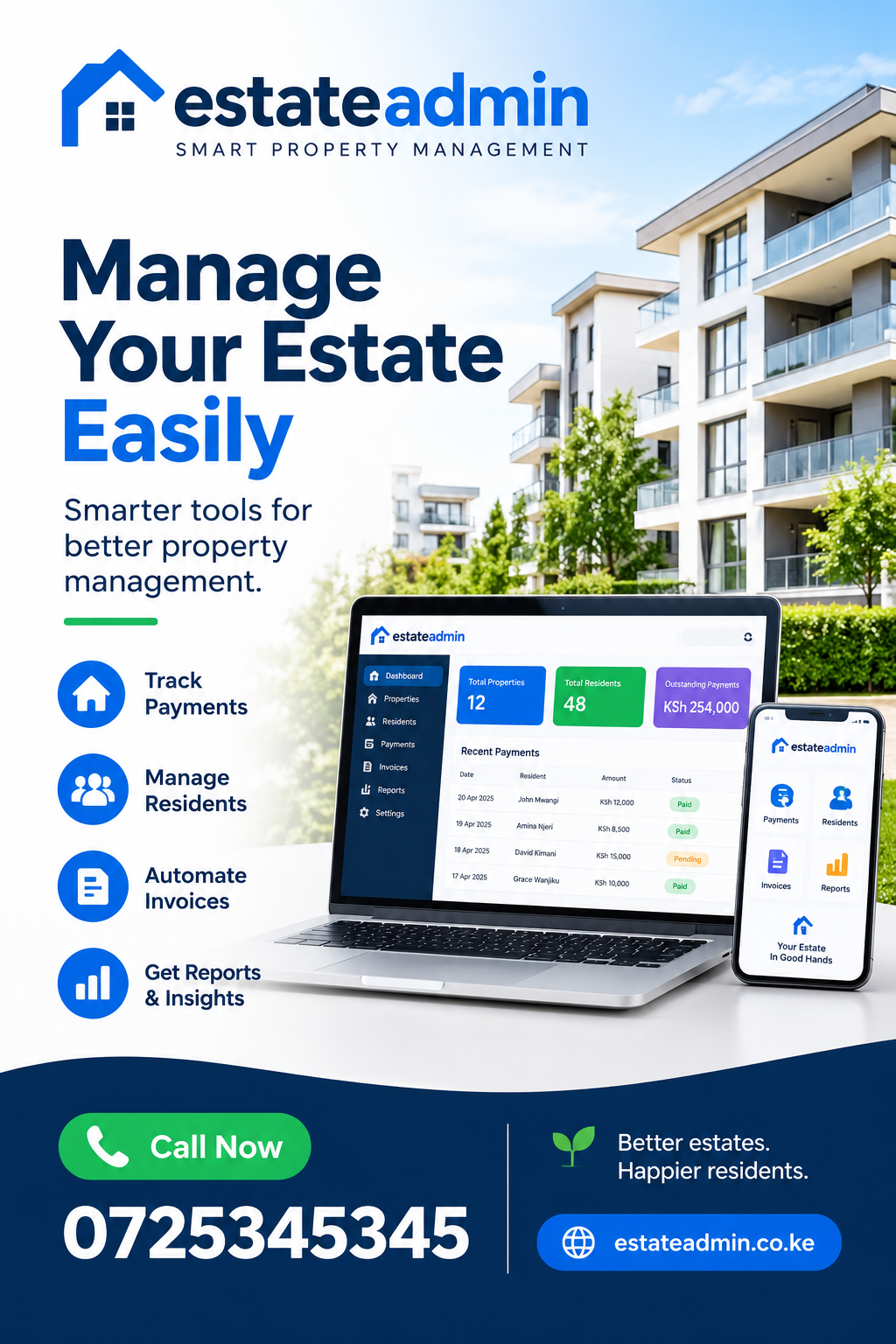
Property Maintenance Management Software Kenya: Complete Guide for Property Managers
Property maintenance becomes difficult when repair requests, inspections, contractor details, costs and follow-ups are scattered across notebooks, WhatsApp messages and spreadsheets. Property Maintenance Management Software Kenya gives property managers, landlords, estate administrators and facility teams a structured way to think about maintenance operations, from identifying a problem to assigning work, confirming completion and reviewing costs. This guide explains what maintenance management software should do, why it matters in Kenya, which features to prioritize, how to evaluate providers, and how to introduce a digital maintenance workflow without disrupting daily property operations.
A maintenance system is not simply a digital version of a maintenance notebook. The real value comes from creating a reliable process around requests, priorities, inspections, contractors, expenses, approvals and reporting. For a residential estate with dozens or hundreds of units, that structure can make a significant difference to response times and accountability.
Property maintenance also affects the wider performance of a property portfolio. A leaking pipe that is ignored can become a larger repair. A broken security light can affect residents’ confidence. A damaged common-area facility can generate repeated complaints. When issues are recorded consistently, managers have a better opportunity to identify recurring problems and plan work before small defects become expensive emergencies.
What Is Property Maintenance Management Software?
At its core, Property Maintenance Management Software Kenya is a digital system for organizing maintenance-related activities across residential, commercial or mixed-use properties.
Instead of relying on separate records, a property team can establish a central workflow for:
- Recording maintenance requests
- Identifying the affected property or unit
- Categorizing the issue
- Setting a priority
- Assigning a technician or contractor
- Tracking the status of the job
- Recording materials and expenses
- Documenting inspections
- Confirming completion
- Keeping maintenance history
- Reviewing maintenance performance
For Kenyan property managers, this can be particularly useful when several people are involved in the same job. A resident may report a fault, an administrator may review it, a manager may approve expenditure, a technician may perform the repair, and an accountant may need the final cost for financial records.
Without a shared workflow, information can easily become fragmented.
With Property Maintenance Management Software Kenya, the objective is to bring those activities into a more organized operational process.
The system should help answer simple but important questions:
- What problem was reported?
- Where is the problem?
- When was it reported?
- How urgent is it?
- Who is responsible?
- What action has been taken?
- How much has the work cost?
- Has the issue been resolved?
- Has the property manager verified the work?
- Is the problem recurring?
Those questions form the foundation of effective maintenance management.
Why Property Maintenance Is Important in Kenya
Property maintenance affects more than the physical condition of a building. It can influence resident satisfaction, operating costs, property reputation and long-term asset value.
A landlord managing several rental units may receive maintenance complaints through phone calls. A property manager may receive messages from tenants throughout the day. An estate administrator may have common-area repairs reported by security guards, cleaners or residents.
When those requests are handled informally, some can be forgotten.
A properly organized Property Maintenance Management Software Kenya workflow gives every issue a place in the maintenance process. The manager can record the problem, assign responsibility and monitor progress rather than depending entirely on memory.
This is particularly important for estates with multiple buildings. A single property may have plumbing, electrical, painting, drainage, lifts, gates, lighting, water systems, landscaping and other maintenance requirements.
A digital system can help separate those categories so that management can understand where maintenance resources are being used.
Maintenance is an operational cost
Every property experiences maintenance expenses. The challenge is controlling them without compromising the quality of the property.
For example, consider an apartment building with recurring plumbing complaints. If every incident is treated independently, management may continue paying for individual repairs without recognizing that the underlying plumbing system requires a broader intervention.
Maintenance records can reveal patterns.
If similar repairs repeatedly occur in the same building, floor or unit type, the manager can investigate the underlying cause.
That makes Property Maintenance Management Software Kenya useful not only for recording work but also for developing a better maintenance strategy.
Common Maintenance Problems Faced by Property Managers
Property managers often deal with similar categories of maintenance problems regardless of the size of their portfolio.
Plumbing problems
These may include:
- Leaking taps
- Blocked drains
- Burst pipes
- Low water pressure
- Toilet faults
- Water tank problems
- Damaged valves
- Sewerage issues
Plumbing problems can become urgent very quickly, especially when water is affecting walls, floors or neighboring units.
Electrical problems
Electrical maintenance may include:
- Failed lights
- Damaged switches
- Faulty sockets
- Tripping circuits
- Common-area lighting problems
- Generator-related issues
- Electrical panel concerns
Electrical complaints should be handled carefully and assigned to appropriately qualified professionals.
Structural and building repairs
Property teams may also deal with:
- Cracked walls
- Broken doors
- Damaged windows
- Roof leaks
- Flooring problems
- Painting
- Ceiling damage
- Fencing
Common-area maintenance
In larger estates, shared facilities create another maintenance workload.
This can include:
- Parking areas
- Walkways
- Gardens
- Security lighting
- Gates
- Swimming pools
- Waste areas
- Community halls
- Recreational facilities
A maintenance system can help managers distinguish between private-unit issues and common-area responsibilities.
How Property Maintenance Management Software Improves Organization
A property team becomes more efficient when every maintenance request follows a recognizable process.
Property Maintenance Management Software Kenya can be used as the foundation for that process.
A typical workflow might look like this:
Report → Review → Prioritize → Assign → Repair → Inspect → Close → Report
Each stage has a purpose.
The report captures the original problem.
The review confirms the details.
Prioritization determines how urgently the issue should be handled.
Assignment gives responsibility to a person or contractor.
Repair addresses the actual fault.
Inspection confirms whether the work was completed satisfactorily.
Closure ensures the issue is no longer sitting in an open-work queue.
Reporting helps management identify trends.
This approach is much easier to control than a process where requests arrive through multiple communication channels and remain mixed together.
Centralized maintenance records
A centralized record means the property team does not need to search through several notebooks, spreadsheets and chat conversations to understand what happened.
Property Maintenance Management Software Kenya can be evaluated specifically for its ability to keep property, unit, request, contractor and cost information organized in a logical structure.
A good maintenance record should ideally answer the basic operational questions without requiring someone to reconstruct the history manually.
Maintenance Requests and Work Orders
One of the most important concepts in maintenance management is the work order.
A maintenance request tells the team that something needs attention.
A work order turns that request into an actionable task.
For example:
Apartment 3B reports water leaking beneath the kitchen sink.
The maintenance team could create a work order containing:
- Unit: Apartment 3B
- Category: Plumbing
- Priority: High
- Date reported: Monday
- Assigned contractor: Plumber
- Estimated cost: KSh amount
- Status: Assigned
- Completion date: Pending
- Notes: Leak appears to originate from the sink connection
This creates a much clearer record.
Property Maintenance Management Software Kenya should therefore be assessed according to how well it supports work-order management rather than simply whether it has a generic “maintenance” label.
Work-order statuses
Useful statuses may include:
- New
- Under review
- Approved
- Assigned
- In progress
- Waiting for parts
- Awaiting approval
- Completed
- Inspected
- Closed
The exact terminology can vary, but the principle remains the same: everyone should understand where a maintenance job currently stands.
Prioritizing Maintenance Requests
Not every maintenance request deserves the same response time.
A broken light in a decorative garden is different from a major water leak. A loose cupboard handle is different from an electrical fault.
Property Maintenance Management Software Kenya can support a priority-based maintenance process when the organization defines its own rules clearly.
A simple priority framework might include:
| Priority | Example | Typical response |
|---|---|---|
| Emergency | Major water leak or serious electrical fault | Immediate attention |
| High | Essential facility unavailable | Same day where possible |
| Medium | Functional problem affecting convenience | Scheduled promptly |
| Low | Cosmetic or minor repair | Planned maintenance |
The important point is not the labels themselves. It is consistency.
When staff members use different standards for urgency, residents may receive inconsistent service. A documented priority system makes decision-making easier.
Preventive Maintenance Versus Reactive Maintenance
Reactive maintenance happens after something breaks.
Preventive maintenance is planned before failure occurs.
Both are necessary, but relying entirely on reactive repairs can create unnecessary disruption.
Property Maintenance Management Software Kenya can form part of a preventive maintenance strategy by helping teams plan recurring inspections and maintenance activities.
Examples include:
- Checking water pumps
- Inspecting roofs
- Servicing generators
- Testing emergency lighting
- Inspecting gates
- Cleaning drainage systems
- Servicing lifts
- Checking fire-safety equipment
- Maintaining landscaping equipment
- Inspecting common facilities
The objective is not to eliminate every unexpected repair. That is unrealistic.
Instead, preventive maintenance aims to identify predictable problems early and schedule work before they become urgent.
Creating maintenance schedules
A maintenance schedule might specify:
Monthly: inspect common-area lighting.
Quarterly: inspect drainage and water systems.
Biannually: review major equipment condition.
Annually: perform broader property inspections.
The appropriate frequency depends on the equipment, building and professional recommendations.
Property Inspections and Maintenance History
Inspections provide another important layer of property maintenance management.
A property inspection can identify defects that residents have not reported.
For example, a manager walking through an estate may notice:
- Peeling paint
- Damaged paving
- Blocked drainage
- Broken lights
- Water stains
- Fence deterioration
- Landscaping problems
The manager can record these observations and create planned work.
A strong Property Maintenance Management Software Kenya workflow should therefore be considered alongside inspection procedures.
Maintenance history also becomes valuable over time.
Suppose a particular building has repeated roof repairs. The historical record may show that the property is spending money repeatedly on temporary fixes.
That information can support a more informed capital expenditure discussion.
Contractor and Vendor Management
Property maintenance often depends on external contractors.
These may include:
- Plumbers
- Electricians
- Painters
- Carpenters
- HVAC technicians
- Lift service companies
- Security-system technicians
- Landscapers
- General repair teams
Managing contractors through informal messages can make accountability difficult.
Property Maintenance Management Software Kenya can be evaluated for whether it provides a clear structure for assigning work and maintaining contractor-related records.
Useful information may include:
- Contractor name
- Contact information
- Service category
- Assigned jobs
- Job status
- Quoted amount
- Approved amount
- Final cost
- Completion date
- Performance notes
This information can help managers compare vendors based on actual experience rather than simply choosing whoever is available.
Contractor performance
A contractor who repeatedly misses deadlines can create operational problems.
A contractor who completes work correctly and communicates clearly may be worth retaining.
Maintenance records can help management build that history.
Tracking Maintenance Costs
Maintenance management should connect operational work with financial control.
Every job can have costs associated with:
- Labour
- Materials
- Transport
- Replacement parts
- Contractor fees
- Emergency call-out charges
- Equipment hire
Property Maintenance Management Software Kenya can help teams think about maintenance as a measurable business activity rather than a collection of isolated repairs.
Managers can ask:
- How much did maintenance cost this month?
- Which properties generated the highest maintenance expenses?
- Which categories cost the most?
- Which contractors were used most frequently?
- Are emergency repairs increasing?
- Are certain assets repeatedly failing?
These questions can influence budgeting and maintenance planning.
Example
Imagine a property spends:
- KSh 25,000 on plumbing
- KSh 18,000 on electrical repairs
- KSh 12,000 on painting
- KSh 10,000 on common-area repairs
The total tells one story.
The detailed categories tell another.
The second view helps management identify where resources are being consumed.
Linking Maintenance With Property Records
Maintenance records become more useful when connected to the property itself.
A manager should ideally know:
- Which building is affected
- Which floor is involved
- Which unit reported the issue
- Which asset requires attention
- When the issue was first recorded
- Whether the problem has happened before
Property Maintenance Management Software Kenya should therefore be evaluated as part of the broader property management workflow.
This is especially useful for companies managing multiple buildings.
Without property-level organization, a maintenance database can quickly become a long list of unrelated requests.
With property-level organization, management can identify patterns.
Resident Maintenance Requests
Residents are often the first people to notice a maintenance issue.
A good process should make it easy for them to report a problem while ensuring that the management team retains control over the workflow.
A maintenance request might contain:
- Resident name
- Unit number
- Issue category
- Description
- Date reported
- Photos where applicable
- Priority
- Preferred access time
- Status
The resident does not necessarily need access to every internal management detail.
The important thing is that the property team receives enough information to act.
Property Maintenance Management Software Kenya can be assessed for how effectively the underlying system supports this type of structured information.
Why Photos and Documentation Matter
A written description can sometimes be unclear.
“Water is leaking” does not tell a technician whether the issue is a tap, pipe, ceiling or drainage system.
A photograph can provide additional context.
Documentation may also include:
- Inspection photographs
- Contractor quotations
- Invoices
- Completion photographs
- Maintenance reports
- Equipment documents
Keeping documentation together with the relevant maintenance record creates a stronger history than keeping everything in separate email threads.
Maintenance Approvals and Internal Controls
Not every repair should automatically be approved.
Property managers may have different spending thresholds.
For example:
- Minor repairs may be approved by an administrator.
- Medium repairs may require manager approval.
- Major works may require owner or committee approval.
The specific policy depends on the organization.
The software should support the organization’s control structure rather than replacing it.
Property Maintenance Management Software Kenya can be evaluated alongside the approval procedures already used by the property team.
A useful approval workflow should make it clear:
- What work is being requested?
- Why is it required?
- What is the estimated cost?
- Who requested it?
- Who approved it?
- Who performed it?
- What was the final cost?
That trail can reduce confusion.
Maintenance Reporting
Reports turn maintenance records into management information.
A useful maintenance dashboard may show:
- Open work orders
- Completed jobs
- Overdue jobs
- Emergency repairs
- Maintenance spending
- Cost by property
- Cost by category
- Contractor activity
- Recurring problems
- Average completion time
Property Maintenance Management Software Kenya can be part of a wider reporting strategy where managers use operational data to make decisions.
Reports should not exist simply because software can produce them.
Every report should answer a business question.
For example:
Question: Are maintenance requests taking too long?
Report: Average time from request to completion.
Question: Which building needs more attention?
Report: Maintenance requests and costs by building.
Question: Which problems keep returning?
Report: Maintenance history by category and asset.
How Software Can Help Reduce Maintenance Delays
Delays often happen because responsibility is unclear.
A tenant reports a problem.
The administrator forwards the message.
The manager forgets to follow up.
The contractor says nobody confirmed the job.
The tenant complains again.
A digital workflow can reduce these handoff problems by making the assigned responsibility visible.
Property Maintenance Management Software Kenya can support a process where every open issue has an identifiable status and owner.
The objective is not to promise that every repair will be completed instantly.
The objective is to make it harder for an important request to disappear unnoticed.
Maintenance Management for Nairobi Properties
Nairobi property managers deal with a wide range of residential and commercial properties.
These include:
- Apartment developments
- Gated communities
- Office buildings
- Mixed-use properties
- Student accommodation
- Rental houses
- Commercial centres
Different properties have different maintenance requirements.
A large apartment complex may receive many resident requests every week, while a smaller property may have fewer but more significant repairs.
Property Maintenance Management Software Kenya should therefore be selected according to the size and complexity of the portfolio rather than based only on the number of advertised features.
A small landlord does not necessarily need a complicated enterprise platform.
A property management company handling hundreds of units may quickly outgrow a simple spreadsheet.
Maintenance Management for Property Companies With Multiple Estates
Managing one property is already a responsibility.
Managing several properties introduces additional complexity.
The team needs to distinguish:
- Property A
- Property B
- Property C
while still maintaining consistent procedures.
Property Maintenance Management Software Kenya can be useful as a framework for standardizing how maintenance information is recorded across a portfolio.
Standardization makes comparisons easier.
For example, if every property uses the same maintenance categories, management can compare plumbing, electrical and general repairs across locations.
That can highlight differences that deserve investigation.
How Maintenance Data Supports Better Budgeting
A maintenance budget should ideally be informed by previous experience.
Historical data can show whether a property consistently spends more on certain categories.
For example, repeated plumbing expenses might indicate:
- Aging pipes
- Poor installation
- High water pressure
- Recurring blockages
- Inadequate preventive maintenance
Property Maintenance Management Software Kenya can be considered alongside financial and property records to create a more complete view of maintenance spending.
The important distinction is between recording costs and understanding costs.
Recording tells you what happened.
Analysis helps you decide what to do next.
Choosing the Right Maintenance Software
Selecting maintenance software should begin with business requirements.
Do not start by asking which system has the longest feature list.
Start by asking what problems the property team needs to solve.
Property Maintenance Management Software Kenya should be evaluated against practical requirements such as:
- Ease of use
- Property organization
- Maintenance requests
- Work orders
- Priorities
- Contractor assignment
- Maintenance history
- Cost tracking
- Reporting
- User permissions
- Data security
- Cloud access
- Support
- Scalability
A product can have many features and still be difficult for staff to use.
Usability matters.
Questions to Ask a Software Provider
Before selecting a system, ask direct questions.
1. Can the system manage multiple properties?
This matters for property management companies and developers.
2. Can users assign maintenance responsibilities?
The team needs to know who owns each task.
3. Can the system record maintenance history?
Historical records are valuable for recurring problems.
4. Can maintenance costs be tracked?
Operational and financial information should connect where appropriate.
5. Are user permissions available?
Different employees may need different levels of access.
6. Can reports be exported?
Management may need information for meetings, budgets or accounting.
7. How is data protected?
Ask about access controls, backups and security practices.
8. Is training available?
Even good software can fail if users do not understand the workflow.
Property Maintenance Management Software Kenya should therefore be judged through a practical demonstration rather than a marketing feature list alone.
Cloud-Based Maintenance Management
Cloud software allows authorized users to access information through an internet connection rather than keeping the system tied to one office computer.
This can be useful for property teams that work across several locations.
A manager visiting an estate can potentially review records without returning to the office.
A company managing properties in Nairobi and other Kenyan towns can also maintain a more centralized operating structure.
Property Maintenance Management Software Kenya can be evaluated for accessibility, user permissions, reliability and the organization’s actual connectivity requirements.
Cloud access should not be confused with automatic security.
The provider should still demonstrate appropriate controls for protecting data.
Data Security and User Permissions
Property management systems can contain sensitive operational and financial information.
Access should therefore be based on responsibility.
For example:
| User | Possible access |
|---|---|
| Property manager | Broad operational access |
| Maintenance coordinator | Maintenance records |
| Accountant | Financial information |
| Technician | Assigned work |
| Administrator | Administrative functions |
| Property owner | Relevant reports |
The exact roles should be determined by the organization’s policies.
Property Maintenance Management Software Kenya should be evaluated for whether permissions can be configured appropriately.
Good access control reduces the risk of unnecessary exposure of information.
Integrating Maintenance With Broader Property Management
Maintenance should not operate in complete isolation.
Property management can include:
- Resident records
- Rent or service-charge billing
- Payment tracking
- Property records
- Inspections
- Maintenance
- Expenses
- Reporting
EstateAdmin’s current platform emphasizes estate administration, service-charge billing, payments, arrears, statements and reporting.
Its published material also describes maintenance management as part of a broader real-estate management workflow.
For a property team evaluating Property Maintenance Management Software Kenya, the important step is to test the specific maintenance workflow required rather than assuming that every feature described under broad property-management terminology is included in every current package.
M-Pesa and Maintenance Expenses in Kenya
M-Pesa is an important part of the Kenyan business environment, but maintenance software should not automatically be assumed to provide every possible M-Pesa integration.
Property managers should distinguish between:
- Recording a payment
- Receiving a payment
- Automatically matching a payment
- Generating an invoice
- Reconciling a payment
EstateAdmin’s current website prominently documents service-charge payment tracking and M-Pesa-related collection and reconciliation workflows.
When evaluating Property Maintenance Management Software Kenya, ask the provider exactly how maintenance-related expenses and payments are handled.
Do not rely on assumptions.
A live demonstration using a realistic scenario is more useful than a general statement that the platform “supports payments.”
Preventive Maintenance Planning
Preventive maintenance deserves special attention because it changes the team’s mindset.
Instead of asking:
What broke today?
the property manager also asks:
What should we inspect or service before it breaks?
Property Maintenance Management Software Kenya can support this approach when the system provides appropriate scheduling and task-management capabilities.
A preventive plan may include:
Water systems
Inspect pumps, tanks, valves and visible pipework.
Electrical systems
Check common-area lighting and relevant electrical infrastructure.
Roofing
Inspect areas vulnerable to leakage, particularly before or during rainy periods.
Drainage
Check gutters, channels and drainage points for blockage.
Common facilities
Inspect shared amenities regularly and document defects.
Preventive maintenance does not guarantee that equipment will never fail. It creates a better opportunity to identify predictable risks.
Emergency Maintenance
Some maintenance problems cannot wait.
Examples may include:
- Serious water leaks
- Major electrical faults
- Security-related equipment failure
- Significant structural damage
- Critical equipment breakdown
- Dangerous conditions
Property Maintenance Management Software Kenya can help organize the information surrounding emergency work, provided the system supports the relevant workflow.
An emergency process should define:
- Who receives the report?
- Who determines the priority?
- Who is contacted?
- Who authorizes emergency expenditure?
- Who verifies completion?
- How is the incident documented?
A software system works best when those responsibilities already exist.
Measuring Maintenance Performance
Managers need more than a list of completed repairs.
They need indicators.
Possible maintenance KPIs include:
- Number of open requests
- Number of overdue requests
- Average response time
- Average completion time
- Maintenance cost per unit
- Emergency repairs per month
- Repeat repairs
- Contractor completion time
- Preventive versus reactive work
- Cost by maintenance category
Property Maintenance Management Software Kenya can provide value when these measurements can be produced consistently from operational records.
The goal is not to create hundreds of metrics.
A small set of meaningful indicators is usually more useful.
Reducing Repeated Maintenance Problems
One of the strongest reasons to maintain historical records is to identify recurring faults.
Suppose a particular apartment experiences the same plumbing problem four times in six months.
A basic record might simply show four repairs.
A better analysis asks why.
Potential causes could include:
- Incorrect repair
- Poor-quality replacement parts
- Underlying pipe damage
- Installation problems
- Excessive pressure
- A larger system defect
Property Maintenance Management Software Kenya can help provide the historical context needed for such analysis when the relevant maintenance data is captured consistently.
This can shift maintenance from repeated firefighting toward problem solving.
Maintenance and Resident Satisfaction
Residents expect reasonable communication when something goes wrong.
Even if a repair cannot be completed immediately, clear communication can improve the experience.
For example, a resident may prefer to know:
- The issue has been received.
- It has been classified as high priority.
- A technician has been assigned.
- The technician is waiting for a replacement part.
- The work has been completed.
- The manager has verified the repair.
Property Maintenance Management Software Kenya can support a structured internal process that makes this communication easier.
The software itself does not replace good customer service.
It gives the property team better information with which to provide it.
Common Mistakes When Introducing Maintenance Software
Buying software does not automatically solve maintenance problems.
Several mistakes can undermine the implementation.
Mistake 1: Digitizing a broken process
If the existing workflow is unclear, putting it into software simply creates digital confusion.
Mistake 2: Recording incomplete information
A maintenance request without a location, description or priority may still require unnecessary follow-up.
Mistake 3: Giving everyone unlimited access
Users should receive access appropriate to their responsibilities.
Mistake 4: Ignoring historical data
Old maintenance records can be valuable when planning future work.
Mistake 5: Failing to train staff
Employees need to understand not just which buttons to click, but why the workflow matters.
Mistake 6: Measuring too much
Too many reports can distract from the indicators management actually needs.
Property Maintenance Management Software Kenya should therefore be implemented alongside clear procedures and staff responsibilities.
How to Implement a Maintenance System
A practical implementation can be divided into stages.
Stage 1: Map the current process
Document how maintenance requests currently arrive and how they are handled.
Stage 2: Identify weaknesses
Find out where requests are lost, approvals are delayed or costs are difficult to track.
Stage 3: Define categories
Create maintenance categories such as plumbing, electrical, structural and common-area repairs.
Stage 4: Define priorities
Agree on what constitutes emergency, high, medium and low priority.
Stage 5: Configure responsibilities
Decide who receives, approves, assigns and closes requests.
Stage 6: Enter essential property data
Start with accurate properties, units, assets and relevant contacts.
Stage 7: Train users
Train administrators, managers, accountants and technicians according to their roles.
Stage 8: Test the workflow
Use real-life examples before full rollout.
Stage 9: Review performance
After implementation, examine whether response times, visibility and record quality have improved.
Property Maintenance Management Software Kenya becomes more useful when the implementation process is deliberate rather than rushed.
Maintenance Software for Small Landlords
A landlord with a small number of units may initially believe software is unnecessary.
If maintenance requests are genuinely few, a simple system may be sufficient.
However, complexity grows as the portfolio grows.
A landlord managing several buildings may need to track:
- Multiple tenants
- Multiple contractors
- Different properties
- Repeated repairs
- Maintenance costs
- Inspection records
- Payment information
Property Maintenance Management Software Kenya can become more valuable as the number of properties and maintenance events increases.
The right solution should match the landlord’s actual needs.
Maintenance Software for Property Management Companies
Property management companies face a different challenge because they manage assets on behalf of clients.
They need accountability.
A property owner may ask:
- What repairs were performed?
- Why was the repair necessary?
- Who performed it?
- How much did it cost?
- When was it completed?
- Is the issue recurring?
Property Maintenance Management Software Kenya can support a more organized record-keeping approach when maintenance workflows are configured appropriately.
The company can then use maintenance history as part of its reporting and client communication process.
Maintenance Software for Gated Communities and Estates
Gated communities have unique maintenance requirements because they contain shared infrastructure.
Examples include:
- Roads
- Drainage
- Street lighting
- Gates
- Security infrastructure
- Water systems
- Landscaping
- Recreational facilities
The management team may also need to distinguish between resident responsibility and estate responsibility.
Property Maintenance Management Software Kenya can be assessed according to how well it organizes these different categories and locations.
For estates that already use service-charge management systems, connecting operational maintenance information with broader financial records can also improve visibility.
EstateAdmin currently emphasizes service-charge billing, payment tracking, arrears visibility, resident statements and reporting for estates and gated communities.
Maintenance Software and Service Charges
Maintenance is often one of the operational areas funded through property or estate charges, depending on the property’s structure and management arrangements.
That makes financial visibility important.
Managers may need to understand:
- Maintenance expenditure
- Service-charge budgets
- Outstanding balances
- Contractor costs
- Planned maintenance requirements
EstateAdmin’s published platform information emphasizes service-charge billing, payment tracking, resident ledgers and reporting.
For teams considering Property Maintenance Management Software Kenya, it is useful to evaluate whether maintenance information can be connected to the wider financial workflow or whether a separate integration or process is required.
How Much Does Property Maintenance Software Cost?
There is no universal price.
Costs depend on factors such as:
- Number of units
- Number of users
- Features
- Integrations
- Support
- Implementation
- Data migration
- Customization
EstateAdmin’s currently published pricing lists plans at KSh 5,000 per month for up to 100 residential units, KSh 10,000 per month for up to 500 units, and KSh 20,000 per month for unlimited residential units. These published prices should be checked again before procurement because packages and pricing can change.
Property Maintenance Management Software Kenya should be evaluated based on total value rather than subscription cost alone.
A cheaper system that staff cannot use effectively may cost more in administrative time.
What Makes a Good Maintenance Management System?
A good system should make work clearer rather than more complicated.
Look for:
- Simple request capture
- Clear work orders
- Property and unit organization
- Maintenance history
- Assignment
- Priority management
- Cost recording
- Contractor information
- Inspection records
- Reporting
- User permissions
- Reliable support
Property Maintenance Management Software Kenya should also fit the team’s actual operating habits.
If employees need several hours of training just to perform simple maintenance tasks, adoption may become difficult.
Comparing Manual and Digital Maintenance Management
| Area | Manual process | Digital process |
|---|---|---|
| Requests | Calls, notebooks, messages | Structured records |
| Assignment | Informal | Clearly assigned |
| History | Difficult to search | Centralized |
| Costs | Separate records | Can be linked to jobs |
| Reporting | Manual compilation | System-generated where supported |
| Follow-up | Memory dependent | Status-based |
| Multi-property management | Difficult | Easier to organize |
| Recurring issues | Hard to identify | Easier to analyze |
The objective of Property Maintenance Management Software Kenya is not to make every maintenance decision automatically. It is to provide a better operating structure.
Human judgment remains important.
A Practical Example
Consider a residential estate with 200 units.
A resident reports a leaking bathroom pipe.
The administrator records:
Property: Block B
Unit: B-104
Category: Plumbing
Priority: High
Date: Monday
Description: Water leaking below bathroom basin
The manager assigns a plumber.
The plumber inspects the unit and identifies a damaged connector.
The manager approves the required replacement.
The repair is completed.
The administrator records the final cost and marks the work complete.
Two months later, another similar complaint occurs in the same block.
Because the maintenance history exists, the manager can investigate whether the incidents are related.
Property Maintenance Management Software Kenya provides the type of structured workflow that property teams should look for when evaluating a digital maintenance platform.
The value is not just the first repair.
The value accumulates as records build over time.
Future-Proofing Property Maintenance Operations
Property portfolios change.
A landlord may acquire more units.
A management company may win additional contracts.
An estate may expand.
Maintenance volume can therefore increase faster than expected.
Property Maintenance Management Software Kenya should be evaluated for scalability before the organization commits to a platform.
Ask:
- Can more properties be added?
- Can more users be added?
- Can permissions remain organized?
- Can reporting handle larger datasets?
- Can the workflow accommodate additional maintenance categories?
- Can the team export relevant information?
Planning for growth is usually easier than replacing systems after operational complexity has already increased.
The Role of Management in Successful Maintenance
Software cannot replace management discipline.
A system works when people use it consistently.
Managers should establish expectations such as:
- Every maintenance request must be recorded.
- Every work order must have an owner.
- Every completed job must be verified.
- Costs must be documented.
- Recurring problems must be reviewed.
- Emergency work must follow a defined process.
- Reports should be reviewed periodically.
Property Maintenance Management Software Kenya becomes significantly more useful when these rules are part of the organization’s normal operating procedures.
Maintenance Checklist for Property Managers
A property manager can use the following checklist when reviewing maintenance operations:
Daily
- Review new maintenance requests.
- Check emergency issues.
- Follow up on overdue jobs.
- Confirm assignments.
Weekly
- Review open work orders.
- Check contractor performance.
- Identify recurring complaints.
- Review pending approvals.
Monthly
- Review maintenance spending.
- Compare property performance.
- Analyze repair categories.
- Review preventive maintenance.
- Identify major recurring problems.
Quarterly
- Review contractor relationships.
- Assess maintenance trends.
- Update preventive schedules.
- Review major assets.
- Evaluate whether maintenance budgets remain appropriate.
Property Maintenance Management Software Kenya can make this checklist easier to execute when the relevant information is captured consistently.
Final Buying Checklist
Before selecting software, score each potential solution against the following:
| Requirement | Priority |
|---|---|
| Maintenance request management | Essential |
| Work-order tracking | Essential |
| Property/unit records | Essential |
| User permissions | Essential |
| Maintenance history | Essential |
| Contractor management | High |
| Cost tracking | High |
| Preventive scheduling | High |
| Reporting | High |
| Mobile access | Useful |
| Integrations | Depends on workflow |
| Data export | Useful |
| Support and training | Essential |
The best option is not necessarily the one with the largest feature list.
It is the one that solves the property’s actual problems reliably.
Property Maintenance Management Software Kenya should be tested using realistic examples before making a final decision.
Frequently Asked Questions
What is Property Maintenance Management Software?
Property Maintenance Management Software Kenya is software designed to organize property maintenance requests, work orders, assignments, inspections, contractors, costs, maintenance history and reporting in a structured digital workflow.
It can replace fragmented processes where information is spread across notebooks, spreadsheets, phone calls and messaging applications.
Who should use property maintenance software?
Landlords, property managers, estate administrators, facility teams, developers and companies managing multiple buildings can benefit from a structured maintenance system.
The larger the portfolio and the higher the number of maintenance requests, the more valuable centralized records can become.
Can maintenance software track contractors?
Yes, depending on the platform. A suitable system can be evaluated for contractor records, assignments, job history, quotations, costs and completion information.
Property Maintenance Management Software Kenya should be tested with an actual contractor scenario before purchase.
Can maintenance software support preventive maintenance?
Some systems support preventive maintenance schedules, recurring tasks and inspections. Organizations should verify the exact scheduling capabilities of each product.
Preventive maintenance is useful for equipment and property components that require periodic inspection or servicing.
Can maintenance software track maintenance costs?
Many maintenance platforms provide some form of cost tracking. The organization should confirm whether costs can be attached to individual work orders, properties, units, contractors or maintenance categories.
Property Maintenance Management Software Kenya should be evaluated against the financial reporting requirements of the property business.
Is cloud-based maintenance software useful for Kenyan property managers?
It can be useful for teams managing properties from different locations because authorized users can access centralized records without relying on a single office computer.
However, businesses should assess internet connectivity, data security, permissions and provider support before adoption.
Can maintenance management software be used for apartments?
Yes. Apartment buildings can use maintenance workflows to organize resident complaints, unit repairs, common-area work, contractor assignments, inspections and maintenance histories.
Property Maintenance Management Software Kenya can be particularly useful when a property has many units and multiple people handling maintenance.
How should property managers choose maintenance software?
Start by documenting the current maintenance process and its weaknesses.
Then compare systems based on:
- Request management
- Work orders
- Property records
- Contractor management
- Cost tracking
- Reporting
- User permissions
- Preventive maintenance
- Ease of use
- Support
- Scalability
A live demonstration using realistic property scenarios is more useful than choosing a system based only on its marketing page.
Does EstateAdmin manage property maintenance?
EstateAdmin’s current website focuses strongly on estate management, service-charge billing, payments, arrears, resident records and reporting.
Its published real-estate material also discusses maintenance management as part of broader property operations.
Property Maintenance Management Software Kenya should therefore be evaluated against the exact maintenance features required by your organization, with the provider confirming the current functionality available in the relevant plan.
Why a Structured Maintenance Process Matters
Property maintenance is one of those responsibilities that can appear simple until the number of units, residents, contractors and repairs begins to increase.
A manager may start with a notebook.
Then comes a spreadsheet.
Then WhatsApp messages.
Then phone calls.
Then photographs saved on different phones.
Eventually, the team spends more time searching for information than managing the property.
Property Maintenance Management Software Kenya offers a more structured way to organize this information when the selected system supports the team’s requirements.
The objective is straightforward: every maintenance problem should have a clear record, a responsible person, a defined status and an understandable outcome.
That creates accountability.
Conclusion
Effective maintenance management is about much more than fixing broken equipment. It involves identifying problems early, prioritizing requests, assigning responsibility, managing contractors, controlling costs, documenting repairs and learning from maintenance history.
For Kenyan property managers, landlords and estate administrators, Property Maintenance Management Software Kenya can be an important part of building that structure. The right system can help teams move away from fragmented maintenance records and toward a consistent workflow that is easier to monitor.
The most important step is to choose software based on actual operational requirements. Test how requests are captured. Test work orders. Test assignments. Test cost records. Test reports. Check user permissions. Review the provider’s support process. If preventive maintenance is important, demonstrate the scheduling workflow before making a commitment.
EstateAdmin currently provides an estate-focused platform centered on service-charge billing, resident records, payments, arrears and reporting, while its broader published property-management material discusses maintenance among wider property operations.
Ultimately, Property Maintenance Management Software Kenya should help property teams become more organized, more accountable and better informed.
The goal is not to automate every decision.
The goal is to make sure that when a maintenance problem is reported, the team knows what happened, what needs to happen next, who is responsible, what it will cost and whether the work has actually been completed.
That is the foundation of a professional property maintenance operation.
Property Maintenance Management Software Kenya
Property Maintenance Management Software Kenya
Property Maintenance Management Software Kenya
Property Maintenance Management Software Kenya
Property Maintenance Management Software Kenya
Property Maintenance Management Software Kenya
Property Maintenance Management Software Kenya
Property Maintenance Management Software Kenya
Property Maintenance Management Software Kenya
Property Maintenance Management Software Kenya
Property Maintenance Management Software Kenya
Property Maintenance Management Software Kenya
Property Maintenance Management Software Kenya
Property Maintenance Management Software Kenya
Property Maintenance Management Software Kenya