
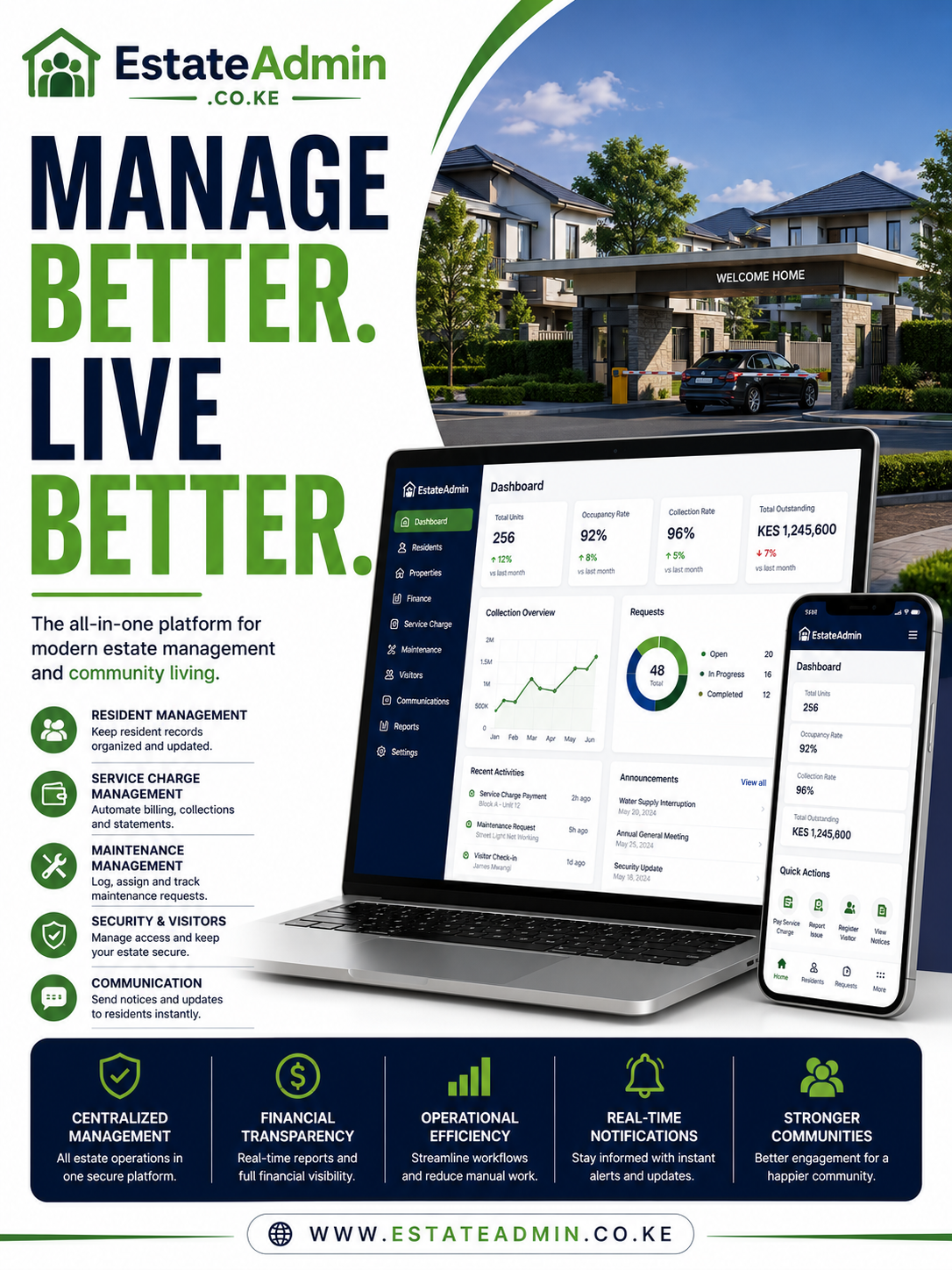
Estate finance management software Nairobi helps property managers, estate administrators, landlords, and management companies organize the financial operations of residential estates, apartments, gated communities, commercial properties, and mixed-use developments. Instead of depending on spreadsheets, notebooks, separate payment records, and manual reports, management can centralize income, expenses, billing, payments, budgets, and financial reporting within one system.
Managing estate finances involves much more than collecting rent. A property may have service charges, utility costs, maintenance expenses, supplier payments, staff costs, reserve funds, insurance, taxes, and other recurring financial obligations. Without proper controls, it can become difficult to know exactly how much money has been collected, where it has been spent, and whether the property is operating within its approved budget.
Modern real estate finance platforms increasingly connect invoicing, receipts, payables, cash flow, budgeting, reporting, and accounting records. This approach gives finance teams a single source of information instead of forcing them to reconcile disconnected spreadsheets and systems.
Table of Contents
ToggleWhat Is Estate Finance Management Software?
Estate finance management software is a digital platform designed to help property owners and managers control the financial activities associated with one or more properties.
The software can bring together:
- Rent and revenue tracking
- Service charge billing
- Invoice management
- Payment collection
- Expense management
- Supplier payments
- Budgeting
- Cash-flow monitoring
- Arrears management
- Financial reporting
- Resident accounts
- Accounting records
- Audit trails
Rather than treating each financial activity as a separate process, the platform connects them.
For example:
Unit → Resident → Invoice → Payment → Receipt → Account balance → Financial report
This connected structure makes it easier for management to follow the movement of money throughout the estate.
Why Estate Financial Management Is Important
Financial management is at the center of successful property operations.
An estate may generate significant revenue every month, but poor financial controls can still create cash-flow problems.
For example, management may collect rent and service charges but fail to track:
- Outstanding balances
- Supplier invoices
- Maintenance costs
- Utility expenses
- Staff payments
- Bank transactions
- Reserve funds
When these records are maintained separately, management may have difficulty obtaining an accurate financial picture.
A centralized system can make these records easier to organize and monitor.
Managing Estate Income
An estate can receive income from several sources.
These may include:
- Rent
- Service charges
- Parking fees
- Water charges
- Facility fees
- Advertising income
- Penalties where applicable
- Other approved property charges
A finance platform can categorize each revenue stream.
This allows management to understand not just how much money was received, but also where the income originated.
Rent Collection
Rent collection is one of the most important financial functions for rental properties.
A digital platform can help management:
- Generate rent invoices
- Track due dates
- Record payments
- Monitor arrears
- Send reminders
- Issue receipts
- Generate tenant statements
This creates a more structured collection process.
Service Charge Management
Service charges are another important source of estate revenue.
These funds may support:
- Security
- Cleaning
- Landscaping
- Waste management
- Common-area electricity
- Lift maintenance
- Repairs
- Estate administration
A finance platform can connect service charge invoices with resident accounts and payment records.
Managing Utility Revenue
Some estates recover utility costs from residents.
Common examples include:
- Water
- Electricity
- Generator charges
- Waste collection
- Other shared utilities
Where the platform supports meter-based billing, management can record consumption and calculate charges according to the configured rates.
Multiple Revenue Streams
One advantage of centralized financial management is the ability to separate revenue categories.
For example:
| Revenue Source | Monthly Amount |
|---|---|
| Rent | KSh 8,000,000 |
| Service charges | KSh 1,500,000 |
| Parking | KSh 300,000 |
| Water recovery | KSh 250,000 |
| Other income | KSh 100,000 |
Management can then analyze each category independently.
Expense Management
Income is only one side of estate finance.
Property managers must also track expenses.
Typical expenses include:
- Security
- Cleaning
- Landscaping
- Repairs
- Plumbing
- Electrical work
- Water
- Electricity
- Waste management
- Lift servicing
- Staff salaries
- Insurance
- Administrative expenses
Expense tracking allows management to understand where estate funds are being spent.
Categorizing Expenses
Every expense should ideally be assigned to an appropriate category.
For example:
Security
Cleaning
Maintenance
Utilities
Administration
Landscaping
This makes financial reporting easier and helps management identify areas where spending is increasing.
Supplier Invoice Management
Estates often work with multiple suppliers.
A property may have separate vendors for:
- Security
- Cleaning
- Landscaping
- Plumbing
- Electrical services
- Lift maintenance
- Waste collection
The finance system can record supplier invoices and track whether they have been approved and paid.
Real-estate finance platforms commonly connect payables and payments to the underlying property or agreement, improving visibility over money leaving the organization.
Accounts Payable
Accounts payable refers to amounts the estate owes to suppliers and service providers.
A centralized system can help management monitor:
- Supplier
- Invoice number
- Invoice date
- Due date
- Amount
- Approval status
- Payment status
This reduces the possibility of forgotten supplier obligations.
Accounts Receivable
Accounts receivable focuses on money owed to the estate.
This can include:
- Rent
- Service charges
- Utility charges
- Parking fees
- Other resident charges
The finance team can monitor outstanding balances and follow up accordingly.
Cash-Flow Management
Cash flow is one of the most important financial indicators for an estate.
Management needs to know:
How much money is coming in?
How much money is going out?
When are payments expected?
Are there enough funds to meet upcoming obligations?
A financial dashboard can help answer these questions.
Real-estate finance systems increasingly provide connected cash-flow reporting alongside invoices, receipts, payables, and payments.
Budgeting for Estates
A budget establishes expected income and expenditure.
For example, an estate may create an annual budget covering:
- Security
- Cleaning
- Maintenance
- Utilities
- Staff
- Insurance
- Administration
- Capital projects
The system can then compare actual performance against the approved budget.
Budget Versus Actual
Suppose the annual maintenance budget is:
KSh 2,000,000
Actual expenditure reaches:
KSh 2,300,000
The variance is:
KSh 300,000
This information allows management to investigate why spending exceeded the original plan.
Forecasting
Historical financial information can support future planning.
Management can analyze previous:
- Rent collections
- Service charge collections
- Utility expenses
- Maintenance costs
- Supplier payments
This can help create more realistic future budgets.
Reserve and Sinking Funds
Large estates may need funds for future capital expenditure.
Examples include:
- Roof replacement
- Lift replacement
- Major plumbing work
- Painting
- Security equipment
- Road repairs
- Generator replacement
A financial management system can help management track these funds separately from ordinary operating expenditure.
Monitoring Maintenance Costs
Maintenance can become one of the largest estate expenses.
A digital platform can help management determine:
- How much has been spent
- Which properties required repairs
- Which suppliers performed the work
- Which maintenance category costs the most
This can reveal spending patterns that may not be obvious from individual invoices.
Preventive Maintenance Planning
Financial management can also support preventive maintenance.
Instead of waiting for equipment to fail, management can plan maintenance expenses in advance.
This can apply to:
- Lifts
- Pumps
- Generators
- Security systems
- Water systems
- Electrical infrastructure
Planned expenditure is easier to incorporate into annual budgets.
Financial Dashboards
A dashboard can give management a quick overview of the estate’s financial position.
Key indicators may include:
- Total income
- Total expenditure
- Outstanding balances
- Collection rate
- Current cash position
- Budget variance
- Supplier liabilities
This reduces the need to manually compile information from multiple spreadsheets.
Income and Expenditure Reports
Management committees often need regular financial reports.
A digital platform can generate reports showing:
- Income
- Expenses
- Net position
- Outstanding receivables
- Outstanding payables
These reports can be reviewed monthly or quarterly.
Profit and Loss Reporting
Where appropriate, a financial system can produce income statements or profit-and-loss reports.
This can help property owners and management companies understand the financial performance of individual properties.
Balance Sheet Information
A more comprehensive accounting environment can also track:
- Assets
- Liabilities
- Receivables
- Payables
- Equity
This is particularly useful for larger property organizations with formal accounting departments.
Bank Reconciliation
Bank reconciliation involves comparing internal financial records with bank transactions.
A digital system can help finance teams identify:
- Deposits
- Payments
- Bank charges
- Unmatched transactions
- Outstanding entries
This improves the accuracy of financial records.
M-PESA Payment Tracking
For estates in Nairobi and across Kenya, M-PESA can be an important payment channel.
A suitable platform can integrate with supported payment workflows to help management identify and allocate resident payments.
A typical process is:
M-PESA payment → Transaction reference → Resident account → Invoice → Updated balance → Receipt
This can reduce manual payment entry.
Payment Reconciliation
Receiving money does not automatically mean the accounting record is complete.
The finance team must identify:
- Who paid
- Which property
- Which unit
- Which invoice
- How much was paid
- What balance remains
Automated reconciliation can simplify this process.
Managing Arrears
Unpaid balances can affect estate cash flow.
A financial dashboard can help identify residents with:
- Current balances
- Overdue invoices
- Long-term arrears
- Partial payments
Management can then prioritize collection activities.
Arrears Aging
An aging report can group outstanding balances by age.
For example:
| Age | Amount |
|---|---|
| Current | KSh 350,000 |
| 30 days | KSh 180,000 |
| 60 days | KSh 100,000 |
| 90 days | KSh 70,000 |
| Over 90 days | KSh 50,000 |
This helps management identify accounts that may require urgent attention.
Automated Payment Reminders
Manual reminders can take significant time.
A digital platform can automate reminders based on billing dates and account status.
Messages can be sent:
- Before the due date
- On the due date
- After the due date
- During arrears follow-up
This creates a consistent collection process.
Digital Receipts
After payment, residents should receive confirmation.
A digital receipt can contain:
- Receipt number
- Resident
- Unit
- Amount
- Payment method
- Transaction reference
- Date
- Remaining balance
This creates a useful record for both parties.
Resident Statements
A resident statement provides a complete account history.
It can show:
- Previous balance
- New invoices
- Payments
- Credits
- Adjustments
- Closing balance
Residents can use statements to verify their accounts.
Financial Transparency
Transparency is important in estate management.
Residents and management committees need confidence that financial records are accurate.
A digital system can make financial information easier to organize and retrieve.
This can help answer questions such as:
How much was collected this month?
How much remains outstanding?
How much was spent on maintenance?
Which suppliers have been paid?
Audit Trails
An audit trail provides a history of financial activities.
It can show:
- Who created a transaction
- Who edited it
- Who approved it
- Who recorded payment
- When the action occurred
This strengthens accountability.
Role-Based Permissions
Different employees should have different levels of access.
For example:
Accountant: Financial transactions
Estate Manager: Property and resident information
Maintenance Officer: Maintenance records
Administrator: System configuration
Committee Member: Reports
This reduces the risk of unauthorized financial changes.
Multi-Estate Finance Management
Property management companies may oversee several estates.
A centralized platform can manage multiple properties while maintaining separate financial records.
For example:
Management Company
→ Estate A
→ Estate B
→ Estate C
→ Estate D
Management can then view each estate separately or analyze the portfolio as a whole.
Comparing Estate Performance
Portfolio-level reporting allows managers to compare properties.
For example:
| Estate | Income | Expenses | Outstanding |
|---|---|---|---|
| Estate A | KSh 10M | KSh 7M | KSh 400K |
| Estate B | KSh 8M | KSh 6M | KSh 900K |
| Estate C | KSh 12M | KSh 8M | KSh 300K |
This can help identify properties with unusually high arrears or expenses.
Managing Commercial and Residential Properties
A flexible finance platform can support different property types.
Residential properties may focus heavily on:
- Rent
- Service charges
- Water
- Parking
Commercial properties may have:
- Lease payments
- Service charges
- Utilities
- Parking
- Other commercial fees
Mixed-use developments may require both approaches.
Unit-Level Financial Records
Each unit can maintain its own financial history.
For example:
Apartment A204
- Resident
- Owner
- Rent
- Service charge
- Water
- Parking
- Payments
- Outstanding balance
This makes account management more organized.
Property-Level Financial Records
Management can also view financial information at property level.
This provides an overview of:
- Total income
- Total expenditure
- Arrears
- Supplier obligations
- Budget performance
The combination of unit-level and property-level reporting creates stronger financial visibility.
Cloud-Based Finance Management
Cloud-based systems can allow authorized users to access financial information from different locations.
This can be particularly useful for management companies overseeing properties across Nairobi.
Managers can access the information they need without depending on a single office computer.
Mobile Access
Mobile-friendly platforms allow managers to check financial information while working remotely or visiting properties.
A manager may need to review:
- Outstanding balances
- Recent payments
- Expense approvals
- Supplier invoices
Mobile access can make this information available without requiring a desktop workstation.
Data Security
Financial software contains sensitive information.
Before selecting a platform, management should evaluate:
- Authentication
- Access controls
- Encryption
- User permissions
- Backup procedures
- Audit logs
Security should be treated as part of financial management rather than an afterthought.
Data Backup
Financial records can be extremely difficult to recreate after data loss.
Important information includes:
- Invoices
- Payments
- Resident accounts
- Supplier records
- Expense transactions
- Reports
Regular backups help protect this information.
Accounting Integration
Some estates already use accounting software.
An estate finance platform should therefore be evaluated for integration capabilities.
Connected systems can reduce duplicate data entry and keep financial information synchronized.
Modern real-estate finance platforms increasingly connect budgeting, accounts payable, accounts receivable, procurement, and accounting information in a single environment.
Tax and Compliance Management
Financial software can also assist with maintaining records required for tax and regulatory processes.
Depending on the organization and transaction type, management may need to consider:
- Tax invoices
- VAT
- Rental income obligations
- Payroll obligations
- Supplier documentation
- Applicable electronic invoicing requirements
The exact obligations depend on the entity and transaction, so management should confirm current requirements with the relevant Kenyan authorities or tax adviser.
Reducing Spreadsheet Dependence
Spreadsheets remain useful for analysis, but relying on multiple spreadsheets for an entire estate can create problems.
Common issues include:
- Duplicate information
- Broken formulas
- Manual updates
- Different versions
- Missing transactions
- Difficult reconciliation
A centralized platform can provide one primary source of financial information.
Improving Decision-Making
Better financial data supports better decisions.
Management can use current information to decide:
- Whether expenses are within budget
- Which residents require follow-up
- Whether reserves are sufficient
- Which suppliers need payment
- Whether service charges are adequate
- Where costs are increasing
Instead of relying on assumptions, managers can use actual records.
Saving Administrative Time
Automation can reduce repetitive work.
Staff can spend less time:
- Creating invoices
- Updating spreadsheets
- Calculating balances
- Matching payments
- Preparing reports
- Sending reminders
The time saved can be redirected toward property operations and resident service.
Improving Accountability
When financial transactions are recorded in a structured system, responsibilities become clearer.
Management can identify:
- Who approved an expense
- Who recorded a payment
- Who issued an invoice
- Who modified a financial record
This can strengthen internal controls.
Supporting Estate Committees
Management committees often require clear financial information before making decisions.
A digital system can provide reports on:
- Collections
- Expenses
- Arrears
- Cash flow
- Budget performance
- Maintenance expenditure
This allows committees to make decisions using current financial information.
Supporting Property Owners
Owners may want to understand how their property is performing.
Reports can show:
- Revenue
- Expenses
- Net income
- Occupancy
- Arrears
- Maintenance costs
This gives owners greater visibility into the financial performance of their investments.
Supporting Property Management Companies
For professional property managers, centralized finance software can make it easier to manage several clients.
Each property can maintain separate financial records while the company retains centralized administrative controls.
This can improve scalability.
Choosing Estate Finance Software in Nairobi
Before selecting Estate finance management software Nairobi, property managers should evaluate the platform against the actual requirements of the estate.
Important features include:
- Rent management
- Service charge billing
- M-PESA payment integration
- Invoice management
- Expense tracking
- Supplier management
- Budgeting
- Cash-flow reporting
- Arrears management
- Financial statements
- Resident portals
- Accounting integration
- Audit trails
- Role-based permissions
- Multi-property support
- Mobile access
- Data backups
The best system should simplify the existing workflow rather than introduce unnecessary complexity.
Questions to Ask Software Providers
Before implementation, management should ask:
- Can the platform manage multiple estates?
- Can it handle service charge billing?
- Can it track rental income?
- Does it support M-PESA workflows?
- Can payments be reconciled automatically?
- Can residents access statements?
- Can it track arrears?
- Can supplier invoices be managed?
- Does it support budgets?
- Can it generate cash-flow reports?
- Does it provide audit trails?
- Can user permissions be customized?
- Can it integrate with accounting software?
- How are backups handled?
- How is financial data protected?
- Can reports be exported?
- Can the system be accessed on mobile devices?
- What support is provided during implementation?
These questions can help management compare solutions based on practical needs rather than marketing claims.
Measuring the Results
After implementation, estate managers should monitor measurable improvements.
Useful indicators include:
Collection Rate
How much of the amount billed is actually collected?
Arrears
Is the outstanding balance increasing or decreasing?
Reconciliation Time
How long does it take to match payments with accounts?
Expense Control
Are actual expenses remaining within approved budgets?
Reporting Time
How long does it take to produce monthly financial reports?
Administrative Workload
How much manual work has been eliminated?
These measurements help determine whether the software is providing meaningful value.
The Future of Estate Financial Management
Estate finance technology is moving toward greater automation and integration.
Future platforms are likely to combine:
- Digital payments
- Automated reconciliation
- Smart meters
- Mobile applications
- AI analytics
- Predictive forecasting
- Accounting integrations
- Automated financial reporting
This means property finance management can become increasingly proactive.
AI-Powered Financial Analysis
Artificial intelligence can analyze large amounts of estate financial information and identify patterns.
For example, AI could potentially highlight:
- Increasing arrears
- Unusual expenses
- Declining collection rates
- Unexpected utility consumption
- Repeated supplier cost increases
These insights could help managers investigate potential problems earlier.
Smart Meter Integration
Smart water and electricity meters can provide consumption information automatically.
When connected to financial software, consumption can potentially flow directly into billing calculations.
The workflow could become:
Meter reading → Consumption → Charge → Invoice → Payment
This reduces manual data entry.
Predictive Cash-Flow Management
Historical payment and expense data can support cash-flow forecasting.
Management may be able to estimate expected collections and upcoming expenses more accurately.
This can help prevent avoidable cash shortages.
Fully Connected Estate Management
The future of estate finance is not just about accounting.
Financial management can connect with:
- Property management
- Resident management
- Maintenance
- Vendor management
- Payments
- Communication
- Reporting
The result is a unified operating environment.
Smarter Accounting, Budgeting, Collections and Financial Control
Estate finance management software Nairobi gives property managers, estate administrators, landlords, management companies, and estate committees a centralized way to manage the financial operations of residential and commercial properties. Instead of depending on multiple spreadsheets, payment messages, paper receipts, and disconnected accounting records, management can bring billing, collections, expenses, budgets, reconciliations, and reporting into one digital environment.
Modern property-management platforms in Kenya are increasingly combining financial management with rent and service-charge collection, M-PESA and bank payments, accounting, resident portals, maintenance, and reporting. For example, Kenyan platforms now offer features such as double-entry accounting, accounts receivable and payable aging, budgets, owner reporting, and automated payment reconciliation.
Understanding Estate Financial Management
Estate finance covers every financial transaction associated with operating a property.
For a residential estate, this may include:
- Rent
- Service charges
- Water charges
- Parking fees
- Maintenance contributions
- Utility recoveries
- Supplier payments
- Security costs
- Cleaning costs
- Landscaping
- Repairs
- Staff expenses
- Insurance
- Administrative expenses
Without a centralized financial system, these activities can quickly become difficult to track.
A digital platform creates a structured relationship between the property, units, residents, invoices, payments, expenses, and financial reports.
Bringing Estate Income Into One System
Property managers may receive money through several channels.
Residents might pay through:
- M-PESA
- Bank transfers
- Other supported payment channels
The finance team then needs to identify the payment and allocate it to the correct account.
A connected platform can simplify this workflow.
Payment received → Resident identified → Unit identified → Invoice matched → Account updated → Receipt issued
This reduces unnecessary manual work.
Managing Service Charge Revenue
Service charges are often essential to the operation of residential estates.
They may fund:
- Security
- Cleaning
- Garbage collection
- Landscaping
- Common-area electricity
- Lift maintenance
- Water systems
- Repairs
- Property administration
A financial management platform can track how much has been billed, how much has been collected, and what remains outstanding.
Connecting Service Charges With Expenses
The real financial value comes from comparing collections with expenditure.
For example:
Service charges collected: KSh 2,000,000
Estate expenses: KSh 1,750,000
Remaining operating funds: KSh 250,000
Management can then determine whether the estate is collecting enough to cover its operational obligations.
Managing Rental Income
For rental estates, rent may represent the largest revenue source.
A centralized platform can track:
- Tenant
- Unit
- Rent amount
- Due date
- Invoice
- Payment
- Balance
- Arrears
This creates a complete financial record for each unit.
Combining Rent and Service Charges
Some properties need to manage several recurring charges at once.
For example:
Rent: KSh 45,000
Service charge: KSh 8,000
Water: KSh 2,000
Parking: KSh 3,000
Total: KSh 58,000
A consolidated billing system can present these charges clearly instead of requiring separate manual records.
Payment Reconciliation
Payment reconciliation is one of the most important finance functions.
When an estate receives hundreds of payments, staff need to determine which payment belongs to which resident and invoice.
Modern Kenyan property platforms advertise automatic matching and reconciliation of M-PESA and bank payments.
This can significantly reduce manual spreadsheet updates.
Managing Partial Payments
Residents do not always settle the full amount at once.
Suppose an invoice is:
KSh 20,000
The resident pays:
KSh 12,000
The remaining balance is:
KSh 8,000
The system should maintain the outstanding amount and correctly allocate the payment.
This gives management an accurate account balance.
Tracking Unpaid Accounts
Finance teams need to identify unpaid accounts quickly.
A dashboard can display:
- Current balances
- Overdue invoices
- Long-term arrears
- Partial payments
- Total outstanding amount
This makes collection follow-up more systematic.
Arrears Aging Reports
An aging report can divide outstanding balances by how long they have remained unpaid.
For example:
| Aging | Outstanding |
|---|---|
| Current | KSh 400,000 |
| 30 days | KSh 180,000 |
| 60 days | KSh 100,000 |
| 90 days | KSh 60,000 |
| Over 90 days | KSh 35,000 |
This allows management to identify older debts that may require additional attention.
Automated Payment Reminders
Manual follow-up can become expensive for large estates.
Automated reminders can be scheduled around the billing cycle.
For example:
Before due date: Payment reminder
Due date: Payment notification
After due date: Outstanding balance reminder
Long-term arrears: Follow-up notification
This creates a consistent collection process.
Digital Receipts
Digital receipts provide confirmation after payment.
A receipt can include:
- Resident name
- Unit
- Amount
- Date
- Payment method
- Transaction reference
- Receipt number
- Remaining balance
This eliminates much of the need for physical receipt management.
Resident Financial Statements
Residents can benefit from access to complete account statements.
A statement can show:
- Previous balance
- New invoices
- Payments
- Credits
- Adjustments
- Current balance
This makes it easier to understand how an account balance was calculated.
Expense Management
Managing income without tracking expenses gives only half the financial picture.
An estate finance platform can organize expenses by category.
Common categories include:
- Security
- Cleaning
- Repairs
- Utilities
- Landscaping
- Waste management
- Administration
- Insurance
- Maintenance
Categorization makes reporting and budgeting easier.
Supplier Management
Estate managers often work with many suppliers.
For example:
- Security companies
- Cleaning contractors
- Landscaping teams
- Plumbing contractors
- Electrical technicians
- Lift companies
- Waste collection companies
A financial system can maintain supplier records and associate invoices and payments with the appropriate vendor.
Tracking Supplier Invoices
Each supplier invoice can contain:
- Supplier
- Invoice number
- Date
- Amount
- Due date
- Approval status
- Payment status
This helps management identify outstanding obligations.
Accounts Payable
Accounts payable shows how much the estate owes suppliers.
A dashboard can show:
Total supplier invoices: KSh 3,000,000
Paid: KSh 2,500,000
Outstanding: KSh 500,000
This gives the finance team greater control over upcoming obligations.
Accounts Receivable
Accounts receivable represents money owed to the estate.
This may include:
- Rent
- Service charges
- Water charges
- Parking
- Other approved fees
Management can use receivables reports to monitor collection performance.
Budget Management
Budgeting is essential for controlling estate expenditure.
Management can create annual or monthly budgets for:
- Security
- Cleaning
- Maintenance
- Utilities
- Staff
- Administration
- Capital projects
Actual expenditure can then be compared with the approved budget.
Budget Variance Analysis
Suppose the approved annual cleaning budget is:
KSh 1,200,000
Actual spending reaches:
KSh 1,350,000
The variance is:
KSh 150,000
This prompts management to investigate the reason for the additional expenditure.
Cash-Flow Management
An estate can appear financially healthy while still experiencing cash-flow problems.
For example, the estate may have KSh 2 million in outstanding invoices but only KSh 500,000 available in the bank.
Cash-flow reporting helps management distinguish between:
Money owed
and
Money currently available
This is important when planning supplier and maintenance payments.
Cash Position
A financial dashboard can combine information from different accounts to provide an overview of the estate’s current cash position.
Management can then consider upcoming:
- Supplier payments
- Salaries
- Utility bills
- Maintenance
- Insurance
- Other obligations
Reserve Fund Management
Large properties may need reserves for major future expenses.
Examples include:
- Lift replacement
- Roof repairs
- Painting
- Road resurfacing
- Generator replacement
- Security upgrades
- Major plumbing projects
Tracking reserve funds separately helps management avoid confusing long-term funds with ordinary operating cash.
Capital Expenditure
Capital projects can have significant financial implications.
A project might involve:
Budget: KSh 5,000,000
Contracted amount: KSh 4,800,000
Paid: KSh 3,000,000
Remaining: KSh 1,800,000
A centralized system can help management monitor the project’s financial position.
Financial Reporting
One of the biggest advantages of digital estate finance is automated reporting.
Management can generate reports covering:
- Income
- Expenses
- Payments
- Arrears
- Budgets
- Supplier obligations
- Cash flow
- Resident balances
This reduces the need to manually compile monthly reports.
General Ledger
For larger property organizations, a general ledger provides a structured record of financial transactions.
Modern property platforms can provide double-entry accounting with journals, ledgers, trial balances, profit-and-loss statements, and balance sheets.
This gives finance teams a stronger accounting foundation.
Trial Balance
A trial balance provides a summary of account balances and helps finance teams verify the accounting records.
It can be particularly useful during month-end and year-end financial processes.
Profit and Loss Reporting
Profit-and-loss reporting can help owners and management companies understand the financial performance of a property.
The report can compare:
Income
against
Expenses
to determine the property’s operating result.
Balance Sheet Reporting
Where full accounting functionality is available, the system can also support balance-sheet reporting.
This can include:
- Assets
- Liabilities
- Receivables
- Payables
- Equity
This provides a broader view of the financial position.
Owner Reporting
Property owners may need regular information about their investments.
Reports can show:
- Rental income
- Service charges
- Expenses
- Maintenance costs
- Arrears
- Net income
This allows owners to monitor their properties without relying entirely on manually prepared updates.
Estate Committee Reporting
Management committees may require financial reports before making decisions.
A centralized platform can provide information about:
- Collections
- Expenditure
- Arrears
- Supplier obligations
- Budget performance
- Reserve funds
This supports more informed decision-making.
Multi-Property Financial Management
Property management companies may oversee many developments.
Instead of maintaining separate spreadsheets for every property, a centralized platform can organize the portfolio.
For example:
Company
→ Estate A
→ Estate B
→ Estate C
→ Commercial Property D
Each property maintains its own financial records while authorized users can access portfolio-level information.
Comparing Property Performance
Portfolio reporting allows managers to compare properties.
For example:
| Property | Revenue | Expenses | Arrears |
|---|---|---|---|
| Estate A | KSh 10M | KSh 7M | KSh 400K |
| Estate B | KSh 8M | KSh 6M | KSh 800K |
| Estate C | KSh 12M | KSh 8M | KSh 300K |
This can reveal which property requires additional financial attention.
Managing Mixed-Use Estates
Mixed-use properties may have:
- Apartments
- Shops
- Offices
- Restaurants
- Parking
- Shared facilities
Each category can have different financial requirements.
A flexible platform can organize these revenue and expense structures under the same property.
Financial Management for Gated Communities
Gated communities often depend heavily on service charges.
The system can track:
- Household contributions
- Security costs
- Landscaping
- Waste collection
- Road maintenance
- Lighting
- Water
- Common facilities
This creates a clearer relationship between collections and community expenses.
Financial Management for Apartments
Apartment developments may need to manage:
- Rent
- Service charges
- Water
- Parking
- Maintenance
- Common-area utilities
Connecting these records reduces fragmented financial administration.
Mobile Financial Management
Property managers do not always work from an office.
Mobile-friendly software can allow authorized users to review:
- Payments
- Outstanding accounts
- Expenses
- Supplier invoices
- Reports
This can improve responsiveness.
Some Kenyan property-management platforms provide mobile applications or mobile access for landlords and property managers.
Cloud-Based Access
Cloud software allows authorized users to access financial information from different locations.
This can be useful for:
- Property management companies
- Remote landlords
- Estate committees
- Regional managers
- Accountants
Access should always be controlled using appropriate permissions.
Financial Data Security
Estate financial systems contain sensitive information.
Management should evaluate:
- Authentication
- Role-based access
- Encryption
- Audit logs
- Backups
- Data recovery
- User activity monitoring
Security is essential when financial records are stored digitally.
Audit Trails
An audit trail records important actions.
For example:
Invoice created → Payment recorded → Adjustment made → Approval completed
The system can associate these activities with specific users and timestamps.
This provides greater accountability.
Role-Based Financial Access
Different users should have different permissions.
For example:
Accountant: Financial transactions and reports
Estate Manager: Property and resident information
Administrator: System settings
Committee Member: Approved financial reports
Resident: Personal account
Role-based access helps prevent unauthorized changes.
Integrating Maintenance With Finance
Maintenance and finance are closely connected.
A maintenance request can generate:
Issue → Work order → Supplier → Invoice → Approval → Payment
Connecting these processes allows management to understand the financial impact of maintenance work.
Tracking Maintenance Spending
Management can analyze how much is spent on:
- Plumbing
- Electrical
- Painting
- Lift repairs
- Landscaping
- General repairs
This can help identify recurring problem areas.
Vendor Performance
Financial data can also help management evaluate suppliers.
For example, management may compare:
- Cost
- Frequency of work
- Payment history
- Work completion
- Recurring repairs
This can support better supplier decisions.
Reducing Financial Leakage
One important goal of digital financial management is reducing opportunities for financial leakage.
Centralized records can help identify:
- Duplicate payments
- Unapproved expenses
- Unallocated income
- Missing receipts
- Unusual transactions
- Outstanding supplier invoices
The more connected the records are, the easier it becomes to identify inconsistencies.
Improving Financial Accountability
When every transaction has a clear record, accountability improves.
Management can answer:
Who approved this expense?
Who made the payment?
Which supplier received the money?
Which resident account received this payment?
When was the transaction recorded?
This level of traceability is difficult to maintain through disconnected spreadsheets.
Automating Month-End Processes
Month-end can be one of the busiest periods for finance teams.
Tasks may include:
- Reconciling payments
- Reviewing expenses
- Updating balances
- Preparing reports
- Checking supplier obligations
- Reviewing arrears
Automation can reduce the amount of manual work required.
Closing the Financial Period
A structured financial workflow can help management review transactions before closing a period.
The finance team can verify:
- Income
- Expenses
- Payments
- Receivables
- Payables
- Bank balances
This creates cleaner financial records.
Exporting Financial Data
Management may need to export information for:
- Auditors
- Accountants
- Property owners
- Management committees
- Tax professionals
A platform should therefore provide suitable export and reporting options.
Accounting Software Integration
Some organizations already use accounting platforms.
Integration can allow financial information to flow between the property management system and accounting software.
For example, some Kenyan property platforms support connections with QuickBooks and other accounting tools.
This can reduce duplicate entry.
eTIMS Considerations
Kenyan businesses may have electronic tax invoicing requirements depending on their circumstances.
Property managers should evaluate whether the chosen system supports the applicable KRA eTIMS workflows.
The exact tax requirements can vary depending on the organization, transaction, and taxpayer status, so professional tax guidance may be appropriate.
Improving Financial Decision-Making
The ultimate purpose of financial management software is not simply record keeping.
It is about giving management information that can support better decisions.
For example:
If maintenance costs are increasing, management can investigate.
If arrears are rising, collection policies can be reviewed.
If utility expenses are unusually high, consumption can be analyzed.
If the estate consistently exceeds its budget, expenditure controls may need improvement.
Moving Beyond Spreadsheets
Spreadsheets can remain useful for analysis, but they become difficult to manage when several people edit multiple versions.
Common problems include:
- Duplicate files
- Formula errors
- Missing transactions
- Manual reconciliation
- Version conflicts
- Limited access control
A centralized platform can provide one source of financial information.
Creating a Single Source of Truth
A well-designed estate finance system connects:
Property
→ Unit
→ Resident
→ Invoice
→ Payment
→ Receipt
→ Expense
→ Accounting
→ Report
This makes it easier for different teams to work from consistent information.
What to Look for When Choosing Software
Before purchasing Estate finance management software Nairobi, management should evaluate the platform’s ability to support the entire financial lifecycle.
Important capabilities include:
- Billing
- Rent collection
- Service charge management
- M-PESA integration
- Bank reconciliation
- Expense tracking
- Supplier management
- Budgeting
- Cash-flow reporting
- Arrears management
- Accounting
- Financial statements
- Resident portals
- Owner reporting
- Audit trails
- User permissions
- Multi-property management
- Mobile access
The software should solve the property’s actual financial challenges rather than simply provide a large collection of features.
Advanced Financial Control, Automation and Property Performance
Estate finance management software Nairobi is becoming increasingly important for property managers who need greater control over billing, collections, expenses, budgets, accounting, and financial reporting. As residential estates, apartment complexes, gated communities, commercial buildings, and mixed-use developments become more complex, manual financial processes can make it difficult to maintain accurate records and make timely decisions.
A modern estate finance platform can connect the financial activities of a property from the moment a charge is created to the moment a payment is received, reconciled, reported, and included in financial planning. This creates a more organized environment where managers can monitor the financial health of individual units as well as the entire estate.
Automating Recurring Financial Processes
One of the biggest advantages of digital financial management is automation.
Many estate transactions occur repeatedly every month.
These can include:
- Rent invoices
- Service charges
- Parking charges
- Water bills
- Security contributions
- Utility recoveries
- Supplier payments
- Financial reminders
Instead of recreating these transactions manually every month, management can configure recurring processes.
This can reduce administrative workload and improve consistency.
Automated Invoice Generation
Recurring invoices can be generated according to configured billing schedules.
For example, management may configure:
Monthly rent → 1st of every month
Service charge → 1st of every month
Water → After meter readings
Parking → Monthly
Once the billing rules are established, the system can generate the appropriate invoices.
Automated Notifications
Financial communication can also be automated.
Residents may receive notifications when:
- A new invoice is generated
- A payment is received
- A balance remains outstanding
- A payment is approaching its due date
- A statement becomes available
This keeps residents informed without requiring staff to send every message manually.
Improving Collection Efficiency
Collection performance is one of the most important financial indicators for an estate.
Management can calculate:
Collection Rate = Amount Collected ÷ Amount Billed × 100
For example:
If an estate bills KSh 5 million and collects KSh 4.7 million:
Collection rate = 94%
Monitoring this percentage every month helps management understand whether collections are improving or deteriorating.
Identifying Collection Problems
A digital platform can help identify why collections may be falling.
Possible causes include:
- Incorrect invoices
- Payment difficulties
- Poor communication
- High arrears
- Disputed charges
- Incorrect resident records
Once the problem is identified, management can take appropriate action.
Managing Disputed Charges
Billing disputes can consume considerable administrative time.
A system can maintain the invoice and related account information while management investigates the dispute.
The record may contain:
- Original invoice
- Payment history
- Adjustments
- Notes
- Communication history
- Final resolution
This provides a documented financial trail.
Credit Notes and Adjustments
Financial management sometimes requires corrections.
For example, an invoice may have been generated with an incorrect amount.
Rather than deleting the transaction completely, the system should support appropriate adjustments or credit notes.
This preserves financial history while correcting the account.
Avoiding Duplicate Transactions
Duplicate entries can distort financial reports.
A centralized system can help reduce duplicate:
- Invoices
- Payments
- Supplier expenses
- Receipts
This is particularly useful in estates with many monthly transactions.
Managing Financial Approvals
Expenses should not necessarily move directly from creation to payment.
A controlled workflow can be:
Expense request → Review → Approval → Supplier invoice → Payment → Record
This provides stronger financial controls.
Approval Limits
Different employees can have different approval responsibilities.
For example:
- Estate manager: Approves smaller operational expenses
- Finance manager: Approves larger transactions
- Committee: Approves major capital projects
The exact structure should reflect the organization’s governance policies.
Procurement and Financial Control
Large estates may purchase services and materials regularly.
A connected system can help management track:
- Purchase requests
- Supplier quotations
- Approved suppliers
- Purchase orders
- Supplier invoices
- Payments
This creates greater visibility over procurement expenditure.
Comparing Supplier Costs
Historical supplier data can help management compare costs.
For example, the estate may discover that maintenance expenditure from a particular category has increased significantly.
Management can then review supplier rates, service frequency, or contract terms.
Contract-Based Financial Management
Estates often have recurring supplier contracts.
Examples include:
- Security contracts
- Cleaning contracts
- Lift maintenance
- Landscaping
- Waste management
The system can help management monitor contract costs and renewal dates.
Tracking Recurring Expenses
Recurring expenses can be scheduled and monitored.
For example:
Security: Monthly
Cleaning: Monthly
Lift maintenance: Quarterly
Insurance: Annual
This helps management include predictable expenses in budgets.
Financial Forecasting
Historical financial data can support forecasting.
Management can analyze previous:
- Collections
- Expenses
- Maintenance
- Utilities
- Arrears
- Supplier costs
This information can help create realistic financial forecasts.
Forecasting Estate Cash Flow
A cash-flow forecast can estimate expected income and expenditure.
For example:
Expected collections: KSh 4,500,000
Expected supplier payments: KSh 2,000,000
Expected salaries: KSh 800,000
Expected utilities: KSh 600,000
Expected maintenance: KSh 500,000
Management can then estimate the expected cash position.
Managing Seasonal Expenses
Some estate expenses may fluctuate throughout the year.
Utility consumption, maintenance, security requirements, and major repairs may change over time.
Historical information can help management anticipate these variations.
Financial Performance Dashboards
A financial dashboard should make important information easy to understand.
A manager might see:
Total Revenue
Total Expenses
Outstanding Arrears
Collection Rate
Current Cash
Budget Variance
Supplier Payables
This gives management a quick overview before they examine detailed reports.
Real-Time Financial Visibility
When payments and expenses are recorded promptly, management can access more current information.
This is particularly valuable for large estates where financial activity happens continuously.
Instead of waiting for a spreadsheet to be updated at the end of the week, management can review the current system records.
Financial KPIs for Estates
Property managers can monitor key performance indicators such as:
Collection Rate
Measures how much of the billed amount has been collected.
Arrears Ratio
Shows the proportion of outstanding charges relative to total billing.
Expense Variance
Measures the difference between budgeted and actual expenditure.
Operating Cost Per Unit
Shows average estate operating expenditure per unit.
Maintenance Cost
Tracks spending on repairs and maintenance.
Supplier Outstanding
Shows unpaid supplier obligations.
These indicators help turn financial data into management information.
Cost Per Unit Analysis
Large estates can calculate the average operating cost per unit.
For example:
Total annual operating expenditure: KSh 12,000,000
Units: 400
Average annual cost per unit: KSh 30,000
This information can help management evaluate service-charge structures and future budgets.
Service Charge Budgeting
Service charges should ideally be based on realistic operating costs.
Management can review historical expenditure before establishing future service-charge budgets.
This may include:
- Security
- Cleaning
- Landscaping
- Utilities
- Maintenance
- Administration
- Reserve contributions
Accurate budgeting reduces the risk of underfunding essential services.
Reviewing Service Charge Performance
After implementing a budget, management can compare:
Budgeted service charge income
against
Actual service charge collections
and
Actual operating expenditure
This provides a clearer picture of whether the estate’s service-charge structure is financially sustainable.
Managing Utility Costs
Utility expenditure can represent a significant part of estate operating costs.
Management can monitor:
- Water
- Electricity
- Generator fuel
- Common-area lighting
Unexpected increases can then be investigated.
Detecting Unusual Expenses
Digital reporting can make unusual financial activity easier to identify.
For example:
A normal monthly maintenance expense might be KSh 200,000.
If it suddenly rises to KSh 600,000, management can investigate.
The increase may be legitimate, but the system makes the variance visible.
Detecting Unusual Payment Patterns
The same principle applies to collections.
If an estate normally collects KSh 4 million per month but suddenly collects only KSh 2.8 million, management can investigate the reason.
Potential explanations could include:
- Delayed billing
- Payment-channel issues
- Resident disputes
- Increasing arrears
- Data problems
Digital Audit Preparation
Preparing for an audit can be easier when financial records are organized digitally.
Management can retrieve:
- Invoices
- Receipts
- Payment records
- Expense transactions
- Supplier invoices
- Bank reconciliation records
- Financial reports
This reduces the time spent searching through physical documents.
Maintaining Document Attachments
Where supported, financial transactions can be associated with relevant documents.
For example, an expense record may contain:
- Supplier invoice
- Approval documentation
- Payment confirmation
- Supporting quotation
This creates a more complete financial record.
Paperless Financial Administration
Digital records can reduce dependence on physical paperwork.
Instead of storing boxes of:
- Receipts
- Invoices
- Statements
- Supplier documents
management can maintain digital records that are easier to search and retrieve.
Improving Communication Between Departments
Estate financial information may be used by several teams.
For example:
Maintenance → Finance
Maintenance identifies a repair and provides the financial requirement.
Finance → Management
Finance reports the expenditure.
Management → Committee
Management presents the financial impact.
A centralized platform can help different departments work from consistent information.
Connecting Residents With Management
A resident portal can make financial communication more direct.
Residents may be able to:
- View invoices
- View balances
- Download statements
- Download receipts
- Make payments
- Submit queries
This can reduce unnecessary administrative interactions.
Self-Service Financial Information
If residents can access their own account information, they may not need to contact the management office for every question.
For example, instead of asking:
“How much do I owe?”
the resident can log in and view the current balance.
This can save time for both residents and management.
Financial Communication Through Mobile Channels
Because many residents use smartphones as their primary digital device, mobile-friendly financial services are increasingly useful.
Payment notifications, invoice alerts, and account statements can be delivered through supported digital channels.
Managing Property Portfolios
Professional property managers can use portfolio-level dashboards to monitor multiple estates.
For example:
Portfolio
→ Residential Estate A
→ Residential Estate B
→ Apartment Development C
→ Commercial Building D
Management can view each property separately while maintaining centralized controls.
Portfolio-Wide Financial Reporting
Portfolio reporting can answer questions such as:
- Which property has the highest collection rate?
- Which property has the largest arrears?
- Which property has the highest maintenance costs?
- Which property is exceeding its budget?
This helps management prioritize resources.
Consolidated Reporting
Where appropriate, property management companies can generate consolidated reports covering multiple properties.
This can simplify management reporting while retaining property-specific information.
Scalability
Software should be capable of growing with the property portfolio.
A system that works for 50 units should ideally have a clear path for managing:
- 200 units
- 500 units
- 1,000 units
- Multiple properties
Scalability should be considered before implementation rather than after the organization has outgrown the system.
Managing Estate Growth
When an estate expands, financial complexity increases.
There may be:
- More residents
- More invoices
- More payment transactions
- More suppliers
- More expenses
- More reports
Automation becomes increasingly valuable as transaction volume grows.
Financial Management for Nairobi Properties
Nairobi has a wide range of property developments, from apartment buildings and gated communities to commercial and mixed-use developments.
These properties can have very different financial requirements.
A flexible platform should allow management to configure charges, expenses, users, properties, and reporting according to the actual operating structure.
M-PESA and Digital Payments
Digital payments are particularly relevant to Kenyan property management.
A system supporting appropriate payment integrations can reduce manual processes around payment identification and allocation.
The goal is not simply to accept payments but to connect payments with the correct financial accounts.
Bank Payment Management
Some residents and commercial tenants may prefer bank transfers.
A complete financial environment should therefore be capable of handling multiple payment channels and reconciling them appropriately.
Managing Payment References
Payment references can help identify transactions.
For example:
Resident → Unit → Invoice → Payment Reference
Maintaining these relationships improves reconciliation and reduces unidentified payments.
Handling Unidentified Payments
Sometimes money reaches an estate account without sufficient information.
A centralized system can allow finance staff to record unidentified transactions temporarily and resolve them after obtaining the necessary information.
This is safer than forcing a payment into an incorrect resident account.
Financial Data Retention
Property financial information may need to remain accessible for extended periods.
Management should establish appropriate retention policies for:
- Invoices
- Receipts
- Payments
- Supplier documents
- Reports
- Accounting records
Retention requirements can vary depending on the organization and applicable laws.
Data Privacy
Resident information should be handled responsibly.
Financial systems may contain:
- Names
- Contact details
- Unit information
- Payment information
- Account balances
Management should implement appropriate controls to prevent unauthorized access.
Choosing Cloud Software
Cloud platforms can be useful for organizations with distributed teams.
Before choosing a cloud platform, management should investigate:
- Data hosting
- Backup procedures
- Availability
- Security
- Access controls
- Recovery procedures
A provider should be able to explain how customer data is protected.
Implementation Strategy
Successful implementation should follow a structured process.
Step One: Assess Current Processes
Document how the estate currently manages:
- Billing
- Payments
- Expenses
- Suppliers
- Budgets
- Reports
Step Two: Clean Existing Data
Review resident, unit, supplier, invoice, and balance information.
Step Three: Configure Financial Rules
Set up:
- Charges
- Billing schedules
- Expense categories
- Payment methods
- Approval workflows
Step Four: Import Data
Transfer verified information into the platform.
Step Five: Train Users
Train:
- Finance staff
- Property managers
- Administrators
- Other authorized users
Step Six: Test
Run sample:
- Invoices
- Payments
- Receipts
- Reconciliations
- Reports
Step Seven: Launch
Begin live operations once the system has been verified.
Step Eight: Monitor
Review performance after launch and correct issues.
Measuring Software ROI
Management should evaluate whether the software provides measurable value.
Potential improvements include:
- Reduced administrative hours
- Faster reconciliation
- Better collection rates
- Lower billing errors
- Faster reporting
- Better expense control
- Improved resident communication
These indicators help justify the technology investment.
Common Implementation Challenges
Some organizations may face challenges during implementation.
Poor Data Quality
Incorrect information can lead to incorrect financial records.
Resistance to Change
Staff accustomed to spreadsheets may need time to adapt.
Incomplete Configuration
If billing rules are not configured correctly, invoices may be inaccurate.
Insufficient Training
Users need practical training, not simply access to the platform.
Weak Communication
Residents should understand the new billing and payment process.
How to Avoid Implementation Problems
A strong implementation plan should include:
- Data verification
- User training
- Testing
- Clear responsibilities
- Resident communication
- Support during launch
- Regular performance reviews
This makes the transition smoother.
The Role of Automation in Future Estate Finance
Automation will continue to change property finance management.
Future systems are likely to automate more activities involving:
- Billing
- Payment matching
- Expense classification
- Reporting
- Forecasting
- Resident communication
This can allow finance teams to focus increasingly on analysis and decision-making.
Artificial Intelligence and Estate Finance
AI can potentially analyze large financial datasets and identify patterns that require attention.
For example, an AI-assisted platform could highlight:
- Unusual expense increases
- Declining collection rates
- High-risk arrears
- Repeated supplier cost increases
- Unexpected utility changes
Human review would still remain important, especially for financial decisions.
Smart Property Technology
Estate finance systems can also connect with other property technologies.
Potential integrations include:
- Smart water meters
- Electricity meters
- Access-control systems
- Parking systems
- Maintenance platforms
- Resident applications
This creates a broader digital property ecosystem.
From Financial Records to Financial Intelligence
Traditional accounting mainly focuses on recording what happened.
Modern estate finance technology can go further by helping management understand:
What happened?
Why did it happen?
What is likely to happen next?
What action should management consider?
This shift from record keeping to financial intelligence can make property management more proactive.
Building a Strong Financial Culture
Technology alone cannot guarantee good financial management.
Estate management should also establish:
- Clear approval procedures
- Defined financial responsibilities
- Regular reporting
- Budget reviews
- Collection policies
- Expense controls
- Audit procedures
Software should support these processes rather than replace good governance.
Why Nairobi Property Managers Need Better Financial Controls
As property portfolios grow, the volume of financial transactions grows with them.
A manager overseeing a few units may manage accounts manually.
A professional management company handling hundreds or thousands of units requires stronger systems.
The more properties and transactions an organization handles, the more valuable centralized financial management becomes.
Final Conclusion
Estate finance management software Nairobi can transform the way property managers control financial operations by bringing billing, collections, expenses, budgeting, accounting, reconciliation, reporting, and financial planning into a connected system.
The biggest advantage is not simply automation. It is the ability to create a reliable financial picture of the estate.
Management can determine how much has been billed, how much has been collected, which accounts are in arrears, how much is owed to suppliers, whether expenses are within budget, and how much cash is available for upcoming obligations.
Digital payment integration can simplify the movement from payment to account reconciliation, while automated invoices, reminders, receipts, and statements can improve both administrative efficiency and the resident experience.
For management committees and property owners, financial dashboards and reports provide greater visibility into how estate funds are being collected and spent. For professional property managers, multi-property functionality makes it easier to scale operations without creating a growing collection of disconnected spreadsheets.
The technology can also connect finance with maintenance, procurement, supplier management, resident services, and accounting. This creates a more complete property-management environment where financial information is connected to the activities that generate income and expenditure.
Looking ahead, artificial intelligence, smart meters, mobile applications, automated reconciliation, predictive analytics, and deeper accounting integrations will make estate financial management increasingly sophisticated.
However, successful financial management still depends on accurate data, clear procedures, trained employees, appropriate permissions, and strong governance.
The right platform should therefore be selected based on the actual needs of the estate. It should make billing easier, improve payment tracking, control expenditure, strengthen accountability, simplify reporting, and provide management with reliable information for decision-making.
For property owners, estate committees, landlords, and management companies operating in Nairobi, moving from fragmented manual financial administration to a connected digital environment can provide a stronger foundation for efficient, transparent, and scalable property management.