
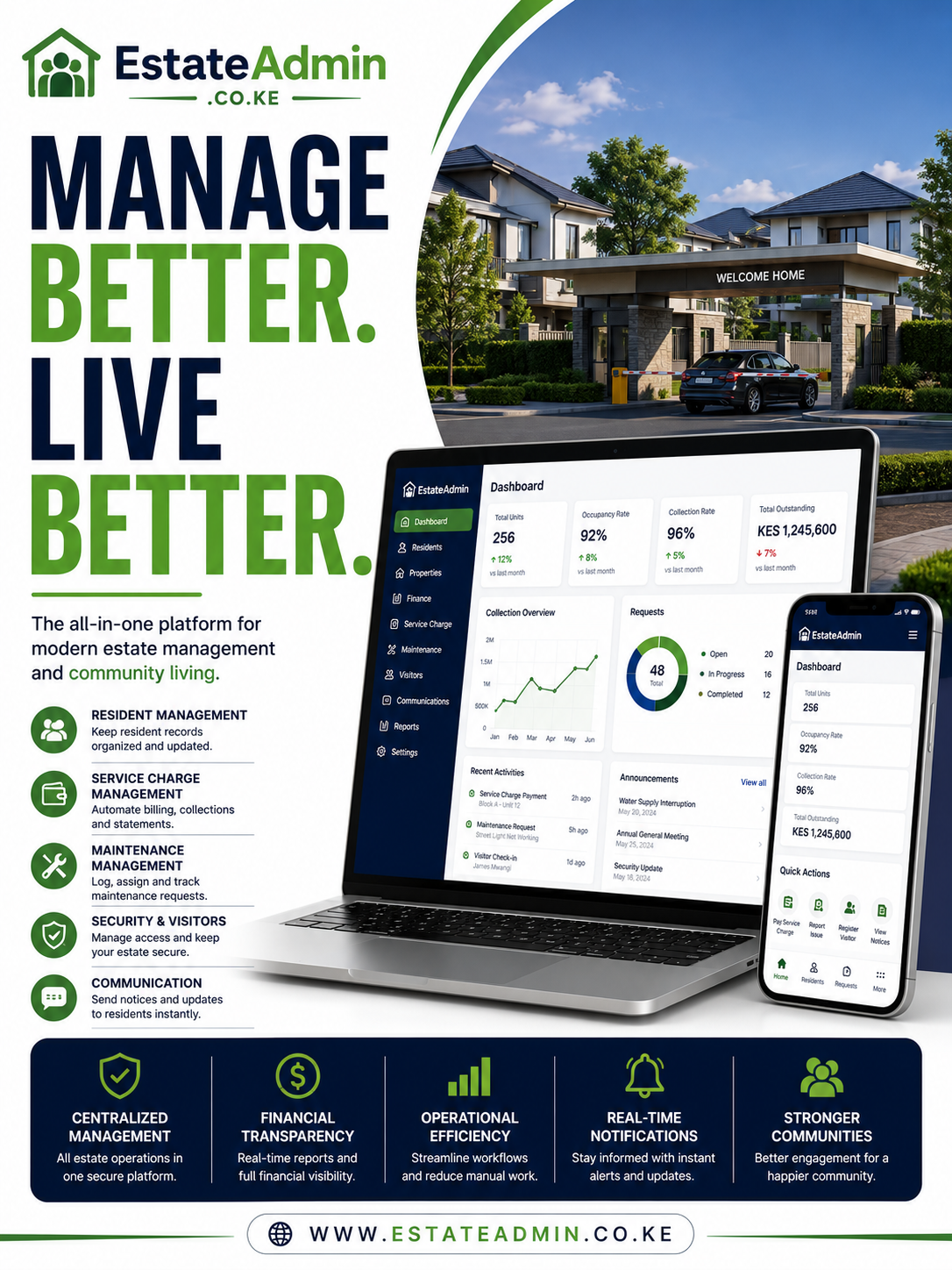
Residents management system Kenya solutions are helping property managers, estate administrators, landlords, gated communities, apartment managers, and homeowners associations organize residential operations more efficiently. As residential communities grow, managing residents through spreadsheets, paper files, WhatsApp messages, and separate payment records can become increasingly difficult.
A modern digital platform provides a centralized way to manage resident information, units, communication, payments, service requests, visitor information, notices, and property records. Instead of relying on disconnected systems, management teams can access important residential information from one organized platform.
For Kenyan residential properties, the need for efficient resident administration is particularly important as apartment developments, gated communities, and managed estates continue to require better communication and more structured administration. A Residents management system Kenya platform can help management teams improve record keeping, simplify communication, monitor payments, and provide better services to residents.
Table of Contents
ToggleWhat Is a Residents Management System?
A residents management system is software designed to help residential property managers organize information and activities involving people living within an estate, apartment complex, gated community, or other managed residential development.
The system can maintain information about:
- Residents
- Property owners
- Tenants
- Units
- Apartments
- Houses
- Parking spaces
- Service charges
- Payments
- Maintenance requests
- Visitors
- Communication
- Community notices
By bringing this information together, management can reduce the need for multiple spreadsheets and manual records.
A Residents management system Kenya platform can also provide residents with self-service features, depending on the software being used.
Why Resident Management Is Important
Managing a residential community involves much more than knowing who occupies each unit.
Management may need to know:
- Who lives in each unit
- Who owns each property
- Which residents have outstanding payments
- Which maintenance requests are open
- Which visitors entered the property
- Which notices have been communicated
- Which units are occupied or vacant
When this information is not organized, management can spend significant amounts of time searching for records and responding to routine questions.
A centralized system makes these processes easier to manage.
Challenges of Manual Resident Management
Paper-Based Records
Some residential communities still depend heavily on paper files.
Paper records can become difficult to manage when the number of residents increases.
Problems may include:
- Lost documents
- Damaged records
- Difficult searches
- Duplicate information
- Slow updates
- Limited access
Digital records provide a more convenient alternative.
Spreadsheet Management
Spreadsheets are useful for basic record keeping, but they can become complicated when several people manage the same property.
Different spreadsheets may contain different information about the same resident.
This can lead to:
- Inconsistent records
- Incorrect contact details
- Duplicate entries
- Outdated information
- Difficult reporting
A centralized Residents management system Kenya solution provides one primary database for residential information.
Centralized Resident Profiles
Every resident can have a digital profile containing important information.
A profile may include:
- Full name
- Phone number
- Email address
- Unit number
- Resident type
- Move-in date
- Emergency contact
- Vehicle information
- Account information
Management can update the profile whenever resident information changes.
This creates a reliable source of information for daily operations.
Owner and Tenant Management
Residential properties may contain both owners and tenants.
A good system should distinguish between:
- Property owners
- Tenants
- Family members
- Domestic workers
- Authorized occupants
This helps management understand who is authorized to occupy each unit.
It also makes communication more accurate because notices can be directed to the appropriate person.
Unit Management
Resident information should be connected to specific properties and units.
For example:
Estate → Block → Floor → Unit → Resident
This structure allows management to quickly determine who occupies a particular unit.
Unit records can include:
- Unit number
- Building
- Floor
- Owner
- Tenant
- Occupancy status
- Parking allocation
- Account information
This is particularly useful for apartment complexes with hundreds of units.
Occupancy Management
A Residents management system Kenya platform can help managers monitor occupancy.
Units can be categorized as:
- Occupied
- Vacant
- Reserved
- Under maintenance
- Awaiting occupancy
This provides property managers with a clearer overview of the residential development.
Resident Registration
New residents need to be registered before moving into a managed community.
A digital registration process can collect:
- Resident details
- Unit information
- Contact details
- Identification information
- Vehicle details
- Emergency contacts
- Occupancy information
Once approved, the resident can be associated with the relevant unit.
This reduces the need for repetitive manual data entry.
Resident Move-In Management
Moving into a new residential property involves several administrative activities.
Management may need to record:
- Move-in date
- Resident details
- Unit details
- Parking allocation
- Access information
- Deposit information
- Initial property condition
A digital platform can centralize these records.
Resident Move-Out Management
When a resident leaves, management should update the unit status and resident information.
The system can record:
- Move-out date
- Final account balance
- Outstanding charges
- Property inspection
- Key return
- Parking access
- Unit status
This helps maintain accurate occupancy records.
Service Charge Management
Many residential communities collect service charges to fund shared services.
These may include:
- Security
- Cleaning
- Garbage collection
- Landscaping
- Common-area electricity
- Water
- Lift maintenance
- Shared facilities
A Residents management system Kenya platform can connect residents to their service charge accounts.
Management can generate charges, track payments, monitor outstanding balances, and provide statements.
Payment Tracking
Payment records should be associated with the correct resident and unit.
The system can record:
- Payment amount
- Payment date
- Payment method
- Transaction reference
- Invoice
- Account balance
This improves financial visibility.
M-PESA Payment Support
M-PESA is widely used for digital payments in Kenya.
Where supported, a Residents management system Kenya solution can integrate M-PESA payment workflows into resident accounts.
This can simplify:
- Service charge payments
- Rent payments
- Facility charges
- Other approved property payments
A connected process can reduce manual payment entry and make account updates more efficient.
Automated Payment Reminders
Outstanding payments require consistent follow-up.
Instead of manually contacting every resident, management can use automated reminders.
Notifications can be sent:
- Before the due date
- On the due date
- After the due date
- When an account becomes overdue
This creates a more consistent collection process.
Digital Receipts and Statements
Residents often need confirmation of payments.
Digital receipts can provide:
- Resident name
- Unit
- Amount paid
- Date
- Transaction reference
- Remaining balance
Statements can provide a broader history of charges and payments.
This can make it easier to resolve account questions.
Resident Communication
Communication is one of the most important functions of residential management.
Management may need to notify residents about:
- Water interruptions
- Security updates
- Maintenance
- Community meetings
- Service charge deadlines
- Parking changes
- Cleaning schedules
- Emergency information
A Residents management system Kenya platform can provide centralized communication tools for these announcements.
Community Announcements
Instead of relying entirely on informal messaging groups, management can publish official announcements through a resident platform where available.
This creates a more organized communication channel.
Announcements can be categorized according to:
- General notices
- Maintenance
- Security
- Financial information
- Community events
- Emergency notices
Maintenance Request Management
Residents frequently report property issues.
Common requests include:
- Plumbing problems
- Electrical faults
- Water leaks
- Broken lights
- Damaged gates
- Lift problems
- Drainage issues
- Common-area repairs
A digital maintenance module allows residents to submit requests while management tracks their progress.
Tracking Maintenance Status
Each maintenance request can have a status such as:
- New
- Assigned
- In progress
- Awaiting parts
- Completed
- Closed
This gives management a clear view of unresolved issues.
It also helps prevent maintenance requests from being forgotten.
Resident Feedback
A digital system can also provide ways for residents to submit feedback.
Feedback may concern:
- Security
- Cleaning
- Maintenance
- Communication
- Shared facilities
- Property management
Management can use this information to identify recurring problems and improve services.
Visitor Management
Visitor management is another important function for residential communities.
A digital system can help record visitor information such as:
- Visitor name
- Resident being visited
- Date
- Time
- Vehicle registration
- Visit status
Depending on the platform, residents may also be able to authorize visitors in advance.
Vehicle and Parking Management
Many apartment complexes and gated estates have limited parking spaces.
A resident management platform can connect vehicles with specific residents and units.
Records may include:
- Vehicle registration
- Vehicle type
- Resident
- Unit
- Parking space
- Parking status
This can help management maintain better control over parking areas.
Security Management
Resident records can support security operations by helping security teams verify authorized occupants and visitors.
Management can maintain information about:
- Residents
- Vehicles
- Visitors
- Contractors
- Domestic workers
- Service providers
This creates a more organized approach to residential security administration.
Domestic Worker Management
Some residential communities need to manage information about domestic workers and other authorized personnel.
Records can include:
- Name
- Resident connection
- Unit
- Contact information
- Authorization status
This can help security and management teams maintain accurate access records.
Contractor Management
Residential communities depend on contractors for various services.
These may include:
- Plumbing
- Electrical work
- Cleaning
- Landscaping
- Pest control
- Security
- Lift maintenance
A centralized system can maintain contractor information and associate contractors with maintenance jobs.
Resident Access Control
Some modern residential properties use electronic access systems.
Where integrations are available, resident information can potentially connect with:
- Gate access
- Access cards
- Digital visitor authorization
- Parking access
This can improve coordination between resident administration and physical property access.
Financial Reporting
Management committees and property owners need accurate reports.
A resident management platform can provide reports covering:
- Resident accounts
- Service charge collections
- Outstanding balances
- Payments
- Unit occupancy
- Maintenance
- Visitor activity
These reports can support better decision-making.
Improving Transparency
Transparency helps build trust between residents and property management.
Residents are more likely to understand property administration when they can access accurate information about their own accounts and receive timely communication.
A Residents management system Kenya platform can support this transparency through digital statements, payment records, announcements, and service requests.
Benefits for Property Managers
A centralized resident management platform can help property managers:
- Reduce paperwork
- Improve record accuracy
- Automate communication
- Track payments
- Monitor maintenance
- Organize resident information
- Improve reporting
- Save administrative time
This allows management teams to focus more on property operations and resident satisfaction.
Benefits for Residents
Residents can also benefit from digital management.
Depending on the platform, they may be able to:
- View account information
- Receive notices
- Make payments
- Download receipts
- Submit maintenance requests
- Register visitors
- Update information
This provides a more convenient way to interact with property management.
Why Kenyan Residential Communities Need Digital Resident Management
Residential developments are becoming increasingly complex to manage. A single property may have hundreds of residents, multiple buildings, shared facilities, security requirements, payment obligations, and maintenance activities.
A Residents management system Kenya platform can bring these functions into one centralized environment.
This allows management to move away from fragmented records and toward a more structured digital workflow.
Key Features to Look For
Before selecting a resident management platform, property managers should consider:
- Resident registration
- Unit management
- Owner and tenant management
- Service charge management
- Payment tracking
- M-PESA integration
- Automated reminders
- Digital receipts
- Resident communication
- Maintenance requests
- Visitor management
- Vehicle management
- Parking management
- Contractor management
- Financial reporting
- User permissions
- Data security
- Multi-property support
The right solution should match the size and operational requirements of the residential community.
Advanced Features, Benefits and Best Practices
Residents management system Kenya solutions are becoming increasingly valuable for apartment complexes, gated communities, residential estates, and property management companies that need better control over residents, payments, communication, maintenance, and daily operations.
A modern resident management platform can connect resident records with units, accounts, service charges, maintenance requests, visitor information, and communication. Kenyan property management platforms increasingly combine these functions with M-PESA payment workflows, automated reminders, tenant portals, maintenance tracking, and reporting.
For residential communities with many units, this centralized approach can reduce administrative work while giving management better visibility into what is happening across the property.
Resident Portals
One of the most useful features of a modern Residents management system Kenya platform is a resident portal.
Instead of requiring residents to call the management office for every request, the portal can provide access to relevant information and services.
Depending on the system, residents may be able to:
- View their account balance
- View invoices
- Download receipts
- Check payment history
- Submit maintenance requests
- Receive announcements
- Update selected personal information
- Register visitors
- View community notices
Resident self-service is already becoming a feature of Kenyan property-management platforms.
Digital Service Requests
Residents frequently need to report problems affecting their homes or shared facilities.
A digital request system allows residents to submit an issue and gives management a structured process for handling it.
For example:
Resident submits request → Manager reviews → Task assigned → Work completed → Request closed
This is much easier to monitor than searching through phone messages or informal conversations.
Maintenance Prioritization
Not every maintenance issue has the same urgency.
A platform can categorize requests according to priority.
Emergency
Examples include:
- Major water leaks
- Electrical hazards
- Security-related failures
- Serious plumbing problems
High Priority
Examples include:
- Broken locks
- Lift problems
- Major lighting failures
Normal Priority
Examples include:
- Minor repairs
- Painting
- Non-urgent fittings
This helps management allocate resources appropriately.
Maintenance History
A complete maintenance history can be maintained against a property, unit, or facility.
Management can see:
- Previous requests
- Repair dates
- Contractors
- Costs
- Materials
- Completion status
Over time, this information can reveal recurring problems.
For example, repeated plumbing repairs in the same building may indicate a larger infrastructure issue requiring a planned solution.
Vendor Management
Residential communities rely on suppliers and contractors to maintain shared facilities.
A digital vendor directory can store:
- Company name
- Contact details
- Service category
- Contract information
- Rates
- Payment records
- Performance history
This makes it easier for management to identify the appropriate supplier when a problem occurs.
Contractor Performance
Management can also evaluate contractors based on:
- Response time
- Completion time
- Cost
- Quality of work
- Number of repeat visits
This provides useful information when contracts are renewed or new suppliers are considered.
Service Charge Collection
Service charges are an important part of managing many residential developments.
A system can automate recurring charges and connect them to individual units or residents.
Managers can monitor:
- Amount billed
- Amount collected
- Outstanding balances
- Payment dates
- Collection rates
This can make financial administration more structured.
Service Charge Statements
Residents may want to understand what they owe and what they have already paid.
A digital statement can provide a record of:
- Previous balance
- Current charges
- Payments
- Adjustments
- Outstanding amount
This can help reduce disputes caused by incomplete records.
Automated Arrears Monitoring
Outstanding balances should be easy to identify.
A Residents management system Kenya platform can organize overdue accounts by age and amount.
Management may see categories such as:
- Current
- 30 days overdue
- 60 days overdue
- 90 days overdue
- Long-term arrears
This helps management prioritize collection efforts.
M-PESA Reconciliation
For Kenyan residential communities, M-PESA can be an important part of payment administration.
Modern property platforms can connect M-PESA payment workflows with resident accounts, allowing payments to be matched and balances updated.
A typical workflow is:
Resident receives bill → Resident pays → Payment is matched → Account is updated → Receipt is issued
This reduces manual reconciliation.
Bank Payment Reconciliation
Residents may also pay through bank transfers.
A centralized system can help management identify bank payments and associate them with the correct resident or unit.
This becomes increasingly important as the number of transactions increases.
Automated Receipts
Once payment is confirmed, a digital receipt can be generated.
A receipt may contain:
- Resident name
- Unit number
- Amount
- Date
- Payment method
- Transaction reference
- Account balance
Digital receipts are easier to store and retrieve than paper copies.
Automated Notifications
Communication can be automated for recurring events.
Notifications may include:
- Payment reminders
- Payment confirmations
- Maintenance updates
- Service interruptions
- Meeting announcements
- Community notices
Some Kenyan property platforms already provide SMS, email, and in-app communication capabilities.
Emergency Communication
Emergency communication requires speed and accuracy.
Management may need to notify residents about:
- Security incidents
- Fire emergencies
- Water interruptions
- Power issues
- Building evacuations
- Urgent repairs
A centralized communication system can help management send important information to the appropriate residents quickly.
Community Meetings
Residential communities often hold meetings involving owners, residents, committees, or management.
A digital platform can help organize:
- Meeting announcements
- Reminders
- Attendance information
- Documents
- Notices
- Follow-up communication
This can make community administration more organized.
Document Management
Residential properties generate many documents.
These may include:
- Lease agreements
- Ownership records
- Service contracts
- Insurance documents
- Property rules
- Meeting minutes
- Notices
- Maintenance contracts
A document management feature can keep these records organized.
Document Expiry Alerts
Some documents have expiration dates.
Examples include:
- Insurance policies
- Supplier contracts
- Licenses
- Service agreements
Automated reminders can help management review documents before they expire.
Visitor Management
Visitor management is particularly important in gated estates and apartment complexes.
A digital visitor system can record:
- Visitor name
- Resident being visited
- Date
- Time
- Vehicle registration
- Visit status
Where supported, residents can pre-authorize visitors before they arrive.
Visitor History
Maintaining visitor history can provide useful operational information.
Management can review:
- Visitor activity
- Frequent visitors
- Visit dates
- Associated units
- Vehicle information
Access to such information should always follow the property’s security and privacy policies.
Vehicle Management
Many residential communities have parking challenges.
A digital platform can associate vehicles with residents and units.
Information may include:
- Registration number
- Vehicle type
- Resident
- Unit
- Parking space
- Authorization status
This can reduce confusion about who is authorized to use particular parking spaces.
Parking Allocation
Parking spaces can be assigned to units or residents according to property rules.
Management can maintain records of:
- Allocated spaces
- Visitor parking
- Reserved spaces
- Available spaces
- Disabled-access spaces where applicable
This provides a clearer picture of parking availability.
Facility and Amenity Management
Some residential developments provide shared facilities such as:
- Swimming pools
- Gyms
- Clubhouses
- Tennis courts
- Function rooms
- Children’s play areas
A digital platform can help manage access, bookings, notices, and maintenance for these facilities.
Amenity Booking
Where booking functionality exists, residents can request facilities through the platform.
A typical workflow could be:
Resident selects facility → Chooses date → Checks availability → Submits booking → Receives confirmation
This reduces manual booking conflicts.
Resident Directory
A centralized resident directory allows authorized management personnel to find resident information quickly.
The directory can be organized according to:
Estate → Block → Floor → Unit → Resident
This structure is particularly useful in large apartment complexes.
Occupancy Tracking
Management needs to know which units are occupied.
A digital dashboard can categorize units as:
- Occupied
- Vacant
- Reserved
- Under maintenance
This helps management maintain accurate property records.
Owner-Occupied and Rented Units
Residential developments can contain both owner-occupied and rented properties.
The system should distinguish between these categories.
For rented units, management may need tenant and lease information.
For owner-occupied units, the system may primarily need owner and resident information.
This flexibility supports different residential arrangements.
Communication History
Keeping a record of important communications can improve accountability.
Management may be able to see:
- Message sent
- Recipient
- Date
- Communication type
- Delivery status
This can be useful when following up on payment reminders, maintenance requests, or important notices.
Financial Dashboards
A financial dashboard gives management a quick overview of the community’s financial position.
It can show:
- Total billed
- Total collected
- Outstanding balances
- Expenses
- Service charge collection
- Budget performance
This information can help committees and managers make informed decisions.
Budget Versus Actual Spending
Residential communities need to control expenditure.
A digital system can compare planned budgets against actual spending.
For example, management may budget for:
- Security
- Cleaning
- Landscaping
- Repairs
- Utilities
If actual expenditure becomes significantly higher than planned, management can investigate the reason.
Expense Tracking
Every property expense should be recorded and categorized.
Examples include:
- Security contracts
- Cleaning
- Repairs
- Electricity
- Water
- Landscaping
- Pest control
- Equipment maintenance
Categorized expenses make financial reporting easier.
Approval Workflows
Large residential communities may require approval before certain expenses are paid.
A system can support workflows such as:
Expense submitted → Reviewed → Approved → Paid → Recorded
This creates stronger financial controls.
Role-Based Access
Not every user should have access to all information.
For example:
Property Manager: Operational and financial access.
Accountant: Financial records and reports.
Security Officer: Visitor and access information.
Committee Member: Authorized reports and community information.
Resident: Their own account, requests, and notices.
Role-based access can reduce unauthorized access and accidental changes.
Audit Trails
An audit trail records significant system activity.
It may show:
- Who created a record
- Who edited information
- Who approved an expense
- Who recorded a payment
- When an action occurred
This improves accountability.
Modern property-management systems can include audit trails alongside role-based permissions.
Data Security
Resident management systems contain personal and financial information.
Management should therefore consider:
- Access controls
- Strong authentication
- Data encryption
- Backups
- User permissions
- Activity monitoring
For Kenyan property operators, data handling should also take applicable privacy obligations into account. Some local property platforms explicitly incorporate security controls such as encryption, backups, MFA, and role-based permissions.
Cloud-Based Access
Cloud-based systems allow authorized users to access property information through supported devices.
This is useful for managers who work across:
- Different estates
- Multiple apartment blocks
- Management offices
- Property sites
Instead of relying on a single office computer, authorized users can work from different locations.
Mobile Access
Mobile-friendly systems are particularly useful for property managers and caretakers.
A manager visiting an estate can potentially:
- Check resident information
- Review maintenance requests
- Confirm payments
- Record inspections
- Send notices
This can reduce delays in property operations.
Multi-Property Management
Property management companies may manage several residential communities.
A scalable platform can allow them to manage different estates from one account.
Each property can maintain separate:
- Residents
- Units
- Payments
- Maintenance
- Vendors
- Expenses
- Reports
At the same time, managers can obtain portfolio-level information.
Reporting by Estate
Management may need reports for individual estates.
For example:
- Estate A collections
- Estate B maintenance
- Estate C outstanding balances
This makes portfolio management more organized.
Reporting by Unit
Unit-level reports can help management investigate specific account issues.
A unit report may show:
- Resident
- Charges
- Payments
- Outstanding balance
- Maintenance requests
- Occupancy history
This creates a complete operational picture of the unit.
Improving Resident Experience
A successful residential community is not measured only by its financial performance.
Resident experience also matters.
A Residents management system Kenya platform can improve that experience by making services easier to access.
Residents can potentially pay digitally, submit maintenance requests, receive notifications, and access statements without repeatedly visiting the management office.
Reducing Administrative Work
Automation can eliminate many repetitive tasks.
Instead of manually:
- Sending payment reminders
- Preparing receipts
- Updating spreadsheets
- Recording maintenance requests
- Preparing basic reports
management can automate these workflows.
This allows staff to focus on higher-value activities.
Improving Record Accuracy
Centralized records reduce the risk of different departments maintaining conflicting information.
When resident, unit, payment, and maintenance information is connected, staff can work from the same underlying records.
Better Decision-Making
Accurate information helps management make better decisions.
For example, management can review:
- Collection performance
- Maintenance costs
- Occupancy
- Outstanding balances
- Supplier expenditure
before deciding where resources should be allocated.
Supporting Community Transparency
Transparency is particularly important where residents contribute service charges toward shared services.
Clear records can help residents understand their own financial obligations while giving authorized committees and managers better visibility into community finances.
Choosing the Right System
Before implementing a Residents management system Kenya platform, management should evaluate the actual needs of the community.
Important questions include:
- How many units are being managed?
- How many residents are registered?
- Does the property collect service charges?
- Are M-PESA payments required?
- Is maintenance tracking needed?
- Does the community need visitor management?
- Are there shared facilities?
- Does management need multiple user roles?
- Are financial reports required?
- Does the property have multiple blocks?
- Will the portfolio grow?
The answers can help determine which features are essential.
Implementation Strategy
Successful implementation should be organized in stages.
Step 1: Prepare Resident Data
Collect and verify:
- Resident names
- Contact information
- Unit numbers
- Ownership or tenancy status
- Vehicle details
- Emergency contacts
Step 2: Configure Properties
Create:
- Estates
- Blocks
- Floors
- Units
- Parking spaces
- Shared facilities
Step 3: Configure Financial Rules
Set up:
- Service charges
- Payment methods
- Billing schedules
- Outstanding balances
- Receipt procedures
Step 4: Configure Operations
Set up:
- Maintenance categories
- Vendors
- Visitor procedures
- Communication templates
- User permissions
Step 5: Train Management
Staff should learn how to:
- Register residents
- Record payments
- Manage requests
- Send communications
- Generate reports
Step 6: Introduce Residents
Residents should receive clear instructions about how to:
- Access the system
- View their accounts
- Make payments
- Submit requests
- Receive notices
Measuring System Performance
After implementation, management should track measurable results.
Important indicators can include:
- Payment collection rate
- Outstanding balances
- Maintenance response time
- Number of unresolved requests
- Resident complaints
- Administrative hours
- Communication response rates
These metrics help determine whether the system is delivering practical improvements.
Common Mistakes During Implementation
Poor Data Preparation
Incorrect resident information can cause problems with communication and billing.
Insufficient Training
Employees may avoid using the system if they do not understand it.
Ignoring Resident Onboarding
Residents should understand why the system is being introduced and how it benefits them.
Excessive User Permissions
Access should be limited according to responsibilities.
Failing to Review Reports
The purpose of collecting information is to use it for better management.
Future of Resident Management in Kenya
Residential management is likely to become increasingly digital.
Future systems may incorporate:
- Artificial intelligence
- Smart access control
- Digital visitor authorization
- Smart meters
- Predictive maintenance
- Automated financial analysis
- Mobile applications
- Advanced resident communication
Some Kenyan property platforms are already moving toward AI-assisted portfolio analysis, automated payment matching, digital resident portals, and automated maintenance workflows.
Artificial Intelligence
AI can potentially help management analyze large amounts of property data.
For example, systems may identify:
- Increasing arrears
- Unusual payment activity
- Repeated maintenance problems
- Rising expenses
- Occupancy trends
This can help management identify issues earlier.
Smart Property Management
Smart buildings can generate data from:
- Water meters
- Electricity meters
- Access systems
- Security devices
- Building equipment
Connecting these systems with resident management platforms could provide more detailed operational information.
Predictive Maintenance
Instead of waiting for equipment to fail, future systems may use historical data to identify potential problems.
For example, repeated repairs to the same pump could indicate that replacement should be considered.
This could reduce unexpected costs and improve planning.
Why Resident Management Software Matters
Residential communities require coordination between people, property, finance, security, and maintenance.
Without a centralized system, information can become fragmented.
A Residents management system Kenya platform connects these activities and gives management a structured way to administer the community.
The most effective systems do not simply store resident names. They connect residents to units, payments, service charges, maintenance, communication, visitor management, and operational records.
That creates a complete digital picture of the residential community.
Implementation, Benefits, Best Practices and the Future of Residential Management
Residents management system Kenya solutions provide residential communities with a centralized way to organize residents, units, payments, service charges, maintenance, communication, visitors, vehicles, and property operations. For apartment complexes, gated communities, homeowners associations, and managed estates, having accurate and accessible information can make daily administration considerably easier.
As residential communities become larger and more sophisticated, property managers need more than spreadsheets and paper records. They need systems that can connect different activities and provide timely information for decision-making.
Part 3 focuses on practical implementation, measurable benefits, management best practices, security, reporting, frequently asked questions, and the future of resident management technology in Kenya.
Creating an Efficient Resident Management Process
Technology works best when it supports a clearly defined management process.
A residential community can establish a workflow such as:
Resident registration → Unit allocation → Account setup → Billing → Payment → Communication → Service requests → Reporting
Each stage should have clearly assigned responsibilities.
This prevents important tasks from falling between different members of the management team.
Resident Registration Best Practices
When a new resident joins the community, management should collect only the information required for legitimate operational purposes.
Typical information may include:
- Resident name
- Contact details
- Unit
- Resident type
- Occupancy date
- Emergency contact
- Vehicle details where applicable
Records should be verified before they become part of the main resident database.
Keeping Resident Information Updated
Resident records should not be treated as permanent.
Phone numbers, email addresses, vehicles, occupants, and tenancy arrangements can change.
Management should establish procedures for updating information.
For example, residents can be encouraged to report:
- New phone numbers
- New vehicles
- Changes in occupancy
- New emergency contacts
- Changes in tenancy
Accurate information improves communication and administration.
Managing Owners and Tenants Separately
A residential unit can have an owner who does not live on the property and a tenant who occupies the unit.
The system should therefore maintain relationships between:
Owner → Unit → Tenant → Account
This structure helps management identify the correct person for different communications.
For example, a tenant may need maintenance information while an owner may need financial or property-related information.
Improving Service Charge Administration
Service charges are often used to fund shared property services.
A structured process can include:
- Establishing the approved charge.
- Generating resident invoices.
- Sending notifications.
- Recording payments.
- Reconciling transactions.
- Monitoring outstanding balances.
- Producing reports.
This gives management better control over collections.
Improving Arrears Management
Outstanding balances should be monitored consistently.
Management can categorize accounts according to:
- Amount outstanding
- Age of debt
- Payment history
- Previous follow-ups
A dashboard can help management identify accounts requiring immediate attention.
This is more efficient than manually reviewing multiple spreadsheets.
Payment Reconciliation
Payment reconciliation should be performed regularly.
Management should confirm that:
- Every received payment is recorded.
- Payments are assigned to the correct account.
- Duplicate entries are identified.
- Unidentified payments are investigated.
- Outstanding balances are updated.
For properties processing many transactions, automation can significantly reduce reconciliation workload.
Digital Payment Options
Convenient payment methods can improve the resident experience.
Depending on the platform and integrations available, residents may be able to use:
- M-PESA
- Bank transfers
- Online payment channels
- Other approved electronic methods
The important consideration is that payments should be correctly associated with the relevant resident or unit.
Automated Receipts
Residents should receive confirmation when their payments are successfully recorded.
Digital receipts can be delivered electronically and stored within the resident’s account.
This reduces the need for paper receipts and makes historical transactions easier to retrieve.
Resident Statements
A resident statement can provide a chronological record of account activity.
It may include:
- Opening balance
- Charges
- Payments
- Adjustments
- Credits
- Closing balance
This is particularly useful when residents have questions about outstanding amounts.
Managing Maintenance Efficiently
Maintenance should follow a structured workflow.
A useful process is:
Report → Categorize → Assign → Repair → Inspect → Close
Each request should have an identifiable status.
This allows management to determine how many issues are:
- New
- Assigned
- In progress
- Waiting
- Completed
Measuring Maintenance Performance
Management should monitor maintenance performance using measurable indicators.
These may include:
- Average response time
- Average completion time
- Number of unresolved requests
- Repeat maintenance requests
- Cost per repair
These metrics can reveal areas where property operations need improvement.
Preventive Maintenance Planning
Reactive repairs can become expensive when equipment repeatedly fails.
Management should maintain preventive schedules for important infrastructure.
Examples include:
- Water pumps
- Generators
- Lifts
- Fire equipment
- Electrical systems
- Security equipment
- Plumbing infrastructure
Scheduled maintenance can help identify problems before they become emergencies.
Managing Vendors and Contractors
Contractors should be managed systematically.
A vendor profile can contain:
- Company name
- Contact details
- Service category
- Contract dates
- Pricing information
- Payment records
- Performance history
This allows management to make better supplier decisions.
Monitoring Property Expenses
Residential communities need to control expenditure.
Management should categorize expenses into areas such as:
- Security
- Cleaning
- Repairs
- Utilities
- Landscaping
- Pest control
- Equipment maintenance
- Administration
Categorization makes financial analysis easier.
Budget Management
An annual or monthly budget can establish spending expectations.
Management can compare:
Budgeted amount vs Actual amount
For example, if security was budgeted at KSh 500,000 for a particular period but actual spending reaches KSh 600,000, management can investigate the KSh 100,000 variance.
This provides an early warning of financial problems.
Financial Reporting for Management Committees
Residential communities may have committees responsible for overseeing property operations.
A Residents management system Kenya platform can provide authorized committee members with reports covering:
- Service charge collections
- Outstanding balances
- Expenses
- Supplier payments
- Maintenance costs
- Budget performance
This supports more informed oversight.
Improving Transparency With Residents
Residents want to know that their accounts are accurate and that property services are being managed responsibly.
Digital systems can improve transparency by providing:
- Account statements
- Payment receipts
- Notices
- Maintenance updates
- Service information
Transparency can reduce unnecessary disagreements and improve confidence in management.
Community Communication Strategy
A residential community should establish clear communication procedures.
Different types of messages may require different channels.
Financial Messages
Examples:
- Payment reminders
- Service charge notices
- Account statements
Operational Messages
Examples:
- Water interruptions
- Maintenance notices
- Cleaning schedules
Security Messages
Examples:
- Access changes
- Security alerts
- Visitor procedures
Community Messages
Examples:
- Meetings
- Events
- General announcements
A centralized platform can help management organize these communications.
Handling Resident Complaints
Complaints should be recorded and tracked.
A complaint management process can include:
- Complaint received
- Issue categorized
- Responsible person assigned
- Investigation conducted
- Resolution provided
- Complaint closed
This creates accountability and helps management identify recurring issues.
Resident Feedback and Surveys
Management can periodically collect resident feedback about:
- Security
- Cleanliness
- Maintenance
- Communication
- Facilities
- Management services
Survey results can help identify areas for improvement.
Managing Visitors
Visitor records should be organized without creating unnecessary administrative work.
Where digital visitor management is available, residents may be able to authorize visitors before arrival.
Security personnel can then verify the authorization according to the property’s procedures.
Vehicle and Parking Administration
Parking management can become challenging when many residents share limited spaces.
A digital platform can associate:
Resident → Unit → Vehicle → Parking Space
Management can quickly identify allocated and available spaces.
Managing Shared Facilities
Residential developments often have facilities that require scheduling and maintenance.
Examples include:
- Clubhouses
- Gyms
- Swimming pools
- Function rooms
- Play areas
- Sports facilities
Digital booking systems can reduce conflicts and provide management with usage information.
Security and Access Management
A centralized resident database can support security teams by helping verify:
- Residents
- Authorized occupants
- Visitors
- Vehicles
- Contractors
Where system integrations are available, resident records can potentially connect with access-control systems.
User Roles and Permissions
Different employees should have different levels of access.
For example:
| User | Typical Access |
|---|---|
| Property Manager | Full operational access |
| Accountant | Financial information |
| Maintenance Officer | Maintenance records |
| Security Officer | Visitor and access information |
| Committee Member | Authorized reports |
| Resident | Own account and requests |
This principle reduces the risk of unauthorized changes.
Data Protection
Resident information should be handled carefully.
Management should consider:
- Strong passwords
- User authentication
- Access controls
- Secure backups
- Encryption
- Activity monitoring
- Appropriate data retention
The goal is to ensure that resident information is available to authorized users without exposing it unnecessarily.
Backup and Disaster Recovery
Important residential records should not depend on one computer.
Backups should protect information such as:
- Resident profiles
- Payment records
- Service charge accounts
- Maintenance history
- Supplier information
- Documents
- Reports
A recovery plan should also define what happens if the primary system becomes unavailable.
Cloud-Based Resident Management
Cloud technology can make property management more flexible.
Authorized users can access information from supported devices without being physically present in the management office.
This is useful for managers overseeing multiple properties.
Mobile Management
Mobile access can improve responsiveness.
A property manager at an estate can check information while conducting an inspection instead of waiting until returning to the office.
Mobile access may support:
- Maintenance updates
- Resident searches
- Payment checks
- Communication
- Inspections
- Visitor information
Multi-Property Management
Property management companies may operate several residential communities.
A scalable system can organize each development separately while providing management with an overall portfolio view.
For example:
Portfolio → Estate A → Blocks → Units → Residents
and
Portfolio → Estate B → Blocks → Units → Residents
This structure helps maintain separation while keeping management centralized.
Reporting and Analytics
Reports transform raw data into useful management information.
Important reports can include:
- Resident directory
- Occupancy report
- Service charge collection
- Arrears report
- Payment report
- Maintenance report
- Expense report
- Vendor report
- Visitor report
Management can use these reports to identify trends and make operational decisions.
Key Performance Indicators
Residential managers can track several KPIs.
Collection Rate
Percentage of billed charges successfully collected.
Arrears
Total amount currently outstanding.
Maintenance Response Time
Average time between submitting and acknowledging a maintenance request.
Maintenance Completion Time
Average time required to resolve a request.
Occupancy Rate
Percentage of units currently occupied.
Complaint Resolution Rate
Percentage of complaints successfully resolved.
Tracking these indicators provides an objective way to measure performance.
Benefits of a Residents Management System
Saves Administrative Time
Automation reduces repetitive data entry and manual follow-up.
Improves Accuracy
Centralized records reduce conflicting information.
Improves Communication
Automated notifications make it easier to communicate consistently.
Improves Payment Visibility
Management can see collections and outstanding balances more clearly.
Improves Maintenance Tracking
Every request can be recorded and monitored.
Supports Better Reporting
Management can generate reports without manually combining several spreadsheets.
Improves Resident Convenience
Residents can access services and information digitally.
Return on Investment
The value of a resident management platform should not be measured only by the software subscription cost.
Management should also consider savings from:
- Reduced paperwork
- Less manual data entry
- Faster reconciliation
- Reduced administrative time
- Better collection follow-up
- Fewer missed maintenance requests
- Improved reporting
If automation saves significant staff time while improving collections and service delivery, the system can provide substantial operational value.
When Should a Community Adopt Digital Management?
Digital management becomes particularly valuable when:
- The number of units is increasing.
- Management uses several spreadsheets.
- Payment reconciliation takes too long.
- Residents frequently request account statements.
- Maintenance requests are being missed.
- Communication is fragmented.
- Multiple properties are being managed.
- Financial reporting is difficult.
These are signs that manual administration may no longer be sufficient.
How to Choose the Right Platform
Before selecting a Residents management system Kenya solution, management should evaluate the platform against actual operational requirements.
Important considerations include:
Ease of Use
Residents and staff should be able to understand the platform without unnecessary complexity.
Payment Support
Check whether the platform supports the payment channels used by the community.
Maintenance
Ensure the system can track requests from submission to completion.
Communication
Look for SMS, email, portal, or other communication capabilities where required.
Security
Review authentication, permissions, backups, and data protection.
Reporting
Ensure the system provides useful financial and operational reports.
Scalability
The platform should accommodate future growth.
Support
Reliable technical and customer support is important when implementing a new system.
Questions to Ask a Software Provider
Before selecting a platform, management can ask:
- Can the system manage multiple estates?
- Can it manage both owners and tenants?
- Can residents access their own accounts?
- Does it support M-PESA integration?
- Can it track service charges?
- Can it generate digital receipts?
- Can residents submit maintenance requests?
- Does it provide visitor management?
- Can vehicles be linked to residents?
- Can users be assigned different permissions?
- Can management generate financial reports?
- Are backups automated?
- Can the platform be accessed from mobile devices?
- How is resident information protected?
- What support is available after implementation?
These questions help management evaluate a platform based on practical needs rather than marketing claims.
Implementing the System Successfully
Implementation should be planned rather than rushed.
A practical rollout can follow these stages:
Stage One: Data Preparation
Clean existing resident and unit records.
Stage Two: Property Setup
Create estates, blocks, floors, units, parking spaces, and facilities.
Stage Three: Resident Migration
Import verified resident, owner, and tenant information.
Stage Four: Financial Setup
Configure service charges, payment methods, opening balances, and billing schedules.
Stage Five: Operational Setup
Configure maintenance categories, vendors, visitor procedures, and communication templates.
Stage Six: Staff Training
Train management, accounting, maintenance, and security personnel according to their roles.
Stage Seven: Resident Onboarding
Show residents how to access their accounts and use the available services.
Stage Eight: Performance Monitoring
Review system usage and operational KPIs after implementation.
Training Residents
Residents should understand how the platform benefits them.
Training can cover:
- Logging in
- Viewing balances
- Making payments
- Downloading receipts
- Submitting maintenance requests
- Registering visitors
- Receiving notices
Clear instructions can improve adoption.
Encouraging Adoption
Some residents may initially prefer familiar communication channels.
Management can encourage adoption by making the platform useful for everyday activities.
For example, residents can be encouraged to use it for:
- Payments
- Maintenance
- Visitor registration
- Statements
- Notices
When residents see practical value, adoption becomes easier.
Future Trends
The next generation of resident management will likely be more automated and connected.
Potential developments include:
- AI-powered reporting
- Smart access control
- Digital visitor management
- Smart utility meters
- Predictive maintenance
- Mobile-first resident applications
- Automated payment reconciliation
- Advanced community analytics
These technologies can make residential management more proactive.
Artificial Intelligence and Resident Management
Artificial intelligence could help management analyze large volumes of residential data.
For example, AI-assisted analytics may identify:
- Growing arrears
- Unusual expenses
- Recurring maintenance problems
- Changes in occupancy
- Communication trends
Management can then investigate these issues before they become major problems.
Smart Buildings
Smart-building technologies can generate information about:
- Electricity consumption
- Water consumption
- Equipment performance
- Access activity
- Environmental conditions
Connecting this information with resident management could provide management with a broader picture of property performance.
Predictive Maintenance
Future platforms may use maintenance histories and equipment information to predict when certain systems are likely to require attention.
This could help reduce:
- Emergency repairs
- Equipment downtime
- Unexpected costs
It can also support better maintenance budgeting.
Digital Transformation of Residential Communities
Digital transformation is not simply about replacing paper with software.
It involves redesigning how information moves through the organization.
For example:
Old process:
Resident calls → Staff writes note → Manager contacts contractor → Repair completed → Staff updates spreadsheet
Digital process:
Resident submits request → System creates task → Contractor assigned → Status updated → Resident notified → Cost recorded
The second process creates a clear digital record at every stage.
Building a More Responsive Residential Community
Good residential management depends on responsiveness.
Residents want to know that:
- Payments are recognized.
- Maintenance requests are being handled.
- Important notices reach them.
- Security concerns are taken seriously.
- Their account information is accurate.
A centralized digital platform can support these expectations.
Frequently Asked Questions
What is a residents management system?
It is software designed to help residential property managers organize resident information, units, payments, communication, maintenance, visitors, and other community operations.
Who can use a residents management system?
It can be used by apartment managers, estate administrators, gated communities, homeowners associations, landlords, and property management companies.
Can the system manage tenants?
Yes. Resident platforms can maintain tenant profiles and connect them with their assigned units.
Can owners and tenants be managed separately?
Yes. A properly structured system can distinguish property owners from tenants while maintaining their relationship to the same unit.
Can residents pay service charges online?
This depends on the payment functionality of the selected platform. Systems designed for Kenya may support M-PESA and other digital payment workflows.
Can residents report maintenance issues?
Yes. Maintenance request functionality allows residents to report issues and management to track them through resolution.
Can the system manage visitors?
Many platforms provide visitor-management features that can record visitors and associate them with residents or units.
Can it manage parking?
Where parking management is supported, vehicles and parking spaces can be linked to residents and units.
Can management send announcements?
Yes. Resident management platforms can provide communication tools for notices, reminders, and community updates.
Can one platform manage multiple estates?
Yes, provided the selected platform supports multi-property management.
Is resident management software suitable for apartments?
Yes. It can be especially useful for apartment developments with many units, residents, service charges, shared facilities, and maintenance requirements.
Does the system replace property managers?
No. It supports property managers by organizing information and automating administrative tasks. Human management remains essential.
- Residents management system Kenya
- Residents management system Kenya
- Residents management system Kenya
- Residents management system Kenya
- Residents management system Kenya
- Residents management system Kenya
- Residents management system Kenya
- Residents management system Kenya
- Residents management system Kenya
- Residents management system Kenya
- Residents management system Kenya
- Residents management system Kenya
- Residents management system Kenya
- Residents management system Kenya
- Residents management system Kenya
- Residents management system Kenya
- Residents management system Kenya
- Residents management system Kenya
- Residents management system Kenya
- Residents management system Kenya
- Residents management system Kenya
- Residents management system Kenya
- Residents management system Kenya
- Residents management system Kenya
- Residents management system Kenya
- Residents management system Kenya
- Residents management system Kenya
- Residents management system Kenya
- Residents management system Kenya
- Residents management system Kenya
- Residents management system Kenya
- Residents management system Kenya
- Residents management system Kenya
- Residents management system Kenya
- Residents management system Kenya
- Residents management system Kenya
- Residents management system Kenya
- Residents management system Kenya
- Residents management system Kenya
- Residents management system Kenya
- Residents management system Kenya
- Residents management system Kenya
- Residents management system Kenya
- Residents management system Kenya
- Residents management system Kenya
- Residents management system Kenya
- Residents management system Kenya
- Residents management system Kenya
- Residents management system Kenya
- Residents management system Kenya
- Residents management system Kenya
- Residents management system Kenya
- Residents management system Kenya
- Residents management system Kenya
- Residents management system Kenya
- Residents management system Kenya
- Residents management system Kenya
- Residents management system Kenya
- Residents management system Kenya
- Residents management system Kenya
- Residents management system Kenya
- Residents management system Kenya
- Residents management system Kenya
- Residents management system Kenya
- Residents management system Kenya
- Residents management system Kenya
- Residents management system Kenya
- Residents management system Kenya
- Residents management system Kenya
- Residents management system Kenya
- Residents management system Kenya