
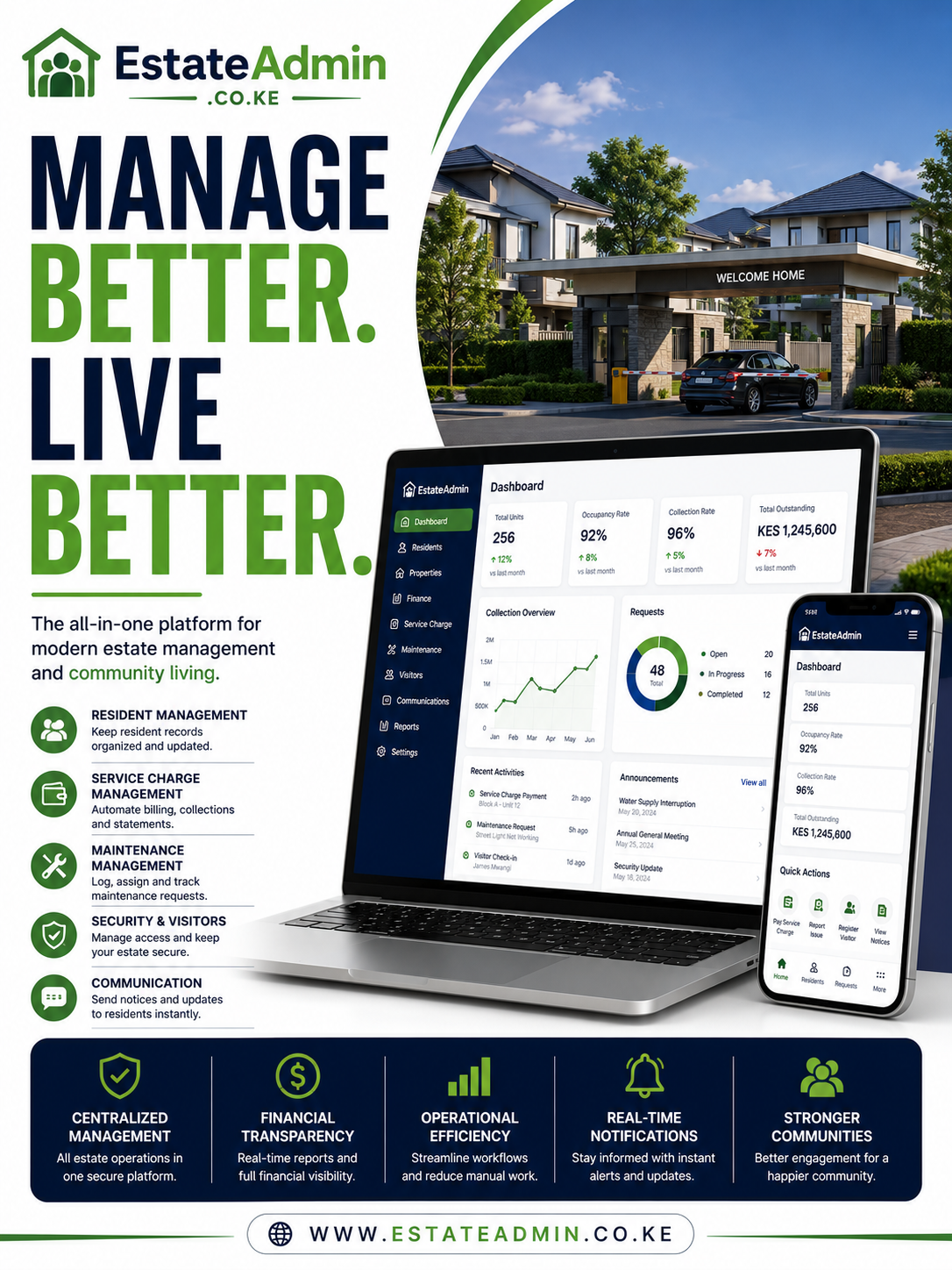
Apartment management software Kenya is transforming how property managers, landlords, estate administrators, and residential property companies manage apartment buildings. As apartment developments continue to grow, managing tenants, rent, maintenance, service charges, payments, communication, and property records through spreadsheets and manual processes can become increasingly difficult.
Modern apartment management requires more than simply collecting rent. Property managers need to keep track of multiple units, monitor tenant accounts, respond to maintenance requests, manage suppliers, communicate with residents, and maintain accurate financial records. When these activities are handled through disconnected systems, important information can easily become difficult to find.
A centralized Apartment management software Kenya solution brings these activities together in one digital platform. It can help property managers organize units, maintain tenant records, automate rent and service charge billing, track payments, manage maintenance requests, and generate reports.
For Kenyan property managers, digital systems can also support local payment methods such as M-PESA and bank transfers. This makes it easier for tenants to pay their obligations while allowing management teams to maintain better records of incoming payments.
This guide explains what apartment management software is, why it is important, the challenges of manual apartment administration, and the essential features property managers should consider when selecting a modern digital solution.
Table of Contents
ToggleWhat Is Apartment Management Software?
Apartment management software is a digital platform designed to help property owners and managers organize and automate the day-to-day operations of residential apartment buildings.
Instead of using separate spreadsheets, notebooks, messaging applications, payment records, and accounting files, management can use one centralized system.
Depending on the platform, apartment management software can handle:
- Property management
- Building management
- Unit management
- Tenant records
- Rent billing
- Rent collection
- Service charges
- Payment tracking
- Maintenance requests
- Expense management
- Supplier management
- Tenant communication
- Financial reporting
The main purpose is to make apartment operations more organized, efficient, and transparent.
Why Apartment Management Is Becoming More Complex
Apartment buildings can have dozens or hundreds of individual units, each with its own tenant, payment history, lease information, maintenance needs, and account balance.
At the same time, the building itself has shared operational requirements.
Management may need to coordinate:
- Security
- Cleaning
- Water
- Electricity
- Garbage collection
- Landscaping
- Repairs
- Parking
- Common-area maintenance
- Lift servicing
Managing these activities manually can create a considerable administrative burden.
As the number of units increases, property managers need systems that can scale with the property.
Challenges of Managing Apartments Manually
Using Spreadsheets for Everything
Spreadsheets are commonly used for apartment administration because they are inexpensive and familiar.
However, using multiple spreadsheets can result in:
- Duplicate information
- Incorrect balances
- Missing records
- Accidental changes
- Difficult reporting
- Limited collaboration
A centralized platform provides a single source of property information.
Manual Rent Collection
Rent collection is one of the most important responsibilities of an apartment manager.
In a manual environment, staff may have to:
- Prepare rent invoices.
- Send payment requests.
- Monitor payment messages.
- Identify tenants.
- Update spreadsheets.
- Issue receipts.
- Follow up on unpaid accounts.
Repeating these tasks every month becomes time-consuming as the number of tenants increases.
An Apartment management software Kenya solution can automate many of these processes.
Difficulty Tracking Tenant Balances
Property managers need to know exactly how much each tenant owes.
A tenant account may include:
- Monthly rent
- Service charges
- Utility charges
- Previous balances
- Payments
- Penalties
- Adjustments
- Credits
When these records are maintained manually, calculating an accurate balance can become difficult.
Digital tenant accounts provide a complete transaction history in one place.
Maintenance Management Problems
Maintenance is another major challenge.
Tenants may report issues through:
- Phone calls
- WhatsApp messages
- SMS
- Emails
- Verbal requests
When requests come through different channels, some issues may be forgotten or delayed.
A centralized maintenance system allows management to record every request and track its progress.
Limited Financial Visibility
Apartment managers need to monitor both income and expenses.
Income may include:
- Rent
- Service charges
- Parking fees
- Utility charges
- Other property fees
Expenses may include:
- Repairs
- Security
- Cleaning
- Water
- Electricity
- Maintenance
- Supplier payments
Without centralized reporting, it can be difficult to understand the property’s financial position.
How Digital Apartment Management Works
A modern apartment management platform creates a structured workflow for property operations.
A typical process may look like:
Property → Building → Units → Tenants → Billing → Payments → Maintenance → Reports
Each part of the system is connected.
For example, a tenant can be linked to a specific unit. That unit can have its own rent invoice, payment history, maintenance requests, and account balance.
This makes information easier to access and manage.
Apartment and Unit Management
A strong property management platform should provide detailed information about every apartment.
Managers can record:
- Unit number
- Building
- Floor
- Apartment type
- Occupancy status
- Owner
- Tenant
- Rent amount
- Service charge
- Lease information
Managers can quickly see which units are:
- Occupied
- Vacant
- Reserved
- Under maintenance
This provides a clear overview of the property.
Managing Multiple Apartment Blocks
Large developments may contain multiple buildings or blocks.
For example, a residential development could have:
- Block A
- Block B
- Block C
- Block D
Each block may contain different numbers of units.
Digital property management allows managers to organize units according to their respective buildings while maintaining a centralized view of the entire development.
Tenant Management
Tenant information is at the center of apartment operations.
A digital tenant profile can include:
- Full name
- Contact details
- Identification information
- Unit number
- Lease information
- Rent amount
- Payment history
- Outstanding balance
- Maintenance requests
This eliminates the need to search through multiple files whenever a tenant’s information is required.
Tenant Move-In and Move-Out
Apartment managers regularly deal with tenant changes.
A digital platform can help organize the move-in process by recording:
- Tenant information
- Assigned unit
- Lease details
- Deposit information
- Initial meter readings
- Move-in date
When a tenant moves out, management can record:
- Move-out date
- Final balance
- Utility readings
- Inspection information
- Deposit adjustments
- Unit status
This creates a complete occupancy history.
Rent Billing
Rent billing is one of the most important functions of an apartment management platform.
Managers can configure recurring rent charges based on the tenancy agreement.
The system can generate invoices automatically according to the selected billing schedule.
This eliminates the need to create rent invoices manually every month.
Automated Rent Collection
A modern Apartment management software Kenya platform can connect billing with payment tracking.
When a tenant pays, the transaction can be recorded against the appropriate account.
The system can then update:
- Amount paid
- Outstanding balance
- Payment date
- Transaction reference
- Invoice status
This gives managers an up-to-date view of rent collection.
M-PESA Integration
M-PESA is an important payment method for Kenyan tenants.
Apartment management platforms that support M-PESA integration can simplify payment collection and reconciliation.
The process can be structured as:
Tenant receives invoice → Tenant pays → Payment is received → Account is updated → Receipt is generated
This reduces manual payment entry and can make rent collection more efficient.
Payment Reconciliation
Payment reconciliation ensures that money received is accurately reflected in tenant accounts.
Managers may need to reconcile payments from:
- M-PESA
- Banks
- Cheques
- Online payment channels
A digital system can help match payments to the correct tenant and invoice.
This reduces unidentified payments and incorrect account balances.
Automated Payment Reminders
Late rent payments can affect property cash flow.
Automated reminders allow managers to communicate with tenants consistently.
Notifications can be sent:
- Before rent is due
- On the due date
- After the due date
- When an account becomes overdue
This reduces the need for staff to manually contact every tenant.
Digital Receipts
After a successful payment, the system can generate a digital receipt.
A receipt can show:
- Tenant name
- Unit number
- Payment amount
- Date
- Payment method
- Transaction reference
- Remaining balance
Digital receipts are easier to store and retrieve than paper receipts.
Service Charge Management
Many apartments have shared costs that must be paid by residents.
These can include:
- Security
- Cleaning
- Garbage collection
- Landscaping
- Common-area electricity
- Water
- Lift maintenance
- Shared facility maintenance
A digital apartment platform can create recurring service charge invoices and track payments separately from rent.
This gives management a clearer understanding of both rental income and property operating income.
Utility Management
Utilities can represent a significant part of apartment operations.
Depending on the property, management may need to track:
- Water
- Electricity
- Internet
- Garbage collection
- Common-area utilities
If utilities are billed to individual tenants, the system can record charges against the appropriate accounts.
This reduces the need for separate manual calculations.
Maintenance Management
Maintenance directly affects tenant satisfaction and property value.
An apartment management platform can allow tenants to submit maintenance requests through a centralized channel.
Common requests include:
- Plumbing issues
- Electrical problems
- Water leaks
- Broken doors
- Lighting problems
- Appliance faults
- Lift issues
- Structural repairs
Each request can be assigned a status such as:
- New
- Assigned
- In progress
- Completed
- Closed
This helps managers ensure that requests are not forgotten.
Maintenance Cost Tracking
Maintenance also affects the property’s financial performance.
Managers should know how much is being spent on repairs.
A digital system can record:
- Maintenance request
- Contractor
- Materials
- Labor
- Total cost
- Payment
- Completion date
This creates a connection between operational activity and financial records.
Supplier Management
Apartment buildings often depend on external service providers.
These may include:
- Security companies
- Cleaning companies
- Plumbers
- Electricians
- Landscapers
- Pest control providers
- Lift maintenance companies
A centralized supplier database can record contact details, invoices, contracts, and payment histories.
Expense Management
An apartment’s financial management should track every major expense category.
Examples include:
Security Expenses
- Guards
- CCTV maintenance
- Access control
Cleaning Expenses
- Cleaning services
- Cleaning supplies
- Common-area cleaning
Maintenance Expenses
- Plumbing
- Electrical
- Painting
- Repairs
Utility Expenses
- Water
- Electricity
- Fuel
Organized expense tracking helps managers understand where property funds are being spent.
Budget Management
Every property should operate according to a realistic budget.
A budget can cover:
- Security
- Cleaning
- Utilities
- Maintenance
- Insurance
- Administration
- Major projects
An Apartment management software Kenya solution can help compare actual expenses with planned spending.
This makes it easier to identify budget overruns and adjust property operations.
Financial Reporting
Property managers need accurate reports to make informed decisions.
A digital platform can generate reports such as:
- Rent collection reports
- Service charge reports
- Outstanding balance reports
- Expense reports
- Tenant statements
- Supplier reports
- Cash-flow reports
- Budget reports
These reports can be generated based on specific properties, buildings, units, or periods.
Improving Property Manager Productivity
Manual administration consumes a large amount of time.
Property managers may spend hours:
- Entering payments
- Preparing invoices
- Sending reminders
- Updating tenant records
- Following up on maintenance
- Preparing reports
Automation reduces repetitive tasks.
This gives property managers more time to focus on:
- Tenant relationships
- Property inspections
- Maintenance planning
- Supplier management
- Financial planning
- Property improvements
Improving Tenant Experience
Good property management is not only about collecting rent.
Tenants expect convenient and responsive services.
Digital platforms can improve the tenant experience through:
- Online payments
- Digital receipts
- Easy maintenance reporting
- Automated notifications
- Account statements
- Faster communication
A better tenant experience can contribute to improved tenant retention.
Increasing Financial Transparency
Transparency is important for property owners and managers.
A centralized system provides clear records of:
- Rent collected
- Service charges
- Expenses
- Outstanding balances
- Supplier payments
- Property income
Property owners can therefore receive more accurate information about how their investments are performing.
Why Kenyan Apartments Need Digital Management
Kenya’s residential property sector includes a wide range of apartment developments, from small buildings to large gated residential communities.
As the number of units increases, manual administration becomes increasingly difficult.
An Apartment management software Kenya platform provides a scalable way to manage:
- Units
- Tenants
- Rent
- Service charges
- Payments
- Maintenance
- Expenses
- Reports
This allows property managers to organize growing portfolios without relying entirely on spreadsheets and paper records.
What Makes Apartment Management Different From Basic Rent Collection?
Rent collection is only one part of apartment management.
A complete apartment management platform should address the entire property operation.
This includes:
Tenants + Units + Rent + Service Charges + Payments + Maintenance + Expenses + Communication + Reporting
Connecting these functions gives managers a complete view of their properties.
For example, if a tenant reports a plumbing problem, management can track the maintenance request, assign a contractor, record the repair cost, and maintain the information alongside the tenant and unit records.
Preparing for Digital Apartment Management
Before implementing a new system, property managers should organize existing records.
This includes:
- Unit information
- Tenant records
- Lease information
- Rent schedules
- Service charge structures
- Payment histories
- Outstanding balances
- Supplier records
- Maintenance information
Accurate data makes the transition smoother.
Choosing the Right Apartment Management Platform
Before selecting Apartment management software Kenya, property owners and managers should evaluate the system’s capabilities.
Important features include:
- Property management
- Unit management
- Tenant management
- Automated rent billing
- M-PESA integration
- Payment reconciliation
- Service charge management
- Maintenance management
- Expense tracking
- Supplier management
- Financial reporting
- Tenant communication
- User permissions
- Data security
- Cloud accessibility
- Multi-property support
The best system should match the property’s actual requirements and provide room for future growth.
Apartment management software Kenya is increasingly becoming an important tool for property owners, property managers, landlords, and residential management companies that want to improve efficiency and maintain better control over apartment operations. Managing an apartment building involves far more than collecting rent. Managers must coordinate tenants, units, maintenance, service charges, utilities, suppliers, expenses, communication, and financial reporting.
As apartment portfolios grow, these responsibilities can become difficult to coordinate using spreadsheets and separate applications. A centralized platform provides a way to bring these activities together while reducing repetitive administrative work.
With Apartment management software Kenya, property managers can create structured workflows for billing, payment tracking, maintenance requests, tenant communication, expense monitoring, and reporting. This allows management teams to spend less time searching for information and more time focusing on property performance and tenant satisfaction.
Advanced Apartment Management Features
Modern apartment management platforms are designed to support the complete property management lifecycle.
A well-designed platform can connect:
- Properties
- Buildings
- Units
- Owners
- Tenants
- Leases
- Invoices
- Payments
- Maintenance requests
- Suppliers
- Expenses
- Reports
This creates a centralized information environment where property managers can access important information without maintaining multiple disconnected records.
Automated Rent Billing
Rent billing is one of the most repetitive responsibilities in residential property management.
A digital platform can automatically generate recurring rent invoices based on information configured for each unit.
Managers can define:
- Monthly rent
- Due dates
- Billing frequency
- Penalties
- Discounts
- Adjustments
- Other recurring charges
Once these rules are configured, the system can generate invoices without requiring staff to manually prepare every bill.
This reduces administrative workload and helps maintain consistency across the property portfolio.
Automated Service Charge Billing
Service charges can be managed separately from rental income.
Depending on the property, service charges may cover:
- Security
- Cleaning
- Garbage collection
- Landscaping
- Common-area electricity
- Water
- Lift maintenance
- Shared facility maintenance
A digital platform can automatically generate these charges and associate them with the correct unit or tenant.
For property managers, this creates a clearer distinction between rental income and shared property expenses.
Flexible Billing Structures
Different apartments may have different billing requirements.
For example, a development may have:
- Studio apartments
- One-bedroom apartments
- Two-bedroom apartments
- Three-bedroom apartments
- Penthouses
Each category may have different rental rates or service charges.
A flexible system can assign appropriate billing rules to individual units rather than forcing management to use one standard amount for every apartment.
Tenant Account Management
Every tenant should have a complete account profile.
A digital tenant account can contain:
- Name
- Phone number
- Email address
- Unit number
- Lease information
- Rent amount
- Service charges
- Payment history
- Outstanding balance
- Maintenance requests
This gives property managers a complete picture of the tenant’s relationship with the property.
Instead of searching through paper files or spreadsheets, staff can access the relevant account from one location.
Lease Management
Lease information is an important part of apartment administration.
A property management platform can help organize:
- Lease start dates
- Lease expiry dates
- Rental amounts
- Security deposits
- Renewal information
- Tenant details
- Unit information
Managers can also monitor upcoming lease expirations and plan renewal discussions in advance.
This reduces the risk of overlooking important tenancy dates.
Vacancy Management
Vacant apartments generate no rental income while still creating operational costs.
A digital platform can show which units are:
- Occupied
- Vacant
- Reserved
- Under maintenance
- Awaiting inspection
This gives property owners a quick overview of occupancy performance.
Managers can also use vacancy information to support leasing and marketing decisions.
M-PESA Payment Integration
For Kenyan apartment properties, payment convenience is an important consideration.
Apartment management software Kenya can support M-PESA-based collection where appropriate integrations are available.
A connected payment workflow can allow:
Invoice → Payment → Transaction identification → Account update → Receipt
This reduces manual payment entry and helps management maintain more accurate tenant balances.
It can also make payment confirmation faster for tenants.
Bank Payment Tracking
Not every tenant will use the same payment method.
Some tenants may pay through bank transfers or other electronic channels.
A centralized platform can help management monitor payments from different channels and associate them with the correct tenant accounts.
This is particularly useful for property managers handling large numbers of transactions every month.
Automated Payment Reconciliation
Payment reconciliation ensures that money received is correctly reflected in the property’s financial records.
A digital system can help identify:
- Unallocated payments
- Duplicate transactions
- Incorrect amounts
- Missing transactions
- Outstanding invoices
For example, if a tenant pays an amount that differs from the invoice, management can identify the difference and determine whether an adjustment is required.
Automated Payment Reminders
Late payments can affect property cash flow.
Instead of manually contacting every tenant, managers can configure automated notifications.
Reminders can be sent:
- Before the due date
- On the due date
- Shortly after the due date
- When an account becomes overdue
Consistent reminders help create a predictable collection process.
Digital Receipts
Digital receipts provide tenants with immediate confirmation of successful payments.
A receipt can contain:
- Tenant name
- Unit number
- Amount paid
- Payment date
- Transaction reference
- Invoice reference
- Remaining balance
Digital receipts also make historical records easier to retrieve.
Tenant Statements
Tenants may occasionally need a detailed statement of their account.
A digital statement can show:
- Previous charges
- Payments
- Adjustments
- Credits
- Outstanding amounts
- Current balance
This makes it easier to answer tenant queries and resolve billing disputes.
Outstanding Rent Management
One of the most important financial functions is monitoring overdue rent.
Managers should be able to identify:
- Tenants who have not paid
- Partially paid accounts
- Amount outstanding
- Number of overdue days
- Previous payment history
Accounts can then be prioritized for follow-up.
Aging Reports
Aging reports categorize outstanding balances according to how long they have remained unpaid.
For example:
| Aging Category | Meaning |
|---|---|
| Current | Payment not yet overdue |
| 30 Days | Recently overdue |
| 60 Days | Moderately overdue |
| 90 Days | Significantly overdue |
| 90+ Days | Long-term outstanding |
This allows property managers to focus collection efforts where they are most needed.
Maintenance Request Management
Maintenance is one of the areas where apartment managers receive frequent tenant requests.
Issues may include:
- Plumbing problems
- Electrical faults
- Water leaks
- Broken doors
- Lighting failures
- Lift problems
- Drainage issues
- Painting requirements
Instead of managing requests through scattered WhatsApp messages or phone calls, a digital system can create a structured maintenance workflow.
Maintenance Request Tracking
A maintenance request can be assigned a status such as:
- New
- Assigned
- In progress
- Awaiting parts
- Completed
- Closed
This allows managers to see which requests still require attention.
It also provides a historical record of maintenance activities.
Contractor Management
Apartment properties often depend on external contractors.
These may include:
- Plumbers
- Electricians
- Painters
- Security companies
- Cleaners
- Landscapers
- Pest control companies
- Lift technicians
A digital platform can store contractor information and connect suppliers to maintenance jobs and financial transactions.
Maintenance Cost Tracking
Every repair has a financial impact.
Management should know:
- What was repaired
- Who performed the work
- Cost of labor
- Cost of materials
- Date of repair
- Unit or area affected
This information helps managers understand maintenance expenditure over time.
Apartment management software Kenya can connect maintenance records with financial information, creating a more complete picture of property costs.
Preventive Maintenance
Property management should not focus only on responding to breakdowns.
Preventive maintenance can help reduce unexpected failures.
Managers can schedule recurring maintenance for:
- Elevators
- Generators
- Water pumps
- Security systems
- Fire equipment
- Plumbing infrastructure
- Electrical systems
Scheduled maintenance can be monitored through a centralized platform.
Utility Management
Utilities can represent a significant expense in apartment buildings.
Depending on the property structure, management may need to monitor:
- Water
- Electricity
- Internet
- Garbage collection
- Common-area power
- Generator fuel
A digital system can organize utility information and, where applicable, allocate charges to the appropriate units.
Water Billing
Some apartment developments use individual or shared water meters.
A property management platform can help record meter readings and calculate tenant charges according to configured billing rules.
This reduces manual calculations and provides a historical record of consumption and billing.
Common-Area Expense Management
Not all expenses belong to individual tenants.
Apartment buildings have shared costs associated with:
- Corridors
- Lifts
- Parking
- Security gates
- Gardens
- Clubhouses
- Swimming pools
- Common lighting
Management can categorize these expenses to understand how much is being spent on shared facilities.
Supplier Invoice Management
Property managers receive invoices from many suppliers.
A digital platform can organize supplier invoices and track:
- Invoice date
- Invoice amount
- Service category
- Payment status
- Payment date
- Supplier
This reduces the risk of losing invoices or forgetting outstanding supplier payments.
Expense Approval
Financial controls are important for apartment management.
An expense approval workflow can require authorized users to review spending before payment.
A typical workflow can be:
Expense request → Review → Approval → Payment → Record
This creates stronger control over property expenditure.
Budget Management
Every apartment property should have an operating budget.
Budget categories may include:
- Security
- Cleaning
- Utilities
- Maintenance
- Insurance
- Landscaping
- Administration
- Repairs
- Capital projects
A digital platform can compare planned spending with actual expenditure.
Budget Variance Analysis
Budget variance analysis helps managers understand whether actual expenses are different from what was planned.
For example, if maintenance expenditure is significantly higher than the approved budget, management can investigate the reason.
Possible causes may include:
- Unexpected repairs
- Equipment failures
- Emergency maintenance
- Rising contractor costs
- Increased material prices
This allows management to respond before the financial impact becomes too large.
Financial Dashboards
A dashboard gives managers a quick view of important property indicators.
A dashboard may display:
- Total rent billed
- Rent collected
- Outstanding rent
- Service charge collections
- Monthly expenses
- Maintenance costs
- Occupancy
- Vacant units
- Supplier balances
This makes it easier to understand property performance without manually preparing spreadsheets.
Property Owner Reporting
Property owners need reliable information about their investments.
Reports can show:
- Rental income
- Collection rates
- Vacancy
- Operating expenses
- Maintenance costs
- Outstanding tenant balances
- Net property performance
This enables owners to make better investment and operational decisions.
Multi-Property Management
Property management companies may manage several apartment developments.
A scalable platform can allow multiple properties to be managed from one account.
Each property can maintain separate:
- Units
- Tenants
- Rent schedules
- Service charges
- Expenses
- Suppliers
- Financial reports
At the same time, management can access portfolio-level information.
Resident Communication
Effective communication is essential for apartment operations.
A centralized platform can help managers send notifications concerning:
- Rent due dates
- Payment confirmations
- Maintenance activities
- Water interruptions
- Security notices
- Building repairs
- Service charge updates
- Community announcements
This reduces dependence on manual communication.
Resident Self-Service
A resident portal can give tenants direct access to relevant information.
Depending on the platform, residents may be able to:
- View invoices
- Check balances
- Make payments
- Download receipts
- View statements
- Submit maintenance requests
- Receive announcements
Self-service can reduce the number of routine requests handled by property management staff.
Improving Tenant Satisfaction
Tenant satisfaction is affected by more than the physical quality of an apartment.
It is also influenced by:
- Payment convenience
- Communication
- Maintenance response
- Transparency
- Issue resolution
Digital tools can improve these areas by giving tenants clearer information and easier ways to interact with management.
Security and User Permissions
Apartment management systems contain sensitive information.
Access should therefore be controlled according to each user’s responsibilities.
For example:
Property Manager: Access to property operations and financial information.
Accountant: Access to financial transactions and reports.
Maintenance Officer: Access to maintenance information.
Owner: Access to approved property performance reports.
Tenant: Access to their own account and property services.
Role-based permissions reduce the risk of unauthorized changes.
Audit Trails
An audit trail records important actions performed within the system.
It can show:
- Who created an invoice
- Who changed an account
- Who recorded a payment
- Who approved an expense
- When a transaction was modified
This improves accountability and can help management investigate discrepancies.
Data Backup
Property information should be protected against accidental loss.
Important records include:
- Tenant information
- Payment histories
- Lease information
- Financial reports
- Maintenance records
- Supplier records
Regular automated backups provide an additional layer of protection.
Cloud-Based Access
Cloud-based platforms can allow authorized users to access information from different locations.
This can be useful for property managers who:
- Manage multiple buildings
- Work from different offices
- Conduct property inspections
- Travel between developments
Managers can access relevant information without depending on a single office computer.
Mobile Property Management
Mobile access makes it easier for managers to work while away from their desks.
A mobile-friendly system can allow staff to:
- Check tenant accounts
- Review maintenance requests
- Approve expenses
- Monitor payments
- Access reports
- Communicate with residents
This supports faster decision-making.
Reporting by Building and Unit
Large apartment developments require detailed reporting.
Management may need to analyze information by:
- Property
- Building
- Floor
- Unit
- Tenant
- Billing category
- Payment period
This makes it easier to identify trends and individual account issues.
Improving Property Management Efficiency
The main advantage of digitalization is the reduction of repetitive administrative tasks.
Instead of manually:
- Creating every invoice
- Recording every payment
- Sending every reminder
- Searching for tenant records
- Preparing every report
management can automate many of these processes.
This allows staff to focus on property inspections, tenant relationships, maintenance planning, and strategic management.
Supporting Better Financial Decisions
Accurate financial information helps managers and owners make better decisions.
Before approving a major project, for example, management can review:
- Available funds
- Current expenses
- Outstanding rent
- Service charge collections
- Maintenance expenditure
- Budget performance
This reduces reliance on assumptions and supports data-driven decisions.
Scaling Apartment Operations
A property management process should remain effective as the portfolio grows.
A system that manages 20 units should ideally provide a foundation that can accommodate 100, 500, or more units.
Scalability is important because property managers may eventually add:
- New buildings
- New apartment blocks
- New tenants
- Additional properties
- More suppliers
- More financial transactions
A centralized platform makes this growth easier to manage.
Choosing Apartment Management Software
When evaluating Apartment management software Kenya, property owners and managers should consider the actual needs of their properties rather than choosing a platform based solely on the number of features advertised.
Important considerations include:
- Property and unit management
- Tenant management
- Automated rent billing
- M-PESA integration
- Payment reconciliation
- Service charge management
- Maintenance tracking
- Expense management
- Supplier management
- Budget management
- Financial reporting
- Tenant communication
- Resident self-service
- User permissions
- Audit trails
- Data security
- Cloud access
- Multi-property support
- Customer support
- Scalability
Questions to Ask a Software Provider
Before purchasing or subscribing to a platform, property managers should ask:
Can the system manage multiple apartment buildings?
This is important for growing property management companies.
Does it support recurring rent billing?
Automated recurring billing reduces manual administration.
Can payments be reconciled automatically?
This can significantly reduce finance-related workload.
Does it integrate with M-PESA?
For Kenyan properties, payment convenience can be an important consideration.
Can tenants access their accounts?
A resident portal can improve transparency and reduce routine administrative requests.
Can the system manage maintenance?
Integrated maintenance management prevents property issues from becoming disconnected from tenant records.
Can management generate financial reports?
Reports should provide useful information for owners, managers, and authorized committees.
Is access controlled by user role?
Different users should only have access to information appropriate to their responsibilities.
Preparing for Implementation
Successful implementation begins with accurate information.
Before moving to Apartment management software Kenya, management should organize:
- Property details
- Unit information
- Tenant records
- Lease agreements
- Rent amounts
- Service charges
- Outstanding balances
- Payment histories
- Supplier information
- Maintenance records
Data should be reviewed and cleaned before migration.
Staff Training
Employees should receive adequate training on the new platform.
Training can cover:
- Property setup
- Tenant registration
- Billing
- Payment recording
- Reconciliation
- Maintenance
- Expense management
- Reporting
- Communication
- User permissions
Staff training ensures that the system is used consistently across the organization.
Measuring the Results
After implementation, management should track measurable improvements.
Useful indicators include:
- Rent collection rate
- Number of overdue accounts
- Time spent on reconciliation
- Maintenance response time
- Vacancy rate
- Administrative workload
- Expense variance
- Tenant complaints
These metrics help determine whether the digital platform is producing meaningful operational improvements.
Common Implementation Mistakes
Property managers should avoid implementing technology without changing inefficient processes.
Simply transferring a manual process into software may not deliver the expected results.
Management should review existing workflows and determine where automation can eliminate unnecessary steps.
Another common mistake is failing to maintain accurate resident information. Incorrect phone numbers, unit assignments, rent amounts, or opening balances can affect billing and reporting.
It is also important not to give every employee unrestricted access. User permissions should be established from the beginning.
The Role of Automation in Modern Apartment Management
Automation is becoming one of the most valuable capabilities available to property managers.
Recurring activities such as billing, reminders, receipts, payment allocation, and reporting can be performed with less manual intervention.
This helps create a consistent operational process.
For property managers handling several buildings, automation can make a significant difference in productivity.
Integrating Apartment Management With Accounting
Property operations and accounting are closely connected.
Rent collection generates income, while maintenance, security, utilities, and supplier services generate expenses.
A connected system can provide a more complete view of:
Income + Expenses + Occupancy + Maintenance + Collections
This helps owners understand the actual performance of their apartment investments.
The Importance of Real-Time Information
Property managers should not have to wait until the end of the month to understand what is happening.
Real-time information can show:
- Current collections
- Outstanding balances
- Recent expenses
- Open maintenance requests
- Occupancy status
- Payment activity
This enables faster action when problems occur.
Building a More Professional Property Management Process
Professional property management requires reliable information, consistent processes, and clear communication.
Apartment management software Kenya can provide the digital infrastructure needed to bring these areas together.
Instead of managing property information through multiple disconnected tools, management can create a structured workflow where information moves from one process to another.
For example:
Tenant registration → Lease → Rent invoice → Payment → Receipt → Account statement
Similarly:
Maintenance request → Work order → Contractor → Expense → Payment → Financial report
These connected workflows create better visibility across the property.
Apartment management software Kenya is becoming an important solution for landlords, property managers, estate administrators, and property management companies that want to improve the way residential buildings are operated. Managing apartments involves many connected responsibilities, including rent collection, tenant administration, maintenance, service charges, utility management, supplier coordination, communication, and financial reporting.
When these activities are handled manually, property managers can spend significant amounts of time entering information, checking payment records, following up on outstanding balances, responding to maintenance requests, and preparing reports. As the number of apartments increases, these challenges can become more difficult to control.
A centralized digital platform provides a structured way to manage these responsibilities. It brings property information, tenant accounts, payments, maintenance records, expenses, and reports into one environment.
Part 3 focuses on practical implementation, best practices, financial and operational benefits, common questions, and the future of digital apartment management in Kenya.
Best Practices for Managing Apartments Digitally
Technology alone does not guarantee better property management. The system needs to be supported by clear processes and good management practices.
Keep Tenant Records Updated
Tenant information should be reviewed regularly.
Management should ensure that records contain accurate:
- Names
- Phone numbers
- Email addresses
- Unit numbers
- Lease dates
- Rental amounts
- Deposit information
- Emergency contacts
Outdated information can lead to missed notifications and incorrect billing.
Maintain Accurate Unit Information
Every apartment should have a unique and clearly defined record.
Important details may include:
- Unit number
- Building
- Floor
- Apartment type
- Occupancy status
- Rental amount
- Service charge
- Owner
- Current tenant
Accurate unit records make reporting and account management easier.
Establish Clear Rent Collection Policies
Property managers should establish consistent rules for rent collection.
These should define:
- Payment due dates
- Accepted payment methods
- Reminder schedules
- Late-payment procedures
- Receipt procedures
- Account reconciliation processes
When these rules are consistent, tenants understand what is expected and management can follow a predictable collection process.
Monitor Collection Performance
Property managers should regularly review rent collection performance.
Useful metrics include:
- Total rent billed
- Total rent collected
- Outstanding rent
- Collection rate
- Number of overdue accounts
- Average payment delay
For example, if a property bills KSh 5 million in a month and collects KSh 4.7 million, management can quickly identify the KSh 300,000 outstanding amount and investigate the affected accounts.
Follow Up on Outstanding Accounts
Outstanding rent should not be ignored.
Management can organize overdue accounts according to:
- Amount owed
- Number of days overdue
- Payment history
- Tenant circumstances
- Previous follow-up activity
This allows the team to prioritize collection efforts.
Keep Service Charges Transparent
Service charges should be properly documented.
Residents should be able to understand what their charges support, where applicable.
Common service charge categories include:
- Security
- Cleaning
- Landscaping
- Waste management
- Common-area electricity
- Water
- Lift maintenance
- Shared facilities
Clear records can help reduce misunderstandings between residents and management.
Track Property Expenses
Property income should always be considered alongside property expenditure.
Management should monitor spending on:
- Repairs
- Security
- Cleaning
- Utilities
- Landscaping
- Maintenance
- Insurance
- Administration
Expense categorization helps identify where property funds are being used.
Review Supplier Performance
Suppliers can have a major impact on property operating costs.
Management should monitor:
- Service quality
- Response times
- Pricing
- Contract terms
- Invoice accuracy
- Payment history
Keeping supplier information in a centralized system can make these reviews easier.
Schedule Preventive Maintenance
Preventive maintenance can reduce the likelihood of expensive breakdowns.
Managers can schedule inspections and servicing for:
- Lifts
- Generators
- Water pumps
- Fire equipment
- Security systems
- Electrical systems
- Plumbing systems
Instead of waiting for equipment to fail, management can plan maintenance activities in advance.
Respond Quickly to Maintenance Requests
Tenant satisfaction is strongly influenced by how quickly maintenance issues are addressed.
A digital system can help management track:
- Request submission
- Issue classification
- Assignment
- Contractor response
- Repair
- Completion
- Closure
This provides accountability throughout the process.
Use Digital Communication
Communication should be organized and consistent.
Management can use digital notifications for:
- Rent reminders
- Payment confirmations
- Maintenance announcements
- Water interruptions
- Security notices
- Building meetings
- Service charge information
- General announcements
This reduces reliance on informal communication channels.
Give Residents Access to Information
A resident portal can improve transparency.
Where supported, tenants can access:
- Current balance
- Rent invoices
- Service charges
- Payment history
- Receipts
- Statements
- Maintenance requests
- Announcements
Giving residents access to their own information can reduce routine questions directed to management.
Benefits of Digital Apartment Management
Reduced Administrative Work
Automation reduces repetitive activities.
Instead of manually creating every invoice and updating every payment, staff can use automated workflows.
This can free time for more important responsibilities.
Faster Payment Processing
Connected payment systems can reduce the time between receiving a payment and updating the tenant’s account.
This is particularly valuable for properties with many tenants.
Better Financial Accuracy
Centralized records reduce the risk of inconsistent balances between different spreadsheets and payment records.
Every transaction can be associated with a specific account.
Better Cash-Flow Visibility
Managers can see:
- How much has been billed
- How much has been collected
- How much remains outstanding
- How much has been spent
This gives property owners better visibility into cash flow.
Improved Tenant Communication
Automated notifications ensure important information reaches tenants consistently.
This can reduce communication gaps and missed payment reminders.
Faster Maintenance Response
Centralized maintenance requests make it easier to identify unresolved issues and assign them to the appropriate person.
Better Owner Reporting
Property owners can receive structured reports showing how their properties are performing.
This can include:
- Income
- Expenses
- Occupancy
- Outstanding balances
- Maintenance costs
- Collection performance
Easier Multi-Property Management
Property managers handling several developments can use one platform rather than maintaining separate systems for each property.
This can significantly simplify administration.
How Digital Systems Improve Property Owner Control
Property owners may not be involved in daily apartment operations, but they need accurate information about their investments.
A centralized system can provide visibility into:
- Monthly rental income
- Outstanding rent
- Vacancy
- Property expenses
- Maintenance
- Service charges
- Supplier payments
This allows owners to identify potential problems earlier.
How Digital Systems Benefit Tenants
Tenants also benefit from a more organized management process.
They may receive:
- Faster payment confirmation
- Digital receipts
- Clear account statements
- Convenient payment options
- Easier maintenance reporting
- Faster communication
A better experience can contribute to stronger tenant relationships.
Improving Occupancy Management
Vacant units represent lost rental income.
Management can use occupancy information to monitor:
- Current vacancies
- Upcoming vacancies
- Lease expirations
- Move-in dates
- Move-out dates
This supports better leasing planning.
Reducing Rental Income Leakage
Rental income leakage can occur when:
- Payments are not recorded correctly
- Tenants pay incorrect amounts
- Outstanding balances are overlooked
- Units have outdated rental rates
- Manual records contain errors
Automated billing and account tracking can help identify these issues.
Supporting Better Budget Planning
Historical financial data can help management prepare more realistic future budgets.
Managers can review previous:
- Maintenance expenses
- Utility costs
- Security costs
- Cleaning expenses
- Supplier payments
This information can support future financial planning.
Using Reports for Strategic Decisions
Reports should help management answer important questions.
For example:
Which units have outstanding balances?
How much rent was collected this month?
Which expenses increased?
How many apartments are vacant?
Which maintenance issues remain unresolved?
How much was spent on contractors?
A good reporting system makes these answers easier to obtain.
Common Mistakes to Avoid
Choosing Software Without Considering Property Size
A small apartment building and a large residential portfolio may have very different requirements.
The selected platform should be appropriate for the number of units and properties being managed.
Ignoring Payment Integration
If most tenants use digital payments, management should choose a platform that can support the relevant payment channels.
For Kenyan properties, M-PESA compatibility may be particularly important.
Failing to Train Staff
Even a powerful system will not produce good results if employees do not know how to use it.
Training should be treated as part of implementation.
Migrating Inaccurate Data
Moving incorrect information into a new system simply transfers existing problems.
Data should be cleaned and verified before migration.
Giving Everyone Full Access
Employees should only access information necessary for their responsibilities.
Role-based permissions reduce unnecessary exposure to sensitive information.
Not Reviewing Reports
Collecting data is not enough.
Managers should regularly review reports and use the information to improve operations.
Security Considerations
Property management systems contain valuable information.
This may include:
- Tenant contact information
- Payment records
- Lease information
- Financial data
- Supplier information
Security measures should include appropriate authentication, access controls, backups, and activity monitoring.
Management should also establish internal policies for password security and user access.
Audit and Accountability
A digital audit trail helps establish accountability.
If a financial record changes, management should be able to determine:
- Who made the change
- What was changed
- When it was changed
This can be useful when investigating discrepancies or reviewing financial activity.
Cloud-Based Apartment Management
Cloud platforms provide access to property information through supported internet-connected devices.
This can be useful for property managers who need to work:
- At the property
- From an office
- From home
- Across multiple buildings
Instead of keeping information on one computer, authorized users can access centralized records according to their permissions.
Mobile Access for Property Managers
Mobile access can make apartment administration more responsive.
A manager inspecting a property could potentially:
- Check a tenant account
- Review an open maintenance request
- Record an inspection
- Check payment status
- Contact a resident
This reduces dependence on office-based administration.
Integration With Other Property Systems
The future of apartment management will increasingly involve integrations.
An apartment platform may connect with:
- Payment systems
- Accounting platforms
- SMS services
- Email systems
- Access control
- Smart meters
- Maintenance systems
These integrations can reduce duplicate data entry.
The Future of Apartment Management in Kenya
The property management industry is increasingly moving toward digital operations.
As property portfolios become larger and tenants expect more convenient services, manual systems may become less practical.
Future developments may include:
- Artificial intelligence
- Predictive maintenance
- Smart meters
- Automated financial forecasting
- Mobile resident applications
- Digital lease management
- Automated payment reconciliation
- Advanced property analytics
These technologies can help property managers make faster and more informed decisions.
Artificial Intelligence in Property Management
Artificial intelligence can potentially support property managers by analyzing large amounts of operational information.
For example, analytics could identify:
- Tenants who frequently pay late
- Increasing maintenance costs
- Seasonal changes in collections
- Unusual expenses
- Potential maintenance problems
This could allow managers to address problems before they become more expensive.
Smart Metering and Utility Management
Smart meters may become increasingly important in apartment developments.
Digital meter information can potentially help management monitor:
- Water consumption
- Electricity consumption
- Common-area usage
Automated readings can reduce manual meter recording and improve billing accuracy.
Predictive Maintenance
Predictive maintenance uses historical and operational data to identify potential equipment problems.
For example, repeated maintenance records for a water pump could indicate that replacement may be more economical than continued repairs.
This type of analysis can help property owners make better long-term maintenance decisions.
Apartment Management Software and Property Growth
As a property portfolio grows, administrative complexity usually increases.
Managing ten apartments is different from managing 100 apartments. Managing 1,000 units across several developments creates an even greater need for automation.
A scalable platform provides a foundation for growth.
It can allow management to add:
- New properties
- New buildings
- New units
- New tenants
- New suppliers
without rebuilding the entire administrative process.
What Should Property Managers Look For?
When selecting Apartment management software Kenya, property managers should focus on functionality, usability, security, support, and scalability.
A strong solution should ideally provide:
- Property management
- Unit management
- Tenant management
- Rent billing
- Rent collection
- M-PESA integration
- Payment reconciliation
- Service charge management
- Utility management
- Maintenance management
- Supplier management
- Expense management
- Budget management
- Financial reports
- Tenant statements
- Digital receipts
- Automated reminders
- Resident communication
- User permissions
- Audit trails
- Data backups
- Multi-property support
The platform should also be easy enough for staff and residents to use consistently.
Frequently Asked Questions
What is apartment management software?
Apartment management software is a digital platform designed to help property managers organize residential properties, tenants, rent, payments, maintenance, expenses, communication, and reporting.
Is apartment management software suitable for small buildings?
Yes. The right platform can be useful for both small apartment buildings and larger residential developments, provided its features and pricing match the property’s requirements.
Can apartment software manage rent collection?
Yes. Rent billing, payment tracking, outstanding balances, receipts, and reminders are common functions of modern property management platforms.
Can tenants pay rent using M-PESA?
This depends on the platform’s payment integrations. Systems designed for the Kenyan market may support M-PESA-based payment workflows.
Can the system manage service charges?
Yes. A suitable platform can separate service charges from rent and track the associated payments and balances.
Can it manage maintenance requests?
Yes. Maintenance management allows tenants to report issues while property managers assign, monitor, and close requests.
Can property owners view reports?
Platforms with owner reporting can provide authorized owners with information about income, expenses, occupancy, maintenance, and outstanding balances.
Can one system manage several properties?
Yes. Multi-property functionality allows management companies to manage several buildings or developments from a centralized platform.
Does software eliminate the need for property managers?
No. Software supports property managers by automating administrative tasks and organizing information. Human decision-making, tenant relationships, inspections, supplier management, and strategic planning remain important.
How does software improve rent collection?
It can automate recurring invoices, reminders, payment tracking, reconciliation, receipts, and outstanding balance reports, reducing manual collection work.
Is cloud-based software better?
Cloud-based systems can provide convenient access and centralized data, but the best option depends on the property’s requirements, security needs, budget, and operational structure.
How to Measure the Success of an Apartment Management System
After implementation, management should monitor measurable results.
Useful indicators include:
Collection Rate
Measure the percentage of billed rent actually collected.
Outstanding Balances
Monitor the total amount owed by tenants.
Vacancy Rate
Track the percentage of units that remain unoccupied.
Maintenance Response Time
Measure how quickly reported problems are addressed.
Expense Variance
Compare actual spending against approved budgets.
Administrative Time
Monitor how much staff time is spent on repetitive tasks.
Tenant Satisfaction
Track complaints, response times, and recurring service issues.
These measurements help determine whether digital management is producing practical improvements.
Making the Transition From Manual to Digital Management
Property managers do not need to change every process overnight.
A phased approach can make implementation easier.
Phase One: Data Preparation
Clean tenant, unit, lease, and financial records.
Phase Two: Property Setup
Create buildings, units, billing structures, and user accounts.
Phase Three: Payment Setup
Configure supported payment channels and reconciliation processes.
Phase Four: Staff Training
Teach employees how to use the platform.
Phase Five: Resident Onboarding
Inform tenants about payment procedures and available services.
Phase Six: Monitoring
Review system usage, collection rates, maintenance performance, and financial reports.
A structured transition can reduce disruption.
Why Digital Apartment Management Is Becoming Essential
Apartment management is becoming increasingly data-driven.
Property managers need access to accurate information about:
- Income
- Expenses
- Tenants
- Occupancy
- Maintenance
- Payments
- Service charges
Manual systems can make this information difficult to consolidate.
Digital platforms provide a centralized alternative.
With Apartment management software Kenya, property managers can create connected workflows that bring together financial and operational activities.
For example:
Tenant → Unit → Lease → Invoice → Payment → Receipt → Statement
And for maintenance:
Tenant → Request → Work Order → Contractor → Expense → Completion
These connected processes can create better visibility and accountability.
Conclusion
Managing apartments efficiently requires more than collecting monthly rent. Property managers must coordinate tenants, units, leases, payments, service charges, maintenance, utilities, suppliers, expenses, communication, and financial reporting.
Apartment management software Kenya provides a centralized approach to these responsibilities. By bringing important property operations into one digital environment, management teams can reduce repetitive administrative work, improve financial accuracy, monitor property performance, and provide better services to tenants.
Automated rent billing and payment tracking can make collections more consistent. M-PESA integration can provide convenient payment options for Kenyan tenants where supported. Digital receipts and statements can improve transparency, while automated reminders can help management follow up on outstanding accounts.
The benefits also extend to maintenance and property operations. Centralized maintenance requests make it easier to track problems, assign contractors, monitor repair progress, and record associated costs. Expense and budget management can provide owners with greater visibility into how property funds are being used.
For growing property portfolios, scalability is particularly important. A platform capable of managing multiple buildings and properties can help management companies expand without creating separate manual systems for every development.
Successful implementation requires accurate data, proper staff training, clear financial procedures, appropriate user permissions, and regular reporting. Property managers should also choose a solution based on their actual requirements, including payment integration, tenant management, maintenance, reporting, security, and future scalability.
As Kenya’s residential property sector continues to adopt digital tools, apartment management technology will become increasingly important. Automation, mobile access, digital payments, smart metering, predictive maintenance, and advanced analytics are likely to shape the future of residential property management.
Ultimately, the right Apartment management software Kenya solution can give property managers better control over daily operations while helping property owners protect their investments and giving tenants a more convenient and transparent experience.
- Apartment management software Kenya
- Apartment management software Kenya
- Apartment management software Kenya
- Apartment management software Kenya
- Apartment management software Kenya
- Apartment management software Kenya
- Apartment management software Kenya
- Apartment management software Kenya
- Apartment management software Kenya
- Apartment management software Kenya
- Apartment management software Kenya
- Apartment management software Kenya
- Apartment management software Kenya
- Apartment management software Kenya
- Apartment management software Kenya
- Apartment management software Kenya
- Apartment management software Kenya
- Apartment management software Kenya
- Apartment management software Kenya
- Apartment management software Kenya
- Apartment management software Kenya
- Apartment management software Kenya
- Apartment management software Kenya
- Apartment management software Kenya
- Apartment management software Kenya
- Apartment management software Kenya
- Apartment management software Kenya
- Apartment management software Kenya
- Apartment management software Kenya
- Apartment management software Kenya
- Apartment management software Kenya
- Apartment management software Kenya
- Apartment management software Kenya
- Apartment management software Kenya
- Apartment management software Kenya
- Apartment management software Kenya
- Apartment management software Kenya
- Apartment management software Kenya
- Apartment management software Kenya
- Apartment management software Kenya
- Apartment management software Kenya
- Apartment management software Kenya
- Apartment management software Kenya
- Apartment management software Kenya
- Apartment management software Kenya
- Apartment management software Kenya
- Apartment management software Kenya
- Apartment management software Kenya
- Apartment management software Kenya
- Apartment management software Kenya
- Apartment management software Kenya
- Apartment management software Kenya
- Apartment management software Kenya
- Apartment management software Kenya
- Apartment management software Kenya
- Apartment management software Kenya
- Apartment management software Kenya
- Apartment management software Kenya
- Apartment management software Kenya
- Apartment management software Kenya
- Apartment management software Kenya
- Apartment management software Kenya
- Apartment management software Kenya
- Apartment management software Kenya
- Apartment management software Kenya
- Apartment management software Kenya
- Apartment management software Kenya
- Apartment management software Kenya
- Apartment management software Kenya
- Apartment management software Kenya