
Estate Maintenance Coordination System
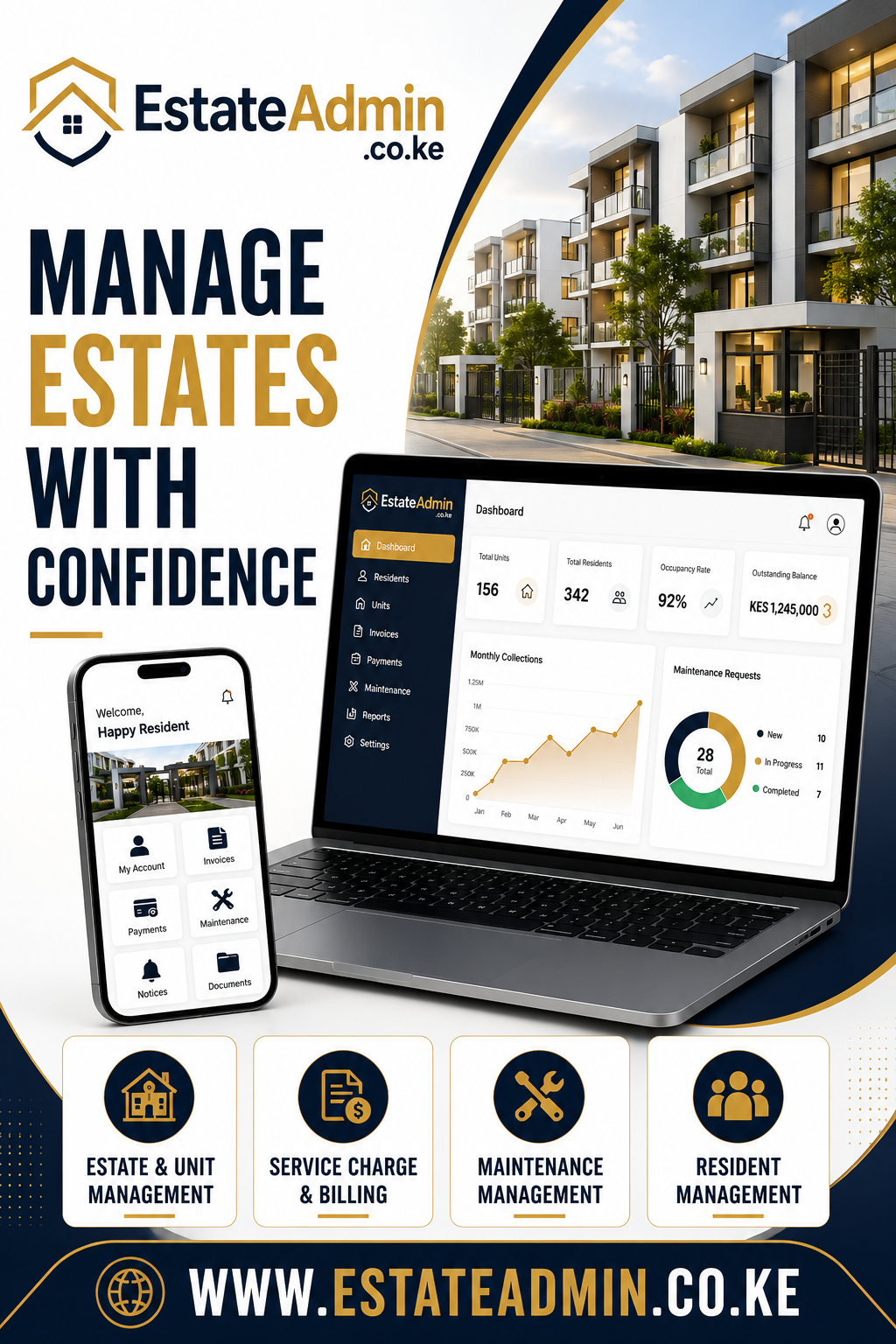
Property maintenance is one of the most important responsibilities in estate management. Well-maintained estates provide safer environments, preserve property value, improve resident satisfaction, and reduce long-term maintenance costs. As residential estates, gated communities, apartment complexes, and commercial developments continue to grow across Kenya, manually coordinating maintenance activities has become increasingly difficult. An Estate Maintenance Coordination System provides a centralized platform for planning, tracking, assigning, and managing maintenance activities efficiently across an entire estate.
From routine landscaping and street lighting repairs to plumbing, electrical work, waste management, security equipment servicing, and infrastructure maintenance, estate managers must coordinate multiple service providers while ensuring that maintenance requests are resolved promptly. Traditional methods such as paper logs, spreadsheets, phone calls, and messaging applications often result in delayed responses, poor communication, duplicated work, and incomplete maintenance records. An Estate Maintenance Coordination System eliminates these challenges by bringing every maintenance process into one integrated digital platform.
Across Kenya, estate developers, property management companies, homeowners’ associations, and facility management firms are increasingly adopting digital technologies to improve service delivery. Residents expect maintenance issues to be resolved quickly while management committees require accurate reporting on maintenance costs, contractor performance, and completed work. Implementing an Estate Maintenance Coordination System enables estate managers to monitor maintenance activities in real time, prioritize urgent repairs, assign technicians efficiently, and provide transparent updates to residents.
A modern maintenance coordination platform goes beyond simply recording repair requests. It integrates maintenance workflows with resident communication, contractor management, inspections, asset management, service charge administration, and reporting tools. This centralized approach improves operational efficiency while ensuring that every maintenance request is tracked from submission to completion.
Whether managing gated communities in Nairobi, apartment developments in Kiambu, mixed-use estates in Mombasa, commercial properties in Kisumu, or residential neighborhoods throughout Kenya, an Estate Maintenance Coordination System helps organizations improve maintenance operations, reduce response times, and maintain attractive, well-functioning properties.
Table of Contents
- Understanding Estate Maintenance Coordination
- Why Efficient Maintenance Management Matters
- Core Features of Maintenance Coordination Systems
- Managing Maintenance Requests Efficiently
- Preventive Maintenance Planning
- Contractor and Technician Management
- Maintenance Reporting and Analytics
- Improving Resident Satisfaction
- Applications Across Different Estate Types
Understanding Estate Maintenance Coordination
Effective maintenance coordination involves much more than responding to repair requests. Estate managers must oversee preventive maintenance, emergency repairs, inspections, contractor scheduling, inventory management, infrastructure servicing, and communication with residents. An Estate Maintenance Coordination System centralizes these activities into one platform, enabling management teams to oversee every maintenance task from a single dashboard.
The system records maintenance requests, assigns tasks to technicians or contractors, tracks progress, captures completion reports, and stores maintenance histories for future reference. This ensures that every maintenance activity is documented while reducing the possibility of overlooked repairs.
By replacing manual processes with digital workflows, estate managers gain better visibility into ongoing work and improve the overall quality of maintenance services.
Why Efficient Maintenance Management Matters
Well-maintained estates create positive living and working environments while protecting valuable property investments. Delayed maintenance often leads to higher repair costs, dissatisfied residents, safety concerns, and declining property values. Estate Maintenance Coordination System technology helps organizations address maintenance issues quickly while improving accountability and operational efficiency.
Effective maintenance coordination helps organizations:
- Reduce repair delays
- Improve resident satisfaction
- Extend infrastructure lifespan
- Lower maintenance costs
- Improve contractor accountability
- Enhance estate appearance
- Increase property value
- Support long-term maintenance planning
For estate managers across Kenya, proactive maintenance contributes directly to safer communities and better financial performance.
Core Features of Maintenance Coordination Systems
A modern Estate Maintenance Coordination System includes a wide range of tools designed to simplify maintenance management while improving communication between residents, estate managers, contractors, and maintenance teams.
Common features include:
- Maintenance request management
- Work order tracking
- Preventive maintenance scheduling
- Contractor management
- Technician assignment
- Resident communication
- Inspection management
- Asset management
- Inventory tracking
- Service history records
- Mobile accessibility
- Automated notifications
- Performance dashboards
- Document management
- Role-based user permissions
These capabilities provide estate managers with complete visibility into maintenance activities across the entire property.
Managing Maintenance Requests Efficiently
One of the primary functions of an Estate Maintenance Coordination System is organizing and tracking maintenance requests from submission to completion.
Residents or staff can report issues such as:
- Plumbing leaks
- Electrical faults
- Street lighting failures
- Road damage
- Drainage problems
- Security equipment faults
- Water supply issues
- Landscaping concerns
- Waste collection issues
- Building repairs
Each request receives a unique work order, allowing estate managers to assign technicians, monitor progress, and verify completion without relying on manual follow-ups.
Real-time tracking ensures that urgent maintenance receives immediate attention while routine work is scheduled efficiently.
Preventive Maintenance Planning
Preventive maintenance is essential for avoiding expensive emergency repairs and extending the lifespan of estate infrastructure. An Estate Maintenance Coordination System allows managers to schedule recurring maintenance activities based on predefined intervals.
Preventive maintenance may include:
- Generator servicing
- Water pump inspections
- Street lighting maintenance
- CCTV servicing
- Fire safety equipment inspections
- Landscaping schedules
- Road maintenance
- Electrical system inspections
By performing maintenance proactively, estate managers reduce equipment failures while improving service reliability.
Contractor and Technician Management
Large estates often work with multiple contractors and service providers. Coordinating their activities manually can become challenging. Estate Maintenance Coordination System software enables managers to organize contractor assignments, monitor work quality, and evaluate performance over time.
Managers can:
- Assign work orders
- Track technician availability
- Monitor response times
- Record completed work
- Evaluate contractor performance
- Store service histories
- Verify maintenance completion
- Manage contractor documentation
This structured approach improves accountability while ensuring maintenance standards remain consistent.
Maintenance Reporting and Analytics
Comprehensive reporting helps estate managers evaluate maintenance performance and identify areas requiring improvement. Estate Maintenance Coordination System software generates detailed reports covering maintenance activities, response times, repair costs, and contractor performance.
Typical reports include:
- Work order summaries
- Maintenance costs
- Response time analysis
- Technician performance
- Contractor performance
- Preventive maintenance schedules
- Asset maintenance history
- Infrastructure condition reports
- Resident request trends
- Budget utilization
These reports support strategic planning while helping management allocate maintenance resources more effectively.
Improving Resident Satisfaction
Maintenance quality has a direct impact on resident satisfaction. Prompt responses, clear communication, and well-maintained common areas create positive living environments that encourage long-term residency.
An Estate Maintenance Coordination System improves resident experiences by providing:
- Faster issue reporting
- Transparent maintenance updates
- Quicker repair completion
- Better communication
- Improved estate appearance
- Reliable infrastructure
- Enhanced safety
- Higher service quality
Satisfied residents are more likely to support estate management initiatives and contribute positively to the community.
Applications Across Different Estate Types
An Estate Maintenance Coordination System supports a wide variety of residential and commercial developments throughout Kenya.
Residential estates use the platform to manage common area maintenance, infrastructure repairs, security systems, landscaping, and resident requests.
Apartment complexes coordinate plumbing, electrical work, lifts, parking facilities, and shared amenities.
Commercial estates oversee office maintenance, retail facilities, parking areas, HVAC systems, and building infrastructure.
Mixed-use developments manage maintenance across residential, commercial, and shared facilities from one centralized platform.
Industrial parks coordinate infrastructure servicing, road maintenance, lighting, utilities, and facility inspections.
For organizations seeking a comprehensive estate management solution, EstateAdmin naturally integrates maintenance coordination, service charge management, resident communication, visitor management, asset tracking, inspections, financial reporting, and estate administration into one centralized platform. This enables estate managers to improve maintenance efficiency while delivering better services to residents and protecting valuable community assets.
Benefits of Estate Maintenance Coordination System for Different Stakeholders
An effective Estate Maintenance Coordination System benefits everyone involved in the management and operation of an estate. From estate managers and property owners to maintenance teams, contractors, finance departments, and residents, a centralized maintenance platform improves communication, accountability, and service delivery.
As residential and commercial developments continue expanding across Kenya, digital maintenance coordination enables organizations to manage larger estates efficiently while maintaining high service standards.
Estate Managers
Estate managers oversee multiple maintenance activities every day. Estate Maintenance Coordination System software provides complete visibility into ongoing work, helping managers prioritize repairs, allocate resources effectively, and monitor contractor performance.
Key benefits include:
- Centralized maintenance management
- Faster work order processing
- Better contractor supervision
- Improved maintenance planning
- Reduced administrative workload
- Real-time maintenance tracking
- Better reporting
- Improved operational efficiency
Having one centralized platform enables estate managers to deliver consistent maintenance services across the entire estate.
Property Owners and Management Companies
Property owners want their investments to remain attractive, functional, and profitable. Estate Maintenance Coordination System provides valuable insights into maintenance performance, operational costs, and infrastructure condition.
Benefits include:
- Improved property value
- Better maintenance budgeting
- Reduced repair costs
- Longer infrastructure lifespan
- Better investment protection
- Increased resident satisfaction
- Improved financial planning
- Stronger operational control
Well-maintained estates attract and retain residents while protecting long-term investment value.
Maintenance Teams
Maintenance personnel require organized workflows that allow them to respond quickly to reported issues. Estate Maintenance Coordination System simplifies task management by assigning work orders, prioritizing urgent repairs, and tracking job completion.
Maintenance teams benefit from:
- Clear work assignments
- Faster communication
- Better scheduling
- Maintenance history access
- Reduced paperwork
- Improved productivity
- Better resource planning
- Accurate job tracking
This structured workflow helps technicians complete repairs more efficiently.
Contractors and Service Providers
External contractors often handle specialized maintenance work such as electrical installations, plumbing, landscaping, generator servicing, and security systems.
With Estate Maintenance Coordination System, contractors can:
- Receive work assignments promptly
- Monitor scheduled jobs
- Submit completion reports
- Track maintenance history
- Improve accountability
- Communicate with estate management
- Reduce administrative delays
- Deliver services more efficiently
Improved coordination results in better service quality and faster project completion.
Residents
Residents experience the greatest benefits through improved estate maintenance and faster issue resolution.
Advantages include:
- Faster repair response
- Better communication
- Well-maintained common areas
- Improved safety
- Reliable infrastructure
- Cleaner environment
- Greater community satisfaction
Prompt maintenance enhances the overall living experience while increasing confidence in estate management.
Improving Efficiency Through Automation
Automation has become an essential component of modern estate management. Estate Maintenance Coordination System automates repetitive administrative tasks, reduces manual errors, and ensures maintenance activities are completed on time.
Automated Work Order Generation
When residents submit maintenance requests, the platform automatically generates work orders containing all relevant details.
Work orders may include:
- Issue description
- Property location
- Priority level
- Assigned technician
- Scheduled completion date
- Maintenance history
- Supporting photos
- Status updates
Automated work order creation speeds up response times and reduces manual processing.
Automated Maintenance Scheduling
Routine maintenance no longer depends on manual reminders.
The system automatically schedules recurring activities such as:
- Generator servicing
- Lift inspections
- Street lighting maintenance
- CCTV servicing
- Water tank cleaning
- Landscaping
- Fire equipment inspections
- Drainage maintenance
This ensures critical infrastructure receives regular servicing.
Automated Notifications
Estate Maintenance Coordination System automatically sends alerts regarding important maintenance events.
Notifications may include:
- New maintenance requests
- Technician assignments
- Scheduled inspections
- Contractor appointments
- Completed repairs
- Delayed work orders
- Preventive maintenance reminders
- Resident updates
Automated communication improves coordination among all stakeholders.
Automated Reporting
Preparing maintenance reports manually consumes valuable time.
The platform automatically generates reports covering:
- Completed work orders
- Outstanding repairs
- Maintenance expenses
- Technician productivity
- Contractor performance
- Response times
- Infrastructure condition
- Budget utilization
These reports help estate management evaluate operational performance and identify opportunities for improvement.
Compliance, Security and Risk Management
Managing maintenance activities involves valuable operational data that must be protected. Estate Maintenance Coordination System includes security and governance features that improve accountability while protecting sensitive estate information.
Role-Based User Permissions
Different users require different levels of access.
Typical roles include:
- Estate Managers
- Maintenance Supervisors
- Technicians
- Contractors
- Finance Teams
- Residents
- Administrators
Each user accesses only the information necessary for their responsibilities.
Secure Maintenance Records
The platform securely stores:
- Work orders
- Maintenance history
- Contractor information
- Inspection reports
- Asset records
- Service documentation
- Financial records
Digital record management improves document security while simplifying future reference.
Audit Trails
Every important system activity is recorded automatically.
Audit logs include:
- User logins
- Maintenance updates
- Work order changes
- Contractor assignments
- Inspection reports
- Administrative actions
These records improve transparency and simplify audits.
Backup and Disaster Recovery
Reliable maintenance data should never be lost.
Modern platforms provide:
- Automated backups
- Secure cloud storage
- Historical maintenance records
- Configuration recovery
- Disaster recovery planning
These capabilities support continuous estate operations even during unexpected incidents.
Reducing Operational Risks
Accurate maintenance coordination reduces risks such as:
- Missed maintenance
- Delayed repairs
- Infrastructure failures
- Contractor disputes
- Budget overruns
- Resident complaints
Digital workflows improve consistency while strengthening operational control.
Why EstateAdmin is the Ideal Estate Maintenance Coordination System
Successful estate maintenance requires more than simply recording repair requests. Estate managers need a comprehensive platform that connects maintenance coordination with resident communication, service charge management, inspections, asset tracking, contractor management, and financial reporting.
EstateAdmin has been designed specifically to simplify estate management while improving service delivery across residential and commercial developments.
Key capabilities include:
- Maintenance request management
- Work order tracking
- Preventive maintenance scheduling
- Resident communication
- Service charge management
- Contractor management
- Asset management
- Inspection management
- Visitor management
- Financial reporting
- Estate dashboards
- Multi-estate administration
Because EstateAdmin supports estates of different sizes, it is suitable for gated communities, apartment complexes, mixed-use developments, commercial estates, and homeowners’ associations throughout Kenya.
Its centralized approach enables estate managers to improve maintenance efficiency while delivering higher-quality services to residents.
Future Trends in Estate Maintenance Coordination System
Technology continues transforming estate management, and Estate Maintenance Coordination System platforms will continue becoming smarter and more automated.
Artificial Intelligence
AI will increasingly assist estate managers by:
- Predicting equipment failures
- Prioritizing maintenance requests
- Forecasting maintenance budgets
- Recommending preventive maintenance
- Improving contractor scheduling
Predictive Maintenance
Historical maintenance data will support:
- Equipment lifecycle forecasting
- Maintenance optimization
- Infrastructure planning
- Budget forecasting
- Asset replacement planning
Predictive maintenance will help reduce emergency repairs and improve long-term cost management.
Internet of Things (IoT)
Smart estates will increasingly integrate connected technologies.
Future Estate Maintenance Coordination System platforms will work with:
- Smart lighting
- Water monitoring systems
- Security sensors
- Smart electricity meters
- Environmental monitoring devices
These integrations will improve real-time maintenance visibility.
Mobile Maintenance Management
Mobile applications will allow maintenance teams to:
- Receive work orders
- Upload photos
- Update repair status
- Complete inspections
- Communicate with managers
This mobility improves response times and operational efficiency.
Greater Automation
Future systems will automate:
- Technician assignments
- Preventive maintenance scheduling
- Resident notifications
- Contractor evaluations
- Maintenance reporting
Automation will continue reducing manual work while improving service consistency.
Getting Started with Estate Maintenance Coordination System
Successfully implementing an Estate Maintenance Coordination System begins by reviewing existing maintenance processes and identifying recurring operational challenges. Estate managers should document estate assets, maintenance schedules, contractor information, infrastructure records, and historical maintenance activities before migrating this information into the platform.
The next step is configuring user roles, establishing maintenance categories, defining response priorities, assigning contractors, and setting up automated notifications for inspections, preventive maintenance, and work order updates. Staff training is equally important to ensure estate managers, technicians, and administrators can use the platform effectively.
Regularly reviewing maintenance reports, contractor performance, response times, and infrastructure condition enables continuous improvement while helping management allocate resources more efficiently. For residential and commercial estates across Kenya, implementing a centralized maintenance coordination platform provides greater operational control, improved resident satisfaction, and long-term infrastructure sustainability.
Conclusion
Maintaining a modern estate requires efficient coordination, timely communication, and proactive maintenance planning. Manual processes often lead to delayed repairs, increased operational costs, inconsistent service quality, and dissatisfied residents. Estate Maintenance Coordination System provides the centralized tools needed to manage maintenance activities efficiently while improving visibility, accountability, and operational performance.
By integrating maintenance requests, preventive servicing, contractor management, inspections, reporting, and resident communication into one platform, estate managers can streamline operations while protecting valuable community infrastructure. This results in better-maintained estates, improved property values, and stronger relationships between management and residents.
Whether managing gated communities, apartment developments, commercial properties, mixed-use estates, or homeowners’ associations, organizations that implement an Estate Maintenance Coordination System are better positioned to deliver reliable maintenance services and support sustainable estate growth. With a comprehensive solution like EstateAdmin, estate managers across Kenya can confidently modernize maintenance operations while creating safer, cleaner, and more efficient communities.
Benefits of Estate Maintenance Coordination System for Different Stakeholders
An effective Estate Maintenance Coordination System benefits everyone involved in the management and operation of an estate. From estate managers and property owners to maintenance teams, contractors, finance departments, and residents, a centralized maintenance platform improves communication, accountability, and service delivery.
As residential and commercial developments continue expanding across Kenya, digital maintenance coordination enables organizations to manage larger estates efficiently while maintaining high service standards.
Estate Managers
Estate managers oversee multiple maintenance activities every day. Estate Maintenance Coordination System software provides complete visibility into ongoing work, helping managers prioritize repairs, allocate resources effectively, and monitor contractor performance.
Key benefits include:
- Centralized maintenance management
- Faster work order processing
- Better contractor supervision
- Improved maintenance planning
- Reduced administrative workload
- Real-time maintenance tracking
- Better reporting
- Improved operational efficiency
Having one centralized platform enables estate managers to deliver consistent maintenance services across the entire estate.
Property Owners and Management Companies
Property owners want their investments to remain attractive, functional, and profitable. Estate Maintenance Coordination System provides valuable insights into maintenance performance, operational costs, and infrastructure condition.
Benefits include:
- Improved property value
- Better maintenance budgeting
- Reduced repair costs
- Longer infrastructure lifespan
- Better investment protection
- Increased resident satisfaction
- Improved financial planning
- Stronger operational control
Well-maintained estates attract and retain residents while protecting long-term investment value.
Maintenance Teams
Maintenance personnel require organized workflows that allow them to respond quickly to reported issues. Estate Maintenance Coordination System simplifies task management by assigning work orders, prioritizing urgent repairs, and tracking job completion.
Maintenance teams benefit from:
- Clear work assignments
- Faster communication
- Better scheduling
- Maintenance history access
- Reduced paperwork
- Improved productivity
- Better resource planning
- Accurate job tracking
This structured workflow helps technicians complete repairs more efficiently.
Contractors and Service Providers
External contractors often handle specialized maintenance work such as electrical installations, plumbing, landscaping, generator servicing, and security systems.
With Estate Maintenance Coordination System, contractors can:
- Receive work assignments promptly
- Monitor scheduled jobs
- Submit completion reports
- Track maintenance history
- Improve accountability
- Communicate with estate management
- Reduce administrative delays
- Deliver services more efficiently
Improved coordination results in better service quality and faster project completion.
Residents
Residents experience the greatest benefits through improved estate maintenance and faster issue resolution.
Advantages include:
- Faster repair response
- Better communication
- Well-maintained common areas
- Improved safety
- Reliable infrastructure
- Cleaner environment
- Greater community satisfaction
Prompt maintenance enhances the overall living experience while increasing confidence in estate management.
Improving Efficiency Through Automation
Automation has become an essential component of modern estate management. Estate Maintenance Coordination System automates repetitive administrative tasks, reduces manual errors, and ensures maintenance activities are completed on time.
Automated Work Order Generation
When residents submit maintenance requests, the platform automatically generates work orders containing all relevant details.
Work orders may include:
- Issue description
- Property location
- Priority level
- Assigned technician
- Scheduled completion date
- Maintenance history
- Supporting photos
- Status updates
Automated work order creation speeds up response times and reduces manual processing.
Automated Maintenance Scheduling
Routine maintenance no longer depends on manual reminders.
The system automatically schedules recurring activities such as:
- Generator servicing
- Lift inspections
- Street lighting maintenance
- CCTV servicing
- Water tank cleaning
- Landscaping
- Fire equipment inspections
- Drainage maintenance
This ensures critical infrastructure receives regular servicing.
Automated Notifications
Estate Maintenance Coordination System automatically sends alerts regarding important maintenance events.
Notifications may include:
- New maintenance requests
- Technician assignments
- Scheduled inspections
- Contractor appointments
- Completed repairs
- Delayed work orders
- Preventive maintenance reminders
- Resident updates
Automated communication improves coordination among all stakeholders.
Automated Reporting
Preparing maintenance reports manually consumes valuable time.
The platform automatically generates reports covering:
- Completed work orders
- Outstanding repairs
- Maintenance expenses
- Technician productivity
- Contractor performance
- Response times
- Infrastructure condition
- Budget utilization
These reports help estate management evaluate operational performance and identify opportunities for improvement.
Compliance, Security and Risk Management
Managing maintenance activities involves valuable operational data that must be protected. Estate Maintenance Coordination System includes security and governance features that improve accountability while protecting sensitive estate information.
Role-Based User Permissions
Different users require different levels of access.
Typical roles include:
- Estate Managers
- Maintenance Supervisors
- Technicians
- Contractors
- Finance Teams
- Residents
- Administrators
Each user accesses only the information necessary for their responsibilities.
Secure Maintenance Records
The platform securely stores:
- Work orders
- Maintenance history
- Contractor information
- Inspection reports
- Asset records
- Service documentation
- Financial records
Digital record management improves document security while simplifying future reference.
Audit Trails
Every important system activity is recorded automatically.
Audit logs include:
- User logins
- Maintenance updates
- Work order changes
- Contractor assignments
- Inspection reports
- Administrative actions
These records improve transparency and simplify audits.
Backup and Disaster Recovery
Reliable maintenance data should never be lost.
Modern platforms provide:
- Automated backups
- Secure cloud storage
- Historical maintenance records
- Configuration recovery
- Disaster recovery planning
These capabilities support continuous estate operations even during unexpected incidents.
Reducing Operational Risks
Accurate maintenance coordination reduces risks such as:
- Missed maintenance
- Delayed repairs
- Infrastructure failures
- Contractor disputes
- Budget overruns
- Resident complaints
Digital workflows improve consistency while strengthening operational control.
Why EstateAdmin is the Ideal Estate Maintenance Coordination System
Successful estate maintenance requires more than simply recording repair requests. Estate managers need a comprehensive platform that connects maintenance coordination with resident communication, service charge management, inspections, asset tracking, contractor management, and financial reporting.
EstateAdmin has been designed specifically to simplify estate management while improving service delivery across residential and commercial developments.
Key capabilities include:
- Maintenance request management
- Work order tracking
- Preventive maintenance scheduling
- Resident communication
- Service charge management
- Contractor management
- Asset management
- Inspection management
- Visitor management
- Financial reporting
- Estate dashboards
- Multi-estate administration
Because EstateAdmin supports estates of different sizes, it is suitable for gated communities, apartment complexes, mixed-use developments, commercial estates, and homeowners’ associations throughout Kenya.
Its centralized approach enables estate managers to improve maintenance efficiency while delivering higher-quality services to residents.
Future Trends in Estate Maintenance Coordination System
Technology continues transforming estate management, and Estate Maintenance Coordination System platforms will continue becoming smarter and more automated.
Artificial Intelligence
AI will increasingly assist estate managers by:
- Predicting equipment failures
- Prioritizing maintenance requests
- Forecasting maintenance budgets
- Recommending preventive maintenance
- Improving contractor scheduling
Predictive Maintenance
Historical maintenance data will support:
- Equipment lifecycle forecasting
- Maintenance optimization
- Infrastructure planning
- Budget forecasting
- Asset replacement planning
Predictive maintenance will help reduce emergency repairs and improve long-term cost management.
Internet of Things (IoT)
Smart estates will increasingly integrate connected technologies.
Future Estate Maintenance Coordination System platforms will work with:
- Smart lighting
- Water monitoring systems
- Security sensors
- Smart electricity meters
- Environmental monitoring devices
These integrations will improve real-time maintenance visibility.
Mobile Maintenance Management
Mobile applications will allow maintenance teams to:
- Receive work orders
- Upload photos
- Update repair status
- Complete inspections
- Communicate with managers
This mobility improves response times and operational efficiency.
Greater Automation
Future systems will automate:
- Technician assignments
- Preventive maintenance scheduling
- Resident notifications
- Contractor evaluations
- Maintenance reporting
Automation will continue reducing manual work while improving service consistency.
Getting Started with Estate Maintenance Coordination System
Successfully implementing an Estate Maintenance Coordination System begins by reviewing existing maintenance processes and identifying recurring operational challenges. Estate managers should document estate assets, maintenance schedules, contractor information, infrastructure records, and historical maintenance activities before migrating this information into the platform.
The next step is configuring user roles, establishing maintenance categories, defining response priorities, assigning contractors, and setting up automated notifications for inspections, preventive maintenance, and work order updates. Staff training is equally important to ensure estate managers, technicians, and administrators can use the platform effectively.
Regularly reviewing maintenance reports, contractor performance, response times, and infrastructure condition enables continuous improvement while helping management allocate resources more efficiently. For residential and commercial estates across Kenya, implementing a centralized maintenance coordination platform provides greater operational control, improved resident satisfaction, and long-term infrastructure sustainability.
Conclusion
Maintaining a modern estate requires efficient coordination, timely communication, and proactive maintenance planning. Manual processes often lead to delayed repairs, increased operational costs, inconsistent service quality, and dissatisfied residents. Estate Maintenance Coordination System provides the centralized tools needed to manage maintenance activities efficiently while improving visibility, accountability, and operational performance.
By integrating maintenance requests, preventive servicing, contractor management, inspections, reporting, and resident communication into one platform, estate managers can streamline operations while protecting valuable community infrastructure. This results in better-maintained estates, improved property values, and stronger relationships between management and residents.
Whether managing gated communities, apartment developments, commercial properties, mixed-use estates, or homeowners’ associations, organizations that implement an Estate Maintenance Coordination System are better positioned to deliver reliable maintenance services and support sustainable estate growth. With a comprehensive solution like EstateAdmin, estate managers across Kenya can confidently modernize maintenance operations while creating safer, cleaner, and more efficient communities.