
Estate Budget Planning Software – Complete Guide for Smart Estate Financial Planning
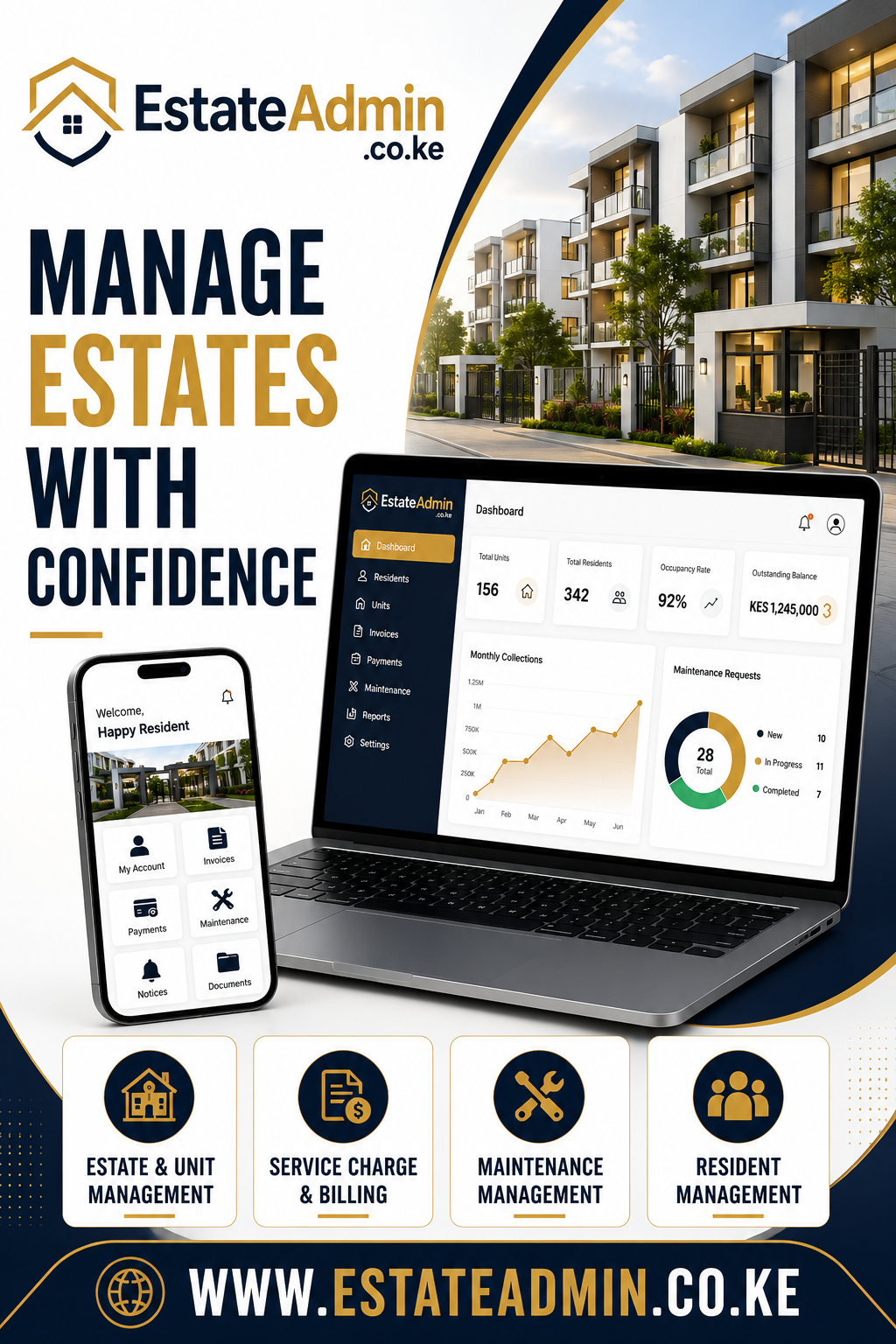
Financial planning is one of the most critical responsibilities in managing modern residential estates. Every gated community, apartment complex, mixed-use development, and homeowners’ association depends on well-prepared budgets to maintain infrastructure, fund security operations, manage landscaping, pay staff, maintain utilities, support maintenance activities, and finance future development projects. Without structured budgeting, estates struggle to balance income with operational expenses, resulting in declining service quality and dissatisfied residents.
As residential communities continue expanding throughout Kenya, estate budgeting has become increasingly complex. Estate managers must forecast annual expenses, estimate service charge revenue, allocate departmental budgets, monitor reserve funds, control operational costs, approve expenditures, and prepare financial reports for management committees and property owners. Performing these tasks manually using spreadsheets and paper records often leads to calculation errors, inconsistent reporting, duplicated work, and limited financial visibility.
An Estate Budget Planning Software solution provides a centralized platform that simplifies every stage of estate budgeting and financial planning. Instead of relying on disconnected spreadsheets, manual calculations, and printed reports, estate managers can prepare budgets, monitor expenditure, forecast revenue, manage reserve funds, compare actual spending with planned allocations, and generate comprehensive financial reports from one integrated system.
Modern residential communities require proactive financial planning rather than reactive budgeting.
Management committees expect accurate financial projections before approving annual budgets.
Property developers require visibility into future operational costs.
Residents expect transparent use of service charge contributions.
Auditors require complete budgeting records that support financial accountability.
An Estate Budget Planning Software platform satisfies these requirements by maintaining accurate financial information while providing real-time reporting and forecasting capabilities.
Automation significantly improves budgeting efficiency.
Annual budgets can be prepared using historical financial information.
Departmental allocations can be monitored continuously.
Budget variances are identified automatically.
Managers receive alerts whenever expenditure approaches approved limits.
Financial forecasts update as new operational information becomes available.
These automated processes reduce administrative effort while improving budgeting accuracy.
The software also strengthens financial transparency.
Every budget revision, expenditure approval, departmental allocation, reserve fund adjustment, operational forecast, and financial decision is securely recorded.
Historical budget performance remains available for future planning, audits, committee reviews, and strategic decision-making.
Residents also benefit indirectly from stronger financial planning.
Well-managed budgets ensure adequate funding for maintenance, security, infrastructure improvements, landscaping, waste management, utilities, recreational facilities, and other community services.
Stable financial management contributes directly to higher service quality and better living environments.
As residential estates continue growing throughout Kenya, scalable budgeting systems become increasingly important.
Whether managing a small gated estate or a large mixed-use development with thousands of residential units, Estate Budget Planning Software provides the flexibility needed to support expanding financial operations without increasing administrative complexity.
Implementation generally begins with reviewing historical budgets, service charge collections, expenditure categories, procurement procedures, reserve fund policies, reporting requirements, and committee approval processes.
Financial data is then organized within the system while administrators configure workflows according to estate policies.
Management teams receive training before full deployment.
Continuous monitoring and optimization ensure budgeting processes remain efficient and aligned with community objectives.
For residential estates, homeowners’ associations, apartment developments, and gated communities throughout Kenya, Estate Budget Planning Software provides the financial planning foundation necessary to improve accountability, strengthen governance, increase operational efficiency, and support sustainable estate management.
Organizations that invest in modern budgeting technology position themselves for stronger financial stability while delivering consistent, high-quality services to residents.
Table of Contents
- Understanding Estate Budget Planning Software
- Why Digital Budget Planning Matters
- Core Features of Estate Budget Planning Software
- Annual Budget Preparation and Forecasting
- Expense Monitoring and Budget Control
- Reserve Fund Planning and Capital Projects
- Financial Reporting and Strategic Decision Making
- Supporting Sustainable Estate Financial Growth
Understanding Estate Budget Planning Software
Budget planning provides the roadmap that guides every financial decision within a residential estate.
From routine maintenance to long-term infrastructure investments, every activity depends on well-structured financial planning supported by accurate operational data.
An Estate Budget Planning Software platform centralizes budgeting activities by combining financial forecasting, expenditure planning, departmental allocations, reserve fund management, budget monitoring, reporting, and historical analysis within one secure environment.
Estate managers gain complete visibility into planned and actual financial performance without relying on multiple spreadsheets or disconnected accounting tools.
Centralized budgeting improves financial discipline while supporting more informed operational decisions.
As residential communities throughout Kenya continue expanding, digital budget planning provides greater control over estate finances while improving long-term sustainability.
Why Digital Budget Planning Matters
Manual budgeting methods often create unnecessary complexity.
Preparing annual budgets requires collecting financial information from numerous sources, reviewing historical expenditure, estimating future costs, forecasting revenue, and consolidating departmental requests.
Spreadsheet-based budgeting increases the possibility of calculation errors, duplicated data, inconsistent reporting, and delayed approvals.
An Estate Budget Planning Software solution automates many of these activities.
Historical financial information remains available for comparison.
Budget templates simplify annual planning.
Forecasting models improve revenue estimation.
Managers receive immediate visibility into expenditure performance throughout the financial year.
Committee approvals become more efficient because accurate financial information remains readily accessible.
Digital budgeting also strengthens accountability by maintaining complete historical records of every financial decision.
For residential estates throughout Kenya, modern budgeting systems improve governance while supporting responsible financial management.
Core Features of Estate Budget Planning Software
Modern estate budgeting platforms combine multiple financial planning capabilities within one integrated solution.
Annual budget preparation simplifies planning.
Departmental budget allocation organizes expenditure.
Expense monitoring compares actual spending with approved budgets.
Revenue forecasting estimates future collections.
Reserve fund management supports long-term infrastructure planning.
Financial reporting generates operational insights.
Approval workflows strengthen governance.
Audit trails maintain accountability.
Historical analysis supports continuous improvement.
Dashboard reporting provides real-time financial visibility.
An Estate Budget Planning Software platform integrates these capabilities into one centralized environment that simplifies financial planning while improving operational efficiency.
Annual Budget Preparation and Forecasting
Preparing annual budgets requires balancing expected income with operational expenditure while ensuring sufficient resources remain available for future infrastructure improvements.
Historical financial information provides valuable guidance during this process.
Digital budgeting platforms simplify annual planning by allowing managers to reuse previous budgets while updating projected revenue and expenditure according to current operational requirements.
Forecasting tools estimate service charge collections, contractor costs, maintenance expenses, utility bills, staffing requirements, insurance premiums, and reserve fund contributions.
Scenario planning also becomes easier.
Management teams can compare multiple budgeting options before selecting the most appropriate financial strategy.
An Estate Budget Planning Software platform enables residential estates throughout Kenya to prepare more accurate budgets while reducing planning time and improving financial confidence.
Expense Monitoring and Budget Control
Preparing budgets alone is insufficient.
Estate managers must continuously monitor expenditure to ensure spending remains aligned with approved financial plans.
Digital dashboards display real-time expenditure against budget allocations.
Managers immediately identify overspending, underutilized budgets, or emerging financial risks.
Approval workflows ensure expenditure follows established governance procedures.
Budget alerts notify management whenever departments approach approved spending limits.
Historical expenditure trends also support future financial planning.
An Estate Budget Planning Software solution improves financial discipline while strengthening operational accountability across every department.
Reserve Fund Planning and Capital Projects
Long-term sustainability requires proactive financial planning.
Residential estates must prepare for future infrastructure repairs, equipment replacement, security upgrades, road maintenance, landscaping improvements, water system expansion, and community development projects.
Reserve funds provide the financial resources required to support these investments.
Digital planning tools monitor reserve fund contributions while forecasting future capital requirements.
Managers evaluate project priorities using accurate financial information rather than assumptions.
Long-term planning becomes significantly more reliable.
For residential communities throughout Kenya, structured reserve fund management protects community assets while supporting sustainable development.
Financial Reporting and Strategic Decision Making
Reliable financial reporting strengthens governance by providing decision-makers with accurate operational information.
Budget reports summarize planned expenditure, actual spending, revenue performance, reserve fund balances, budget variances, departmental allocations, and financial forecasts.
Real-time dashboards improve visibility while reducing reliance on manually prepared reports.
Historical reporting supports committee reviews, audits, financial planning, and operational evaluation.
An Estate Budget Planning Software platform transforms financial information into actionable insights that support better decision-making throughout the estate.
Supporting Sustainable Estate Financial Growth
Successful residential communities depend upon responsible financial planning supported by accurate operational information.
Historical budgeting data improves future forecasts.
Expense monitoring strengthens financial discipline.
Revenue forecasting improves cash flow planning.
Reserve fund management protects long-term investments.
Strategic reporting supports informed decision-making.
An Estate Budget Planning Software solution enables residential estates throughout Kenya to establish financially sustainable operations capable of supporting continuous community improvement, infrastructure development, and long-term resident satisfaction.
Benefits for Estate Managers
Estate managers are responsible for ensuring that residential communities remain financially stable while delivering high-quality services to residents. Every operational decision, from maintaining roads and landscaping to paying security personnel, contractors, cleaners, utility providers, and maintenance teams, depends on proper financial planning. As residential developments continue expanding throughout Kenya, budgeting has become one of the most important management responsibilities.
One of the greatest advantages of Estate Budget Planning Software is the ability to centralize every budgeting activity within a single digital platform. Instead of maintaining multiple spreadsheets, printed reports, manual calculations, and disconnected accounting systems, estate managers gain complete visibility into budgets, expenditures, forecasts, reserve funds, and departmental allocations from one secure dashboard.
This centralized approach significantly improves operational efficiency.
Managers spend less time preparing annual budgets and monitoring expenditure manually while gaining more time to focus on improving estate services and planning future community developments.
Budget preparation becomes faster because historical financial information remains readily available.
Previous budgets, expenditure trends, contractor costs, maintenance expenses, and service charge collections can all be reviewed during planning sessions without searching through years of manual records.
Another important benefit is stronger financial control.
Real-time dashboards compare actual expenditure against approved budgets continuously.
Managers immediately identify overspending, underutilized allocations, unexpected operational expenses, or departments approaching approved spending limits.
This enables corrective action before financial challenges affect estate operations.
Estate Budget Planning Software also improves communication between finance teams, estate managers, accountants, and management committees.
Everyone works from the same financial information, reducing misunderstandings while improving budgeting accuracy.
Historical budgeting reports further support strategic planning by identifying recurring expenditure patterns, infrastructure maintenance requirements, staffing costs, and future investment opportunities.
Instead of relying on assumptions, estate managers make financial decisions supported by accurate operational data.
As residential estates continue growing throughout Kenya, structured budgeting systems improve governance while creating financially sustainable communities capable of supporting long-term development.
Benefits for Property Developers, Estate Owners, and Management Committees
Property developers, homeowners’ associations, estate owners, and management committees require reliable financial information to make informed investment and operational decisions.
Without structured budgeting processes, it becomes difficult to prioritize projects, allocate resources efficiently, or evaluate long-term financial sustainability.
An Estate Budget Planning Software platform provides comprehensive visibility into every aspect of estate financial planning.
Management committees receive accurate reports covering projected income, departmental budgets, reserve fund allocations, operational expenditure, capital improvement planning, and budget performance.
Instead of relying on manually prepared summaries, decision-makers access continuously updated financial dashboards supported by historical records.
Developers managing multiple residential communities benefit from standardized budgeting procedures across every property.
Uniform planning processes improve financial consistency while simplifying operational oversight.
The software also strengthens governance.
Every budget revision, expenditure approval, reserve allocation, departmental adjustment, and financial decision remains securely documented.
Audit trails improve accountability while supporting financial reviews and committee meetings.
Long-term planning becomes significantly easier.
Historical financial information helps estimate future maintenance costs, infrastructure replacement schedules, utility requirements, landscaping expenses, staffing budgets, and community development initiatives.
Estate Budget Planning Software also protects long-term property values.
Well-funded maintenance programs preserve estate infrastructure while ensuring consistent service delivery.
Financial stability encourages resident confidence and contributes to sustainable community growth.
For residential developments throughout Kenya, digital budgeting supports responsible governance while protecting valuable residential investments.
Benefits for Residents
Residents may not prepare estate budgets directly, but they benefit greatly from responsible financial planning.
Every service residents receive depends on effective budgeting.
Security operations, road maintenance, waste collection, landscaping, recreational facilities, lighting, water systems, cleaning services, and community improvements all require sufficient financial resources.
An Estate Budget Planning Software platform helps ensure these resources are allocated efficiently.
Residents benefit from improved service quality because management teams can monitor expenditure continuously while preventing unnecessary financial shortages.
Transparent budgeting also strengthens resident confidence.
Management committees can share summarized financial reports showing how service charge contributions support estate operations.
This openness improves trust while encouraging greater resident participation during annual meetings and financial discussions.
Digital financial planning further supports better communication.
Residents receive timely updates regarding major infrastructure projects, budget priorities, maintenance schedules, and community improvements.
Long-term planning ensures reserve funds remain available for future capital projects rather than relying on emergency collections.
Residents also benefit indirectly from stronger financial discipline.
When budgets are managed responsibly, unnecessary expenditure decreases, operational efficiency improves, and estate resources are utilized more effectively.
For residential communities throughout Kenya, responsible budgeting contributes directly to safer environments, better facilities, improved infrastructure, and stronger long-term financial stability.
Improving Financial Planning Through Automation
Preparing and monitoring annual budgets manually requires considerable administrative effort.
Financial teams often spend weeks collecting expenditure information, reviewing historical data, calculating forecasts, preparing spreadsheets, revising allocations, and producing committee reports.
Manual budgeting also increases the possibility of calculation errors and inconsistent reporting.
An Estate Budget Planning Software platform automates many of these repetitive activities.
Historical financial information becomes immediately available during budget preparation.
Revenue projections update automatically as financial data changes.
Departmental expenditure is monitored continuously against approved allocations.
Budget alerts notify managers whenever expenditure exceeds established limits.
Automation also simplifies budget revisions.
When operational priorities change during the financial year, management teams can update allocations without rebuilding entire budgeting models.
Reporting becomes significantly faster.
Instead of manually compiling financial summaries from multiple departments, managers generate real-time budget reports instantly.
Automation improves collaboration as well.
Finance personnel, estate managers, accountants, committee members, and property owners work from one centralized financial database.
This reduces duplication while improving consistency across every budgeting activity.
For residential estates throughout Kenya, automated financial planning reduces administrative workloads while supporting more accurate and proactive budgeting.
Financial Governance, Compliance, and Risk Management
Financial governance remains essential for every residential community.
Responsible budgeting requires secure financial records, transparent approval procedures, accurate reporting, and effective risk management.
An Estate Budget Planning Software platform strengthens governance by maintaining complete budgeting histories together with every financial approval and expenditure decision.
Role-based user permissions ensure only authorized personnel modify budget information.
Audit trails document every adjustment, approval, allocation change, expenditure revision, and planning activity.
Historical records remain available for audits, financial reviews, committee meetings, taxation requirements, and regulatory compliance.
Risk management also improves significantly.
Managers identify budget overruns, declining revenue, unexpected operational expenses, delayed projects, and reserve fund shortages before they become major financial problems.
Forecasting tools support proactive decision-making by estimating future financial requirements using historical operational data.
The software also strengthens internal controls by ensuring expenditure follows predefined approval workflows.
Financial accountability improves because every budgeting decision remains transparent and fully documented.
For residential communities throughout Kenya, improved governance reduces operational risks while supporting sustainable financial management.
Why EstateAdmin Is the Ideal Solution
EstateAdmin has been developed specifically to simplify financial planning and estate administration for residential communities.
Unlike generic budgeting applications, EstateAdmin integrates budgeting with resident management, service charge administration, maintenance management, procurement, reporting, communication, and operational oversight.
An Estate Budget Planning Software solution becomes significantly more valuable when budgeting activities operate within one integrated estate management platform.
EstateAdmin combines annual budgeting, expenditure monitoring, financial forecasting, reserve fund planning, operational reporting, departmental budgeting, approval workflows, and financial dashboards into one centralized cloud-based solution.
Estate managers gain complete visibility into financial performance while reducing administrative complexity.
Finance teams prepare more accurate budgets using historical operational information.
Management committees receive transparent reports that strengthen governance and decision-making.
Property developers benefit from standardized budgeting processes capable of supporting multiple residential communities simultaneously.
Whether managing a newly established gated estate or a mature mixed-use development, EstateAdmin provides scalable financial technology that supports sustainable growth while maintaining operational excellence.
For residential estates throughout Kenya, EstateAdmin delivers comprehensive budgeting capabilities that improve financial accountability, strengthen governance, enhance operational efficiency, and support long-term community development.
Future Trends
Financial planning within residential estates will continue evolving alongside advances in digital technology.
Artificial intelligence will increasingly assist estate managers by forecasting expenditure, predicting maintenance costs, analysing operational risks, and recommending optimal budget allocations.
Machine learning will improve budgeting accuracy by identifying historical financial patterns and seasonal expenditure trends.
Cloud-based budgeting systems will provide greater accessibility while allowing management teams to monitor financial performance from anywhere.
An Estate Budget Planning Software platform will increasingly integrate with accounting software, procurement systems, payment gateways, banking platforms, smart estate technologies, and business intelligence solutions.
Predictive analytics will support long-term infrastructure planning while improving reserve fund management.
Automation will continue reducing manual budgeting activities while improving financial accuracy and operational transparency.
Residential communities throughout Kenya that adopt modern budgeting technology early will remain better positioned to maintain financial sustainability while delivering exceptional resident services.
Getting Started
Implementing a modern budgeting platform begins with reviewing current financial planning procedures and identifying opportunities for improvement.
Estate managers should evaluate annual budgeting processes, historical expenditure records, departmental allocations, reserve fund policies, procurement procedures, financial reporting requirements, and approval workflows.
Following this assessment, budgeting structures are configured according to the estate’s operational and financial requirements.
Historical financial information is migrated where necessary while user roles are established for finance personnel, estate managers, accountants, committee members, and senior administrators.
Comprehensive staff training ensures budgeting workflows are followed consistently throughout the financial year.
Continuous monitoring after implementation allows management teams to refine financial planning while improving budgeting accuracy.
For residential communities seeking comprehensive financial planning capabilities, EstateAdmin provides integrated solutions covering annual budgeting, expenditure monitoring, reserve fund planning, financial reporting, operational forecasting, approval workflows, accounting integration, and estate administration.
By implementing Estate Budget Planning Software, residential estates throughout Kenya can improve financial planning, strengthen governance, increase budgeting accuracy, reduce administrative workloads, enhance operational transparency, support responsible expenditure management, and establish a scalable financial foundation capable of supporting sustainable long-term community growth.
- Estate Budget Planning Software
- Estate Budget Planning Software
- Estate Budget Planning Software
- Estate Budget Planning Software
- Estate Budget Planning Software